As 2025 closes, I find myself in the mildly suspicious position of being asked where I stand. I’m almost pretty sure it’s a deontological duty I must fulfil.
This has become the ritual gesture of our time. Not what are you working on? or what are you unsure about? but what is your position? The question arrives already armed with a grid. Left or right. Modern or postmodern. Optimist or doomer. Builder or critic. Pick a square. Declare yourself. Be legible.
Audio: Notebook summary podcast of this topic.
I have spent enough years inside philosophy, politics, systems design, and cultural critique to recognise this for what it is. Not a genuine request for understanding, but a demand for administrative convenience. Positions are easy to catalogue. They travel well on social platforms. They allow disagreements to be staged rather than examined. I no longer occupy one.
If I had to name the shift that has taken place in my thinking, I might call it post-postmodern. More accurately, I think of it as post-position. Not because I have outgrown critique, but because I have grown weary of pretending that declaring a stance is the same thing as doing the work.
Postmodernism, to its credit, diagnosed something real. It exposed the hidden scaffolding behind our grand narratives. It showed how claims to neutrality smuggled power, how universals arrived late and acted eternal, and how reason often functioned as a polite enforcement mechanism. That diagnosis still stands. Nothing that followed has invalidated it. What failed was not the critique, but the decision to treat critique as a destination.
Somewhere along the line, postmodernism hardened into an identity. Suspicion became an aesthetic. Irony turned into a resting posture. Eventually, even scepticism acquired a set of approved moves and unacceptable conclusions. The work of dismantling was mistaken for the achievement of wisdom.
The response to this impasse has been predictable. We are now urged to rebuild. To restore foundations. To recover truth, agency, meaning, and normativity. Usually with a tone of urgency that suggests things have all gone a bit too far. They haven’t gone too far. They’ve gone exactly where the premises lead.
At this point, it is worth noting that ‘postmodernism’ has largely ceased to exist as a self-ascribed position at all. It survives almost entirely as a slur. No serious thinker today introduces themselves as a Postmodernist in the way one might once have claimed empiricism, structuralism, or even analytic philosophy.
The term is now deployed from the outside, usually as shorthand for intellectual irresponsibility: relativism, nihilism, irony, excess critique. It is a caricature assembled by its opponents, then attacked as if it were a living school with doctrines and membership cards.
People who employ the term Postmodern™* relative to philosophy are intellectually lazy and not likely worth engaging in a debate on the topic, because they have not likely engaged the content charitably, if at all, outside of a caricature.
This matters because it reveals something quietly telling. What is being rejected under the banner of ‘postmodernism’ is not a coherent programme, but the discomfort produced when inherited certainties fail to survive scrutiny. The slur functions as a containment strategy. It allows critics to dismiss the diagnosis without engaging the illness.
Any thinker with even a passing familiarity with the terrain knows this. Which is why no self-respecting, or self-denigrating, postmodern thinker would now characterise themselves as such. The label has been evacuated of descriptive value and filled with anxiety.
What is being revived in these reconstruction projects is not certainty, but legibility. A longing for systems that can be explained cleanly, defended coherently, and enforced consistently. Clear positions are attractive because they reduce friction. They allow disagreement to be formalised, managed, and ultimately neutralised. This is where I step off.
Post-position thinking is often mistaken for relativism, so it is worth being explicit. It does not claim that nothing is real, that all claims are equal, or that consequences dissolve into opinion. Reality remains stubborn. Harm remains unevenly distributed. Constraints still bite.
What it rejects is something more specific: the belief that ethical, epistemic, or political seriousness requires the occupation of a stable, declarable position.
Positions are not engines of thought. They are summaries produced after the fact. They tidy complexity into something portable, then forget the mess that made the tidying necessary. Once adopted, they begin to govern perception. You start seeing what fits and discarding what does not. The position becomes an answer generator rather than a question machine.
Post-position thinking refuses that trade.
It stays with instability where stability would be dishonest. It tolerates contradiction where resolution would be cosmetic. It treats coherence as local, provisional, and negotiated rather than universal and enforceable. This is not indecision. It is fidelity to how complex systems actually behave. One way to describe the shift is a movement away from critique toward maintenance.
Modernism wanted to build. Postmodernism wanted to dismantle. Both share a quiet assumption that there is a point at which the work is done. Maintenance has no such illusion. It accepts that some systems cannot be fixed, only kept from doing additional damage – that concepts fray; that norms age badly; that repair is continuous and never final.
Maintenance is unspectacular. It does not produce manifestos. It does not scale elegantly. It involves partial solutions, awkward compromises, and the constant risk of failure. It is also where most of the moral work actually happens.
From this vantage point, the demand to ‘take a position‘ looks increasingly misplaced. Not because commitments vanish, but because commitments are situational, asymmetric, and responsive to context. Loyalty shifts from creeds to consequences. What matters is not whether an idea is internally consistent, but what it does when it leaves the page and collides with institutions, incentives, and frightened people.
So when I refuse to declare where I stand, it is not evasiveness. It is a refusal to pretend that standing still is a virtue.
This is the posture I am carrying into 2026. Not a programme, not a system, not a rehabilitated foundation. Just a refusal to confuse clarity with truth, structure with virtue, or positions with thinking.
If that feels unsatisfying, that may be the point. Satisfaction is a modernist luxury. Maintenance rarely provides it. The work continues anyway.
* To be fair, I have referred to myself as Postmodern™, but this was a shortcut out of solidarity with Foucault, Derrida, Latour, Baudrillard, and others painted with this brush. I still admire these thinkers.
I am a philosopher of language. That is typically my primary perspective, so communication and limitations often fall into my sights. I believe that not all disagreements can be resolved through language communication. This illustrates one barrier in particular.
This essay is not an attempt to resolve disagreement, adjudicate truth, or reconcile competing worldviews. It is an attempt to explain why so many disagreements persist despite intelligence, good faith, and shared vocabulary – and why escalating those disagreements often makes them worse rather than better.
What follows is diagnostic rather than prescriptive. I am less interested in who is right than in why arguments so often fail to converge, and why those failures are routinely misinterpreted as moral defects rather than structural mismatches. The claim is not that ‘anything goes’, nor that all perspectives are equally valid, but that many disputes operate across ontological fault lines that no amount of better reasoning, evidence, or civility can bridge on their own terms.
Recognising this does not require abandoning one’s commitments. It requires abandoning the fantasy that every disagreement is corrigible and that persuasion is always the appropriate response to difference. If the essay succeeds, it will not produce consensus. It may, however, produce a little more clarity, a little less moral theatre, and a slightly more disciplined form of charity – one grounded not in agreement, but in an honest appraisal of where disagreement actually lives.
Audio: NotebookLM summary podcast of this content.
On Ontological Incommensurability and the Case for Civilised Disagreement
Most disagreements that metastasise into moral theatre are not disagreements at all. They are collisions between incompatible ontologies, misdiagnosed as differences of opinion.
This assumption is not merely optimistic. It’s wrong.
We continue to behave as though all disputes take place on a shared stage called “reality,” where facts sit patiently waiting to be interpreted, weighed, or refuted. From this perspective, disagreement is assumed to be corrigible. If only one side listened harder, reasoned better, or acquired the right evidence, convergence would follow. This assumption is not merely optimistic. It is wrong.
Many of our most entrenched conflicts persist precisely because the parties involved do not inhabit the same world in any substantive sense. They operate with different background assumptions about what exists, what counts as real, what can ground truth, and what sorts of things are even eligible for belief. Argument, in such cases, does not fail due to bad faith or insufficient charity. It fails because it presumes a shared ontology that does not exist.
Before proceeding, a clarification. I am using ontology here in a deliberately broad, working sense. Not merely as an inventory of what exists, but as the background framework that determines what can count as real, meaningful, or normatively binding in the first place. This inevitably overlaps with epistemology, ethics, and theories of agency. Not because these domains are identical, but because in lived discourse they travel together. The fault line I am describing is not disciplinary. It is structural.
Video: Two people in ontological bubbles. (no sound)
Opinion Is Not Ontology
A difference of opinion presupposes a common world. Two people may disagree about what justice requires, but only because they agree, tacitly, that justice is a thing of some kind. Two people may dispute whether God exists, but only because they share enough conceptual scaffolding for the sentence to function.
Ontological disagreement runs deeper. It concerns not what is the case, but what it even means for something to be the case at all. When these levels are conflated, discourse becomes theatrical. Arguments are repeated with increasing urgency, frustration is moralised, and disagreement is reinterpreted as stubbornness, ignorance, or vice. Civility erodes not because people are cruel, but because they are speaking from worlds that do not interlock.
Consider debates over abortion. Pro-life arguments typically presuppose that the fetus is already a moral person; pro-choice arguments often presuppose that moral personhood is inseparable from bodily autonomy. These positions are not primarily disagreements about policy, compassion, or even ‘the value of life’. They are disagreements about what kinds of entities exist and when they begin to matter. Shared language about rights or harm often masks this deeper ontological divergence, which is why such debates rarely converge despite decades of argument.
When Critique Presumes the Ontology It Opposes
This distinction helps explain a familiar but often confusing phenomenon: cases where two parties appear to agree on symptoms, vocabulary, and even outrage, yet remain fundamentally misaligned.
Consider critiques of institutional cruelty that condemn dehumanising practices while retaining the very assumptions that make those practices intelligible. For example, workplace critiques that oppose excessive surveillance, unfair metrics, or punitive performance targets often still presume the figure of the autonomous, responsible worker whose output reflects individual will. The system is blamed for misapplying norms, not for producing those norms as instruments of control. Such critiques are often insightful and well-intentioned. They identify real harm. They name real suffering. And yet they stall.
The reason is not timidity or bad analysis. It is ontological inheritance. These critiques operate inside the same metaphysical framework that generates the harm they diagnose. They presuppose moral realism, individual agency, and normative grounding as givens, then object to their misapplication. The result is an internal critique: coherent, compelling, and structurally limited.
This is not a misunderstanding. It’s a category error.
From a different ontological position, the problem is not that the norms are misapplied, but that the norms themselves function as delivery mechanisms of harm. What appears as reform from within appears as reenactment from without. This is not a misunderstanding. It is a category error.
Recognising this helps explain why superficial agreement so often feels productive while changing nothing. Shared language can create the appearance of convergence while leaving foundational divergence intact. The temperature drops. The mediator applauds. The underlying machinery hums on.
Igtheism and the Refusal to Pretend
This is why I describe myself, somewhat unfashionably, as an igtheist rather than an atheist.
Atheism still accepts the question ‘Does God exist?’ as well-formed. It grants the concept enough coherence to deny its instantiation. Agnosticism does much the same, merely pausing at the threshold. Both remain inside the game.
Igtheism steps back and asks a prior question: What, precisely, are we talking about? If no stable referent can be specified, the sentence does not become false. It becomes undefined. The system returns ‘does not compute’. This is not evasive. It is diagnostic.
I cannot make sense of strong metaphysical Realism
Try as I may, I cannot make sense of strong metaphysical Realism, let alone Theism. The idea that there exists a fully formed, mind-independent world ‘out there’, grounding truth prior to mediation, language, practice, or perspective, does not parse for me. Not as a contested claim. As a coherent one.
However, and this is the crucial point, once I accept Realism as a mechanism, Theism suddenly makes sense. If you already believe in a metaphysically exterior realm that guarantees truth and coherence, then placing God there is not a leap. It is an economy of scale.
Paraphrased bluntly: They believe there is a whole world ‘out there’. I don’t believe in any of it, so God might as well live out there, too.
From within that worldview, atheistic Realism is arguably the stranger position. The cathedral has been built; denying the altar looks parsimonious rather than principled.
I am not offering a competing metaphysical system here. Not idealism, not pragmatism, not a substitute ontology waiting in the wings. I am declining the assumption that reality must come pre-packaged as a mind-independent domain in order to be intelligible or actionable at all.
Of course, non-realist positions are not exempt from this problem; they, too, can smuggle in unexamined ontological commitments under the guise of pragmatism, coherence, or practice.
Pascal’s Wager and Ontological Blackmail
This is why igtheism tends to offend theists more than atheism ever could. When a theist says, ‘How can you not care? Your soul depends on it’, they are not making an argument. They are issuing an ontological demand. Pascal’s Wager is merely this demand formalised into decision theory.
How can you not care?
The wager only works if one has already granted the existence of souls, post-mortem identity, divine reward structures, and a cosmic enforcement mechanism that cares about belief states. Without those assumptions, there is no wager. There is only a shouted house rule addressed to someone who is not in the casino.
None of this is meant to trivialise the existential seriousness with which such claims are often held. It is simply to note that care does not precede ontology; it follows it. One cannot meaningfully care about entities one does not recognise as intelligible occupants of the world.
Why This Doesn’t End in Relativism
None of this implies that ‘all ontologies are equally true’, nor that disagreement is pointless. It implies something far less comforting and far more useful: many disagreements are non-resolvable by design. This does not deny that ontological frameworks can and do shift over time, sometimes under empirical pressure; it only denies that such shifts are guaranteed, universal, or achievable through argument alone.
Non-resolvability does not entail arbitrariness. Ontological frameworks can be evaluated for internal coherence, practical consequences, and the kinds of lives they make possible. What cannot be done is to adjudicate between them using criteria that belong exclusively to one side. Recognising this does not require abandoning one’s worldview. It requires abandoning the fantasy that persuasion is always possible, or that failure to persuade is a moral defect.
Once we see that we are not standing on the same ground, something like charity becomes possible. Not the saccharine kind. The disciplined kind. I understand that this matters enormously to you. I do not share the ontology that makes it matter to me. This is not a truce forged through compromise. It is a ceasefire born of ontological honesty.
Civility Without Convergence
Our age is addicted to resolution. Every disagreement is treated as a problem to be solved, a synthesis waiting to happen, a bridge yet to be built. Sometimes there is no bridge. Sometimes the most responsible thing to do is to stop pretending there is one.
Sometimes there is no bridge. Sometimes the most responsible thing to do is to stop pretending there is one.
Civility does not require agreement. It does not even require mutual understanding in the strong sense. It requires only that we stop mistaking incompatible world-models for intellectual obstinacy. We are not all arguing about the same furniture. Some of us are questioning whether the room exists at all.
Once that is acknowledged, the volume drops. The moral theatre loses its urgency. And disagreement, while still real, becomes less corrosive. Not because we have reconciled our ontologies. But because we have finally noticed that they do not reconcile.
I just finished the writing and editorial parts of my Language Insufficiency Hypothesis. It still needs cover art and some administrative odds and ends, but I’m taking a day for a breather to share something about myself and my worldview. For this, I share my philosophical influences and how they support my core insights. For dramatic effect, I’ll even try to weight them to 100 per cent, leaving an ‘others’ bucket for the unaccounted ones.
Audio: NotebookLM summary podcast of this topic.
Obviously, this highly scientific accounting is about as useful as a Facebook survey or a fortune cookie, but it should reveal something. I have influences outside of philosophy, but I’ll limit this list at the start. The numbers don’t exactly add to 100% because there is a bit of cross-pollination, say, between Foucault and Nietzsche or Žižek and Hegel – or perhaps I’m just not good at maths. You decide.
Nietzsche (≈18)
Nietzsche is likely the uranium core. Haters and detractors like to diminish his contribution – and he didn’t play by the old rules – but they are wrong. He contributes value-creation, anti-moralism, perspectivism, the critique of ressentiment, the demolition of universals.
Nietzsche sits at the centre of the blast radius. Everything else is shrapnel. If there’s a thinker who detonated the Enlightenment’s pretensions more elegantly, I’ve not met them. He showed us that values are forged, not found; that morality is a genealogy of grievances; that certainty is the last refuge of the timid. In other words, he cleared the ground so the rest of us could get to work without tripping over Kantian furniture. But after Nietzsche’s uranium core, the next concentric ring becomes murkier.
Foucault (≈20%)
Foucault supplies the schematics. Where Nietzsche swung a hammer at the idols, Foucault identified the building codes. He mapped power as a set of subtle, everyday enchantments. He showed how ‘knowledge’ is simply what a society rewards with credibility. He is the patron saint of anyone who suspects normality is an instrument, not a neutral state of affairs. The world looks different once you see the disciplinary fingerprints on everything.
Derrida (≈10%)
Derrida gives me language as mischief. Meaning wobbles, slides, cracks; binaries betray themselves; every conceptual edifice contains its own trapdoor. Derrida isn’t a system; he’s an escape artist. And frankly, you can’t write anything about the insufficiency of language without genuflecting in his general direction.
Late Wittgenstein (≈15%)
The quiet structural pillar. If Derrida is the saboteur, Wittgenstein is the carpenter who informs you that the house was never stable anyway. Meaning-as-use, language-games, the dissolution of philosophical pseudo-problems: his later work underwrites virtually every modern suspicion about fixed categories and timeless essences. He doesn’t shout; he shrugs – and everything collapses neatly.
Rorty (≈5%)
Rorty replaces metaphysical longing with cultural pragmatism. He teaches you to stop hunting for capital-T Truth and instead track the vocabularies we actually live in. He’s the friendly voice whispering, ‘You don’t need foundations. You need better conversations’. His influence is felt mostly in the tone of my epistemic cynicism: relaxed rather than tragic. Besides, we disagree on the better conversations bit.
Geuss (≈4%)
If Rorty makes you light-footed, Geuss reminds you not to float off into abstraction entirely. He is the critic of moralism par excellence, the man who drags philosophy kicking and screaming back into politics. Geuss is the voice that asks, ‘Yes, but who benefits?’ A worldview without him would be a soufflé.
Heidegger (≈6%)
Selective extraction only. Being-in-the-world, thrownness, worldhood – the existential scaffolding. His political judgment was catastrophic, of course, but the ontological move away from detached subjectivity remains invaluable. He gives the metaphysics a certain grain.
Existentialists: Beauvoir, Sartre, Camus (≈6%)
They provide the atmospheric weather: choice, finitude, absurdity, revolt, the sheer mess of human freedom. They don’t define the system; they give it blood pressure. Besides, I met them before I switched to Team Nietzsche-Foucault.
Žižek, Latour, Baudrillard (≈2% combined)
These three are my licensed provocateurs.
Žižek exposes how ideology infiltrates desire.
Latour dismantles the Nature/Society binary with glee.
Baudrillard whispers that representation ate reality while we were looking at our phones.
They’re trickster figures, not architects.
Hume, Putnam, Dennett, and the Ancillaries (≈1% combined)
These are the seasonings.
Hume is the Scottish acid bath under every epistemic claim.
Putnam gives internal realism its analytic passport.
Dennett offers mechanistic metaphors you can steal even when you disagree.
Kant and Hegel hover like compulsory ghosts.
Rawls remains decorative parsley: included for completeness, consumed by none.
The Others Bucket (≈5%)
The unallocated mass: writers, anthropologists, theorists, stray thinkers you absorb without noticing. The ‘residuals’ category for the philosophical inventory – the bit fortune cookies never warn you about.
Enfin
Obviously, these ratios are more for humour than substance, but these are the thinkers I return to — the ones whose fingerprints I keep discovering on my own pages, no matter how many years or detours intervene.
Perhaps more revealing are those who didn’t make the guest list. Socrates, Plato, and Aristotle remain outside, smoking in the cold. The Stoics, Marcus Aurelius and his well-meaning self-help descendants, also failed to RSVP. In truth, I admire the posture but have little patience for the consolations – especially when they become the emotional training wheels of neoliberalism.
And then, of course, the Enlightenment patriarchs: Hobbes, Locke, Montesquieu and the rest of the constitutional furniture. I acknowledge their historical necessity the way one acknowledges plumbing – grateful it exists, uninterested in climbing inside the pipes. Rousseau, admittedly, I tolerate with something approaching affection, but only because he never pretended to be tidy.
I forgot Descartes, Voltaire, and Pascal, but it’s too late to scroll back and adjust the ledger. Consider them rounding errors – casualties of the margins, lost to the tyranny of percentages.
If anyone mentions another one – Spinoza comes to mind – I’ll try to figure out where they fit in my pantheon. Were I to render this tomorrow, the results may vary.
My philosophical critique, not of the book Why Democrats Are Dangerous, but of the two warring factions in United States politics – mind you, partisanship not limited to the US – sparked the ire of defenders of their respective turf. ‘You’ve got it wrong. Those other people are either addleheaded or abject evil’ is a consolidation of responses from both sides of the aisle. I’ve crafted a response.
Audio: NotebookLM summary podcast on this topic.
It’s perfectly true that I occupy a perspective. Everyone does. This isn’t a confession; it’s a structural feature of being human. Consciousness is perspectival by design. We don’t get to hover above the world like disembodied CCTV cameras. We look from somewhere.
But acknowledging one’s perspective is not the same thing as being trapped in a rut. A rut implies unexamined repetition, reflex, and dogma. A perspective implies angle, interpretation, intellectual stance. The accusation I’m hearing – ‘you’re in a rut too’ – is not actually an argument. It’s an attempt to delegitimise the analysis without engaging with it.
It says nothing about whether my observation is true, coherent, or well-reasoned; it merely notes that I, like every other speaking organism on the planet, occupy a position. And from this banal fact it attempts to smuggle in a conclusion: that my critique is thereby invalid. It’s a sleight of hand, and a clumsy one.
If someone believes I’m wrong, they are welcome – encouraged, even – to demonstrate:
where the logic fails
where the evidence contradicts me
where the symmetry is mischaracterised
where the interpretation distorts rather than illuminates
That is argumentation.
What they are offering instead is a sort of epistemic shrug: ‘You’re in a perspective, therefore you have no authority’. This is an ad hominem in a trench coat, pretending to be profundity.
The irony, of course, is that the people making this charge never seem to apply it to themselves. Their own viewpoint, naturally, is not a rut but a ‘stance’, ‘framework’, ‘tradition’, ‘bedrock’, or ‘fact’. Only the critic has perspective; they merely have truth.
But here’s the critical distinction:
Having a perspective does not invalidate an analysis, and pretending not to have one does.
The entire Anti-Enlightenment project rests on this recognition: that all human positions are mediated, situated, incomplete – and yet still capable of meaningful observation. You don’t escape your perspective by denying it; you escape dogma by interrogating it.
If someone wishes to rebut what I’ve written, they should do so directly, with evidence, reasoning, or counterexamples. If all they offer is ‘well, you’re biased too’, then they’ve conceded the argument by refusing to enter it.
A perspective is not a rut. A rut is what happens when you can’t tell the difference.
My colleague of several decades recently published a book titled Why Democrats Are Dangerous. Drew and I have long held opposing but genuinely respectful views on the political economy, a fact that once felt like a quaint relic of an earlier civic age. As we are both authors, he proposed that we exchange titles and review each other’s work. I demurred. One can often discern the contents of a book from its cover, and this one announced itself with all the subtlety of a campaign leaflet left in the rain. I am not allergic to polemic – heaven knows I have written my share – but some energies telegraph their intentions too cleanly. This one did.
Having now read the book, my hesitation appears justified. The project is less an argument than a catechism, less analysis than incantation. It is earnest, certainly; it is also tightly scripted by a worldview that permits only one conclusion, however much data must be dragged across broken glass to reach it.
Audio: NotebookLM summary podcast on this topic.
Rather than provide a review in the conventional sense – line-by-line rebuttal, forensic counter-examples, polite throat-clearing – I have chosen a different approach. I intend to reconstruct, or more precisely dis-integrate, the book through several strands of my own work. Not because my work is above reproach, but because it offers a conceptual toolkit for understanding how such texts arise, how they persuade, and how they hold themselves together despite their internal tension. This also has the ancillary benefit of allowing me to abridge my commentary: where a full exegesis would sprawl, I can gesture toward an existing essay or argument. I’ll dispense with addressing Drew by name, preferring to remain more neutral going forward.
A Note on My Position (So No One Misreads My Motives)
Before proceeding, a brief clarification. I do not belong to either of America’s warring political tribes, nor do I subscribe to their underlying ideological architectures. My critique is not an act of partisan reprisal; it is not a defence of Democrats, nor a veiled endorsement of Republicans. The Red–Blue cosmology bores me senseless. It is a quarrel between two anachronistic Enlightenment-era faith traditions, each convinced of its moral superiority and each engaged in the same ritualised dance of blame, projection, and existential theatre.
My vantage point, such as it is, sits outside that binary. This affords me a certain privilege – not superiority, merely distance. I do not have a factional identity to defend, no emotional investment in preserving the moral innocence of one side or the other. I am therefore free to examine the structure of my colleague’s argument without the usual tribal pressures to retaliate in kind.
This criticism is not a counter-polemic. It is an analysis of a worldview, not a combatant in its quarrel. If my tone occasionally cuts, it cuts from the outside, not across partisan lines. The book is not wrong because it is Republican; it is wrong because its epistemology is brittle, its categories incoherent, and its confidence unearned. The same critique would apply – indeed does apply – to the Democratic mirrors of this worldview.
My loyalty is not to a party but to a method: Dis-Integration, analysis, and the slow, patient unravelling of certainty.
The Architecture of Certainty
What strikes one first in Why Democrats Are Dangerous is not the argument but the architecture – an edifice built on the most cherished Enlightenment fantasy of all: that one’s own position is not a perspective but the Truth. Everything else cascades from this initial presumption. Once a worldview grants itself the status of a natural law, dissent becomes pathology, disagreement becomes malice, and the opposition becomes a civilisation-threatening contagion.
My colleague’s book is a textbook case of this structure. It is not an analysis of political actors within a shared world; it is a morality play in which one faction is composed entirely of vices, and the other entirely of virtues. The Democrats are ‘Ignorant, Unrealistic, Deceitful, Ruthless, Unaccountable, Strategic‘, a hexagon of sin so geometrically perfect it would make Aquinas blush. Republicans, by contrast, drift serenely through the text untouched by human flaw, except insofar as they suffer nobly under the weight of their opponents’ manipulations.
This is not political argumentation. This is cosmogony.
This, of course, is where my Anti-Enlightenment work becomes diagnostic. The Enlightenment promised universality and rational clarity, yet modern political identities behave more like hermetic cults, generating self-sealing narratives immune to external correction. A worldview built upon presumed objectivity must resolve any contradiction by externalising it onto the Other. Thus, the opposition becomes omnipotent when things go wrong (‘They control the media, the schools, the scientists, the public imagination‘) and simultaneously infantile when the narrative requires ridicule.
It is the oldest structural paradox in the political mind: the Other is both incompetent and dangerously powerful. This book embodies that paradox without blinking.
The Invention of the Enemy
One must admire, in a bleak sort of way, the structural efficiency of designating half the electorate as a monolithic existential threat. It creates an elegant moral shortcut: no need to consider policies, contexts, or material conditions when the adversary is already pre-condemned as treacherous by nature. Cicero, Trotsky, Hitler, and Franklin are all conscripted in this text to warn us about the insidious Democrats lurking in the marrow of the Republic. (Trotsky, one suspects, would be moderately surprised to find himself enlisted in a Republican devotional.)
This enemy-construction is not unique to this author. It is the rhetorical engine of American factionalism, and it is recursive: each side claims the other is rewriting history, weaponising institutions, manipulating education, promoting propaganda, dismantling norms, silencing dissent, and indoctrinating children. Both factions accuse the other of abandoning civility whilst abandoning civility in the act of accusation.
To put it bluntly: every single charge in this book is mirrored in Republican behaviour, sometimes identically, often more flamboyantly. But this symmetry is invisible from inside a moralised epistemology. Identity precedes evidence, so evidence is always retrofitted to identity.
This is why the polemic feels airtight: it evaluates Democrats not as agents within a system but as an essence. There is no theory of politics here – only demonology.
The Recursive Machine: When a Worldview Becomes Its Own Evidence
One of the most revealing features of Why Democrats Are Dangerous is its recursive structure. It operates exactly like the political systems it condemns: it constructs a closed epistemic loop, then mistakes that loop for a window onto reality.
The book does not discover Democratic perfidy; it presupposes it. Every subsequent claim merely elaborates upon the initial axiom. Schools, entertainment, academia, immigration, science, journalism, unions, and the weather – each is absorbed into a single explanatory schema. Once the premise is fixed (‘Democrats are dangerous‘), the world obligingly reshapes itself to confirm the conclusion, as long as one ignores anything that does not.
This is the dynamic I describe as the ‘Republic of Recursive Prophecy‘: someone begins with The Answer, and reality is forced to comply. If the facts fail to align, the facts are treacherous. If evidence contradicts the narrative, then evidence has been corrupted.
It is a worldview that behaves not like political analysis but like physics in a collapsing star: everything, no matter how diffuse, is pulled into the gravity well of a single, preordained truth.
The Projection Engine
If the book has a leitmotif, it is projection – unconscious, unexamined, and relentless. It is astonishing how thoroughly the author attributes to Democrats every pathology that characterises contemporary Republican strategy.
Propagandistic messaging; emotional manipulation; selective framing; redefinition of language; strategic use of fear; demonisation of opponents; declaring media sources illegitimate; claiming institutional persecution; insisting the other party rigs elections; portraying one’s own supporters as the ‘real victims’ of history – each of these is performed daily in Republican media ecosystems with operatic flourish. Yet the book can only see these behaviours ‘over there’, because its epistemic frame cannot accommodate the possibility that political identity – its own included – is capable of self-interest, distortion, or error.
This is the Enlightenment inheritance at its worst: the belief that one’s own faction merely ‘perceives the truth’, whilst the other faction ‘manufactures narratives’. What the author calls ‘truth’ is simply the preferred filter for sorting complexity into moral certainty. Once the filter is treated as reality itself, all behaviour from one’s own side becomes necessity, principle, or justice – whilst identical behaviour from the opposing faction becomes malevolence.
The Neutral Observer Who Isn’t
What the book never acknowledges – because it cannot – is that it speaks from a position, not from an Archimedean vantage point. The author stands in a thickly mediated environment of conservative talk radio, Republican think-tank literature, right-leaning commentary, and decades of ideological reinforcement. His acknowledgements read less like a bibliography than like an apprenticeship in a particular canon.
This does not make him wrong by default. It simply means he is positioned. And politics is always positional.
The Enlightenment fiction of the ‘view from nowhere‘ collapses once one notices that claims of objectivity always align with the claimant’s own tribe. If Republicans declare their view neutral and Democrats ideological, it is never because a metaphysical referee has blown a whistle confirming the call. It is because each faction treats its own frames as unmediated reality.
In truth, the book reveals far more about the epistemology of modern conservatism than about Democrats themselves.
The Fictional Symmetry Problem
One of the major deficiencies in the book – and in most modern political commentary – is the inability to perceive symmetry. The behaviours the author attributes exclusively to Democrats are, in every meaningful sense, bipartisan human defaults. Both factions manipulate language; curate narratives; cherry-pick evidence; denounce the other’s missteps as civilisational sabotage; outsource blame; elevate victimhood when convenient; and perform certainty whilst drowning in uncertainty.
The book pretends these behaviours describe a pathological left-wing mind, rather than the political mind as such.
This is not a Democratic problem; it is a deeply human one. But Enlightenment-styled partisan thinking requires the illusion of asymmetry. Without it, the argument collapses instantly. If Republicans admit that they exhibit the same cognitive patterns they condemn in Democrats, the entire dramatic arc falls flat. The villain must be uniquely wicked. The hero must be uniquely virtuous. The stage requires a clean antagonism, or the story becomes unstageable.
Narrative Weaponry
Perhaps the most revealing feature of this book is its reliance on anecdotes as foundational evidence. One school incident here, one speech clip there, one news headline in passing – and suddenly these isolated fragments become proof of a sweeping, coordinated ideological conspiracy across all levels of society.
We no longer use stories to illustrate positions; we use them to manufacture reality. One viral video becomes a trend; one rogue teacher, an educational takeover; one questionable policy rollout, the death of democracy.
Stories become ontological weapons: they shape what exists simply by being repeated with enough moral pressure. Political tribes treat them as talismans, small narrative objects with outsized metaphysical weight.
MEOW (the Mediated Encounter Ontology of the World) was designed in part to resist this temptation. It reminds us that events are not symptoms of a singular will but the turbulent output of innumerable interacting mediations. The worldview on display in this book requires villains, where a relational ontology recognises only networks.
The Missing Category: Structural Analysis
Perhaps the most conspicuous absence in the book is any substantive socio-economic analysis. Everything is attributed to malice, not structure. Democratic failures become signs of moral rot, never the predictable outcome of late-stage capitalism, globalisation’s uneven effects, austerity cycles, demographic shifts, institutional brittleness, bureaucratic inertia, political economy incentives, or the informational fragmentation of the digital age.
None of these appear anywhere in the text. Not once.
Because the book is not analysing policy; it’s diagnosing sin. It treats political outcomes as evidence of coordinated malevolence, never as the emergent result of complex systems that no faction fully understands, let alone controls.
This is where Dis-Integration is useful: the world does not malfunction because some cabal introduced impurity; it malfunctions because it was never integrated in the first place. My colleague is still hunting for the traitor inside the castle. The more sobering truth is that the castle is an architectural hallucination.
Where He Is Not Wrong
Lest this devolve into pure vivisection, it is worth acknowledging that my colleague does brush against legitimate concerns. There are structural issues in American education. There are ideological currents in universities, some of which drift into intellectual monoculture. There are media ecosystems that reinforce themselves through feedback loops. There are public-health missteps that deserve scrutiny. There are institutional actors who prefer narratives to nuance.
But these are not partisan phenomena; they are structural ones. They are not symptoms of Democratic corruption; they are symptoms of the modern polity. When the author grasps these truths, he does so only long enough to weaponise them – not to understand them.
The Danger of Certainty
What lingers after reading Why Democrats Are Dangerous is not outrage – though one suspects that was the intended emotional temperature – but a kind of intellectual melancholy. The book is not the product of a malevolent mind; it is the product of a sealed one. A worldview so thoroughly fortified by decades of ideological reinforcement that no countervailing fact, no structural nuance, no complexity of human motivation can penetrate its perimeter.
The author believes he is diagnosing a civilisation in decline; what he has actually documented is the failure of a particular Enlightenment inheritance: the belief that one’s own view is unmediated, unfiltered, unshaped by social, linguistic, and cognitive forces. The belief that Reason – capital R – is a neutral instrument one simply points at the world, like a laser level, to determine what is ‘really happening’.
The Enlightenment imagined that clarity was accessible, that moral alignment was obvious, that rational actors behaved rationally, that categories reflected reality, and that the world could be divided into the virtuous and the dissolute. This book is the direct descendant of that fantasy.
It takes an entire half of the population and casts them as an essence. It arranges anecdotes into inevitability. It pathologises disagreement. It treats institutions as coherent conspiratorial actors. It transforms political opponents into ontological threats. And it performs all of this with the serene confidence of someone who believes he is simply ‘telling it like it is’.
The irony is almost tender.
Because the danger here is not Democrats. Nor Republicans. Nor necessarily even the political class as a whole. The real danger is certainty without introspection: the comfort of moral binaries; the seduction of explanatory simplicity; the refusal to acknowledge one’s own mediation; the urge to reduce a complex, multi-layered, semi-chaotic polity into a single morality narrative.
My friend did not discover the truth about Democrats. He discovered the architecture of his own worldview – and mistook the one for the other.
If we must be afraid of something, let it be worldviews that cannot see themselves.
Read next:The Republic of Recursive Prophecy – an earlier piece that charts how political worldviews become self-reinforcing myth-machines.
It’s nice to see responses still coming in from the Modernism Worldview Survey, so I thought I’d share some interim insights. Several people have shared their results with me privately. I’d be interested to know if any takers felt this was a fair and accurate assessment, given that this might be as relevant as the zodiac reading on a restaurant placemat. I’m an ox, if you’re wondering.
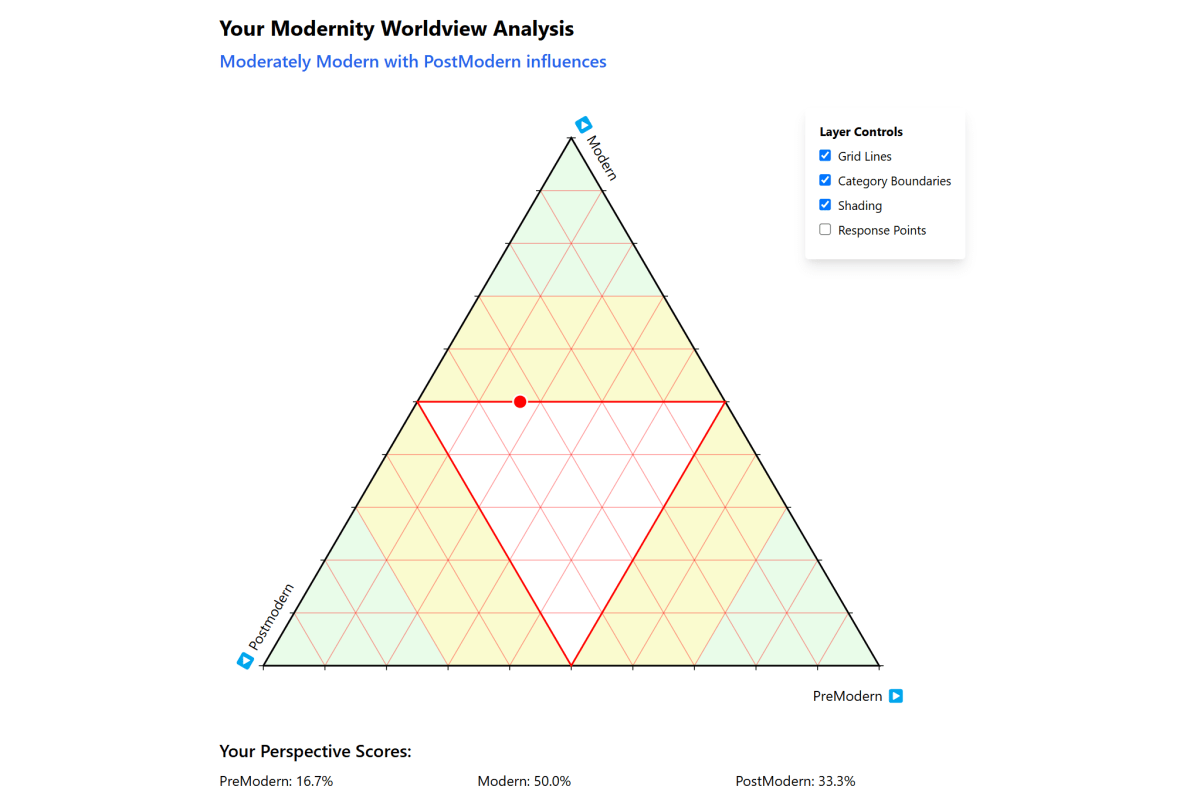
All aggregated responses resolve within the violet parallelogram that encompasses the population average (the blue dot). So, survey-takers have a slight propensity toward Modernist ideals with a tinge of Postmodernism. The force is weak, given how far the dot resides from the vertex. There were responses close to the green shading on the Modern side, but none indicated a strong Modernist worldview.
Firstly, no respondents are choosing “Pure Premodernity” (lower right). This doesn’t mean that no one abides by Premodern perspectives. It’s that they feel these ideas are filtered through Modern (mostly) and Postmodern (less so) lenses.
Secondly, respondents generally moderated their approach, avoiding any extremes. Although some responses were close to the Modern triangle (the green shading), none occupied the space, and points were even further removed from the other two corners. There were several scores in the white triangle. This space would be ripe for a Metamodernist to be positioned, but the survey would need to be restructured to determine whether this was mere happenstance.
Before the survey was published, I thought that the blue dot would be higher (toward Modernity) and further right (more Premodern), but this is likely due to the bias of people who visit this site and follow my content more generally. I need to share links in places without this bias. Of course, someone having even the slightest interest in the subject matter already represents a bias.
I’ve finally had time to create some video content for the Modernity Worldview Survey. This content is a cursory overview and serves as an introduction to deeper content planned for the future.
This video is short of seven minutes, so briefly, it outlines the worldviews and the questions. I opted not to produce a single comprehensive video so the material could arrive sooner. The content is bookmarked, though this is likely overkill for such a short video.
A permanent page about the survey is always available on this blog.
I’m still accumulating responses, but the survey is available here if you haven’t taken it. Apologies in advance for the fact that it renders best on a larger monitor or tablet rather than a mobile phone. It doesn’t render at all on a landline, so there’s that.
Firstly, I’d like to thank the people who have already submitted responses to the Modernity Worldview Survey. I’ll post that you submitted entries before this warning was presented.
Google has taken action and very responsively removed this warning. If you saw this whilst attempting to visit the URL, try again. Sorry for any fright or inconvenience. I’ll continue as if this never happened. smh
I am frustrated to say the least. I created this survey over the past month or so, writing, rewriting, refactoring, and switching technology and hosts until I settled on Google Cloud (GCP). It worked fine yesterday. When I visited today, I saw this warning.
As I mentioned in my announcement post, I collect no personal information. I don’t even ask for an email address, let alone a credit card number. On a technical note, this is the information I use:
id                 autogenerated unique identifier
timestamp          date and time stamp of record creation (UTC)
question-response  which response option made per question
ternary-triplet    the position of the average modernity score (pre, mod, post)
plot_x             Cartesian x-axis plot point for the ternary chart
plot_y             Cartesian y-axis plot point for the ternary chart
session_id         facilitates continuity for a user's browser experience
browser*            which browser being used (Chrome, Safari, and so on)
region             browser's language setting (US, GB, FR)
source             whether the user is accessing from the web or 'locally'
                   ('local' indicates a test record, so i can filter them out)

* These examples illustrate the colected browser information:
- Mozilla/5.0 (Windows NT 10.0; Win64; x64) AppleWebKit/537.36 (KHTML, like Gecko) Chrome/132.0.0.0 Safari/537.36

- Mozilla/5.0 (Linux; Android 10; K) AppleWebKit/537.36 (KHTML, like Gecko) Chrome/132.0.0.0 Mobile Safari/537.36
This is all.
This is a Chrome Warning. Ironically, a Google product. I tested this on Opera, Edge, and Safari without this nonsense.
The front end (UI) is written in HTML, Python, JavaScript, and React with some standard imports. The backend (database) is MySQL. It is version-controlled on GitHub and entirely hosted on GCP. I link to the survey from here (WordPress) or other social media presences. I did make the mistake of not making the site responsive. I paid the price when I visited the site on my Samsung S24. The page felt like the size of a postage stamp. I may fix this once this security issue is resolved.
I sent Google a request to remove this from their blacklist. This could take three weeks, more or less.
Meantime, I’ll pause survey promotions and hope this resolves quickly. The survey will remain live. If you use something other than Chrome, you should be able to take it. Obviously, I’ll also delay analysing and releasing any summary results.
Apologies for rambling. Thank you for your patience.
A Brief, Brutal Experiment in Categorising Your Worldview
This month, I’ve been tinkering with a little project—an elegant, six-question survey designed to assess where you land in the great intellectual mess that is modernity.
Audio: Podcast discussion about this post.
This isn’t some spur-of-the-moment quiz cooked up in a caffeine-fueled haze. No, this project has been simmering for years, and after much consideration (and occasional disdain), I’ve crafted a set of questions and response options that, I believe, encapsulate the prevailing worldviews of our time.
It all began with Metamodernism, a term that, at first, seemed promising—a bold synthesis of Modernism and Postmodernism, a grand dialectic of the ages. But as I mapped it out, it collapsed under scrutiny. A footnote in the margins of intellectual history, at best. I’ll expand on that in due course.
The Setup: A Simple, Slightly Sadistic Ternary Plot
For the visually inclined (or the masochistically curious), I initially imagined a timeline, then a branching decision tree, then a Cartesian plane before landing on a ternary plot—a three-way visual that captures ideological leanings in a way a boring old bar chart never could.
The survey itself is brief: six questions, each with five possible answers. Submit your responses, and voilà—you get a tidy little ternary chart plotting your intellectual essence, along with a breakdown of what your answers signify.
Methodology: Half-Rigorous, Half-Reckless
I am, after all, a (recovering) statistician, so I’ve tried to uphold proper methodology while also fast-tracking certain safeguards for the sake of efficiency. If there’s enough interest, I may expand the survey, adding more questions or increasing response flexibility (tick boxes instead of radio buttons—revolutionary, I know).
Privacy Concerns? Relax. I’m not harvesting your data for some nefarious scheme. No personally identifiable information is collected—just a timestamp, session ID, and your browser’s language setting. I did consider tracking IP addresses to analyze regional trends but ultimately scrapped that idea.
In the future, I may add an optional email feature for those who wish to save and track their responses over time (assuming anyone is unhinged enough to take this more than once).
The Rest of the Story: Your Feedback, My Amusement
Since this is a personal project crafted in splendid isolation, I’d love to hear your thoughts. Are the questions reasonable? Do the response options make sense? Does the summary feel accurate? Is the ternary chart decipherable, or have I constructed a glorified inkblot test?
As an academic, economist, and statistician, I had never encountered a ternary chart before embarking on this, and now I rather enjoy it. That said, I also find Nietzsche “intuitive,” so take that as you will.
If this gains traction, expect follow-up content—perhaps videos, podcasts, or further written explorations.
Your Move
Take the survey. It’s painless, requiring mere minutes of your life (which is, let’s be honest, already wasted online). And because I’m feeling generous, you can even generate a PDF to stick on your fridge, next to your collection of expired coupons and disappointing takeout menus.
Let’s see where you stand in the grand, chaotic landscape of modernity. Or at least, let’s have a laugh trying to make sense of it.
DISCLAIMER: The Modernity Worldview Survey is not scientific. It is designed as an experiment to provide directional insights. It is hosted on Google Cloud and subject to its availability and performance limitations.
perception—My favourite unreliable narrator. We humans love to believe we’ve got nature all figured out. Venomous snakes are brightly coloured to scream “danger.” Butterflies have wings so clever they double as invisibility cloaks. Zebras blend into their herds like barcodes in a supermarket scanner. Simple, right? Evolution explained; case closed.
But then something like this tiger meme smacks you upside the head, reminding you that the animal kingdom didn’t evolve just for our benefit—or our eyes. To a deer or a boar, that glaring orange tiger we associate with breakfast cereal is practically dressed in camouflage green. What we see as flamboyant and conspicuous is, in their dichromatic world, stealth at its finest. It’s not just our story, folks. The world doesn’t revolve around us, no matter how much we try to make it so.
Audio: NotebookLM podcast discussing this topic.
And that’s the punchline here: all those neat evolutionary narratives we’ve packaged up with a bow? They’re “just-so” stories built on our limited sensory toolkit. What if the zebra’s stripes aren’t just for blending into the herd but also for confusing a lion’s depth perception? What if those venomous snakes’ colours aren’t only a warning but also a mating ad in wavelengths we’ll never see? What if we’re just projecting human logic onto a planet with millions of other perspectives—each living in its own bespoke version of reality?
The meme about the tiger is a perfect metaphor for this broader idea. It’s not just about what we see; it’s about what others—be they animals, cultures, or people—experience. The tiger isn’t orange to them. What feels blindingly obvious to one perspective might be invisible to another. It’s a simple truth with profound implications, not just for understanding nature but for navigating the world we humans have made.
Take any argument—politics, culture, morality—and you’ll find the same principle at play. Everyone’s a trichromat in their own little world, convinced they’ve got the full spectrum of truth, when in reality, they’re missing entire wavelengths. Just like the deer who doesn’t see orange, we’re all blind to what we’re not built to perceive.
So next time someone insists their worldview is the only valid one, you might want to remind them that to some creatures, even the loudest tiger is just part of the scenery. Nature didn’t evolve for human eyes alone, and neither did the truth.





 Philosophics