Apologies in advance for another business-oriented post, but it ties in well with the latest McGilchrist content. Simon Sinek is the presenter, and he asks how the Navy pick the members of Seal Team Six—as he says, “the best of the best of the best of the best,” which happens to align with the way my toddler might tell me how very, very, very, very much she likes something.
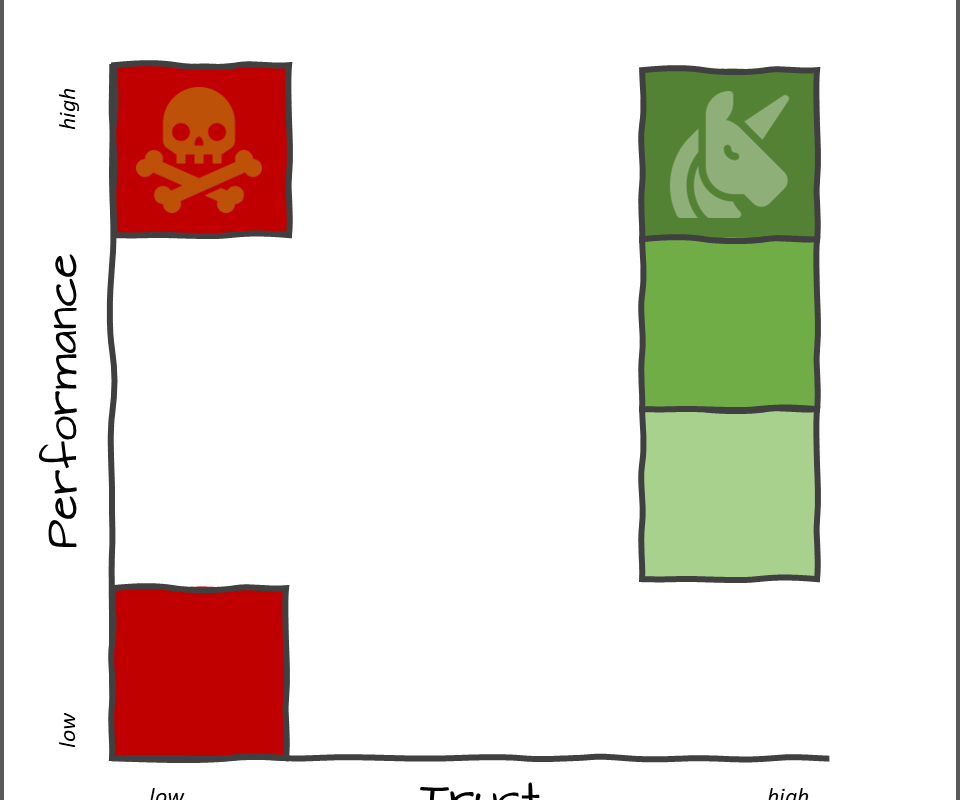
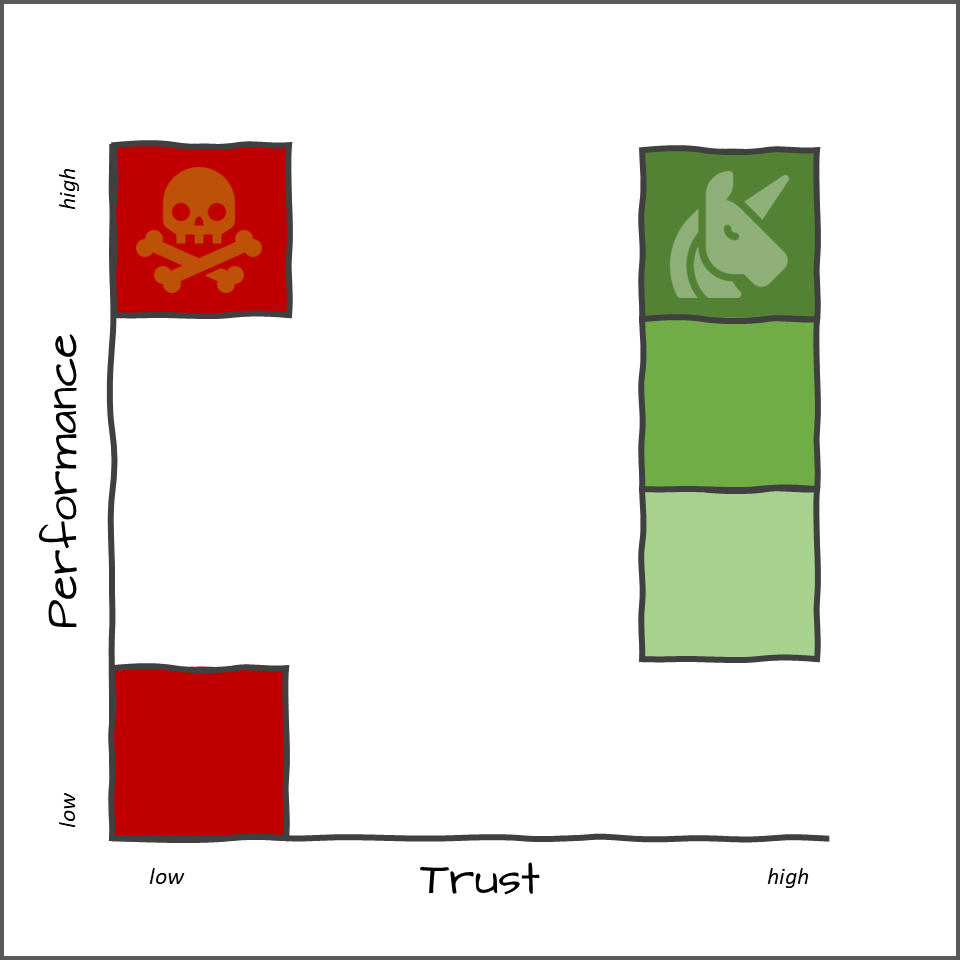
Simon is an adept communicator with a high woo factor, but this isn’t about him. I’ve cued this video to a place where Simon illustrates the assessment mindset employed to separate the wheat from the chaff in the minds of the Navy command. I’ve effectively recreated the chart Simon draws, and I use it as a reference.
Performance is on the Y-axis and Trust is on the X-axis. Effectively, they assess competency on and off the battlefield, respectively. He describes Performance as capturing “Do I trust you with my life?” and Trust as “Do I trust you with my money and my wife?” Perhaps he’s reflecting the sentiment of the generation managing the Seals. Not judging.
His point is that no one wants an untrustworthy low-performer (bottom left) and everyone wants a trustworthy high-performer (top right). He goes on to say that high-performing, low-trust members are toxic to the team. The team is better off with a relatively moderate performer that is otherwise trustworthy. I suppose the rest is a wash.
Performance is typical left-hemisphere fare: how much, how many, how fast, and so on. Companies have a million and one ways to measure performance.
Trust is a resident of the right hemisphere. This is an intuition and can’t be measured.
As Simon points out, even without explicit metrics, if you ask each team member who’s the highest performer, they’ll all point to the same person. Correspondingly, if you ask who’s the most trustworthy, they’ll all point to the same person as well. I can’t say that I trust this judgment, and thankfully, they do document whatever performance measures they have determined are appropriate. This option is not available for trust, so they have to rely on intuition. I don’t know if they also rely on consensus. I will grant that if all of the members do point to the same person as having the highest level of trust–presuming some performance threshold has been met–and the goal is to find a leader for that team, this person would make a fine leading candidate. If this person happened to be the highest performer then great, but being the best leader doesn’t require being the highest performer.
A sports coach doesn’t even need to excel at the sport s/he is leading. Their function is to motivate and inspire the team. Of course, in the case of the seals, I’m presuming this role is more of a player-manager. Still, the cohesion factor should be taken into account.
Trust is a heuristic that can’t be measured, and it’s fairly simple to find examples of people who appeared to be trustworthy but turned out not to be. It’s also conceivable that a trustworthy person may be misunderstood and perceived as trustworthy.
My question relates to the object of trust. When I think of police officers in the United States, I think that their trust is in each other, but at the expense of society. So they will generally protect each other even when they are morally and legally in the wrong. This is not the trust we want to foster for the public good. But since in my opinion policing is not about the public good but rather maintaining the status quo power structure, this is not a problem for their hiring managers.
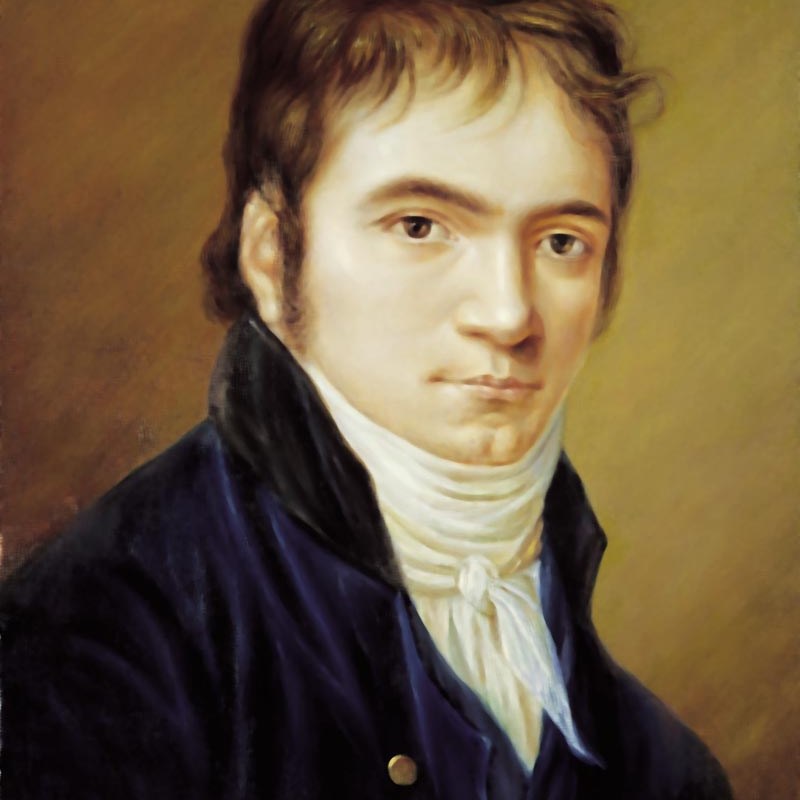
Real music comes from the heart. Rather, it’s a right-hemisphere affair. Beethoven was such a true musical genius, he had to express himself even when you couldn’t hear himself.
Above, Rick Reato gives us a little appreciation for Daniel Barenboim’s rendition of Beethoven’s Op.110 Piano Sonata. I’ve included the entire opus below. The entire 31st sonata can also be found on YouTube.
To be a musician and continue to write when deaf is the same as continuing to write as a deaf author. Musical notation is just symbols as words are symbols in a different medium. The inspiration happens in the right hemisphere and the left hemisphere translates them into symbols.
Musically speaking, I am more left-hemisphere. I have ideas that spawn from the right, but without an instrument, I couldn’t articulate them. Not even relatively. Many of my own compositions are left-hemisphere fare. I either take a mathcore approach or perhaps something along the lines of Schoenberg, where I want to convey a pattern—an example that comes to mind is Tool’s Lateralis, wherein the lyrical melody is based on the Fibonacci sequence—, or I let the instrument do the talking and transcribe the music after the fact. I know just about enough music theory to be dangerous, but not enough to be self-sufficient. This is why I always tended to collaborate with music directors or someone competent in this along the way.
My point is that the ears are not necessary to produce music—at least after you’ve figured out how to articulate it. For the record, there are blind artists and sculptors.
Most people have heard the term schizophrenia. It’s a mental health pathology wherein people interpret reality abnormally. To oversimplify to make a point, in a ‘normal’ brain, the left and right hemispheres operate together to regulate bodily functions and to interpret the world we live in. In brief, schizophrenia is a condition where the left cerebral hemisphere overly dominates the right. Some might be led to believe that schizophrenics interpret reality irrationally, but the opposite is true. Schizophrenics are hyperrational to a fault.
Schizophrenia has been on the rise this past half century or so, but this might just be a symptom of Modernity, as cultures are also experiencing a leftward shift—a shift toward hyperrationality. Cultures have swung like a pendulum from left-hemisphere-dominance to right dominance and back through the ages, but we may be seeing an uncorrected swing further and further to the left, led by science, followed by commerce and politics, dangerously close to the territory of schizophrenia, if not already occupying this territory. Allow me to briefly summarise how the hemisphere function to help the reader understand what it means to be too far left or right.
Cerebral Bilateral Hemispheres
Most people experience the world—what some otherwise known as reality—with both cerebral hemispheres, and each hemisphere has a function. In a nutshell, the right hemisphere experiences reality holistically, which is to say that it views the world through a Gestalt lens. The right hemisphere is open and divergent. It is creative—generative. It knows no categories or subdivisions. All is one and connected. I like to refer to this as Zen. Many people can relate to this Zen notion. The right hemisphere is a creative and empathetic centre that only knows the world as it is presented—without words or naming. Intuition lives here. It distinguishes differences in the world in a manner similar to that of a preverbal child who can tell mum from a bowl of porridge without knowing the word for either. Children are right hemisphere creatures. As we mature toward adulthood, the function of the left hemisphere increases to offset the dominance of the right.
The left hemisphere is the sphere of intellect. Its function is to categorise, to create symbols—words, names, labels, icons, and so on. It doesn’t know how to create, intuit, or empathise. In fact, it doesn’t even experience the world as presented; it relies on re-presentation. To borrow from a computer analogy, when it experiences something in the world, it caches a symbol. Where the right hemisphere experiences a tree and just appreciates its ‘treeness’, and it doesn’t know that it’s a tree by name. It’s just another thing in the world. The left hemisphere, on the other hand, notices these things with ‘treeness’ and categorises them as trees—or des arbres, árboles, Bäume, 木, درختان , पेड़, or whatever. And it reduces the tree to an icon, so it can file it away for later retrieval to compare with other tree-like inputs.
The left hemisphere is where difference, the sense of self, and ego come from
The left hemisphere is where difference, the sense of self, and ego come from. Where the right hemisphere is open and divergent, the left hemisphere is closed and convergent. It is particularly egotistical, stubborn, and always thinks it’s right if I can anthropomorphise analogically. The left hemisphere knows no nuance, and it doesn’t recognise connotation, metaphor, allegory, or allusion. Everything is literal.
The left hemisphere can use similes and understand that a man is like a tiger, but it takes the right hemisphere to know that a man is a tiger, has metaphorically embodied the tiger and assumed its form, say in the manner of indigenous Americans. Poetically, there is a difference between being a tiger and being like a tiger. The left will have none of this. The response to hearing ‘he was a tiger’ would either result in ‘no he isn’t, he’s a human’ or ‘someone must be talking about a male tiger’. The nuance would be lost.
At the risk of further digression, this is why a poem can’t be dissected for meaning—this despite so many valiant attempts by high school teachers and undergraduate professors. Dissecting a living poem is like dissecting a living animal. You might learn something, but at the risk of devitalisation—you’ve killed the subject. It’s like having to explain a joke. If you have to explain it, it didn’t work. You can’t explain a work of art or a piece of music. The best you can do is to describe it. Although we’re likely familiar with the adage, “A picture is worth a thousand words”, a thousand words is not enough to do more than summarise a picture. This sentiment is captured by Oscar Wilde when he wrote, “Education is an admirable thing, but it is well to remember from time to time that nothing that is worth knowing can be taught.” Education is a left-brain function, that can be stuffed like a sausage, but no amount of education can make someone feel a work of art, music, or poetry. This can only be experienced and is apart from language.
A Tree is not a Tree
As already noted, schizophrenics are hyperrational. They are devoid of the empathy and intuition afforded by the right hemisphere. So, they fail to connect the parts to a constructed whole. They presume that a whole is constructed of parts. This is the mistake of Dr Frankenstein, that he could construct a man from parts, but all he could manage is to construct a monster.
In the experienced world, there are only whole objects as experienced by the right hemisphere. As humans, we break them down for easier storage and retrieval, but this is like lossy compression if I can risk losing some in technical lingo.
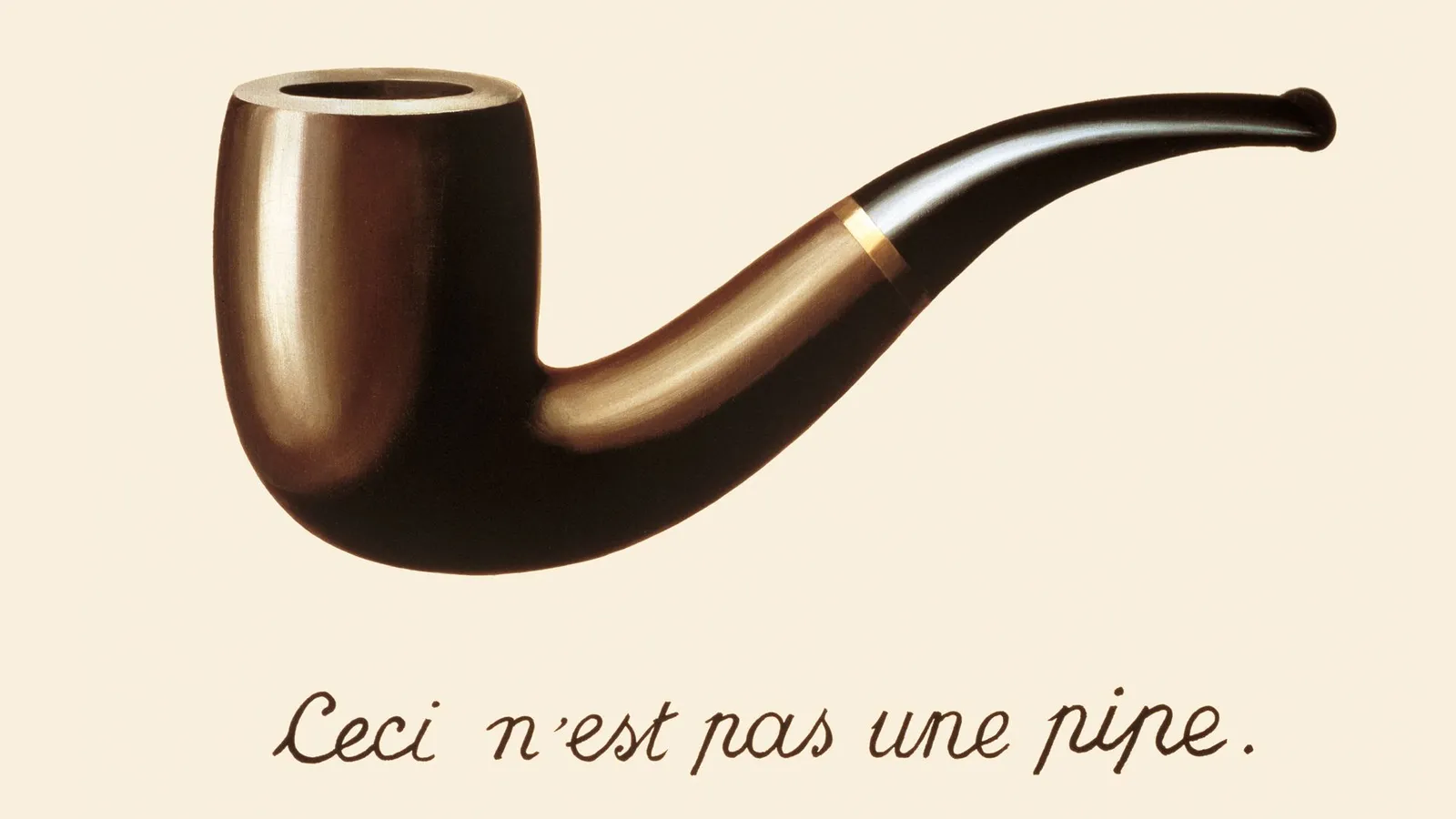
But a tree is not built from parts. It’s just a tree. We can articulate that a tree has a trunk and roots and branches and leaves and seeds and blooms, but it’s just a tree. The rest we impose on it with artificially constructed symbol language. This is what post-modern painter Rene Magritte was communicating with the “Ceci n’est pas une pipe” inscription in his work The Treachery of Images—This is not a pipe. He was not being cute or edgy or trying to be clever. He was making the point that the symbol is not the object.
In the manner that the image is not the pipe, it’s been said that to document a system is to make an inferior copy. The documented system is less optimal. This may feel counterintuitive. In fact, you may even argue that a documented system allows subsequent process participants to plug into the system to allow it to continue to operate into perpetuity. Whilst this is true, it comes at a cost. I’ll leave this here for you to ponder. The right hemisphere understands the difference. The document is not the process.
Getting Down to Business
If you’ve been following along, you may have already noticed that the left hemisphere looks and sounds a lot like the business world. Everything is systematised, structured, and ordered. We have all sorts of symbols and jargon, processes, and procedures. Everything is literal. There is no room for metaphor. There is no room for empathy. HR instructs that there be empathy, but they might as well instruct everyone to speak Basque or Hopi. In fact, it’s worse because at least Basque and Hopi can be learnt.
Sadly, this leftward shift isn’t limited to the world of commerce. It’s affected science, politics, and entire cultures. It’s caused these entities to abandon all that isn’t rational as irrational. But empathy and intuition are irrational. Science says if you can’t measure it and reproduce it, it’s not worth noting, but science is not the arbiter of the non-scientific realm. Business takes a similar position.
Politics of the Left (Hemisphere)
And politics creates categories: left and right, red and blue, black and white, men and women, gay and straight, and this and that. All of this is all left-hemisphere debate.
Categories and names are exclusive provinces of the left hemisphere. If you are hung up on an ideology, whether Democracy, Republicanism, Marxism, or Anarchism, you’re stuck in your left hemisphere. If you defend your positions with logic and words, you’re stuck in your left hemisphere. If you can’t imagine an alternative, you are really stuck in the left. I’ll stop here.
Science and Scientism
How did we get here and come to this? Science was receptive to right hemisphere influence up until about the 1970s. That’s where Scientism began to take hold. Scientism is when faith in science becomes a religion. I feel that many scientists today are less likely to hold a belief in Scientism as a religious belief. Paradoxically, I think this is more apt to be a faith held by non-scientists. Unfortunately, this faith is exploited by politics as exemplified by the recent trust in science campaign perpetrated by politicians, which is to say non-scientists with their own agenda, whether they practised Scientism or not.
The problem is that the left hemisphere has an outsized ego. It thinks it’s always right. In practice, it’s right about half the time. Because of its reliance on stored data and a ‘belief’ that it doesn’t need to fresh its data until it’s effectively overwhelmed and acquiesced. It fails to give enough weight to the experienced world, so that it shifts belief further and further left, which is to say further from reality as it is.
It trusts the symbol of the tree more than the tree itself. We may all be familiar with stories of cars driving down train tracks and off cliffs because the SAT-NAV user put more faith in their device than the world outside. This is the risk companies face as well, choosing to believe that the documented process is superior to the system in and of itself.
Getting on About?
You may be wondering what inspired me to write this and where I get my information. My realisation started in chapter 9 of The Matter with Things and was reinforced by this video interview by its author, Iain McGilchrist.
Actually, it started even before this with The Corporation, a Canadian documentary and companion book released in 2003. One of the points of The Corporation is to articulate the parallels between corporate behaviour relative to the definition of psychopathy as presented in The Diagnostic and Statistical Manual of Mental Disorders, henceforth DSM. Per Wikipedia, the DSM ‘is a publication by the American Psychiatric Association for the classification of mental disorders using a common language and standard criteria and is the main book for the diagnosis and treatment of mental disorders in the United States and is considered one of the “Bibles” of psychiatry’. Essentially, corporations ticked all the boxes.
Methodologically, this assertion is a bit weak, but it is at least sometimes entirely valid despite provoking an emotional trigger reaction. Nonetheless, this established corporations as pathological entities. But that is not my focus here. It simply tilled the soil for me to be more receptive to this topic. This topic is less about the legal fiction that is a corporation and more about the people embodied in it. From the height of the C-suite to the workaday staff, floor workers, warehouse workers, and the mailroom. Do they still have mailrooms? I digress.
I can’t claim to know what it is to be schizophrenic or schizoaffective, but I’ve known enough people who have these diagnoses. My brother was one of those. Although I use these and other labels, I am not a fan of labels, generally, especially psychological labels, specifically this label. Autism is another nonsensical label. Both fall into the realm of medical syndromes, which for the uninitiated is the equivalent of your kitchen junk drawer. It’s equivalent to the other choice when all others fail. I don’t want to go off on a tangent from the start, so I’ll leave it that these categories are overly broad and reflect intellectual laziness. There is no single schizophrenia or autism. There are many, but the distinction is lost in the category. The push to create an autism spectrum for DSM obscures the problem, but it helps for insurance purposes. As the saying goes, follow the money and you can gain clues to the driving force behind why this happened. I suppose you can also label me a conspiracy theorist. If I learned one thing in my undergrad Sociology classes, it’s to eschew labels.
Almost finished
Given the length of this segment, I am not going to summarise it here, save to say that this leftward shift in business and culture doesn’t have a good outlook. We are not only being replaced by machines, but we are also forced into becoming machines, and we aren’t even questioning it. All we need to do is to become more analytic, right?
What I suggest is to watch the six-minute video of Dr Iain McGilchrist discussing this topic, and if you really want a deep dive, read The Matter with Things, an almost three-thousand-page tome, to fill in the details.
Postscript
Here’s a music analogy to help to express why the whole is more important than the sum of the parts. If I want to learn to play a new piece, I will listen to the piece first. Depending on the length and genre, I may have to listen many times. In some cases, once or twice is enough, but let’s say this is at least somewhat complex and not some repetitive three-chord pop song. I’ll probably break the song into pieces or movements—verse, chorus, bridge, and whatever—, and then, I’ll learn each note and each pattern of notes, perhaps as musical phrases. Once I figure out the verse, I might either learn how the next verse differs or move on to the chorus and defer that verse-to-verse step. I’ll rinse and repeat until I’ve got through each of the sections. If I’ve had the luxury of hearing the piece, I’m at an advantage as far as tone, timbre, and dynamics are concerned; otherwise, I’d better hope these are all documented and that I interpret them in the manner they were intended. If the audience is familiar with a tune, they’ll notice the difference.
When I am practising, I need to get the mechanics down pat. All of what I’ve described thus far is left-hemisphere fare. It’s translating the symbolic representation of notes—like letters and words in writing—into an utterance. In this case, it’s a musical utterance. But once I am ready to perform the piece, it needs to be performed through the right hemisphere or it will feel mechanical and stilted.
I used to earn my living as an audio recording engineer and producer. Most of the time I was working with unknown artists recording demo records and trying to get a record deal. For the uninitiated, that usually translated into not having a large recording budget. Occasionally, we want, say string parts—violins, viola, cello, or whatever—but we couldn’t afford union players. We’d hire music students from USC or UCLA. These players would be more than willing to play for cheap in exchange for something to add to their portfolios or experience chops.
Somebody would transcribe the musical notation, and we’d give it to the string player. Of course, it could be a keyboard or wind or reed part, but I’ll stick to strings. Part of music is the vibe. This is something that can’t be captured in symbols. Revisiting Scientism and the left-hemisphere analogy, vibes can’t be real because they can’t be notated.
Almost invariably, if we got someone with Classical training, they could not get the vibe. The music was right in front of them. We’d play it for them on piano, maybe on a synthesiser, but they couldn’t get it—even if they were playing along to a reference track just trying to double the synth part. They would hit every note for the specified duration and dynamic, but it might have as well been the equivalence of a player piano or music box. We could have played it on a synthesiser, but we might be seeking the nuance a real instrument would bring.
We never had the luxury of auditioning players or recording several players and grabbing the best parts. That’s for the bigger-budget artists who go through a half-dozen or more performers to get just the right one. When we got lucky, it was usually because we got someone from the jazz program. These cats seem to have a natural feel for vibe inaccessible to the classical performers.
In business, the classical performer is good enough, but for art, it wasn’t. Business might appreciate the difference if it happens to get it, but it won’t seek it, and it won’t pay for it. A pet peeve of mine is a quip in business I heard often—don’t let perfection be the enemy of the good. This is obviously a left-hemisphere sentiment based on Voltaire’s statement. Besides, even from a left hemisphere perspective, reciting, “Don’t let perfection be the enemy of the good” doesn’t mean you shouldn’t at least strive for good enough because I noticed that mark was missed often enough, too.
I was riding a chrain down a shchreet banging a jrum and eating shrimp.
Podcast: Audio rendition of this page content
If you keep up with English language morphology—and let’s be honest here, who doesn’t?—the opening sentence is a phonetic respelling of ‘I was riding a train down a street banging a drum and eating shrimp’ but for a new generation. Dr Geoff Lindsey created a video, which includes material drawn from his book English After RP: Standard British Pronunciation Today. But don’t be fooled by the RP reference. There is plenty of relevance to the shifts in General American English if ever there was such a thing.
As noted previously, the principle of least effort tends to be a guiding factor for language morphology, and we’re witnessing the conservation of effort driving this shift.
Technically, what’s happening is that, traditionally, we performed some lingual gymnastics gliding (or not) from an alveolar consonant to a post-alveolar shift. The new fashion is to shift the entire structure into a post-alveolar space. Lazy wins. Of course, I’ll expect to hear from vocal prescriptivists, the traditional grammar Nazis, who will insist, “If I see a T in train, I’m going to pronounce it like a T, dammit. No ch-ch as in choo-choo for this ‘adult’.”
I’ve summarised the italicised words in a table.
Tradition
IPA
Nouveau
IPA
train
/tɹeɪn/
chrain
/t͡ʃɹeɪn/
drum
/ˈdɹʌm/
jrum
/ˈdʒɹʌm/
street
/stɹiːt/
shchreet
/ʃt͡ʃɹiːt/
shrimp
/ʃɹɪmp/
shrimp
/ʃɹɪmp/
Traditionally—which is to say the language spoken by older native English speakers—, the consonant clusters are pronounced pretty much as written. One would pronounce the T or TR in train; the DR in drum; and the STR in street. Shrimp had already made the shift, so we can think of it as a trendsetter.
Notice how the T in train shifts to a CH sound (/t͡ʃ/) or how the D in drum shifts to a J sound (/dʒ/). As the video shows, Michelle Obama is a bit ahead of the change curve, as she’s already shifted the S in street to a post-alveolar-friendly Sh Ch (/ʃt͡ʃ/), replacing the ST with a Sh-Ch combination, the S becoming Sh and the T becoming Ch. This trend has not caught on more broadly, but it seems it may be inevitable and allows us to keep this in a nice and tidy box.
In the video, there is a clip recounting a story of a seven-year-old just learning to write (and evidently into Star Wars) who wrote the following.
IMAGE: Watch out for the stormtrooper as written by a 7-year-old native English speaker
Notice that he is trying to capture a quasi-phonetic rendition of the word TROOPER that he hears (correctly) as CHROOPER. Again, this might cause grammar Nazis to go on a rampage. I don’t expect any spelling back-formation reformation to follow suit. We’ll just add this to the “English is not a phonetic language and has a lot of spelling exceptions” adage.
If you are a native English speaker, is this something you notice? If you speak English as a second language, have you noticed this trend? Which camp are you in? Old school or new school?
I have been so utterly distracted by YouTube this weekend. In this case, it’s a video by Dr Geoff Lindsey explaining weak forms of the English language.
Podcast: Audio rendition of this page content
Much of my work life involves speaking either with non-native English speakers or speakers of English who may be quite well versed in English and yet have a certain rigidity in their execution. Along with local accents, this makes the language feel unnatural to a native speaker.
A common challenge is the adoption of weak forms. Following the principle of least effort, language speakers are lazy. In fact, one may extrapolate this morphology to predict where language may drift next. One example that comes to mind is the American habit of uttering flap Ts over ‘real’ Ts that require slightly more effort to produce.
In English, one says the words, butter, water, doctor, and sister as /ˈbʌtə/,/ˈwɔtəɹ/, /ˈdɒktə/, /ˈsɪstə(ɹ)/ whilst in American English, using the flap T sound, one says (respelt in parentheses) /ˈbʌdəɹ/ (buhd-er), / ˈwɔdəɹ/ (wahd-er), /ˈdɔkdɚ/ (dok-der), /ˈsɪsdər/ (sis-der). Whether the pronunciation of the R is rhotic or non-rhotic is another issue altogether.
But this is about something a bit different. It’s about weak forms, particularly vowels that can be weakened from the strong vowel sound to the shwa (/ə/) sound. It turns out that we do this a lot. In fact, more often than not. Rather than a rehash from the video, I’ve cued it to where Tom Hiddleston recites Lord Byron’s So We’ll Go No More a Roving.
So, we'll go no more a roving
   So late into the night,
Though the heart be still as loving,
   And the moon be still as bright.

For the sword outwears its sheath,
   And the soul wears out the breast,
And the heart must pause to breathe,
   And love itself have rest.

Though the night was made for loving,
   And the day returns too soon,
Yet we'll go no more a roving
   By the light of the moon.
As it happens, much of the difference between native English and English as spoken by non-natives is the hyper-diction heard by choosing the strong rather than the weak form of certain words.
Cubism reminds us that we don’t see the world as it is. We see pieces, and we fill in the gaps. From the front, we can’t see the back. From the top, we can’t see the bottom.
Video: YouTube Video
The illusion that, if we can see something clearly, we see it as it really is, is hugely seductive. John Ruskin makes the point that clarity is bought at the price of limitation. He paints a scenario wherein we are asked to imagine viewing an open book and an embroidered handkerchief on a lawn. From a quarter mile away, the two are indistinguishable. Moving closer, we can see which is which, but we can neither read the book nor trace the embroidery. Closer still, we can read the text and trace the embroidery, but we can’t see the fibres of the paper or the threads of the kerchief. And we can’t simultaneously focus on both and see detail in each. Focusing on the book, we can look closer and see the watermark, the hills and dales in the paper’s surface. With a microscope, we can see more still, as infinitum.
But at which point do we see it clearly?
I’ve created a YouTube short. I have to admit that I dislike the format. Sixty seconds isn’t really enough time to convey a concept. There’s too much missing context, and no time to elaborate. Nonetheless, I was reading The Master and His Emissary and wanted to share a point. I don’t feel I succeeded. I posted it anyway, and here it is.
I recently posted a YouTube Short video titled You Have No Free Will, but this is still debatable.
Video: You Have No Free Will
The premise of the belief in free-will is that human decisions are made approximately half a second before we are conscious of them, and then the conscious brain convinces itself that it just made a choice. This sounds pretty damning, but let’s step back for a moment.
Podcast: Audio rendition of this page content
If you’ve been following this blog these past few months, you’ll be aware that I feel the question of free will is a pseudo-question hinging primarily on semantics. As well, there’s the causa sui argument that I’d like to ignore for the purpose of this post.
There remains a semantic issue. The free will argument is centred around the notion that a person or agent has control or agency over their choices. This means that how we define the agent matters.
In the study this references, the authors define the agent as having conscious awareness. Since this occurs after the decision is made, then the person must have had no agency. But I think an argument can be made that the earlier decision gateway is formed through prior experience. Applying computer metaphors, we can say that this pre-consciousness is like embedded hardware or read-only logic. It’s like autopilot.
In business, there are various decision management schemes. In particular, the conscious but slow version is for a person to be notified to approve or deny a request. But some decisions are automatic. If a purchase is over, say 50,000 then a manager needs to sign off on the request. But if the purchase is under 50,000, then the request is made automatically and then the manager is notified for later review if so desired.
I am not saying that I buy into this definition, but I think the argument could be made.
You might not know it by the number of posts discussing it, but I am not really concerned about whether or not free will really exists. I don’t lose any sleep over it. At the same time, I tend to react to it. Since I feel it’s a pseudo-problem where tweaking the definition slightly can flip the answer on its head, it’s just not worth the effort. On to better things.
At heart, I’m an Emotivist. Following Ayer, I don’t believe that morals (and their brethren ethics) convey more than, “I like this, and I don’t like that.” Stevenson’s Prescriptivist extension makes sense, too: “I think this is good, and so should you.”
It seems that Hilary Lawson and I share this perspective. He makes the further point, one I’ll surely adopt, that morals and ethics are effectively ‘designed’ to shut down argument and discussion. It’s akin to the parent telling the kid, “Because I said so”—or “because it’s the right thing to do”.
Podcast: Audio rendition of this page content
I’m a moral non-cognitivist, but people have difficulty enough grasping relativism and subjectivism, so I’m only going to reference moral relativism here. As a moral relativist, right and wrong were both subjective and contextual. One person’s freedom fighter is another person’s terrorist. I won’t derail this with obvious examples. Once one adopts a position, they enjoy the luxury of turning off any critical thinking.
I’ll presume that morals predate religion and deities, but now that the thinking world has abandoned the notion of gods, they’ve replaced it with morals and ethics—and nature, but that’s a topic for another day. The faith-based world retains a notion of gods, but that is fraught with the same relativism of my god is right, and your god is wrong.
As Hilary notes, we’ve transferred the authority, per Nietzsche, from gods to morals in and of themselves, so it again becomes a device for the unengaged. He notes, as I do, that some absolute Truth is a fool’s errand. Echoing Donald Hoffman, what we need is fitness—what Lawson calls usefulness—, not Truth, which is inaccessible anyway—even if it did exist, which of course it doesn’t.
He cites the position Wittgenstein arrives at in his Tractatus. There is and can never be a place where language—words and symbols—intersect with ‘reality’, so the best we can do is to talk about it in a third-person sort of way.
As I consider the works of McGilchrist, it feels like Lawson is establishing moral simplicity as a left hemisphere function. Seeing beyond this is a right hemisphere activity, so that’s not promising. There seem to be few right-brain thinkers and then it comes to convincing the left-brain crowd. In a poor metaphor, the challenge is rather like trying to convey the maths of special relativity to the same crowd. They are going to tune out before they hear enough of the story. The left-brain is good at saying, ”la la la la, la la, la”.
Without getting too far off track, a major challenge is that systems of government and laws are facile left hemisphere-dominant activities. These are people in power and influential. Rhetoricians have right hemisphere dominance, but they understand that their power depends on defending the status quo that has elevated them to where they are. As Upton Sinclair said, “’It is difficult to get a man to understand something, when his salary depends on his not understanding it.” This holds true for women and non-binary others.
In closing, Lawson asserts that apart from comic book supervillains, people tend to do what they believe to be good, and yet all goods are not created equally, nor all bads. And in the manner that one person’s trash is another’s treasure, one person’s good is another’s bad.
This moral discourse is not benign. It’s dangerous. I don’t want to steep this in contemporary politics, but this is being propagandised in things like the Ukraine conflict or the Covid response. If you’re not with us, you’re against us. This is divisive and creates a rift. That governments are propagating this divide is even more disconcerting, especially when they unapologetically backtrack only a few months later in the wake of people suffering economic impacts, including getting fired, for opposing a position that has turned out to be wrong and that was being asserted in the name of science and yet with little empirical support. These people are politicians and not scientists but attempting to hide behind science like a human shield, it serves to erode trust in science. Trust in science is a separate topic, so I’ll leave it there.
I recommend watching the complete video of Hilary Lawson to gain his perspective and nuance. My point is only to underscore his positions and to say that I agree. What do you think about morals? Are they a device to assert power over others, or is there something more to it than this? If not moral, then what? Leave a comment.
As with chickens, humans can learn through reinforcement AKA operant conditioning.
In this video clip, we see a chicken learning that pecking a red circle yields a payload of food. Yet there is a problem with this algorithm. I don’t expect this study was meant to elucidate this point, but I’ll continue.
Except for one instance where the blue circle was pecked to yield nothing, the chicken learned that packing the red yielded a treat and so became fixed on seeking the red. What the chicken did not explore where the other colours—beige, green, and yellow. Perhaps these might have had a larger payout or a ‘better’ reward. Perhaps even a penalty or punishment, but I’ll ignore that eventuality.
The point is that through operant conditioning, the chicken is habituated. I feel that this is a metaphor for many such habituations in humans. People are indoctrinated (habituated) into all sorts of beliefs and behaviours, from the organisation of social and political systems to economic systems.
When I see people defending Democracy as Churchill did as “the worst form of government, but the best so far,” I can’t help but consider the parallels: Democracy is the red dot; capitalism is the red dot.
This not being a self-help blog, I’ll mention is passing the routines we get ourselves into that are analogous to this chicken—wandering through the world as if with blinders. The difference between a rut and a grave is the depth or dimensions. Are you in a rut on your way to the grave?
This is all I wanted to say. No chickens were harmed during the production of this blog entry.
I wrote about this content in 2019, but I wanted to revisit it for a video as well as create a podcast audio version.
Video: YouTube version of this page content
Podcast: Audio rendition of this page content
In today’s segment, I am going to share my perspectives on the truth about truth. To start, I’ll let the audience know that I do not believe in the notion of truth. I feel the term is ill-defined especially in the realm of metaphysics and morality. I feel that when most people employ the word ‘truth’, what they mean to say is ‘fact.’ That a fire engine is red, for example, may be a fact, if indeed the fire engine happens to be red, but it is not true. This is a misapplication of the term. If you employ truth as a direct synonym for fact, then this is not what’s being discussed here, and perhaps your time might be better spent watching some content by the Critical Drinker.
My argument is that truth is not objective. Rather it is subjective and perspectival. I concede that there may be some objective truth out there somewhere, but it is not and will not ever be accessible to us because of limitations in our sense-perception faculties and cognitive limitations. Per Aristotle, we only have five senses with which we can connect to the world, and these senses are limited. If there is anything out there that would require another sense receptor—a sense receptor not available to us—, we would never be able to sense it, to even know of its existence. Perhaps the universe emits 100 sense signals, but we are only capable of receiving and translating five. We’d be oblivious to 95 per cent of reality.
I am not making any claims that this is the case, but human cognition is so limited, that we can’t even conceive of what another sense might be. If you can, please leave a comment.
To be clear, I am not talking about senses we know other species possess. Bats may have echolocation, and sharks may have electroreception. Some animals may have greater sensory acuity—superior vision and auditory senses, olfactory and gustatory, tactile, or whatever. Some can see into infrared or ultraviolet light spectra. Technology that includes biomimicry provides humans with microscopes for the microworld and telescopes for the macroworld. We have x-rays and sonar and radar, radios and televisions that extend our senses, but these provide no new sensory receptors.
Like the story of the blind people and the elephant, we are left grasping at parts. But even if we are able to step back to view the whole elephant, to hear the elephant, to touch and smell or even taste the elephant, if there is more to the elephant, we cannot know it. The same goes for ourselves.
I know that some people might inject gods or psychic or paranormal energy into this void, and sure, feel free, but I am looking beyond these pedestrian concepts. What else might there be?
But let’s depart this train and head in a different direction. I want us to focus on the senses we do have. For the typical human, sight is our primary arbiter of reality, at least as defined idiomatically. We tend to believe what we see, and what we see, we assume as real—even if we are later mistaken. I guess that wasn’t a unicorn or a pink elephant. I must have been hallucinating or dreaming. I could have sworn that was Auntie Em.
There are several competing theories around truth, but I’ll focus on the Correspondence theory, which is simply put, the notion that, proxying reality for truth, human perception corresponds with the real world. And a pragmatist might argue that’s close enough for the government.
Keep in mind that historically humans have contorted themselves into making calculations. Remember how long people had been tying themselves into knots to show planetary motion in a geocentric system creating epicycles and retrograde motion to map understanding to a perceived reality.
One might even argue that we’ve progressed. It wasn’t true or accurate then, but now it is. And perhaps it is. Let’s look at some illustrations.
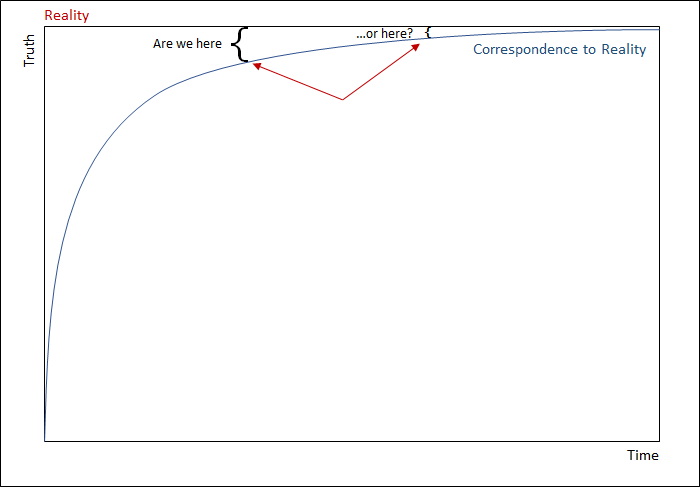
NB: Due to an editorial mishap, this paragraph was dropped in the podcast, hence dropped from the video, which shared the podcast audio source. As such, this image was also not used in the video. This is unfortunate, as it was meant to introduce those with limited maths knowledge to the asymptotic curve, as described. Apologies, and I hope this serves to orient any travellers who may have lost their way at this point.
In this first illustration, we see Truth (or relative truthiness) on the Y-axis and Time on the X-Axis. On the top, we see a threshold representing Reality. In the plane, I’ve rendered an asymptotic curve, where over time, we get closer and closer to the Truth. But we never quite get there. More on this later.
The next illustration will help to demonstrate what’s happening.
Notice there is a gap between the curve and the Reality cap. For one thing, we don’t really know where we are relative to Reality. In the case of the geocentric system, we might have been at the leftmost space. Once we determined that the system is actually solar-centric, we might have moved right on the curve to close the gap. We might be tempted to defend that we’ve finally reached the truth, but we’d have been equally willing to make the same defence from the geocentric position, so we need to be mindful of the past.
Perhaps, this last example was too obvious. We feel comfortable staking a truth claim—or at least a claim of fact. So let’s look at another example.
Let’s re-use the same axes—Truth and Time—, but rather than an asymptotic curve, let’s presume something more polynomial in nature—or not particularly cyclic. Rather than retrograde motion in planets, let’s visit the supposed progress of Newtonian over Einsteinian physics.
This takes a bit more setup but bear with me. In this case, I have taken liberties and illustrated the Einsteinian physics gap to capture an inferior vantage on reality over Newtonian physics. Granted, I need to rely on a bit of suspension of disbelief, but in the bigger picture, I am trying to convey a scenario where some new paradigm puts the prior knowledge in perspective.
In this instance, both Newtonian and Einsteinian flavours of physics are based on a materialistic, particles-based model, which is where the modern physics consensus resides. But, let’s say that consensus changes in such a way that it is determined that something else underlies reality, say consciousness per Analytic Idealism as proposed by Bernardo Kastrup or per Integrated Information Theory (IIT) as advanced by Donald Hoffman and others. As with retrograde motion, we might end up finding that we were barking up the wrong tree. This might be a bit different because the particles are a directly perceived manifestation of the underlying consciousness, but I wanted to create a scenario where knowledge thought to have advanced actually regressed, but this wasn’t revealed until a new perspective was available.
Yet again, an important aspect of note is that we don’t actually know the distance between our perceptions and real Reality.
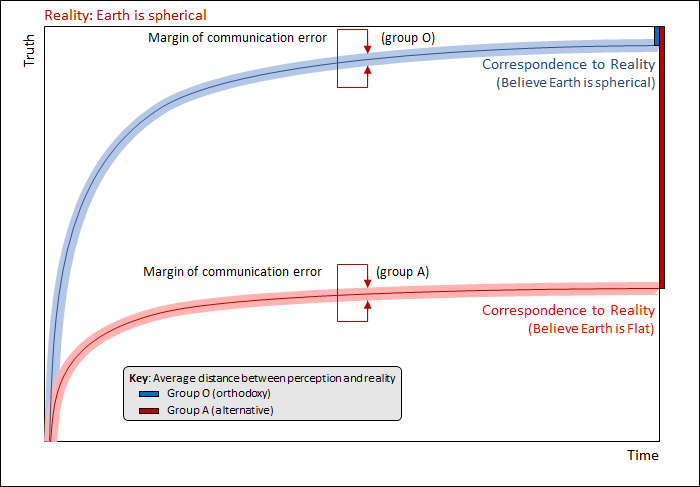
This last illustration builds upon the first asymptotic chart but has an in-built error margin meant to reflect language insufficiencies. There is some concept that people feel they grasp, but the consensus is not as unified as the group thinks.
I’ll share two examples, the first being the concept of justice. To me, Justice is what I deem a weasel word. It’s a word we commonly use, but it means different things to different people. To me, it’s a euphemism for vengeance by proxy, but for others, it transcends that and mirrors some impartial dispensation of just desert—some good old-fashioned law and order.
[Justice is] a euphemism for vengeance by proxy
Without getting stuck down some rabbit hole, my point is that if we aggregate these beliefs, the asymptotic curve represents an average consensus vantage rather than something as obvious as 2 plus 2 equals 4. On this note, allow me to clear the air.
Some viewers might be clamouring to say, “but 2 plus 2 equals four is true.” But this is tautologically true, which is to say that it’s true by definition. It’s a similar tautology to saying that it’s true that snow is white, or coal is black. We’ve already defined snow, white, coal, and black, so these may be facts, but they are true by definition.
Revisiting the chart, notice that there are two curves in the space. In this case, I illustrate competing truth claims from the perspective of an omniscient narrator. The case is whether the earth is an oblate spheroid or is flat. I am going to go out on a limb and assert the earth is spherical, as represented by the top blue curve—and we have some margin of error as to what that might mean. The bottom red curve depicts the perceived truth of the flat earthers, who also have some room for semantic error.
Given that I am presuming that I am in the right adopting the majority position—please be right—, the blue curve is closer to Reality than the red curve. Of course, in the event that the earth is really flat, then it proves my point that we don’t know where we are relative to truth, so we assume that the state of knowledge at any given time is what’s real.
Again, forgive my fanciful examples. Please don’t tell me that this spheroid versus planer earth is tautological too because you’d be correct, but I am already aware. They are just nonsensical illustrations. Nonetheless, I hope they’ve served to express a point.
I could have as well created curves that depicted two cohorts’ beliefs on the efficacy of tarot or astrology in predicting the future. I am sure that it might render somewhat like the last chart, but I’d also presume that both curves would have very low truth values as seen from an objective observer. Secretly, I hope tarot wins the truth battle.
Before I end our time together, I’d like to convey that for an Analytic Idealist, these charts might be more acceptable at face value. For a Realist, Naïve or otherwise, they may argue that this curve is not asymptotic and may in fact reach some tangency. I don’t happen to believe this is the case or I wouldn’t have spent my time assembling and presenting this. Time will tell. Or will it?









 Philosophics