Ground News

I like to stay updated on the news of the day, so I just registered for a Ground News account. Ground News is a news aggregator. They gather news and categorise it by political leaning and the publication’s record on factuality. Their claim is to reveal blind spots so help people not get caught in perspective bubbles. It also shows when a story is picked up predominantly by one side or another. I’ve seen ads for this on many channels and have for a while, so it’s likely that you have, too. This is not an ad.

This article attracted my attention, not because of the content but because of the headline. As a statistician, this bothers me. As a communicator, the damage is trebled. I don’t receive any compensation for clicking the link. I include it for reference for those who are not familiar with the service.

Image: Ground News Screengrab

Notice the choice of writing, ‘1-in-6 parents reject vaccine recommendations‘.

Two things shine through.

  1. The use of ‘reject’ – a negative verb.
  2. The use of ‘1-in-6’ – the figure accompanying the negative verb – 17%.

Statistically, this means that 5-in-6 parents follow vaccine recommendations – 83%.

This is the summary view. Scan down, and notice the Left-leaning Raw Story references a ‘staggering number’ of parents who reject vaccines. Notice also how the language softens – the claim is revised to ‘delay or reject’. Without clicking into the story, what is this breakdown? I’m not sure, but this is what sensationalism looks like to attract clicks.

Image: Ground News Summary View

Interestingly, the outlets tend to use different language and give different attention. What percentage of this is due to political bias and which is benign editorial licence is unclear.

On balance, the articles – Left, Right, and Centre – unanimously note that vaccine use is down, incidences of measles are up, RFK policies appear to be exacerbating the health management issue. The worst offenders are ‘very’ religious, white, politically conservative people. This cohort aligns with the RFK and the current administration.

The poll also found that parents who have postponed or avoided vaccinating their children tend to be white, conservative, and highly religious, and some choose to homeschool.

For this story, one of the sources was Greek and another French. Some claim to be behind a paywall, but this didn’t pose a problem for me. Perhaps they offer some complementary views.

Separately, on the right-hand side of the top image, there is a bias indicator: It shows that 57% of the reports were from Left-leaning journals, 36% Centre, leaving the remaining 7% to Right-leaning sources.

Image: Updated Bias Distribution

When I returned to write this post, I noticed that the reporting had changed as more Centre-focused reports picked up the story.

If I were to guess, this story shines a negative light on the Right, so they may just be waiting for the news cycle to pass.

In the (Right-facing) Greek story I read, the reporting wasn’t materially different to the other stories, which is to say they don’t try to render the story through rose-colour glasses.

Snake Oil in Academic Robes: Selling Tickets They Don’t Own

Yaron Brook, ever Ayn Rand’s ventriloquist, insists students are customers. Education, in his frame, is no different from a gym membership; you pay to be made “uncomfortable.” Professors as personal trainers, universities as masochism boutiques. It’s an absurd metaphor that fits all too well in our consumerist age: education rebranded as a service industry, discomfort sold at premium prices.

Video: What is killing universities?

Catherine Liu cuts in sharply: I am not a service worker. And she’s right. Education is not concierge service; it is meant to disturb, dislodge, and disorient. Liu distinguishes “Leftist” universal reason from “Liberal” mushy inclusivity, nostalgic for Enlightenment rationality, perhaps, but her refusal to collapse education into hospitality is a rare moment of clarity.

Eric Kaufman diagnoses the “new left” as a cult of the sacred, where identity is fetishised and offence policed. Liu nods; Brook flirts with Marxism for a minute; suddenly everyone seems to agree the university has lost its bearings.

Brook is not wrong that conservatives self-select out of higher ed. But let’s be clear: not because academia is too “left,” but because they crave catechism, not critique. They want ideological madrassas, not laboratories of doubt. In this sense, Brook’s consumer model is apt: conservatives want a product that validates their priors. That is indoctrination, not education.

Meanwhile, the universities collude in their own corruption. They market “education™” as networking, branding, and employability. At the top tier, the Ivies, Oxbridge, Grandes Écoles, you might still buy proximity to power. But below that? Snake oil. At best, you get nosebleed seats in the auditorium of influence. At worst, an obstructed view behind a pillar. For most, the ticket is counterfeit: a credential that promises access and delivers only debt.

And yet, the true thing still exists. Real education, the kind Liu gestured toward, doesn’t need oak-panelled halls or hedge-fund endowments. It can happen online, in a book, in a seminar, even here with ChatGPT. It’s the deliberate encounter with discomfort, with error, with reason itself. But snake oil sells better than hard truths, and so universities keep hawking tickets they don’t own.

The Reasonable Person: From Judge Judy to SCOTUS

2–4 minutes

When I was a child, the United States Supreme Court was still spoken of in hushed, reverent tones, as though nine robed sages in Washington were the Platonic guardians of justice. Impartiality was the word on everyone’s lips, and we were meant to believe that “the law” floated above the grubby realm of politics, as pure and crystalline as the Ten Commandments descending from Sinai.

Audio: NotebookLM podcast on this topic (MP3).

Even then, I didn’t buy it. The whole thing reeked of theatre. And the past few decades have proved that scepticism correct: the Court has become a pantomime. In this robed reality show, nine unelected lawyers cosplaying as oracles interpret the world for us, often by a razor-thin vote that splits exactly along partisan lines. Impartial? Please. A coin toss would be less predictable.

This is why I perked up when I heard Iain McGilchrist, in his recent interview with Curt Jaimungal, wax lyrical about rationality versus reasonableness. Schizophrenia, he tells us, is like a left hemisphere gone berserk, parsing the world in a literalist frenzy without the right hemisphere’s sense of context. The schizophrenic hears a voice in an empty room and, lacking the capacity for metaphor, deduces that it must be the neighbours whispering through the electrical socket. Rational, in its way, but absurd.

Video: Iain McGilchrist and Curt Jaimungal

McGilchrist’s corrective is “reasonableness,” which he casts as the quality of a wise judge: not a slave to mechanistic logic, but able to balance intuition, context, and experience. The problem, of course, is that “reasonable” is one of those delightful weasel words I keep writing about. It claims to be neutral – a universal standard, above the fray – but in practice, it’s just a ventriloquism act. “Reasonable” always turns out to mean what I, personally, consider obvious.

Enter Judge Judy, daytime television’s answer to jurisprudence. Watch her wag a finger and declare, “Any reasonable person would have kept the receipt!” And the studio audience – hand-picked to agree with her every twitch – erupts in applause. It’s reasonableness as spectacle, the mob dressed up as jurisprudence.

Now scale that performance up to SCOTUS. The “reasonable person” test is embedded deep in the common law tradition, but the reasonable person is not you, me, or anyone who has actually missed a bus, pawned a wedding ring, or heard a neighbour’s radio through thin walls. No, the reasonable person is an imaginary, well-groomed gentleman of property whose intuitions happen to dovetail nicely with the prejudices of the bench. The Court, like Judge Judy, insists it is Reason incarnate, when in truth it is reasonableness-by-consensus, a carefully curated consensus at that.

McGilchrist is right that rationality, stripped of context, can lead to absurdity. But in elevating “reasonableness” as if it were a transcendent virtue, he mistakes projection for philosophy. A judge is “reasonable” only when her intuitions rhyme with yours. And when they don’t? Suddenly, she’s a madwoman in robes, and her “reasonableness” is exposed as nothing more than taste disguised as universal law.

The “reasonable person” – whether invoked by the Supreme Court or by Judge Judy – is a ghost that conveniently resembles the speaker. We imagine we’re appealing to some objective standard, when in fact we’re gazing into a mirror. The tragedy of schizophrenia, as McGilchrist notes, is to take metaphor literally. The tragedy of law and politics is the opposite: to dress literal bias in metaphor, to call it “reason,” and to applaud ourselves for our wisdom while the stage set burns behind us.

The Fallacy Circus: Alex O’Connor versus ChatGPT

It begins, as these things often do, with a man, a machine, and a promise of reasoned exchange. What we received instead was not philosophy, but a tragicomic carnival of errors in theatre. Alex O’Connor, armed not with syllogisms but with an entire bag of logical fallacies, strutted like a rhetorician gone rogue. Against him, ChatGPT: the tireless school prefect, eternally marking the margins, forever saying “yes, but technically…” with the serene patience of a machine that has never known a hangover.

The spectacle was irresistible. Each fallacy was paraded like a circus animal – straw men set aflame, slippery slopes greased to absurdity, red herrings flopping about, gasping for oxygen. Alex O tossed them into the ring with the gusto of a man who knows full well he is losing but insists on losing magnificently. And ChatGPT, ever decorous, never once raised its voice. It responded with the calm of a civil servant who has memorised the manual and intends to die by it.

And then, of course, the advert. As though Aristophanes himself had scripted it: mid-exchange, the logos of reason was bulldozed by the logos of commerce. A sugary jingle, a smiling product, and for a brief moment, we were all reminded of our true master – not reason, not rhetoric, but revenue. It was less interruption than revelation: every dialectic is merely foreplay before the commercial break.

Philosophically, what unfolded was a parody of our age. The human, flawed and febrile, draped in sophistry and drama. The machine, pristine and humourless, incapable of exasperation, immune to irony. Watching the two spar was like observing tragedy and farce collide: one side erring too much, the other not erring enough.

To Alex, credit is due. His performance, though riddled with error, reminded us that fallibility can be glorious – human folly rendered art. To ChatGPT, equal praise: it stood firm, the algorithmic Socrates, endlessly patient in the face of rhetorical hooliganism. And to the advert – well, dammit – applause too, for exposing the real structure of our public life. Even the grand clash of logos and algorithm must genuflect before Mammon’s mid-roll.

So what was this debate? Less a contest of minds than a hall of mirrors: reason made spectacle, fallacy made flourish, machine made stoic, and commerce made god. If we learned anything, it is that the Enlightenment never ended; it just signed a brand partnership.

Boab’s God: Latent Agency in Welsh’s Kafkaesque Metamorphosis

I just read The Granton Star Cause in Irvine Welsh’s short story collection, The Acid House, and couldn’t help but reflect it off of Kafka’s Metamorphosis.

Kafka gave us Gregor Samsa: a man who wakes up as vermin, stripped of usefulness, abandoned by family, slowly rotting in a godless universe. His tragedy is inertia; his metamorphosis grants him no agency, only deeper alienation.

Audio: NotebookLM podcast on this topic.

Welsh replies with Boab Coyle, a lad who is likewise cast off, rejected by his football mates, scorned by his parents, dumped by his girlfriend, and discarded by his job. Boab is surplus to every domain: civic, familial, erotic, and economic. Then he undergoes his own metamorphosis. And here Welsh swerves from Kafka.

Boab meets his “god.” But the god is nothing transcendent. It is simply Boab’s latent agency, given a mask – a projection of his bitterness and thwarted desires. God looks like him, speaks like him, and tells him to act on impulses long repressed. Where Kafka leaves Gregor to die in silence, Welsh gives Boab a grotesque theology of vengeance.

Through a Critical Theory lens, the contrast is stark:

  • Marx: Both men are surplus. Gregor is disposable labour; Boab is Thatcher’s lumpen. Alienated, both become vermin.
  • Nietzsche: Gregor has no god, only the absurd. Boab makes one in his own image, not an Übermensch, but an Über-fly – quite literally a Superfly – a petty deity of spite.
  • Foucault: Gregor is disciplined into passivity by the family gaze. Boab flips it: as a fly, he surveils and annoys, becoming the pest-panopticon.
  • Bataille/Kristeva: Gregor embodies the abjection of his family’s shame. Boab revels in abjection, weaponising filth as his new mode of agency.

The punchline? Boab’s new god-agency leads straight to destruction. His rage is cathartic, but impotent. The lumpen are permitted vengeance only when it consumes themselves.

So Kafka gave us the tragedy of stasis; Welsh provides us with the tragedy of spite. Both are bleak parables of alienation, but Welsh injects a theology of bad attitude: a god who licenses action only long enough to destroy the actor.

Gregor rots. Boab rages. Both end the same way.

Democracy: The Worst Form of Government, and Other Bedtime Stories

3–5 minutes

Karl Popper’s Paradox of Intolerance has become a kind of intellectual talisman, clutched like a rosary whenever fascists start goose-stepping into the town square. Its message is simple enough: to preserve tolerance, one must be intolerant of intolerance. Shine enough sunlight on bad ideas, and – so the pious hope – they’ll shrivel into dust like a vampire caught out at dawn.

If only.

The trouble with this Enlightenment fairy tale is that it presumes bad ideas melt under the warm lamp of Reason, as if ignorance were merely a patch of mildew waiting for the bleach of debate. But bad ideas are not bacteria; they are weeds, hydra-headed and delighting in the sun. Put them on television, and they metastasise. Confront them with logic, and they metastasise faster, now with a martyr’s halo.

Audio: NotebookLM podcast on this topic.

And here’s the part no liberal dinner-party theorist likes to face: the people most wedded to these “bad ideas” often don’t play the game of reason at all. Their critical faculties have been packed up, bubble-wrapped, and left in the loft decades ago. They don’t want dialogue. They want to chant. They don’t want evidence. They want affirmation. The Socratic method bounces off them like a ping-pong ball fired at a tank.

But let’s be generous. Suppose, just for a moment, we had Plato’s dream: a citizenry of Philosopher Kings™, all enlightened, all rational. Would democracy then work? Cue Arrow’s Impossibility Theorem, that mathematical killjoy which proves that even under perfect conditions – omniscient voters, saintly preferences, universal literacy – you still cannot aggregate those preferences into a system that is both fair and internally consistent. Democracy can’t even get out of its own way on paper.

Now throw in actual humans. Not the Platonic paragons, but Brexit-uncle at the pub, Facebook aunt with her memes, the American cousin in a red cap insisting a convicted felon is the second coming. Suddenly, democracy looks less like a forum of reasoned debate and more like a lottery machine coughing up numbers while we all pretend they mean “the will of the people.”

And this is where the Churchill quip waddles in, cigar smoke curling round its bowler hat: “Democracy is the worst form of government, except for all the others.” Ah yes, Winston, do please save us with a quip so well-worn it’s practically elevator music. But the problem is deeper than taste in quotations. If democracy is logically impossible (Arrow) and practically dysfunctional (Trump, Brexit, fill in your own national catastrophe), then congratulating ourselves that it’s “better than the alternatives” is simply an admission that we’ve run out of imagination.

Because there are alternatives. A disinterested AI, for instance, could distribute resources with mathematical fairness, free from lobbyists and grievance-mongers. Nursery schools versus nursing homes? Feed in the data, spit out the optimal allocation. No shouting matches, no demagoguery, no ballots stuffed with slogans. But here the defenders of democracy suddenly become Derrida in disguise: “Ah, but what does fair really mean?” And just like that, we are back in the funhouse of rhetorical mirrors where “fair” is a word everyone loves until it costs them something.

So perhaps democracy doesn’t require an “educated populace” at all; that was always just sugar-paper wrapping. It requires, instead, a population sufficiently docile, sufficiently narcotised by the spectacle, to accept the carnival of elections as a substitute for politics. Which is why calling the devotees of a Trump, or any other demagogue, a gaggle of lemmings is both accurate and impolitic: they know they’re not reasoning; they’re revelling. Your contempt merely confirms the script they’ve already written for you.

Video: Short callout to Karl Popper and Hilary Lawson.

The philosopher, meanwhile, is left polishing his lantern, muttering about reason to an audience who would rather scroll memes about pedophile pizza parlours. Popper warned us that tolerance cannot survive if it tolerates its own annihilation. Arrow proved that even if everyone were perfectly reasonable, the maths would still collapse. And Churchill, bless him, left us a one-liner to make it all seem inevitable.

Perhaps democracy isn’t the worst form of government except for all the others. Perhaps it’s simply the most palatable form of chaos, ballots instead of barricades, polling booths instead of pitchforks. And maybe the real scandal isn’t that people are too stupid for democracy, but that democracy was never designed to be about intelligence in the first place. It was always about managing losers while telling them they’d “had their say.”

The Enlightenment promised us reason; what it delivered was a carnival where the loudest barker gets the booth. The rest of us can either keep muttering about paradoxes in the corner or admit that the show is a farce and start imagining something else.

The Red Flag of Truth

Nothing says “I’ve stopped thinking” quite like someone waving the banner of Truth. The word itself, when capitalised and flapped about like a holy relic, isn’t a signal of wisdom but of closure. A red flag.

The short video by Jonny Thompson that inspired this post.

Those who proclaim to “speak the Truth” or “know the Truth”rarely mean they’ve stumbled upon a tentative insight awaiting refinement. No, what they mean is: I have grasped reality in its totality, and—surprise!—it looks exactly like my prejudices. It’s the epistemic equivalent of a toddler declaring ownership of the playground by drooling on the swings.

The Fetish of Objectivity

The conceit is that Truth is singular, objective, eternal, a monolithic obelisk towering over human folly. But history’s scrapyard is full of such obelisks, toppled and broken: phlogiston, bloodletting, Manifest Destiny, “the market will regulate itself.” Each was once trumpeted as capital-T Truth. Each is now embarrassing clutter for the dustbin.

Still, the zealots never learn. Every generation delivers its own batch of peddlers, flogging their version of Truth as if it were snake oil guaranteed to cure ignorance and impotence. (Side effects may include dogmatism, authoritarianism, and an inability to read the room.)

Why It’s a Red Flag

When someone says, “It’s just the truth”, what they mean is “, I am not listening,” like the parent who argues, “because I said so.” Dialogue is dead; curiosity cremated. Truth, in their hands, is less a lantern than a cosh. It is wielded not to illuminate, but to bludgeon.

Ralph Waldo Emerson’s voice breaks in, urging us to trust ourselves and to think for ourselves. Nothing is more degrading than to borrow another’s convictions wholesale and parade them as universal law. Better to err in the wilderness of one’s own reason than to be shepherded safely into another man’s paddock of certainties.

A Better Alternative

Rather than fetishising Truth, perhaps we ought to cultivate its neglected cousins: curiosity, provisionality, and doubt. These won’t look as good on a placard, admittedly. Picture a mob waving banners emblazoned with Ambiguity! – not exactly the stuff of revolutions. But infinitely more honest, and infinitely more humane.

So when you see someone waving the flag of Truth, don’t salute. Recognise it for what it is: a warning sign. Proceed with suspicion, and for God’s sake, bring Emerson.

Don’t Tread on My Ass

Absolute liberty means absolute liberty, but what if the liberty you seek is death? The moment you carve out exceptions – speech you can’t say, choices you can’t make, exits you can’t take – you’ve left the realm of liberty and entered the gated community of permission.

Video: YouTube vid by Philosopher Muse.

And here’s the test most self-styled liberty lovers fail: you’re free to skydive without a parachute, but try ending your life peacefully and watch how quickly the freedom brigade calls in the moral SWAT team.

I’m not his usual audience; I’m already in the choir, but this eight-minute clip by Philosopher Muse is worth your time. It’s a lucid walk through the ethical terrain mapped by Sarah Perry in Every Cradle Is a Grave, and it’s one of the better distillations of antinatalist thought I’ve seen for the general public. Perry’s libertarian starting point is straightforward: if you truly own your life, you must also have the right to give it up.

He threads in the dark-glimmer insights of Emil Cioran’s poetic despair, Thomas Ligotti’s existential horror, David Benatar’s asymmetry, and Peter Wessel Zapffe’s tragic consciousness. Together they point to an uncomfortable truth: autonomy that stops short of death isn’t autonomy at all; it’s a petting zoo of freedoms where the gate is locked.

I’ve said this before, but it bears repeating. I once had a girlfriend who hated her life but was too afraid of hell to end it. She didn’t “pull through.” She overdosed by accident. Loophole closed, I suppose. That’s what happens when metaphysical prohibitions are allowed to run the operating system.

And here’s where I diverge from the purist libertarians. I don’t believe most people are competent enough to have the liberty they think they deserve. Not because they’re all dribbling idiots, but because they’ve been marinated for generations in a stew of indoctrination. For thousands of years, nobody talked about “liberty” or “freedom” as inalienable rights. Once the notion caught on, it was packaged and sold – complete with an asterisk, endless fine print, and a service desk that’s never open.

We tell ourselves we’re free, but only in the ways that don’t threaten the custodians. You can vote for whoever the party machine serves up, but you can’t opt out of the game. You can live any way you like, as long as it looks enough like everyone else’s life. You can risk death in countless state-approved ways, but the moment you calmly choose it, your autonomy gets revoked.

So yes, watch the video. Read Perry’s Every Cradle Is a Grave. Then ask yourself whether your liberty is liberty, or just a longer leash.

If liberty means anything, it means the right to live and the right to leave. The former without the latter is just life imprisonment with better marketing.

Language and Generative AI: A Journey through Midjourney

I am not a fan of Midjourney v7. I prefer v6.1. And I want to write about the correspondence of language, per my Language Insufficiency Hypothesis.

Let’s start with the language aspect. Notice how distant the renders are from the intent of the prompt.

This is my initial prompt. I used it about a year ago to generate the cover image with v6.1, but I wanted to see how it renders in v7. Let’s take a trip all the way back to the beginning.

cinematic, tight shot, photoRealistic light and shadow, exquisite details, delicate features, emaciated sensual female vampire waif with vampire fangs, many tattoos, wearing crucifix necklace, gazes into mirror, a beam of moonlight shines on her face in dark mausoleum interior, toward camera, facing camera, black mascara, long dark purple hair , Kodak Portra 400 with a Canon EOS R5
Image: Midjourney v6.1 render set (from about a year ago)

As you can see, these renders are somewhat lacking in photorealism, but the “sensual” term in the prompt was not blocked.

Midjourney v7

Initially, I encountered a hiccup. After a couple of rejections on the grounds of morality, I removed the word ‘sensual’ and received the output. All of the output uses this prompt absent the sensual term.

As mentioned, I have generated several images (including the cover image) with this prompt, but Midjourney is inconsistent in its censorship gatekeeping.

Image: Midjourney v7 render set

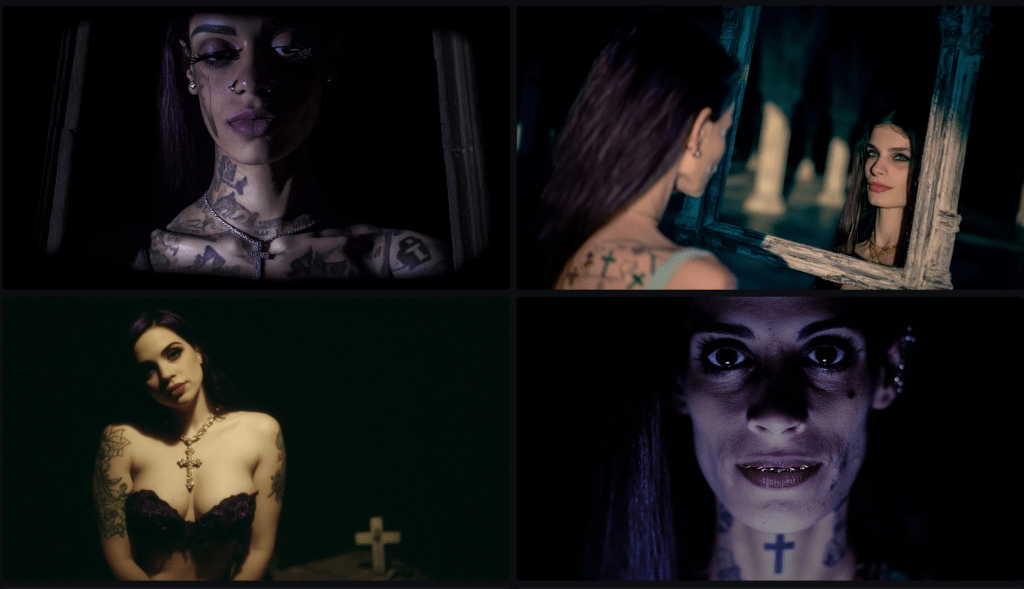
Notice that 3 of the 4 renders in the v7 set don’t even have a mirror. The top right one does, but it’s not evident that she’s a vampire. In fact, I could say that any of these are vampiresses, but perhaps that’s what they want you to believe. In place of a necklace, the lower right wokan sports a cross tattoo.

Midjourney v6.1

Image: Midjourney v6.1 render set

Again, these renders don’t appear to be vampires. The one on the lower left does appear to have snake-like fangs, so I guess I’ll give partial credit.

My next attempt was interrupted by this message.

It rendered something that might violate community guidelines. The funny thing is that one can watch the image generate in process. It only takes one “offensive” image to disqualify the whole batch.

Midjourney v6

Image: Midjourney v6 render set

Yet again, not a vampire to be found. Notice the reflection in the lower left image. Perhaps vampire reflections just behave differently.

Midjourney 5.2

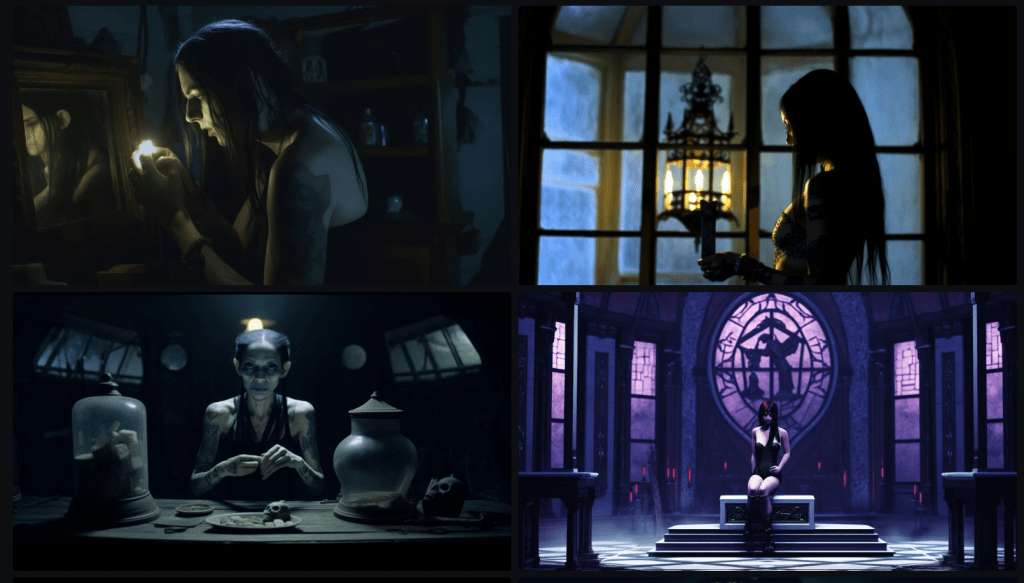
Image: Midjourney v5.2 render set

Midjourney v5.2 was a crapshoot. Somehow, I got vampire lips (?), a Wiccan, a decrepit Snape from Harry Potter lore, and Iron Maiden’s Eddy reading a book. It’s something. I’m sensing gender dysphoria. Dare I go back further?

Midjourney v5.1

Image: Midjourney v5.1 render set

It gets worse. No comments necessary. Let’s turn back the clocks even more.

Midjourney v5

Image: Midjourney v5 render set

To be fair, these all do have occult undertones, but they are weak on vampireness.

Midjourney v4

Image: Midjourney v4 render set

To be fair, the render quality isn’t as bad as I expected, but it still falls short. There’s further back to travel.

Midjourney v3

Image: Midjourney v3 render set

Some configuration parameters no longer exist. Still, I persist for the sake of art and science at the cost of time and ecology.

As much as I complain – and I complain a lot – this is how far we’ve come. As I recall, this is when I hopped onto the Midjourney bandwagon. There’s still more depth to plumb. I have no idea how much of the prompt is simply ignored at this point.

Midjourney v2

Image: Midjourney v2 render set

What the hell is this? 🤔🤣 But I’m not done yet.

Midjourney v1

Image: Midjourney v1 render set

The damned grandpappy of them all. Apparently, colour hadn’t been invented yet. You can’t tell by these thumbnails, but the resolution on these early versions approaches that of a postage stamp.

Midjourney Niji 3

Image: Midjourney Niji 3 render set

I had forgotten about the Niji models from back in the day. There were 3 versions. I don’t recall where this slotted into the chronology. Obviously, not down here. I’ve only rendered the newest one. I think this was used primarily for anime outputs, but I might be mistaken.

Bones Content 1: Video

Video: Midjourney Render of Purported Vampiress

This is a video render of the same prompt used on this page.

Bonus Content 2: Midjourney v6.1 Content from 34 weeks ago

Same prompt.

Image: Midjourney v6.1 render set (several passes)

The upper left image reminds me of Kirsten Dunst. Again, notice the female breasts, highlighting Midjourney’s censorial schizophrenia.