When drawn, this card alters perception itself. It reminds the player that truth is not something one finds under a rock but something one polishes into shape. Each metaphor becomes a spell; each keyword a crutch thrown aside.
Those who wield the Constructivist Lens see not “facts,” but fictions so useful they forgot to call them that. Reality wobbles politely to accommodate belief.
“Knowledge is not a copy of reality but a tool for coping with it.” — Richard Rorty
In game terms: Tap to reframe existence as interpretation. Duration: until the next disagreement.
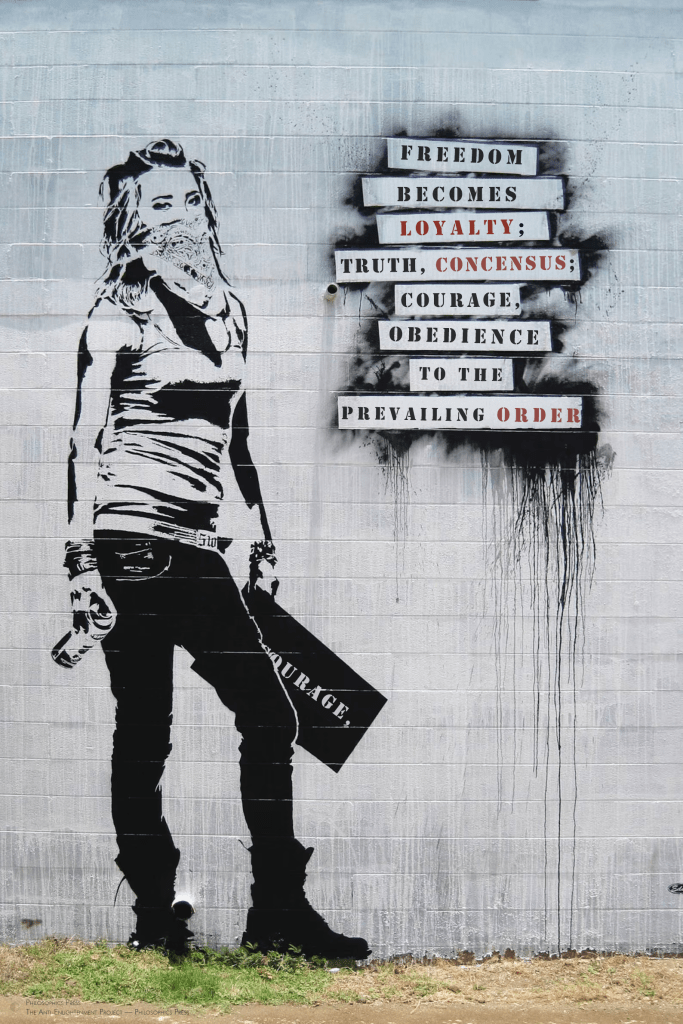
I decided to create some social media sharing content, so I appropriated this iconic graffiti and repurposed it to promote The Will to Be Ruled essay.
Image: “Freedom becomes loyalty; truth, consensus; courage, obedience to the prevailing order.”
I intend to find some pull quotes I like and continue drafting promotional material. As these are essays, I derive no income from them. I only wish to spread the word and get comments on them – supportive or detracting; it doesn’t matter.
I’ve just published Objectivity Is Illusion: An Operating Model of Social and Moral Reasoning, an essay that began as this blog post. I’m sharing the ‘official’ link and this first draft. As the essay matured, I added additional support, but I focused primarily on refuting the anticipated opposing arguments. Rather than regurgitate the final version here, I felt showing the genesis would be more instructive. Of course, the essay didn’t spring fully formed; I’ve pruned and expanded from earlier notes still sitting on my hard drive.
Every so often, I’m told I’m too slippery with words, that I treat truth as if it were just another game of persuasion, that I reduce morality to chalk lines on a playing field. The objection usually comes with force: ‘But surely you believe some things are objectively true?‘
I don’t. Or more precisely, I don’t see how ‘objectivity’ in the metaphysical sense can be defended without lapsing into stagecraft. Granite foundations have always turned out to be scaffolding with the paint touched up. Priests once told us their gods guaranteed truth; scientists later promised the lab would serve as granite; politicians assure us democracy is the stone pillar. But in each case the creaks remain.
Audio: NotebookLM podcast on this topic.
This essay is written with an academic readership in mind. It assumes familiarity with figures like Nietzsche, Foucault, Rorty, and Ayer, and with the long quarrel over subjectivity, relativity, and objectivity. My aim is not to retell those arguments from the ground up, but to position my own framework within that ongoing dispute.
Scope
Before proceeding, some guardrails. When I say ‘objectivity is illusion,’ I mean in the social and moral domain. I’m not denying quarks or mathematics. My claim is narrower: in human discourse, no truth escapes subjectivity or contingency.
This dovetails with my broader Language Insufficiency Hypothesis: that even our words are leaky vessels, prone to misfire and misunderstanding. If language itself is unstable ground, then objectivity built upon it can hardly be granite. My claim here is not that nothing exists outside us, but that in the social world we inhabit together, every ‘truth’ rests on creaking boards.
One more note: just because social administration requires appeals to objectivity doesn’t mean objectivity exists. Courts, laboratories, and parliaments invoke it to secure trust, and it works well enough as theater. But necessity is not proof. And it is not my responsibility to conjure a granite replacement. What follows is an operating model, not a new altar.
Thesis
Objectivity is an illusion. Truth is rhetorical. Morality is prescriptive, not propositional. Our ethic is not granite but care: tending the planks we walk on, knowing they creak.
Operating Model: Five Premises
This framework is not a foundation. It is an operating model – contingent, provisional, subject to revision as circumstances change. Like any model, it can (and should) be updated to fit the culture and times.
Premise 1: Subjectivity is the baseline. Every claim originates in a perspective. No statement is free of the lens through which it is made. Even to deny subjectivity is to speak from a subject.
Premise 2: Relativity is emergent. What we call ‘relative truth’ is not a separate category but the convergence of individual subjectivities into provisional consensus. Consensus is never neutral: it is formed rhetorically – through persuasion, cultural resonance, and power [1]. MacIntyre made a similar point in After Virtue. The moral consensus of the Ancients was not grounded in objectivity but in a shared tradition – a thick account of human flourishing that gave coherence to their claims. When that scaffolding collapsed, consensus fractured, leaving modern moral discourse in fragments. Critics accused MacIntyre of relativism, since different traditions yield different ‘truths’, but his point reinforces mine: what looks like objectivity is in fact the temporary overlap of subjectivities sustained by tradition [2].
Premise 3: Objectivity is illusion. Claims presented as objective are relative norms hardened by repetition and forgotten as contingent scaffolding. ‘Objectivity’ is consensus disguised as granite. Its invocation in courts or parliaments may be useful, but usefulness is not existence. The burden of proof belongs to anyone insisting on an independent, metaphysical anchor for moral or social truths (Nietzsche’s ‘mobile army of metaphors’ [3], Kuhn’s paradigms [4], Latour’s laboratories [5]).
Even if one concedes, with Weber (as MacIntyre reminds us), that objective moral truths might exist in principle, they remain inaccessible in practice. What cannot be accessed cannot guide us; reconciliation of values and virtues must therefore take place within traditions and rhetoric, not in appeal to unreachable granite [13].
Premise 4: Rhetoric establishes truth. What counts as ‘true’ in the social and moral domain is established rhetorically – through coherence, resonance, utility, or force. This does not mean truth is ‘mere spin’. It means truth is never metaphysical; it is enacted and enforced through persuasion. If a metaphysical claim convinces, it does so rhetorically. If a scientific claim holds, it does so because it persuades peers, fits the evidence, and survives testing. In short: rhetoric is the medium through which truths endure [6].
Premise 5: Non-Cognitivism, Stated Plainly. I take moral utterances to be prescriptions, not propositions. When someone says ‘X is wrong’, they are not reporting an objective fact but prescribing a stance, a rule, a line in chalk. This is my operating position: non-cognitivism (Ayer [7], Stevenson [8]).
That said, I know the term feels alien. Many prefer the dialect of subjectivism – ‘X is true-for-me but not-for-you’ – or the quasi-realist stance that moral language behaves like truth-talk without cosmic backing (Blackburn [9]). I have no quarrel with these translations. They name the same scaffolding in different accents. I am not defending any school as such; I am simply stating my plank: morality prescribes rather than describes.
Ethic: Care. Since scaffolding is all we have, the obligation is not to pretend it is stone but to keep it usable. By ‘care’, I do not mean politeness or quietism. I mean maintenance – deliberation, repair, mutual aid, even revolt – so long as they acknowledge the scaffolding we share. Care is not optional: stomp hard enough and the floor collapses beneath us all.
Examples clarify: peer review in science is care in action, patching leaky vessels rather than proving granite. Civil rights movements practiced care by repairing rotten planks of law, sometimes with revolt. Communities rebuilding after disaster embody care by reconstructing scaffolding, not pretending it was indestructible. Care is maintenance, reciprocity, and survival.
Bridge: These five premises do not add up to a system or a foundation. They form an operating model: subjectivity as baseline, relativity as emergent, objectivity as illusion, rhetoric as truth, morality as prescription. Together they outline a practice: walk the planks with care, admit the creaks, patch where needed, and stop pretending we live in marble halls.
Rationale
Why prefer scaffolding to granite? Because granite has always been a mirage. The history of philosophy and politics is a history of crumbling temples and collapsing empires. The promises of permanence never survive the weather.
Think of Nietzsche, who called truths ‘a mobile army of metaphors’ [3]. Think of Foucault, who showed that what counts as ‘truth’ is always bound up with power [1]. Think of Rorty, who reduced truth to what our peers let us get away with saying [6]. These are not nihilists but diagnosticians: they exposed the creaks in the floorboards and the wizard behind the curtain.
Metaphors drive the point home:
Scaffolding and granite: What holds is temporary, not eternal. Granite is an illusion painted on timber.
Chalk lines: Rules of play – binding, real, but contingent. They can be redrawn.
Shoreline houses: Rome, the USSR, the British Empire – each built like beachfront villas with a fine view and bad footing. Storms came, sand eroded, and down they went.
Bias as framing: Kahneman himself admitted ‘bias’ is not a thing in the world [10], only a deviation from a chosen model. Gigerenzer [11] and Jared Peterson [12] remind us heuristics are adaptive. To call them ‘biases’ is not neutral – it’s allegiance to a standard of rationality.
The point is simple: what holds today is scaffolding, and pretending otherwise is self-deception.
Counterarguments and Refutations
Objection: Moral Paralysis. Without objective morality, why abolish slavery or defend rights?
Refutation: Chalk lines still bind. Speed limits aren’t cosmic, but they regulate conduct. Abolition endured not because it tapped a cosmic truth but because it persuaded, resonated, and took root. Slavery was once ‘in bounds’. Now it is ‘offsides’. That shift was rhetorical, emotional, political – but no less binding.
Objection: Problem of Dissent. If all is subjective, the lone dissenter is ‘just another voice’.
Refutation: Dissent gains traction through coherence, predictive success, or resonance. Galileo, abolitionists, suffragists – none relied on metaphysical granite. They persuaded, they resonated, they moved chalk lines. Truth was made through rhetoric, not uncovered in stone.
Objection: Performative Dependency. Even to say ‘subjective’ assumes the subject/object split. Aren’t you still inside the house?
Refutation: Of course. But I’m the one pointing at the slippery boards: ‘Mind the dust’. Yes, I’m in the house. But I refuse to pretend it’s marble. And even the category ‘subject’ is not eternal – it’s porous, dynamic, and leaky, just like language itself.
Objection: Infinite Regress. Why stop at subjectivity? Why not de-integrate further?
Refutation: Subjectivity is not granite, but it is the last plank before void. Peel it back and you erase the possibility of claims altogether. If tomorrow we discover that the ‘subject’ is a swarm of quarks or circuits, fine – but the claim still emerges from some locus. Regression refines; it doesn’t disprove.
Conclusion: The Ethic of Care
This is not reintegration. It is dis-integration: naming the creaks, stripping polyvinyl from rotten boards, refusing granite illusions.
If you wish to build here, build. But know the ground shifts, the storms come, the shoreline erodes. The ethic is not certainty but care: to tend the scaffolding we share, to patch without pretending it is stone, and to let dissent itself become part of the maintenance.
“Truths are illusions which we have forgotten are illusions.” — Nietzsche
Declaring the Problem
Most people say truth as if it were oxygen – obvious, necessary, self-evident. I don’t buy it.
Nietzsche was blunt: truths are illusions. My quarrel is only with how often we forget that they’re illusions.
Most people say truth as if it were oxygen – obvious, necessary, self-evident. I don’t buy it.
My own stance is unapologetically non-cognitivist. I don’t believe in objective Truth with a capital T. At best, I see truth as archetypal – a symbol humans invoke when they need to rally, persuade, or stabilise. I am, if you want labels, an emotivist and a prescriptivist: I’m drawn to problems because they move me, and I argue about them because I want others to share my orientation. Truth, in this sense, is not discovered; it is performed.
The Illusion of Asymptotic Progress
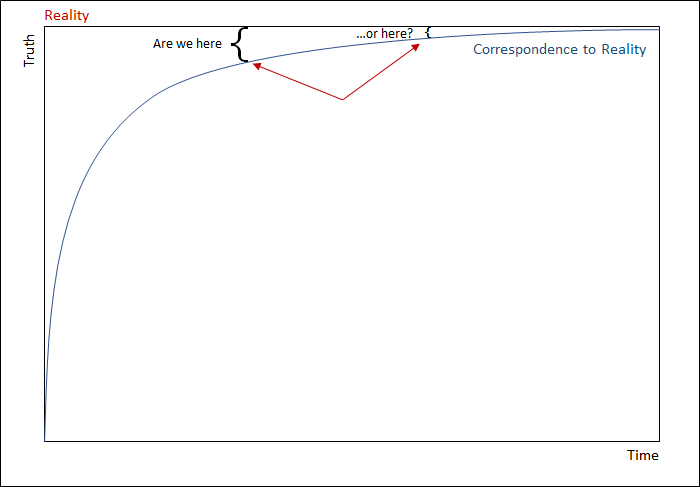
The standard story is comforting: over time, science marches closer and closer to the truth. Each new experiment, each new refinement, nudges us toward Reality, like a curve bending ever nearer to its asymptote.
Chart 1: The bedtime story of science: always closer, never arriving.
This picture flatters us, but it’s built on sand.
Problem One: We have no idea how close or far we are from “Reality” on the Y-axis. Are we brushing against it, or still a light-year away? There’s no ruler that lets us measure our distance.
Problem Two: We can’t even guarantee that our revisions move us toward rather than away from it. Think of Newton and Einstein. For centuries, Newton’s physics was treated as a triumph of correspondence—until relativity reframed it as local, limited, provisional. What once looked like a step forward can later be revealed as a cul-de-sac. Our curve may bend back on itself.
Use Case: Newton, Einstein, and Gravity Take gravity. For centuries, Newton’s laws were treated as if they had brought us into near-contact with Reality™—so precise, so predictive, they had to be true. Then Einstein arrives, reframes gravity not as a force but as the curvature of space-time, and suddenly Newton’s truths are parochial, a local approximation. We applauded this as progress, as if our asymptote had drawn tighter to Reality. But even Einstein leaves us with a black box: we don’t actually know what gravity is, only how to calculate its effects. Tomorrow another paradigm may displace relativity, and once again we’ll dutifully rebrand it as “closer to truth.” Progress or rhetorical re-baptism? The graph doesn’t tell us.
Chart 2: The comforting myth of correspondence: scientific inquiry creeping ever closer to Reality™, though we can’t measure the distance—or even be sure the curve bends in the right direction.
Thomas Kuhn was blunt about this: what we call “progress” is less about convergence and more about paradigm shifts, a wholesale change in the rules of the game. The Earth does not move smoothly closer to Truth; it lurches from one orthodoxy to another, each claiming victory. Progress, in practice, is rhetorical re-baptism.
Most defenders of the asymptotic story assume that even if progress is slow, it’s always incremental, always edging us closer. But history suggests otherwise. Paradigm shifts don’t just move the line higher; they redraw the entire curve. What once looked like the final step toward truth may later be recast as an error, a cul-de-sac, or even a regression. Newton gave way to Einstein; Einstein may yet give way to something that renders relativity quaint. From inside the present, every orthodoxy feels like progress. From outside, it looks more like a lurch, a stumble, and a reset.
Chart 3: The paradigm-gap view: what feels like progress may later look like regression. History suggests lurches, not lines, what we call progress today is tomorrow’s detour..
If paradigm shifts can redraw the entire map of what counts as truth, then it makes sense to ask what exactly we mean when we invoke the word at all. Is truth a mirror of reality? A matter of internal coherence? Whatever works? Or just a linguistic convenience? Philosophy has produced a whole menu of truth theories, each with its own promises and pitfalls—and each vulnerable to the same problems of rhetoric, context, and shifting meanings.
The Many Flavours of Truth
Philosophers never tire of bottling “truth” in new vintages. The catalogue runs long: correspondence, coherence, pragmatic, deflationary, redundancy. Each is presented as the final refinement, the one true formulation of Truth, though each amounts to little more than a rhetorical strategy.
Correspondence theory: Truth is what matches reality. Problem: we can never measure distance from “Reality™” itself, only from our models.
Coherence theory: Truth is what fits consistently within a web of beliefs. Problem: many mutually incompatible webs can be internally consistent.
Pragmatic theory: Truth is what works. Problem: “works” for whom, under what ends? Functionality is always perspectival.
Deflationary / Minimalist: Saying “it’s true that…” adds nothing beyond the statement itself. Problem: Useful for logic, empty for lived disputes.
Redundancy / Performative: “It is true that…” adds rhetorical force, not new content. Problem: truth reduced to linguistic habit.
And the common fallback: facts vs. truths. We imagine facts as hard little pebbles anyone can pick up. Hastings was in 1066; water boils at 100°C at sea level. But these “facts” are just truths that have been successfully frozen and institutionalised. No less rhetorical, only more stable.
So truth isn’t one thing – it’s a menu. And notice: all these flavours share the same problem. They only work within language-games, frameworks, or communities of agreement. None of them delivers unmediated access to Reality™.
Truth turns out not to be a flavour but an ice cream parlour – lots of cones, no exit.
Multiplicity of Models
Even if correspondence weren’t troubled, it collapses under the weight of underdetermination. Quine and Duhem pointed out that any body of evidence can support multiple competing theories.
Chart 4: orthodox vs. heterodox curves, each hugging “reality” differently
Hilary Putnam pushed it further with his model-theoretic argument: infinitely many models could map onto the same set of truths. Which one is “real”? There is no privileged mapping.
Conclusion: correspondence is undercut before it begins. Truth isn’t a straight line toward Reality; it’s a sprawl of models, each rhetorically entrenched.
Truth as Rhetoric and Power
This is where Orwell was right: “War is Peace, Freedom is Slavery, Ignorance is Strength.”
Image: INGSOC logo
Truth, in practice, is what rhetoric persuades.
Michel Foucault stripped off the mask: truth is not about correspondence but about power/knowledge. What counts as truth is whatever the prevailing regime of discourse allows.
We’ve lived it:
“The economy is strong”, while people can’t afford rent.
“AI will save us”, while it mainly writes clickbait.
“The science is settled” until the next paper unsettles it.
These aren’t neutral observations; they’re rhetorical victories.
Truth as Community Practice
Chart 5: Margin of error bands
Even when rhetoric convinces, it convinces in-groups. One group converges on a shared perception, another on its opposite. Flat Earth and Round Earth are both communities of “truth.” Each has error margins, each has believers, each perceives itself as edging toward reality.
Wittgenstein reminds us: truth is a language game. Rorty sharpens it: truth is what our peers let us get away with saying.
So truth is plural, situated, and always contested.
Evolutionary and Cognitive Scaffolding
Step back, and truth looks even less eternal and more provisional.
We spread claims because they move us (emotivism) and because we urge others to join (prescriptivism). Nietzsche was savage about it: truth is just a herd virtue, a survival trick.
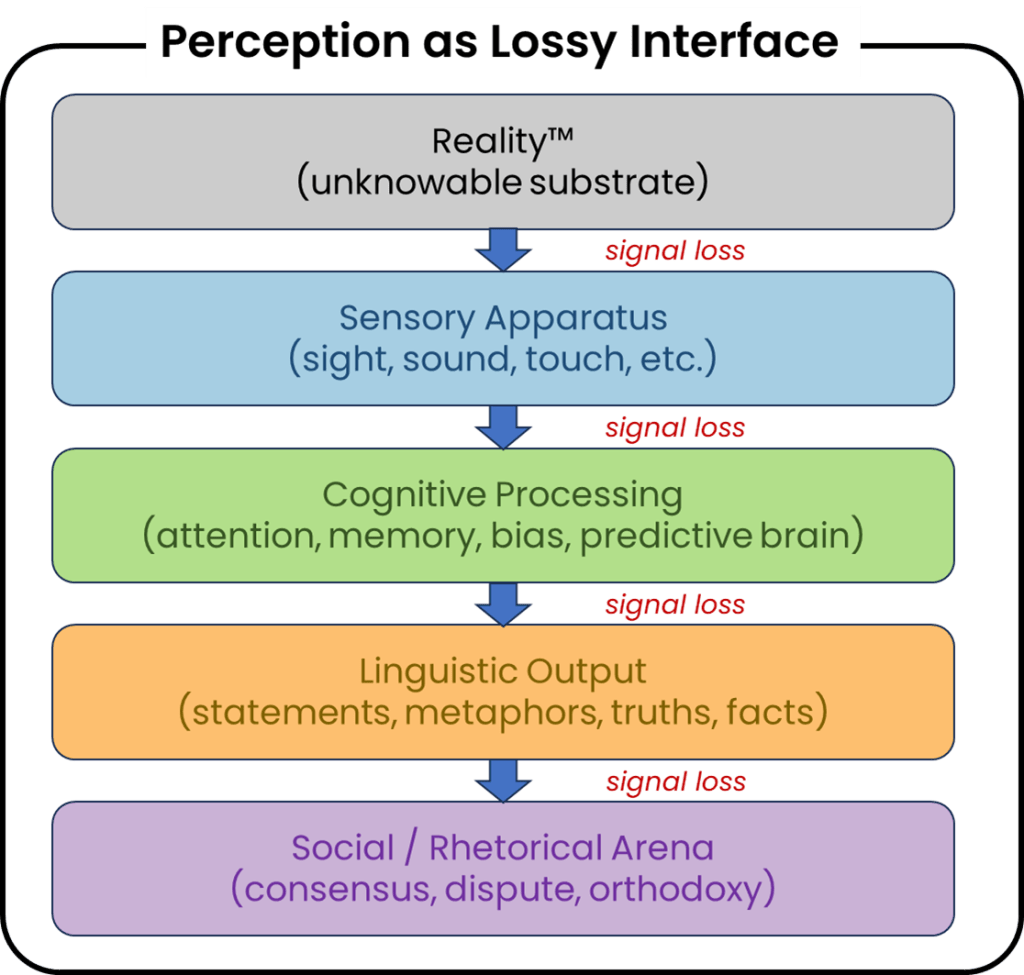
Cognitive science agrees, if in a different language: perception is predictive guesswork, riddled with biases, illusions, and shortcuts. Our minds don’t mirror reality; they generate useful fictions.
Diagram: Perception as a lossy interface: Reality™ filtered through senses, cognition, language, and finally rhetoric – signal loss at every stage.
Archetypal Truth (Positive Proposal)
So where does that leave us? Not with despair, but with clarity.
Truth is best understood as archetypal – a construct humans rally around. It isn’t discovered; it is invoked. Its force comes not from correspondence but from resonance.
Here, my own Language Insufficiency Hypothesis bites hardest: all our truth-talk is approximation. Every statement is lossy compression, every claim filtered through insufficient words. We can get close enough for consensus, but never close enough for Reality.
Truth is rhetorical, communal, functional. Not absolute.
The Four Pillars (Manifesto Form)
Archetypal – truth is a symbolic placeholder, not objective reality.
Asymptotic – we gesture toward reality but never arrive.
Rhetorical – what counts as truth is what persuades.
Linguistically Insufficient – language guarantees slippage and error.
Closing
Nietzsche warned, Rorty echoed: stop fetishising Truth. Start interrogating the stories we tell in its name.
Every “truth” we now applaud may be tomorrow’s embarrassment. The only honest stance is vigilance – not over whether we’ve captured Reality™, but over who gets to decide what is called true, and why.
Truth has never been a mirror. It’s a mask. The only question worth asking is: who’s wearing it?
Nothing says “I’ve stopped thinking” quite like someone waving the banner of Truth. The word itself, when capitalised and flapped about like a holy relic, isn’t a signal of wisdom but of closure. A red flag.
The short video by Jonny Thompson that inspired this post.
Those who proclaim to “speak the Truth” or “know the Truth”rarely mean they’ve stumbled upon a tentative insight awaiting refinement. No, what they mean is: I have grasped reality in its totality, and—surprise!—it looks exactly like my prejudices. It’s the epistemic equivalent of a toddler declaring ownership of the playground by drooling on the swings.
The Fetish of Objectivity
The conceit is that Truth is singular, objective, eternal, a monolithic obelisk towering over human folly. But history’s scrapyard is full of such obelisks, toppled and broken: phlogiston, bloodletting, Manifest Destiny, “the market will regulate itself.” Each was once trumpeted as capital-T Truth. Each is now embarrassing clutter for the dustbin.
Still, the zealots never learn. Every generation delivers its own batch of peddlers, flogging their version of Truth as if it were snake oil guaranteed to cure ignorance and impotence. (Side effects may include dogmatism, authoritarianism, and an inability to read the room.)
Why It’s a Red Flag
When someone says, “It’s just the truth”, what they mean is “, I am not listening,” like the parent who argues, “because I said so.” Dialogue is dead; curiosity cremated. Truth, in their hands, is less a lantern than a cosh. It is wielded not to illuminate, but to bludgeon.
Ralph Waldo Emerson’s voice breaks in, urging us to trust ourselves and to think for ourselves. Nothing is more degrading than to borrow another’s convictions wholesale and parade them as universal law. Better to err in the wilderness of one’s own reason than to be shepherded safely into another man’s paddock of certainties.
A Better Alternative
Rather than fetishising Truth, perhaps we ought to cultivate its neglected cousins: curiosity, provisionality, and doubt. These won’t look as good on a placard, admittedly. Picture a mob waving banners emblazoned with Ambiguity! – not exactly the stuff of revolutions. But infinitely more honest, and infinitely more humane.
So when you see someone waving the flag of Truth, don’t salute. Recognise it for what it is: a warning sign. Proceed with suspicion, and for God’s sake, bring Emerson.
Post-COVID, we’re told trust in science is eroding. But perhaps the real autopsy should be performed on the institution of public discourse itself.
Since the COVID-19 crisis detonated across our global stage—part plague, part PR disaster—the phrase “trust in science” has become the most abused slogan since “thoughts and prayers.” Every public official with a podium and a pulse declared they were “following the science,” as if “science” were a kindly oracle whispering unambiguous truths into the ears of the righteous. But what happened when those pronouncements proved contradictory, politically convenient, or flat-out wrong? Was it science that failed, or was it simply a hostage to an incoherent performance of authority?
Audio: NotebookLM podcast discussing this topic.
Two recent Nature pieces dig into the supposed “decline” of scientific credibility in the post-pandemic world, offering the expected hand-wringing about public opinion and populist mistrust. But let’s not be so credulous. This isn’t merely a crisis of trust—it’s a crisis of theatre.
“The Science” as Ventriloquism
Let’s begin by skewering the central absurdity: there is no such thing as “The Science.” Science is not a monolith. It’s not a holy writ passed down by lab-coated Levites. It’s a process—a messy, iterative, and perpetually provisional mode of inquiry. But during the pandemic, politicians, pundits, and even some scientists began to weaponise the term, turning it into a rhetorical cudgel. “The Science says” became code for “shut up and comply.” Any dissent—even from within the scientific community—was cast as heresy. Galileo would be proud.
In Nature Human Behaviour paper (van der Linden et al., 2025) identifies four archetypes of distrust: distrust in the message, the messenger, the medium, and the motivation. What they fail to ask is: what if all four were compromised simultaneously? What if the medium (mainstream media) served more as a stenographer to power than a check upon it? What if the message was oversimplified into PR slogans, the messengers were party apparatchiks in lab coats, and the motivations were opaque at best?
Trust didn’t just erode. It was actively incinerated in a bonfire of institutional vanity.
A Crisis of Influence, Not Integrity
The second Nature commentary (2025) wrings its hands over “why trust in science is declining,” as if the populace has suddenly turned flat-Earth overnight. But the real story isn’t a decline in trust per se; it’s a redistribution of epistemic authority. Scientists no longer have the stage to themselves. Influencers, conspiracy theorists, rogue PhDs, and yes—exhausted citizens armed with Wi-Fi and anxiety—have joined the fray.
Science hasn’t lost truth—it’s lost control. And frankly, perhaps it shouldn’t have had that control in the first place. Democracy is messy. Information democracies doubly so. And in that mess, the epistemic pedestal of elite scientific consensus was bound to topple—especially when its public face was filtered through press conferences, inconsistent policies, and authoritarian instincts.
Technocracy’s Fatal Hubris
What we saw wasn’t science failing—it was technocracy failing in real time, trying to manage public behaviour with a veneer of empirical certainty. But when predictions shifted, guidelines reversed, and public health policy began to resemble a mood ring, the lay public was expected to pretend nothing happened. Orwell would have a field day.
This wasn’t a failure of scientific method. It was a failure of scientific messaging—an inability (or unwillingness) to communicate uncertainty, probability, and risk in adult terms. Instead, the public was infantilised. And then pathologised for rebelling.
Toward a Post-Scientistic Public Sphere
So where does that leave us? Perhaps we need to kill the idol of “The Science” to resurrect a more mature relationship with scientific discourse—one that tolerates ambiguity, embraces dissent, and admits when the data isn’t in. Science, done properly, is the art of saying “we don’t know… yet.”
The pandemic didn’t erode trust in science. It exposed how fragile our institutional credibility scaffolding really is—how easily truth is blurred when science is fed through the meat grinder of media, politics, and fear.
The answer isn’t more science communication—it’s less scientism, more honesty, and above all, fewer bureaucrats playing ventriloquist with the language of discovery.
Conclusion
Trust in science isn’t dead. But trust in those who claim to speak for science? That’s another matter. Perhaps it’s time to separate the two.
Medical doctors, lawyers, and judges have been the undisputed titans of professional authority for centuries. Their expertise, we are told, is sacrosanct, earned through gruelling education, prodigious memory, and painstaking application of established knowledge. But peel back the robes and white coats, and you’ll find something unsettling: a deep reliance on rote learning—an intellectual treadmill prioritising recall over reasoning. In an age where artificial intelligence can memorise and synthesise at scale, this dependence on predictable, replicable processes makes these professions ripe for automation.
Rote Professions in AI’s Crosshairs
AI thrives in environments that value pattern recognition, procedural consistency, and brute-force memory—the hallmarks of medical and legal practice.
Medicine: The Diagnosis Factory Despite its life-saving veneer, medicine is largely a game of matching symptoms to diagnoses, dosing regimens, and protocols. Enter an AI with access to the sum of human medical knowledge: not only does it diagnose faster, but it also skips the inefficiencies of human memory, emotional bias, and fatigue. Sure, we still need trauma surgeons and such, but diagnosticians are so yesterday’s news. Why pay a six-figure salary to someone recalling pharmacology tables when AI can recall them perfectly every time? Future healthcare models are likely to see Medical Technicians replacing high-cost doctors. These techs, trained to gather patient data and operate alongside AI diagnostic systems, will be cheaper, faster, and—ironically—more consistent.
Law: The Precedent Machine Lawyers, too, sit precariously on the rote-learning precipice. Case law is a glorified memory game: citing the right precedent, drafting contracts based on templates, and arguing within frameworks so well-trodden that they resemble legal Mad Libs. AI, with its infinite recall and ability to synthesise case law across jurisdictions, makes human attorneys seem quaintly inefficient. The future isn’t lawyers furiously flipping through books—it’s Legal Technicians trained to upload case facts, cross-check statutes, and act as intermediaries between clients and the system. The $500-per-hour billable rate? A relic of a pre-algorithmic era.
Judges: Justice, Blind and Algorithmic The bench isn’t safe, either. Judicial reasoning, at its core, is rule-based logic applied with varying degrees of bias. Once AI can reliably parse case law, evidence, and statutes while factoring in safeguards for fairness, why retain expensive and potentially biased judges? An AI judge, governed by a logic verification layer and monitored for compliance with established legal frameworks, could render verdicts untainted by ego or prejudice. Wouldn’t justice be more blind without a human in the equation?
The Techs Will Rise
Replacing professionals with AI doesn’t mean removing the human element entirely. Instead, it redefines roles, creating new, lower-cost positions such as Medical and Legal Technicians. These workers will:
Collect and input data into AI systems.
Act as liaisons between AI outputs and human clients or patients.
Provide emotional support—something AI still struggles to deliver effectively.
The shift also democratises expertise. Why restrict life-saving diagnostics or legal advice to those who can afford traditional professionals when AI-driven systems make these services cheaper and more accessible?
But Can AI Handle This? A Call for Logic Layers
AI critics often point to hallucinations and errors as proof of its limitations, but this objection is shortsighted. What’s needed is a logic layer: a system that verifies whether the AI’s conclusions follow rationally from its inputs.
In law, this could ensure AI judgments align with precedent and statute.
In medicine, it could cross-check diagnoses against the DSM, treatment protocols, and patient data.
A second fact-verification layer could further bolster reliability, scanning conclusions for factual inconsistencies. Together, these layers would mitigate the risks of automation while enabling AI to confidently replace rote professionals.
Resistance and the Real Battle Ahead
Predictably, the entrenched elites of medicine, law, and the judiciary will resist these changes. After all, their prestige and salaries are predicated on the illusion that their roles are irreplaceable. But history isn’t on their side. Industries driven by memorisation and routine application—think bank tellers, travel agents, and factory workers—have already been disrupted by technology. Why should these professions be exempt?
The real challenge lies not in whether AI can replace these roles but in public trust and regulatory inertia. The transformation will be swift and irreversible once safeguards are implemented and AI earns confidence.
Critical Thinking: The Human Stronghold
Professions that thrive on unstructured problem-solving, creativity, and emotional intelligence—artists, philosophers, innovators—will remain AI-resistant, at least for now. But the rote professions, with their dependency on standardisation and precedent, have no such immunity. And that is precisely why they are AI’s lowest-hanging fruit.
It’s time to stop pretending that memorisation is intelligence, that precedent is innovation, or that authority lies in a gown or white coat. AI isn’t here to make humans obsolete; it’s here to liberate us from the tyranny of rote. For those willing to adapt, the future looks bright. For the rest? The machines are coming—and they’re cheaper, faster, and better at your job.
Welcome to Part 2 of a Week-Long Series on the Evolution and Limits of Language! This article is part of a seven-day exploration into the fascinating and often flawed history of language – from its primitive roots to its tangled web of abstraction, miscommunication, and modern chaos. Each day, we uncover new layers of how language shapes (and fails to shape) our understanding of the world.
If you haven’t yet, be sure to check out the other posts in this series for a full deep dive into why words are both our greatest tool and our biggest obstacle. Follow the journey from ‘flamey thing hot’ to the whirlwind of social media and beyond!
Saussure and the Signified: Words as Slippery Symbols
Fast-forward a few thousand years, and humans are no longer just warning each other about hot flames or toothy predators. We’ve moved on to the exciting world of abstract thought, but the language tools we’re using haven’t quite caught up. Enter Ferdinand de Saussure, who basically waltzed in to tell us, ‘Hey, all those words you’re throwing around? They’re not doing what you think they’re doing.’
Saussure gave us the idea of the signifier and the signified. Now, don’t let the fancy terms fool you. It’s just a way of pointing out that when we say ‘tree’, we’re not actually talking about a tree. No, we’re using the word ‘tree’ as a symbol – a signifier – that points to the idea of a tree. The signified is the actual concept of ‘tree-ness’ floating around in your brain. But here’s the kicker: everyone’s idea of a tree is a little different.
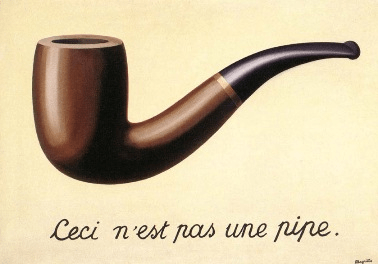
And this isn’t just a language problem – it’s an art problem too. Enter René Magritte, the surrealist artist who really drove this point home with his famous painting, Ceci n’est pas une pipe (‘This is not a pipe’). At first glance, it looks like a straightforward picture of a pipe, but Magritte was making a deeper point. It’s not actually a pipe – it’s an image of a pipe, a representation. You can’t stuff it with tobacco and smoke it, because what you’re looking at is a representation, not the real thing.
In the same way, when we use words, we’re not talking about the thing itself – we’re just waving a flag toward the concept of that thing. So, when you say ‘tree’, you’re really saying ceci n’est pas un arbre – this is not a tree. It’s just a word, a placeholder, a verbal painting of something real. And just like Magritte’s pipe, it’s easy to get confused. You might think you’re talking about the same tree, or the same ‘freedom’, but all you’ve got is a symbol – and everyone’s symbol looks a little different.
This is where things start to unravel. Words are slippery symbols, and as soon as we move away from concrete, physical objects – like trees or, yes, pipes – and into abstract ideas, like ‘justice’ or ‘truth’, the symbols become even harder to hold onto. The cracks in language start to widen, and before you know it, you’re no longer even sure if you’re talking about the same concept at all.
Language, Saussure argues, isn’t this neat, objective system we thought it was. It’s a game we’re playing, and the rules are written in invisible ink. By the time we get to abstract nouns, we’re basically playing with loaded dice. You think you’re communicating clearly, but every word you use is just a placeholder for the idea you hope the other person has in their head. And nine times out of ten? They don’t.
So, while early humans were struggling to agree on the ‘flamey thing’, we’re here trying to agree on concepts that are infinitely more complicated. And Saussure? He’s just sitting in the corner with a smirk, telling us we never had control over language in the first place. “Good luck with your ‘truth'”, he seems to be saying. ‘I’m sure it’ll mean the same thing to everyone’.
Abstraction: Enter Freedom, Truth, and Confusion
Now that we’ve wrapped our heads around the fact that words are nothing but slippery symbols, let’s take it up a notch. You thought ‘tree’ was tricky? Try something more abstract. Enter: freedom, truth, justice. Things that can’t be seen, touched, or stuffed into a pipe. Here’s where language goes from being slippery to downright treacherous.
See, early language worked because it was tied to concrete things. ‘Toothey thing scary’ wasn’t up for debate. Either you got eaten, or you didn’t. Simple. But then humans, ever the overachievers, decided it wasn’t enough to just label the world around them. They wanted to label ideas, too – things that don’t have any physical form but somehow drive us all crazy.
Take ‘freedom’, for instance. Sounds nice, right? Except, if you ask ten people what it means, you’ll get ten different answers. For some, it’s ‘freedom from’ something – a kind of liberation. For others, it’s ‘freedom to’ do whatever you want, whenever you want. And yet for others, it’s an abstract ideal tied up in political philosophy. Suddenly, you’re not just dealing with different trees – you’re dealing with entirely different forests.
The same goes for truth. Is it objective? Subjective? Relative? Absolute? Everyone’s got a different take. Plato had his own grand ideas about ‘Truth’ with a capital T, while Nietzsche basically rolled his eyes and said, ‘Good luck with that’. You’re out here using the word, assuming it means the same thing to everyone else, but really you’re all just talking past each other.
And don’t even get started on justice. Some say it’s about fairness, others say it’s about the law, and still others think it’s just a nice idea for dinner party debates. The problem with these words – these abstract nouns – is that they represent ideas that live entirely in our heads. Unlike the ‘flamey thing’ or the ‘toothey thing’, there’s no physical reality to pin them to. There’s no universally agreed-upon image of ‘freedom’ that we can all point to and nod along, like Magritte’s pipe. There’s just… vague agreement. Sometimes. On a good day.
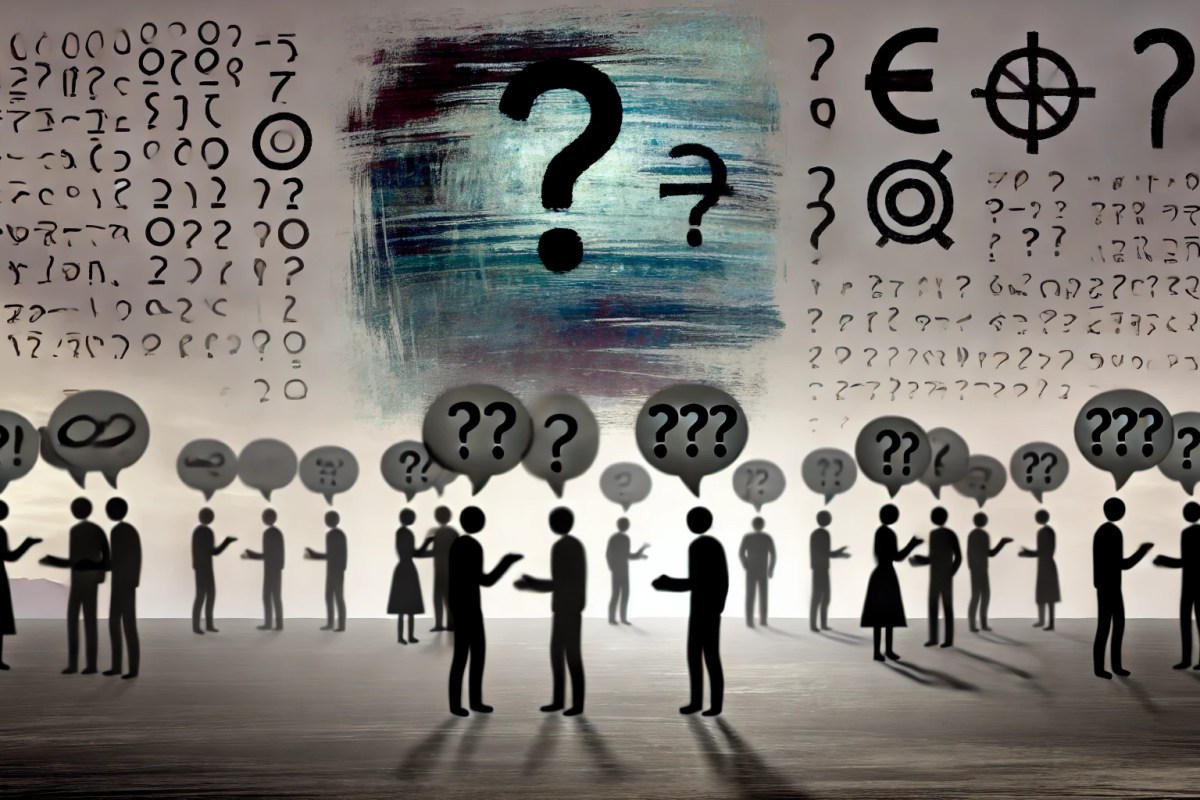
This is where language really starts to break down. You might think you’re having a productive conversation about ‘freedom’ or ‘truth’, but half the time, you’re speaking different languages without even realising it. Words like these aren’t just slippery – they’re shapeshifters. They bend and morph depending on who’s using them, when, and why.
So, while early humans were busy with their simple, effective ‘toothey thing scary’, we’re now trying to nail down ideas that refuse to be nailed down. What started as a useful survival tool has turned into a game of philosophical Twister, with everyone tied up in knots trying to define something they can’t even see. And, as usual, language is just standing in the corner, smirking, knowing full well it’s not up to the task.
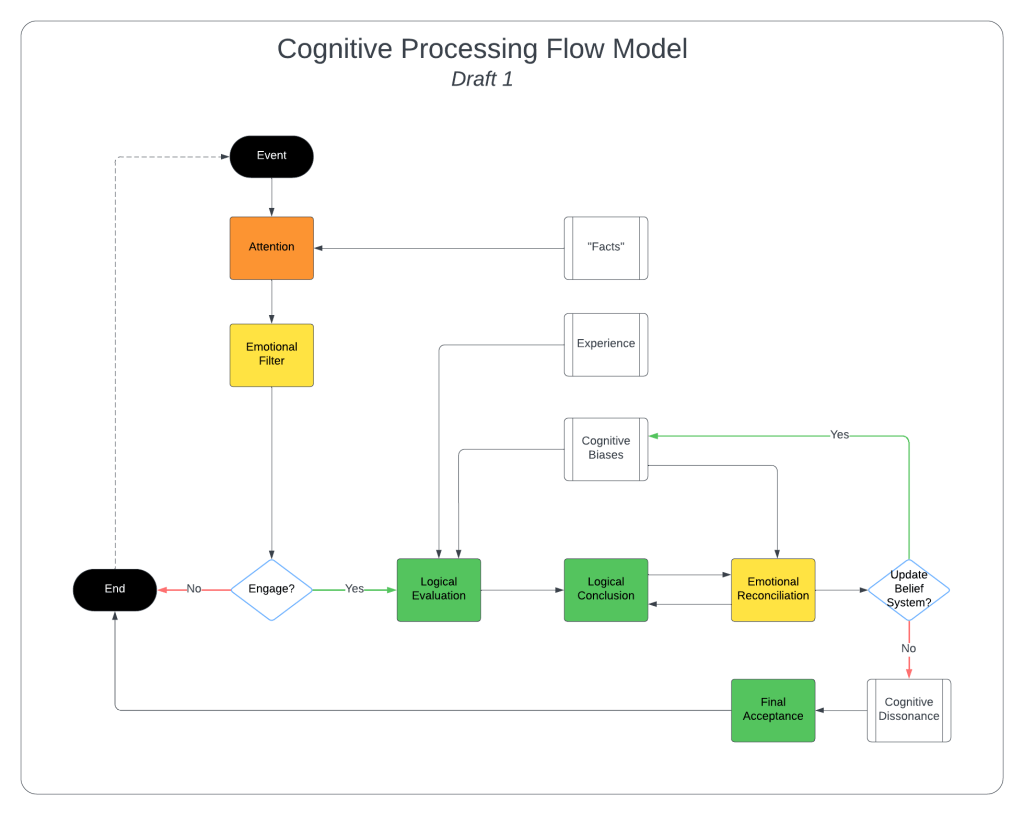
The Cognitive Process Flow Model illustrates how we process the phenomenal world. It’s reductionist and is missing aspects because it is just a back-of-the-napkin sketch. I created it because I uttered, “I can model it for you”. And so I did.
EDIT: I’ve updated the model slightly as the article head image, but the copy content refers to the first draft.
My response was to a person making the claim, that all you need to facts and logic prevails. Rather than restate the argument, I’ll just walk through the diagramme.
There’s meta information to set it up. We are subjective entities in the world. We have a sense-perception apparatus as we exist in it. Countless events occur in this world. We recognise only a few of them within our limited range, though technology expands this range in various ways.
Most of us interact in the world. Some are less ambulatory, so the world visits them. Some have sense-perception deficits whilst others have cognitive deficits. My point is not to capture every edge and corner case. This is just a generalised model.
All models are wrong, but some are useful.
—George Box
It starts with an event. Events occur ceaselessly. In our small portion of the world and elsewhere. For the purpose of the model, the first thing that happens is an event catches our attention. We might notice a shape, a colour, or a movement; we might hear a sound, smell an aroma, feel a sensation, or taste something.
A pre-emotion, pre-logic function serves to process these available inputs. Perhaps, you hear a report on anthropogenic climate change or read something about a political candidate. This emotional filter will police sensory inputs and unconsciously or preconsciously determine if you will react to the initial stimulus. If not, you’ll continue in an attention-seeking loop. Not that kind of attention-seeking.
As my dialogue was about the presentation of facts, our next stop will be logical evaluation. Does this make sense to us, or can we otherwise make it? This is a process in itself. I’ll assume here that it requires little elaboration. Instead, I’ll focus on the operating environment.
Our logical processes are coloured by past experiences and tainted by cognitive biases and deficits. We may also trigger the calling of additional facts through past experiences or the current engagement.
We’ll process these fragments and reach some logical conclusion. But we’re not done. We take this intermediate conclusion and run it through more emotional processing. Cognitive biases come back into play. If the event conforms with your past experiences and cognitive biases, we may run it through a cognitive dissonance routine. To be honest, this probably is part of the emotional reconciliation process, but I’ve drawn it here, so I’ll let it be. In this case, it’s just a filter. If it happens to conform to our belief system, it will pass unfettered; otherwise, it will be squared with our beliefs. Again, this leads me to believe it’s a subcomponent of emotional reconciliation. I’ll update the chart later.
In any case, we’ll end at Final Acceptance. This acceptance may be that we accept or reject the logic, but we arrive at an opinion that gets catalogued with the rest of them. Some may be elevated to facts or truths in the epistemological hierarchy. Although an end marker is identified, it’s really a wait state for the next event. Rinse and repeat until death.
I’ll update this presently. Be on the lookout. It could include more dimensions and interactions, but that might have to wait until version 3.
Meantime, does this feel right to you? Did it even get your attention?
An Example: Anthropogenic Climate Change
Let’s wrap up with an example. I’ll use climate change. An article comes into your attention field, and you have an interest in these things, so it passes through the emotional filter. If your propensity for these articles is high, it might race to the next stage.
You read the article, and it contains some facts—rather, it contains claims for evaluation. To do this, you’ll recall past experiences and cognitive biases are always lying in wait. You may have to look for new facts to add to the mix. These will have to take a similar route past your attention gatekeeper and emotional sidekick.
If you are already predisposed that climate change is a hoax, these facts will filter through that lens—or vice versa.
When all of this is resolved, you’ll have arrived at a conclusion—perhaps we’ll call it a proto-conclusion. It hasn’t been set yet.
You are still going to introspect emotionally and decide if this is a position you want to hold. Perhaps, you feel that climate change is a hoax but this doesn’t jive with that position. Here, you’ll either accept these facts and flip a bit to a sceptical believer or cognitive dissonance will kick in and ensure your sense of the world isn’t thrown off kilter. You may update your belief system to include this datum for future assessments.
Now we are ready for final acceptance. You can now express your established opinion. If the net event is to counter that acceptance, rinse and repeat ad infinitum.
The topic of this video touches upon my insufficiency of language thesis. Tim Maudlin defends language realism but only to the extent that ‘we can use it to describe the world and that some of those descriptions are true’.
Video: Does Language Describe Reality? (IAI)
The challenge, then, is determining which descriptions are true. I’ve discussed a couple of my positions on this.
The Truth About Truth
Firstly, we can only perceive what is true as we have no access to absolute truth. The best we can achieve is an asymptotic function approaching truth, a notion that resonates with Hilary Putnam’s concept of internal realism (pdf). Putnam argues that truth is not a matter of correspondence with a mind-independent reality but is instead tied to our conceptual schemes. This means that what we consider “true” is always shaped by the language and concepts we use, making our understanding inherently partial and context-dependent. Even then, we have no way to determine how close to truth our perception is. It just has to feel true—an idea that aligns with Putnam’s pragmatic conception of truth, where truth is something that emerges from our practices and inquiries, rather than being a fixed point we can definitively reach. In terms of physics, this underlying reality may be relatively more stable than abstract concepts, which are ephemeral and shifting sands.
The Rhetoric of Truth
Secondly, given that we have no access to objective truth, we can only expect subjective or relative truths. This brings us to Putnam’s critique of the metaphysicalcorrespondence theory of truth. According to Putnam, the idea that language can perfectly correspond to an external reality is flawed. Instead, truth is what can be justified within a particular conceptual framework, making all truth somewhat relative. This leaves us open to rhetoric—the more convincing argument wins, regardless of whether it reflects an objective reality. In fact, as Putnam’s ideas suggest, the most persuasive argument might favour an incorrect position simply because it resonates more with our internal conceptual schemes, not because it corresponds to an external truth. This has happened many times historically—or has it?
Conclusion: Language, Truth, and the Influence of Rhetoric
Putnam’s work reminds us that language is deeply connected to our understanding of the world, but it is also limited by the conceptual frameworks within which it operates. While language helps us navigate and describe the world, it cannot provide us with direct access to objective truth. Instead, it gives us tools to construct truths that are internally coherent and pragmatically useful, though always subject to change and reinterpretation. As we engage with rhetoric and persuasion, we must remain aware that the truths we accept are often those that best fit our current conceptual schemes, not necessarily those that best correspond to an elusive objective reality.











 Philosophics