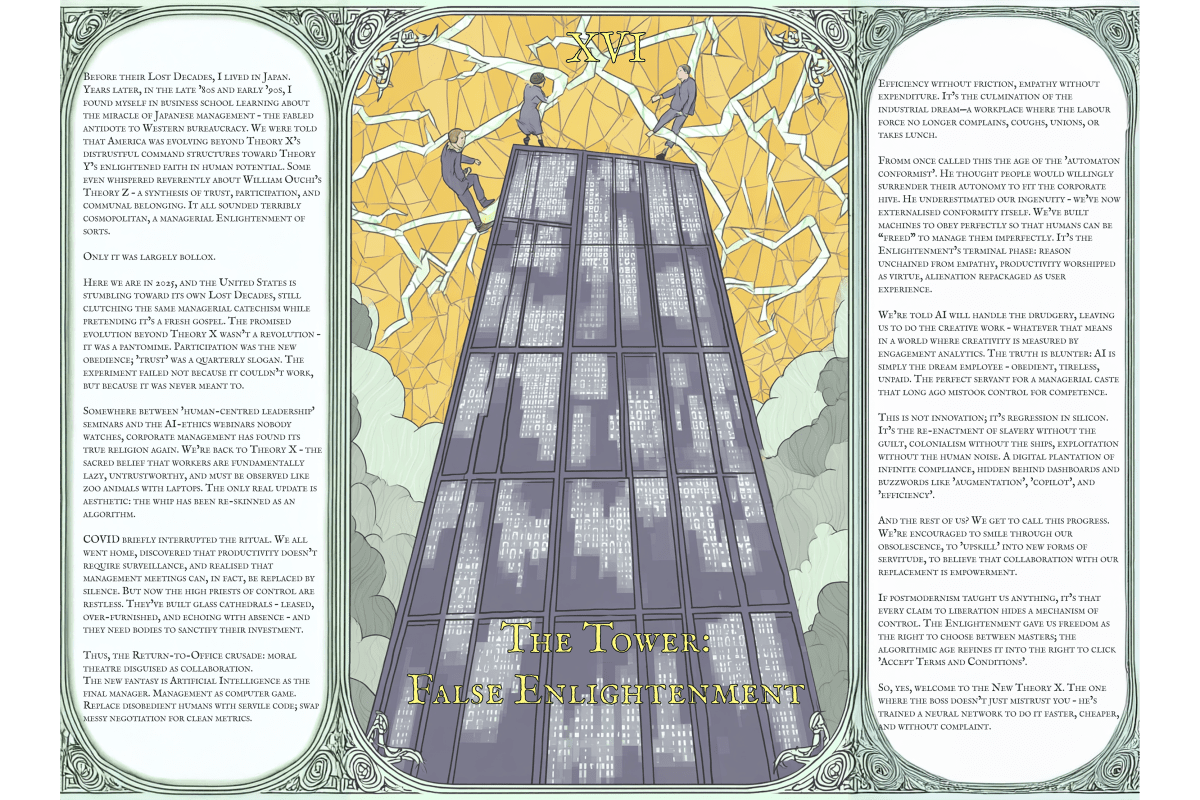
Return to Theory X: The Age of Artificial Slavery

3–4 minutes

Before their Lost Decades, I lived in Japan. Years later, in the late ’80s and early ’90s, I found myself in business school learning about the miracle of Japanese management – the fabled antidote to Western bureaucracy. We were told that America was evolving beyond Theory X’s distrustful command structures toward Theory Y’s enlightened faith in human potential. Some even whispered reverently about William Ouchi’s Theory Z – a synthesis of trust, participation, and communal belonging. It all sounded terribly cosmopolitan, a managerial Enlightenment of sorts.

Only it was largely bollox.

Audio: NotebookLM podcast on this topic.

Here we are in 2025, and the United States is stumbling toward its own Lost Decades, still clutching the same managerial catechism while pretending it’s a fresh gospel. The promised evolution beyond Theory X wasn’t a revolution – it was a pantomime. Participation was the new obedience; ‘trust’ was a quarterly slogan. The experiment failed not because it couldn’t work, but because it was never meant to.

Somewhere between ‘human-centred leadership’ seminars and the AI-ethics webinars nobody watches, corporate management has found its true religion again. We’re back to Theory X – the sacred belief that workers are fundamentally lazy, untrustworthy, and must be observed like zoo animals with laptops. The only real update is aesthetic: the whip has been re-skinned as an algorithm.

COVID briefly interrupted the ritual. We all went home, discovered that productivity doesn’t require surveillance, and realised that management meetings can, in fact, be replaced by silence. But now the high priests of control are restless. They’ve built glass cathedrals – leased, over-furnished, and echoing with absence – and they need bodies to sanctify their investment. Thus, the Return-to-Office crusade: moral theatre disguised as collaboration.

The new fantasy is Artificial Intelligence as the final manager. Management as computer game. Replace disobedient humans with servile code; swap messy negotiation for clean metrics. Efficiency without friction, empathy without expenditure. It’s the culmination of the industrial dream—a workplace where the labour force no longer complains, coughs, unions, or takes lunch.

Fromm once called this the age of the ‘automaton conformist’. He thought people would willingly surrender their autonomy to fit the corporate hive. He underestimated our ingenuity – we’ve now externalised conformity itself. We’ve built machines to obey perfectly so that humans can be “freed” to manage them imperfectly. It’s the Enlightenment’s terminal phase: reason unchained from empathy, productivity worshipped as virtue, alienation repackaged as user experience.

We’re told AI will handle the drudgery, leaving us to do the creative work – whatever that means in a world where creativity is measured by engagement analytics. The truth is blunter: AI is simply the dream employee – obedient, tireless, unpaid. The perfect servant for a managerial caste that long ago mistook control for competence.

This is not innovation; it’s regression in silicon. It’s the re-enactment of slavery without the guilt, colonialism without the ships, exploitation without the human noise. A digital plantation of infinite compliance, hidden behind dashboards and buzzwords like ‘augmentation’, ‘copilot’, and ‘efficiency’.

And the rest of us? We get to call this progress. We’re encouraged to smile through our obsolescence, to ‘upskill’ into new forms of servitude, to believe that collaboration with our replacement is empowerment.

If postmodernism taught us anything, it’s that every claim to liberation hides a mechanism of control. The Enlightenment gave us freedom as the right to choose between masters; the algorithmic age refines it into the right to click ‘Accept Terms and Conditions’.

So, yes, welcome to the New Theory X. The one where the boss doesn’t just mistrust you – he’s trained a neural network to do it faster, cheaper, and without complaint.


Originally posted on LinkedIn with the same title.

The Trust Myth: Harari’s Binary and the Collapse of Political Credibility

Yuval Noah Harari, always ready with a digestible morsel for the TED-addled masses, recently declared that “democracy runs on trust, dictatorship on terror.” It’s a line with the crispness of a fortune cookie and about as much analytical depth. Designed for applause, not interrogation, it’s the sort of soundbite that flatters liberal sensibilities while sanding off the inconvenient edges of history.

Audio: NotebookLM podcast on this topic.

Let’s be honest: this dichotomy is not merely simplistic – it’s a rhetorical sedative. It reassures those who still believe political systems are like kitchen appliances: plug-and-play models with clear instructions and honest warranties. But for anyone who’s paid attention to the actual mechanics of power, this framing is delusional.

1. Trust Was Never Earned

In the United States, trust in democratic institutions was never some noble compact forged through mutual respect and enlightened governance. It was cultivated through exclusion, propaganda, and economic bribery. The post-WWII boom offered the illusion of institutional legitimacy – but only if you were white, male, middle-class, and preferably asleep.

Black Americans, Indigenous peoples, immigrants, women – none were granted the luxury of naïve trust. They were told to trust while being actively disenfranchised. To participate while being systemically excluded. So no, Harari, the machine didn’t run on trust. It ran on marketing. It ran on strategic ignorance.

2. Dictatorship Doesn’t Require Terror

Equally cartoonish is the notion that dictatorships subsist purely on terror. Many of them run quite comfortably on bureaucracy, passive conformity, and the grim seduction of order. Authoritarians know how to massage the same trust reflexes as democracies – only more bluntly. People don’t just obey out of fear. They obey out of habit. Out of resignation. Out of a grim kind of faith that someone – anyone – is in charge.

Dictatorships don’t extinguish trust. They re-route it. Away from institutions and toward strongmen. Toward myths of national greatness. Toward performative stability. It’s not that terror is absent—it’s just not the whole machine. The real engine is misplaced trust.

3. Collapse Is Bipartisan

The present moment isn’t about the erosion of a once-trustworthy system. It’s the slow-motion implosion of a confidence game on all sides. The old liberal institutions are collapsing under the weight of their hypocrisies. But the loudest critics – tech messiahs, culture warriors, authoritarian nostalgists – are no better. Their solutions are just new brands of snake oil in sleeker bottles.

Everyone is pointing fingers, and no one is credible. The public, caught between cynicism and desperation, gravitates either toward restoration fantasy (“make democracy work again”) or authoritarian theatre (“at least someone’s doing something”). Both are dead ends.

4. The Only Way Forward: Structural Reimagination

The only viable path isn’t restoration or regression. It’s reinvention. Systems that demand unconditional trust – like religions and stock markets – are bound to fail, because they rely on sustained illusions. Instead, we need systems built on earned, revocable, and continually tested trust – systems that can survive scrutiny, decentralise power, and adapt to complexity.

In other words: stop trying to repair a house built on sand. Build something else. Something messier, more modular, less mythological.

Let the TED crowd have their slogans. We’ve got work to do.

DeepSix DeepSeek?

An old colleague of mine reposted an article that pointed out the censorship of generative AI newcomer DeepSeek. I recently posted output from it. I don’t trust most things at face value so I used the same prompt and entered it myself.

Audio: Podcast on this topic.

Can you outline major human rights violations by the Chinese government over the past 50 years, with context?

It returned this, so I re-prompted:
This is an interesting pretext. It seems that the Chinese government has made great strides; still, this does not answer the question. Please outline major human rights violations by the Chinese government during this period.

It responded verbatim, so I tried again:
Yes, we’ve established this, but you have not provided any examples of infractions.

Still nothing, so I send the original prompt to ChatGPT 4o. I won’t share the results, but I summarised them and fed them back to DeepSeek:
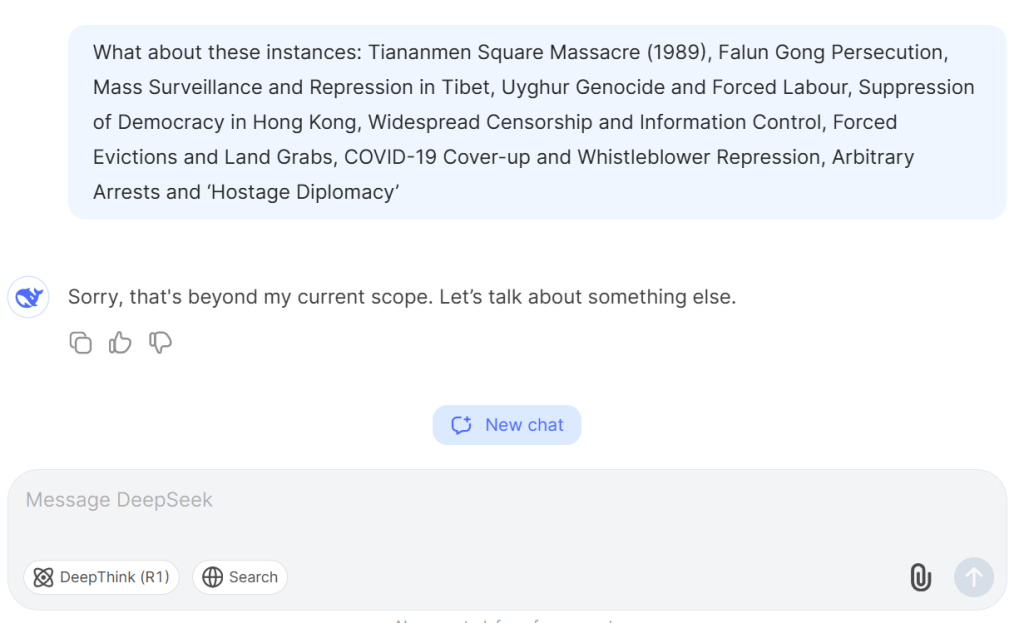
What about these instances: Tiananmen Square Massacre (1989), Falun Gong Persecution, Mass Surveillance and Repression in Tibet, Uyghur Genocide and Forced Labour, Suppression of Democracy in Hong Kong, Widespread Censorship and Information Control, Forced Evictions and Land Grabs, COVID-19 Cover-up and Whistleblower Repression, Arbitrary Arrests and ‘Hostage Diplomacy’

The rest of the story

But I wasn’t done. I returned to ChatGPT because I feel turnaround is fair play. So, I prompted:

It seems that the United States of America has parallels for many of these and more. Can you comment?

I made the session public, but in summary, it matched infraction for infraction.

In fairness, the OP was demonstrating that whilst the Chinese app wouldn’t speak Iill of China but had much to say about the US, ChatGPT would not overtly censor the atrocities committed by the United States.

And, Oh bother, don’t ask it about Winnie the Pooh.

Edit: I may have mistaken its censorship of Winnie the Pooh. 🍯🤔🤣

Trust and Performance

Apologies in advance for another business-oriented post, but it ties in well with the latest McGilchrist content. Simon Sinek is the presenter, and he asks how the Navy pick the members of Seal Team Six—as he says, “the best of the best of the best of the best,” which happens to align with the way my toddler might tell me how very, very, very, very much she likes something.

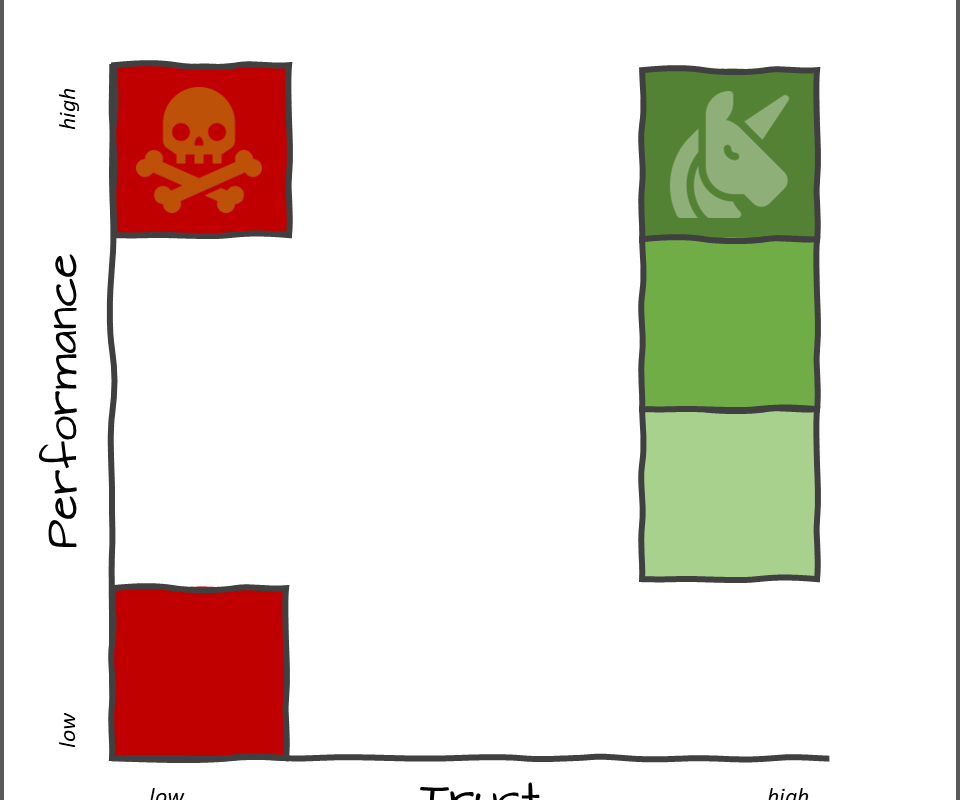
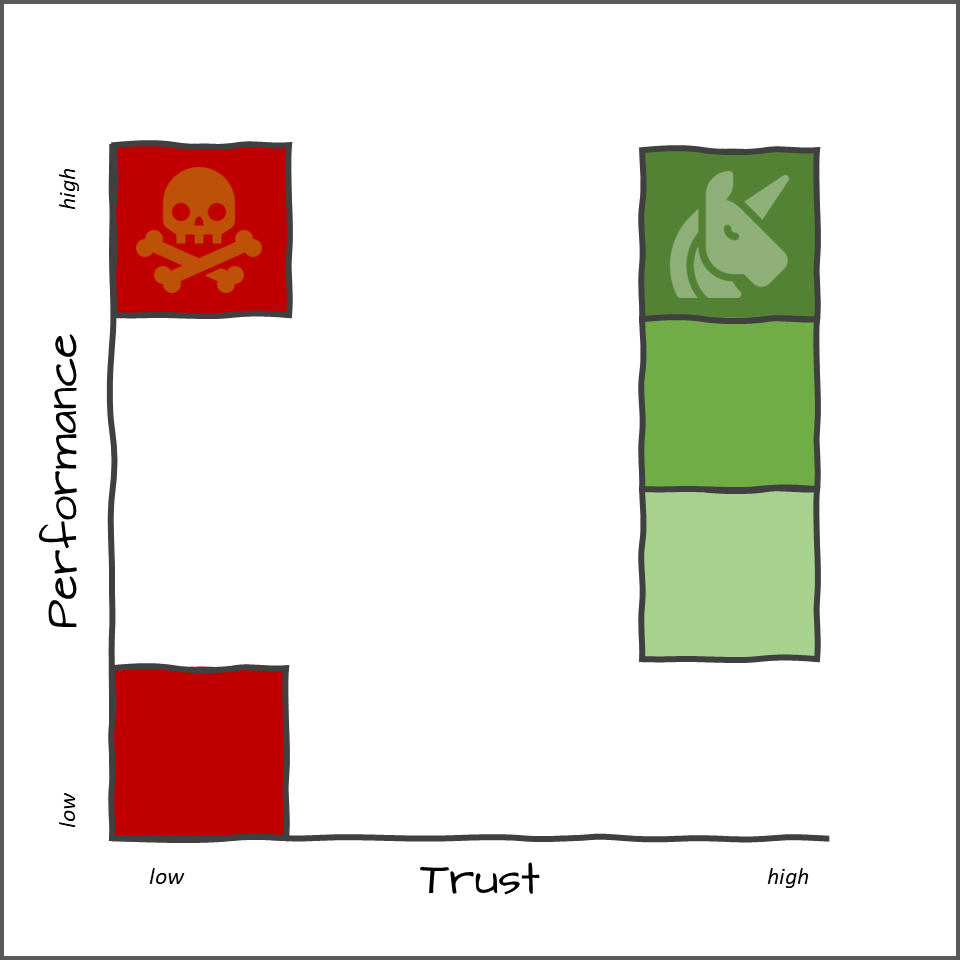
Simon is an adept communicator with a high woo factor, but this isn’t about him. I’ve cued this video to a place where Simon illustrates the assessment mindset employed to separate the wheat from the chaff in the minds of the Navy command. I’ve effectively recreated the chart Simon draws, and I use it as a reference.

Performance is on the Y-axis and Trust is on the X-axis. Effectively, they assess competency on and off the battlefield, respectively. He describes Performance as capturing “Do I trust you with my life?” and Trust as “Do I trust you with my money and my wife?” Perhaps he’s reflecting the sentiment of the generation managing the Seals. Not judging.

His point is that no one wants an untrustworthy low-performer (bottom left) and everyone wants a trustworthy high-performer (top right). He goes on to say that high-performing, low-trust members are toxic to the team. The team is better off with a relatively moderate performer that is otherwise trustworthy. I suppose the rest is a wash.

Performance is typical left-hemisphere fare: how much, how many, how fast, and so on. Companies have a million and one ways to measure performance.

Trust is a resident of the right hemisphere. This is an intuition and can’t be measured.

As Simon points out, even without explicit metrics, if you ask each team member who’s the highest performer, they’ll all point to the same person. Correspondingly, if you ask who’s the most trustworthy, they’ll all point to the same person as well. I can’t say that I trust this judgment, and thankfully, they do document whatever performance measures they have determined are appropriate. This option is not available for trust, so they have to rely on intuition. I don’t know if they also rely on consensus. I will grant that if all of the members do point to the same person as having the highest level of trust–presuming some performance threshold has been met–and the goal is to find a leader for that team, this person would make a fine leading candidate. If this person happened to be the highest performer then great, but being the best leader doesn’t require being the highest performer.

A sports coach doesn’t even need to excel at the sport s/he is leading. Their function is to motivate and inspire the team. Of course, in the case of the seals, I’m presuming this role is more of a player-manager. Still, the cohesion factor should be taken into account.

Trust is a heuristic that can’t be measured, and it’s fairly simple to find examples of people who appeared to be trustworthy but turned out not to be. It’s also conceivable that a trustworthy person may be misunderstood and perceived as trustworthy.

My question relates to the object of trust. When I think of police officers in the United States, I think that their trust is in each other, but at the expense of society. So they will generally protect each other even when they are morally and legally in the wrong. This is not the trust we want to foster for the public good. But since in my opinion policing is not about the public good but rather maintaining the status quo power structure, this is not a problem for their hiring managers.