Varoufakis Solves Zeno’s Paradox

Having finished Technofeudalism, I’ve moved on to Society of the Spectacle, which has me thinking.

They say no one escapes the Spectacle. Guy Debord made sure of that. His vision was airtight, his diagnosis terminal: we are all spectators now, alienated from our labour, our time, our own damn lives. It was a metaphysical mugging—existence held hostage by images, by commodities dressed in drag. The future was a feedback loop, and we were all doomed to applaud.

Audio: NotebookLM podcast on this topic. Apologies in advance for the narrators’ mangling of the pronunciation of ‘Guy Debord’.

But what if the loop could be hacked?
What if the infinitely halved distances of motionless critique—Zeno’s Paradox by way of Marx—could finally be crossed?

Enter: Yanis Varoufakis.
Economist, ex-finance minister, techno-cassandra with a motorbike and a vendetta.
Where Debord filmed the catastrophe in black-and-white, Varoufakis showed up with the source code.

Debord’s Limbo

Debord saw it all coming. The substitution of reality with its photogenic simulacrum. The slow death of agency beneath the floodlights of consumption. But like Zeno’s paradox, he could only gesture toward the end without ever reaching it. Each critique halved the distance to liberation but never arrived. The Spectacle remained intact, omnipresent, and self-replicating—like an ontological screensaver.

He gave us no path forward, only a beautiful, ruinous analysis. A Parisian shrug of doom.

Varoufakis’ Shortcut

But then comes Varoufakis, breaking through the digital labyrinth not by philosophising the Spectacle, but by naming its successor: Technofeudalism.

See, Debord was chasing a moving target—a capitalism that morphed from industrial to financial to semiotic faster than his prose could crystallise. But Varoufakis caught it mid-mutation. He pinned it to the slab and sliced it open. What spilled out wasn’t capital anymore—it was rent. Platform rent. Algorithmic tolls. Behavioural taxes disguised as convenience. This isn’t the market gone mad—it’s the market dissolved, replaced by code-based fiefdoms.

The paradox is resolved not by reaching utopia, but by realising we’ve already crossed the line—we just weren’t told. The market isn’t dying; it’s already dead, and we’re still paying funeral costs in monthly subscriptions and attention metrics.

From Spectacle to Subjugation

Debord wanted to unmask the performance.
Varoufakis realised the theatre had been demolished and replaced with a server farm.

You don’t watch the Spectacle anymore. It watches you.
It optimises you.
It learns your keystrokes, your pulse rate, your browsing history.
Welcome to feudal recursion, where Amazon is your landlord, Google your priest, and Meta your confessor.

Solving Zeno the Varoufakis Way

So how does one cross the infinite regress of alienation?
Simple. You call it what it is. You reclassify the terrain.

“This is not capitalism,” Varoufakis says, in the tone of a man pulling a mask off a Scooby-Doo villain.
“It’s technofeudalism. Capital didn’t win. It went feudal. Again.”

By doing so, he bypasses the academic ballet that has critics forever inching closer to the truth without touching it. He calls the system new, not to sell books, but to make strategy possible. Because naming a beast is the first step in slaying it.

In Conclusion: Debord Dreamed, Varoufakis Drives

Debord haunts the museum.
Varoufakis raids the server room.
Both are essential. But only one gives us a new map.

The Spectacle hypnotised us.
Technofeudalism enslaves us.
And if there’s a way out, it won’t be through slogans spray-painted on Parisian walls. It will be built in code, deployed across decentralised networks, and carried forward by those who remember what it meant to be not watched.

Let Debord whisper. Let Varoufakis roar.
And let the rest of us sharpen our blades.
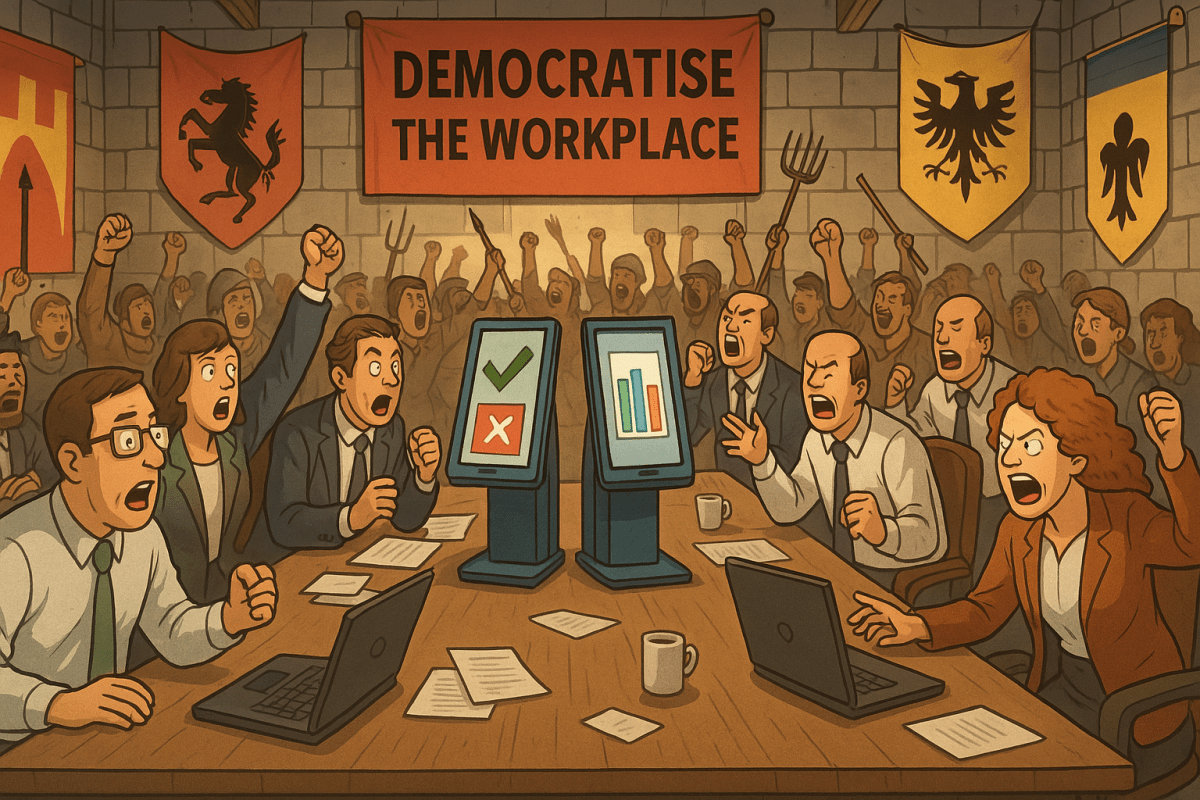
Technofeudalism: It’s a Wrap

By the time we reach Chapter Seven of Technofeudalism: What Kills Capitalism, Yanis Varoufakis drops the ledger sheets and spreadsheets and starts sketching utopia in crayon. Entitled Escape from Technofeudalism, it proposes—brace yourself—a workplace democracy. It’s aspirational, yes. Compelling? Not particularly. Especially if, like me, you’ve long since stopped believing that democracy is anything more than a feel-good placebo for structural impotence.

Audio: NotebookLM podcast discussing this topic.

To be clear: the preceding chapters, particularly the first six, are sharp, incisive, and frankly, blistering in their indictment of today’s economic disfiguration. But Chapter Seven? It’s less an escape plan, more a group therapy session masquerading as an operational model.

So let’s take his proposal for Democratised Companies apart, one charming layer at a time.

Splendid. One person, one vote. Adorable.

Because there’s nothing more efficient than a hiring committee comprised of thirty engineers, two janitors, a receptionist, and Steve from Accounts, whose main contribution is passive-aggressive sighing.

Marvellous. We’ve now digitised the tyranny of the majority and can timestamp every idiotic decision for posterity.

A relief. Until it doesn’t.

Here, dear reader, is where the cake collapses. Why, precisely, should a randomly-assembled group of employees—with wildly varying financial literacy—be entrusted to divide post-tax revenue like it’s a birthday cake at a toddler’s party?

And how often are these slices recalibrated? Each fiscal year? Every time someone is hired or fired? Do we amend votes quarterly or wait until the economic ship has already struck an iceberg?

Varoufakis does suggest preference voting to tackle allocation disputes:

Fine. In theory, algorithmic voting procedures sound neat. But it presumes voters are rational, informed, and cooperative. If you’ve ever seen a corporate Slack thread devolve into emoji warfare, you’ll know that this is fiction on par with unicorns and meritocracy.

Ah yes, the ‘equality’ bit. Equal pay, unequal contribution. This isn’t egalitarianism—it’s enforced mediocrity. It might work in a monastery. Less so in a competitive tech firm where innovation requires both vision and differentiated incentive.

Now, on to bonuses, which are democratically determined by:

Welcome to Black Mirror: Workplace Edition. This is less economics, more playground politics. Who gets tokens? The charismatic chatterbox in the break room? The person who shared their lunch? The ghost employee who never shows up but emails back promptly?

And how, pray tell, does one evaluate the receptionist’s contribution relative to the lead engineer’s or the janitor’s? This isn’t peer review—it’s populism with a smiley face.

We’ve all seen “Teacher of the Year” competitions turn into contests of who had the cutest class poster or best cupcakes. Now imagine your livelihood depending on it.

In summary, democracy in the workplace may sound noble, but in practice, it’s the bureaucratic equivalent of herding caffeinated cats. It doesn’t even work in small groups, let alone an organisation of hundreds. Democracy—when applied to every function of an enterprise—is not liberation; it’s dilution. It’s design-by-committee, strategy-by-consensus, and ultimately, excellence-by-accident.

Escape from Technofeudalism? Perhaps. But not by replacing corporate lords with intranet polls and digital tokens. That’s not an exit strategy—it’s a cosplay of collectivism.

Clouds, Crowns, and Clowns

How the West Bungled Its Way into Technofeudalism

History doesn’t repeat itself, but, my God, it certainly rhymes — badly, and in the case of America’s self-immolation vis-à-vis China, completely off-key.

Yanis Varoufakis’ brutal dissection in Technofeudalism reads like a coronial report on the West’s terminal idiocy:
We’re not watching the rise of a “new China threat” — we’re watching the dying spasms of a clownish empire losing to its own creation: cloud capital.

Audio: NotebookLM podcast on this topic. NB: The announcers confused my commentary on Varoukakis as my ideas, where I am simply summarising and editorialising.

A Recap for the Attention-Deficit West:

Once upon a time (i.e., post-WWII), America ran a magnificent scam: sell the world things — aeroplanes, refrigerators, good old-fashioned stuff — in exchange for gold. When America became a deficit country (buying far more than it sold), it pivoted brilliantly:
“No more gold, peasants. Here, have an IOU instead.”
Thus was born the Dollar Empire: a global system where America got to run enormous deficits, foreigners got paper promises, and everyone smiled through gritted teeth.

Fast-forward: Japan, Korea, China — they got in line. They built things, exported things, grew rich — and recycled all their lovely profits straight into American property, debt, and Wall Street snake oil.
Win-win!
(Except for the workers on both sides, who were flogged like medieval peasants, but who’s counting?)

The Minotaur Has a Stroke

Then came 2008: America’s financial system committed hara-kiri on live television.
China stepped up to save global capitalism (yes, really), jacking up investment to absurd levels, buying up Western assets, and quietly building something far more dangerous than steelworks and solar panels: cloud finance.

While the West was still dry-humping neoliberal fantasies about “free markets,” China fused Big Tech and Big Brother into a seamless, sprawling surveillance-finance-entertainment-behavioural-modification apparatus.
Think Facebook, Amazon, Citibank, your GP, your car insurance, and your government — all rolled into one app.
Welcome to WeChat World™ — population: everyone.

The New Cold War: Idiots vs Strategists

Enter Trump. And Biden. And the bipartisan realisation, delivered with all the subtlety of a pub brawl, that China’s Big Tech wasn’t just mimicking Silicon Valley — it was obliterating it.
TikTok wasn’t just teenagers dancing. It was dollar extraction without the need for US trade deficits or dollar supremacy.

Cue blind panic. Ban Huawei! Ban TikTok! Ban chips! Ban thought!
Meanwhile, Beijing smiled, nodded, and built its own chips, its own cloud, its own digital currency.
When the US froze Russian central bank assets in 2022, it unwittingly told every finance minister from Delhi to Dakar:
“Your money isn’t safe with us.”
Oops.

The Chinese digital yuan — a once quaint science project — suddenly looked like the lifeboat on a burning ship.
Guess which way the rats are swimming?

Europe: Toasted, Buttered, and Eaten

As for Europe? Bless them. Still fantasising about “strategic autonomy” while chained to America’s collapsing empire like a loyal spaniel.
Europe lacks cloud capital, lacks industrial capacity, and now — post-Ukraine, post-energy crisis — lacks even the pretence of relevance.
Germany, France, the Netherlands: mere franchisees of American technofeudal overlords.

Brussels’ vision for the future?
“Please sir, may we remain a respectable vassal state?”

The Global South: Choose Your Feudal Lord

The so-called “developing world” faces an even grimmer menu:

  • Pledge allegiance to Washington’s dying dollar-based cloud fief?
  • Or become serfs under Beijing’s emerging digital rentier aristocracy?
    Either way, the crops are taxed, the wells are privatised, and the commons are torched.

Development? Don’t make me laugh. The South has been invited to another game of “Heads they win, tails you starve.”

Technofeudalism: A Lovable New Hell

Meanwhile, back in the heartlands of Empire, cloudalists — Google, Amazon, Tencent, Alibaba — are fencing off reality itself.
You will own nothing, subscribe to everything, and feed their algorithms while praying for a dopamine hit.
Democracy?
A charming relic, like powdered wigs and carrier pigeons.

In a final, cosmically ironic twist, it turns out that the only force keeping China’s cloudalists in check is… the Chinese Communist Party itself.
Yes, dear liberals: the last faint flicker of “people power” resides under authoritarian rule, while the “free world” rolls over like a half-seduced Victorian maiden.

Technofeudalism: Taxing Rent

I’ve just finished Chapter 5 of Technofeudalism by Greek economist Yanis Varoufakis, and I can’t recommend it enough. Retiring from being a professional economist, I’d paused reading economic fare in favour of philosophy and fiction. Recently, I picked up Hobbes’ Leviathan and Graeber’s Bullshit Jobs, but this one called to me. I recall when it was released. I read some summaries and reviews. I heard some interviews. I thought I understood the gist. I did. But it goes deeper. Much deeper.

I considered Technofeudalism or Feudalism 2.0 as more of a political statement than a sociopolitical one. Now, I know better. Rather than review the book, I want to focus on a specific aspect that occurred to me.

In a nutshell, Varoufakis asserts that with Capitalism, we moved from a world of property-based rents to one of profits (and rents). We’ve now moved past this into a new world based on platform-based rents (and profits and property rents). Rent extraction yields more power than profits, again reordering power structures. Therefore, I think we might want to handle (read: tax) rents separately from profits.

Audio: NotebookLM podcast discussing this topic.

A Radical Proposal for Modern Taxation

Introduction: The Old Dream Reawakened

Economists have long dreamt of a world in which rent — the unearned income derived from control of scarce assets — could be cleanly distinguished from profit, the reward for productive risk-taking. Ricardo dreamt of it. Henry George built a movement upon it. Even today, figures like Thomas Piketty hint at its necessity. Yet rent and profit have grown entangled like ancient ivy around the crumbling edifice of modern capitalism.

Today, under what some call “technofeudalism,” the separation of rent from productive profit has become not merely an academic exercise but a matter of existential urgency. With rents now extracted not only from land but from data, networks, and regulatory capture, taxation itself risks becoming obsolete if it fails to adapt.

Thus, let us lay out a theoretical and applied map for what could — and arguably must — be done.

I. The Theoretical Framework: Defining Our Terms

First, we must operationally define:

  • Profit: income generated from productive risk-taking — investment, innovation, labour.
  • Rent: income generated from ownership or control of scarce, non-replicable assets — land, intellectual property, platforms, regulatory privilege.

Key Principle: Rent is unearned. Profit is earned.

This distinction matters because rent is an economic extraction from society’s collective value creation, whereas profit rewards activities that enlarge that pie.

II. Mapping EBITA: Where Rent Hides

EBITA (Earnings Before Interest, Taxes, and Amortisation) is the preferred metric of modern corporate reporting. Within it, rents hide behind several masks:

  • Property rental income
  • Intellectual property licensing fees
  • Monopoly markups
  • Platform access fees
  • Network effect premiums
  • Regulatory arbitrage profits

Parsing rent from EBITA would thus require methodical decomposition.

III. Theoretical Approaches to Decomposing EBITA

  1. Cost-Plus Benchmarking
    • Estimate what a “normal” competitive firm would earn.
    • Treat any surplus as rent.
  2. Rate-of-Return Analysis
    • Compare corporate returns against industry-normal rates adjusted for risk.
    • Excess returns imply rent extraction.
  3. Monopolistic Pricing Models
    • Apply measures like the Lerner Index to estimate pricing power.
    • Deduce the rentier share.
  4. Asset Valuation Decomposition
    • Identify earnings derived strictly from asset control rather than active operation.
  5. Economic Value Added (EVA) Adjustments
    • Assign a competitive cost of capital and strip out the residual super-profits as rents.

IV. Toward Applied Solutions: Imposing Sanity on Chaos

In theory, then, we could pursue several applied strategies:

  1. Mandated Rent-Adjusted Reporting
    • Require corporations to file a “Rent-Adjusted EBITA” metric.
    • Auditors would have to categorise income streams as “productive” or “rentier.”
  2. Differential Taxation
    • Tax normal profits at a competitive corporate rate.
    • Tax rents at punitive rates (e.g., 70-90%), since taxing rents does not distort incentives.
  3. Sector-Specific Rent Taxes
    • Levy special taxes on land, platforms, patents, and monopoly franchises.
    • Create dynamic rent-extraction indices updated annually.
  4. Platform Rent Charges
    • Impose data rent taxes on digital platforms extracting value from user activity.
  5. Public Registry of Rents
    • Create a global registry classifying rents by sector, firm, and mechanism.
    • Provide public transparency to rent-seeking activities.

V. The Political Reality: Clouds on the Horizon

Needless to say, the aristocracy of the digital age will not go gentle into this good night. Rentiers — whether in Silicon Valley, the City of London, or Wall Street — are deeply entwined with the political machinery that might otherwise regulate them.

Yet the costs of inaction are higher. If rent extraction continues to eclipse productive activity, the very legitimacy of markets — and democracy — will erode into cynicism, stagnation, and oligarchic decay.

Conclusion: The Choice Before Us

Separating rent from profit is not merely a technocratic tweak. It is a radical act — one that could reorient economic activity away from parasitic extraction and back toward genuine value creation.

In a world where algorithms are castles, platforms are fiefdoms, and data is the new serfdom, reclaiming the ancient dream of taxing rent is no longer optional. It is, quite simply, the price of our collective survival.