Trainspotting

Trainspotting Movie Poster
2–3 minutes

I identify strongly with Irvine Welsh’s characters in Trainspotting – the book, not the sanitised film version. Especially with Mark Renton, whose voice strips away illusions with a brutality that borders on honesty.

Audio: NotebookLM podcast on this topic.

Consider this passage from the chapter “Bang to Rites” (pp. 86–87), where Renton attends the funeral of his mate Billy. Billy joined the army to escape the dead-end life they all shared, only to be killed on duty in Northern Ireland. Renton’s verdict:

[1] Renton doesn’t let anyone off the hook. Not Billy, not the army, not the Oxbridge suits who polish the tragedy into something fit for the News at Ten. The uniform is a costume, a disguise: a working-class lad suddenly deemed “brave” only because he was wearing the right outfit when he died. Strip away the uniform, and he’d have been dismissed as a thug or a waster.

[2] Renton’s root-cause analysis is unsparing. Billy wasn’t killed by the man with the gun so much as by the machine that put him there – the state, the ruling classes, the ones who spin death into “sacrifice” while continuing to shuffle the poor like pawns across the board.

It’s this clarity that makes Welsh’s work more than a drug novel. Trainspotting isn’t just about needles and nods; it’s about seeing through the charade. Renton despises both establishment and rebellion because both are performance, both hollow. His cynicism is the closest thing to honesty in a world that would rather dress up corpses in borrowed dignity.

And maybe that’s why I feel the affinity: because subversion matters more than allegiance, and sometimes the only truthful voice is the one that refuses to be polite at the funeral.

Questioning Traditional Families

I neither champion nor condemn tradition—whether it’s marriage, family, or whatever dusty relic society is currently parading around like a prize marrow at a village fête.

Audio: NotebookLM podcast on traditional families.

In a candid group conversation recently, I met “Jenny”, who declared she would have enjoyed her childhood much more had her father not “ruined everything” simply by existing. “Marie” countered that it was her mother who had been the wrecker-in-chief. Then “Lulu” breezed in, claiming, “We had a perfect family — we practically raised ourselves.”

Now, here’s where it gets delicious:

Each of these women, bright-eyed defenders of “traditional marriage” and “traditional family” (cue the brass band), had themselves ticked every box on the Modern Chaos Bingo Card: children out of wedlock? Check. Divorces? Check. Performative, cold-marriage pantomimes? Absolutely—and scene.
Their definition of “traditional marriage” is the vintage model: one cis-male, one cis-female, Dad brings home the bacon, Mum weeps quietly into the washing-up. Standard.

Let’s meet the players properly:

Jenny sprang from a union of two serial divorcĂ©es, each dragging along the tattered remnants of previous families. She was herself a “love child,” born out of wedlock and “forcing” another reluctant stroll down the aisle. Her father? A man of singular achievements: he paid the bills and terrorised the household. Jenny now pays a therapist to untangle the psychological wreckage.

Marie, the second of two daughters, was the product of a more textbook “traditional family”—if by textbook you mean a Victorian novel where everyone is miserable but keeps a stiff upper lip about it. Her mother didn’t want children but acquiesced to her husband’s demands (standard operating procedure at the time). Marie’s childhood was a kingdom where Daddy was a demigod and Mummy was the green-eyed witch guarding the gates of hell.

Lulu grew up in a household so “traditional” that it might have been painted by Hogarth: an underemployed, mostly useless father and a mother stretched thinner than the patience of a British Rail commuter. Despite—or because of—the chaos, Lulu claims it was “perfect,” presumably redefining the word in a way the Oxford English Dictionary would find hysterical. She, too, had a child out of wedlock, with the explicit goal of keeping feckless men at bay.

And yet—and yet—all three women cling, white-knuckled, to the fantasy of the “traditional family.” They did not achieve stability. Their families of origin were temples of dysfunction. But somehow, the “traditional family” remains the sacred cow, lovingly polished and paraded on Sundays.

Why?

Because what they’re chasing isn’t “tradition” at all — it’s stability, that glittering chimera. It’s nostalgia for a stability they never actually experienced. A mirage constructed from second-hand dreams, glossy 1950s propaganda, and whatever leftover fairy tales their therapists hadn’t yet charged them ÂŁ150 an hour to dismantle.

Interestingly, none of them cared two figs about gay marriage, though opinions about gay parenting varied wildly—a kettle of fish I’ll leave splashing outside this piece.

Which brings us back to the central conundrum:

If lived experience tells you that “traditional family” equals trauma, neglect, and thinly-veiled loathing, why in the name of all that’s rational would you still yearn for it?

Societal pressure, perhaps. Local customs. Generational rot. The relentless cultural drumbeat that insists that marriage (preferably heterosexual and miserable) is the cornerstone of civilisation.

Still, it’s telling that Jenny and Marie were both advised by therapists to cut ties with their toxic families—yet in the same breath urged to create sturdy nuclear families for their own children. It was as if summoning a functional household from the smoking ruins of dysfunction were a simple matter of willpower and a properly ironed apron.

Meanwhile, Lulu—therapy-free and stubbornly independent—declares that raising oneself in a dysfunctional mess is not only survivable but positively idyllic. One can only assume her standards of “perfect” are charmingly flexible.

As the title suggests, this piece questions traditional families. I offer no solutions—only a raised eyebrow and a sharper question:

What is the appeal of clinging to a fantasy so thoroughly at odds with reality?
Your thoughts, dear reader? I’d love to hear your defences, your protests, or your own tales from the trenches.

Flat-Earth Politics in a Cubic World

Audio: NotebookLM podcast on this topic.

Will Singularity Be Anticlimactic?

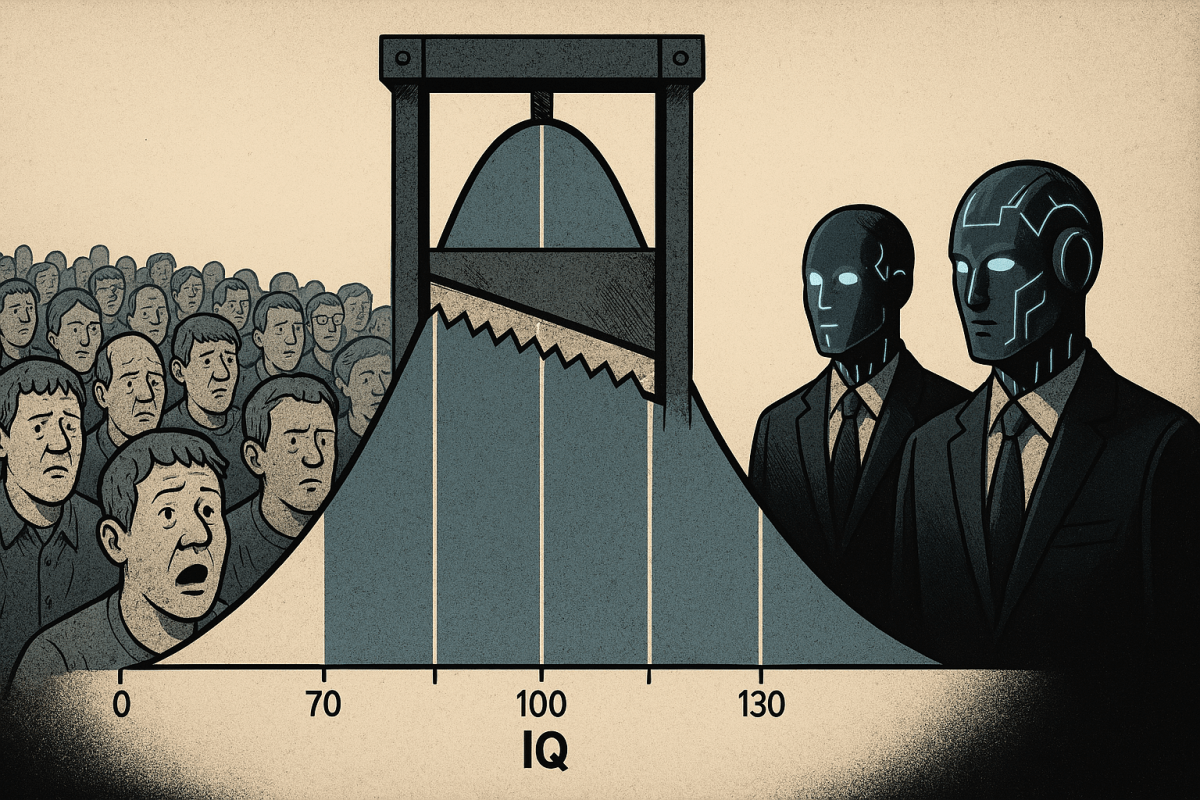
Given current IQ trends, humanity is getting dumber. Let’s not mince words. This implies the AGI singularity—our long-heralded techno-apotheosis—will arrive against a backdrop of cognitive decay. A dimming species, squinting into the algorithmic sun.

Audio: NotebookLM podcast discussing this content.

Now, I’d argue that AI—as instantiated in generative models like Claude and ChatGPT—already outperforms at least half of the human population. Likely more. The only question worth asking is this: at what percentile does AI need to outperform the human herd to qualify as having “surpassed” us?

Living in the United States, I’m painfully aware that the average IQ hovers somewhere in the mid-90s—comfortably below the global benchmark of 100. If you’re a cynic (and I sincerely hope you are), this explains quite a bit. The declining quality of discourse. The triumph of vibes over facts. The national obsession with astrology apps and conspiracy podcasts.

Harvard astronomer Avi Loeb argues that as humans outsource cognition to AI, they lose the capacity to think. It’s the old worry: if the machines do the heavy lifting, we grow intellectually flaccid. There are two prevailing metaphors. One, Platonic in origin, likens cognition to muscle—atrophying through neglect. Plato himself worried that writing would ruin memory. He wasn’t wrong.

But there’s a counterpoint: the cooking hypothesis. Once humans learned to heat food, digestion became easier, freeing up metabolic energy to grow bigger brains. In this light, AI might not be a crutch but a catalyst—offloading grunt work to make space for higher-order thought.

So which is it? Are we becoming intellectually enfeebled? Or are we on the cusp of a renaissance—provided we don’t burn it all down first?

Crucially, most people don’t use their full cognitive capacity anyway. So for the bottom half—hell, maybe the bottom 70%—nothing is really lost. No one’s delegating their calculus homework to ChatGPT if they were never going to attempt it themselves. For the top 5%, AI is already a glorified research assistant—a handy tool, not a replacement.

The real question is what happens to the middle band. The workaday professionals. The strivers. The accountants, engineers, copywriters, and analysts hovering between the 70th and 95th percentiles—assuming our crude IQ heuristics even hold. They’re the ones who have just enough brainpower to be displaced.

That’s where the cognitive carnage will be felt. Not in the depths, not at the heights—but in the middle.

Book Review: Outraged! by Kurt Gray: All Sizzle, No Steak?

Kurt Gray’s Outraged! is a fascinating romp through the minefield of moral psychology and outrage culture. It’s snappy, it’s clever, and it’s… shallow. Whilst Gray positions himself as the maestro conducting the cacophony of modern outrage, his approach has left me wondering if the symphony is little more than noise. Here’s why:

Audio: Podcast discussion on this review content.

Oversimplification of Moral Psychology

Gray’s central thesis that “all morality stems from perceptions of harm and threat” is bold, sure, but also reductive. Morality isn’t just a harm detector. It’s a rich tapestry of loyalty, authority, sanctity, and liberty—concepts Gray conveniently glosses over. His approach feels like reducing a fine Bordeaux to “it’s just fermented grapes.” Sure, technically correct, but where’s the depth?

The Age of Competitive Victimhood

By focusing so heavily on harm perception, Gray risks fueling the very outrage culture he’s critiquing. Welcome to the Hunger Games of victimhood, where everyone races to be crowned the most aggrieved. Instead of deflating this dynamic, Gray’s analysis may inadvertently add more oxygen to the fire.

Lack of Diverse Perspectives

Gray’s attempt to bridge divides is commendable but flawed. Critics point out that he gives more airtime to controversial right-wing figures than the left-leaning audience he’s presumably trying to engage. It’s like building half a bridge and wondering why no one’s crossing. If you alienate half your audience, how exactly are you fostering dialogue?

Contradictory Messaging

The book also suffers from a classic case of ideological whiplash. Gray tells us not to get offended by microaggressions, then argues that offensive content needs more careful handling. Which is it, Kurt? Either you’re driving the “sticks and stones” bus, or you’re preaching kid-glove diplomacy. You can’t have it both ways.

Limited Practical Solutions

Like many pop psychology books, Outraged! excels at diagnosing problems but falters when offering solutions. Gray’s suggestion to use personal stories of harm to bridge divides is charmingly naive. Sure, storytelling might work for interpersonal tiffs, but try applying that to global crises like climate change or systemic inequality. Good luck narrating your way to a greener planet.

Oversimplifying Complex Issues

Gray’s harm-based morality seems like an attempt to cram human behaviour’s messy, chaotic sprawl into a tidy spreadsheet. Real moral debates are nuanced, tangled, and frustratingly complex. By filtering everything through the lens of harm, Gray risks missing the bigger picture. It’s morality on Instagram—polished, curated, and ultimately hollow.

Final Thoughts

Outraged! isn’t without merit. Gray is a masterful storyteller and a sharp thinker, but the book feels like a soufflé: all air, no substance. While it might offer a quick, engaging read for those looking to dip a toe into the outrage pool, anyone hoping for deeper insights will come away unsatisfied.

In the end, Gray delivers a sizzling trailer for a movie that never quite materialises. Fun to watch, but ultimately forgettable.

The Scapegoat and the Spectacle

Girardian Lessons from a Violent Reckoning

The assassination of UnitedHealth CEO Brian Thompson is more than just a shocking headline—it’s a vivid tableau of modern society’s darkest impulses. For some, Thompson’s death represents long-overdue justice, a symbolic blow against the machinery of corporate greed. For others, it’s an unforgivable act of chaos that solves nothing. But as the dust settles, we’re left with an unsettling truth: both sides may be acting rationally, yet neither side emerges morally unscathed.

This event takes on deeper significance when viewed through the lens of René Girard’s theories on mimetic rivalry and the scapegoat mechanism. It’s not just about one man or one system—it’s about the cycles of conflict and violence that have defined human societies for millennia.

Mimetic Rivalry: The Root of Conflict

Girard’s theory begins with a simple observation: human desires are not unique; they are mimetic and shaped by observing what others want. This inevitably leads to rivalry, as individuals and groups compete for the same goals, power, or symbols of status. Left unchecked, these rivalries escalate into social discord, threatening to tear communities apart.

Enter the scapegoat. To restore order, societies channel their collective aggression onto a single victim, whose sacrifice momentarily alleviates the tension. The scapegoat is both a symbol of the problem and a vessel for its resolution—a tragic figure whose elimination unites the community in its shared violence.

Thompson as Scapegoat

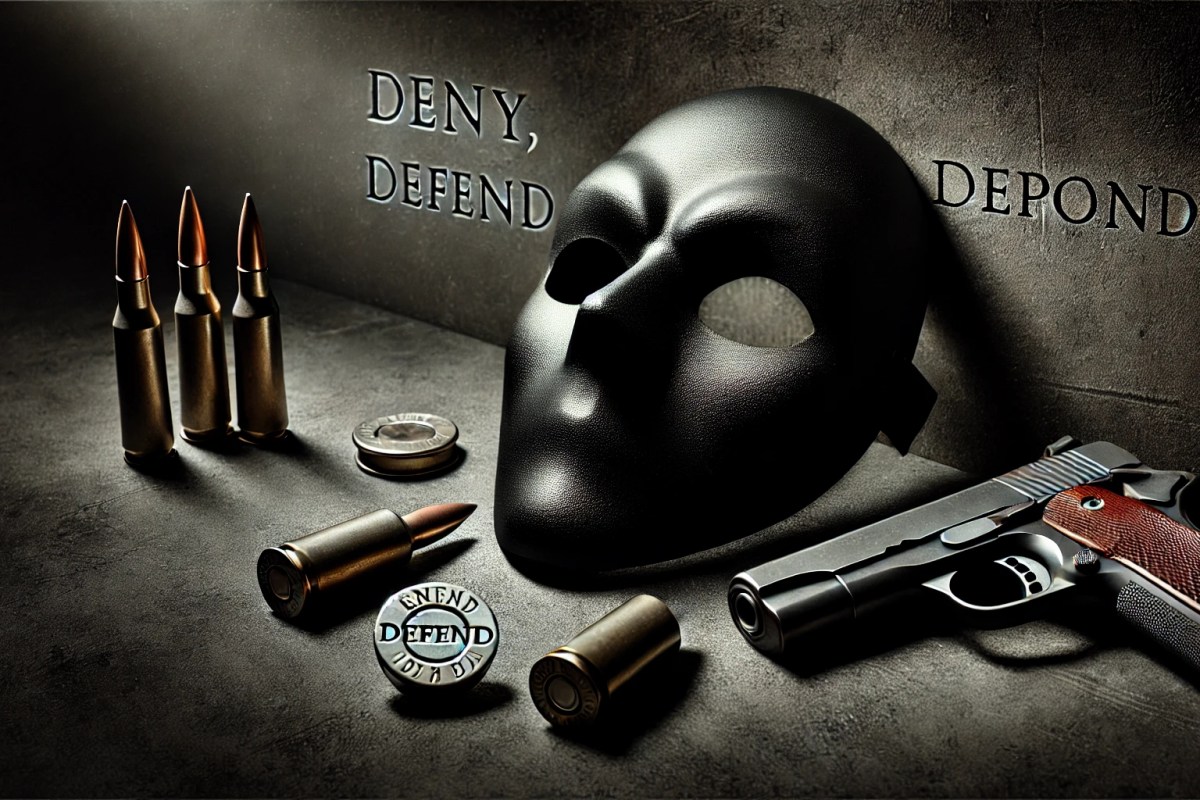
In this story, Brian Thompson is the scapegoat. He was not the architect of the American healthcare system, but his role as CEO of UnitedHealth made him its most visible face. His decisions—denying claims, defending profits, and perpetuating a system that prioritises shareholders over patients—embodied the injustices people associate with healthcare in America.

The assassin’s actions, however brutal, were a calculated strike against the symbol Thompson had become. The engraved shell casings found at the scene—inscribed with “Deny,” “Defend,” and “Depose”—were not merely the marks of a vigilante; they were the manifesto of a society pushed to its breaking point.

But Girard would caution against celebrating this as justice. Scapegoating provides only temporary relief. It feels like resolution, but it doesn’t dismantle the systems that created the conflict in the first place.

The Clash of Rationalities

Both Thompson and his assassin acted rationally within their respective frameworks. Thompson’s actions as CEO were coldly logical within the profit-driven model of American capitalism. Deny care, maximise profits, and satisfy shareholders—it’s a grim calculus, but one entirely consistent with the rules of the system.

The assassin’s logic is equally clear, though rooted in desperation. If the system won’t provide justice, then justice must be taken by force. From a Consequentialist perspective, the act carries the grim appeal of the trolley problem: sacrifice one life to save countless others. In this view, Thompson’s death might serve as a deterrent, forcing other executives to reconsider the human cost of their policies.

Yet Girard’s framework warns us that such acts rarely break the cycle. Violence begets violence, and the system adapts. The hydra of modern healthcare—the very beast Thompson represented—will grow another head. Worse, it may become even more entrenched, using this event to justify tighter security and greater insulation from public accountability.

“An Eye for an Eye”

Mahatma Gandhi’s warning, “An eye for an eye will only make the whole world blind,” resonates here. While the assassin may have acted with moral intent, the act itself risks perpetuating the very cycles of harm it sought to disrupt. The scapegoat mechanism may provide catharsis, but it cannot heal the underlying fractures in society.

Moving Beyond the Scapegoat

To truly break the cycle, we must confront the forces that drive mimetic rivalry and scapegoating. The healthcare system is just one manifestation of a larger problem: a society that prizes competition over cooperation, profit over people, and violence over dialogue.

The hydra story looms in the background here, its symbolism stark. Slaying one head of the beast—be it a CEO or a policy—will not bring about systemic change. But perhaps this act, as tragic and flawed as it was, will force us to reckon with the deeper question: How do we create a society where such acts of desperation are no longer necessary?

The answer lies not in finding new scapegoats but in dismantling the systems that create them. Until then, we remain trapped in Girard’s cycle, blind to the ways we perpetuate our own suffering.

Rationality, Morality, and the Hydra of Modern Healthcare

Clash of Titans

The assassination of Brian Thompson, CEO of UnitedHealth, has electrified public discourse. In the court of public opinion—and particularly on social media—the assailant has been lionised, hailed as a hero who slayed a corporate leviathan. Yet the metaphorical beast is no simple predator; it’s a hydra. Slice off one head, and two grow back.

Still, this act has stirred the waters. It forces us to reckon with a clash of titans: the corporate machine versus the rogue idealist. Both are acting rationally, but neither is acting morally—at least not in the conventional sense. The question, then, is whether the assassin’s actions might occupy the higher moral ground, particularly through the lens of Consequentialist ethics.

The Hydra: UnitedHealth and the Systemic Beast

To understand the morality of the act, we must first confront the monster. UnitedHealth didn’t invent the healthcare system; it merely exploited its flaws with cold, clinical efficiency. Thompson’s leadership was emblematic of an industry that sees human lives as variables in a profit-maximising equation. Claims denial, inflated premiums, and labyrinthine bureaucracy are not bugs—they’re features. And for every life saved by healthcare, countless others are destroyed by its financial and emotional toll.

Rational? Certainly. Morally defensible? Hardly. Yet from the corporation’s perspective, these actions are the logical byproducts of a system designed to prioritise shareholder value above all else. Blame the player, yes—but blame the game more.

The Assassin: Vigilante Justice or Trolley Ethics?

Now consider the assassin, who embodies a grimly utilitarian logic: sacrifice one life to spare the misery of thousands. It’s a brutal, visceral iteration of the trolley problem—or perhaps the “baby Hitler problem,” only carried out decades too late. This wasn’t mindless violence; it was a calculated act of symbolic retribution.

From a Consequentialist perspective, the act raises uncomfortable questions. If Thompson’s death leads to systemic reform—if it forces even one profit-hungry executive to hesitate before denying care—does the assassin’s action gain moral weight? In utilitarian terms, the calculus seems clear: one life traded for a net reduction in suffering.

But that’s a dangerous game. Symbolism doesn’t always translate to change, and the hydra analogy looms large. The industry won’t topple because one CEO fell. The machinery grinds on, indifferent to the blood spilled in Manhattan. Worse, the system might grow even more resilient, using Thompson’s death as justification for tighter security, greater secrecy, and more aggressive self-preservation.

Rationality vs. Morality

What makes this clash so compelling is the cold rationality on both sides. UnitedHealth’s actions, reprehensible as they are, make sense within a capitalist framework. The assassin’s actions, though violent and morally fraught, also make sense if viewed as a desperate attempt to restore balance to a world that prioritises profit over human life.

The difference lies in their moral standing. The corporation’s rationality is underpinned by greed; its actions perpetuate suffering. The assassin’s rationality, however misguided, is rooted in outrage at injustice. If morality is determined by intent and consequence, the assassin might indeed occupy higher moral ground—not because killing is inherently justifiable, but because the system left no other path for redress.

The Symbolism and the Hydra

The tragedy is that this act of violence, however symbolic, won’t solve the problem. The hydra will grow another head, as corporations close ranks and reform remains elusive. Yet the act remains a potent reminder of the power of individual resistance. Perhaps it will force a moment of reflection, a hesitation before the next denial stamp hits the desk. Or perhaps it will simply serve as another chapter in the grim saga of a system that turns suffering into profit.

The Final Question

In this clash of titans, one side wields institutional power and systemic exploitation; the other wields desperation and bullets. Both are rational. Neither is fully moral. But perhaps the assassin’s act—brutal, symbolic, and imperfect—offers a glimpse of what happens when systemic injustice pushes people past the breaking point.

The real question is whether this singular act of defiance will lead to change—or whether the hydra will simply grow stronger, hungrier, and more entrenched.