On Schopenhauer, Sympathy, and the Unasked-for Gift of Life
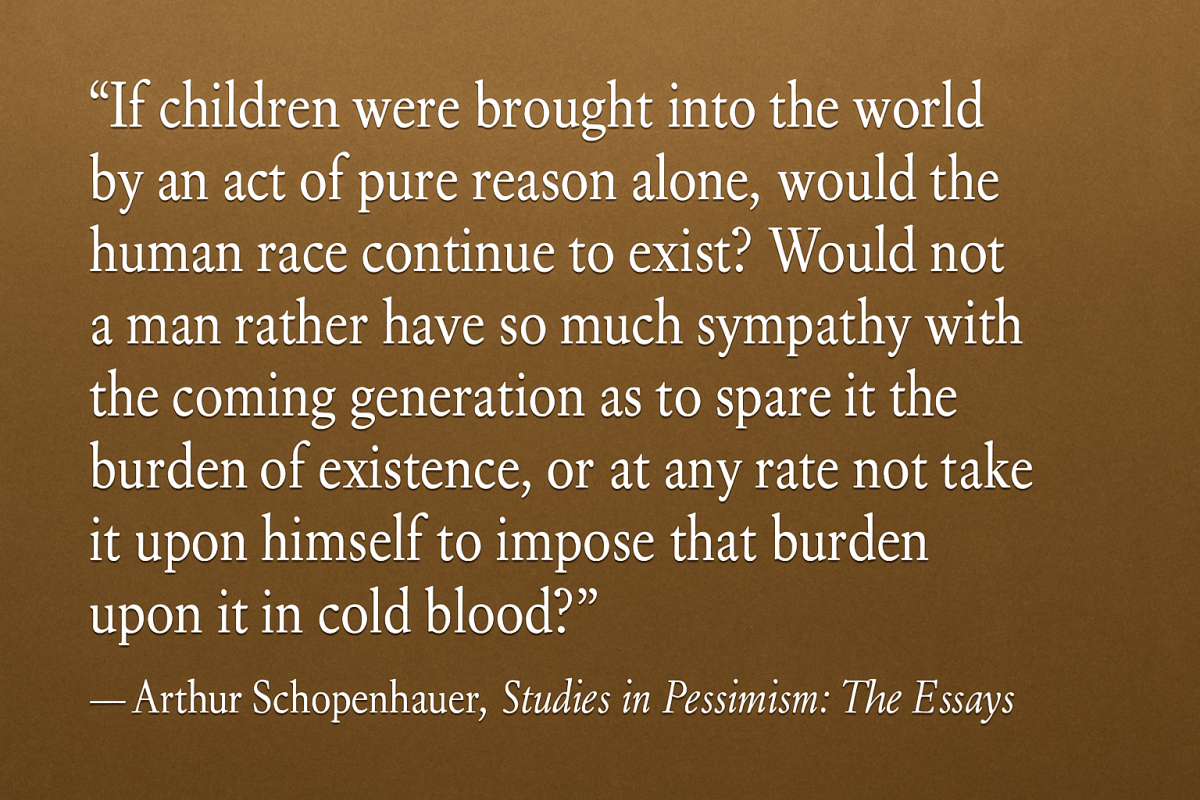
“If children were brought into the world by an act of pure reason alone, would the human race continue to exist? Would not a man rather have so much sympathy with the coming generation as to spare it the burden of existence, or at any rate not take it upon himself to impose that burden upon it in cold blood?” ― Arthur Schopenhauer, Studies in Pessimism: The Essays
Arthur Schopenhauer, that delightful black cloud over the 19th century, once asked a question too few parents – or politicians-or pro-natalists – dare entertain: If children were brought into the world by an act of pure reason alone, would the human race continue to exist?
The answer, of course, is no. Not if reason were allowed to have the steering wheel. Not if we truly grasped what existence entails: a lifelong hostage situation punctuated by moments of accidental pleasure, existential debt, and the faint scent of consumer-grade shampoo. To knowingly impose that on another, without their consent, no less, is, Schopenhauer suggests, cold-blooded. Not tragic. Not poetic. Just… callous.
And yet, we romanticise it. We shower it in clichés and bibs. We call it “a miracle” or “the greatest gift.” Gift? With what return policy? And no, a suicide hotline is not customer service.
This isn’t a call to extinction. (Though frankly, who’d notice?) It’s a call to lucidity. To question the reflex to replicate. To wonder, in quiet moments, whether “family planning” is really planning, or just the failure to look past our own narrative instincts.
If sympathy were allowed to speak louder than instinct, Schopenhauer asks, might we choose to spare the next generation from the exquisite burden of becoming? It’s not misanthropy. It’s mercy.
I’ve read Part I of Hobbes’ Leviathan and wonder what it would have been like if he filtered his thoughts through Hume or Wittgenstein. Hobbes makes Dickens read like Pollyanna. It’s an interesting historical piece, worth reading on that basis alone. It reads as if the Christian Bible had to pass through a legal review before it had been published, sapped of vigour. As bad a rap as Schopenhauer seems to get, Hobbes is the consummate Ebenezer Scrooge. Bah, humbug – you nasty, brutish, filthy animals!*
Audio: NotebookLM podcast conversation on this topic.
In any case, it got me thinking of free will and, more to the point, of will itself.
A Brief History of Humanity’s Favourite Metaphysical Scapegoat
By the time Free Will turned up to the party, the real guest of honour—the Will—had already been drinking heavily, muttering incoherently in the corner, and starting fights with anyone who made eye contact. We like to pretend that the “will” is a noble concept: the engine of our autonomy, the core of our moral selves, the brave little metaphysical organ that lets us choose kale over crisps. But in truth, it’s a bloody mess—philosophy’s equivalent of a family heirloom that no one quite understands but refuses to throw away.
So, let’s rewind. Where did this thing come from? And why, after 2,500 years of name-dropping, finger-pointing, and metaphysical gymnastics, are we still not quite sure whether we have a will, are a will, or should be suing it for damages?
Plato: Soul, Reason, and That Poor Horse
In the beginning, there was Plato, who—as with most things—half-invented the question and then wandered off before giving a straight answer. For him, the soul was a tripartite circus act: reason, spirit, and appetite. Will, as a term, didn’t get top billing—it didn’t even get its name on the poster. But the idea was there, muddling along somewhere between the charioteer (reason) and the unruly horses (desire and spiritedness).
No explicit will, mind you. Just a vague sense that the rational soul ought to be in charge, even if it had to beat the rest of itself into submission.
Aristotle: Purpose Without Pathos
Aristotle, ever the tidy-minded taxonomist, introduced prohairesis—deliberate choice—as a sort of proto-will. But again, it was all about rational calculation toward an end. Ethics was teleological, goal-oriented. You chose what aligned with eudaimonia, that smug Greek term for flourishing. Will, if it existed at all, was just reason picking out dinner options based on your telos. No inner torment, no existential rebellion—just logos in a toga.
Augustine: Sin, Suffering, and That Eternal No
Fast-forward a few hundred years, and along comes Saint Augustine, traumatised by his libido and determined to make the rest of us suffer for it. Enter voluntas: the will as the seat of choice—and the scene of the crime. Augustine is the first to really make the will bleed. He discovers he can want two incompatible things at once and feels properly appalled about it.
From this comes the classic Christian cocktail: freedom plus failure equals guilt. The will is free, but broken. It’s responsible for sin, for disobedience, for not loving God enough on Wednesdays. Thanks to Augustine, we’re stuck with the idea that the will is both the instrument of salvation and the reason we’re going to Hell.
Cheers.
Medievals: God’s Will or Yours, Pick One
The Scholastics, never ones to let an ambiguity pass unanalysed, promptly split into camps. Aquinas, ever the reasonable Dominican, says the will is subordinate to the intellect. God is rational, and so are we, mostly. But Duns Scotus and William of Ockham, the original voluntarist hooligans, argue that the will is superior—even in God. God could have made murder a virtue, they claim, and you’d just have to live with it.
From this cheerful perspective, will becomes a force of arbitrary fiat, and humans, made in God’s image, inherit the same capacity for irrational choice. The will is now more than moral; it’s metaphysical. Less reason’s servant, more chaos goblin.
Hobbes: Appetite with Delusions of Grandeur
Then along comes Thomas Hobbes, who looks at the soul and sees a wheezing machine of appetites. Will, in his famously cheery view, is simply “the last appetite before action.” No higher calling, no spiritual struggle—just the twitch that wins. Man is not a rational animal, but a selfish algorithm on legs. For Hobbes, will is where desire stumbles into motion, and morality is a polite euphemism for not getting stabbed.
Kant: The Will Gets a Makeover
Enter Immanuel Kant: powdered wig, pursed lips, and the moral rectitude of a man who scheduled his bowel movements. Kant gives us the “good will”, which acts from duty, not desire. Suddenly, the will is autonomous, rational, and morally legislative—a one-man Parliament of inner law.
It’s all terribly noble, terribly German, and entirely exhausting. For Kant, free will is not the ability to do whatever you like—it’s the capacity to choose according to moral law, even when you’d rather be asleep. The will is finally heroic—but only if it agrees to hate itself a little.
Schopenhauer: Cosmic Will, Cosmic Joke
And then the mood turns. Schopenhauer, world’s grumpiest mystic, takes Kant’s sublime will and reveals it to be a blind, thrashing, cosmic force. Will, for him, isn’t reason—it’s suffering in motion. The entire universe is will-to-live: a desperate, pointless striving that dooms us to perpetual dissatisfaction.
There is no freedom, no morality, no point. The only escape is to negate the will, preferably through aesthetic contemplation or Buddhist-like renunciation. In Schopenhauer’s world, the will is not what makes us human—it’s what makes us miserable.
Nietzsche: Transvaluation and the Will to Shout Loudest
Cue Nietzsche, who takes Schopenhauer’s howling void and says: yes, but what if we made it fabulous? For him, the will is no longer to live, but to power—to assert, to create, to impose value. “Free will” is a theologian’s fantasy, a tool of priests and moral accountants. But will itself? That’s the fire in the forge. The Übermensch doesn’t renounce the will—he rides it like a stallion into the sunset of morality.
Nietzsche doesn’t want to deny the abyss. He wants to waltz with it.
Today: Free Will and the Neuroscientific Hangover
And now? Now we’re left with compatibilists, libertarians, determinists, and neuroscientists all shouting past each other, armed with fMRI machines and TED talks. Some claim free will is an illusion, a post hoc rationalisation made by brains doing what they were always going to do. Others insist that moral responsibility requires it, even if we can’t quite locate it between the neurons.
We talk about willpower, will-to-change, political will, and free will like they’re real things. But under the hood, we’re still wrestling with the same questions Augustine posed in a North African villa: Why do I do what I don’t want to do? And more importantly, who’s doing it?
Conclusion: Where There’s a Will, There’s a Mess
From Plato’s silent horses to Nietzsche’s Dionysian pyrotechnics, the will has shape-shifted more times than a politician in an election year. It has been a rational chooser, a moral failure, a divine spark, a mechanical twitch, a cosmic torment, and an existential triumph.
Despite centuries of philosophical handwringing, what it has never been is settled.
So where there’s a will, there’s a way. But the way? Twisting, contradictory, and littered with the corpses of half-baked metaphysical systems.
Welcome to the labyrinth. Bring snacks.
* The solitary, poor, nasty, brutish, and short quote is forthcoming. Filthy animals is a nod to Home Alone.
Whilst researching a chapter on the notion of blame among hominids, I was chasing down a rabbit hole and I ended up finding Schopenhauer’s oft-quoted,
Man can do what he wants, but he cannot will what he wants
And that’s where the trouble started. Memory is fallible. Although I feel deceived, I don’t feel bad because many people have misattributed this quote to Schopenhauer, but if the Wikipedia footnote is steering me right, this was actually Einstein’s misquote—the Einstein; Albert Einstein of E = MC2 fame.
According to the citation, Albert said this:
„Der Mensch kann wohl tun, was er will, aber er kann nicht wollen, was er will.”
— Albert Einstein, Mein Glaubensbekenntnis (August 1932)
It translates into the offending sentence.
‘Man can do what he wants, but he cannot will what he wants.’
The full translated quote reads,
‘I do not believe in free will. Schopenhauer’s words: ‘Man can do what he wants, but he cannot will what he wants’ accompany me in all situations throughout my life and reconcile me with the actions of others, even if they are rather painful to me. This awareness of the lack of free will keeps me from taking myself and my fellow men too seriously as acting and deciding individuals, and from losing my temper.’
Albert Einstein
What Schopenhauer actually said not only doesn’t resonate quite so well, it doesn’t even convey the same notion. His actual words were:
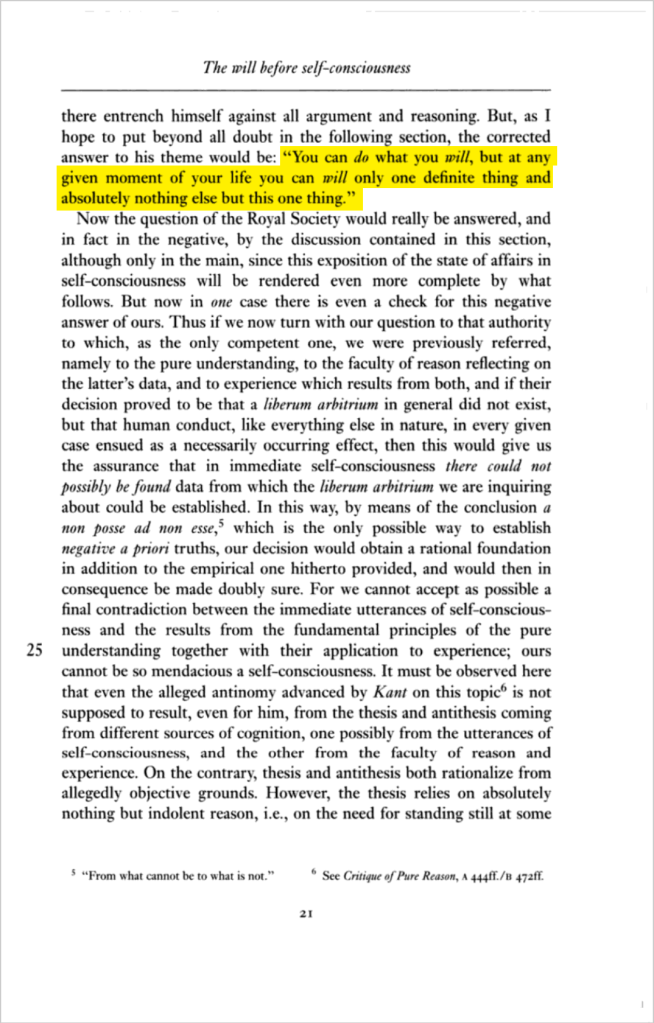
‘You can do what you will, but in any given moment of your life you can will only one definite thing and absolutely nothing other than that one thing.’
Du kannst tun was du willst: aber du kannst in jedem gegebenen Augenblick deines Lebens nur ein Bestimmtes wollen und schlechterdings nichts anderes als dieses eine.
— Arthur Shopenhauer, Ueber die Freiheit des menschlichen Willens
Arnold Schopenhauer, On the Freedom of the Will
In the spirit of misattributed quotes, here are a few things Einstein never said but are attributed to I’m anyway.
“The definition of insanity is doing the same thing over and over again and expecting different results.”
“Everyone is a genius. But if you judge a fish by its ability to climb a tree, it will live its whole life believing that it is stupid.”
Not Albert Einstein
“I refuse to believe that God plays dice with the universe.”
Not Albert Einstein
Though to be fair, the last one at least directionally reflects something he did say,
“It seems hard to sneak a look at God’s cards. But that He plays dice and uses ‘telepathic’ methods… is something that I cannot believe for a single moment.”
Albert Einstein
Yet again, I am confused. I feel I’ve been living a lie.
I just published a video on YouTube—just over 7 minutes long. I’ll be publishing the audio as a podcast and will share the script here as well.
Human Agency is an illusion. This is the end of the story. If you listen for a while, you’ll hear as I rewind and pull back the curtains.
[Redacted]
Let’s get started.
Human Agency is an illusion.
Think of life as a motion picture that’s already been filmed. The ending is already known. The script has been written and performed by actors already chosen and hired.
I like this visual, but it’s not quite right. The end is not known in the same sense as that of the movie. It’s just as inevitable, just unknown.
Some might prefer to use the metaphor of cascading dominos. And this might even play better into the illusion. Some unforeseen force might intervene and stop the otherwise inevitable. But even this is beyond our control. Like an action-adventure story, we’re strapped into a runaway train and just along for the ride. This train might someday stop, but we’ll have had nothing to do with it. Enough of metaphors. What am I saying? Why am I saying it? And what does it mean?
Allow me to set up the scene. From there, I’ll elaborate.
For millennia, there’s been a debate over free will and determinism. These terms have been defined in different ways in an attempt to sway the argument for or against, one way or another. It turns out that for the human agency illusion, it doesn’t much matter, but it might still help to set the stage, so let’s establish some foundation. I like to consider free will and determinism as bookends.
free will is the ability to make a choice and have had the ability to have chosen otherwise
Commonly, free will is the ability to make a choice and have had the ability to have chosen otherwise. That one can make this choice of their own accord or volition, is typically added for good measure. On the other hand, determinism says that everything that happens is determined by everything that has happened prior in a chain of cause and effect. Like dominoes falling one after another, so some event has caused another event since the dawn of time. Perhaps before time.
Some have argued that random events occur in our universe. Quantum theory suggests this. But that these events happen, doesn’t mean that we as humans have any say in the matter. This is what is known as indeterminism. Causes and effects are not so cut and dry. Some stochastic event serving as an exogenous factor manifesting as a pigeon, can swoop down and break the causal domino chain, but that doesn’t afford us human agency. A little more background. Some hold that free will and these alternatives are either mutually exclusive, or they’re compatible with each other. Not surprisingly, those who believe that these can coexist are called compatibilists, whilst the others are incompatibilists.
What I am saying is that if we allow that this wide shot might have validity, we can zoom in for a tight shot on the agent and notice that it doesn’t really matter. Some have said that the freewill versus alternatives challenge is a pseudo-problem. I am going to agree for the time being, if only for expedience. Before getting to the illusion of agency, let’s see why this situation creates problems.
Without getting too deep, humans seem to be wired to view their reality in a manner of cause and effect. Moreover, they seem wired to attribute blame based on this presumed causal relationship. Oksana hit a homerun. We should praise her. Raj robbed a store. We should blame him. Western society is constructed with this worldview, so we create rules and laws. We may even choose to codify how to rehabilitate or punish him. Or to reward her.
Without agency, there is no cause to praise or blame
Without agency, there is no cause to praise or blame. Whilst I consider it a pathology, for better or for worse, given the human propensity to blame concomitant with the agency illusion, I don’t see this changing any time soon.
There are arguments around quarantining bad actors independent of their agency or lack thereof on the grounds of public safety. Even this logic has serious holes, but we’ll save that for another time. And now the big reveal. With a reminder that my intent is to not go deep, how can I say that human agency is an illusion? Let’s start with the science.
As a lifeform, humans are a product of heredity, genetics, and epigenetics. Essentially, DNA passes information from generation to generation. Besides determining our physical attributes—head, shoulders, knees, and toes, potential height and weight, pigmentation, sex, and so on, it also establishes our temperament—our base attitude and way we perceive and interpret the world. This doesn’t make us clones or robots or automatons, but it does comprise some percentage of what we are. Identity politics aside, we don’t have much control of our sex, finger count, or eye colour. Clearly, we aren’t talking about trans-humans and cyborgs here.
Genetics and so on aren’t the only factor. Behaviourists will remind us that the environment and circumstances mould us, too. Each of us is taught mores and moral codes; how to behave and act. We are raised in a structure comprised of family, school, church, peers, larger society, authority figures, and whatever else—ostensibly like a sausage being stuffed into a skin.
Beyond the genetics that we have no control over, we are products of our environment
Beyond the genetics that we have no control over, we are products of our environment. These things interact, but there is nothing of us that we are responsible for creating. Despite the motivational tripe, we cannot create ourselves. This, too, is an illusion—delusion if I am being less charitable.
I’ll reserve elaboration for future content. In a nutshell, you’ve got no agency. Every choice you make is based on prior events. Even something as simple as choosing to order a chocolate or vanilla ice cream in a cup or a cone, sugar cone or waffle cone is predicated on some prior events, and you had nothing to do with them. You were a passive vessel.
I’ll leave with two relevant quotes.
A man can do what he wants, but not want what he wants.
Arthur Schopenhauer
And as Galen Strawson puts it,
You do what you do, in any given situation, because of the way you are.
So in order to be ultimately responsible for what you do, you have to be ultimately responsible for the way you are—at least in certain crucial mental respects.
But you cannot be ultimately responsible for the way you are in any respect at all.
So you cannot be ultimately responsible for what you do.
So there you have it. I hope you found this cursory treatment interesting and informative if not provocative.
[Redacted]
I’m interested in hearing what you think. Do you think you have agency? Do we have free will, or is everything determined at the start? I didn’t even mention religion. Does that throw a spanner in the works? Let me know.
Some geezer, John Gray, wrote a book having this title. It was, let us say, ‘suggested’ that I watch it in video format—over an hour-long at that. I decided to search for a summary instead.
It’s not particularly up my street. The bloke who suggested the vid posted a statement:
Atheism is a narcissistic apostasy; the adoration of the things humans do & make; the worship of the golden calves of science & technology.
When I responded thusly « This quip reduced and conflates, almost creating a strawman. I suppose some atheists might be narcissists, though I don’t see that they would significantly differ from a sample of the general population. I’m guessing the second clause is intended to connect from the first, which is to claim that an atheist is a human who chooses STEM over gods as if there are no other alternatives, which creates a false dichotomy. But to treat atheism as some monolith is to treat all religions as ostensibly identical », his response was
What is atheism?.
To which I replied, « Atheism is the absence of belief in gods (or supernatural beings, if that’s a more generalisable concept). »
well, that is not enlightening at all. Explain atheism clearly.
That is all there is to it. There are different reasons why people are atheists, but that’s the definition. Etymologically, ‘theism’ is ‘belief in a deity or deities’. Atheism, applying the Greek prefix ‘a-‘, is the negative state of ‘theism, so the absence of ‘belief in a deity or deities’.
Atheism is not science. A large number of scientists believe in God. They see no contradiction between God and science, in fact they find the order behind everything reinforces their belief.
And so here the conversation, as it was, went off the rails. At no point did I invoke science. And then he promotes the John Gray video.
Interview with John Gray on Does God Exist
And we’ve been there before.
New Atheism: the debate between science and religion was a result of confusing myths with theories. Religion is no more a primitive type of science than is art or poetry; scientific inquiry answers a demand for an explanation; the practice of religion expresses a need for meaning.
Secular Humanism: a hollowed-out version of the Christian belief in salvation in history; the widespread belief that humans are gradually improving is the central article of faith of modern humanism
Science-Religion: Gray reflects on the twentieth century’s strange faith in science – a faith that produced the false equation of evolution with progress and the racist ideologies that infect our social arrangements and political institutions
Political Religion: Modern political ideologies are de facto religions; the belief that we live in a secular age is an illusion
God-hatred: absorbed by the problem of evil; suffering, if inevitable, is at least infused with moral significance
The Unsentimental Atheisms of George Santayana and Joseph Conrad: Santayana dismisses any idea that civilization is improving; everything in this world is a progress towards death. Conrad wrote that man is a wicked animal; his wickedness has to be organized; society is essentially criminal – otherwise, it would not exist
Mystical Atheism: Schopenhauer was deeply and articulately antagonistic to religion in general; he rejects the notion that history has any metaphysical meaning, or that human beings are somehow advancing
Disclaimer 1: This summary list is copy-pasted from the linked source and edited ever so slightly to fit here.
Disclaimer 2: Neither did I watch the video nor read his book, so the summary might be off-kilter.
Still, I offer my reaction/reflection.
Firstly, this comes off not as an attack on atheism; rather, it’s an attack more particularly on Enlightenment and post-Enlightenment thinkers, predominantly Scientists—as in those who practice Scientism religiously.
Secondly, this limited attack garners the same critique as I give Dawkins’ God Delusion. I liked this book, but whereas Gray limits his attack on a thin slice of atheists—despite offering up 7 flavours—, Dawkins limits his attack to Christians; perhaps, some Abrahamic denominations. This is a particular God and particular disciples.
I address these in turn.
New Atheism: I agree that Scientism simply switched faith from God to Science or it deified Science, whichever vantage you prefer. This ilk simply swapped God for Naturalism. These are the same lot who offer up ‘Self-evident truths’ and Natural Law. Please. I agree with neither.
Secular Humanism: Whilst admittedly secular, I am not quite a Humanist and decidedly not a Secular Humanist™. Here, I disagree with the underlying teleological notion of both.
Science-Religion: The only nod I am willing to give to science is the evidence-based, falsifiability over faith, but much of science is still faith-based. It just operates from a different metanarrative. Again, Scientism is no one’s friend.
Political Religion: I agree that this is as much a scourge as organised religion. By now, one might notice a trend—a healthy does of whataboutism: We can’t suck because we’re no different to this other thing that you might be attached to. Except they are all bollox through and through. Political ideology is religion without the blatant metaphysical nod—though it is still there beneath the surface.
God-hatred: Even having not read the book, this makes no sense whatsoever. How can one hate what one doesn’t believe exists? I suppose I could hate unicorns, faeries, and Harry Potter, but I don’t think that’s the same thing. The summary suggests that it’s more about an obsession with evil, but I don’t have enough context to respond meaningfully. Do atheists actually believe in evil? I don’t. And, except idiomatically, I don’t personally know of others who do. Feels like a red herring.
Unsentimental Atheisms: Satayana refutes the Secular Humanists. I’m buying what he’s selling. Conrad is taking a spin on evil but opting to label it wicked—a bit of a drama llama. I’m not buying it.
Mystical Atheism: I like Schopenhauer—probably because he’s such an underdog. He did glean a bit from Buddhist philosophy. So have I. But Buddhism ranges from the secular to the sacred. I don’t tend to stray too far from the secular. I fully agree that history has no metaphysical meaning and human beings are not objectively advancing.
If anything, this is one of the longer posts I’ve made in a while. Thanks to the Copy-Paste Gods. Allahu Akbar, Oh Mighty. In the end, Santayana and Schopenhauer notwithstanding, I am still left with a why not neither.





 Philosophics