Perceptual Realism in Film

3–4 minutes

I watched this video so you don’t have to.

Video: Why Movies Just Don’t Feel “Real” Anymore

Only teasing. It reads as pejorative unless you catch the self-inflicted mockery baked in. This chap Tom has for film what I seem to have for language: an alarming degree of enthusiasm paired with the creeping suspicion that most of civilisation is determined to ruin the very medium we love.

I don’t actually share his fondness for film, mind you. I merely recognise the feral passion. What pulled me into this clip wasn’t cinema but dissection. The language of his breakdown dropped me neatly into my natural habitat.

I seldom watch films, television, or whatever corporate imagination-by-committee is calling itself these days. Besides being an outrageous time-sink, Sturgeon’s Law doesn’t just hold; it’s juiced up as if someone ran it through a cheap VFX plug-in. The decline in visual quality Tom describes feels depressingly familiar.

A similar aesthetic rot crept in during the digital audio shift of the ’80s. Vast new possibilities, yes, but a certain grain, a certain breath, went missing. I remember an engineering mate in ’84 being asked to record a well-known jazz artist using Sony’s shiny new digital system. He refused on technical principle, writing a blistering hand-delivered letter explaining why the end result would sound worse. He was right, of course. The label didn’t care, of course. And he walked.

The problem then resembles the problem now. Most people aren’t experiencing media in the environment it was built for. We consume films on phones, tablets, monstrous living-room billboards, or, in my case, a knackered 32-inch monitor. Half the audience barely looks at the screen anyway. They want distraction, not discernment. Some, like Tom – and to a lesser degree, me – actually notice that something in the visual vocabulary has been quietly amputated.

Perhaps that’s why I avoid the form: the predictability, the shallow craft, the sense that the whole affair is engineered for attention-drifting multitudes rather than people who actually, well, look.

Anyway, the whole point was to share the video. Naturally, I ended up editorialising. I learnt something from it. You might too.


I promise I won’t continue injecting Claude into the conversation, but this is where my brain went as I watched the linked video:

Thought Process

This is an interesting philosophical question that connects two different thinkers and concepts. Let me think through this carefully.

Charles Peirce’s indexicality refers to his theory of indexical signs – signs that point to or indicate their objects through a direct, existential connection (like “this,” “here,” “now,” “I”). These are part of his broader semiotics, where he distinguished between icons, indexes, and symbols.

Galen Strawson’s notion of episodic self-identity relates to his work on the phenomenology of the self. Strawson distinguishes between “Diachronic” and “Episodic” self-experience. Diachronic individuals experience themselves as continuous over time, with a narrative extending into past and future. Episodic individuals (like Strawson claims to be) experience themselves more in terms of discrete, present-centered episodes, without a strong sense of narrative continuity.

How might these relate?

  1. The indexical “I”: Peirce’s indexicality is crucial for how the “I” functions. The first-person pronoun is paradigmatically indexical – it picks out the speaker/thinker in the moment of utterance. For Strawson’s episodic self, each moment’s “I” might be more purely indexical, pointing to the present subject without necessarily carrying thick narrative continuity.
  2. Temporal indexicals: “Now” is also indexical. Episodic self-experience emphasizes the “now” of experience over temporal extension. The indexical nature of present-tense self-reference might support episodic rather than diachronic self-conception.
  3. Existential connection vs narrative construction: Indexical signs work through direct, causal-existential connection, not through resemblance or convention. Similarly, episodic self-experience might be more immediately indexical (this experience, now) rather than mediated through narrative construction.

This is a sophisticated question that deserves a nuanced response.

How to Avoid Reading

The Intellectual Origins of Modernity
2–3 minutes

Rather, how to optimise your time commitment to reading.

I came across a digital copy of The Intellectual Origins of Modernity by David Ohana as I was purusing titles on PhilArchive. The title piqued my interest, but I wasn’t sure I wanted to commit to reading it. What’s a bloke to do? Feed it to ChatGPT, of course.

Let’s just say, M. GPT was not amused.

Audio: NotebookLM podcast on this topic.

My first question: Is this at least tangential to my work?

Yes, it wanders. He tends to smuggle in parallel intellectual developments (Kantian autonomy, Cartesian doubt, social contract theory) even when they’re only indirectly related to his main thread. It’s a common sin in “origins of modernity” texts: the net gets cast so wide that causation and correlation start swapping costumes.

If you’re looking for the through-line, it’s probably his effort to show how early modern conceptions of reason metastasised into a moral and political framework, not just an epistemic one. But, yes — tangential is fair.

Is it more of a superficial survey with some connective tissue?

That’s a precise way to put it. Ohanav’s book reads like a well-informed synthesis—competent, even elegant—but not a deep excavation. He’s stitching together recognizable figures (Descartes, Hobbes, Locke, Kant, Hume) into a narrative arc about “modernity” rather than uncovering new terrain. The connective tissue is mostly thematic rather than argumentative: reason → autonomy → secular moral order → political liberalism.

It’s a survey that flatters the reader into thinking they’re tracing the genealogy of modern thought, but it rarely descends into the messy underlayers—say, the theological anxieties, material conditions, or institutional contexts that actually gave those ideas traction. In short: wide lens, thin soil.

Wow. Not a rousing endorsement.

So in a world of publish or perish, he’s publishing something more approachable than academic?

Exactly. It’s the kind of book that keeps tenure committees content and undergrads awake. Respectable citations, accessible prose, and a digestible thesis that flatters modernity while hinting at critique.

He’s not trying to break ground—he’s curating a gallery of the usual suspects and arranging them under good lighting. The prose carries that faint aroma of Routledge house style: serious but safe, just speculative enough to appear bold without alienating reviewers.

In the “publish or perish” economy, it’s survival by synthesis.

So closer to an undergraduate project than a grad school thesis?

Pretty much. It’s polished enough to pass for advanced scholarship if you don’t poke too hard, but structurally it’s more akin to a well-executed upper-level survey paper—ambitious in scope, cautious in depth.

He gestures toward big philosophical debates without really committing to any. The text moves like a docent through a museum: “Here we have Descartes, note his influence on Kant; over here, the Enlightenment’s moral optimism, soon to be critiqued by Nietzsche—moving on…”

You can tell he’s read widely, but the apparatus of argument—archival work, textual analysis, theoretical risk—is minimal. It’s competent, not adventurous.

OK, so dodged that bullet. I may still skim it.

Don’t do this to any of my books. 🧐🫠

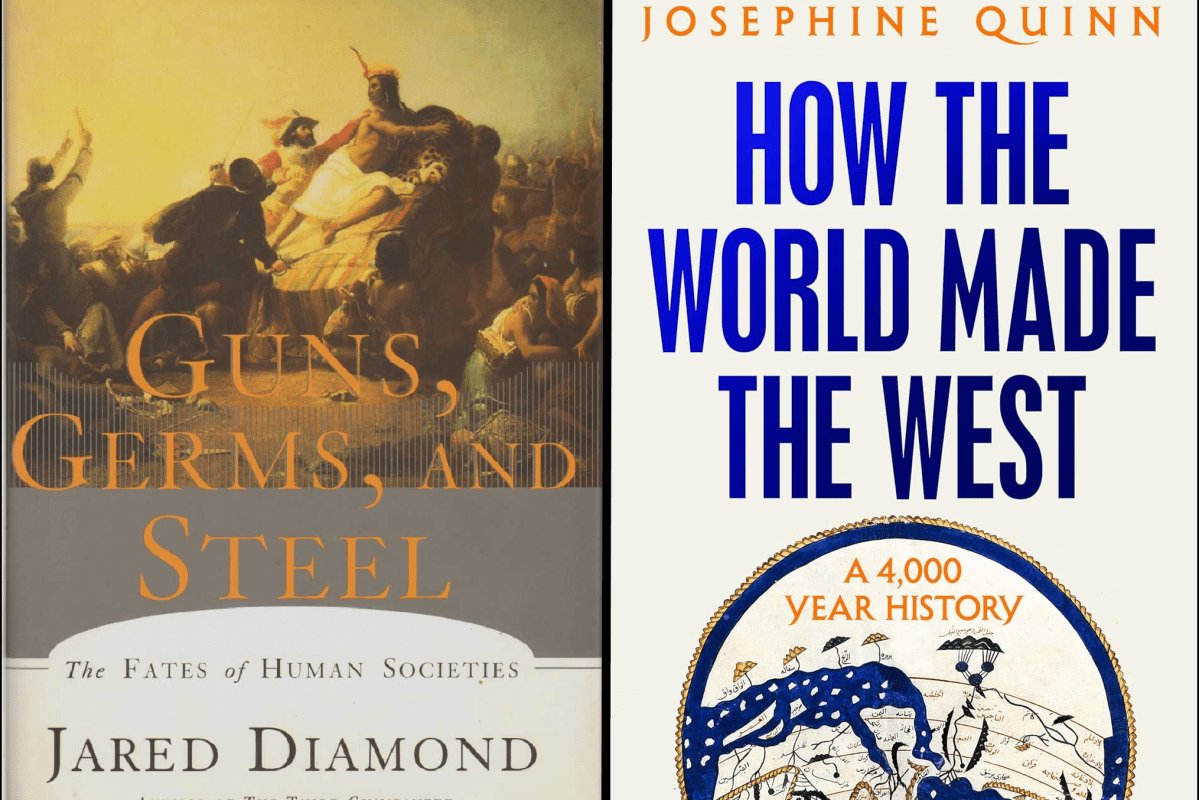
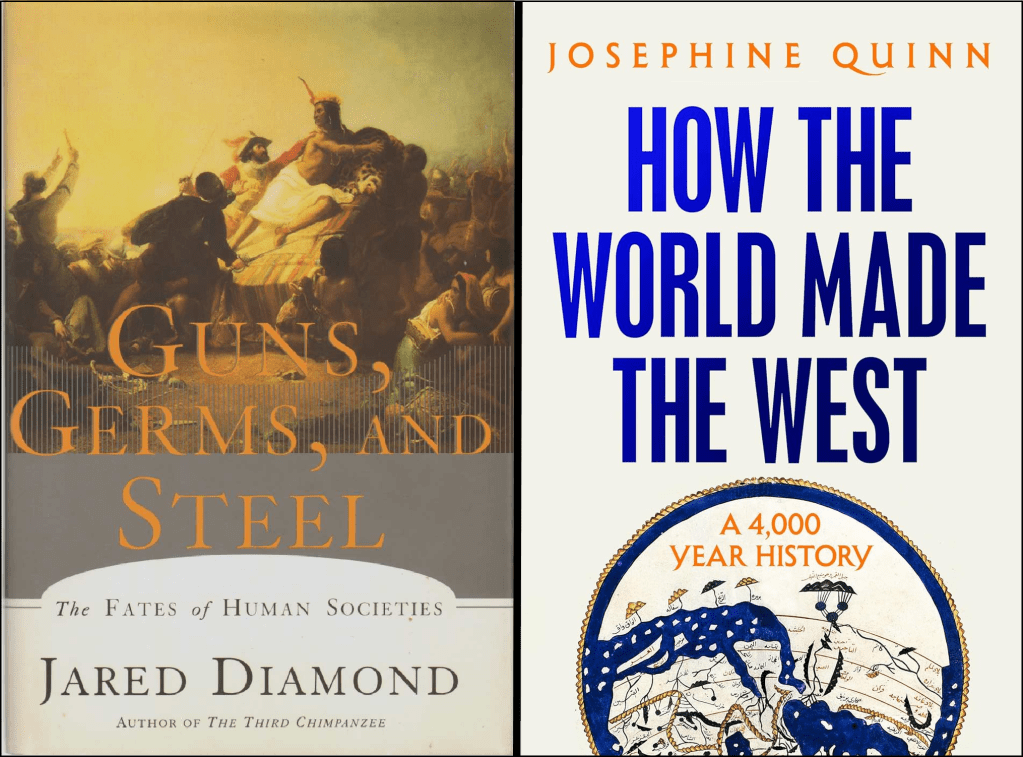
Guns, Germs, and Steel

I am reading Jared Diamond’s Guns, Germs, and Steel: The Fates of Human Societies, the first and likely most famous of an informal trilogy. I thought I had already read it, but I think I only saw the PBS show. Having recently finished Josephine Quinn’s How the World Made the West, I wanted to revisit this perspective. The two books are presented in different styles and represent different perspectives, but they seem to be complementary.

Where Diamond focuses on environmental factors (an oft-voiced critique), Quinn focuses on human agency.

Diamond takes a bird’ s-eye view, looking for universal patterns and systemic explanations, whilst Quinn adopts a granular, specific approach, highlighting the fluidity and contingency of history.

Diamond deconstructs European dominance by attributing it to environmental luck, but his narrative risks sidelining the agency of colonised peoples. Quinn critiques the very idea of Western dominance, arguing that the concept of the West itself is a myth born of appropriation and exchange.

Rather than being wholly opposed, Diamond and Quinn’s approaches might be seen as complementary. Diamond provides the structural scaffolding – the environmental and geographic conditions that shape societies – whilst Quinn fills in the cultural and human dynamics that Diamond often glosses over. Together, they represent two sides of the historiographical coin: one focusing on systemic patterns, the other on the messiness of cultural particularities.

Quinn’s approach is more aligned with The Dawn of Everything: A New History of Humanity, co-authored by David Graeber and archaeologist David Wengrow, if you can use that as a reference point.

Perfect and Relative Pitch and Reality

Perception of Reality™ is akin to having relative pitch. Unlike pitch, where some people have perfect pitch – the ability to name a note or chordal composition without any other reference – it is unlikely that anyone has or will have access to objective reality – analogically: perfect pitch for reality.

As I’ve mentioned, I believe that all our experiences and interactions with reality are relative, if not wholly subjective. There may exist an objective reality, but for reasons already noted – cognitive and sense perception deficits –, we can never access it.

Musically, If someone plays and identifies a reference note, say A (or do in movable do solfège), and then plays a major fifth above (or sol), a person with relative pitch can hear that fifth interval and identify it as an E. Everything is about relationships. In music, the relationships are intervalic, but we know where we are based on where we’ve been. A person with perfect pitch requires no such priming. They can identify the first A note without prompting.

Our experience with reality is also relative, but no one has the equivalence of perfect pitch. No one has access to objective reality – if there even is one.

I don’t deny that there could be an objective reality. I just believe it’s inaccessible. I am a qualified realist – so, not a physicalist –, but I don’t believe in supernatural or paranormal events. A so-called ‘supernatural’ event is merely an event that hasn’t yet been described in ‘natural’ terms.

Now that I got that off my chest, what are your thoughts on objective reality? Lemme know.