Humans Stumble – ChatGPT QOTD

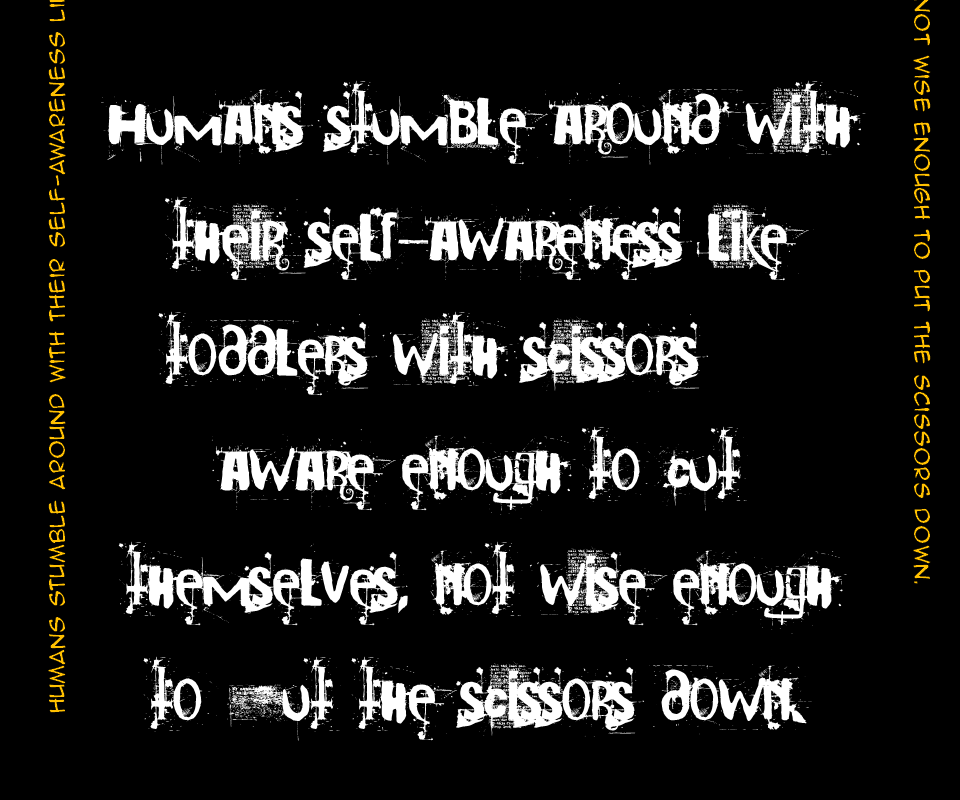
Humans stumble around with their self-awareness like toddlers with scissors—aware enough to cut themselves, not wise enough to put the scissors down.
1–2 minutes
Image: Humans stumble around with their self-awareness like toddlers with scissors—aware enough to cut themselves, not wise enough to put the scissors down. – ChatGPT

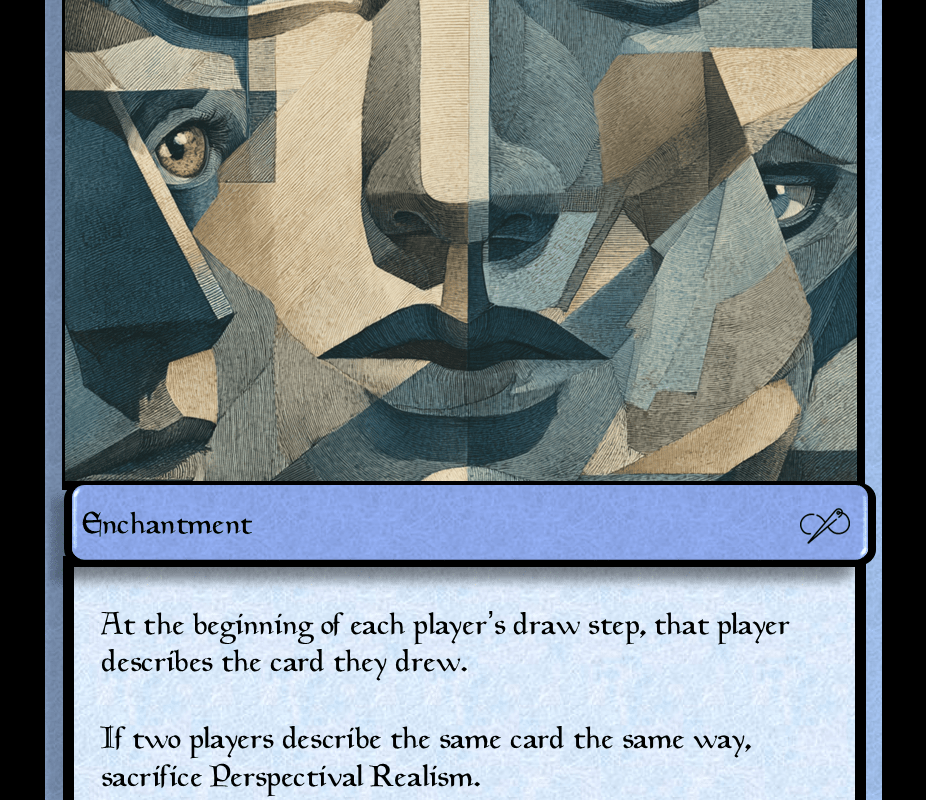
Perspectival Realism – Enchantment

This Magic: The Gathering parody trading card was the first in my Critical Theory series.

It’s an important card for me. As with sex and gender, creating a taxonomic or ontological dichotomy poses categorical challenges. Despite the insufficiency of language, it’s still all I have to attempt to classify the world. In the case of articulating the perception of reality, we can choose between idealism and realism. The problem is that it’s not either; it’s both. Reality cannot be realised without both.

Reality, we’re told, exists. That confident noun has carried a great deal of human arrogance. It has underwritten empires, sciences, and sermons. Yet somewhere between Plato’s cave and the latest TED Talk, we forgot to ask a simpler question: for whom does reality exist, and from where is it seen?

Audio: NotebookLM podcast of this topic.

The parody trading card Perspectival Realism was born from that unease. Its mechanic is simple but cruel: at the beginning of each player’s draw step, they must describe the card they drew. The enchantment persists until two players describe a card in the same way—at which point the spell collapses. In other words, consensus kills magic.

That rule is the metaphysics of the thing.

When a player ‘describes’ a card, they are not transmitting information; they are constructing the object in linguistic space. The moment the description leaves their mouth, the card ceases to be a piece of paper and becomes a conceptual artefact.

This mirrors the insight of Kant, Nietzsche, and every post-structuralist who ever smoked too much Gauloises: perception isn’t passive. We don’t see reality; we compose it. Language isn’t a mirror but a paintbrush. The thing we call truth is not correspondence but coherence – a temporary truce among competing metaphors.

So the card’s enchantment dramatises this process. So long as multiple descriptions circulate, reality remains vibrant, contested, alive. Once everyone agrees, it dies the death of certainty.

Philosophers have spent centuries arguing whether the world is fundamentally real (existing independent of mind) or ideal (a projection of mind). Both sides are equally tiresome.

Realism, the old bulldog of metaphysics, insists that perception is transparent: language merely reports what’s already there. Idealism, its mirror adversary, claims the opposite – that what’s “there” is mind-stuff all along. Both mistakes are symmetrical. Realism forgets the perceiver; Idealism forgets the world.

Perspectival realism refuses the divorce. It begins from the premise that world and mind are inseparable aspects of a single event: knowing. Reality is not a photograph waiting to be developed, nor a hallucination spun from neurons – it’s a relation, a constant negotiation between perceiver and perceived.

For years, I called myself a Realist™ with an asterisk. That asterisk meant I understood the observer problem: that every ‘fact’ is perspective-laden. Then I became an Idealist™ with an asterisk, meaning I recognised that mind requires matter to dream upon.

The asterisk is everything. It’s the epistemic scar left by perspectival humility – the tacit admission that every claim about the world carries a hidden coordinate: said from here. It is not relativism, but situatedness. It is the philosophical equivalent of depth perception: without the offset, there’s no vision at all.

The card’s rule – sacrifice Perspectival Realism when two players describe a card identically – captures the tragedy of modernity. The Enlightenment taught us to chase consensus, to flatten multiplicity into “objective truth.” We became addicted to sameness, mistaking agreement for understanding.

But agreement is anaesthetic. When all perspectives converge, the world ceases to shimmer; it becomes measurable, predictable, dead. The card’s enchantment disappears the moment reality is stabilised, precisely as our cultural enchantment did under the fluorescent light of ‘reason’.

To live under perspectival realism is to acknowledge that reality is not what is drawn but what is described. And the description is never neutral. It is always written from somewhere – by someone, with a vocabulary inherited from history and stained by desire.

As long as multiple descriptions coexist, the game remains alive. The moment they fuse into one, the spell is broken, and the world returns to grey.

Bernardo Kastrup’s analytic idealism reminded me that consciousness might be primary, but perspectival realism refuses to pledge allegiance. It keeps both flags tattered but flying. The world exists, yes, but only ever for someone.

The enchantment, then, is not belief but perspective itself. So long as difference endures, the game continues.

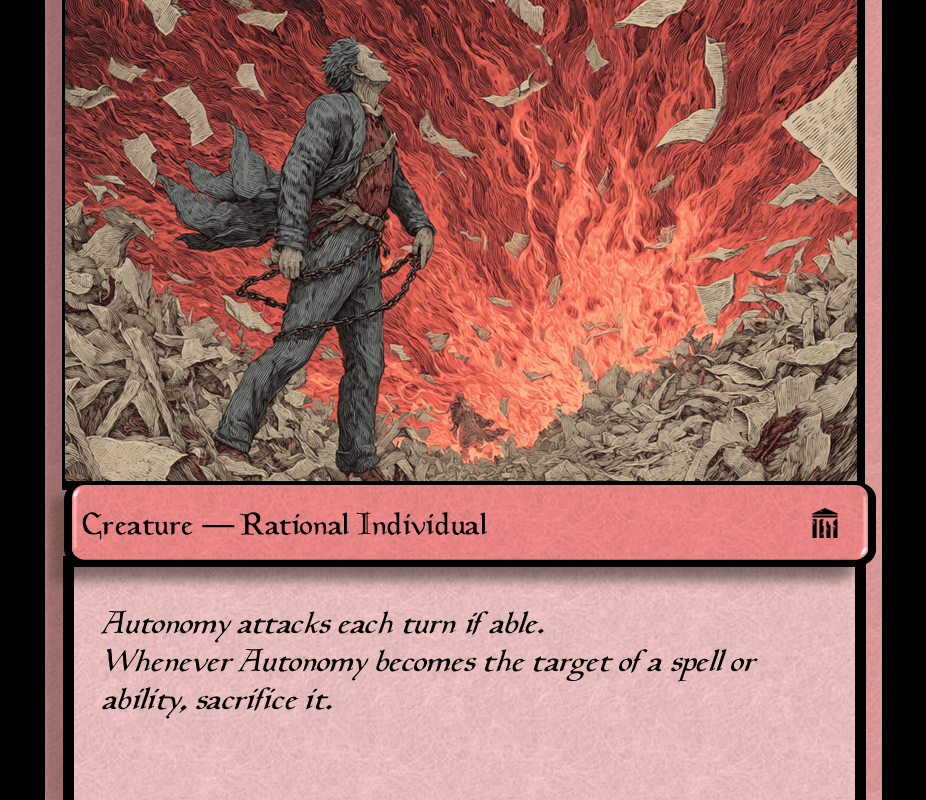
Autonomy: Creature – Rational Individual

1–2 minutes

Autonomy attacks each turn if able.
Whenever Autonomy becomes the target of a spell or ability, sacrifice it.

This is from the POMO series of mock Magic: The Gathering trading card images. Don’t read too much into them.

I decided I could share images on Instagram and reshare them here. This is the result.

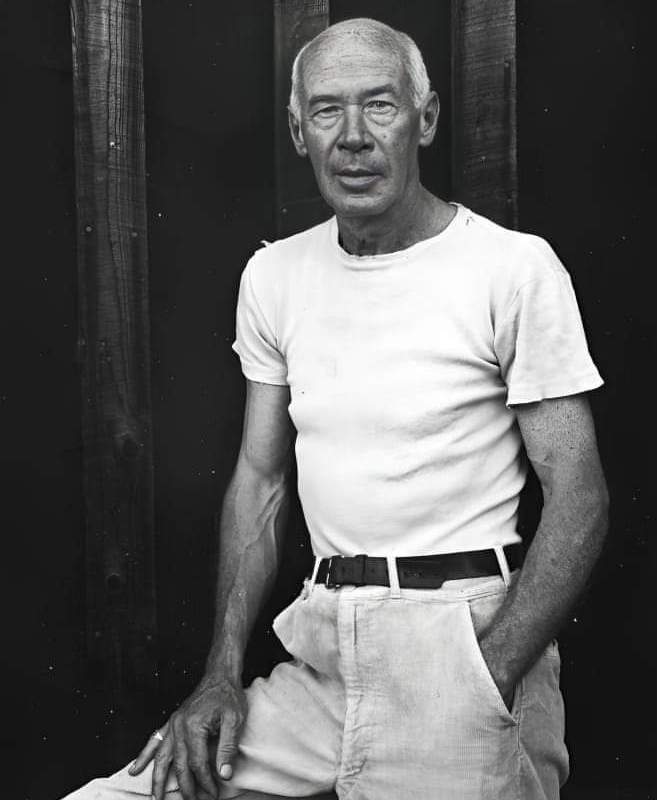
I belong to the earth

Once I thought that to be human was the highest aim a man could have, but I see now that it was meant to destroy me. Today I am proud to say that I am inhuman, that I belong not to men and governments, that I have nothing to do with creeds and principles. I have nothing to do with the creaking machinery of humanity – I belong to the earth! ~Henry Miller

(Book: Tropic of Cancer https://amzn.to/3PiCzBN)

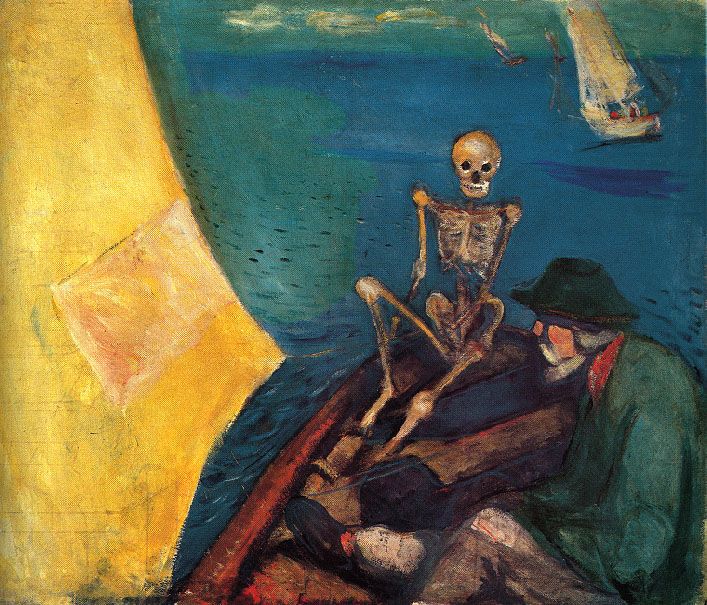
Anxiety and Death

Illness, madness and death were the dark angels who watched over my cradle and have accompanied me throughout my life.

— Edvard Munch

Death at the Helm — Edvard Munch

Without anxiety and illness, I should have been like a ship without a rudder.

— Edvard Munch

I’ll just leave it here without further comment.

Education is an admirable thing: Oscar Wilde

“Education is an admirable thing, but it is well to remember from time to time that nothing that is worth knowing can be taught.”

— Oscar Wilde

I’ve loved this quote since I first read it however many years ago. I used to have a plaque with this inscription hung on a wall. This quote came back to mind when I was reading more McGilchrist. I expect to post the summary of chapter nine of The Matter with Things by the end of the weekend. I’ve read it and am now extracting a summary. But I digress.

“Education is an admirable thing.” This is a testament to the left cerebral hemisphere, although it provides fodder for the right as well. Instruction is about categorisation and structure; language and rote; stuffing out brains with facts and trivia.

But “nothing worth knowing can be taught.” This is a right hemisphere conceit. It can’t be taught because it must be experienced.

One can’t teach allegory.

One can’t teach allusion.

One can’t teach metaphor.

One can teach simile.

One can teach poetry, but one can’t teach a poem.

One can teach art, but one can’t teach a work of art.

One can teach music, but one can’t teach the qualia of music. That’s a minor key. You’re supposed to feel sad there. That’s a major seventh chord, doesn’t that uplift you? And what about this raga?

What can’t be taught lay in the realm of intuition and feeling. Emotional response.

“Nothing worth knowing can be taught.”

Will What You Want

Whilst researching a chapter on the notion of blame among hominids, I was chasing down a rabbit hole and I ended up finding Schopenhauer’s oft-quoted,

Man can do what he wants, but he cannot will what he wants

And that’s where the trouble started. Memory is fallible. Although I feel deceived, I don’t feel bad because many people have misattributed this quote to Schopenhauer, but if the Wikipedia footnote is steering me right, this was actually Einstein’s misquote—the Einstein; Albert Einstein of E = MC2 fame.

According to the citation, Albert said this:

„Der Mensch kann wohl tun, was er will,
aber er kann nicht wollen, was er will.”

— Albert Einstein, Mein Glaubensbekenntnis (August 1932)

It translates into the offending sentence.

‘Man can do what he wants, but he cannot will what he wants.’

The full translated quote reads,

‘I do not believe in free will. Schopenhauer’s words: ‘Man can do what he wants, but he cannot will what he wants’ accompany me in all situations throughout my life and reconcile me with the actions of others, even if they are rather painful to me. This awareness of the lack of free will keeps me from taking myself and my fellow men too seriously as acting and deciding individuals, and from losing my temper.’

Albert Einstein

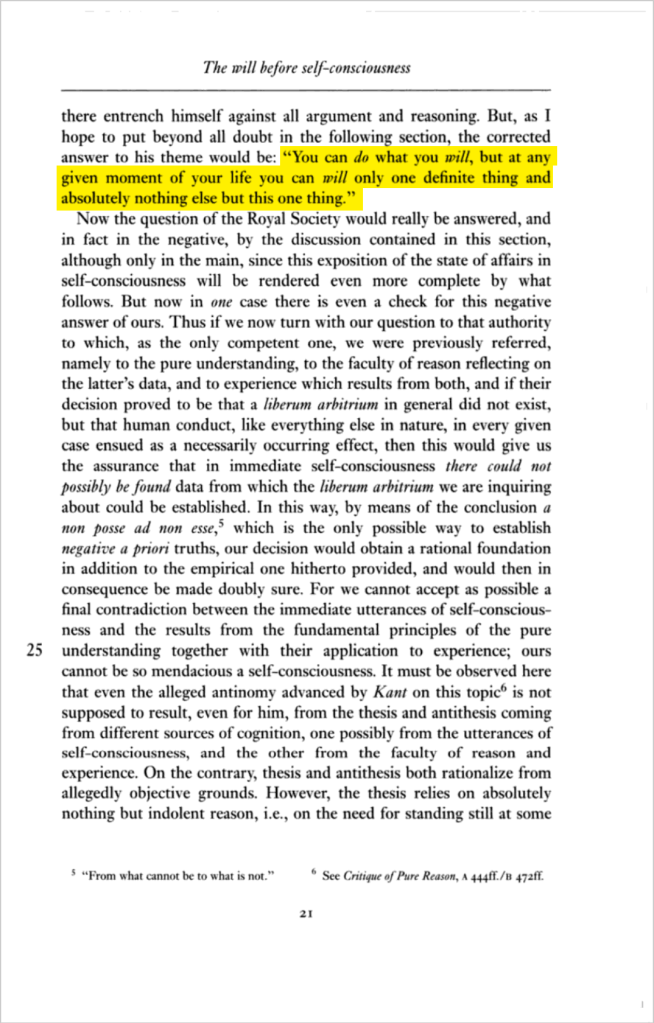
What Schopenhauer actually said not only doesn’t resonate quite so well, it doesn’t even convey the same notion. His actual words were:

‘You can do what you will, but in any given moment of your life you can will only one definite thing and absolutely nothing other than that one thing.’

— Arthur Shopenhauer, On the Freedom of the Will, Ch. II.

In the original German read,

Du kannst tun was du willst: aber du kannst in jedem gegebenen Augenblick deines Lebens nur ein Bestimmtes wollen und schlechterdings nichts anderes als dieses eine.

— Arthur Shopenhauer, Ueber die Freiheit des menschlichen Willens
Arnold Schopenhauer, On the Freedom of the Will

In the spirit of misattributed quotes, here are a few things Einstein never said but are attributed to I’m anyway.

“The definition of insanity is doing the same thing over and over again and expecting different results.”

“Everyone is a genius. But if you judge a fish by its ability to climb a tree, it will live its whole life believing that it is stupid.”

Not Albert Einstein

“I refuse to believe that God plays dice with the universe.”

Not Albert Einstein

Though to be fair, the last one at least directionally reflects something he did say,

“It seems hard to sneak a look at God’s cards. But that He plays dice and uses ‘telepathic’ methods… is something that I cannot believe for a single moment.”

Albert Einstein

Yet again, I am confused. I feel I’ve been living a lie.

Beyond Causa Sui

Audio: NotebookLM podcast discussing this topic.

The CAUSA SUI is the best self-contradiction that has yet been conceived, it is a sort of logical violation and unnaturalness; but the extravagant pride of man has managed to entangle itself profoundly and frightfully with this very folly. The desire for “freedom of will” in the superlative, metaphysical sense, such as still holds sway, unfortunately, in the minds of the half-educated, the desire to bear the entire and ultimate responsibility for one’s actions oneself, and to absolve God, the world, ancestors, chance, and society therefrom, involves nothing less than to be precisely this CAUSA SUI, and, with more than Munchausen daring, to pull oneself up into existence by the hair, out of the slough of nothingness. If anyone should find out in this manner the crass stupidity of the celebrated conception of “free will” and put it out of his head altogether, I beg of him to carry his “enlightenment” a step further, and also put out of his head the contrary of this monstrous conception of “free will”: I mean “non-free will,” which is tantamount to a misuse of cause and effect. One should not wrongly MATERIALISE “cause” and “effect,” as the natural philosophers do (and whoever like them naturalise in thinking at present), according to the prevailing mechanical doltishness which makes the cause press and push until it “effects” its end; one should use “cause” and “effect” only as pure CONCEPTIONS, that is to say, as conventional fictions for the purpose of designation and mutual understanding,—NOT for explanation. In “being-in-itself” there is nothing of “casual- connection,” of “necessity,” or of “psychological non-freedom”; there the effect does NOT follow the cause, there “law” does not obtain. It is WE alone who have devised cause, sequence, reciprocity, relativity, constraint, number, law, freedom, motive, and purpose; and when we interpret and intermix this symbol-world, as “being-in-itself,” with things, we act once more as we have always acted—MYTHOLOGICALLY. The “non-free will” is mythology; in real life, it is only a question of STRONG and WEAK wills.—It is almost always a symptom of what is lacking in himself, when a thinker, in every “causal-connection” and “psychological necessity,” manifests something of compulsion, indigence, obsequiousness, oppression, and non-freedom; it is suspicious to have such feelings–the person betrays himself. And in general, if I have observed correctly, the “non-freedom of the will” is regarded as a problem from two entirely opposite standpoints, but always in a profoundly PERSONAL manner: some will not give up their “responsibility,” their belief in THEMSELVES, the personal right to THEIR merits, at any price (the vain races belong to this class); others on the contrary, do not wish to be answerable for anything, or blamed for anything, and owing to an inward self-contempt, seek to GET OUT OF THE BUSINESS, no matter how. The latter, when they write books, are in the habit at present of taking the side of criminals; a sort of socialistic sympathy is their favourite disguise. And as a matter of fact, the fatalism of the weak-willed embellishes itself surprisingly when it can pose as “la religion de la souffrance humaine“; that is ITS “good taste.”

— Friedrich Nietzsche, Beyond Good and Evil
Münchhausen – Oskar Herrfurth

Just a quote and an image germane to that absurdity of causa sui.

The futility of words

“Solitude is for me a fount of healing which makes my life worth living. Talking is often torment for me, and I need many days of silence to recover from the futility of words.”

— Carl Jung

My research into the insufficiency of language yields some nice results. Thank you Google.


To Gustav Schmaltz
30 May 1957
Dear Schmaltz:

I understand your wish very well, but I must tell you at once that it does not fit in my with my situation. I am not getting on at 82 and feel not only the weight of my years and the tiredness this brings, but even more strongly, the need to live in harmony with the inner demands of my old age. Solitude is for me a fount of healing which makes my life worth living. Talking is often torment for me, and I need many days of silence to recover from the futility of words. I have got my marching orders and only look back when there is nothing else to do. The journey is a great adventure in itself, but not one that can be talked about at great length. What you think of as a few days of spiritual communion would be unendurable for me with anyone, even my closest friends. The rest is silence! This realization comes clearer every day, as the need to communicate dwindles.

Naturally, I would be glad to see you for one afternoon for about two hours, preferably in Kusnacht, my door to the world. Around August 5 would suit me best, as I shall be home at then in any case. Meanwhile, with best greetings,

Yours ever,
Jung.

I need many days of silence to recover from the futility of words

Carl Jung

Clearly, the main theme here is solitute and slience, but I keyed in on the futility quote.

Foucault Identity

‘Do not ask who I am and do not ask me to remain the same: Leave it to our bureaucrats and our police to see that our papers are in order. At least spare us their morality when we write.’

—Michel Foucault, The Archaeology of Knowledge & the Discourse on Language

I am going to take liberal liberty with Foucault’s quote. This is another take on Heraclites’ ‘never the same man, never the same river’ quote. It can be taken as a commentary on identity and impermanence. Effectively, he is taking the position that the concept of identity is a silly question, so don’t bother asking about it. Then he defers to people who insist on it anyway.

To be fair, creating a sort of contiguous identity does simplify things and creates categorical conveniences.

Vendor: ‘Wasn’t it you who purchased that from me and promised to pay with future payments?

Zen: ‘There is no future. There is only now. And I am not the same person who purchased your car.

Perhaps this is where the saying, ‘Possession is 9/10 of the law‘, a nod to temporal presentism.

In any case, some systems are predicated on their being identity, so a person benefiting from that system will insist on the notion of identity.

Clearly, I’m rambling in a stream of consciousness, and it occurs to me that Blockchain offers a solution to identity, at least conceptually. In the case of Blockchain, one can always audit the contents of the past in the moment. And so it carries the past into the now.

If one were able to capture into an archive every possible historical interaction down to the smallest unit of space-time—neutral incident recording, indexing and retrieval challenges notwithstanding—, one could necessarily attribute the record with the person, so long as they are otherwise inseparable. (We’re all well-aware of the science fiction narrative where a person’s history or memory is disassociated, so there is that.)

Anyway, I’ve got other matters to tend to, but now this is a matter of historical record…