The Matter with Things: Chapter Ten Summary: What Is Truth?

In this first chapter of the second section of The Matter with Things, Iain McGilchrist asks, What is Truth? Section two has a different focus than the first, which was focused on foundation building. From here on in, he wants to build on this foundation.

Check out the table of contents for this series of summaries. Note that I have rendered my interstitial commentaries in grey boxes with red text, so the reader can skip over and just focus on the chapter summary.

At first, he establishes that each hemisphere ‘thinks’ it knows the true truth and has the best vantage on reality. He makes it clear that a short chapter will not do the topic of truth the justice he feels it deserves and notes that others have written books on the matter. He just wants to make a few points and clarify his position.

As we discovered in the first section, the left and right hemispheres perceive the world differently. The right hemisphere experiences the world as it is presented in a Gestalt manner. This is contrasted by the left hemisphere which views the world as a symbolic re-presentation. It’s not unfair to say that the right hemisphere experiences the world directly whilst the left hemisphere views a cache of the world.

In this chapter, McGilchrist (Iain) attempts to convince the reader that one side is more correct or correct more often than the other and so is more veridical. As he says, the left hemisphere ‘is a good servant but a poor master’. Of course, if we had a third hemisphere [sic], we might think it could mediate the other two, but then we’d need a fourth and a fifth, ad infinitum to act as the new arbiter.

Spoiler Alert: The right hemisphere wins the battle on truth pretty much hands down.

He wants to make it clear to the reader that he is no strict idealist. There is a reality ‘out there’ apart from mental processes that objectively exists even in the absence of a subject. Reality is not exclusively a projection of the brain.

His choice rather relies on the correspondence theory of truth, which is to say that the hemisphere that conveys perceptions more correspondent to our perceived reality would be more veridical.

Here, I challenge his reasoning on two accounts. In the first place,each hemisphere may operate better in one context versus another. In the second case, there may be a consequential factor, which again distils down to context. In risk management, there are notions of probability of failure and consequence of failure. For example, a failure to recognise the truth of a matter (we’ll use truth as a proxy for ‘fact’), may be inconsequential. If I am assessing the probability of a pipe bursting in a nuclear facility and the pipe is connected to a sink to deliver tap water, the consequence of this failure is practically insignificant. But if I am assessing the probability of a pipe containing radioactive materials, even if the probability of failure is low, the consequence of failure may be catastrophic.

Evolutionarily speaking, if you mistake a garden hose for a venomous snake, the consequence of failure is trivial. Turn the tables, and mistake a snake for a garden hose, the consequence may be fatal. I am not attempting to claim that one hemisphere interprets the low consequence scenario and the other interprets the high. I simply want to raise this nuance.

He makes the point that if we compare some known authentic object to a recollection, we want to retain the one that is more accurate.

I see a similar challenge. Hypothetically, let’s say I present a red disc and manipulate the hemispheres to activate only one at a time, asking to recall the object. If the left says it’s red and the right says it’s a disc, which is more correct? Again, I am not claiming that this is a real scenario, but if one side possesses facts unavailable to the other side, we’ve got a problem in making a truth claim.

To reiterate, the left hemisphere is more analogous to a photograph or a video account whereas the right hemisphere is to be in the place that is being photographed. The right hemisphere is duratively presenced whilst the left is re-presented. We move from a nominative form to a verbial form of representing reality. This leads him to ask if ‘truth’ is a thing or a process.

He shifts to a linguistic argument. When people view ‘truth’ as a noun, as a thing, the expectation is that it is static. Moreover, the descriptors of truth are rendered mainly in the past tense—representation, fact, perfect, precise, certain, and concluded. He provides definitions. When viewed duratively, ‘truth’ becomes a process. It is an active relationship. It flows. It’s an intercourse.

We may not ever get to an agreed truth, but neither is every position valid. Interpreting a text, for example, may have several conflicting meanings, but the possible meanings are relatively finite.

Take a simple sentence such as, “The dog bit the hand that feeds him.” This could be meant literally or figuratively. We might imagine different dogs, hands and person to whom the hand is attached. Perhaps the hand is attached to a bonobo. Perhaps, it’s a robotic hand. These are among various possible interpretations, and we may not ever agree on the truth of the matter. However, we can rule out that a giraffe or a watermelon were central to this narrative for what it’s worth.

The bookgoes on to discuss the etymology of the word ‘truth’ and of its relationship to the word ‘true’ (faithful) which is further related to ‘trust’. I won’t exhaust his explanation.

He does discuss correspondence and coherence theories of truth and discounts others such as consensus theory and social constructivism. He cautions not to equate truth with correctness. This is a left hemisphere game insisting on dichotomising things.

The book declares the despite a general agreement on the source or nature of truth, there is something there, so don’t give up un it. In the end, he seems to settle for a Pragmatistic version à la William James.

Personally, I feel he and others are over-invested in the nature of truth. And inflate its meaning over ‘fact’. To me, Capital-T Truth is an archetype, but it doesn’t otherwise exist. We have facts, and truth is sort of a perfect version of a fact. Love is in the same category, though I know Iain would disagree with this assertion. Of course, James dismissed semantic argument as petty and insisted that people simply know the truth of something. I’ve always found this take to be dismissive. I also feel that Pragmatism is too steeped in Empiricism and loses hold of the notion that what happened yesterday may not in fact manifest today or not in the same way.

I’ll also argue as others have before me that (besides being archetypal) the term is a redundant filler word. On a minuscule level, if I say ‘The cup is red’, saying ,’It’s true that the cup is red adds nothing’. The equation was already asserted. This leaves one to wonder what the purpose of it is.

Returnng to the asymmetry of the hemispheres he cautions up not to take a position that one of the other side is correct. Rather, even though there is an asymmetry in value, there is still a synthesis.

Iain uses the example of Newtonian and Einsteinian physics. At one point, they are practically synonymous and interchangeable. Only as we reach the speed of light does Newtonian physic exceed the bounds of its scope. He also educated the reader on the difference between precision and accuracy.

I like to view this in a musical context. If I play two notes together, say a B over an E, neither is more correct than the other. Notionally, I am playing an E5/B. This is neither an E or a B. The chord is the result of the two playing simultaneously. In this case E and B are both true and not true because the E5 is a synthesis. If I add a G# I get an E-major chord, subsequently adding a D renders an E7. In each of these cases, the truth of the notes, B, D, E, and G# remain true to their identity, but the fact is that the individuality is subsumed by the collective. This is the prevailing truth even though a person with perfect pitch can still individually identify the constituents of the chord. I don’t know if this is more confusion than necessary, but it helps me.

I’ve always like this illustration with target grouping, but this was not referenced by the book.
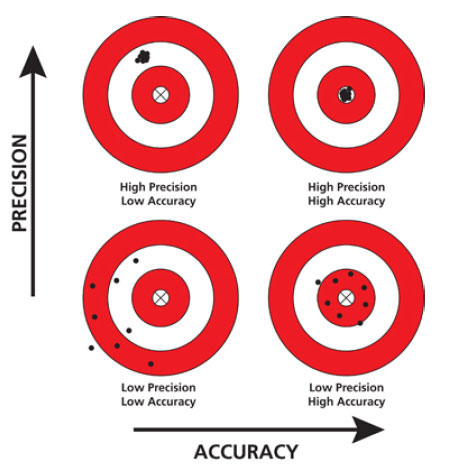
Image: Precision and Accuracy Chart

Interestingly, he cites Jay Zwicky’s definition: “Truth is the asymptotic limit of sensitive attempts to be responsible to our actual experience of the world … ‘sensitive attempts to be responsible’ means truth is the result of attention. (As opposed to inspection.) Of looking informed by love. Of really looking.” He accedes that there are degrees of truth.

Truth is the asymptotic limit of sensitive attempts to be responsible to our actual experience of the world

Jay Zwicky

This asymptosis is how I describe Truth in my Truth about Truth post.

As the chapter comes to a close, he leaves us with a twisted categorical syllogism,

  • [p1] All monkeys climb trees
  • [p2] The porcupine in a monkey
  • [ c ] The porcupine climes trees

This structure presents a valid argument. However, it is not sound. It follows the Socratic logical syntax:

  • [p1] M a P
  • [p2] S a M
  • [ c [ S a P

Because of our exposure to and experience with the external world, we can assess this argument to be unsound, which is to say untrue by observation. Without this context, we could not render this assessment. He discusses the way right- and left-hemisphere occluded subjects respond to this discrepancy. In summary, an isolated left hemisphere with defend the logical syntax over the lived experience.

In conclusion, the hemispheres take different paths to assess truth and often end up at different destinations. The left hemisphere sees truth as a thing whilst the right views it as a process.
Unwitting Carnivores?

Children are ethically indisposed to think it’s wrong to eat animals. This article from the Journal of Environmental Psychology published a year ago looks into the schism and cognitive dissonance assuaging mechanisms in play.

This study relied on a small sample size (n=176), between the ages of 4 and 7 years living in a metropolitan area located in the southeastern region of the United States. The sample was otherwise diverse.

As this study was limited in geographic scope (see WIERD on a tangential note), it noted that eating habits vary by culture. For example, eating horse (or dog) meat is not condoned in the United States, but it is acceptable in many other places.

In summary, the childer were shown cards each with a picture of an item, whether a French fry, a horse, a cat, a fish, a tomato, and so on. At the start, they were asked to identify the item represented on the card. Next, they were asked to put the card into one of two bins, each decorated to approximate an animal or vegetation. Finally, they were asked to sort the cards into two areas, one represented by false teeth indicating edible products and a rubbish bin representing inedible items.

The subjects did a fair job of identifying the card items. They had very high image recognition of these particular animals. On the lower end of recognition were hamburger (ground beef patty), almonds, and shrimp. There was a difference between the older children and the younger children, but this may relate to the added acculturation their age would bring.

Without delving deeply into details, in this study, most 6- and 7-year-olds classified chicken, cows, and pigs as not OK to eat. The interesting cognitive trick is that these children also classified these derivative food items as non-animals thus removing the cognitive dissonance. No longer classified as an animal, their ethical framework remained internally coherent.

In discussing the results, many children were ill-informed about the source of various food products. Language games obscured the source. No one should eat a cow, but beef is fine—a hamburger is fine. Hot dogs grow on trees, don’t they?

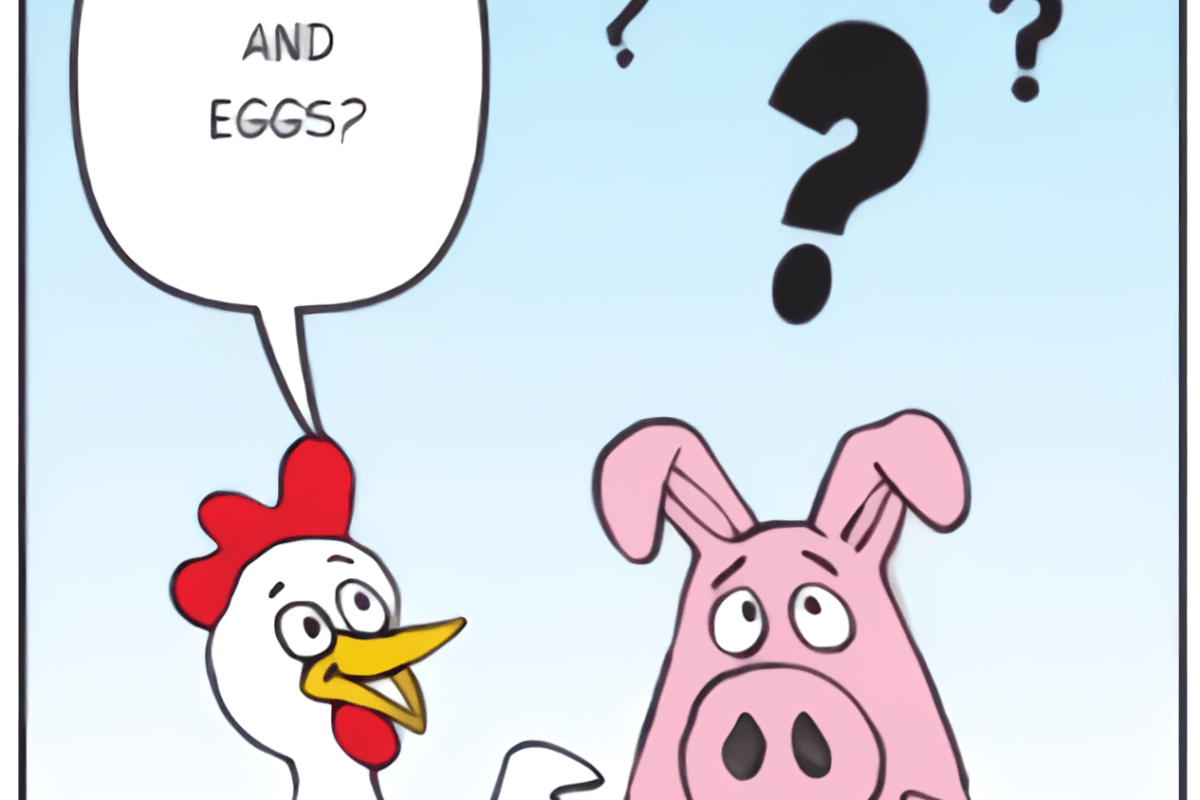
This reminds me of the story wherein a chicken and a pig are conversing, and the chicken suggests that it and the pig go into the restaurant business. The pig considers the proposition and declines by the rationale that it would be committed but the chicken would only be involved. Children may believe that hot dogs are a by-product like eggs, fur, or feathers—don’t get me started on the down used in pillows, jackets, and comforters—rather than grasping that the animals yield these products at the expense of their lives.

Some people grow up and realise the inconsistency of their ethics and actions, but they find any number of ways to reconcile their actions, noting that the activity is normal and natural.

FULL: DISCLOSURE: For the record, I eat chicken, turkey (on festive holidays in lieu of chicken), and I eat beef (that’s cows, for the uninformed). I also consume some animal byproducts, i.e., chicken eggs and cheese. I also wear leather. I was a vegetarian for about three years until I opted to become a chickenatarian. My life partners goaded me into eating beef, and so I’ve since added that. In all cases, I feel bad for eating defenceless, sentient beings. I’m not sure it serves as any consolation that I limit my consumption to these three animals—or even if it were only one. For the record, I don’t particularly like the taste of turkey or beef, but it’s not offensive like pork, coffee, or alcohol. Chicken, I like. Sorry chickens.

Video: Homer Simpson’s (not so) ethical dilemma

For the record, this is post number 500 on Philosophics. Perhaps I should write a post about it.

John Vervaeke and Lex Fridman on the Meaning Crisis

jimoeba mentioned that he enjoyed an interview with Vervake and Fridman in a comment, so I thought I’d give it a listen. It turns out there are several including a 3-plus-hour version. Arbitrarily, I chose this one. Even if it’s not the particular interview on the meaning crisis, it gives me a sense of the two and their dynamics. I’m glad I listened to it. I like Vervaeke. I can’t say I’m much of a Fridman fan on first listen.

John Vervaeke and Lex Fridman interview: Human civilisation is facing a meaning crisis

This interview content provides an orientation of where Vervaeke is coming from. It helps to clarify his position. His claim seems to be that many people today identify as having no religion but being spiritual. By extension, he posits that this cohort is searching for meaning. I can’t disagree. What it tells me is that I am not in his target demographic. I have no religion, as I am an atheist. I have no spiritual void to fill. This is Vervaeke’s goal—to find something to perform the function of the religion without the, perhaps, baggage and dogma.

I sympathise with his goal. He brings up Nietzsche’s “God is dead” quote, famous or infamous depending on your worldview. Essentially, he wants to answer Nietzsche’s query of what to do now that it’s been revealed that humans created God, not the other way around. His aim is to replace the font of wisdom for this generation.

For me, wisdom is a heuristic, part of the Gestalt McGilchrist mentions. McGilchrist’s work is even referenced here. Of course, I interpret McGilchrist’s references in this space to be metaphorical. It seems that he views it as ‘real’. I’m not sure where Vervaeke places it. Somehow, I feel that if there is a spectrum, Vervaeke leans closer to McGilchrist than me, and that’s OK. They just happen to be wrong.

I still don’t get the need for meaning. I don’t feel despondent that there is no inherent meaning in anything, but we are free to invite or adopt one or many. I remember a Christian mate of mine who explained that people have a God-sized hole that can only be filled by God. Essentially, Vervaeke is making a similar claim, but his void is filled by wisdom. I suppose that I don’t feel I have a void doesn’t mean there isn’t one.

Weird, That

I’m not a fan of psychology as a discipline, so this WEIRD phenomenon comes as no surprise. In fact, it’s not even that new. If memory serves, I think I first stumbled upon the notion from Jonathan Haidt.

WEIRD—Western, Educated, Industrialised, Rich, and Democratic.

WEIRD is the bias underpinning most university psychology studies—the ones that make the best memes and we tend to recite. The problem is that a vast majority of psych subjects are WEIRD—Western, Educated, Industrialised, Rich, and Democratic. There is a marked selection bias, so the composition tends to be gullible first-year psych students. As even a neophyte in statistical methods will tell you that random samples are a key ingredient of a decent social study, and a broad demographic base is another.

But, “So what?”, you say. The problem is that these students are not only not a good representational cross-section, they’re actually outliers, which is to say statistically nothing like the average world citizen. So whilst these studies do reveal certain psychological propensities, they are of this subgroup.

Common sense is not so common

— Voltaire

By extension, this means, as per Voltaire’s quip about common sense, if you have been taught that a person behaves like this, you should immediately flip that on its head and presume that the ordination non-WEIRDo would behave contrariwise.

The bigger problem is that the US having only five per cent of the global population has the tendency to be jingoistic and wants to impose its worldview on the rest, but it often if not almost always doesn’t realise that the world is not like them and doesn’t necessarily want to be like them. Moreover, Americans tend to believe they are better and better off than the rest of the world. of course, through their own lens, perhaps they are, but this is a minority lens with a minority view. People in the US don’t tend to get out much, and when they do it’s as tourists like visiting a zoo rather than trying to acculturate, so most world travelling doesn’t realise the opportunity it otherwise might have.

Deconstructing WIERD, the Western portion is beyond obvious. This would remain a factor even if studies weren’t restricted to undergrads. Educated is a bit of an odd one. Who knows how many student progress beyond their first year? But they are industrialised. I’d argue perhaps postindustralised. Rich is an interesting notion I’ll come back to in a moment, and their democracy is in name only, though I know where they are coming from.

Returning to Rich, the mean income of a family in the US in 2021 was $97,962. The median was $69,717. Statistically, what this indicates is that there are a few high wage-earners skewing the figure from the median. This phenomenon is known all too well. Somehow, I feel this has a sort of halo or affiliation effect, similar to the feeling a city has when its sports team wins a championship. Even the poor people feel they are part of the prosperity that by and large spits on them and holds them down. These people are indoctrinated with this WEIRD pseudoscience.

I don’t have much more to say. I’ve been distracted and have been writing this since yesterday. Weird, that.

Search for Meaning

Ever since encountering Viktor Frankl’s Man’s Search for Meaning in my youth, I’ve pondered why people search for and indeed invent meaning. By meaning, I am speaking in terms of finding a higher purpose or some spiritual affinity rather than the meaning of why bad things happen, though there are undoubtedly some intersections of the concepts.

This lecture, Ep. 39 – Awakening from the Meaning Crisis – The Religion of No Religion, from a series by John Vervaeke was recommended to an associate in my social network by another trusted associate, and it’s got me going. I’ve long been a nihilist and existentialist. I am even partial to aspects of the philosophic framework of Zen Buddhism. But I’ve never felt there was some higher meaning or raison d’être that isn’t self-imposed. How else would it be imposed? A person may be indoctrinated, but in the end, ignorance is no excuse from self-imposition.

I guess I can’t quite understand what drives this search for meaning. As Vervaeke notes, even some noted atheists like Richard Dawkins have suggested that we should find a secular proxy for the religion—or the namesake religion of no religion. I understand the social function of religion as well as some psychological functions, but the disconnect for me is that I have no such drive. I am admittedly an introvert, so whilst I admit the need for social cohesion and coöperation, I don’t understand the fabrication of religions or the personal, not only belief in meaning, but a yearning for it and even a belief that one has found it.

some people don’t search for meaning so much as they feel they have discovered meaning, but when their discovered meaning doesn’t jibe with another’s discovered meaning, the result is a search to justify or reconcile this conflict

I am empathetic to people like Iain McGilchrist who asserts that there is exogenous meaning out there to be had. He’d probably also assert that asking for proof is a left-hemisphere cerebral request but that absent the imposition by the left hemisphere, one would just feel it and know it. I just can’t abide.

Vervaeke does touch on the postmodern critique of religion as a power play, which is how I feel about it, but this is about the social aspect and doesn’t touch on the personal search for meaning. What I can’t say is whether a person would have this drive to search for meaning if they were either absent socialisation or exposed only to people who are not going to suggest meaning. I understand that previous generations have shown this propensity, but are there cultures that don’t? And is there a common thread to those who do?

In the past, many cultures have asserted gods and higher powers (whether or not as a power play), but could this simply prompt the people to search for alternative meanings, perhaps having noticed the dissonance between certain dogma and their lived lives?

Interestingly, some people don’t search for meaning so much as they feel they have discovered meaning, but when their discovered meaning doesn’t jibe with another’s discovered meaning, the result is a search to justify or reconcile this conflict.

It’s late. Time to retire for the evening. I have none of these answers, but I will jot the questions down on my to-do list just above the search for meaning.

Retributive Injustice

I’ve already said that justice is a weasel word, but let’s pretend that it’s actually something more substantial and perhaps even real. I’ve spoken on the notion of blame as well. I have been thinking about how untenable retributive justice is and it seems to include restorative justice, too. But let’s focus on the retributive variety for now.

In short, retributive justice is getting the punishment one deserves, and I think desert is the weak link. Without even delving into causa sui territory, I feel there are two possible deserving parties. The agent and society. Let’s regard these in turn.

The Agent

An agent, or more specifically moral agents, are entities that can be deemed responsible for their actions on moral grounds. Typically, moral agency assumes that an agent, an actor, is fully aware of the cultural rules of a given society, whether norms or legislated. Under this rationale, we tend to exclude inanimate objects with no agency, non-human life forms, children, and persons with diminished cognitive faculties. In some cases, this diminution may have been self-imposed as in the case of chemically induced impairment, for example by drugs or alcohol. We might consider these entities as being broken. In any case, they do not qualify as having agency. An otherwise moral agent until duress or coercion may no longer be expected to retain agency.

Unless an informed and unimpaired agent commits an act with intent … there can be no moral desert

Unless an informed and unimpaired agent commits an act with intent, another weasely word in its own right, there can be no moral desert. But let’s hold this thought for a bit and turn our attention to society.

Society

For the purposes of this commentary, society is a group of like-minded persons who have created norms, customs, laws, and regulations. In most cases, people come into societies whose structure is already formed, and they need to acculturate and adapt, as changing the fabric of society generally takes time. Even in the case of warfare where a society is subsumed, cultural norms will persist for at least a time.

Whilst it is incumbent for a person to become aware of the rules of engagement and interaction with a society, this is reciprocally a responsibility of society to impart its norms through signalling and performance as well as through more formal training, such as public fora, schools, and activities. Even media and entertainment can serve to reinforce this function.

So What?

I argue that retributive justice is bullshit (to employ technical language) is because if an informed and unimpaired agent does violate some standard or protocol, the society is at least partially to blame—perhaps fully so. Again, if the person is not unimpaired, a pivotal question might be why is s/he uninformed? If the person has the information but ignores it, to what extent is the person impaired and what responsibility does society have for being unaware?

Special Case?

What if a particularly predacious person from Society A infiltrates Society B? Is the person broken or is Society A responsible to creating a person that would prey on some other unsuspecting society? Again, the person is never entirely responsible unless s/he is broke, in which case, s/he is exempt and not morally responsible.

When Then?

As I’ve said before, a person who commits an act against the interest of a society may be quarantined or perhaps exiled or shunned as some cultures practice, but these are meant to preserve the cohesion of the society and not meant to exact a point of flesh in retribution.

In the end, I just don’t see a use case where retribution would fall upon a single actor. If some transgression is made, how then do we ensure society pays its dues as well? In my mind, society is more apt to fail the individual than the other way around, but maybe that’s just me and my world.

What am I missing here?

The Matter with Things: Chapter Twenty Summary: The coincidentia oppositorum

I have a confession to make. I finished reading the first volume of The Matter with Things about a month ago, and I took a break from reading more of it. I finally got around to continuing, and I read chapter twenty. When I got to the end and turned to the next chapter—chapter twenty-one—, it dawned on me that volume I ended at chapter nine. I had inadvertently skipped volume II and began volume III. Oopsie. I’m lucky it wasn’t a novel, having skipped ten chapters.

Since I’ve read it, I might as well summarise it, Spoiler alert: there are no spoilers to alert. As this chapter is more about exposition and colour, this summary will be much shorter than the summaries of the first volume. I don’t know if this will be a continuing trend. We’ll find out together.

This chapter is labelled the coincidentia oppositorum, the coincidence of opposites. Effectively, the chapter wants to impart three main points.

Symmetry

Firstly, asymmetry is the norm. Symmetry is the exception. We perceive things in opposites. This brings attention to bear. Line straight lines, symmetry does not exist in nature. It is something the left hemisphere perspective approximates. No face is symmetrical; planets are not symmetrical. In fact, if one manipulates an image of a face and mirrors one side as both to appear as a face, it becomes obvious that something is amiss.

Excess

The Ancient Greeks had a penchant for moderation. Buddhists have the Middle Path. Everything is poisonous in large enough quantities. Even poisons can be therapeutic at low doses. The point is to retain this perspective.

To be or not to be…or both

This is not about Schrodinger’s cat. We need to break ourselves of the habit of thinking in opposites. Not everything is a dichotomy—black and white. Some things are black and white—and not just a draughts board. McGilchrist opens the chapter with a nice Iriqois about two brothers who were seeming opposites but were nonetheless necessary. In a manner, this is the good versus evil story. Opposition strengthens us. Trees raised in a windless environment don’t have the strength of natural-grown trees.

This story is encapsulated in a story told by Rabbi Jonathan Sacks.

A faithful man finds in the scriptures that Rabbi X said that a certain thing was true. Later he finds that Rabbi Y said that the very same thing was false. He prays for guidance: ‘Who is right?’ God answers: ‘Both of them are right.’ Perplexed, the man replies: ‘But what do you mean? Surely they can’t both be right?’ To which God replies: ‘All three of you are right.’

In the chapter summary, McGlichrists ends with this:

Just as there is an asymmetry in the relationship of the hemispheres, there is an asymmetry in the coincidentia oppositorum. We need not just difference and union but the union of the two; we need, as I have urged, not just non-duality, but the non-duality of duality with non-duality; and we need not just asymmetry alone, or symmetry alone, but the asymmetry that is symmetry-and-asymmetry taken together.

Summary

As I mentioned at the start, this is a short summary. I really enjoyed this chapter and its lessons. It’s nice to be reminded of such things. This extends to the asymmetry of the hemispheres of the brain. As much as I don’t appreciate the imbalance of the left hemisphere in Modernity, I need to be reminded that we just need to tweak the dial a tab to the right. We don’t need the right hemisphere operating at eleven, to share a reference to Spinal Tap.

Language Perception

The link between language and cognition is interesting though not entirely grasped.

VIDEO: TED Talk on YouTube — Lera Boroditsky

“I speak Spanish to God, Italian to women, French to men and German to my horse.”

― Charles V, Holy Roman Emperor (probably not, but whatevs…)

Perspective

In the West, we tend to be quite self-centric. We are the centres of our universes, and this has several implications. Firstly, we orient conversation around ourselves; occasionally, we orient conversation around others. Instead, some cultures orient themselves around their world.

Self as Centre

Ordinarily, if a Westerner is asked which is their dominant hand, they might answer left or right. If they are asked to describe where something is spatially, one might answer on my left or right or above or below me. If the person asking is present, they may simply point to the object as a gesture.

Other as Centre

In some cases, we might feel it necessary to orient relative to another? The answer to the question, “Where is the book?” might be, “On your left”, or “You’ve got something on your left cheek”.

Terrain as Centre

In the West, we have notions of cardinal directions—North, East, West, and South—, but we still tend to orient communication around ourselves or others. In some regions, the use of cardinal directions is more prominent than in others. For example, when I am in Boston, I didn’t find many people reference places by cardinal directions, but when I am in Los Angeles, much conversation is relative to head north or head east. I notice that Google Maps tend to employ this. It’s often confusing when I am in an unfamiliar place, and the voice instructs me to travel west toward Avenue X. If I happen to have remembered where Avenue X is, I might internally orient toward that. Otherwise, I head in some direction until Google reinforces my choice or it rather recalculates based on my bad choice, if even nonjudgmentally.

In some cultures, this cardinality includes the body, so in comparison with the aforementioned self-as-centre dominant hand query, the response would depend on which way the subject was facing. Were they a southpaw (lefthander) facing north, they would respond that their west hand is dominant. But if they were facing south, it would be their east hand. This may seem to be confusing to a Westerner, but to a native, they would explicitly understand because they would be intimately oriented. As Lera relates in the video, someone might point out an ant crawling on your southwest leg.

To be fair, this space is not entirely alien to some Westerners. For example, mariners can shift the conversation from themselves to their ship or boat. Rather than left and right, relative to themselves or another, they might refer to port and starboard relative to the vessel. Being on the vessel and facing front (the bow), left is port and starboard is right; however, facing the rear (the stern), left is not starboard and right is now port. So, if someone asks where the lifeboat is, landlubbers may say it’s on their left whilst a sailor might say it’s on the starboard side.

Centring Time

Time is another aspect we centre on ourselves. I won’t even endeavour to raise the circular notion of time. If an English speaker thinks about a timeline, we would likely configure it from left to right equating with past to future. This aligns with our writing preference. For native Arabic or Hebrew speakers, they might naturally opt to convey this from right to left in accordance with their preferred writing system.

For the Aboriginal Kuuk Thaayorre in Australia, their rendition of time was contingent on their orientation in the world. Essentially, time flows from east to west, perhaps in accordance with the apparent movement of the sun across the sky relative to Earth. Facing south or north, they rendered time left to right and right to left, respectively. When they faced east, time came toward the subject, with time moving away from the body when facing west.

Counting

So-called modern or advanced societies have developed number systems, but some cultures either have no counting or limited counting, having systems that might extend 1, 2, many, or 1, 2, 3, many. This means that tasks we learn like accounting, inventory management, or comparing counts of apples and oranges are not only not available to these people, they are irrelevant to them.

Categorical Imperitive

Lera tells us about the blues. Not B.B. King Blues, but the categorisation of blue, blues, and colours more generally. I’ve discussed this before in various places. As with numbers, some languages have a lot and some have few; some have only distinctions for light and dark, or equivalents of white, black, red, and so on. Colour names are typically added to a language in a similar order based on the frequency within the visual colour spectrum. I may have written about that earlier as well if only I could find it.

Different cultures and languages categorise colours differently, subdividing them differently. In many non-English languages, pink is simply light red. English opts to assign it a unique label. On the other hand, blue is basically one colour name in English whilst it is further broken down in Russian to goluboi (light blue, голубой) and siniy (darker blue, синий). This mirrors the pattern of pink (lighter red) and red (darker red) in English, a distinction not prevalent in other languages. Of course, we also have variations of reds and blues such as crimson or cyan, but this is rather second-order nuance.

Interestingly, in neurological studies, when measuring a person with a language that splits a colour, say a Russian looking at blues, the instruments capture the event of the subject having noticed the category shift. No such shift occurs in speakers without such a switch. I would be interested to know what the results would be for a bilingual speaker to be asked to respond in each language. Informally, I asked a Russian mate of mine if he experienced anything differently seeing blue whilst thinking in Russian versus English. He said yes, but couldn’t really provide any additional information. If a reader happens to be fluent in two or more languages, I’d be interested in hearing about your experiences.

One last note on colour, I’ve read studies that claim that women on balance have more colour names than men, which is to say where a typical male only sees shades of blue, the typical woman sees periwinkle, ultramarine, cyan, navy, cobalt, indigo, cerulean, teal, slate, sapphire, turquoise, and on and on. Of course, many English-speaking males may be defensive about now, arguing, “I know cyan. I know teal. Who doesn’t know turquoise?” Knowing is different to employing, and perhaps you’re not typical. You’re an atypical male. Let’s not get into gender challenges. Rather, let’s.

Gender Problems

Yet again, gender rears its ugly head. I am wondering when people are going to start demanding fluidity among gendered nouns. Sticking with Lera’s examples, a bridge happens to be grammatically feminine in Germans and masculine in Spanish. When asked to describe a bridge, German speakers are more apt to choose stereotypically feminine adjectives, beautiful or elegant whilst Spanish speakers opted for stereotypically masculine terms, strong or long. I suppose she was reaching for laughter on that last reference.

Structured Events

Objects and subjective injection are other possible conventions. Lera mentions a tourist bumping into a vase. In English, one would be comfortable declaring, “The man knocked the vase off the pedestal.” In Spanish, the same event might more often be described as “The vase fell off the pedestal”. Notice the shift in agency and dispersion of blame. In English, we have some apparent need to inject not only a cause but an agent as a source of the cause. As I see it, one might have these several (possibly inexhaustive) options:

  1. He knocked the vase off the stand.
  2. Someone knocked the vase off the stand.
  3. The vase got knocked off the stand.
  4. The vase fell off the stand.

I decided to note the relationship between the case and the stand. I suppose this is not strictly necessary and might seem superfluous in some contexts.

In case 1, a specific agent (he) is responsible for knocking off the vase. This does not suggest intent, though even negligence carries weight in many circles.

In case 2, the agent becomes indefinite. The speaker wants to specify that the vase didn’t just fall over on its own.

In case 3, agency is not only indefinite, but it also may not have a subject. Perhaps, a cat knocked it off—or the wind or an earth tremor.

In the final case, 4, the agent is removed from the conversation altogether, All that is conveyed is that the vase fell from a stand.

One might want to argue, “So what?” but this is not simply a convention of language; it stems from perception—or perhaps perception was altered by language through acculturation, but let’s not quibble here. It determines what someone pays attention to. When an event was witnessed, people from cultures where agency is a strong component, the witness is more apt to remember the culprit, whereas a non-agency-focused witness, would not be as likely to recall attributes about the person who may have knocked it over. Practically, this leads to issues of blame and culpability. Clearly, a culture with an agent orientation might be quicker to assess blame, where this would be further removed from the conversation from a different cultural perspective. I am speculating here, but I don’t feel it’s a large logical leap.

In a retributive justice system, the language that assigns agency is more likely to mete out harsher punishments because he broke the vase, it wasn’t simply broken. The use of language guides our reasoning. This leads me to wonder whether those who are ‘tough on crime‘ use different language construction than those who are more lenient.

Enfin

I just wanted to share my thoughts and connect language with cognition. I don’t think that the connection is necessarily strong or profound, but there is something, and there are more language nuances than noted here.

Whence Morality?

Where does morality come from? I believe that there exists three possible vectors for morality in one of two categories—objective and subjective. Absolute objective morality derives from some single source outside of the subjective experience. Monotheistic religions have the propensity to adopt this ontology. Subjective morality is a human social construct and may be subdivided into logical and emotional subcategories. As a non-cognitivist, I feel that I am biased toward the emotional vector.

Podcast: Audio rendition of this page content

In my view, emotion always proceeds logic. I’ve been told for as long as I remember that I am hyper-logical and can be as dispassionate as Mr Spock or the Data character from the Star Trek franchise. As an economist, I was trained to stand back and objectify problems. However, the impetus for attention in the first place is always emotional. Or at least I can claim it to be alogical or prelogical. Even so, there would be a chain of events that moved from prelogical to emotional to logical. One may claim that applying logic to 2 + 3 requires no emotional content, but this has been habituated. Neither is there emotion nor logic. It’s a simple rote recitation.

I am going to take literary licence and dismiss objective reality out of hand as excessively unlikely. I think it’s fair to categorise the logical view as Kantian. In this view, humans employed reason and I suppose a consequentialist framework to arrive at the notion that it just made sense to construct moral underpinnings. Of course, by the time of Kant, the Enlightenment was firmly afoot, so we could just borrow and advance the same moral notions. I feel he’d be OK accepting the claim that some classes, say religious, if we follow the money and power trail, and realised that they could exert control and manipulate the playing field if they were the arbiters of morality. I am neither a deeply-read Kant scholar nor an anthropologist, but this is how I see it.

I feel that the emotional impetus for morality might best be characterised by David Hume. In his view, morals would have been made on sentiment and empathy. Then they were interpreted and amended by different cultures and societies. I feel this adjustment is actually the logical element in play.

Fundamentally, animals want a sense of fairness. This is well-documented even in monkeys, so morals are an attempt to codify fairness and fair outcomes. Of course, fairness means different things to different people, so that makes for an unstable foundation. I think Nietzsche takes a more instrumental stance but would side more with Kant with the addition of the power plays that caught Foucault’s attention in the last century.

I’ve shared my perspective here several times. As a non-cognitivist—in the manner of Ayer, Stephenson, and Hare—, morals are entirely emotive responses that then become prescriptive as a template for a civil society. However, as Nietzsche points out in Genealogy of Morals, this template is on the one hand not neutral and, on the other hand, applied differently to different cohorts.

This is not an attempt to provide a deep discourse on morality. Rather, it is just documenting my current perspective on a yet unresolved topic. I’m not sure there that the Kantian or Humean perspective will be the definitive answer. Evolutionary biologists have been tossing their proposals in the hat, but I don’t think we’ll ever get beyond speculation and opinion. This reflects mine.

Related Video Content

Systematic Violence

As humans, we often leverage systems. They seem to make life easier. Whether a routine or a step-by-step instruction through an unknown process, a system can guide us. Systems are also connected, interactive entities, but that’s not for this segment. I am more interested in the loss of humanity that systematic processes and bureaucracy bring, so I am interested in imposed systems rather than systems we invent to find our keys and wallets.

Podcast: Audio rendition of this page content
Image: Spectrum of System versus Human

If we consider systematisation and humanity on a scale, we can see that any move toward systematisation comes at the expense of humanity. It might make logical sense to make this trade-off to some degree or another. The biggest hit to humanity is the one-size-fits-all approach to a problem. It removes autonomy or human agency from the equation. If a system can be that mechanised, then automate it. Don’t assign a human to do it. This is an act of violence.

As I’ve been reading and writing a lot about Iain McGilchrist’s work lately, I feel one can easily map this to left versus right cerebral hemisphere dominance. System-building is inherently human, but it’s in the domain of the left hemisphere. But my imposition of a system on another is violence—one might even argue that it’s immoral.

As with bureaucracy, these imposed systems are Procrustean beds. Everyone will fit, no matter what. And when human beings need to interact with systems, we can not only feel the lack of humanity, but our own humanity suffers at the same time.

A close friend of mine recently checked herself into a mental health facility. After a few days, she called and asked if I could bring her a change of clothes and some toiletries—deodorant, soap, and shampoo. She had some in her house, but the packaging needed to be unopened and factory sealed. I stopped at a shop to buy these items and I brought them to the facility.

At the reception area, I needed to be cross-referenced as an authorised visitor, so I was asked to show proof of my identity as if it mattered who was delivering clothing that was going to be checked anyway. No big deal, they recorded my licence number on a form and ask me to fill it out—name, phone number, and what I was delivering.

The form stated that any open consumable items would not be allowed. I signed the form. An attendant took the bag and told me that I needed to remove the ‘chemicals’, that they would not be delivered. I pointed to the lines on the form that read that this restriction was for open items and reinforced that I had just purchased these and showed her the sales receipt. She told me that the patient would need to obtain a doctor’s permission, and she assured me that the patients all had soap.

I’m sure she thought she was being compassionate and assertive. I experienced it as patronising. Me being me, I chided her lack of compassion and humanity, not a great match for a mental health attendant. In fact, it reminded me of a recent post I wrote on Warmth. In it, I suggested that service staff should at least fake conviviality. I take that back. Faux congeniality is patronising. She mimicked me. “Yes, systems are so inhumane, but here we follow a system.” My first thought was of Adolf Eichmann, who kept the trains on schedule without a care for the cargo. This is the violence inherent in systems.

Systems are not illogical. In fact, they are hyper-logical. And that’s the problem, logic is traded off at the expense of empathy. And one might have a strong argument for some accounting or financial system process, but I’ll retort that this should be automated. A human should not have to endure such pettiness.

I can tell that this will devolve quickly into a rant and so I’ll take my leave and not foist this violence upon you.