The Melian Dialogue, Trump, and the Persistent Fantasy of Fair Play

3–4 minutes

We like to believe the world is governed by rules. By fairness. By international law, norms, institutions, treaties, and laminated charters written in earnest fonts. This belief survives not because it is true, but because it is psychologically necessary. Without it, we would have to admit something deeply unfashionable: power still runs the table.

Two and a half millennia ago, Thucydides recorded what remains the most honest conversation in political theory: the Melian Dialogue. No soaring ideals, no speeches about freedom. Just an empire explaining itself without makeup.

Audio: NotebookLM summary podcast of this topic.

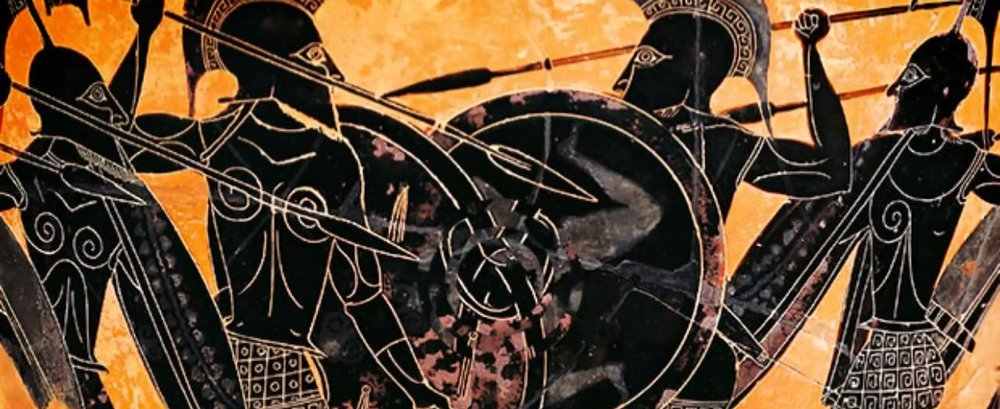
Athens, the regional superpower of the ancient world, demanded that the small island of Melos surrender and pay tribute. Melos appealed to justice, neutrality, and divine favour. Athens replied with a line so indecently clear that political philosophy has been trying to forget it ever since: ‘The strong do what they can and the weak suffer what they must’.

That sentence is not an ethical claim. It is a descriptive one. It does not say what ought to happen. It says what does. The Athenians even went further, dismantling the very idea that justice could apply asymmetrically: ‘Justice, as the world goes, is only in question between equals in power’.

This is the part liberal internationalism prefers to skip, usually by changing the subject to institutions, norms, or aspirations. But the Athenians were being brutally honest. Appeals to fairness only work when neither side can impose its will outright. When there is a power imbalance, morality becomes theatre.

The Melians refused to submit. They chose honour, principle, and the hope that the gods would intervene. Athens killed every Melian man of fighting age and enslaved the women and children. End of dialogue. End of illusions. Fast-forward to now.

In early 2026, under Donald Trump, the United States launched a military operation against Venezuela, striking targets in Caracas and forcibly detaining NicolĂĄs Maduro, who was transported to the United States to face federal charges. The justification was framed in familiar moral language: narco-terrorism, stability, regional security, democratic transition. The accompanying signals were less coy: temporary U.S. administration, resource access, and ‘order’. Cue outrage. Cue talk of illegality. Cue appeals to sovereignty, international law, and norms violated. All of which would have been very moving… to the Athenians.

Strip away the rhetoric and the structure is ancient. A dominant power identifies a weaker one. Moral language is deployed, not as constraint, but as narrative cover. When resistance appears, force answers. This is not a deviation from realism. It is realism functioning exactly as advertised.

Modern audiences often confuse realism with cynicism, as if acknowledging power dynamics somehow endorses them. It does not. It merely refuses to lie. The Melian Dialogue is not an argument for empire. It is an autopsy of how empire speaks when it stops pretending. And this is where the discomfort really lies.

We continue to educate citizens as if the world operates primarily on ‘shoulds’ and ‘oughts’, whilst structuring global power as if only ‘can’ and ‘must’ matter. We teach international law as though it binds the strong, then act shocked when it doesn’t. We pretend norms restrain power, when in reality power tolerates norms until they become inconvenient.

The Athenians did not deny justice. They reclassified it as a luxury good. Trump’s Venezuela operation does not abolish international law. It demonstrates its conditional application. That is the real continuity across 2,500 years. Not cruelty, not ambition, but the quiet consensus among the powerful that morality is optional when enforcement is absent.

The lesson of the Melian Dialogue is not despair. It is clarity. If we want a world governed by rules rather than force, we must stop pretending we already live in one. Appeals to fairness are not strategies. They are prayers. And history, as ever, is not listening.

James Talks Truth

2–3 minutes

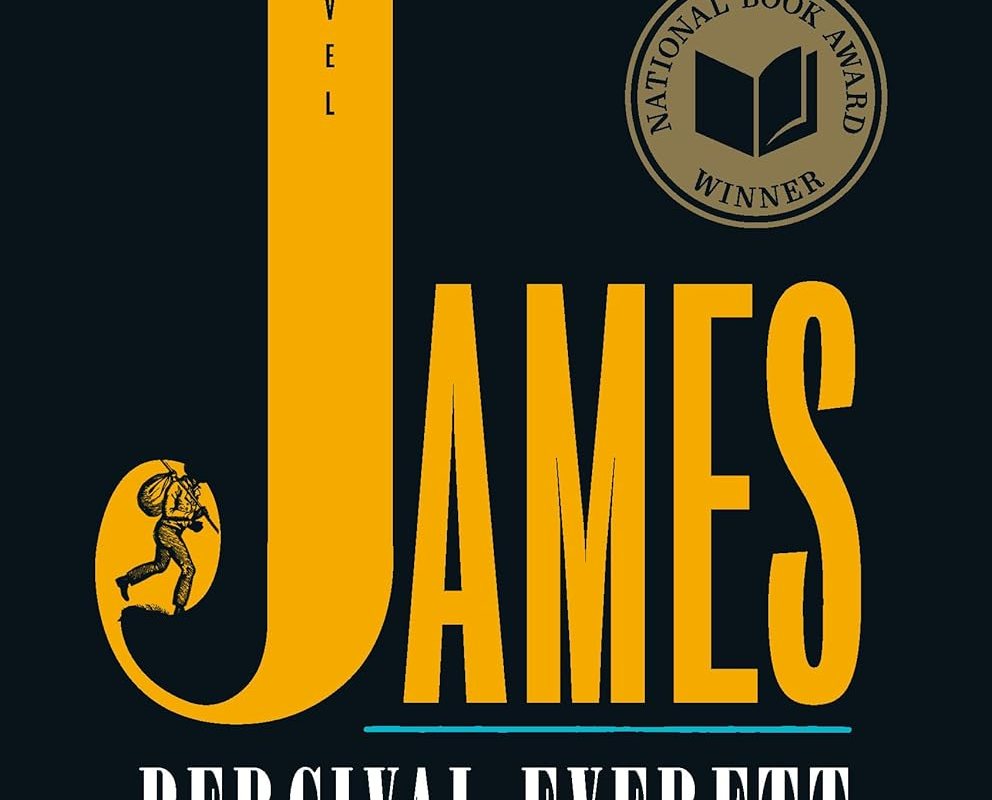
I’ve read about 85 per cent of James by Percival Everett. I recommend it. On the surface, it is simply a very good story set in the narrative universe of Mark Twain’s Huck Finn and Tom Sawyer. I will avoid spoilers as best I can.

The novel is set in the antebellum American South. James and the others move through Missouri, a state that openly supported slavery, and at one point into Illinois, a state that officially opposed it but quietly failed to live up to its own rhetoric. Illinois, it turns out, is no safe haven. Ideology and practice, as ever, are on speaking terms only when it suits them.

Audio: Short NotebookLM summary podcast of this content.

This is not a book review. I may write one later for my Ridley Park site once I’ve finished the book. What interests me here are two philosophical tensions Everett stages with remarkable economy.

There are two characters who are Black but able to pass as white. One of them feels profound guilt about this. He was raised as a slave, escaped, and knows exactly what it means to be treated as Black because he has lived it. Passing feels like theft. Survival, perhaps, but theft all the same.

The other is more unsettled. He was raised as a white man and only later discovers that he is not, as the language goes, “pure-bred”. This revelation leaves him suspended between identities. Should he now accept a Black identity he has never inhabited, or continue to pass quietly, benefitting from a system that would destroy him if it knew?

James offers him advice that is as brutal as it is lucid:

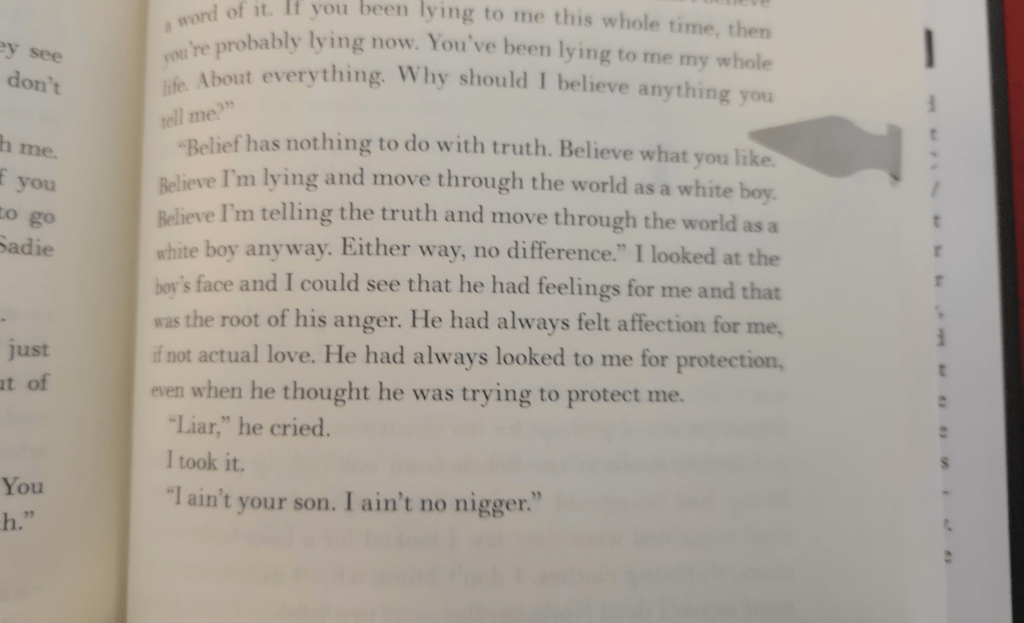
“Belief has nothing to do with truth. Believe what you like. Believe I’m lying and move through the world as a white boy. Believe I’m telling the truth and move through the world as a white boy anyway. Either way, no difference.”

This is the philosophical nerve of the book.

Truth, Everett suggests, is indifferent to belief. Belief does not mediate justice. It does not reorganise power. It does not rewire how the world responds to your body. What matters is not what is true, nor even what is believed to be true, but how one is seen.

The world does not respond to essences. It responds to appearances.

Identity here is not an inner fact waiting to be acknowledged; it is a surface phenomenon enforced by institutions, habits, and violence. The truth can be known, spoken, even proven, and still change nothing. The social machine runs on perception, not ontology.

In James, Everett is not offering moral comfort. He is stripping away a modernist fantasy: that truth, once revealed, obliges the world to behave differently. It doesn’t. The world only cares what you look like while moving through it.

Truth, it turns out, is perfectly compatible with injustice.

The Sane Society, Revisited: Why Work Still Drives Us Mad

4–6 minutes

Erich Fromm’s The Sane Society turns seventy this year, and like a ghost of reason past, it refuses to leave. His target was Capitalism™ – not merely as an economic system, but as a psychic infection. Replace the word factory with Zoom call, and his diagnosis reads like yesterday’s corporate newsletter. We’ve upgraded our machines but not our misery.

Aside from its psychobabble, The Sane Society, published in 1954, reads almost like it could have been written in 2024. I’d go out on a limb and claim it will still be relevant in 2054 – because Capitalism™ and the relationship it creates between humans and machines, and humans and other humans. It’s a divisive ideology. I’ve read a lot of content on employee engagement in the past decade. I’d been exposed to it in my Organisational Behaviour courses in the late ’80s. Things were going to change. We’d plotted a future.

Audio: NotebookLM podcast on this topic.

Only nothing material has changed. We pretended to notice the problem and fix it, but the people reporting the issue and the people in charge did not share a worldview. And the young managers who were taught about the challenge were either not promoted or changed their tune to facilitate their own promotion. Funny how the selection process favours groupthink over diversity of opinion.

Video: Apathetic Office Worker

On balance, most people tend to hate or be otherwise dissatisfied with their jobs. This is nothing new. It was true before Fromm’s book, and it is true now. I published a series of posts on prostitution in 2018 and discovered that escorts had better job satisfaction than the larger population. Let that sink in.

‘…the vast majority of the population work as employees with little skill required, and with almost no chance to develop any particular talents, or to show any outstanding achievements. While the managerial or professional groups have at least considerable interest in achieving something more or less personal, the vast majority sell their physical, or an exceedingly small part of their intellectual capacity to an employer to be used for purposes of profit in which they have no share, for things in which they have no interest, with the only purpose of making a living, and for some chance to satisfy their consumer’s greed.

Dissatisfaction, apathy, boredom, lack of joy and happiness, a sense of futility and a vague feeling that life is meaningless, are the unavoidable results of this situation. This socially patterned syndrome of pathology may not be in the awareness of people; it may be covered by a frantic flight into escape activities, or by a craving for more money, power, prestige. But the weight of the latter motivations is so great only because the alienated person cannot help seeking for such compensations for his inner vacuity, not because these desires are the “natural” or most important incentives for work.

Fromm, ever the optimist, thought alienation might be cured through self-awareness and communal values. The twentieth century politely ignored him, opting instead for mindfulness apps and performance reviews.

I’ve excised the psychobabble, but he continues…

‘But even the data on conscious job satisfaction are rather telling. In a study about job satisfaction on a national scale, satisfaction with and enjoyment of their job was expressed by 85 per cent of the professionals and executives, by 64 per cent of whitecollar people, and by 41 per cent of the factory workers. In another study, we find a similar picture: 86 per cent of the professionals, 74 per cent of the managerial, 42 per cent of the commercial employees, 56 per cent of the skilled, and 48 per cent of the semi-skilled workers expressed satisfaction.

‘We find in these figures a significant discrepancy between professionals and executives on the one hand, workers and clerks on the other. Among the former only a minority is dissatisfied—among the latter, more than half. Regarding the total population, this means, roughly, that over half of the total employed population is consciously dissatisfied with their work, and do not enjoy it. If we consider the unconscious dissatisfaction, the percentage would be considerably higher. Taking the 85 per cent of “satisfied” professionals and executives, we would have to examine how many of them suffer from psychologically determined high blood pressure, ulcers, insomnia, nervous tension and fatigue. Although there are no exact data on this, there can be no doubt that, considering these symptoms, the number of really satisfied persons who enjoy their work would be much smaller than the above figures indicate.

‘As far as factory workers and office clerks are concerned, even the percentage of consciously dissatisfied people is remarkably high. Undoubtedly the number of unconsciously dissatisfied workers and clerks is much higher. This is indicated by several studies which show that neurosis and psychogenic illnesses are the main reasons for absenteeism (the estimates for the presence of neurotic symptoms among factory workers go up to about 50 per cent). Fatigue and high labor turnover are other symptoms of dissatisfaction and resentment.’

In the twenty-first century, job dissatisfaction has increased even more. To me, it’s interesting to consider how many people harken back to the ‘good old days’, yet there is little evidence to support the view. Almost schizophrenically, others look to the promise of the future and technology, yet this is simply another narrative with no basis in fact.

The irony is that we’ve automated everything except fulfilment. Even our dissatisfaction has become efficient – streamlined, quantified, and monetised. Fromm warned that the sickness of society was its sanity. On that front, we’re positively thriving.

Stand by for more sanity to follow…

‘Luigi Mangione Is Not a Terrorist’

3–4 minutes

This isn’t a political post. It’s about language, the insufficiency of it, and the games we play when pretending words carry more weight than they do.

Luigi Mangione is the man accused of killing UnitedHealthcare CEO Brian Thompson. After his arrest, prosecutors stacked the usual charges – murder, firearms, assorted legal bric-a-brac – then added the cherry on top: domestic terrorism.

Audio: NotebookLM podcast on this topic.

Recently, a pretrial judge cut the cherry loose.

NEW YORK, Sept 16 (Reuters) – A New York state judge dismissed on Tuesday two terrorism-related counts against Luigi Mangione over the December 2024 killing of health insurance executive Brian Thompson, though the 27-year-old remains charged with second-degree murder and eight other criminal counts in the case.

“There was no evidence presented of a desire to terrorize the public, inspire widespread fear, engage in a broader campaign of violence, or to conspire with organized terrorist groups,” Judge Gregory Carro found in a 12-page written decision (pdf). “Here, the crime – the heinous, but targeted and discrete killing of one person – is very different from the examples of terrorism set forth in the statute.” (source)

The prosecution insisted the label fit. The judge disagreed. Cue outrage, applause, and confusion. The crime is still horrific, but suddenly the word “terrorist” is off-limits.

The Elasticity of Terror

How can two educated parties look at the same set of facts and come to opposite conclusions? Because “terrorism” isn’t a Platonic form. It’s an elastic linguistic category. The prosecutor drags it out because “terrorist” is a magical word in American law: it inflates an already ugly act into a civilisation-level threat, unlocks harsher penalties, and lets politicians posture about national security.

The judge, however, reminded everyone that a bullet in Manhattan does not equal al-Qaeda. Murder, yes. Terrorism, no. Not because murder is less grotesque, but because the statutory definition won’t stretch that far without breaking.

Language Games, Legal Hierarchies

This is where it gets trickier. The judge isn’t merely “pulling rank”—though rank does matter. American jurisprudence is hierarchical: trial judges hand down rulings, appellate judges review them, and nine robed partisans in Washington can one day rewrite the whole script. On paper, these tiers are meant to iron out ambiguity. In practice, they multiply it.

Even co-equal judges, reading the same facts, can diverge wildly. Split decisions at the Supreme Court prove the point: five minds say “constitutional,” four say “unconstitutional,” and the one-vote margin becomes binding law for 330 million people. That’s not the discovery of truth; it’s the triumph of one language game over another, enforced by hierarchy.

The Insufficiency Laid Bare

So we return to Mangioni. He has been charged with murder – the second degree flavour; that much is uncontested. But is he a “terrorist”? The prosecution said yes, the judge said no, and another judge, higher up or sitting elsewhere, might well say yes again. Each claim is defensible. Each is motivated by language, by politics, and by the institutional pressures of the bench.

And that’s the point. Language doesn’t tether itself to reality; it choreographs our endless arguments about reality. The law tries to tame it with hierarchies and definitions, but the seams always show. Mangioni is a murderer. Whether he is a terrorist depends less on his actions than on which interpretive dance is winning in the courtroom that day.