I set aside some time to design the front cover of my next book. I’m excited to share this – but that’s always the case. It’s substantially complete. In fact, it sidelined another book, also substantially complete, but the content in this might force me to change the other one. It should be ready for February. I share the current state of the Abstract
This book is meant to be an academic monograph, whilst the other, working title: The Competency Paradox, is more of a polemic.
As I mentioned in another post, it builds upon and reorients the works of George Lakoff, Jonathan Haidt, Kurt Gray, and Joshua Greene. I’ve already revised and extended Gallie’s essentially contested concepts in A Language Insufficiency Hypothesis in the form of Contestables, but I lean on them again here.
Abstract
Contemporary moral and political discourse is marked by a peculiar frustration: disputes persist even after factual clarification, legal process, and good-faith argumentation have been exhausted. Competing parties frequently agree on what happened, acknowledge that harm occurred, and yet remain irreconcilably divided over whether justice has been served. This persistence is routinely attributed to misinformation, bad faith, or affective polarisation. Such diagnoses are comforting. They are also often wrong.
This paper advances a different claim. Certain conflicts are not primarily epistemic or semantic in nature, but ontological. They arise from incompatible orientations that structure how agents register salience, threat, authority, autonomy, and legitimacy. These orientations are genealogically shaped through enculturation, institutions, and languaged traditions, yet operationally they function prior to linguistic articulation: salience fires before reasons are narrated. Moral vocabulary enters downstream, tasked with reconciling commitments that were never shared.
From this perspective, the instability of concepts such as justice is not the primary problem but a symptom. Justice belongs to a class of Contestables (in Gallie’s sense, PDF): action-authorising terms that appear determinate while remaining untethered from shared reference under ontological plurality. Appeals to clearer definitions, better process, or shared values therefore misfire. They presume a common ontological ground that does not, in fact, exist.
When institutions are nevertheless required to act, they cannot adjudicate between ontologies. They can only select. Courts, juries, regulatory bodies, and enforcement agencies collapse plural interpretations into a single outcome. That outcome is necessarily experienced as legitimate by those whose orientation it instantiates, and as injustice by those whose orientation it negates. No procedural refinement can eliminate this asymmetry. At best, procedure dampens variance, distributes loss, and increases tolerability. Crucially, the selection itself is constrained but underdetermined. Even within formal structures, human judgment, discretion, mood, confidence, fear, and narrative framing play a decisive role. Following Keynes, this irreducible contingency may be described as animal spirits. In formal terms, institutional outcomes are sampled from a constrained space of possibilities, but the reaction topology remains structurally predictable regardless of which branch is taken.
The consequence is stark but clarifying: outrage is not evidence that a system has failed to deliver justice; it is evidence that plural ontological orientations have been forced through a single decision point. Where semantic reconciliation is structurally unavailable, exogenous power is the dominant near-term mediator. Power does not resolve the conflict; it pauses it and stabilises meaning sufficiently for coordination to continue.
This analysis does not deny the reality of harm, the importance of law, or the necessity of institutions. Nor does it lapse into nihilism or indifference. Rather, it reframes the problem. In ontologically plural environments, the task is not moral convergence but maintenance: containing collision, resisting premature coherence, and designing institutions that minimise catastrophic failure rather than promising final resolution.
The argument developed here predates any particular event. Its value lies precisely in its predictive capacity. Given plural ontologies, untethered contestables, and institutions that must act, the pattern of reaction is invariant. The surface details change; the structure does not. What follows is not a proposal for reconciliation. It is a diagnosis of why reconciliation is so often a category error, and why pretending otherwise is making things worse.
My expanded direction has roots in the works of George Lakoff, Jonathan Haidt, Kurt Gray, and Joshua Greene. These people circle around the problem, even identify it, but then summarily ignore it.
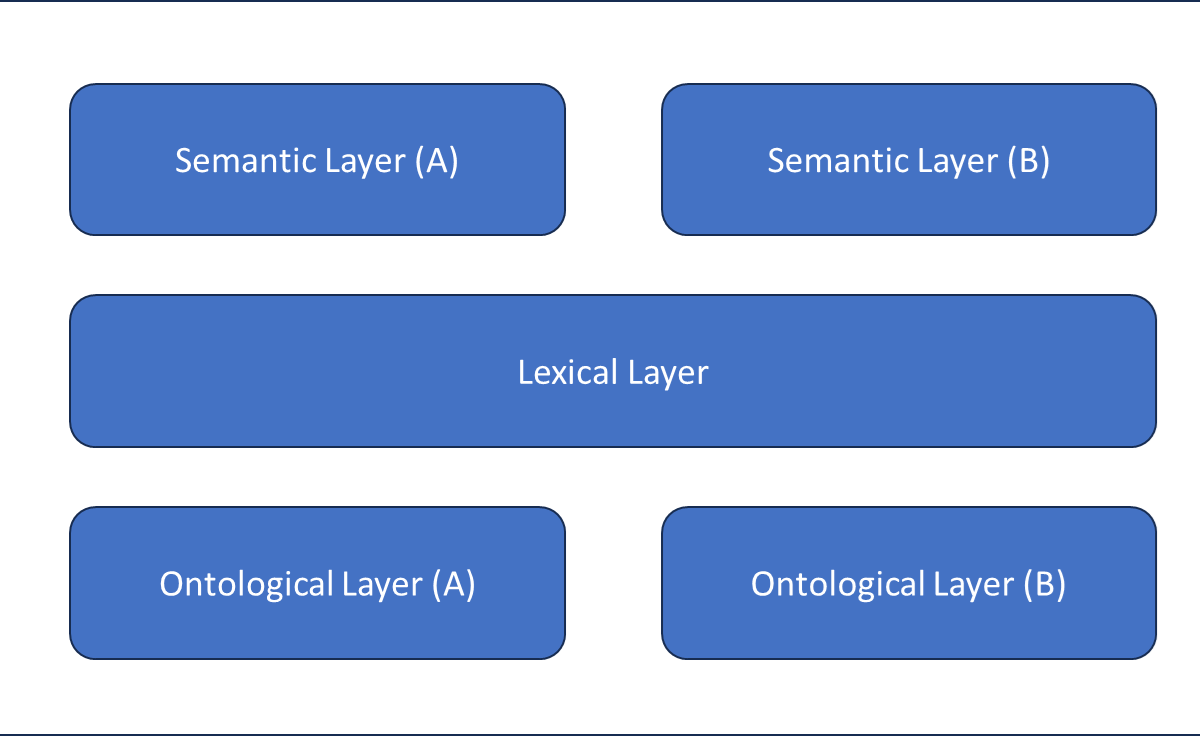
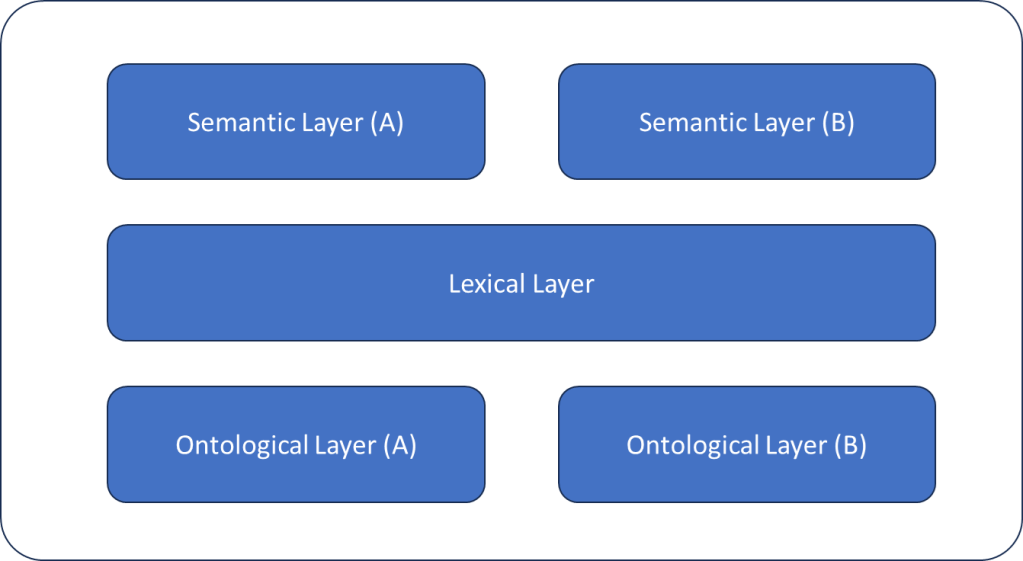
Image: This figure illustrates a simplified layered model of moral and political disagreement. Agents share a common lexical layer, enabling communication and the appearance of mutual understanding. Beneath this surface, however, ontological orientations diverge, structuring salience, legitimacy, and relevance prior to articulation. Semantic interpretation emerges downstream of these ontological commitments, producing divergent meanings despite shared vocabulary. The model highlights why disputes persist even under conditions of factual agreement and linguistic overlap: the instability lies not in words themselves, but in the ontological substrates from which semantic projections are drawn.
It’s more involved than this, but at a 50,000-foot level, it conveys the essence of my hypothesis.
I am also working on this logical expression:
∀ outcomes I(E), ∃ i,j such that Jᵢ ≠ Jⱼ
where,
Jᵢ = f(Oᵢ, E, I, RNG)
Also, in a particular context:
This will all make more sense in time. I’ll be publishing a manuscript as I study supporting research and develop my own perspectives.
I published A Language Insufficiency Hypothesis this month, and this is one of a series of videos summarising the content. In this segment, I’m discussing Chapter 1: A Genealogy of Insufficiency
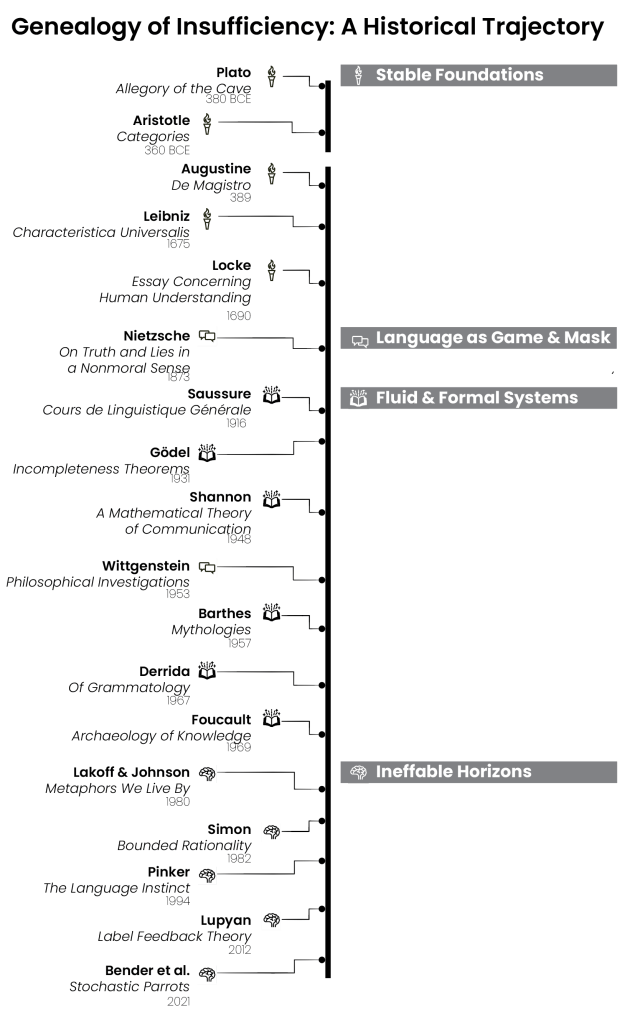
In this video, I touch on Plato to Barthes and Foucault. Derrida gets no love, and I mention bounded rationality, but not Simon. I discuss Steven Pinker’s dissent in more detail in a later chapter.
Below, I’ve included some artefacts from the book.
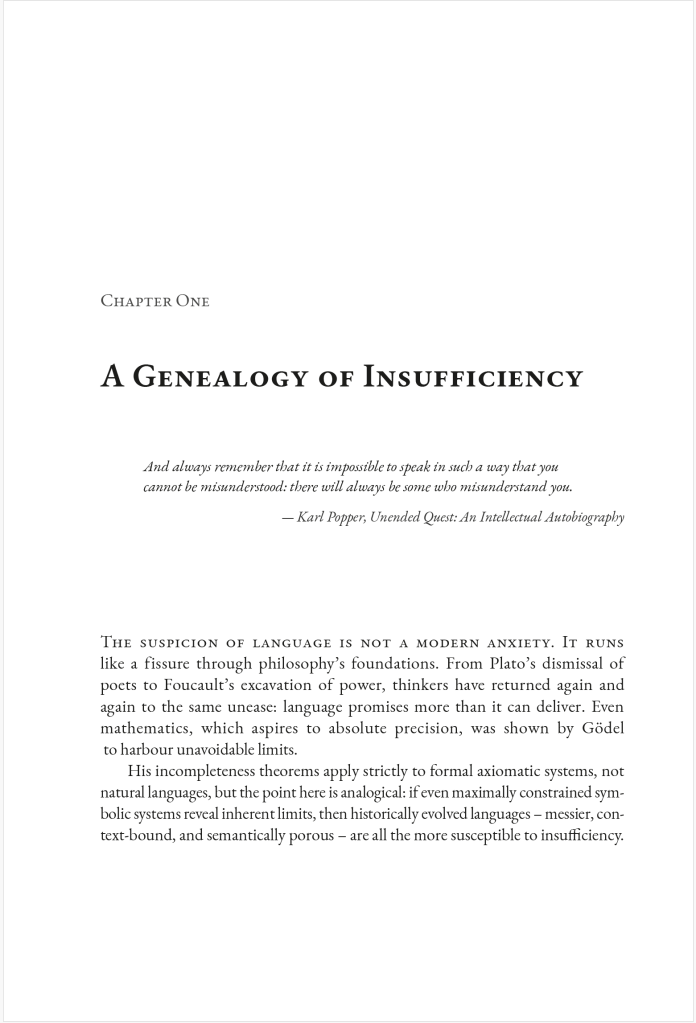
Image: Chapter 1: Page 1
And always remember that it is impossible to speak in such a way that you cannot be misunderstood: there will always be some who misunderstand you. — Karl Popper, Unended Quest: An Intellectual Autobiography
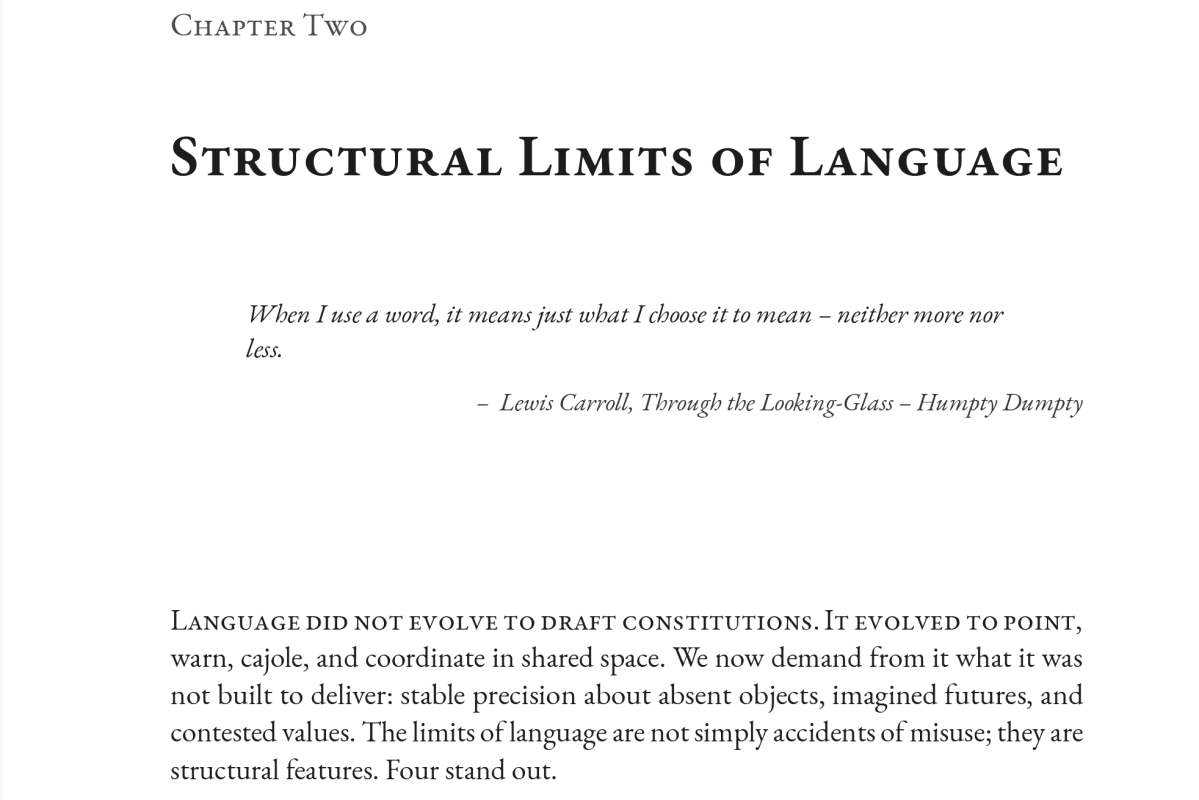
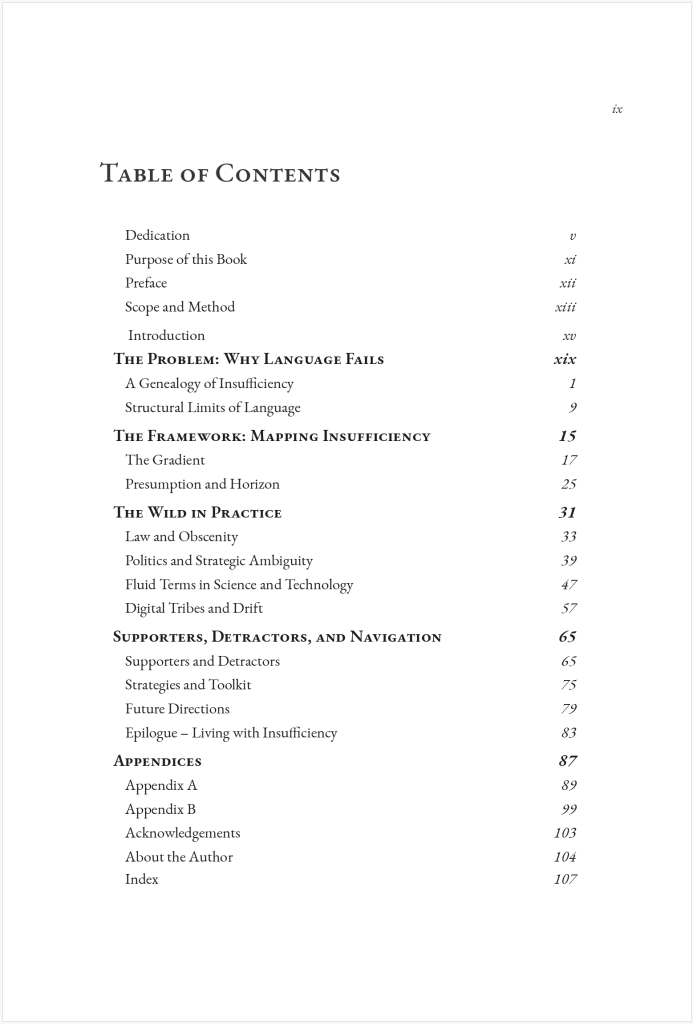
Image: Genealogy of Insufficiency: A Historical TrajectoryImage: Table of Contents
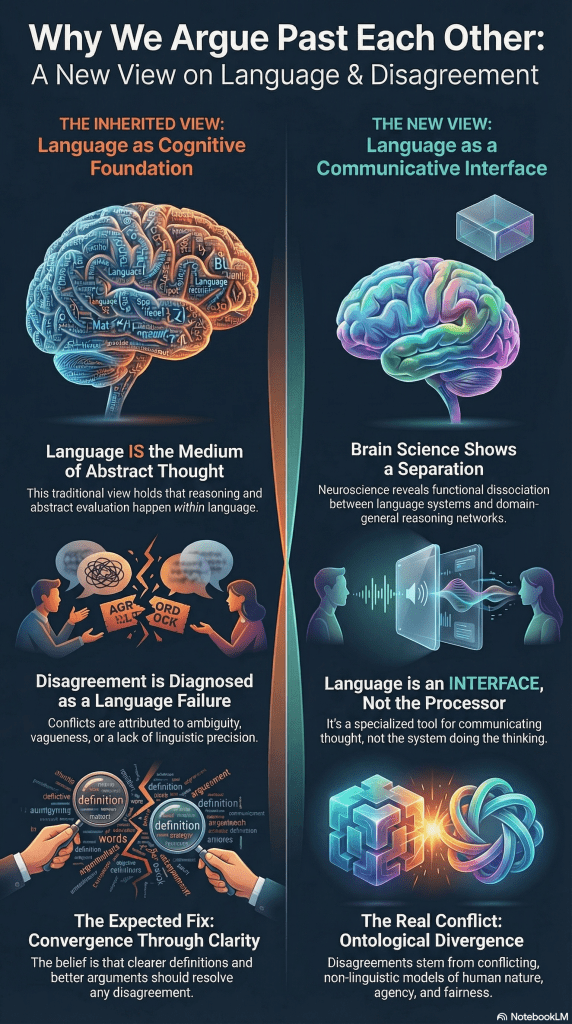
I’ve just published an essay following on the work of cognitive neuroscientist Evelina Fedorenko (cover image). It arrives on the heels of A Language Insufficiency Hypothesis (LIH). A companion essay is in the works.
Language as Interface strengthens the position of LIH, explaining why moral issues fail before language is even engaged. Her work also leads me to believe that we should revisit 20th-century accounts of the history of language.
Audio: NotebookLM summary podcast of the underlying essay.
The essay I am working on now explains why this extends to emotional language more generally.
Meanwhile, read the essay or listen to the podcast summary.
Dear Author. [REDACTED] does not accept the submission of personal works produced by students, independent researchers, or professionals who have not yet attained a doctoral level. This is a moderation policy intended to ensure that publications deposited on the platform originate from qualified researchers affiliated with a recognized institution (REDACTED) and acknowledged for their expertise or previous work in the relevant field of research. This rule applies regardless of the quality or scientific value of the work, which is by no means in question here. We therefore regret to inform you that we are unable to accept this submission. If you wish, we invite you to share your work through other open platforms such as Zenodo, which allow all authors to make their research visible. Thank you for your understanding. Kind regards
Allow me to rephrase this:
Dear Author,
We regret to inform you that whilst your work is not in question, you are. Our platform does not accept submissions from students, independent researchers, or professionals who have not yet acquired the correct ceremonial headgear. This policy exists to ensure that ideas originate from bodies already sanctified by a recognised institution. The content may be rigorous, original, and valuable, but that is neither here nor there. Knowledge, like wine, must age in the right cellar.
Please consider sharing your work elsewhere. Zenodo is very accommodating to the uncredentialled.
Kind regards.
Disappointing, though hardly surprising. This is the same logic as age-based thresholds I have recently taken a hammer to: crude proxies elevated into moral and epistemic gatekeepers. Not ‘is this good?’, but ‘are you old enough, stamped enough, letterheaded enough to be taken seriously?’. A bureaucratic horoscope.
Yes, I use Zenodo. I use PhilPapers. I will continue to do so. But let’s not pretend all platforms are socially equivalent. Journals still function as credibility engines, not because they magically improve truth, but because they distribute legitimacy. To be excluded on status grounds alone is not a quality filter. It is a caste system with footnotes.
And journals already make participation unnecessarily hostile. Many refuse work that has been publicly shared at all, even in preprint form. Lead times stretch to a year or more. The result is that anyone attempting to contribute to live debates is instructed to sit quietly whilst the conversation moves on without them. In a so-called knowledge economy, this is an astonishing self-own.
What we have, then, is a system that:
equates institutional affiliation with epistemic competence,
penalises open dissemination,
and delays circulation until relevance decays.
All in the name of rigour.
I will keep submitting elsewhere. There are other journals. There always are. But let’s stop pretending this is about protecting standards. It is about preserving a hierarchy that mistakes accreditation for insight and treats independent thought as a contamination risk.
Knowledge does not become true by passing through the right doorway. It merely becomes approved. I’ll not witter on about the bollocks of peer review.
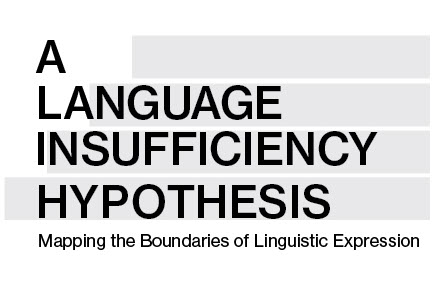
A Language Insufficiency Hypothesis is now available, and I am commencing a series of video content to support it.
Video: Language Insufficiency Hypothesis – Part 1 – The Basic Concepts (Duration: 6:44)
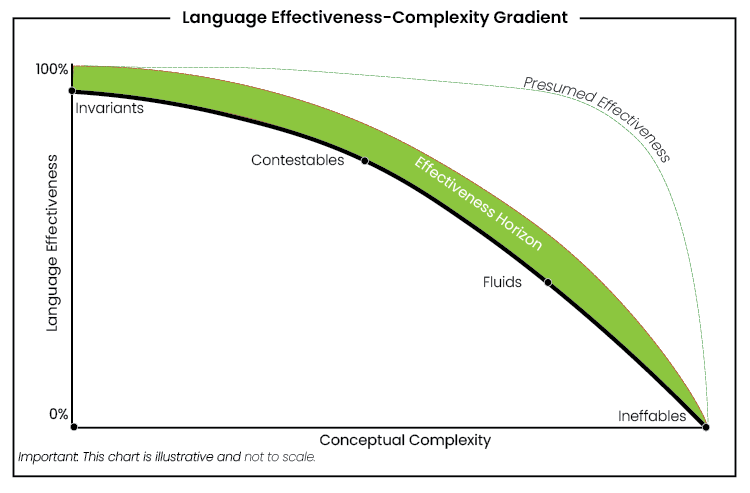
In this primer, I introduce the Language Effectiveness–Complexity Gradient and the nomenclature of the hypothesis: Invariants, Contestables, Fluids, and Ineffables.
In the next segment, I’ll discuss the Effectiveness and Presumed Effectiveness Horizons.
If you would like to support my work, consider purchasing one of my books. Leaving ratings and reviews helps more than you know to appease the algorithm gods.
Almost a decade in the making, this book explains why more time, more effort, and more detail do not reliably improve certain forms of communication. Beyond a point, returns diminish sharply. In some domains, they collapse altogether.
The manuscript focuses on English, but the hypothesis has already been extended to French (published separately), and I am continuing work on other ontological barriers. If you’re interested in testing or extending the framework in your own language, feel free to get in touch.
Over the coming weeks, I’ll be unpacking aspects of the Language Insufficiency Hypothesis in more depth here. The book’s role is deliberately limited: it defines the problem, establishes the structure, and offers grounding examples. The real work happens in the consequences.
For now, the important thing is simple: the book is finally available.
We like to believe the world is governed by rules. By fairness. By international law, norms, institutions, treaties, and laminated charters written in earnest fonts. This belief survives not because it is true, but because it is psychologically necessary. Without it, we would have to admit something deeply unfashionable: power still runs the table.
Two and a half millennia ago, Thucydides recorded what remains the most honest conversation in political theory: the Melian Dialogue. No soaring ideals, no speeches about freedom. Just an empire explaining itself without makeup.
Audio: NotebookLM summary podcast of this topic.
Athens, the regional superpower of the ancient world, demanded that the small island of Melos surrender and pay tribute. Melos appealed to justice, neutrality, and divine favour. Athens replied with a line so indecently clear that political philosophy has been trying to forget it ever since: ‘The strong do what they can and the weak suffer what they must’.
That sentence is not an ethical claim. It is a descriptive one. It does not say what ought to happen. It says what does. The Athenians even went further, dismantling the very idea that justice could apply asymmetrically: ‘Justice, as the world goes, is only in question between equals in power’.
This is the part liberal internationalism prefers to skip, usually by changing the subject to institutions, norms, or aspirations. But the Athenians were being brutally honest. Appeals to fairness only work when neither side can impose its will outright. When there is a power imbalance, morality becomes theatre.
The Melians refused to submit. They chose honour, principle, and the hope that the gods would intervene. Athens killed every Melian man of fighting age and enslaved the women and children. End of dialogue. End of illusions. Fast-forward to now.
In early 2026, under Donald Trump, the United States launched a military operation against Venezuela, striking targets in Caracas and forcibly detaining Nicolás Maduro, who was transported to the United States to face federal charges. The justification was framed in familiar moral language: narco-terrorism, stability, regional security, democratic transition. The accompanying signals were less coy: temporary U.S. administration, resource access, and ‘order’. Cue outrage. Cue talk of illegality. Cue appeals to sovereignty, international law, and norms violated. All of which would have been very moving… to the Athenians.
Strip away the rhetoric and the structure is ancient. A dominant power identifies a weaker one. Moral language is deployed, not as constraint, but as narrative cover. When resistance appears, force answers. This is not a deviation from realism. It is realism functioning exactly as advertised.
Modern audiences often confuse realism with cynicism, as if acknowledging power dynamics somehow endorses them. It does not. It merely refuses to lie. The Melian Dialogue is not an argument for empire. It is an autopsy of how empire speaks when it stops pretending. And this is where the discomfort really lies.
We continue to educate citizens as if the world operates primarily on ‘shoulds’ and ‘oughts’, whilst structuring global power as if only ‘can’ and ‘must’ matter. We teach international law as though it binds the strong, then act shocked when it doesn’t. We pretend norms restrain power, when in reality power tolerates norms until they become inconvenient.
The Athenians did not deny justice. They reclassified it as a luxury good. Trump’s Venezuela operation does not abolish international law. It demonstrates its conditional application. That is the real continuity across 2,500 years. Not cruelty, not ambition, but the quiet consensus among the powerful that morality is optional when enforcement is absent.
The lesson of the Melian Dialogue is not despair. It is clarity. If we want a world governed by rules rather than force, we must stop pretending we already live in one. Appeals to fairness are not strategies. They are prayers. And history, as ever, is not listening.
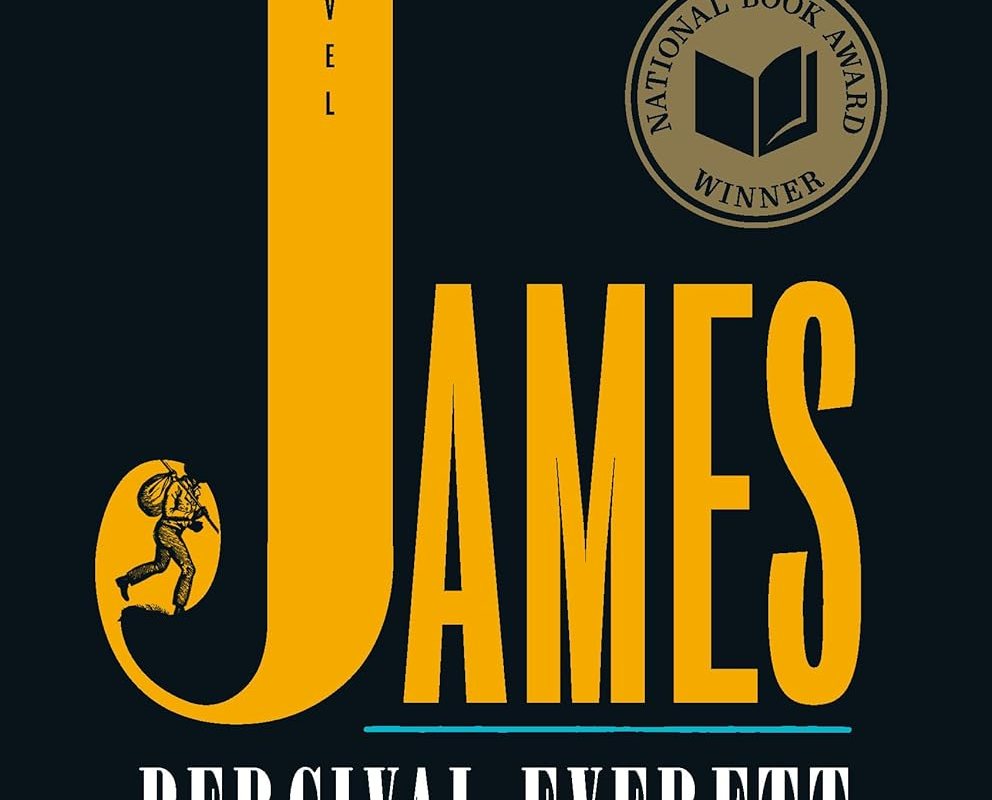
I’ve read about 85 per cent of James by Percival Everett. I recommend it. On the surface, it is simply a very good story set in the narrative universe of Mark Twain’s Huck Finn and Tom Sawyer. I will avoid spoilers as best I can.
The novel is set in the antebellum American South. James and the others move through Missouri, a state that openly supported slavery, and at one point into Illinois, a state that officially opposed it but quietly failed to live up to its own rhetoric. Illinois, it turns out, is no safe haven. Ideology and practice, as ever, are on speaking terms only when it suits them.
Audio: Short NotebookLM summary podcast of this content.
This is not a book review. I may write one later for my Ridley Park site once I’ve finished the book. What interests me here are two philosophical tensions Everett stages with remarkable economy.
There are two characters who are Black but able to pass as white. One of them feels profound guilt about this. He was raised as a slave, escaped, and knows exactly what it means to be treated as Black because he has lived it. Passing feels like theft. Survival, perhaps, but theft all the same.
The other is more unsettled. He was raised as a white man and only later discovers that he is not, as the language goes, “pure-bred”. This revelation leaves him suspended between identities. Should he now accept a Black identity he has never inhabited, or continue to pass quietly, benefitting from a system that would destroy him if it knew?
James offers him advice that is as brutal as it is lucid:
“Belief has nothing to do with truth. Believe what you like. Believe I’m lying and move through the world as a white boy. Believe I’m telling the truth and move through the world as a white boy anyway. Either way, no difference.”
This is the philosophical nerve of the book.
Truth, Everett suggests, is indifferent to belief. Belief does not mediate justice. It does not reorganise power. It does not rewire how the world responds to your body. What matters is not what is true, nor even what is believed to be true, but how one is seen.
The world does not respond to essences. It responds to appearances.
Identity here is not an inner fact waiting to be acknowledged; it is a surface phenomenon enforced by institutions, habits, and violence. The truth can be known, spoken, even proven, and still change nothing. The social machine runs on perception, not ontology.
In James, Everett is not offering moral comfort. He is stripping away a modernist fantasy: that truth, once revealed, obliges the world to behave differently. It doesn’t. The world only cares what you look like while moving through it.
Truth, it turns out, is perfectly compatible with injustice.







 Philosophics