Trainspotting

Trainspotting Movie Poster
2–3 minutes

I identify strongly with Irvine Welsh’s characters in Trainspotting – the book, not the sanitised film version. Especially with Mark Renton, whose voice strips away illusions with a brutality that borders on honesty.

Audio: NotebookLM podcast on this topic.

Consider this passage from the chapter “Bang to Rites” (pp. 86–87), where Renton attends the funeral of his mate Billy. Billy joined the army to escape the dead-end life they all shared, only to be killed on duty in Northern Ireland. Renton’s verdict:

[1] Renton doesn’t let anyone off the hook. Not Billy, not the army, not the Oxbridge suits who polish the tragedy into something fit for the News at Ten. The uniform is a costume, a disguise: a working-class lad suddenly deemed “brave” only because he was wearing the right outfit when he died. Strip away the uniform, and he’d have been dismissed as a thug or a waster.

[2] Renton’s root-cause analysis is unsparing. Billy wasn’t killed by the man with the gun so much as by the machine that put him there – the state, the ruling classes, the ones who spin death into “sacrifice” while continuing to shuffle the poor like pawns across the board.

It’s this clarity that makes Welsh’s work more than a drug novel. Trainspotting isn’t just about needles and nods; it’s about seeing through the charade. Renton despises both establishment and rebellion because both are performance, both hollow. His cynicism is the closest thing to honesty in a world that would rather dress up corpses in borrowed dignity.

And maybe that’s why I feel the affinity: because subversion matters more than allegiance, and sometimes the only truthful voice is the one that refuses to be polite at the funeral.

Jesus Wept, Then He Kicked Bezos in the Bollocks

There’s a curious thing about belief: it seems to inoculate people against behaving as though they believe a single bloody word of it.

Audio: NotebookLM podcast on this topic.

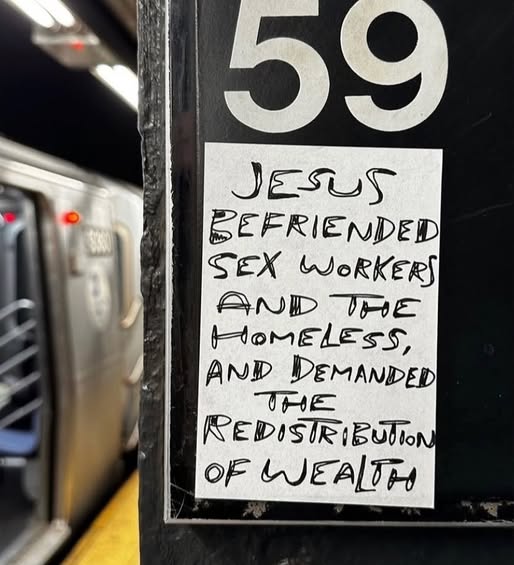
Case in point: Jesus. Supposed son of God, sandal-wearing socialist, friend of lepers, hookers, and the unhoused. A man who — by all scriptural accounts — didn’t just tolerate the downtrodden, but made them his preferred company. He fed the hungry, flipped off the wealthy (quite literally, if we’re being honest about the temple tantrum), and had the gall to suggest that a rich man getting into heaven was about as likely as Jeff Bezos squeezing himself through the eye of a needle. (Good luck with that, Jeffrey — maybe try Ozempic?)

And yet, here we are, two millennia later, and who is doing the persecuting? Who’s clutching their pearls over trans people, sex workers, immigrants, and the poor daring to exist in public? The self-proclaimed followers of this same Jesus.

You see it everywhere. In the subway, on billboards, on bumper stickers: “What would Jesus do?” Mate, we already know what he did do — and it wasn’t vote Tory, bankroll megachurches, or ignore houseless veterans while building another golden tabernacle to white suburban comfort.

No, the real issue isn’t Jesus. It’s his fan club.

They quote scripture like it’s seasoning, sprinkle it on whichever regressive policy or hateful platform suits the day, and ignore the core premise entirely: radical love. Redistribution. Justice. The inversion of power.

Because let’s face it: if Christians actually behaved like Christ, capitalism would implode by Tuesday. The entire premise of American exceptionalism (and British austerity, while we’re at it) would crumble under the weight of its own hypocrisy. And the boot would finally be lifted from the necks of those it’s been pressing down for centuries.

But they won’t. Because belief isn’t about behaviour. It’s about performance. It’s about signalling moral superiority while denying material compassion. It’s about tithing for a Tesla and preaching abstinence from a megachurch pulpit built with sweatshop money.

And here’s the kicker — I don’t believe in gods. I’m not here to convert anyone to the cult of sandal-clad socialism. But if you do believe in Jesus, shouldn’t you at least try acting like him?

The sad truth? We’ve built entire societies on the backs of myths we refuse to embody. We have the tools — the stories, the morals, the examples — but we’re too bloody enamoured with hierarchy to follow through. If there are no gods, then it’s us. We are the ones who must act. No sky-daddy is coming to fix this for you.

You wear the cross. You quote the book. You claim the faith.

So go ahead. Prove it.

Feed someone. Befriend a sex worker. House the homeless. Redistribute the damn wealth.

Or stop pretending you’re anything but the Pharisees he warned us about.

Decolonising the Mind

NgĹ©gÄ© wa Thiong’o published “Decolonising the Mind” in 1986. David Guignion shares a 2-part summary analysis of the work on his Theory and Philosophy site.

I used NotebookLLM to produce this short podcast: [Content no longer extant] https://notebooklm.google.com/notebook/7698ab0b-43ab-47d4-a50f-703866cfb1b9/audio

Decolonising the Mind: A Summary

NgĹ©gÄ© wa Thiong’o’s book Decolonising the Mind centres on the profound impact of colonialism on language, culture, and thought. It argues that imposing a foreign language on colonised people is a key tool of imperial domination. This linguistic imperialism leads to colonial alienation, separating the colonised from their own culture and forcing them to view the world through the lens of the coloniser.

Here are some key points from the concept of decolonising the mind:

  • Language is intimately tied to culture and worldview: Language shapes how individuals perceive and understand the world. When colonised people are forced to adopt the language of the coloniser, they are also compelled to adopt their cultural framework and values.
  • Colonial education systems perpetuate mental control: By privileging the coloniser’s language and devaluing indigenous languages, colonial education systems reinforce the dominance of the coloniser’s culture and worldview. This process results in colonised children being alienated from their own cultural heritage and internalising a sense of inferiority.
  • Reclaiming indigenous languages is crucial for decolonisation: wa Thiong’o advocates for a return to writing and creating in indigenous African languages. He sees this as an act of resistance against linguistic imperialism and a way to reconnect with authentic African cultures. He further argues that it’s not enough to simply write in indigenous languages; the content must also reflect the struggles and experiences of the people, particularly the peasantry and working class.
  • The concept extends beyond literature: While wa Thiong’o focuses on language in literature, the concept of decolonising the mind has broader implications. It calls for a critical examination of all aspects of life affected by colonialism, including education, politics, and economics.

It is important to note that decolonising the mind is a complex and ongoing process. There are debates about the role of European languages in postcolonial societies, and the concept itself continues to evolve. However, wa Thiong’o’s work remains a seminal text in postcolonial studies, raising crucial questions about the enduring legacy of colonialism on thought and culture.

Trust and Performance

Apologies in advance for another business-oriented post, but it ties in well with the latest McGilchrist content. Simon Sinek is the presenter, and he asks how the Navy pick the members of Seal Team Six—as he says, “the best of the best of the best of the best,” which happens to align with the way my toddler might tell me how very, very, very, very much she likes something.

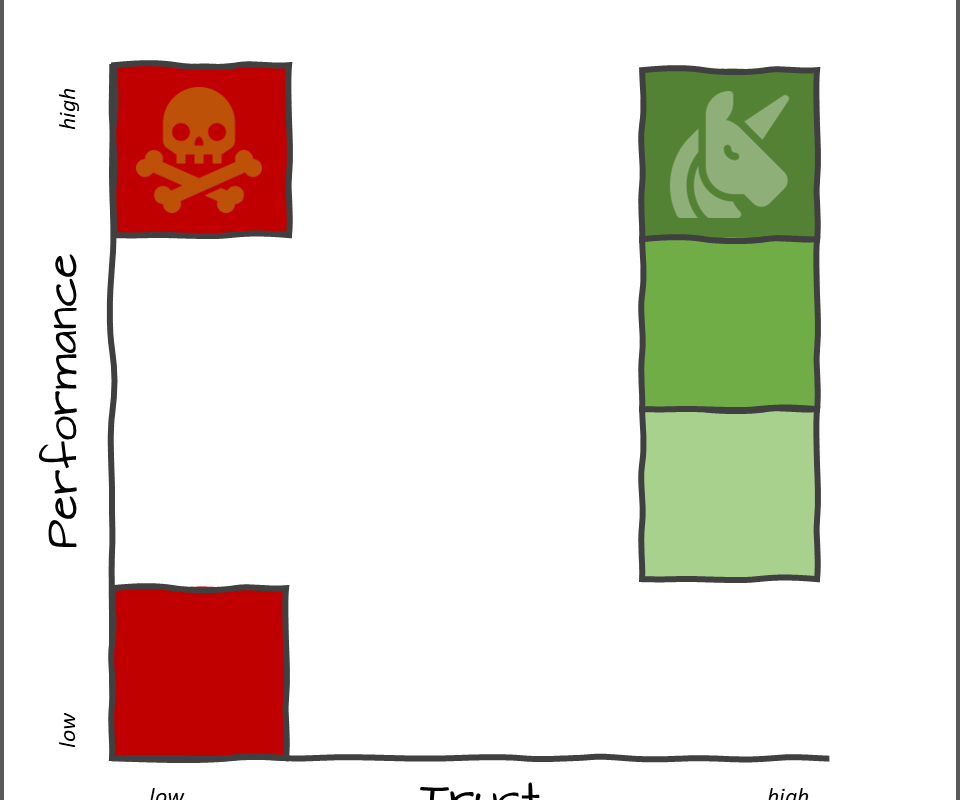
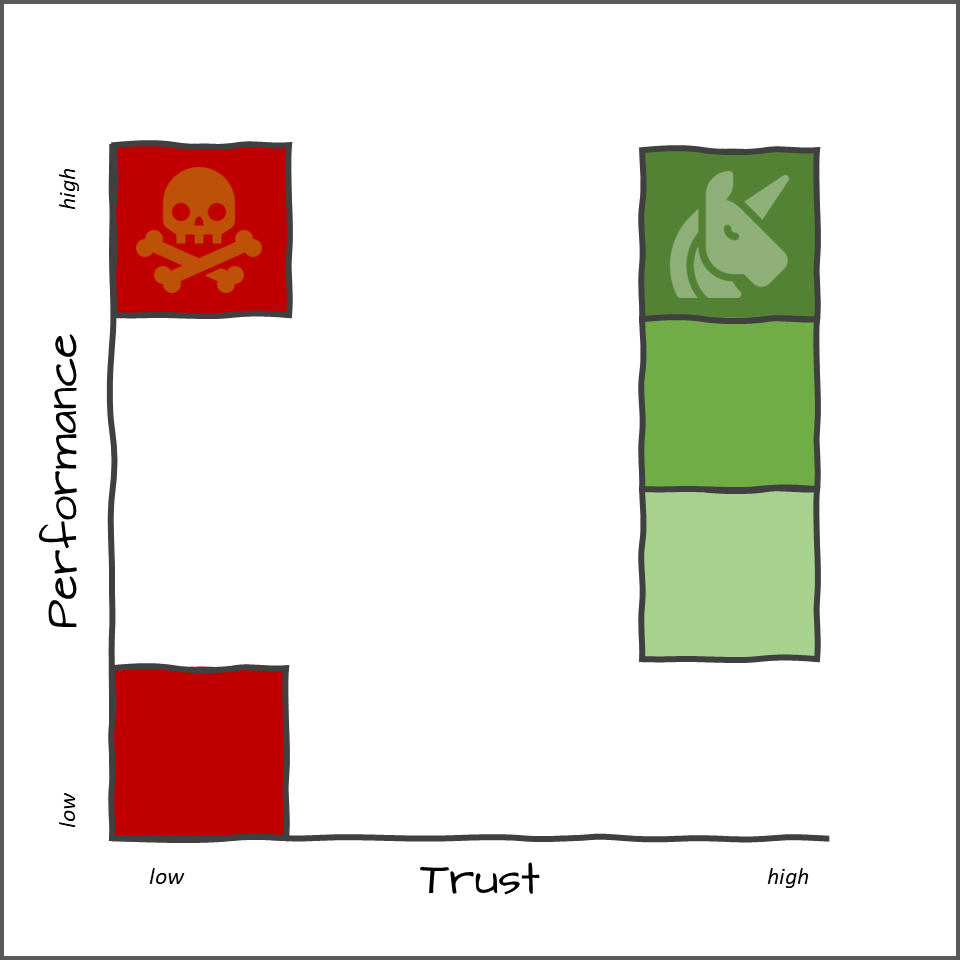
Simon is an adept communicator with a high woo factor, but this isn’t about him. I’ve cued this video to a place where Simon illustrates the assessment mindset employed to separate the wheat from the chaff in the minds of the Navy command. I’ve effectively recreated the chart Simon draws, and I use it as a reference.

Performance is on the Y-axis and Trust is on the X-axis. Effectively, they assess competency on and off the battlefield, respectively. He describes Performance as capturing “Do I trust you with my life?” and Trust as “Do I trust you with my money and my wife?” Perhaps he’s reflecting the sentiment of the generation managing the Seals. Not judging.

His point is that no one wants an untrustworthy low-performer (bottom left) and everyone wants a trustworthy high-performer (top right). He goes on to say that high-performing, low-trust members are toxic to the team. The team is better off with a relatively moderate performer that is otherwise trustworthy. I suppose the rest is a wash.

Performance is typical left-hemisphere fare: how much, how many, how fast, and so on. Companies have a million and one ways to measure performance.

Trust is a resident of the right hemisphere. This is an intuition and can’t be measured.

As Simon points out, even without explicit metrics, if you ask each team member who’s the highest performer, they’ll all point to the same person. Correspondingly, if you ask who’s the most trustworthy, they’ll all point to the same person as well. I can’t say that I trust this judgment, and thankfully, they do document whatever performance measures they have determined are appropriate. This option is not available for trust, so they have to rely on intuition. I don’t know if they also rely on consensus. I will grant that if all of the members do point to the same person as having the highest level of trust–presuming some performance threshold has been met–and the goal is to find a leader for that team, this person would make a fine leading candidate. If this person happened to be the highest performer then great, but being the best leader doesn’t require being the highest performer.

A sports coach doesn’t even need to excel at the sport s/he is leading. Their function is to motivate and inspire the team. Of course, in the case of the seals, I’m presuming this role is more of a player-manager. Still, the cohesion factor should be taken into account.

Trust is a heuristic that can’t be measured, and it’s fairly simple to find examples of people who appeared to be trustworthy but turned out not to be. It’s also conceivable that a trustworthy person may be misunderstood and perceived as trustworthy.

My question relates to the object of trust. When I think of police officers in the United States, I think that their trust is in each other, but at the expense of society. So they will generally protect each other even when they are morally and legally in the wrong. This is not the trust we want to foster for the public good. But since in my opinion policing is not about the public good but rather maintaining the status quo power structure, this is not a problem for their hiring managers.