I’ve been reading Octavia Butler’s Dawn and find myself restless. The book is often lauded as a classic of feminist science fiction, but I struggle with it. My problem isn’t with aliens, or even with science fiction tropes; it’s with the form itself, the Modernist project embedded in the genre, which insists on posing questions and then supplying answers, like a catechism for progress. Sci-Fi rarely leaves ambiguity alone; it instructs.
Simone de Beauvoir understood “woman” as the Other – defined in relation to men, consigned to roles of reproduction, care, and passivity. Her point was not that these roles were natural, but that they were imposed, and that liberation required stripping them away.
Octavia Butler’s Lilith
Lilith Iyapo, the protagonist of Dawn, should be radical. She is the first human awakened after Earth’s destruction, a Black woman given the impossible role of mediating between humans and aliens. Yet she is not allowed to resist her role so much as to embody it. She becomes the dutiful mother, the reluctant carer, the compliant negotiator. Butler’s narration frequently tells us what Lilith thinks and feels, as though to pre-empt the reader’s interpretation. She is less a character than an archetype: the “reasonable woman,” performing the script of liberal Western femininity circa the 1980s.
Judith Butler’s Lens
Judith Butler would have a field day with this. For her, gender is performative: not an essence but a repetition of norms. Agency, in her view, is never sovereign; it emerges, if at all, in the slippages of those repetitions. Read through this lens, Octavia Butler’s Lilith is not destabilising gender; she is repeating it almost too faithfully. The novel makes her into an allegory, a vessel for explaining and reassuring. She performs the role assigned and is praised for her compliance – which is precisely how power inscribes itself.
Why Sci-Fi Leaves Me Cold
This helps me understand why science fiction so often fails to resonate with me. The problem isn’t the speculative element; I like the idea of estrangement, of encountering the alien. The problem is the Modernist scaffolding that underwrites so much of the genre: the drive to solve problems, to instruct the reader, to present archetypes as universal stand-ins. I don’t identify with that project. I prefer literature that unsettles rather than reassures, that leaves questions open rather than connecting the dots.
So, Butler versus Butler on the bedrock of Beauvoir: one Butler scripting a woman into an archetype, another Butler reminding us that archetypes are scripts. And me, somewhere between them, realising that my discomfort with Dawn is not just with the book but with a genre that still carries the DNA of the very Modernism it sometimes claims to resist.
So much of modern life rests on promises of improvement. Governments promise progress, religions promise redemption, therapists promise healing. Feltham’s Keeping Ourselves in the Dark (2015) takes a blunt axe to this edifice. In a series of sharp, aphoristic fragments, he suggests that most of these promises are self-deceptions. They keep us busy and comforted, but they do not correspond to the reality of our condition. For Feltham, reality is not an upward arc but a fog – a place of incoherence, accident, and suffering, which we disguise with stories of hope.
Audio: NotebookLM podcast summarising this post.
It is a book that situates itself in a lineage of pessimism. Like Schopenhauer, Feltham thinks life is saturated with dissatisfaction. Like Emil Cioran, he delights in puncturing illusions. Like Peter Wessel Zapffe, he worries that consciousness is an overdeveloped faculty, a tragic gift that leaves us exposed to too much meaninglessness.
Depressive Realism – Lucidity or Illusion?
One of Feltham’s recurring themes is the psychological idea of “depressive realism.” Researchers such as Lauren Alloy and Lyn Abramson suggested that depressed individuals may judge reality more accurately than their non-depressed peers, particularly when it comes to their own lack of control. Where the “healthy” mind is buoyed by optimism bias, the depressed mind may be sober.
Feltham uses this as a pivot: if the depressed see things more clearly, then much of what we call mental health is simply a shared delusion, a refusal to see the world’s bleakness. He is not romanticising depression, but he is deliberately destabilising the assumption that cheerfulness equals clarity.
Here I find myself diverging. Depression is not simply lucidity; it is also, inescapably, a condition of suffering. To say “the depressed see the truth” risks sanctifying what is, for those who live it, a heavy and painful distortion. Following Foucault, I would rather say that “mental illness” is itself a category of social control – but that does not mean the suffering it names is any less real.
Video: Depressive Realism by Philosopher Muse, the impetus for this blog article
Agency Under the Same Shadow
Feltham’s suspicion of optimism resonates with other critiques of human self-concepts. Octavia Butler, in her fiction and theory, often frames “agency” as a structural mirage: we think we choose, but our choices are already scripted by language and power. Jean-Paul Sartre, on the other hand, insists on the opposite extremity: that we are “condemned to be free,” responsible even for our refusal to act. Howard Zinn echoes this in his famous warning that “you can’t be neutral on a moving train.”
My own work, the Language Insufficiency Hypothesis, takes a fourth line. Like Feltham, I doubt that our central myths – agency, freedom, progress – correspond to any stable reality. But unlike him, I do not think stripping them away forces us into depressive despair. The feeling of depression is itself another state, another configuration of affect and narrative. To call it “realistic” is to smuggle in a judgment, as though truth must wound.
Agency, Optimism, and Their Kin
Feltham’s bleak realism has interesting affinities with other figures who unpick human self-mythology:
Octavia Butler presents “agency” itself as a kind of structural illusion. From the Oankali’s alien vantage in Dawn, humanity looks like a single destructive will, not a set of sovereign choosers.
Sartre, by contrast, radicalises agency: even passivity is a choice; we are condemned to be free.
Howard Zinn universalises responsibility in a similar register: “You can’t be neutral on a moving train.”
Cioran and Zapffe, like Feltham, treat human self-consciousness as a trap, a source of suffering that no optimistic narrative can finally dissolve.
Across these positions, the common thread is suspicion of the Enlightenment story in which rational agency and progress are guarantors of meaning. Some embrace the myth, some invert it, some discard it.
Dis-integration Rather Than Despair
Where pessimists like Feltham (or Cioran, or Zapffe) tend to narrate our condition as tragic, my “dis-integrationist” view is more Zen: the collapse of our stories is not a disaster but a fact. Consciousness spins myths of control and meaning; when those myths fail, we may feel disoriented, but that disorientation is simply another mode of being. There is no imperative to replace one illusion with another – whether it is progress, will, or “depressive clarity.”
From this perspective, life is not rescued by optimism, nor is it condemned by realism. It is simply flux, dissonance, and transient pattern. The task is not to shore up agency but to notice its absence without rushing to fill the void with either hope or despair.
Four Ways to Mistake Agency
I’ve long wrestled with the metaphysical aura that clings to “agency.” I don’t buy it. Philosophers – even those I’d have thought would know better – keep smuggling it back into their systems, as though “will” or “choice” were some indispensable essence rather than a narrative convenience.
Take the famous mid-century split: Sartre insisted we are “condemned to be free,” and so must spend that freedom in political action; Camus shrugged at the same premise and redirected it toward art, creation in the face of absurdity. Different prescriptions, same underlying assumption – that agency is real, universal, and cannot be escaped.
What if that’s the problem? What if “agency” is not a fact of human being but a Modernist fable, a device designed to sustain certain worldviews – freedom, responsibility, retribution – that collapse without it?
Sartre and Zinn: Agency as Compulsion
Sartre insists: “There are no innocent victims. Even inaction is a choice.” Zinn echoes: “You can’t be neutral on a moving train.” Both rhetorics collapse hesitation, fatigue, or constraint into an all-encompassing voluntarism. The train is rolling, and you are guilty for sitting still.
Feltham’s Depressive Realism
Colin Feltham’s Keeping Ourselves in the Dark extends the thesis: our optimism and “progress” are delusions. He leans into “depressive realism,” suggesting that the depressive gaze is clearer, less self-deceived. Here, too, agency is unmasked as myth – but the myth is replaced with another story, one of lucidity through despair.
A Fourth Position: Dis-integration
Where I diverge is here: why smuggle in judgment at all? Butler, Sartre, Zinn, Feltham each turn absence into a moral. They inflate or invert “agency” so it remains indispensable. My sense is more Zen: perhaps agency is not necessary. Not as fact, not as fiction, not even as a tragic lack.
Life continues without it. Stabilisers cling to the cart, Tippers tip, Egoists recline, Sycophants ride the wake, Survivors endure. These are dispositions, not decisions. The train moves whether or not anyone is at the controls. To say “you chose” is to mistake drift for will, inertia for responsibility.
From this angle, nihilism doesn’t require despair. It is simply the atmosphere we breathe. Meaning and will are constructs that serve Modernist institutions – law, nation, punishment. Remove them, and nothing essential is lost, except the illusion that we were ever driving.
Octavia E Butler’s Alien Verdict
Not Judith Buthler. In the opening of Dawn, the Oankali tell Lilith: “You committed mass suicide.” The charge erases distinctions between perpetrators, victims, resisters, and bystanders. From their vantage, humanity is one agent, one will. A neat explanation – but a flattening nonetheless.
Even if one resists his alignment of depression with truth, Feltham’s work is valuable as a counterweight to the cult of positivity. It reminds us that much of what we call “mental health” or “progress” depends on not seeing too clearly the futility, fragility, and cruelty that structure our world.
Where he sees darkness as revelation, I see it as atmosphere: the medium in which we always already move. To keep ourselves in the dark is not just to lie to ourselves, but to continue walking the tracks of a train whose destination we do not control. Feltham’s bleak realism, like Butler’s alien rebuke or Sartre’s burden of freedom, presses us to recognise that what we call “agency” may itself be part of the dream.
I’ve been working through the opening chapters of Octavia Butler’s Dawn. At one point, the alien Jdahya tells Lilith, “We watched you commit mass suicide.”*
The line unsettles not because of the apocalypse itself, but because of what it presumes: that “humanity” acted as one, as if billions of disparate lives could be collapsed into a single decision. A few pulled triggers, a few applauded, some resisted despite the odds, and most simply endured. From the alien vantage, nuance vanishes. A species is judged by its outcome, not by the uneven distribution of responsibility that produced it.
This is hardly foreign to us. Nationalism thrives on the same flattening. We won the war. We lost the match. A handful act; the many claim the glory or swallow the shame by association. Sartre takes it further with his “no excuses” dictum, even to do nothing is to choose. Howard Zinn’s “You can’t remain neutral on a moving train” makes the same move, cloaked in the borrowed authority of physics. Yet relativity undermines it: on the train, you are still; on the ground, you are moving. Whether neutrality is possible depends entirely on your frame of reference.
What all these formulations share is a kind of metaphysical inflation. “Agency” is treated as a universal essence, something evenly spread across the human condition. But in practice, it is anything but. Most people are not shaping history; they are being dragged along by it.
One might sketch the orientations toward the collective “apple cart” like this:
Tippers with a vision: the revolutionaries, ideologues, or would-be prophets who claim to know how the cart should be overturned.
Sycophants: clinging to the side, riding the momentum of others’ power, hoping for crumbs.
Egoists: indifferent to the cart’s fate, focused on personal comfort, advantage, or escape.
Stabilisers: most people, clinging to the cart as it wobbles, preferring continuity to upheaval.
Survivors: those who endure, waiting out storms, not out of “agency” but necessity.
The Stabilisers and Survivors blur into the same crowd, the former still half-convinced their vote between arsenic and cyanide matters, the latter no longer believing the story at all. They resemble Seligman’s shocked dogs, conditioned to sit through pain because movement feels futile.
And so “humanity” never truly acts as one. Agency is uneven, fragile, and often absent. Yet whether in Sartre’s philosophy, Zinn’s slogans, or Jdahya’s extraterrestrial indictment, the temptation is always to collapse plurality into a single will; you chose this, all of you. It is neat, rhetorically satisfying, and yet wrong.
Perhaps Butler’s aliens, clinical in their judgment, are simply holding up a mirror to the fictions we already tell about ourselves.
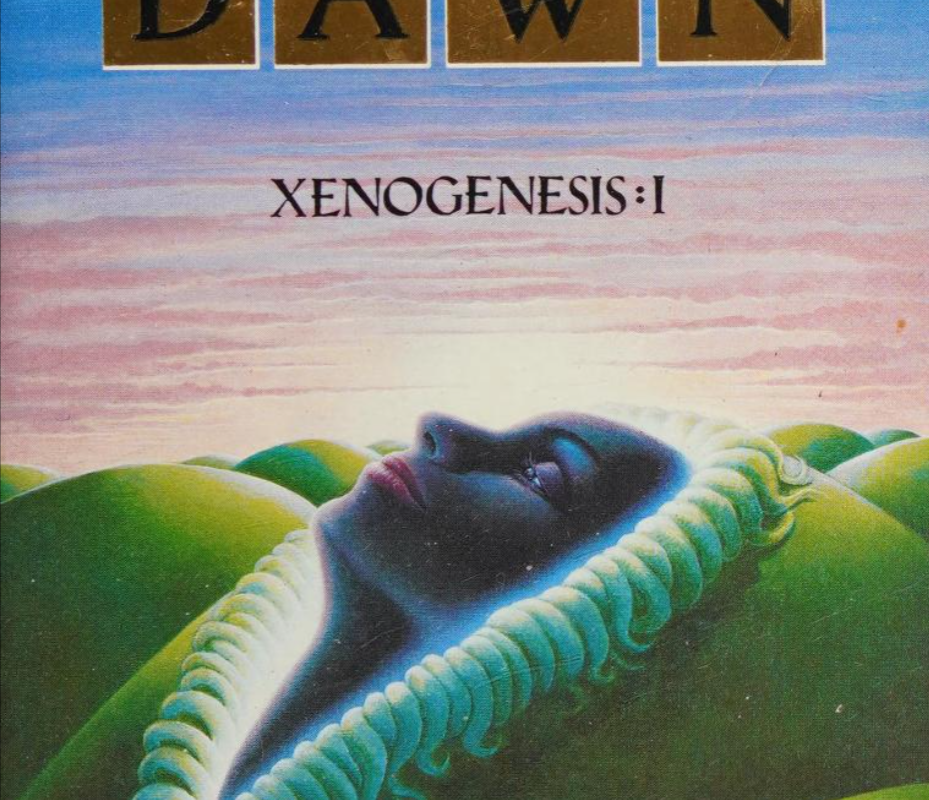
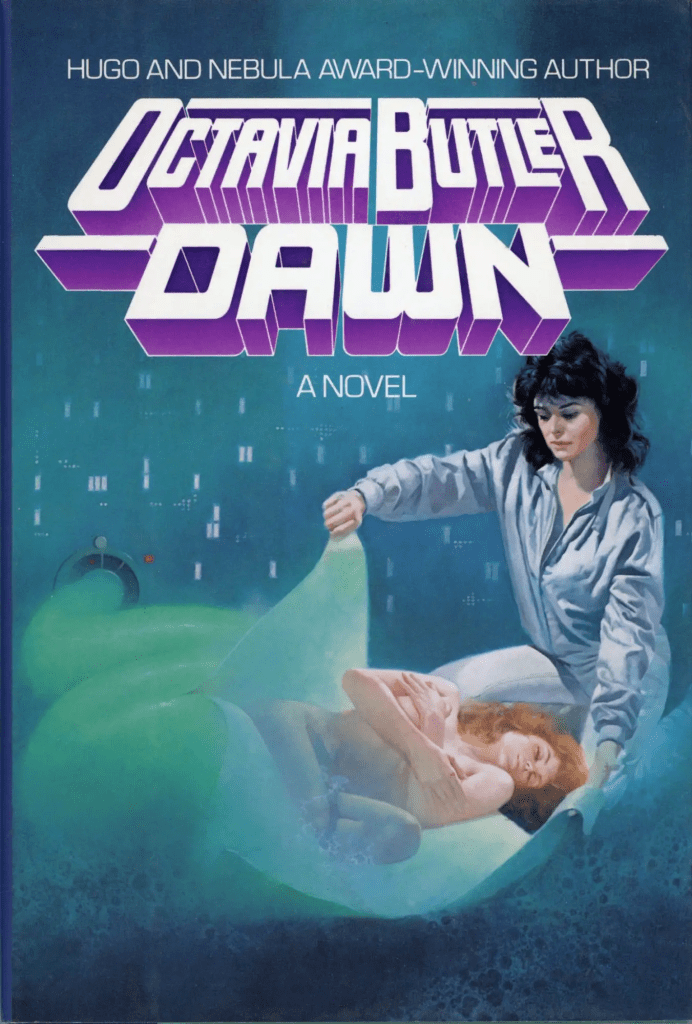
As an aside, this version of the book cover is risible. Not to devolve into identity politics, but Lilith is a dark-skinned woman, not a pale ginger. I can only assume that some target science fiction readers have a propensity to prefer white, sapphic adjacent characters.
I won’t even comment further on the faux 3D title treatment, relic of 1980s marketing.
* Spoiler Alert: As this statement about mass suicide is a Chapter 2 event, I am not inclined to consider it a spoiler. False alarm.


 Philosophics