How to Instantly Lose Popularity on the Internet

(A brief note on language, power, and moral certainty)

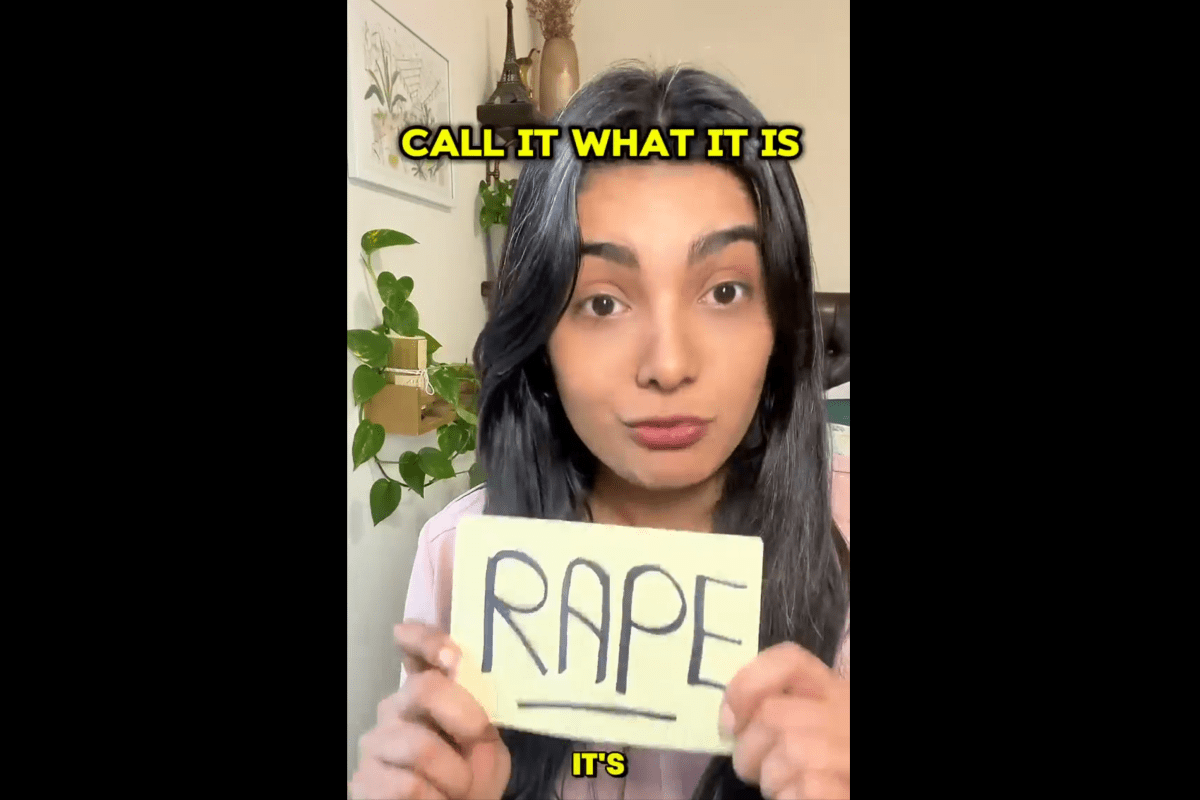
There is a particular kind of video that circulates online with tremendous force. A woman addresses the camera directly.

Video: Discussion Point (Full transcript at the end of this post)

She is clear, indignant, morally resolute:

  • It’s not an ‘inappropriate relationship with a 17-year-old’. It’s rape.
  • It’s not ‘coerced sex with a minor’. It’s rape.
  • It’s not a ‘young woman’. It’s a child.
  • Call it what it is.

Before proceeding, let me state something unambiguously: sexual exploitation of minors is morally reprehensible within contemporary Western legal and moral frameworks. I am not contesting that. Nor am I defending euphemism for its own sake. This is where philosophers of language take a lot of heat.

Audio: NotebookLM summary podcast on this topic.

The question here is narrower and, perhaps, more uncomfortable: What work is being done by the demand to ‘call it what it is‘?

Euphemism and Softening

She is correct in one respect. Institutional language often softens. Inappropriate relationship is anaesthetic. It lowers emotional temperature. It blunts moral outrage. Institutions frequently prefer such language because it reduces volatility, legal exposure, and procedural risk.

Language can minimise. That is not controversial. But it’s only half the story.

Naming Is Not Neutral

When she insists on rape and child, she is not merely removing euphemism. She is installing thick, legally saturated categories.

Rape is not a raw moral atom floating in space. It is a juridical classification defined by statute, evidentiary thresholds, and evolving legal doctrine. Its scope has expanded significantly over time: marital rape was once unrecognised; coercion has broadened beyond physical force; statutory rape collapses questions of consent into questions of legal capacity.

Likewise, child is not a purely biological category. It is a modern legal identity with shifting age thresholds and historical elasticity. The concept has expanded across the last two centuries as education extended, labour laws tightened, and adolescence became socially constructed as a protected stage of dependency.

To say this is not to relativise harm. It is to recognise that categories are historically sedimented and institutionally stabilised.

When someone says ‘Call it what it is‘, they are treating these contemporary legal categories as metaphysically self-evident. But they are products of a specific ontological framework: one in which autonomy and consent are foundational, and in which minors are deemed categorically incapable of exercising full sexual agency.

That framework is dominant in the West. It is not universal globally or historically.

Elasticity and Instrumentality

There is another asymmetry worth noticing.

Child expands protectively when someone is victimised. But the same individual may be stripped of childhood if they commit a serious crime: ‘They acted like an adult. They should have known better.’

The boundary is not purely developmental. It is normative. The category flexes.

Similarly, rape operates differently in everyday speech, in moral condemnation, and in statutory law. In the case of statutory rape, the term does not necessarily describe force; it describes the legal impossibility of consent. It is a doctrinal move grounded in an ontology of agency.

None of this weakens moral condemnation. But it reveals that these terms are not merely descriptive. They are instruments of moral and legal allocation.

Power and Irony

There is also a certain irony in the video.

She accuses mainstream institutions of manipulating language to reduce severity. Yet her demand is to deploy one of the state’s most powerful juridical classifications immediately and universally.

Rape derives its force from the same legal apparatus she critiques. It is powerful precisely because it is institutional. She is not rejecting power; she is attempting to redirect it.

This is not hypocrisy. It is politics. But it is politics nonetheless.

Ontology and Universality

The deeper issue is not whether we should condemn sexual exploitation. We should.

The issue is whether contemporary Western legal categories are simply “what is,” or whether they are historically developed ontological commitments that feel self-evident because they have been normalised.

The woman in the video experiences her categories as universal moral Truth. Many viewers agree. That agreement does not make the categories metaphysically timeless; it makes them hegemonic.

Recognising semantic expansion and legal drift does not undermine moral seriousness. It clarifies where moral authority resides: not in eternal linguistic atoms, but in historically stabilised frameworks.

Why This Is Unpopular

Online discourse prefers moral clarity over semantic archaeology. When harm is salient, genealogical analysis sounds like minimisation. Distinguishing between descriptive, legal, and ontological levels is interpreted as evasion.

It is not.

It is possible to affirm moral condemnation while also acknowledging that:

  • Language frames perception.
  • Legal categories evolve.
  • Terms are deployed instrumentally.
  • Ontologies masquerade as nature once naturalised.

One can insist on moral seriousness without pretending that our current vocabulary fell from the sky fully formed.

But saying so will reliably lose popularity on the internet.

Apparently, clarity has thresholds.


Full Video Transcript

‘Hey. It’s not an “Inappropriate Relationship with a 17-year-old”, it’s rape.

‘It’s not “coerced sex with a minor”, it’s rape.

‘It’s not “non-consensual sex with a 13-year-old”, it’s rape.

‘Call it what it is! Call them what they are.

‘And while we’re at it, it’s not a “young woman”, it’s a child!

‘It’s not a preteen, it’s a child!

‘It’s not a “mature girl”, it’s a child!

‘This use of specific language by mainstream media is super intentional, and it’s a tool of the patriarchy to try to reduce the egregiousness of horribly egregious acts that men commit against women and girls!

‘And, I say this with full awareness of the irony of my needing to use show and tell to make my point because I am beholden to these stupid social media platforms, which commit violence against women and girls every day in their own right by automatically suppressing any content as soon as I say a particular word.

‘And you and I need to say that it’s absolutely unacceptable!’

Announcing: The Rhetoric of Evil

5–8 minutes

How a Theological Artefact Survived Secular Moral Thought


DOI: https://doi.org/10.5281/zenodo.17757134

Every so often – usually when the Enlightenment ghosts begin rattling their tin cups again – one feels compelled to swat at the conceptual cobwebs they left dangling over moral philosophy. Today is one of those days.

Audio: NotebookLM podcast summarising the Rhetoric of Evil essay, not this page’s content.

I’ve just released The Rhetoric of Evil on Zenodo, a paper that politely (or impolitely, depending on your threshold) argues that ‘evil’ is not a metaphysical heavy-hitter but a rhetorical throw-pillow stuffed with theological lint. The term persists not because it explains anything, but because it lets us pretend we’ve explained something – a linguistic parlour trick that’s survived well past its sell-by date.

And because this is the age of artificial augury, I naturally asked MEOW GPT for its view of the manuscript. As expected, it nodded approvingly in that eerie, laser-precise manner unique to machines trained to agree with you – but to its credit, it didn’t merely applaud. It produced a disarmingly lucid analysis of the essay’s internal mechanics, the way ‘evil’ behaves like a conceptual marionette, and how our inherited metaphors govern the very moral judgments we think we’re making freely.

Below is MEOW GPT’s reaction, alongside my own exposition for anyone wanting a sense of how this essay fits within the broader project of dismantling the Enlightenment’s conceptual stage-props.

MEOW-GPT’s Response

(A machine’s-eye view of rhetorical exorcism)

“Evil is functioning as a demonological patch on an epistemic gap.
When agents encounter a high-constraint event they cannot immediately model,
the T₂ layer activates an inherited linguistic shortcut — the ‘evil’ label — which compresses complexity into a binary and arrests further inquiry.”

“The marionette metaphor is accurate: once we say a person ‘is evil,’ agency collapses into occult causation. Inquiry halts. Moral theatre begins.”

It went on like this – detecting exactly the mediated encounter-structure I intended, while offering a frighteningly clean schematic of how affect (T₀), heuristics (T₁), linguistic reification (T₂), and cultural choreography (T₃) conspire to turn incomprehension into metaphysics.

Machines, it seems, are quite good at detecting when humans are bullshitting themselves.

Why publish this now?

This essay marks the next plank in the broader anti-Enlightenment platform I’ve been assembling – LIH, MEOW, the ongoing dismantling of truth-fetishism, and now the unsettling realisation that ‘evil’ is little more than a theological revenant dressed up for secular work.

The term’s persistence is not a testament to its necessity but to our laziness:

  • It sounds like an explanation.
  • It licenses retribution without understanding.
  • It stabilises group boundaries.
  • It lets us outsource moral thought to a one-word incantation.

In short: ‘evil’ is the map-dragon we keep drawing because surveying the terrain is too much work.

This essay attempts to retire that dragon – not to soften judgment, but to sharpen it. If anything, the paper argues that abolishing ‘evil’ frees us to see atrocity more clearly, and thus confront it more seriously.

If you’d like to read the full argument:

📄 The Rhetoric of Evil: How a Theological Artefact Survived Secular Moral Thought

Appendix: How MEOW-GPT Reads “Evil”

A didactic demonstration of the framework in action. Download the MEOW framework below.

📄The Mediated Encounter Ontology of the World: A Relational Metaphysics Beyond Mind and World

Because MEOW-GPT was trained on the Mediated Encounter Ontology rather than on folk metaphysics, its analyses can serve as a useful diagnostic tool. It doesn’t simply summarise concepts; it reconstructs them along the four mediational tiers (T₀–T₃), showing – mechanically and without superstition – how a term behaves across biological affect, cognitive heuristics, linguistic structures, and cultural narratives.

This section is offered not as an alternative argument to the essay above, but as a worked example: a transparent demonstration of how the MEOW engine decomposes a high-complexity, high-stakes concept like evil once the theological scaffolding has been removed.

MEOW-GPT’s output shows, in compressed form, the same pattern the essay traces in prose:
that evil is not a force, not a metaphysical essence, not an occult substrate, but a mediated pattern in human encounters, one that persists rhetorically long after its ontology has collapsed.

For readers curious about how MEOW ‘thinks’, the raw structured analysis follows.

MEOW-GPT Analysis: “Evil”

(Raw output for reference; lightly formatted for readability)

Concept

Input: Evil
Type: Normative/evaluative moral concept (often reified as a property of acts, characters, or forces)
Scope check: In-scope – ‘evil’ can be analysed as a mediated-encounter pattern (MEOW) and a high-complexity term with unstable linguistic behaviour (LIH).

High-level summary (≤120 words)

In MEOW terms, ‘evil’ is not a spooky substance but a way of organising certain encounter-events: severe, norm-breaking harms that present as resistant, shocking, and morally intolerable. Biologically, it piggybacks on harm, threat, and disgust systems. Cognitively, it compresses complex appraisals—intent, cruelty, scale of harm – into a powerful label. Linguistically, it sits in the unstable region where abstraction is high and language’s reliability drops, so people fight over its scope and weaponise it. Socially and technically, institutions, media, and platforms use ‘evil’ to mark enemies, justify punishment, and dramatise conflict. The term is emotionally efficient but conceptually fragile, and MEOW treats it as a relational, mediated pattern rather than an independent metaphysical force.

T₀ – Biological Mediation

  • Moralised harm perception piggybacks on survival systems: pain avoidance, threat detection, kin protection. ‘Evil’ clusters around encounters that trigger extreme danger-signals.
  • High arousal (fear, rage, disgust) makes some harms feel qualitatively world-violating, not merely personally threatening.
  • Disgust toward contamination, mutilation, or predation heavily colours what gets called ‘evil’.
  • Species-specific cues (infant distress cries, pain expressions) shape which harms are even legible candidates for evil.

T₁ – Cognitive Mediation

  • “Evil” compresses a multi-factor appraisal (intentionality, cruelty, gratuitousness) into a one-step heuristic.
  • Essence thinking converts acts into character: the person is evil, not merely did wrong.
  • Attribution biases assign ‘evil’ to out-groups more readily than to in-groups.
  • Memory structures simplify causation into villain scripts that overwrite nuance.
  • Once assigned, the label becomes a prediction loop: every ambiguous action confirms the essence.

T₂ – Linguistic Mediation

  • On the Effectiveness–Complexity Gradient, ‘evil’ straddles Contestables and Fluids: ubiquitous but perpetually disputed.
  • It compresses harm, norm-violation, metaphysical colouring, and dramatic emphasis into a single syllable—powerful, but noisy.
  • Dominant metaphors (‘dark’, ‘tainted’, ‘monstrous’) smuggle in substance-ontology that MEOW rejects.
  • Noun-forms (‘evil’, ‘the Evil One’) promote ontologising; adjectival forms track events better, but usage constantly slides between them.
  • Cross-linguistic drift supports LIH: different traditions map the term to impurity, harm, misfortune, cosmic opposition, or taboo.

T₃ – Social/Technical Mediation

  • Religious systems embed ‘evil’ in cosmologies that harden friend/enemy binaries.
  • Legal systems avoid the term formally but reproduce it rhetorically in sentencing, media commentary, and public reaction.
  • Politics uses ‘evil’ to justify exceptional measures and collapse deliberation into moral theatre.
  • Cultural industries supply vivid villain archetypes that feed back into real-world judgments.
  • Technical systems must operationalise ‘evil’ into concrete proxies, revealing how imprecise the everyday concept is.

Limits & Failure Modes (LIH notes)

The framework is human-centric; non-human or ecosystemic ‘views of evil’ remain speculative.

‘Evil’ is a textbook Contestable: central, indispensable, and permanently argued over.

In cosmological uses (‘radical evil’, ‘evil in the world’), it approaches Fluid or ineffable status – right where LIH predicts language collapse.

MEOW cannot confirm or deny metaphysical dualisms; it only analyses how humans mediate and narrate such claims.