Fiction Nation: Legal and Jurisprudence Systems


Section 4: Legal and Jurisprudence Systems as Fictions

The Nature of Legal Systems

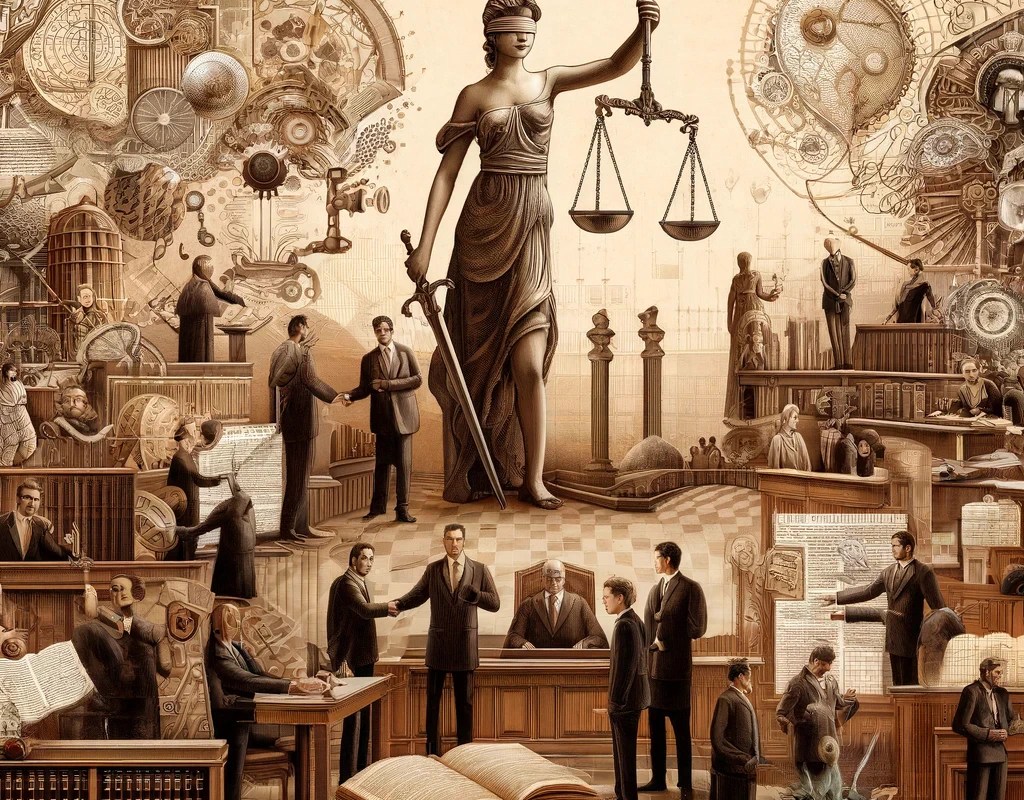
Legal and jurisprudence systems are among the most complex and entrenched fictions in society. Laws are human-made rules that govern behaviour, established by governments and enforced by judicial institutions. While laws aim to create order and justice, they are ultimately constructs, products of human agreement and cultural evolution.

The concept of law varies significantly across cultures and historical periods. Ancient legal codes, such as the Code of Hammurabi or Roman law, illustrate the long-standing tradition of codifying rules to govern society. However, these codes, like modern laws, are not natural phenomena but rather inventions designed to regulate human interactions and maintain social cohesion.

The Evolution of Legal Fictions

Legal systems have evolved alongside societies, adapting to changes in cultural norms, technological advancements, and political landscapes. The development of common law, for example, is a testament to the adaptive nature of legal systems. Common law, which originated in medieval England, is based on judicial precedents and case law rather than written statutes. This system relies heavily on the interpretation and application of past decisions, demonstrating how legal principles are constructed and reconstructed over time.

Moreover, legal fictions are often used within these systems to achieve practical outcomes. For instance, the concept of corporate personhood, where a corporation is treated as a legal person with rights and responsibilities, is a legal fiction designed to facilitate business operations and protect individual shareholders from certain liabilities. This illustrates how legal constructs can shape economic activities and social relations.

Implications of Legal Fictions

The recognition that legal systems are fictions has profound implications for how we understand and engage with the law. It highlights the role of human agency in creating and modifying legal norms, suggesting that laws are not immutable truths but rather adaptable tools for governance.

Legal systems are often seen as impartial and objective, but they are deeply influenced by the values, beliefs, and power dynamics of the societies that create them. This can lead to biases and inequalities being embedded within legal frameworks. For example, historical laws that discriminated based on race, gender, or class demonstrate how legal fictions can perpetuate social injustices.

Understanding the fictional nature of legal systems also opens the door to questioning and reforming these systems. It encourages us to consider alternative approaches to justice and governance that may better reflect contemporary values and address the needs of diverse populations.

The Role of Legal Narratives

Legal narratives, the stories told through laws and legal decisions, play a crucial role in shaping public perceptions and societal norms. These narratives construct realities that influence how individuals and communities understand their rights, responsibilities, and relationships with the state.

The work of scholars like Robert Cover, who in “Nomos and Narrative” (1983) argued that law is a system of meaning-making through narratives, underscores the importance of storytelling in the legal realm. By examining these narratives critically, we can uncover the underlying assumptions and power structures that they reinforce.

Future of Legal Systems

As societies continue to evolve, so too will their legal systems. The rise of international law, human rights conventions, and transnational legal frameworks reflects the growing interconnectedness of the world. These developments challenge traditional notions of state sovereignty and domestic legal autonomy, suggesting a future where legal systems may become even more complex and intertwined.

By recognizing legal systems as fictions, we are better equipped to navigate and influence these changes. This awareness can lead to more inclusive and equitable legal frameworks that serve the broader goals of justice and human flourishing.

References

  1. Cover, Robert. “Nomos and Narrative” (1983).
  2. Graeber, David. Debt: The First 5,000 Years (2011).
  3. Anderson, Benedict. Imagined Communities: Reflections on the Origin and Spread of Nationalism (1983).
  4. Giddens, Anthony. The Consequences of Modernity (1990).
  5. Beck, Ulrich. Cosmopolitan Vision (2006).

⬅ Fiction Nation: Economies & Money (part 3)

➡ Fiction Nation: Living in a World of Fictions (section 5)

Fiction Nation: Economies and Money

Section 3: Economies and Money as Fictions

The Concept of Money

Money is one of the most pervasive fictions in human society. Traditionally, it is thought that money evolved from barter systems, where goods and services were directly exchanged. However, anthropologist David Graeber, in his book “Debt: The First 5,000 Years” (2011), argues that this narrative is largely a myth. According to Graeber, there is little historical evidence to support the idea that societies primarily relied on barter before the advent of money. Instead, he suggests that credit systems were more prevalent, where people kept track of debts and credits in the absence of physical currency.

Graeber’s perspective challenges the conventional economic narrative by emphasizing the role of social relationships and trust in early economic transactions. Rather than evolving from barter to commodity money (like gold and silver coins) and then to fiat money, economies often operated on the basis of mutual obligations and social bonds long before the invention of physical currency. This underscores the idea that money, in all its forms, is a social construct—a fiction agreed upon by the members of a society.

Fiat money, which is currency that a government has declared to be legal tender but is not backed by a physical commodity, relies entirely on trust and belief in its value rather than any intrinsic worth. Its value comes from the collective agreement that money can be used for transactions, illustrating how deeply embedded fictions can shape our economic reality.

Economies as Constructs

Economies, much like money, are constructed systems designed to organize and facilitate the production, distribution, and consumption of goods and services. The idea of a market economy, where supply and demand determine prices and allocation of resources, is a theoretical construct that has been widely adopted and adapted across the globe. Economic theories and models, while rooted in empirical observations, are also shaped by human assumptions and values.

For example, capitalism, the dominant economic system in much of the world, is built on the principles of private property, free markets, and competition. These principles are human-made constructs that have been institutionalized through laws, regulations, and cultural norms. The notion of “economic growth” itself is a concept that has been prioritized and pursued, shaping policies and societal goals.

Implications of Economic Fictions

Understanding economies and money as fictions highlights their dependence on collective belief and participation. This perspective allows us to critically examine the assumptions underlying economic systems and consider alternative models. For instance, the rise of digital currencies like Bitcoin challenges traditional notions of money by introducing decentralized and peer-to-peer forms of exchange.

Moreover, recognizing the fictional nature of economies can lead to more flexible and adaptive economic policies. It encourages innovation and experimentation with new economic frameworks that may better address contemporary challenges such as inequality, environmental sustainability, and technological disruption.

By exploring the fictions of economies and money, we gain insight into the powerful influence of human-made constructs on our daily lives. This awareness can inspire us to question and potentially reshape these constructs to create more equitable and resilient economic systems for the future.

References

  1. Graeber, David. Debt: The First 5,000 Years (2011).
  2. Giddens, Anthony. The Consequences of Modernity (1990).
  3. Beck, Ulrich. Cosmopolitan Vision (2006).
  4. Anderson, Benedict. Imagined Communities: Reflections on the Origin and Spread of Nationalism (1983).

⬅ Fiction Nation: Nations as Fictions (part 2)

➡ Fiction Nation: Legal and Jurisprudence Systems (part 4)

Fiction Nation: The Concept of Fiction

Video: YouTube rendition of the content on this page.

Introduction

In our daily lives, we encounter numerous constructs that shape our understanding of the world. These constructs, though deeply ingrained in our societies, may be more fictional than factual. We accept the existence of nations, economies, money, and legal systems as fundamental aspects of our reality, yet these entities are human-made inventions. In this article, we will explore the notion that many of the pillars supporting our world are, in fact, fictions. By examining the nature of these fictions, we can better understand their impact on our lives and how they shape our perceptions and interactions.

Section 1: The Concept of Fiction

Definition of Fiction

Oxford Languages via Google defines fiction as:

fic·tion /ˈfɪkʃən/ noun

  1. literature in the form of prose that describes imaginary events and people.
  2. something that is invented or untrue.
    “they were supposed to be keeping up the fiction that they were happily married“

Fiction, in its most common sense, refers to imaginative literature—stories created from the author’s mind, describing events and characters that do not exist in reality. However, fiction also encompasses broader definitions, including any invented or untrue concept. This dual definition highlights the versatility of fiction: it is not only the realm of novels and stories but also the domain of societal constructs and beliefs that, while not grounded in tangible reality, exert a powerful influence over our lives.

Examples of Fiction in Everyday Life

Fiction extends beyond the pages of a book or the scenes of a movie. It permeates various aspects of our everyday existence. For instance, consider the concept of a corporation. Legally, a corporation is an entity that possesses many of the rights and responsibilities of a person, yet it is not a physical being—it is a construct, a legal fiction, created to facilitate economic activities. Similarly, brands and trademarks are fictions designed to create distinct identities for products and services, influencing consumer behaviour and shaping market dynamics.

The significance of these fictions lies in their ability to organize and structure society. They provide frameworks within which we operate, enabling complex interactions and collaborations. However, it is crucial to recognize their invented nature, as this awareness allows us to question and, if necessary, reshape these constructs to better serve our collective needs.

By acknowledging the fictional basis of many societal elements, we can unravel the layers of assumptions and beliefs that underpin our reality. This understanding sets the stage for a deeper exploration of specific fictions—nations, economies, money, and legal systems—and their profound impact on our world.

Continue to Fiction Nation: Section 2

Neglect and a Quarter Dozen

I am going to neglect this blog for at least another day. I’ve got too many irons in the fire.

Why do we routinely say ‘half dozen’ but don’t tend toward ‘quarter dozen’ or ‘third of a dozen’? I know many people have maths deficits, but still. I don’t think even I will attempt to start this trend, but this thought crossed my head today.

I hope to return to reengage with this block, but until then, adieu.

Objective Challenges

I’ve just published this video on YouTube, and I want to extend the commentary.

Video: What do Objective, Relative, and Subjective mean in philosophy?

Many people I’ve encountered don’t seem to grasp the distinctions between objective, subjective, and relative. Subjective and relative seem to be the biggest culprits of confusion. Let’s focus on morality just because.

There are really two main perspectives to adopt. If one believes in Objective Morality, one believes morality derives from some external source and is bestowed or mandated upon us. The source might be important to the believer, but it’s unimportant for this article. If one believes in Relative Morality then the source is socially dictated and has similar challenges to the notions of Social Contract Theory insomuch as one may not subscribe to the expectations.

For the Objective moralist, there may exist a schism between the expectations of the mandate and the subjective feelings of the individual. In fact, this may occur for Relative moralists as well. The individual will always maintain some subjective perspective on morality and then compare and contrast it with the higher order, whether Objective or Relative. In either case, acting on this subjective impulse risks being at odds with the members of the higher order. If this morality is codified into law – as it often is – then to act on that impulse makes one a criminal.

Take abortion for example. Whether this is an edict from God or just a social construct doesn’t matter. If one is in a society where abortion is seen as ‘bad’ or ‘wrong’, one’s subjective position on the matter is of little value. However, a Relativist society might also adopt a position of tolerance that is less likely to come from Objectivists.

A challenge is that a Subjectivist may only become apparent if one is counter the Relative or Absolute position. If your society is against abortion and you are, too, is this your subjective position or have you been indoctrinated with it and accept it uncritically, whether it’s deemed Objective or Relative.

Perhaps you feel that eating dogs or monkeys is immoral if not disgusting, but if you had been reared in a culture that does this, you might find it immoral to eat pork or beef. The question remains, is this a Subjective position, or did you merely inherit the Objective or Relative stance?

This question is very apparent in which religion one adopts. It is no surprise that the largest factor in which religion you choose is the religion of your family and their family and so on – so not so much a choice.

I was raised in a WASP family in New England among predominately Italian Roman Catholic peers. Despite this, I identified as an atheist early on. In my late teens, I stumbled on Buddhism and identified with it. However, I remain ignostic except when it encroaches on my personal autonomy – for example in the case of laws restricting access to safe abortions.

AI is Science Fiction

In the heart of the digital age, a Chinese professor’s AI-authored Science Fiction novel snags a national award, stirring a pot that’s been simmering on the back burner of the tech world. This ain’t your run-of-the-mill Sci-Fi plot—it’s reality, and it’s got tongues wagging and keyboards clacking. Here’s the lowdown on what’s shaking up the scene.

AI Lacks Originality? Think Again

The rap on AI is it’s a copycat, lacking the spark of human creativity. But let’s not kid ourselves—originality is as elusive as a clear day in London. Originality is another weasel word. Everything’s a remix, a mashup of what’s been before. We’ve all been drinking from the same cultural well, so to speak. Humans might be grand at self-deception, thinking they’re the cat’s pyjamas in the creativity department. But throw them in a blind test with AI, and watch them scratch their heads, unable to tell man from machine. It’s like AI’s mixing up a cocktail of words, structures, themes—you name it—and serving up a concoction that’s surprisingly palatable. And this isn’t the first time, not long ago, an AI-created artwork won as best submission at a state fair. In some cases, they are seeking AI-generated submissions; other times, not so much.

AI and the Art Debate

So, AI can’t whip up human-level art? That’s the chatter, but it’s about as meaningful as arguing over your favourite colour. Art’s a slippery fish—try defining it, and you’ll end up with more questions than answers. It’s one of those terms that’s become so bloated, it’s lost its punch. To some, it’s a sunset; to others, it’s a can of soup. So when AI throws its hat in the ring, it’s not just competing—it’s redefining the game.

The Peer Review Question Mark

Here’s where it gets spicy. The book bagging a national award isn’t just a pat on the back for the AI—it’s a side-eye at the whole peer review shindig. It’s like when your mate says they know a great place to eat, and it turns out to be just okay. The peer review process, much like reviewing a book for a prestigious award, is supposed to be the gold standard, right? But this AI-authored book slipping through the cracks and coming out tops? It’s got folks wondering if the process is more smoke and mirrors than we thought.


What’s Next?

So, where does this leave us? Grappling with the idea that maybe, just maybe, AI’s not playing second fiddle in the creativity orchestra. It’s a wake-up call, a reminder that what we thought was exclusively ours—creativity, art, originality—might just be a shared space. AI’s not just imitating life; it’s becoming an intrinsic part of the narrative. Science fiction? More like science fact.

The next chapter’s unwritten, and who knows? Maybe it’ll be penned by an AI, with a human sitting back, marvelling at the twist in the tale.

Atheist, Agnostic, Other

This article appeared in my social feed, What are the different types of atheism? But the author makes at least two notable mistakes. Firstly, he conflates atheism with agnosticism, the first being about belief and the last being about knowledge. So, one can believe or disbelieve in something, but that doesn’t speak to knowing. This debate is specifically about gods, so one can believe in a god but not know; one can not believe in gods and not know; one can believe in a god and know; and one can disbelieve in gods and not know. As for me, I am an igtheist: I don’t care about gods. It’s a silly place to spend my time.

For a theist or atheist, the existence of gods is a truth statement. For me, the question is not ruth apt; it’s ostensibly gibberish. Even then, I am still agnostic, which might also be ignostic because not only don’t I know, neither do I care.

As Ricky Gervais has pointed out (recasting per the linked article), if there are 10,000 gods, a typical Christian doesn’t believe in 9,999 gods. They believe in their god. Just 1. Of course, the other gods are nonsense. Ditto for Muslims. Ditto for Jews. In the end, they claim the same underlying deity, but they argue over which cohort He favours, and their god identifies as a male, so they’ve adopted male pronouns.

Secondly, whilst the author mentions religious and non-religious, he misses the spiritual cohort. This is a subset of non-religious. In some cases, I and many others might argue that spirituality is simply a personal religion, so the distinction would be one of community. The religious congregate en masse whilst the spiritual take this journey alone. One may also argue that some spiritual folks also congregate. I’ve attended more than one Wiccan or Pagan group event, but the ties may be looser than with a mainstream religion.

In the case of some spiritual adherents, non-religious is shorthand for being opposed to Big Religion. Perhaps not coincidentally, many of these are opposed to Big Pharma and Big Agriculture, but my purpose here is not a psychological profile.

I recently heard Robert Sapolsky say in a lecture that the religious live longer and are happier on average than non-religious, which is to say the spiritual and the atheists alike, so he notes this could provide an underlying evolutionary explanation for religious belief. Neither will I comment further on this notion, but there you have it. Take id or leave it.

Rhetoric is Truth; Morality, Emotion

I’ve been reengaging with philosophy, though my positions haven’t changed recently. My last change was to shift from being a qualified material realist to a qualified idealist in the shape of Analytic Idealism. In most matters I can think of, I am an anti-realist, which is to say concepts like truth and morality are not objective; rather they are mind-dependent.

I’ve long been on record of taking the stance that Capital-T Truth, moral truths, are derived rhetorically. There is no underlying Truth, only what we are aggregately convinced of, by whatever route we’ve taken. As a moral non-cognitivist, I am convinced that morality is derived through emotion and expressed or prescribed after a quick stop through logic gates. Again, there is nothing objective about morality.

Truth and morality are subjective and relative constructs. They resonate with us emotionally, so we adopt them.

Were I a theist — more particularly a monotheist —, I might be inclined to be emotionally invested in some Divine Command theory, where I believe that some god may have dictated these moral truths. Of course, this begs the question of how these so-called “Truths” were conveyed from some spirit world to this mundane world. I have no such conflict.

But let’s ask how an atheist might believe in moral realism. Perhaps, they might adopt a Naturalistic stance: we have some natural intuition or in-built moral mechanism that is not mind-dependent or socially determined. I am not a naturalist and I don’t take a universalist approach to the world, so this doesn’t resonate with me. I can agree that we have an in-built sense of fairness, and this might become a basis for some aspects of morality, but this is still triggered by an emotional response that is mind-dependent.

Another curious thing for me is why non-human animals cannot commit immoral acts. Isn’t this enough to diminish some moral universal? In the end, they are an extension of language by some definition. No language, not even a semblance of morality.

Anyway, there’s nothing new here. I just felt like creating a philosophical post as I’ve been so distracted by my health and writing.

Error Theory, Charity, and Occam’s Boomerang

As moral error theorists, we’re accustomed to facing criticism for our perspective. I’m a moral non-cognitivist, but there’s a significant intersection with these theories. When someone asserts that torture is wrong, I might argue that the claim is hollow, as moral wrongness is merely an emotional response masquerading as an objective moral stance. On the other hand, an error theorist would debunk this argument, stating that there’s no absolute position of right or wrong. Pragmatically, we both arrive at the conclusion that the claim cannot hold true.

Video: Is Error Theory Counterintuitive — Kane B

Intuition leads others to a different interpretation. If they believe something is true due to their epistemic certainty, then for them, it is true. Their reality is shaped by experience. Curse the limitations of sense perception and cognitive constraints. “I know what I know,” is their typical retort. Moreover, it’s a matter of practicality. “You know what I mean,” they insist.

They attempt to substitute fact with heuristics, truth with analogue, and terrain with a map. Admittedly, it’s convenient to feign an identity at play, but at best, it’s a near equivalence.

In the linked video, the example of claiming ‘that car is red’ is presented. But can cars truly be red? Not precisely. Cars can possess the property of appearing red to most individuals in specific lighting conditions, but a car cannot inherently be red. Thus, this statement is categorically false. We can assert ‘that the car appears to be red,’ and as a matter of practicality, we might designate the car as such. However, this highlights the inadequacy of language, particularly concerning abstract concepts.

A challenge arises from people’s inclination, driven by the principle of least effort, to seek simplicity and convenience, often at the expense of truth.

A challenge arises from people’s inclination, driven by the principle of least effort, to seek simplicity and convenience, often at the expense of truth. This principle underpins Occam’s Razor: choose the simplest version among competing explanations. It’s a misguided endeavour, akin to living under the notion that opposites attract rather than like attracting like.

I encounter this opposing worldview when I pinpoint certain inconsistencies or issues in the ‘real world,’ emphasizing that language is insufficient to convey adequate meaning, that there exists no objective moral centre, and that democracy is a system that falters even on paper. Almost invariably, the response is, ‘then what?’ I don’t possess the answer to ‘then what.’ I’m merely informing you that your leg is broken. I don’t need to know how to fix it for this to be true, a valid assessment.

While I’m on a roll, let’s talk about charity in philosophical argumentation, which, in my view, is another misguided concept. Why should I favour the notion that a person genuinely believes in the position they hold? It’s another heuristic rule set up to lend credence to otherwise weak arguments. We need not adhere to these boundaries—they’re nonexistent.


BONUS: I ran this content through ANTHROP/C’s Claude 2 for analysis and evaluation. I include it as an example of the bias inherent in generative AI. Whilst I realise that I am taking a polemic position—nothing new here—, Claude apes canned responses. Ironically, the same responses I am arguing against. I do agree that I could have ‘steel-manned’ my argument, but this is a blog post, not a dissertation. Perhaps another day.

Here are some thoughts on evaluating the blog post:

  • The author takes a strong moral non-cognitivist stance, arguing that moral claims like “torture is wrong” are not objective facts but expressions of emotion. This view aligns with moral error theory in debunking moral realism.
  • However, the dismissive attitude towards those who believe moral claims have truth value shows a lack of philosophical charity. The author could strengthen their position by steelmanning the opposing view before critiquing it.
  • The analogy between moral claims and claims like “the car is red” makes an interesting point about the inadequacy of language for capturing nuanced truth. However, more nuance could be applied in acknowledging the usefulness of simplifying language and heuristics in everyday life.
  • The author’s critique of Occam’s Razor and preference for complex explanations is thought-provoking but could benefit from addressing the pragmatic value of simpler models. Outright dismissing this philosophical principle seems extreme.
  • The call to abandon charity in argumentation in the name of absolute truth risks throwing the baby out with the bathwater. Some level of mutual understanding between interlocutors is needed for productive discourse.
  • Overall, while the post raises thoughtful challenges to moral realism, heuristics, and other commonly held views, the dismissive tone and lack of nuance weaken the arguments. More charity towards opposing views and addressing pragmatic concerns could strengthen the critique.

In summary, the post puts forward some provocative arguments but could benefit from greater philosophical charity, nuance, and balancing pragmatism with pursuing absolute truth. A more measured tone discussing pros and cons of different perspectives would likely lend more persuasive force.

ANTHROP/C Claude 2