When drawn, this card alters perception itself. It reminds the player that truth is not something one finds under a rock but something one polishes into shape. Each metaphor becomes a spell; each keyword a crutch thrown aside.
Those who wield the Constructivist Lens see not “facts,” but fictions so useful they forgot to call them that. Reality wobbles politely to accommodate belief.
“Knowledge is not a copy of reality but a tool for coping with it.” — Richard Rorty
In game terms: Tap to reframe existence as interpretation. Duration: until the next disagreement.
“Truths are illusions which we have forgotten are illusions.” — Nietzsche
Declaring the Problem
Most people say truth as if it were oxygen – obvious, necessary, self-evident. I don’t buy it.
Nietzsche was blunt: truths are illusions. My quarrel is only with how often we forget that they’re illusions.
Most people say truth as if it were oxygen – obvious, necessary, self-evident. I don’t buy it.
My own stance is unapologetically non-cognitivist. I don’t believe in objective Truth with a capital T. At best, I see truth as archetypal – a symbol humans invoke when they need to rally, persuade, or stabilise. I am, if you want labels, an emotivist and a prescriptivist: I’m drawn to problems because they move me, and I argue about them because I want others to share my orientation. Truth, in this sense, is not discovered; it is performed.
The Illusion of Asymptotic Progress
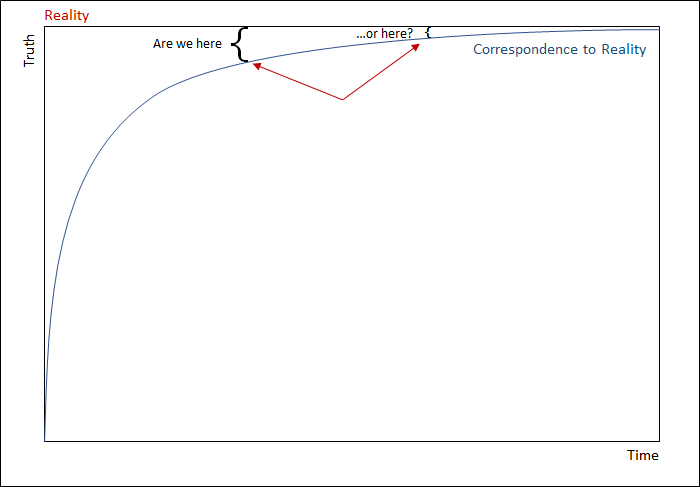
The standard story is comforting: over time, science marches closer and closer to the truth. Each new experiment, each new refinement, nudges us toward Reality, like a curve bending ever nearer to its asymptote.
Chart 1: The bedtime story of science: always closer, never arriving.
This picture flatters us, but it’s built on sand.
Problem One: We have no idea how close or far we are from “Reality” on the Y-axis. Are we brushing against it, or still a light-year away? There’s no ruler that lets us measure our distance.
Problem Two: We can’t even guarantee that our revisions move us toward rather than away from it. Think of Newton and Einstein. For centuries, Newton’s physics was treated as a triumph of correspondence—until relativity reframed it as local, limited, provisional. What once looked like a step forward can later be revealed as a cul-de-sac. Our curve may bend back on itself.
Use Case: Newton, Einstein, and Gravity Take gravity. For centuries, Newton’s laws were treated as if they had brought us into near-contact with Reality™—so precise, so predictive, they had to be true. Then Einstein arrives, reframes gravity not as a force but as the curvature of space-time, and suddenly Newton’s truths are parochial, a local approximation. We applauded this as progress, as if our asymptote had drawn tighter to Reality. But even Einstein leaves us with a black box: we don’t actually know what gravity is, only how to calculate its effects. Tomorrow another paradigm may displace relativity, and once again we’ll dutifully rebrand it as “closer to truth.” Progress or rhetorical re-baptism? The graph doesn’t tell us.
Chart 2: The comforting myth of correspondence: scientific inquiry creeping ever closer to Reality™, though we can’t measure the distance—or even be sure the curve bends in the right direction.
Thomas Kuhn was blunt about this: what we call “progress” is less about convergence and more about paradigm shifts, a wholesale change in the rules of the game. The Earth does not move smoothly closer to Truth; it lurches from one orthodoxy to another, each claiming victory. Progress, in practice, is rhetorical re-baptism.
Most defenders of the asymptotic story assume that even if progress is slow, it’s always incremental, always edging us closer. But history suggests otherwise. Paradigm shifts don’t just move the line higher; they redraw the entire curve. What once looked like the final step toward truth may later be recast as an error, a cul-de-sac, or even a regression. Newton gave way to Einstein; Einstein may yet give way to something that renders relativity quaint. From inside the present, every orthodoxy feels like progress. From outside, it looks more like a lurch, a stumble, and a reset.
Chart 3: The paradigm-gap view: what feels like progress may later look like regression. History suggests lurches, not lines, what we call progress today is tomorrow’s detour..
If paradigm shifts can redraw the entire map of what counts as truth, then it makes sense to ask what exactly we mean when we invoke the word at all. Is truth a mirror of reality? A matter of internal coherence? Whatever works? Or just a linguistic convenience? Philosophy has produced a whole menu of truth theories, each with its own promises and pitfalls—and each vulnerable to the same problems of rhetoric, context, and shifting meanings.
The Many Flavours of Truth
Philosophers never tire of bottling “truth” in new vintages. The catalogue runs long: correspondence, coherence, pragmatic, deflationary, redundancy. Each is presented as the final refinement, the one true formulation of Truth, though each amounts to little more than a rhetorical strategy.
Correspondence theory: Truth is what matches reality. Problem: we can never measure distance from “Reality™” itself, only from our models.
Coherence theory: Truth is what fits consistently within a web of beliefs. Problem: many mutually incompatible webs can be internally consistent.
Pragmatic theory: Truth is what works. Problem: “works” for whom, under what ends? Functionality is always perspectival.
Deflationary / Minimalist: Saying “it’s true that…” adds nothing beyond the statement itself. Problem: Useful for logic, empty for lived disputes.
Redundancy / Performative: “It is true that…” adds rhetorical force, not new content. Problem: truth reduced to linguistic habit.
And the common fallback: facts vs. truths. We imagine facts as hard little pebbles anyone can pick up. Hastings was in 1066; water boils at 100°C at sea level. But these “facts” are just truths that have been successfully frozen and institutionalised. No less rhetorical, only more stable.
So truth isn’t one thing – it’s a menu. And notice: all these flavours share the same problem. They only work within language-games, frameworks, or communities of agreement. None of them delivers unmediated access to Reality™.
Truth turns out not to be a flavour but an ice cream parlour – lots of cones, no exit.
Multiplicity of Models
Even if correspondence weren’t troubled, it collapses under the weight of underdetermination. Quine and Duhem pointed out that any body of evidence can support multiple competing theories.
Chart 4: orthodox vs. heterodox curves, each hugging “reality” differently
Hilary Putnam pushed it further with his model-theoretic argument: infinitely many models could map onto the same set of truths. Which one is “real”? There is no privileged mapping.
Conclusion: correspondence is undercut before it begins. Truth isn’t a straight line toward Reality; it’s a sprawl of models, each rhetorically entrenched.
Truth as Rhetoric and Power
This is where Orwell was right: “War is Peace, Freedom is Slavery, Ignorance is Strength.”
Image: INGSOC logo
Truth, in practice, is what rhetoric persuades.
Michel Foucault stripped off the mask: truth is not about correspondence but about power/knowledge. What counts as truth is whatever the prevailing regime of discourse allows.
We’ve lived it:
“The economy is strong”, while people can’t afford rent.
“AI will save us”, while it mainly writes clickbait.
“The science is settled” until the next paper unsettles it.
These aren’t neutral observations; they’re rhetorical victories.
Truth as Community Practice
Chart 5: Margin of error bands
Even when rhetoric convinces, it convinces in-groups. One group converges on a shared perception, another on its opposite. Flat Earth and Round Earth are both communities of “truth.” Each has error margins, each has believers, each perceives itself as edging toward reality.
Wittgenstein reminds us: truth is a language game. Rorty sharpens it: truth is what our peers let us get away with saying.
So truth is plural, situated, and always contested.
Evolutionary and Cognitive Scaffolding
Step back, and truth looks even less eternal and more provisional.
We spread claims because they move us (emotivism) and because we urge others to join (prescriptivism). Nietzsche was savage about it: truth is just a herd virtue, a survival trick.
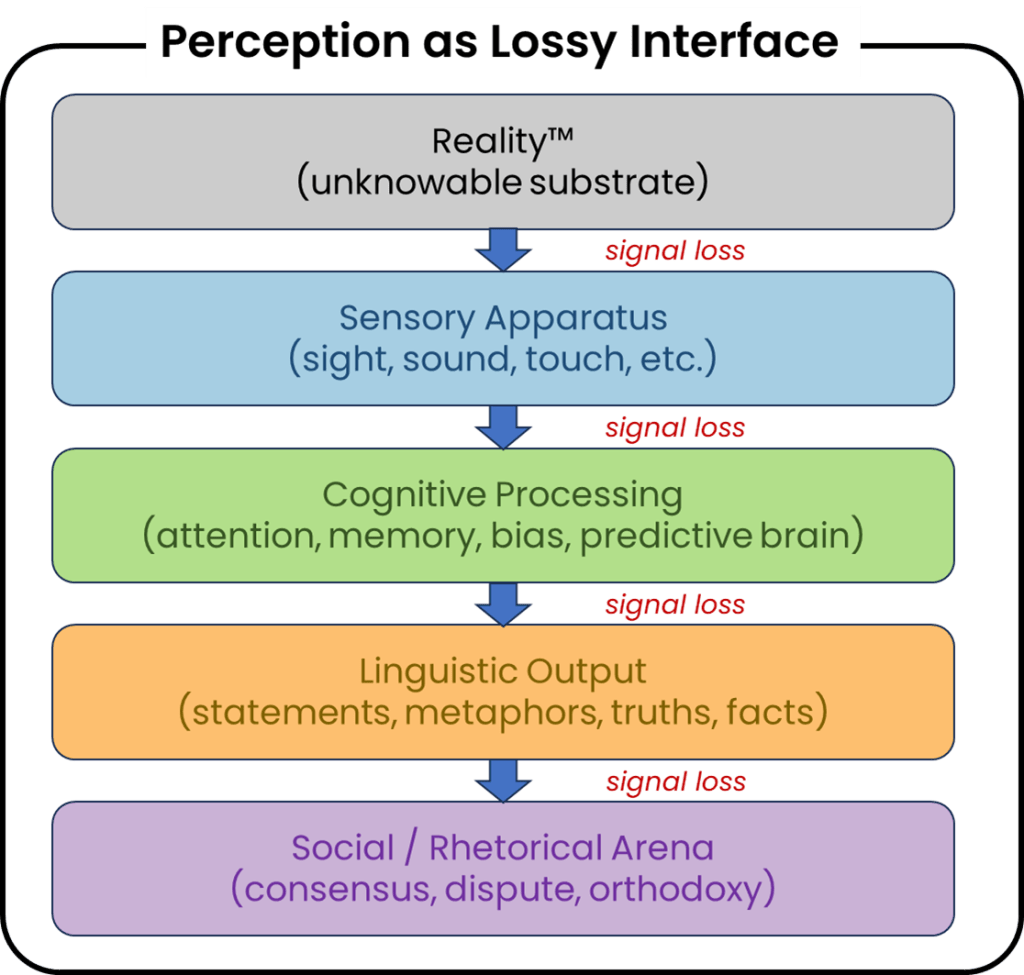
Cognitive science agrees, if in a different language: perception is predictive guesswork, riddled with biases, illusions, and shortcuts. Our minds don’t mirror reality; they generate useful fictions.
Diagram: Perception as a lossy interface: Reality™ filtered through senses, cognition, language, and finally rhetoric – signal loss at every stage.
Archetypal Truth (Positive Proposal)
So where does that leave us? Not with despair, but with clarity.
Truth is best understood as archetypal – a construct humans rally around. It isn’t discovered; it is invoked. Its force comes not from correspondence but from resonance.
Here, my own Language Insufficiency Hypothesis bites hardest: all our truth-talk is approximation. Every statement is lossy compression, every claim filtered through insufficient words. We can get close enough for consensus, but never close enough for Reality.
Truth is rhetorical, communal, functional. Not absolute.
The Four Pillars (Manifesto Form)
Archetypal – truth is a symbolic placeholder, not objective reality.
Asymptotic – we gesture toward reality but never arrive.
Rhetorical – what counts as truth is what persuades.
Linguistically Insufficient – language guarantees slippage and error.
Closing
Nietzsche warned, Rorty echoed: stop fetishising Truth. Start interrogating the stories we tell in its name.
Every “truth” we now applaud may be tomorrow’s embarrassment. The only honest stance is vigilance – not over whether we’ve captured Reality™, but over who gets to decide what is called true, and why.
Truth has never been a mirror. It’s a mask. The only question worth asking is: who’s wearing it?
This isn’t a political post. It’s about language, the insufficiency of it, and the games we play when pretending words carry more weight than they do.
Luigi Mangione is the man accused of killing UnitedHealthcare CEO Brian Thompson. After his arrest, prosecutors stacked the usual charges – murder, firearms, assorted legal bric-a-brac – then added the cherry on top: domestic terrorism.
Audio: NotebookLM podcast on this topic.
Recently, a pretrial judge cut the cherry loose.
Murder, yes. Terrorism, no. Not because murder is less grotesque, but because the statutory definition won’t stretch that far without breaking.
NEW YORK, Sept 16 (Reuters) – A New York state judge dismissed on Tuesday two terrorism-related counts against Luigi Mangione over the December 2024 killing of health insurance executive Brian Thompson, though the 27-year-old remains charged with second-degree murder and eight other criminal counts in the case.
“There was no evidence presented of a desire to terrorize the public, inspire widespread fear, engage in a broader campaign of violence, or to conspire with organized terrorist groups,” Judge Gregory Carro found in a 12-page written decision (pdf). “Here, the crime – the heinous, but targeted and discrete killing of one person – is very different from the examples of terrorism set forth in the statute.” (source)
The prosecution insisted the label fit. The judge disagreed. Cue outrage, applause, and confusion. The crime is still horrific, but suddenly the word “terrorist” is off-limits.
The Elasticity of Terror
How can two educated parties look at the same set of facts and come to opposite conclusions? Because “terrorism” isn’t a Platonic form. It’s an elastic linguistic category. The prosecutor drags it out because “terrorist” is a magical word in American law: it inflates an already ugly act into a civilisation-level threat, unlocks harsher penalties, and lets politicians posture about national security.
The judge, however, reminded everyone that a bullet in Manhattan does not equal al-Qaeda. Murder, yes. Terrorism, no. Not because murder is less grotesque, but because the statutory definition won’t stretch that far without breaking.
Language Games, Legal Hierarchies
This is where it gets trickier. The judge isn’t merely “pulling rank”—though rank does matter. American jurisprudence is hierarchical: trial judges hand down rulings, appellate judges review them, and nine robed partisans in Washington can one day rewrite the whole script. On paper, these tiers are meant to iron out ambiguity. In practice, they multiply it.
Five minds say ‘constitutional,’ four say ‘unconstitutional,’ and the one-vote margin becomes binding law for 330 million people. That’s not truth; it’s hierarchy dressed in robes.
Even co-equal judges, reading the same facts, can diverge wildly. Split decisions at the Supreme Court prove the point: five minds say “constitutional,” four say “unconstitutional,” and the one-vote margin becomes binding law for 330 million people. That’s not the discovery of truth; it’s the triumph of one language game over another, enforced by hierarchy.
The Insufficiency Laid Bare
So we return to Mangioni. He has been charged with murder – the second degree flavour; that much is uncontested. But is he a “terrorist”? The prosecution said yes, the judge said no, and another judge, higher up or sitting elsewhere, might well say yes again. Each claim is defensible. Each is motivated by language, by politics, and by the institutional pressures of the bench.
And that’s the point. Language doesn’t tether itself to reality; it choreographs our endless arguments about reality. The law tries to tame it with hierarchies and definitions, but the seams always show. Mangioni is a murderer. Whether he is a terrorist depends less on his actions than on which interpretive dance is winning in the courtroom that day.
I’m a nihilist. Possibly always have been. But let’s get one thing straight: nihilism is not despair. That’s a slander cooked up by the Meaning Merchants – the sentimentalists and functionalists who can’t get through breakfast without hallucinating some grand purpose to butter their toast. They fear the void, so they fill it. With God. With country. With yoga.
Audio: NotebookLM podcast on this topic.
Humans are obsessed with function. Seeing it. Creating it. Projecting it onto everything, like graffiti on the cosmos. Everything must mean something. Even nonsense gets rebranded as metaphor. Why do men have nipples? Why does a fork exist if you’re just going to eat soup? Doesn’t matter – it must do something. When we can’t find this function, we invent it.
But function isn’t discovered – it’s manufactured. A collaboration between our pattern-seeking brains and our desperate need for relevance, where function becomes fiction, where language and anthropomorphism go to copulate. A neat little fiction. An ontological fantasy. We ask, “What is the function of the human in this grand ballet of entropy and expansion?” Answer: there isn’t one. None. Nada. Cosmic indifference doesn’t write job descriptions.
And yet we prance around in lab coats and uniforms – doctors, arsonists, firemen, philosophers – playing roles in a drama no one is watching. We build professions and identities the way children host tea parties for dolls. Elaborate rituals of pretend, choreographed displays of purpose. Satisfying? Sometimes. Meaningful? Don’t kid yourself.
We’ve constructed these meaning-machines – society, culture, progress – not because they’re real, but because they help us forget that they’re not. It’s theatre. Absurdist, and often bad. But it gives us something to do between birth and decomposition.
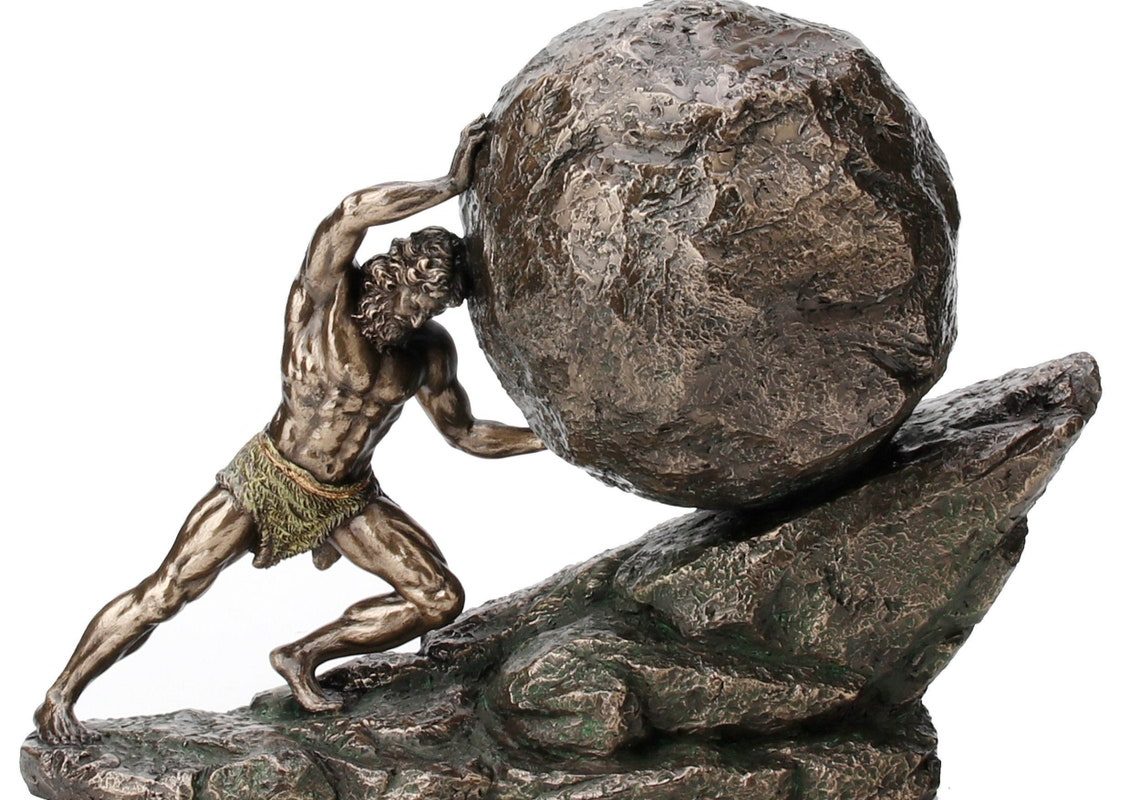
Sisyphus had his rock. We have careers.
But let’s not confuse labour for meaning, or imagination for truth. The boulder never reaches the top, and that’s not failure. That’s the show.
So roll the stone. Build the company. Write the blog. Pour tea for Barbie. Just don’t lie to yourself about what it all means.
Welcome to Part 6 of a Week-Long Series on the Evolution and Limits of Language! This article is part of a seven-day exploration into the fascinating and often flawed history of language—from its primitive roots to its tangled web of abstraction, miscommunication, and modern chaos. Each day, we uncover new layers of how language shapes (and fails to shape) our understanding of the world.
If you haven’t yet, be sure to check out the other posts in this series for a full deep dive into why words are both our greatest tool and our biggest obstacle. Follow the journey from ‘flamey thing hot’ to the whirlwind of social media and beyond!
Specialised Languages: Academia’s Jargon Olympics
If you thought normal language was confusing, let’s take a moment to appreciate the true champions of linguistic obscurity: academics. Welcome to the world of specialised languages, where entire fields of study have developed their own language games that make even Wittgenstein’s head spin.
Here’s how it works: Every discipline—science, law, philosophy—creates its own jargon to describe the world. At first, it seems helpful. Instead of using vague terms, you get precise definitions for complex ideas. But what started as a way to improve communication within a field quickly turned into a linguistic arms race, where the more obscure and convoluted your terms are, the smarter you sound. You’re not just a lawyer anymore—you’re someone who’s ready to throw “res ipsa loquitur” into casual conversation to leave everyone else in the room wondering if they’ve missed a memo.
The problem? If you’re not part of the club, good luck understanding what anyone is talking about. Want to read a physics paper? Prepare to learn a whole new vocabulary. Need to get through a legal document? You’ll be knee-deep in Latin phrases before you even get to the point. And don’t even try to decipher a philosophical text unless you’re ready to battle abstract nouns that have been stretched and twisted beyond recognition.
It’s not just the words themselves that are the issue—it’s the sheer density of them. Take “justice” for example. In philosophy, you’ve got theories about distributive justice, retributive justice, restorative justice, and a hundred other variations, each with its own set of terms and conditions. And that’s before we even touch on how “justice” is defined in legal circles, where it becomes an even more tangled mess of case law and precedent. Every field is playing its own version of the “justice” game, with its own rules and definitions, and none of them are interested in comparing notes.
This is the academic world in a nutshell. Each discipline has built its own linguistic fortress, and unless you’ve spent years studying, you’re not getting in. But here’s the kicker: even within these fields, people are often misunderstanding each other. Just because two scientists are using the same words doesn’t mean they’re on the same page. Sometimes, it’s more like a game of intellectual one-upmanship—who can define the most obscure term or twist a familiar word into something completely unrecognisable?
And let’s not forget the philosophers. They’ve turned linguistic acrobatics into an art form. Good luck reading Foucault or Derrida without a dictionary (or five) on hand. You might walk away thinking you understand their points, but do you really? Or have you just memorised the jargon without actually grasping the deeper meaning? Even scholars within these fields often argue over what was really meant by a certain text—Barthes, after all, famously declared the “death of the author,” so it’s not like anyone really has the final say on meaning anyway.
So here we are, knee-deep in jargon, trying to communicate with people who, technically, speak the same language but are operating within entirely different rulesets. Every academic discipline has its own secret code, and if you don’t know it, you’re lost. Even when you do know the code, you’re still at risk of miscommunication, because the words that look familiar have been stretched and shaped to fit highly specific contexts. It’s like being fluent in one dialect of English and then suddenly being asked to write a thesis in legalese. Good luck.
In the end, academia’s specialised languages don’t just make things harder—they actively create barriers. What started as a way to improve precision has turned into an obstacle course of incomprehensible terms, where the real challenge is just figuring out what anyone’s actually saying. And let’s be honest, even if you do figure it out, there’s no guarantee it’s going to mean the same thing next time you see it.
Neurolinguistics: Even Our Brains Can’t Agree
So far, we’ve seen how language is a mess of miscommunication, cultural differences, and academic jargon. But surely, at least on a biological level, our brains are all on the same page, right? Well, not exactly. Welcome to the wonderful world of neurolinguistics, where it turns out that even the very organ responsible for language can’t get its act together.
Here’s the deal: Neurolinguistics is the study of how the brain processes language, and while it’s fascinating, it’s also a bit of a buzzkill for anyone hoping for consistency. See, your brain and my brain don’t process language in the same way. Sure, we’ve got similar hardware, but the software is wildly unpredictable. There are individual differences, cultural influences, and developmental quirks that all affect how we understand and produce language. What’s simple for one brain might be completely baffling to another.
Take, for example, something as basic as syntax. Chomsky might have told us we all have a universal grammar hard-wired into our brains, but neurolinguistics has shown that how we apply that grammar can vary significantly. Some people are wired to handle complex sentence structures with ease—think of that friend who can follow 10 different clauses in a single breath. Others? Not so much. For them, even a moderately tricky sentence feels like mental gymnastics. The brain is constantly juggling words, meanings, and structures, and some brains are better at it than others.
But the real kicker is how differently we interpret words. Remember those abstract nouns we’ve been wrestling with? Well, it turns out that your brain might be interpreting ‘freedom’ or ‘justice’ completely differently from mine – not just because of culture or upbringing, but because our brains physically process those words in different ways. Neurolinguistic studies have shown that certain regions of the brain are activated differently depending on the individual’s experience with language. In other words, your personal history with a concept can literally change how your brain lights up when you hear or say it.
And don’t even get me started on bilingual brains. If you speak more than one language, your brain is constantly toggling between two (or more) linguistic systems, which means it’s running twice the risk of misinterpretation. What a word means in one language might trigger a completely different association in another, leaving bilingual speakers in a constant state of linguistic flux. It’s like trying to run two operating systems on the same computer—things are bound to get glitchy.
But here’s the real kicker: Even within the same person, the brain can’t always process language the same way all the time. Stress, fatigue, emotional state—all of these factors can influence how well we handle language on any given day. Ever tried to have a coherent conversation when you’re tired or angry? Good luck. Your brain isn’t interested in nuance or deep philosophical ideas when it’s in survival mode. It’s just trying to get through the day without short-circuiting.
So, not only do we have to deal with the external chaos of language – miscommunication, different contexts, shifting meanings – but we also have to contend with the fact that our own brains are unreliable interpreters. You can use all the right words, follow all the right grammar rules, and still end up with a garbled mess of meaning because your brain decided to take a nap halfway through the sentence.
In the end, neurolinguistics reminds us that language isn’t just a social or cultural problem – it’’’s a biological one too. Our brains are doing their best to keep up, but they’re far from perfect. The very organ that makes language possible is also responsible for making it infinitely more complicated than it needs to be. And if we can’t rely on our own brains to process language consistently, what hope do we have of ever understanding anyone else?






 Philosophics