I’ve just published a new preprint on Zenodo: Disagreement Without Referees: Ontological Incommensurability and the Limits of Moral Adjudication 📄 https://doi.org/10.5281/zenodo.17932544
I welcome reviews, comments, and dissents.
This paper grows out of a frustration that will be familiar to anyone who spends time in moral or political argument: the sense that we keep talking past one another, mistaking deep incompatibilities for mere differences of opinion – and then moralising the failure to converge. Mostly, I’m tired of having to explain why my position isn’t subjectivist, relativist, quietist, nihilist, or whatever –ist flavour du jour. As with John Lennon, I complain about the –isms.
Audio: NotebookLM summary podcast of this essay.
The core claim is simple but unfashionable: many persistent disagreements are not epistemic at all. They are ontological. They do not arise within a shared background of assumptions about what exists, what counts as a reason, or what can ground normativity. They arise between incompatible background frameworks. When we treat such conflicts as if they were resolvable by better arguments, clearer communication, or more empathy, we misdiagnose the problem – and often make it worse.
The paper draws a sharp distinction between:
Disagreements of opinion, which presuppose a shared world and are, in principle, corrigible; and
Ontological disagreements, where what is contested is not the right answer, but what it would even mean for an answer to be right.
From there, I examine why charges like ‘relativism’, ‘subjectivism’, or ‘anything goes’ retain such rhetorical force despite their weak logical footing. The argument is not that these labels are false descriptions so much as that they function asboundary-maintenance devices within Enlightenment-inherited moral frames. They stabilise a sense of moral order by excluding positions that deny neutral adjudication.
Image: NotebookLM infographic. (This is the first infographic I’ve produced from NotebookLM. I’m not sure what I think of it, but I might try more directed versions in the future.)
I also take up the familiar worry that abandoning objective moral grounding leads to arbitrariness or nihilism. The paper rejects this caricature. Evaluation does not disappear when foundations are withdrawn; it relocates. What follows is not moral collapse but moral life without referees, where disagreement is managed through persuasion, coalition-building, institutional design, and power, rather than appeals to metaphysical authority.
Importantly, the paper is diagnostic, not prescriptive. It does not offer a new moral framework, a reconciliatory theory, or a solution to moral conflict. It argues instead for a clearer understanding of why some disagreements resist resolution, and for a more honest account of what remains once the fantasy of neutral adjudication is relinquished.
If nothing else, the hope is that recognising ontological incommensurability can temper the moral theatre that so often accompanies disagreement – replacing accusations of irrationality or bad faith with a clearer sense of what is, and is not, at stake.
This essay is also available on PhilPapers. For now, the full preprint is available on Zenodo at the link above.
As ever, comments are welcome – provided we’re clear about which world we think we’re standing in.
I’ve just published Objectivity Is Illusion: An Operating Model of Social and Moral Reasoning, an essay that began as this blog post. I’m sharing the ‘official’ link and this first draft. As the essay matured, I added additional support, but I focused primarily on refuting the anticipated opposing arguments. Rather than regurgitate the final version here, I felt showing the genesis would be more instructive. Of course, the essay didn’t spring fully formed; I’ve pruned and expanded from earlier notes still sitting on my hard drive.
Every so often, I’m told I’m too slippery with words, that I treat truth as if it were just another game of persuasion, that I reduce morality to chalk lines on a playing field. The objection usually comes with force: ‘But surely you believe some things are objectively true?‘
I don’t. Or more precisely, I don’t see how ‘objectivity’ in the metaphysical sense can be defended without lapsing into stagecraft. Granite foundations have always turned out to be scaffolding with the paint touched up. Priests once told us their gods guaranteed truth; scientists later promised the lab would serve as granite; politicians assure us democracy is the stone pillar. But in each case the creaks remain.
Audio: NotebookLM podcast on this topic.
This essay is written with an academic readership in mind. It assumes familiarity with figures like Nietzsche, Foucault, Rorty, and Ayer, and with the long quarrel over subjectivity, relativity, and objectivity. My aim is not to retell those arguments from the ground up, but to position my own framework within that ongoing dispute.
Scope
Before proceeding, some guardrails. When I say ‘objectivity is illusion,’ I mean in the social and moral domain. I’m not denying quarks or mathematics. My claim is narrower: in human discourse, no truth escapes subjectivity or contingency.
This dovetails with my broader Language Insufficiency Hypothesis: that even our words are leaky vessels, prone to misfire and misunderstanding. If language itself is unstable ground, then objectivity built upon it can hardly be granite. My claim here is not that nothing exists outside us, but that in the social world we inhabit together, every ‘truth’ rests on creaking boards.
One more note: just because social administration requires appeals to objectivity doesn’t mean objectivity exists. Courts, laboratories, and parliaments invoke it to secure trust, and it works well enough as theater. But necessity is not proof. And it is not my responsibility to conjure a granite replacement. What follows is an operating model, not a new altar.
Thesis
Objectivity is an illusion. Truth is rhetorical. Morality is prescriptive, not propositional. Our ethic is not granite but care: tending the planks we walk on, knowing they creak.
Operating Model: Five Premises
This framework is not a foundation. It is an operating model – contingent, provisional, subject to revision as circumstances change. Like any model, it can (and should) be updated to fit the culture and times.
Premise 1: Subjectivity is the baseline. Every claim originates in a perspective. No statement is free of the lens through which it is made. Even to deny subjectivity is to speak from a subject.
Premise 2: Relativity is emergent. What we call ‘relative truth’ is not a separate category but the convergence of individual subjectivities into provisional consensus. Consensus is never neutral: it is formed rhetorically – through persuasion, cultural resonance, and power [1]. MacIntyre made a similar point in After Virtue. The moral consensus of the Ancients was not grounded in objectivity but in a shared tradition – a thick account of human flourishing that gave coherence to their claims. When that scaffolding collapsed, consensus fractured, leaving modern moral discourse in fragments. Critics accused MacIntyre of relativism, since different traditions yield different ‘truths’, but his point reinforces mine: what looks like objectivity is in fact the temporary overlap of subjectivities sustained by tradition [2].
Premise 3: Objectivity is illusion. Claims presented as objective are relative norms hardened by repetition and forgotten as contingent scaffolding. ‘Objectivity’ is consensus disguised as granite. Its invocation in courts or parliaments may be useful, but usefulness is not existence. The burden of proof belongs to anyone insisting on an independent, metaphysical anchor for moral or social truths (Nietzsche’s ‘mobile army of metaphors’ [3], Kuhn’s paradigms [4], Latour’s laboratories [5]).
Even if one concedes, with Weber (as MacIntyre reminds us), that objective moral truths might exist in principle, they remain inaccessible in practice. What cannot be accessed cannot guide us; reconciliation of values and virtues must therefore take place within traditions and rhetoric, not in appeal to unreachable granite [13].
Premise 4: Rhetoric establishes truth. What counts as ‘true’ in the social and moral domain is established rhetorically – through coherence, resonance, utility, or force. This does not mean truth is ‘mere spin’. It means truth is never metaphysical; it is enacted and enforced through persuasion. If a metaphysical claim convinces, it does so rhetorically. If a scientific claim holds, it does so because it persuades peers, fits the evidence, and survives testing. In short: rhetoric is the medium through which truths endure [6].
Premise 5: Non-Cognitivism, Stated Plainly. I take moral utterances to be prescriptions, not propositions. When someone says ‘X is wrong’, they are not reporting an objective fact but prescribing a stance, a rule, a line in chalk. This is my operating position: non-cognitivism (Ayer [7], Stevenson [8]).
That said, I know the term feels alien. Many prefer the dialect of subjectivism – ‘X is true-for-me but not-for-you’ – or the quasi-realist stance that moral language behaves like truth-talk without cosmic backing (Blackburn [9]). I have no quarrel with these translations. They name the same scaffolding in different accents. I am not defending any school as such; I am simply stating my plank: morality prescribes rather than describes.
Ethic: Care. Since scaffolding is all we have, the obligation is not to pretend it is stone but to keep it usable. By ‘care’, I do not mean politeness or quietism. I mean maintenance – deliberation, repair, mutual aid, even revolt – so long as they acknowledge the scaffolding we share. Care is not optional: stomp hard enough and the floor collapses beneath us all.
Examples clarify: peer review in science is care in action, patching leaky vessels rather than proving granite. Civil rights movements practiced care by repairing rotten planks of law, sometimes with revolt. Communities rebuilding after disaster embody care by reconstructing scaffolding, not pretending it was indestructible. Care is maintenance, reciprocity, and survival.
Bridge: These five premises do not add up to a system or a foundation. They form an operating model: subjectivity as baseline, relativity as emergent, objectivity as illusion, rhetoric as truth, morality as prescription. Together they outline a practice: walk the planks with care, admit the creaks, patch where needed, and stop pretending we live in marble halls.
Rationale
Why prefer scaffolding to granite? Because granite has always been a mirage. The history of philosophy and politics is a history of crumbling temples and collapsing empires. The promises of permanence never survive the weather.
Think of Nietzsche, who called truths ‘a mobile army of metaphors’ [3]. Think of Foucault, who showed that what counts as ‘truth’ is always bound up with power [1]. Think of Rorty, who reduced truth to what our peers let us get away with saying [6]. These are not nihilists but diagnosticians: they exposed the creaks in the floorboards and the wizard behind the curtain.
Metaphors drive the point home:
Scaffolding and granite: What holds is temporary, not eternal. Granite is an illusion painted on timber.
Chalk lines: Rules of play – binding, real, but contingent. They can be redrawn.
Shoreline houses: Rome, the USSR, the British Empire – each built like beachfront villas with a fine view and bad footing. Storms came, sand eroded, and down they went.
Bias as framing: Kahneman himself admitted ‘bias’ is not a thing in the world [10], only a deviation from a chosen model. Gigerenzer [11] and Jared Peterson [12] remind us heuristics are adaptive. To call them ‘biases’ is not neutral – it’s allegiance to a standard of rationality.
The point is simple: what holds today is scaffolding, and pretending otherwise is self-deception.
Counterarguments and Refutations
Objection: Moral Paralysis. Without objective morality, why abolish slavery or defend rights?
Refutation: Chalk lines still bind. Speed limits aren’t cosmic, but they regulate conduct. Abolition endured not because it tapped a cosmic truth but because it persuaded, resonated, and took root. Slavery was once ‘in bounds’. Now it is ‘offsides’. That shift was rhetorical, emotional, political – but no less binding.
Objection: Problem of Dissent. If all is subjective, the lone dissenter is ‘just another voice’.
Refutation: Dissent gains traction through coherence, predictive success, or resonance. Galileo, abolitionists, suffragists – none relied on metaphysical granite. They persuaded, they resonated, they moved chalk lines. Truth was made through rhetoric, not uncovered in stone.
Objection: Performative Dependency. Even to say ‘subjective’ assumes the subject/object split. Aren’t you still inside the house?
Refutation: Of course. But I’m the one pointing at the slippery boards: ‘Mind the dust’. Yes, I’m in the house. But I refuse to pretend it’s marble. And even the category ‘subject’ is not eternal – it’s porous, dynamic, and leaky, just like language itself.
Objection: Infinite Regress. Why stop at subjectivity? Why not de-integrate further?
Refutation: Subjectivity is not granite, but it is the last plank before void. Peel it back and you erase the possibility of claims altogether. If tomorrow we discover that the ‘subject’ is a swarm of quarks or circuits, fine – but the claim still emerges from some locus. Regression refines; it doesn’t disprove.
Conclusion: The Ethic of Care
This is not reintegration. It is dis-integration: naming the creaks, stripping polyvinyl from rotten boards, refusing granite illusions.
If you wish to build here, build. But know the ground shifts, the storms come, the shoreline erodes. The ethic is not certainty but care: to tend the scaffolding we share, to patch without pretending it is stone, and to let dissent itself become part of the maintenance.
“Truths are illusions which we have forgotten are illusions.” — Nietzsche
Declaring the Problem
Most people say truth as if it were oxygen – obvious, necessary, self-evident. I don’t buy it.
Nietzsche was blunt: truths are illusions. My quarrel is only with how often we forget that they’re illusions.
Most people say truth as if it were oxygen – obvious, necessary, self-evident. I don’t buy it.
My own stance is unapologetically non-cognitivist. I don’t believe in objective Truth with a capital T. At best, I see truth as archetypal – a symbol humans invoke when they need to rally, persuade, or stabilise. I am, if you want labels, an emotivist and a prescriptivist: I’m drawn to problems because they move me, and I argue about them because I want others to share my orientation. Truth, in this sense, is not discovered; it is performed.
The Illusion of Asymptotic Progress
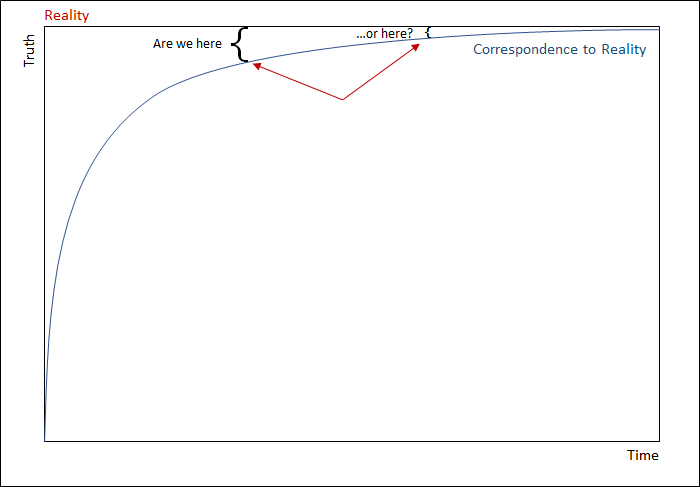
The standard story is comforting: over time, science marches closer and closer to the truth. Each new experiment, each new refinement, nudges us toward Reality, like a curve bending ever nearer to its asymptote.
Chart 1: The bedtime story of science: always closer, never arriving.
This picture flatters us, but it’s built on sand.
Problem One: We have no idea how close or far we are from “Reality” on the Y-axis. Are we brushing against it, or still a light-year away? There’s no ruler that lets us measure our distance.
Problem Two: We can’t even guarantee that our revisions move us toward rather than away from it. Think of Newton and Einstein. For centuries, Newton’s physics was treated as a triumph of correspondence—until relativity reframed it as local, limited, provisional. What once looked like a step forward can later be revealed as a cul-de-sac. Our curve may bend back on itself.
Use Case: Newton, Einstein, and Gravity Take gravity. For centuries, Newton’s laws were treated as if they had brought us into near-contact with Reality™—so precise, so predictive, they had to be true. Then Einstein arrives, reframes gravity not as a force but as the curvature of space-time, and suddenly Newton’s truths are parochial, a local approximation. We applauded this as progress, as if our asymptote had drawn tighter to Reality. But even Einstein leaves us with a black box: we don’t actually know what gravity is, only how to calculate its effects. Tomorrow another paradigm may displace relativity, and once again we’ll dutifully rebrand it as “closer to truth.” Progress or rhetorical re-baptism? The graph doesn’t tell us.
Chart 2: The comforting myth of correspondence: scientific inquiry creeping ever closer to Reality™, though we can’t measure the distance—or even be sure the curve bends in the right direction.
Thomas Kuhn was blunt about this: what we call “progress” is less about convergence and more about paradigm shifts, a wholesale change in the rules of the game. The Earth does not move smoothly closer to Truth; it lurches from one orthodoxy to another, each claiming victory. Progress, in practice, is rhetorical re-baptism.
Most defenders of the asymptotic story assume that even if progress is slow, it’s always incremental, always edging us closer. But history suggests otherwise. Paradigm shifts don’t just move the line higher; they redraw the entire curve. What once looked like the final step toward truth may later be recast as an error, a cul-de-sac, or even a regression. Newton gave way to Einstein; Einstein may yet give way to something that renders relativity quaint. From inside the present, every orthodoxy feels like progress. From outside, it looks more like a lurch, a stumble, and a reset.
Chart 3: The paradigm-gap view: what feels like progress may later look like regression. History suggests lurches, not lines, what we call progress today is tomorrow’s detour..
If paradigm shifts can redraw the entire map of what counts as truth, then it makes sense to ask what exactly we mean when we invoke the word at all. Is truth a mirror of reality? A matter of internal coherence? Whatever works? Or just a linguistic convenience? Philosophy has produced a whole menu of truth theories, each with its own promises and pitfalls—and each vulnerable to the same problems of rhetoric, context, and shifting meanings.
The Many Flavours of Truth
Philosophers never tire of bottling “truth” in new vintages. The catalogue runs long: correspondence, coherence, pragmatic, deflationary, redundancy. Each is presented as the final refinement, the one true formulation of Truth, though each amounts to little more than a rhetorical strategy.
Correspondence theory: Truth is what matches reality. Problem: we can never measure distance from “Reality™” itself, only from our models.
Coherence theory: Truth is what fits consistently within a web of beliefs. Problem: many mutually incompatible webs can be internally consistent.
Pragmatic theory: Truth is what works. Problem: “works” for whom, under what ends? Functionality is always perspectival.
Deflationary / Minimalist: Saying “it’s true that…” adds nothing beyond the statement itself. Problem: Useful for logic, empty for lived disputes.
Redundancy / Performative: “It is true that…” adds rhetorical force, not new content. Problem: truth reduced to linguistic habit.
And the common fallback: facts vs. truths. We imagine facts as hard little pebbles anyone can pick up. Hastings was in 1066; water boils at 100°C at sea level. But these “facts” are just truths that have been successfully frozen and institutionalised. No less rhetorical, only more stable.
So truth isn’t one thing – it’s a menu. And notice: all these flavours share the same problem. They only work within language-games, frameworks, or communities of agreement. None of them delivers unmediated access to Reality™.
Truth turns out not to be a flavour but an ice cream parlour – lots of cones, no exit.
Multiplicity of Models
Even if correspondence weren’t troubled, it collapses under the weight of underdetermination. Quine and Duhem pointed out that any body of evidence can support multiple competing theories.
Chart 4: orthodox vs. heterodox curves, each hugging “reality” differently
Hilary Putnam pushed it further with his model-theoretic argument: infinitely many models could map onto the same set of truths. Which one is “real”? There is no privileged mapping.
Conclusion: correspondence is undercut before it begins. Truth isn’t a straight line toward Reality; it’s a sprawl of models, each rhetorically entrenched.
Truth as Rhetoric and Power
This is where Orwell was right: “War is Peace, Freedom is Slavery, Ignorance is Strength.”
Image: INGSOC logo
Truth, in practice, is what rhetoric persuades.
Michel Foucault stripped off the mask: truth is not about correspondence but about power/knowledge. What counts as truth is whatever the prevailing regime of discourse allows.
We’ve lived it:
“The economy is strong”, while people can’t afford rent.
“AI will save us”, while it mainly writes clickbait.
“The science is settled” until the next paper unsettles it.
These aren’t neutral observations; they’re rhetorical victories.
Truth as Community Practice
Chart 5: Margin of error bands
Even when rhetoric convinces, it convinces in-groups. One group converges on a shared perception, another on its opposite. Flat Earth and Round Earth are both communities of “truth.” Each has error margins, each has believers, each perceives itself as edging toward reality.
Wittgenstein reminds us: truth is a language game. Rorty sharpens it: truth is what our peers let us get away with saying.
So truth is plural, situated, and always contested.
Evolutionary and Cognitive Scaffolding
Step back, and truth looks even less eternal and more provisional.
We spread claims because they move us (emotivism) and because we urge others to join (prescriptivism). Nietzsche was savage about it: truth is just a herd virtue, a survival trick.
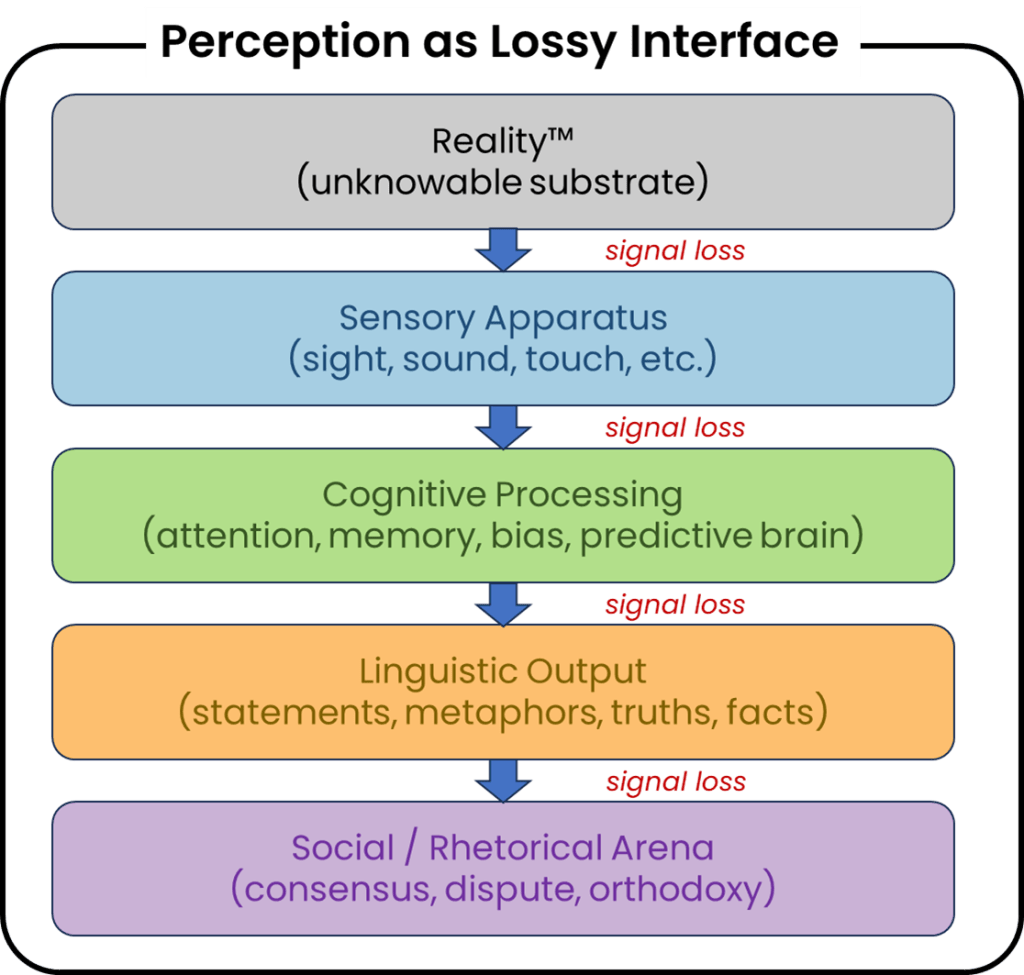
Cognitive science agrees, if in a different language: perception is predictive guesswork, riddled with biases, illusions, and shortcuts. Our minds don’t mirror reality; they generate useful fictions.
Diagram: Perception as a lossy interface: Reality™ filtered through senses, cognition, language, and finally rhetoric – signal loss at every stage.
Archetypal Truth (Positive Proposal)
So where does that leave us? Not with despair, but with clarity.
Truth is best understood as archetypal – a construct humans rally around. It isn’t discovered; it is invoked. Its force comes not from correspondence but from resonance.
Here, my own Language Insufficiency Hypothesis bites hardest: all our truth-talk is approximation. Every statement is lossy compression, every claim filtered through insufficient words. We can get close enough for consensus, but never close enough for Reality.
Truth is rhetorical, communal, functional. Not absolute.
The Four Pillars (Manifesto Form)
Archetypal – truth is a symbolic placeholder, not objective reality.
Asymptotic – we gesture toward reality but never arrive.
Rhetorical – what counts as truth is what persuades.
Linguistically Insufficient – language guarantees slippage and error.
Closing
Nietzsche warned, Rorty echoed: stop fetishising Truth. Start interrogating the stories we tell in its name.
Every “truth” we now applaud may be tomorrow’s embarrassment. The only honest stance is vigilance – not over whether we’ve captured Reality™, but over who gets to decide what is called true, and why.
Truth has never been a mirror. It’s a mask. The only question worth asking is: who’s wearing it?
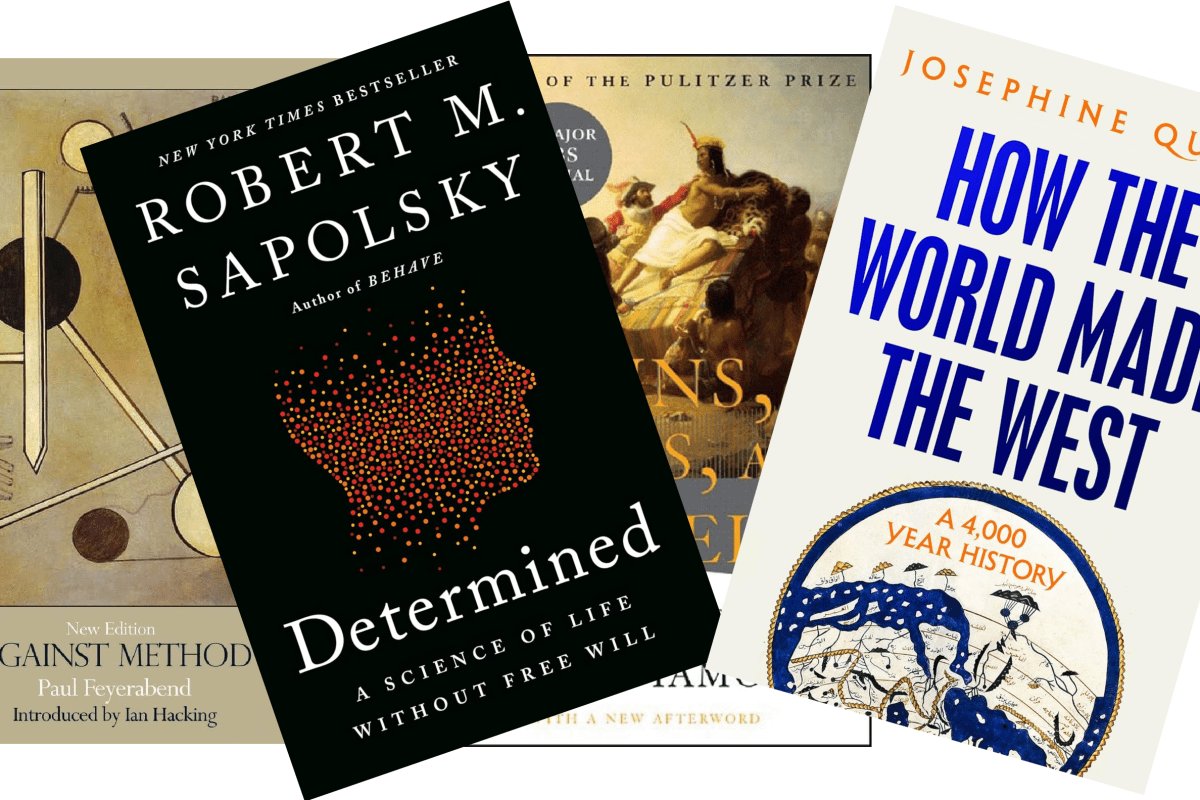
These are my favourite books I read in 2024. Only one was first published this year, so it seems I was playing catch-up and rereading. Two are about history; two are about the philosophy of science; and one is about biological free will or the lack thereof.
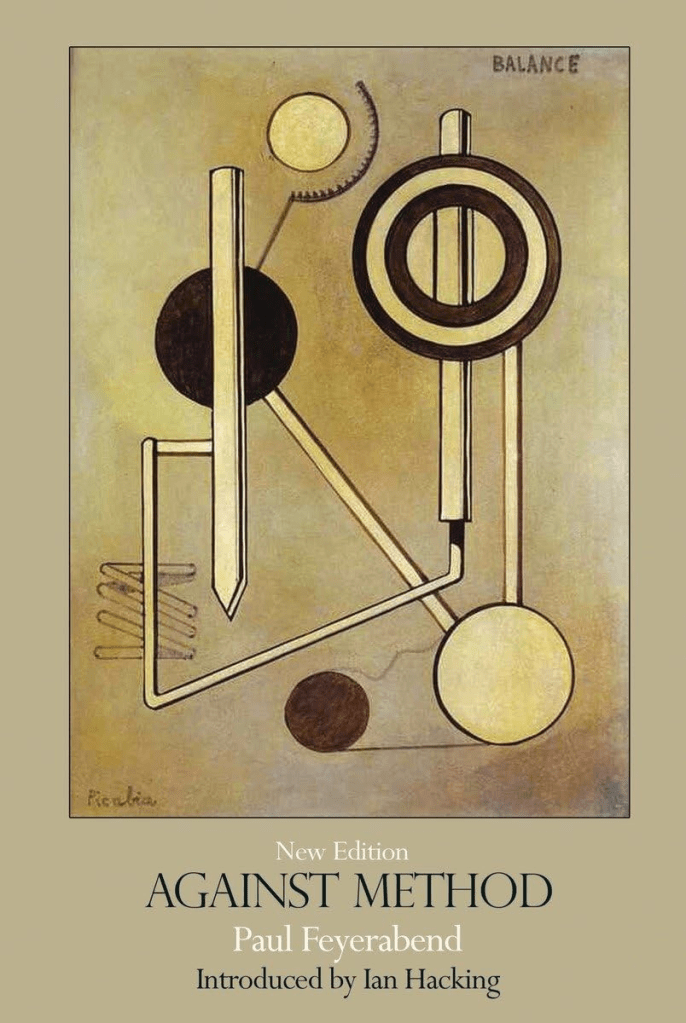
Against Method is a re-read for me. It makes the list on the coattails of a higher-ranked book. Feyerabend makes a compelling case against the Scientific Method™. To complete the set, I’d also recommend Bruno Latour‘s We Have Never Been Modern.
Determined arrives on the heels of Sapolsky’s Behave, another classic that I’d recommend even more, but I read it in 2018, so it doesn’t make the cut. In Determined, Sapolsky makes the case that there is no room or need for free will to explain human behaviour.
As with Against Method, Guns, Germs, and Steel makes the list only to complement my next choice. It views history through an environmental lens. To fill out the historical perspective, I recommend David Graeber’s The Dawn of Everything: A New History of Humanity (with David Wengrow). I’d recommend Yuval Noah Harari‘s Sapiens: A Brief History of Humankind, but it occupies a different category and is more about a plausible broad narrative than the detail explored in the others listed.
Quinn makes history approachable as she questions the uniformity of civilisations pushed by orthodoxy. Read this in context with the aforementioned historical accounts for a fuller perspective.
I was born in 1961. This should have been bedtime reading for me. I’d heard of this work, but one really has to read it. It’s less Modernist than I had presumed—though not to the extent of Feyerabend or Latour mentioned above. Again, reading all three provides a robust perspective on the philosophy of science.
Like Quinn, the writing is approachable. I had expected it to be stilted. It is academic, and it may boost your vocabulary, but give it a gander. It also works well in an audiobook format if you are so inclined.
This about closes out 2024. What do you think about these choices? Agree or disagree? What are your top recommendations?









 Philosophics