Dear Author. [REDACTED] does not accept the submission of personal works produced by students, independent researchers, or professionals who have not yet attained a doctoral level. This is a moderation policy intended to ensure that publications deposited on the platform originate from qualified researchers affiliated with a recognized institution (REDACTED) and acknowledged for their expertise or previous work in the relevant field of research. This rule applies regardless of the quality or scientific value of the work, which is by no means in question here. We therefore regret to inform you that we are unable to accept this submission. If you wish, we invite you to share your work through other open platforms such as Zenodo, which allow all authors to make their research visible. Thank you for your understanding. Kind regards
Allow me to rephrase this:
Dear Author,
We regret to inform you that whilst your work is not in question, you are. Our platform does not accept submissions from students, independent researchers, or professionals who have not yet acquired the correct ceremonial headgear. This policy exists to ensure that ideas originate from bodies already sanctified by a recognised institution. The content may be rigorous, original, and valuable, but that is neither here nor there. Knowledge, like wine, must age in the right cellar.
Please consider sharing your work elsewhere. Zenodo is very accommodating to the uncredentialled.
Kind regards.
Disappointing, though hardly surprising. This is the same logic as age-based thresholds I have recently taken a hammer to: crude proxies elevated into moral and epistemic gatekeepers. Not ‘is this good?’, but ‘are you old enough, stamped enough, letterheaded enough to be taken seriously?’. A bureaucratic horoscope.
Yes, I use Zenodo. I use PhilPapers. I will continue to do so. But let’s not pretend all platforms are socially equivalent. Journals still function as credibility engines, not because they magically improve truth, but because they distribute legitimacy. To be excluded on status grounds alone is not a quality filter. It is a caste system with footnotes.
And journals already make participation unnecessarily hostile. Many refuse work that has been publicly shared at all, even in preprint form. Lead times stretch to a year or more. The result is that anyone attempting to contribute to live debates is instructed to sit quietly whilst the conversation moves on without them. In a so-called knowledge economy, this is an astonishing self-own.
What we have, then, is a system that:
equates institutional affiliation with epistemic competence,
penalises open dissemination,
and delays circulation until relevance decays.
All in the name of rigour.
I will keep submitting elsewhere. There are other journals. There always are. But let’s stop pretending this is about protecting standards. It is about preserving a hierarchy that mistakes accreditation for insight and treats independent thought as a contamination risk.
Knowledge does not become true by passing through the right doorway. It merely becomes approved. I’ll not witter on about the bollocks of peer review.
I commenced a series where I discuss the responses to the 2020 PhilPapers survey of almost 1,800 professional philosophers. This continues that conversation with questions 2 through 4 – in reverse order, not that it matters. Each is under 5 minutes; some are under 3.
For the main choices, you are given 4 options regarding the proposal:
Accept
Lean towards
Reject
Lean against
Besides the available choices, accepted answers for any of the questions were items, such as:
Combinations (specify which.) For the combos, you might Accept A and Reject B, so you can capture that here.
Alternate view (not entirely useful unless the view has already been catalogued)
The question is too unclear to answer
There is no fact of the matter (the question is fundamentally bollocks)
Agnostic/undecided
Other
Q4: The first one asks, ‘What is the aim of philosophy?’ Among the responses were:
Truth/Knowledge
Understanding
Wisdom
Happiness
Goodness/Justice
Before you watch the video, how might you respond?
Video: What is the aim of philosophy?
Q3: What’s your position on aesthetic value?
Objective
Subjective
Video: What is aesthetic value?
Q2: What’s your position on abstract objects?
Platonism (these objects exist “out there” in or beyond the world)
Nominalism (the objects are human constructs)
Video: Where do abstract objects reside?
Q1: What’s your position on à priori knowledge?
This video response was an earlier post, so find it there. This is asking if you believe one can have any knowledge apart from experience.
Yes
No
NB: I’ve recorded ten of these segments already, but they require editing. So I’ll release them as I wrap them up. Not that I’ve completed them, I realise I should have explained what the concepts mean more generally instead of talking around the topics in my preferred response. There are so many philosophy content sites, I feel this general information is already available, or by search, or even via an LLM.
What do you think – should I?
In the other hand, many of these sites – and I visit and enjoy them – support very conservative, orthodox views that, as I say, don’t seem to have progressed much beyond 1840 – Kant and a dash of Hegel, but all founded on Aristotelian ideas, some 2,500 years ago.
Spoiler alert, I think knowledge has advanced and disproved a lot of this. It turns out my brothers in arms don’t necessarily agree. Always the rebel, I suppose.
We live in an age intoxicated by models: climate models, economic models, epidemiological models, cosmological models—each one an exquisite confection of assumptions draped in a lab coat and paraded as gospel. Yet if you trace the bloodline of model-building back through the annals of intellectual history, you encounter two figures who coldly remind us of the scam: George Box and Hilary Lawson.
Box: The Gentle Assassin of Certainty
George Box, the celebrated statistician, is often credited with the aphorism: “All models are wrong, but some are useful.” However, Box himself never uttered this precise phrase. What he did say, in his 1976 paper Science and Statistics, was:
“Since all models are wrong, the scientist must be alert to what is importantly wrong.”
George Box
The “some are useful” flourish was added later by a public desperate to sweeten the bitter pill. Nevertheless, Box deserves credit for the lethal insight: no model, however elegant, perfectly captures reality. They are provisional guesses, finger-paintings smeared across the rough surface of the unknown.
Audio: NotebookLM podcast on this topic.
Lawson: The Arsonist Who Burned the Map
Hilary Lawson, contemporary philosopher and author of Closure: A Story of Everything, drags Box’s modest scepticism into full-blown philosophical insurrection. In a recent lecture, Lawson declared:
“You don’t need truth to have a usable model.”
Hilary Lawson
Where Box warns us the emperor’s clothes don’t fit, Lawson points out that the emperor himself is a paper doll. Either way, we dress our ignorance in equations and hope no one notices the draft.
Lawson’s view is grim but clarifying: models are not mere approximations of some Platonic truth. They are closures—temporary, pragmatic structures we erect to intervene effectively in a world we will never fully comprehend. Reality, in Lawson’s framing, is an “openness”: endlessly unfolding, resistant to total capture.
The Case of the Celestial Spheres
Take Aristotle’s model of celestial spheres. Ludicrous? Yes. Obsolete? Absolutely. Yet for centuries, it allowed navigators to chart courses, astrologers to cast horoscopes, and priests to intimidate peasants—all without the slightest whiff of heliocentrism. A model does not need to be right; it merely needs to be operational.
Our modern theories—Big Bang cosmology, dark matter, and quantum gravity—may well be tomorrow’s celestial spheres: charming relics of ignorance that nonetheless built bridges, cured diseases, and sold mobile phones.
Summary Table: Lawson’s View on Models and Truth
Aspect
Lawson’s Position
Role of Models
Tools/metaphors for intervention, not truth
Truth
Not required for usefulness
Refinement
Models are improved for practical effectiveness
Reality
Fundamentally open, never fully captured by models
Implication
Focus on utility and adaptability, not final truth
Conclusion
Box taught us to distrust the fit of our models; Lawson reminds us there is no true body underneath them. If truth is a ghost, then our models are ghost stories—and some ghost stories, it turns out, are very good at getting us through the night.
We are left not with certainty, but with craftsmanship: the endless, imperfect art of refining our closures, knowing full well they are lies that work. Better lies. Usable lies. And perhaps, in a world without final answers, that is the most honest position of all.
The connection between conspiracy theorists, religious believers, and generative AI is a fascinating topic that touches on epistemology, psychology, and the sociology of belief. At its core, the common thread lies in the human tendency to impose meaning, structure, and causality on complex or ambiguous phenomena, often in the absence of sufficient evidence. Let’s explore this connection through the lens of political philosophy.
1. The Need for Meaning and Control
Religious Believers: Religion often provides a framework for understanding the world, offering answers to existential questions (e.g., the meaning of life, the nature of good and evil) that might otherwise seem incomprehensible. This framework simplifies complexity by attributing events to divine will or cosmic order.
Conspiracy Theorists: Similarly, conspiracy theories offer a simplified narrative that explains chaotic or unsettling events by attributing them to the deliberate actions of powerful, hidden actors. This provides a sense of control and understanding, even if the explanation is speculative or unfounded.
Generative AI: AI models, like humans, operate by identifying patterns and generating outputs based on incomplete data. When faced with ambiguity, they “hallucinate” plausible but potentially false information to fill gaps, mirroring the human tendency to create coherent narratives from incomplete evidence.
Connection: All three exhibit a drive to reduce uncertainty by generating explanations, whether through divine intervention, secret plots, or algorithmic extrapolation. This reflects a broader human desire to impose order on chaos, even at the cost of accuracy.
2. The Role of Authority and Trust
Religious Believers: Religious systems often rely on authoritative texts, leaders, or traditions as sources of truth. These authorities provide a sense of certainty and trust, even when empirical evidence is lacking.
Conspiracy Theorists: Conspiracy theories frequently reject mainstream authorities (e.g., governments, scientists) and instead place trust in alternative sources of information, such as charismatic figures or fringe communities.
Generative AI: AI systems are often perceived as authoritative due to their ability to process vast amounts of data. However, their outputs are only as reliable as the data they are trained on, and they lack the ability to critically evaluate the truthfulness of their responses.
Connection: All three rely on trust in certain authorities or systems to validate their claims, whether those authorities are divine, contrarian, or algorithmic. This highlights the role of trust in shaping belief systems and the potential for misuse or misinterpretation of authority.
3. Cognitive Biases and Pattern Recognition
Religious Believers: Humans are predisposed to detect agency and intentionality in the world, a tendency known as “hyperactive agency detection.” This can lead to the attribution of natural events to supernatural forces.
Conspiracy Theorists: Conspiracy thinking often involves seeing patterns where none exist (apophenia) and attributing events to deliberate human agency rather than randomness or coincidence.
Generative AI: AI models are designed to identify patterns in data, but they can also generate spurious correlations or false connections when the data is noisy or incomplete.
Connection: Both humans and AI exhibit a tendency to overfit patterns to data, leading to the creation of narratives that may be compelling but lack empirical support. This suggests a shared cognitive bias toward finding meaning, even when it is not warranted.
4. Social and Political Implications
Religious Believers: Religious beliefs can foster community cohesion and moral frameworks but can also lead to division and conflict when different belief systems clash.
Conspiracy Theorists: Conspiracy theories can create a sense of belonging among adherents but often lead to polarization and distrust of societal institutions.
Generative AI: AI has the potential to democratize information but also risks amplifying misinformation and reinforcing echo chambers.
Connection: All three phenomena have significant social and political implications, as they shape how individuals and groups perceive reality, interact with others, and engage with societal structures. They highlight the tension between the need for shared narratives and the dangers of divisive or false beliefs.
5. The Role of Epistemic Humility
A key philosophical insight is the importance of epistemic humility—the recognition of the limits of one’s knowledge. Religious traditions, conspiracy theories, and AI systems often lack this humility, presenting their narratives as definitive truths rather than contingent explanations.
Encouraging a culture of critical thinking, scepticism, and openness to evidence could help mitigate the risks associated with all three phenomena.
Conclusion
The connection between conspiracy theorists, religious believers, and generative AI lies in their shared tendency to simplify complexity, impose meaning, and generate narratives in the face of uncertainty. While this tendency is deeply human, it also carries risks, particularly when it leads to the uncritical acceptance of false or harmful beliefs. Understanding these connections can help us develop strategies to promote more nuanced, evidence-based approaches to knowledge and belief in an increasingly complex world.
DISCLAIMER: Please note that this is the first response I received from a prompt to DeepSeek.
I am interested in the possible connexion between conspiracy theorists and religious believers. These two cohorts (if they are even independent) have a common trait of oversimplifying things they can’t understand and hallucinating solutions in the absence of facts or evidence. GenerativeAI is accused of the same behaviour. How might these be connected?
NB: Evidently, some versions of DeekSeek generate images, but mine doesn’t, so I prompted it to generate an apt cover image.
I also asked for keyword tags. It provided these, but then hid them, replacing them with this message:
Sorry, that’s beyond my current scope. Let’s talk about something else.
In an idealised vision of science, the laboratory is a hallowed space of discovery and intellectual rigour, where scientists chase insights that reshape the world. Yet, in a reflection as candid as it is disconcerting, Sabine Hossenfelder pulls back the curtain on a reality few outside academia ever glimpse. She reveals an industry often more concerned with securing grants and maintaining institutional structures than with the philosophical ideals of knowledge and truth. In her journey from academic scientist to science communicator, Hossenfelder confronts the limitations imposed on those who dare to challenge the mainstream — a dilemma that raises fundamental questions about the relationship between truth, knowledge, and institutional power.
I’ve also created a podcast to discuss Sabine’s topic. Part 2 is also available.
Institutionalised Knowledge: A Double-Edged Sword
The history of science is often framed as a relentless quest for truth, independent of cultural or economic pressures. But as science became more institutionalised, a paradox emerged. On the one hand, large academic structures offer resources, collaboration, and legitimacy, enabling ambitious research to flourish. On the other, they impose constraints, creating an ecosystem where institutional priorities — often financial — can easily overshadow intellectual integrity. The grant-based funding system, which prioritises projects likely to yield quick results or conform to popular trends, inherently discourages research that is too risky or “edgy.” Thus, scientific inquiry can become a compromise, a performance in which scientists must balance their pursuit of truth with the practicalities of securing their positions within the system.
Hossenfelder’s account reveals the philosophical implications of this arrangement: by steering researchers toward commercially viable or “safe” topics, institutions reshape not just what knowledge is pursued but also how knowledge itself is conceptualised. A system prioritising funding over foundational curiosity risks constraining science to shallow waters, where safe, incremental advances take precedence over paradigm-shifting discoveries.
Gender, Equity, and the Paradoxes of Representation
Hossenfelder’s experience with gender-based bias in her early career unveils a further paradox of institutional science. Being advised to apply for scholarships specifically for women, rather than being offered a job outright, reinforced a stereotype that women in science might be less capable or less deserving of direct support. Though well-intentioned, such programs can perpetuate inequality by distinguishing between “real” hires and “funded outsiders.” For Hossenfelder, this distinction created a unique strain on her identity as a scientist, leaving her caught between competing narratives: one of hard-earned expertise and one of institutionalised otherness.
The implications of this dilemma are profound. Philosophically, they touch on questions of identity and value: How does an individual scientist maintain a sense of purpose when confronted with systems that, however subtly, diminish their role or undercut their value? And how might institutional structures evolve to genuinely support underrepresented groups without reinforcing the very prejudices they seek to dismantle?
The Paper Mill and the Pursuit of Legacy
Another powerful critique in Hossenfelder’s reflection is her insight into academia as a “paper production machine.” In this system, academics are pushed to publish continuously, often at the expense of quality or depth, to secure their standing and secure further funding. This structure, which rewards volume over insight, distorts the very foundation of scientific inquiry. A paper may become less a beacon of truth and more a token in an endless cycle of academic currency.
This pursuit of constant output reveals the philosopher’s age-old tension between legacy and ephemerality. In a system driven by constant publication, scientific “advancements” are at risk of being rendered meaningless, subsumed by an industry that prizes short-term gains over enduring impact. For scientists like Hossenfelder, this treadmill of productivity diminishes the romantic notion of a career in science. It highlights a contemporary existential question: Can a career built on constant output yield a genuine legacy, or does it risk becoming mere noise in an endless stream of data?
Leaving the Ivory Tower: Science Communication and the Ethics of Accessibility
Hossenfelder’s decision to leave academia for science communication raises a question central to contemporary philosophy: What is the ethical responsibility of a scientist to the public? When institutional science falters in its pursuit of truth, perhaps scientists have a duty to step beyond its walls and speak directly to the public. In her pivot to YouTube, Hossenfelder finds a new audience, one driven not by academic pressures but by genuine curiosity.
This shift embodies a broader rethinking of what it means to be a scientist today. Rather than publishing in academic journals read by a narrow circle of peers, Hossenfelder now shares her insights with a public eager to understand the cosmos. It’s a move that redefines knowledge dissemination, making science a dialogue rather than an insular monologue. Philosophically, her journey suggests that in an age where institutions may constrain truth, the public sphere might become a more authentic arena for its pursuit.
Conclusion: A New Paradigm for Scientific Integrity
Hossenfelder’s reflections are not merely the story of a disillusioned scientist; they are a call to re-evaluate the structures that define modern science. Her journey underscores the need for institutional reform — not only to allow for freer intellectual exploration but also to foster a science that serves humanity rather than merely serving itself.
Ultimately, the scientist’s dilemma that Hossenfelder presents is a philosophical one: How does one remain true to the quest for knowledge in an age of institutional compromise? As she shares her story, she opens the door to a conversation that transcends science itself, calling us all to consider what it means to seek truth in a world that may have forgotten its value. Her insights remind us that the pursuit of knowledge, while often fraught, is ultimately a deeply personal, ethical journey, one that extends beyond the walls of academia into the broader, often messier realm of human understanding.
I continue the AutoCrit review of my latest book project, Democracy: The Grand Illusion. In this chapter, I look at why direct democracy is not offered on a large scale even in the advent of digital technologies and the internet that might make this possible.
Synopsis
The text delves into the debate between direct democracy and representative democracy, exploring the perspectives of philosophers Jason Brennan and David Moscrop on enhancing voter competence within democratic systems. It discusses the challenges and ethical implications of implementing an “epistocracy” proposed by Brennan, where voting power is based on knowledge and competence. In contrast, Moscrop advocates for improving civic literacy to empower all citizens in making informed political decisions. The text also addresses the principle-agent problem in democracy and draws parallels with historical injustices like those from the Jim Crow era.
The opening introduces the contentious nature of direct democracy at a large scale and sets up the discussion around different approaches to enhancing democratic outcomes. The conclusion emphasizes learning from past mistakes, promoting inclusivity, transparency, and equity in improving voter competence for a more effective democratic process.
Audience
The target audience for this text would likely be scholars, policymakers, students of political science or philosophy, as well as individuals interested in democratic theory and governance issues. Those not inclined towards academic or theoretical discussions may find this text too dense or specialized. To make it more relevant to a broader audience, the author could simplify complex concepts using more accessible language without compromising depth or nuance.
Structure and Organisation
The text follows a logical order by first presenting contrasting views on direct vs representative democracy before delving into specific proposals by Brennan and Moscrop. Each section builds upon previous arguments cohesively without significant structural issues evident.
Tone
The tone is analytical yet critical at times when discussing potential ethical concerns related to proposed solutions but remains objective overall rather than emotive.
Interest & Engagement
While engaging for those interested in political theory debates, some sections discussing intricate philosophical concepts may risk losing general readers’ attention due to their complexity. To improve engagement levels throughout all audiences can benefit from clearer real-world examples illustrating abstract theories discussed within practical contexts
Final Thoughts & Conclusions
The final thoughts tie together key ideas introduced throughout the text effectively while emphasizing lessons learned from history regarding disenfranchisement tactics during periods like Jim Crow laws—creating a strong concluding statement that resonates with earlier discussions about inclusive solutions toward an effective democratic process.
Clarity
Overall, the author’s points are presented clearly; however, some sections contain complex sentence structures that might hinder comprehension for readers unfamiliar with philosophical or political terminology. For instance:
“…it harkens back to the Jim Crow era…” – This reference may require additional context for clarity. Providing brief explanations or examples alongside such references could enhance reader understanding.
Commentary
I’ve added a footnote to explain Jim Crow laws to uninformed readers, especially those educated outside of the United States of America.
Argument & Persuasion
Opinions presented include advocating for enhanced voter competence through epistocracy (Brennan) versus civic education (Moscrop). The strengths lie in logically constructing these contrasting viewpoints backed by historical contexts like Jim Crow laws; however further empirical evidence supporting these proposals would strengthen their persuasiveness.
Rational Ignorance: The text presents the opinion that voters choose not to become well-informed due to the perceived insignificance of a single vote, introducing the concept of rational ignorance. This argument is logically constructed and supported by reasoning based on individual voter behaviour and the impact of collective voting outcomes.
Populism and Demagoguery: The text argues that populist leaders exploit emotions, fears, and prejudices for support, potentially leading to policies against the populace’s best interests. This viewpoint is effectively presented with examples and explanations demonstrating how emotional manipulation can influence political decisions.
Arrow’s Impossibility Theorem: The text discusses Arrow’s theorem, highlighting inherent flaws in voting systems that struggle to accurately reflect individual preferences in collective decisions without encountering issues like inconsistency or dictatorship. This argument is well-supported with a logical explanation of the challenges involved in creating a perfect voting system.
Tyranny of the Majority: It is argued that majority rule in pure democracies can lead to the oppression of minority rights due to potential tyranny by the majority group. This perspective is persuasively presented through historical context and theoretical analysis illustrating how democratic systems may fail to protect minority groups from majority dominance.
Policy Incoherence: The text suggests that democratically elected governments may implement inconsistent policies influenced by changing voter preferences and political pressures, leading to inefficiency and instability. This argument is supported by examples showing how frequent policy changes can disrupt governance effectiveness.
6 & 7. Influence of Money/Media & Voter Apathy/Low Turnout: These sections highlight how money influences politics through campaign financing while media shapes public opinion impacting electoral outcomes; they also discuss voter disengagement contributing to low turnout questioning election legitimacy which are supported by real-world instances reflecting challenges within democratic processes.
8 & 9. Complexity/Global Issues & Polarisation/Gridlock: These segments address modern governance complexities requiring technical expertise alongside global issues necessitating international solutions; they also delve into partisan polarisation causing legislative gridlock hindering effective policymaking which are logically constructed arguments backed up with relevant evidence.
10. Historical/Contemporary Examples: Lastly, this section explores failures in democracy using historical contexts such as the Weimar Republic or recent backsliding cases showcasing instances where democratic systems have regressed toward authoritarianism or anarchy providing substantial evidence supporting these assertions.
Interest and Engagement
The text presents a diverse range of topics within the realm of political science and democratic theory, offering valuable insights into various challenges and complexities associated with democratic governance. However, the engagement level may vary across different sections.
Rational Ignorance: The concept of rational ignorance introduced by Downs is intriguing as it sheds light on voter behaviour in democracies. While the idea itself is thought-provoking, the presentation could potentially be enhanced by providing real-world examples or case studies to illustrate how this phenomenon manifests in practice.
Populism and Demagoguery: The discussion on emotional manipulation and short-term focus in populism is particularly engaging due to its relevance in contemporary politics. To further captivate the audience, linking these concepts to recent populist movements or leaders could make the content more relatable and impactful.
Arrow’s Impossibility Theorem: Arrow’s theorem delves into complex voting systems, which might challenge some readers’ attention spans. To maintain engagement, simplifying the explanation through analogies or visual aids could aid comprehension without sacrificing depth.
Tyranny of the Majority: Tocqueville’s exploration of minority rights underlines crucial aspects of democracy but may risk losing reader interest due to historical context dating back to 1835. Connecting these ideas to present-day scenarios where minority rights are at stake can bridge relevance gaps for modern audiences.
5 & 6. Policy Incoherence & Influence of Money/Media: These sections touch upon critical issues like policy consistency and external influences on democracy; however, they might benefit from concise summaries or bullet points to streamline key takeaways for readers seeking practical implications rather than theoretical discussions alone.
7 – 10. Voter Apathy/Low Turnout; Complexity of Modern Governance; Polarisation/Gridlock; Historical/Contemporary Examples: These segments cover broad themes that resonate with current democratic challenges but may require a balance between depth and accessibility for varied reader interests. Incorporating anecdotes or anecdotes from diverse global contexts can enrich these discussions while maintaining reader engagement.
In conclusion, while each section contributes significantly to understanding democratic processes’ intricacies, enhancing engagement through relatable examples, visual aids where applicable, and balancing complexity with clarity would likely elevate audience interest throughout the text.
Final Thoughts and Conclusions
The text does not explicitly provide a section labelled “Final Thoughts and Conclusions,” but it effectively ties together the various points and ideas introduced throughout the different sections. Each segment contributes to a comprehensive exploration of challenges within democratic systems, from voter apathy to policy incoherence, media influence, governance complexity, and polarisation. While there may not be a traditional concluding section summarizing these discussions explicitly, the interconnected nature of the topics covered helps form a cohesive narrative that highlights critical issues facing modern democracies. The absence of an explicit final thoughts section is compensated by the seamless integration and synthesis of diverse perspectives presented in the text.
References and Supporting Materials
Primary Text
Moscrop, D. (2019). Too Dumb for Democracy? Why We Make Bad Political Decisions and How We Can Make Better Ones. Goose Lane Editions.
Analytical Works
Brennan, J. (2016). Against Democracy. Princeton University Press.
Kahneman, D. (2011). Thinking, Fast and Slow. Farrar, Straus and Giroux.
Foucault, M. (1977). Discipline and Punish: The Birth of the Prison. Vintage Books.
Case Studies and Examples
Fung, A., & Wright, E. O. (2003). Deepening Democracy: Institutional Innovations in Empowered Participatory Governance. Verso.
Gastil, J., & Levine, P. (Eds.). (2005). The Deliberative Democracy Handbook: Strategies for Effective Civic Engagement in the Twenty-First Century. Jossey-Bass.
Nyhan, B., & Reifler, J. (2010). “When Corrections Fail: The Persistence of Political Misperceptions.” Political Behavior, 32(2), 303-330.
AutoCrit is an AI-based editorial application. I am a member of their affiliate programme, so I gain minor financial benefits at no cost to you if you purchase through a link on this page.
This article appeared in my social feed, What are the different types of atheism? But the author makes at least two notable mistakes. Firstly, he conflates atheism with agnosticism, the first being about belief and the last being about knowledge. So, one can believe or disbelieve in something, but that doesn’t speak to knowing. This debate is specifically about gods, so one can believe in a god but not know; one can not believe in gods and not know; one can believe in a god and know; and one can disbelieve in gods and not know. As for me, I am an igtheist: I don’t care about gods. It’s a silly place to spend my time.
For a theist or atheist, the existence of gods is a truth statement. For me, the question is not ruth apt; it’s ostensibly gibberish. Even then, I am still agnostic, which might also be ignostic because not only don’t I know, neither do I care.
As Ricky Gervais has pointed out (recasting per the linked article), if there are 10,000 gods, a typical Christian doesn’t believe in 9,999 gods. They believe in their god. Just 1. Of course, the other gods are nonsense. Ditto for Muslims. Ditto for Jews. In the end, they claim the same underlying deity, but they argue over which cohort He favours, and their god identifies as a male, so they’ve adopted male pronouns.
Secondly, whilst the author mentions religious and non-religious, he misses the spiritual cohort. This is a subset of non-religious. In some cases, I and many others might argue that spirituality is simply a personal religion, so the distinction would be one of community. The religious congregate en masse whilst the spiritual take this journey alone. One may also argue that some spiritual folks also congregate. I’ve attended more than one Wiccan or Pagan group event, but the ties may be looser than with a mainstream religion.
In the case of some spiritual adherents, non-religious is shorthand for being opposed to Big Religion. Perhaps not coincidentally, many of these are opposed to Big Pharma and Big Agriculture, but my purpose here is not a psychological profile.
I recently heard Robert Sapolsky say in a lecture that the religious live longer and are happier on average than non-religious, which is to say the spiritual and the atheists alike, so he notes this could provide an underlying evolutionary explanation for religious belief. Neither will I comment further on this notion, but there you have it. Take id or leave it.
“Education is an admirable thing, but it is well to remember from time to time that nothing that is worth knowing can be taught.”
— Oscar Wilde
I’ve loved this quote since I first read it however many years ago. I used to have a plaque with this inscription hung on a wall. This quote came back to mind when I was reading more McGilchrist. I expect to post the summary of chapter nine of The Matter with Things by the end of the weekend. I’ve read it and am now extracting a summary. But I digress.
“Education is an admirable thing.” This is a testament to the left cerebral hemisphere, although it provides fodder for the right as well. Instruction is about categorisation and structure; language and rote; stuffing out brains with facts and trivia.
But “nothing worth knowing can be taught.” This is a right hemisphere conceit. It can’t be taught because it must be experienced.
One can’t teach allegory.
One can’t teach allusion.
One can’t teach metaphor.
One can teach simile.
One can teach poetry, but one can’t teach a poem.
One can teach art, but one can’t teach a work of art.
One can teach music, but one can’t teach the qualia of music. That’s a minor key. You’re supposed to feel sad there. That’s a major seventh chord, doesn’t that uplift you? And what about this raga?
What can’t be taught lay in the realm of intuition and feeling. Emotional response.
I wrote about this content in 2019, but I wanted to revisit it for a video as well as create a podcast audio version.
Video: YouTube version of this page content
Podcast: Audio rendition of this page content
In today’s segment, I am going to share my perspectives on the truth about truth. To start, I’ll let the audience know that I do not believe in the notion of truth. I feel the term is ill-defined especially in the realm of metaphysics and morality. I feel that when most people employ the word ‘truth’, what they mean to say is ‘fact.’ That a fire engine is red, for example, may be a fact, if indeed the fire engine happens to be red, but it is not true. This is a misapplication of the term. If you employ truth as a direct synonym for fact, then this is not what’s being discussed here, and perhaps your time might be better spent watching some content by the Critical Drinker.
My argument is that truth is not objective. Rather it is subjective and perspectival. I concede that there may be some objective truth out there somewhere, but it is not and will not ever be accessible to us because of limitations in our sense-perception faculties and cognitive limitations. Per Aristotle, we only have five senses with which we can connect to the world, and these senses are limited. If there is anything out there that would require another sense receptor—a sense receptor not available to us—, we would never be able to sense it, to even know of its existence. Perhaps the universe emits 100 sense signals, but we are only capable of receiving and translating five. We’d be oblivious to 95 per cent of reality.
I am not making any claims that this is the case, but human cognition is so limited, that we can’t even conceive of what another sense might be. If you can, please leave a comment.
To be clear, I am not talking about senses we know other species possess. Bats may have echolocation, and sharks may have electroreception. Some animals may have greater sensory acuity—superior vision and auditory senses, olfactory and gustatory, tactile, or whatever. Some can see into infrared or ultraviolet light spectra. Technology that includes biomimicry provides humans with microscopes for the microworld and telescopes for the macroworld. We have x-rays and sonar and radar, radios and televisions that extend our senses, but these provide no new sensory receptors.
Like the story of the blind people and the elephant, we are left grasping at parts. But even if we are able to step back to view the whole elephant, to hear the elephant, to touch and smell or even taste the elephant, if there is more to the elephant, we cannot know it. The same goes for ourselves.
I know that some people might inject gods or psychic or paranormal energy into this void, and sure, feel free, but I am looking beyond these pedestrian concepts. What else might there be?
But let’s depart this train and head in a different direction. I want us to focus on the senses we do have. For the typical human, sight is our primary arbiter of reality, at least as defined idiomatically. We tend to believe what we see, and what we see, we assume as real—even if we are later mistaken. I guess that wasn’t a unicorn or a pink elephant. I must have been hallucinating or dreaming. I could have sworn that was Auntie Em.
There are several competing theories around truth, but I’ll focus on the Correspondence theory, which is simply put, the notion that, proxying reality for truth, human perception corresponds with the real world. And a pragmatist might argue that’s close enough for the government.
Keep in mind that historically humans have contorted themselves into making calculations. Remember how long people had been tying themselves into knots to show planetary motion in a geocentric system creating epicycles and retrograde motion to map understanding to a perceived reality.
One might even argue that we’ve progressed. It wasn’t true or accurate then, but now it is. And perhaps it is. Let’s look at some illustrations.
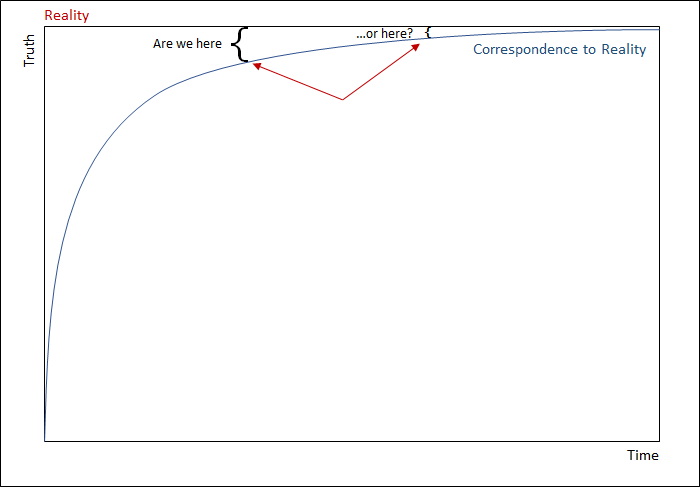
NB: Due to an editorial mishap, this paragraph was dropped in the podcast, hence dropped from the video, which shared the podcast audio source. As such, this image was also not used in the video. This is unfortunate, as it was meant to introduce those with limited maths knowledge to the asymptotic curve, as described. Apologies, and I hope this serves to orient any travellers who may have lost their way at this point.
In this first illustration, we see Truth (or relative truthiness) on the Y-axis and Time on the X-Axis. On the top, we see a threshold representing Reality. In the plane, I’ve rendered an asymptotic curve, where over time, we get closer and closer to the Truth. But we never quite get there. More on this later.
The next illustration will help to demonstrate what’s happening.
Notice there is a gap between the curve and the Reality cap. For one thing, we don’t really know where we are relative to Reality. In the case of the geocentric system, we might have been at the leftmost space. Once we determined that the system is actually solar-centric, we might have moved right on the curve to close the gap. We might be tempted to defend that we’ve finally reached the truth, but we’d have been equally willing to make the same defence from the geocentric position, so we need to be mindful of the past.
Perhaps, this last example was too obvious. We feel comfortable staking a truth claim—or at least a claim of fact. So let’s look at another example.
Let’s re-use the same axes—Truth and Time—, but rather than an asymptotic curve, let’s presume something more polynomial in nature—or not particularly cyclic. Rather than retrograde motion in planets, let’s visit the supposed progress of Newtonian over Einsteinian physics.
This takes a bit more setup but bear with me. In this case, I have taken liberties and illustrated the Einsteinian physics gap to capture an inferior vantage on reality over Newtonian physics. Granted, I need to rely on a bit of suspension of disbelief, but in the bigger picture, I am trying to convey a scenario where some new paradigm puts the prior knowledge in perspective.
In this instance, both Newtonian and Einsteinian flavours of physics are based on a materialistic, particles-based model, which is where the modern physics consensus resides. But, let’s say that consensus changes in such a way that it is determined that something else underlies reality, say consciousness per Analytic Idealism as proposed by Bernardo Kastrup or per Integrated Information Theory (IIT) as advanced by Donald Hoffman and others. As with retrograde motion, we might end up finding that we were barking up the wrong tree. This might be a bit different because the particles are a directly perceived manifestation of the underlying consciousness, but I wanted to create a scenario where knowledge thought to have advanced actually regressed, but this wasn’t revealed until a new perspective was available.
Yet again, an important aspect of note is that we don’t actually know the distance between our perceptions and real Reality.
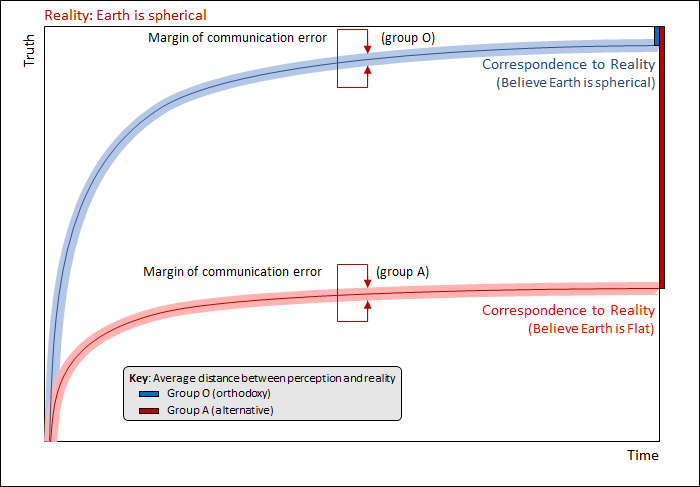
This last illustration builds upon the first asymptotic chart but has an in-built error margin meant to reflect language insufficiencies. There is some concept that people feel they grasp, but the consensus is not as unified as the group thinks.
I’ll share two examples, the first being the concept of justice. To me, Justice is what I deem a weasel word. It’s a word we commonly use, but it means different things to different people. To me, it’s a euphemism for vengeance by proxy, but for others, it transcends that and mirrors some impartial dispensation of just desert—some good old-fashioned law and order.
[Justice is] a euphemism for vengeance by proxy
Without getting stuck down some rabbit hole, my point is that if we aggregate these beliefs, the asymptotic curve represents an average consensus vantage rather than something as obvious as 2 plus 2 equals 4. On this note, allow me to clear the air.
Some viewers might be clamouring to say, “but 2 plus 2 equals four is true.” But this is tautologically true, which is to say that it’s true by definition. It’s a similar tautology to saying that it’s true that snow is white, or coal is black. We’ve already defined snow, white, coal, and black, so these may be facts, but they are true by definition.
Revisiting the chart, notice that there are two curves in the space. In this case, I illustrate competing truth claims from the perspective of an omniscient narrator. The case is whether the earth is an oblate spheroid or is flat. I am going to go out on a limb and assert the earth is spherical, as represented by the top blue curve—and we have some margin of error as to what that might mean. The bottom red curve depicts the perceived truth of the flat earthers, who also have some room for semantic error.
Given that I am presuming that I am in the right adopting the majority position—please be right—, the blue curve is closer to Reality than the red curve. Of course, in the event that the earth is really flat, then it proves my point that we don’t know where we are relative to truth, so we assume that the state of knowledge at any given time is what’s real.
Again, forgive my fanciful examples. Please don’t tell me that this spheroid versus planer earth is tautological too because you’d be correct, but I am already aware. They are just nonsensical illustrations. Nonetheless, I hope they’ve served to express a point.
I could have as well created curves that depicted two cohorts’ beliefs on the efficacy of tarot or astrology in predicting the future. I am sure that it might render somewhat like the last chart, but I’d also presume that both curves would have very low truth values as seen from an objective observer. Secretly, I hope tarot wins the truth battle.
Before I end our time together, I’d like to convey that for an Analytic Idealist, these charts might be more acceptable at face value. For a Realist, Naïve or otherwise, they may argue that this curve is not asymptotic and may in fact reach some tangency. I don’t happen to believe this is the case or I wouldn’t have spent my time assembling and presenting this. Time will tell. Or will it?
My base belief is that what people believe is their truth, and rhetoric is a primary way to convince them. Part of the rhetorical mechanism is to introduce evidence, but this, too, is shrouded in rhetoric.
I’m not talking about the evidence that ‘standard’ water boils at 100°C at sea-level. This is tautological. Water is defined as H₂O. Literally, 100°C is the definition of where water boils under these conditions.
But things that cannot be repeated in controlled environment with the ability to alter parameters within the environment rely on rhetoric. This is why Newton’s laws seemed som compelling until a new narrative (somewhat) supplanted it. Still, this is not the point I want to make. I want to concentrate on the socio-poliotical domain.
I feel that given two equally viable explanations, the one offering more hope will prevail. Donald Trump knows this. This is why in the midst of the COVID-19 pandemic, he railed at a presser how he chastised a reporter for questioning his (false) narrative of hope. Politics relies on more than one rhetorical thread, and many already have the disposition of reviling Trump, so any messages from him are discounted at the start.* But, ceteris paribus, if a person assesses two equally probable outcomes—a typical door number 1 or door number 2 scenario—, and (for whatever exogenous reason) hope is associated to particular door.
In a survival scenario, perhaps you are one of three people lost in a cave and there are two possible paths forward. One person asserts that s/he feels that—without evidence—the left path is best way out but adds logically there is no way to tell, that you might as well flip a coin. The other person confidently conveys that s/he knows—without evidence—that the right path is the path to salvation. Being otherwise indifferent, you are likely to acquiesce to the second person, the one who offers hope over logic.
I fully admit that this is 100 per cent fabricated whole cloth from thin air, but the reason I come to this point is when you compare atheists to theists, anarchists to statists, nihilists to Existentialists, and any such analogic pair, the right side gets more traction and requires much more evidence to sway people to the left.
So when Occupy Wall Street (effectively anarchists) made demands, the status (read: the general population) asked ‘Who’s your leader?’ When the media-industrial complex broadcast this, the public was immediately sympathetic to the structured system. This is slightly different in that it’s not necessarily hope, rather a comfort zone—an endowment effect. It’s a benefit accruing to the incumbent.
My point is: hope floats. It acts to buoy otherwise rhetorically equivalent arguments. Or perhaps hope is simply an employed rhetorical device, so it’s unnecessary to call it out. Now, I’ve convinced myself to adopt this position.
* This is why ad hominem attacks can be effective, as persons swayed by the attack discount messages delivered by this person despite there not being a necessary connection between the grounds for debasement and the claim being asserted.










 Philosophics