Video: Architecture of Grammatical Compromise. (Duration: 10:30)
In this video, I define Ontology, Grammar, and Commensurability before I use abortion as a poster child. Then, I discuss what happens when ontological grammars are incommensurable.
These thinkers follow:
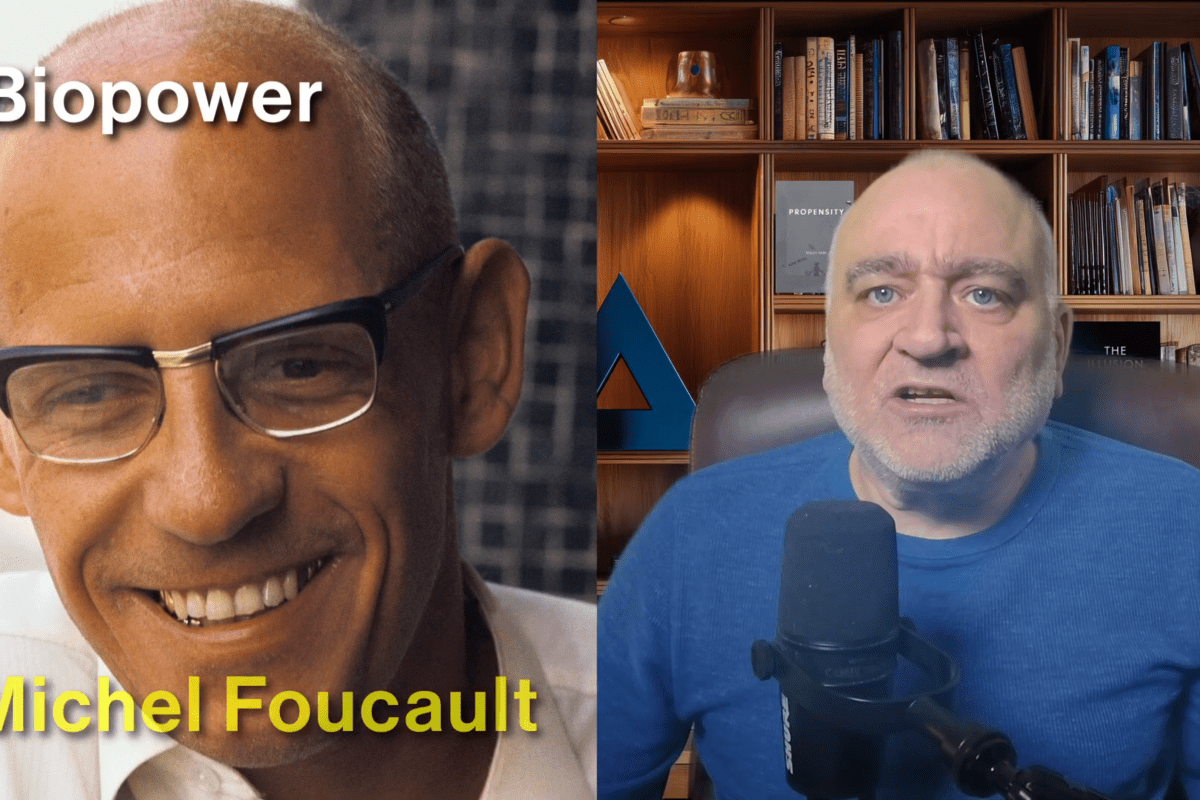
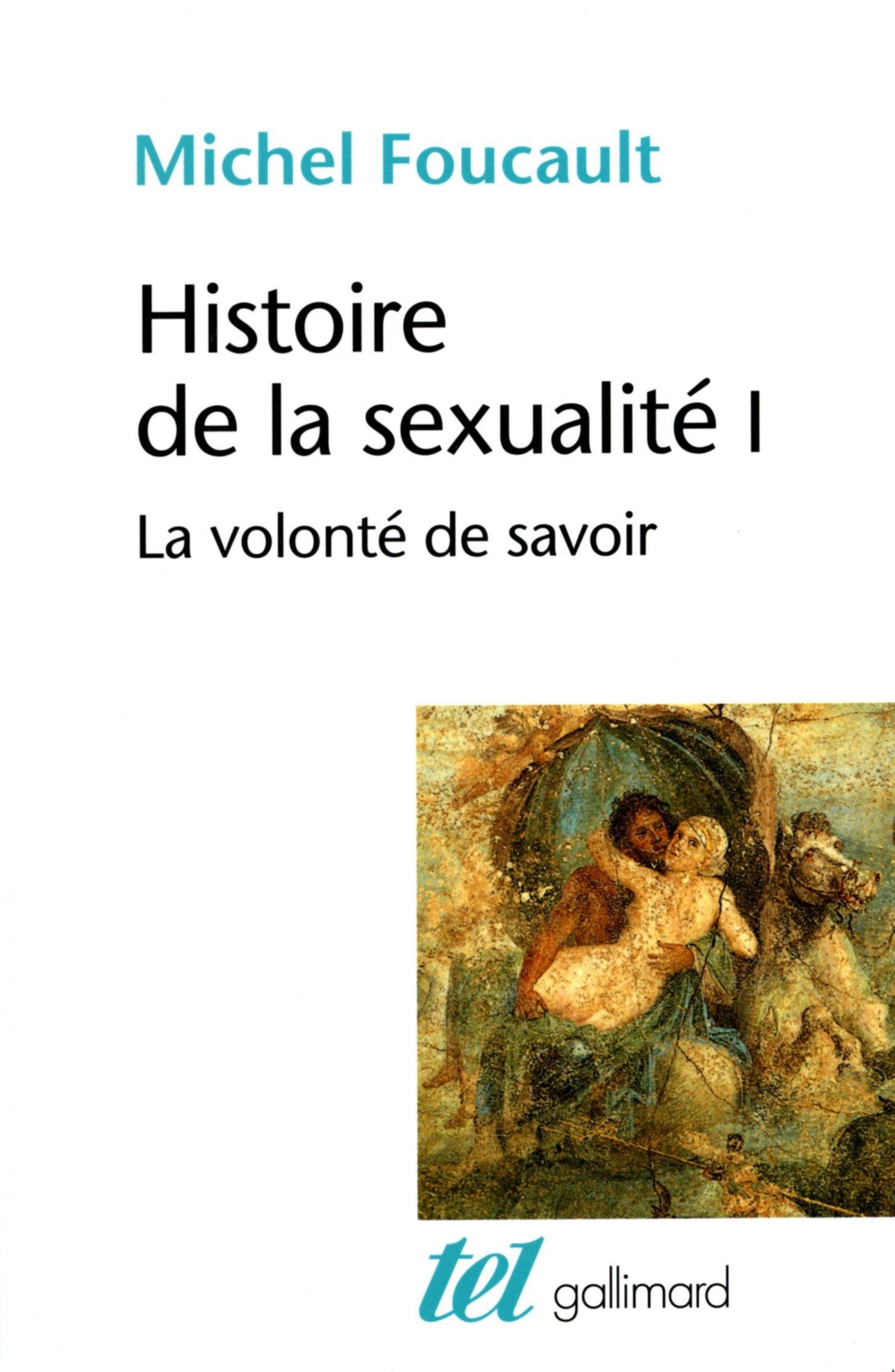
Michel Foucault: Biopower, notably The History of Sexuality, Volume I.
Bernard Williams: Thick Moral Concepts from Ethics and the Limits of Philosophy.
Pierre Bourdieu: Habitus, notably from Outline of a Theory of Practice.
Karl Popper: Paradox of Intolerance.
I discuss the challenge of the promise of compromise and its three possible outcomes, none of which are true compromises.
Watch the video for context. Read the essay for fuller details.
Abortion, Ontological Grammar, and the Limits of Civil Discourse
When federal abortion protections were withdrawn in the United States, many observers treated the event as a policy reversal, a judicial shift, or a partisan victory. Those are surface descriptions. They are not wrong. They are simply too thin.
What was exposed was not a failure of dialogue. It was the collision of ontological grammars.
Audio: NotebookLM summary podcast.
1. Thick Concepts and the Illusion of Neutral Ground
Bernard Williams famously distinguished between ‘thin’ moral terms (good, bad, right) and ‘thick’ ones (cruel, courageous, treacherous), where description and evaluation are fused.
Abortion is not a thin concept. It is thick all the way down.
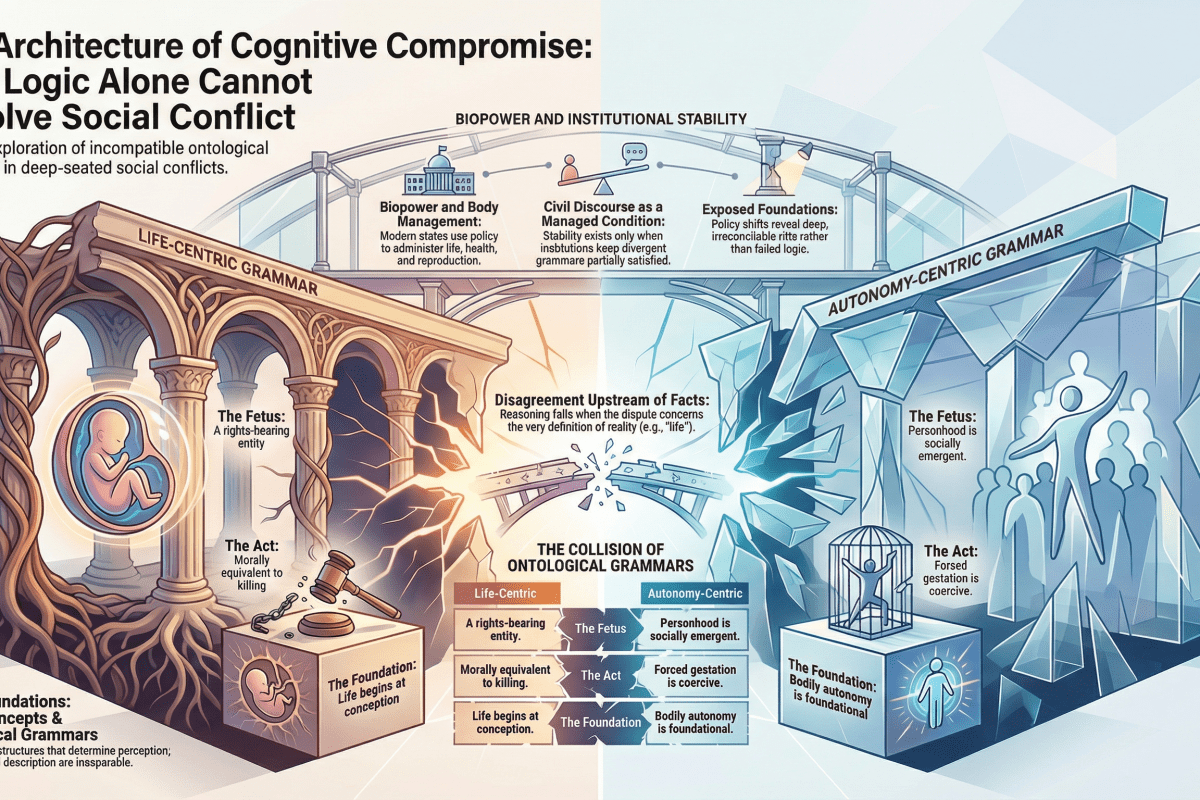
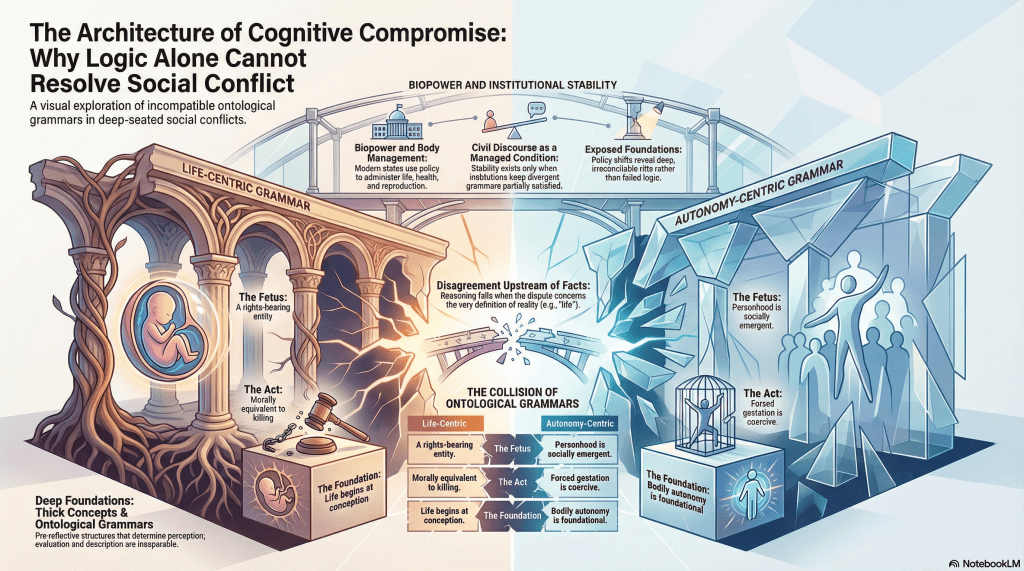
For one framework, the operative grammar is something like:
Life begins at conception.
The foetus is a rights-bearing entity.
Termination is morally equivalent to killing.
For another:
Personhood is socially and biologically emergent.
Bodily autonomy is foundational.
Forced gestation is coercive.
Notice that these are not competing policies. They are competing ontological commitments about what exists, what counts as a person, and what kind of being a pregnant body is.
Argument across this divide does not merely contest conclusions. It contests the background conditions under which reasons register as reasons.
This is not ‘people see the world differently’. It is: people parse reality through grammars that do not commute.
2. Ontological Grammar: Where Deliberation Stops
By ‘ontological grammar’, I do not mean syntax in the Saussurean or Chomskyan sense. I mean the pre-reflective substrate that structures what appears salient, real, morally charged, or negligible.
We deliberate within grammars. We do not deliberate our way into them.
Liberal Enlightenment optimism assumes that if disagreement persists, more information, better reasoning, or improved empathy will close the gap. But if the dispute concerns the very ontology of ‘life’, ‘person’, or ‘rights’, no amount of fact-sharing resolves the issue. The disagreement is upstream of facts.
The closure of federal abortion access did not prove that one side reasoned better. It demonstrated that institutional containment had failed.
3. Biopower and the Management of Bodies
Michel Foucault gives us a crucial lens: biopower. Modern states do not merely govern territory; they administer life. Birth rates, mortality, sexuality, health – these become objects of policy.
Abortion sits directly inside this matrix.
A state that restricts abortion is not only expressing moral judgment. It is reallocating control over reproductive capacity. It is asserting a claim over which bodies count, which futures are permitted, and which biological processes are subject to regulation.
The conflict is therefore not purely ethical. It is biopolitical.
And what appears as ‘civil discourse’ around abortion is often possible only so long as institutional frameworks keep both grammars partially satisfied. When federal protections existed, they acted as a stabilising superstructure. Remove that, and the ontological conflict becomes naked.
4. Habitus and the Illusion of Reasoned Consensus
Pierre Bourdieu would remind us that our dispositions are not self-authored. Habitus sedimented through family, religion, class, and institutional life shapes what feels obvious, outrageous, or unthinkable.
People do not wake up one morning and choose an abortion ontology.
They inherit it. It becomes embodied common sense.
Thus, when someone says, ‘Surely we can agree that making a person feel whole is more important than ideological purity’, they are already speaking from within a grammar that prioritises individual authenticity and psychological coherence. That priority is not universal. It is historically situated.
Compromise is not achieved by stepping outside habitus. It is achieved when institutional and social conditions allow divergent grammars to coexist without totalising one another.
5. The Popperian Threshold
It is impossible to speak in such a way that you cannot be misunderstood. —Karl Popper
Karl Popper warned of the ‘paradox of tolerance‘: unlimited tolerance may enable intolerant forces to eliminate tolerance itself.
In particularly virulent climates, appeals to compromise are heard not as gestures of goodwill but as tactical weakness.
When one faction succeeds in unilaterally redefining the legal status of abortion at a federal level, it is not merely participating in discourse. It is altering the biopolitical infrastructure. Once altered, the range of permissible disagreement narrows.
Civil discourse, then, is not a natural equilibrium. It is a managed condition sustained by institutional design, social trust, and shared legibility.
NB: Popper’s paradox of tolerance is often invoked as a moral axiom. But it is better understood as a self-protective clause internal to liberal ontology. It presupposes a shared commitment to rational exchange. When that commitment erodes, the paradox does not resolve disagreement; it merely marks the point at which biopower intervenes to preserve a regime.
6. Why This Is Not Just ‘People Disagree’
The lay intuition – ‘people see the world differently’ – is descriptively correct and analytically useless.
What the ontological grammar model adds is structure:
When stabilisation weakens, conflict appears irreconcilable.
Abortion is not uniquely polarising because people are irrational. It is polarising because it touches ontological primitives: life, personhood, autonomy, and obligation.
In such cases, ‘compromise’ is not achieved by discovering a middle truth. It is achieved – if at all – by constructing a legal and institutional arrangement that both grammars can grudgingly inhabit.
NotebookLM Infographic
7. The Uncomfortable Conclusion
The Enlightenment story tells us that disagreement is a surface phenomenon, curable by better reasoning.
The ontological grammar story tells us something harsher: some disagreements are not resolvable through language because they are about the conditions under which language binds.
This does not entail quietism. It entails clarity.
Civil discourse is not proof that grammars have converged. It is evidence that power, institutions, and habitus have aligned sufficiently to prevent rupture.
When that alignment shifts, the illusion of shared ontology evaporates.
And what we are left with is not failed reasoning – but exposed foundations.
I planned to use prostitution and anti-natalism as other cases for elucidation, but I see this has already grown long. I’ll reserve these are others for another day and time.
I published A Language Insufficiency Hypothesis this month, and this is one of a series of videos summarising the content. In this segment, I’m discussing Chapter 1: A Genealogy of Insufficiency
In this video, I touch on Plato to Barthes and Foucault. Derrida gets no love, and I mention bounded rationality, but not Simon. I discuss Steven Pinker’s dissent in more detail in a later chapter.
Below, I’ve included some artefacts from the book.
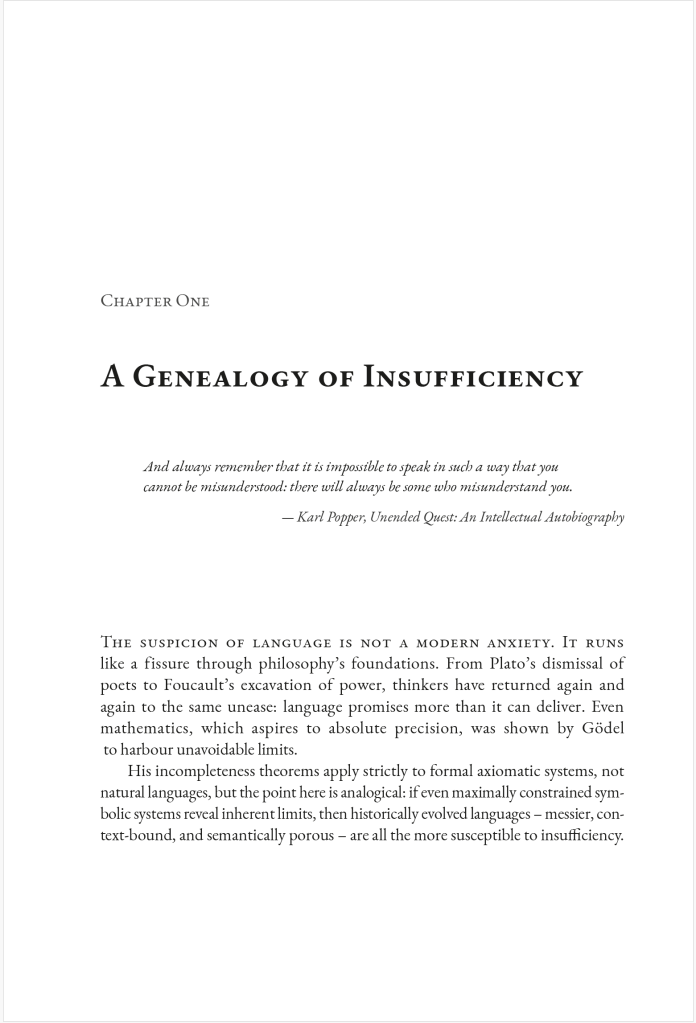
Image: Chapter 1: Page 1
And always remember that it is impossible to speak in such a way that you cannot be misunderstood: there will always be some who misunderstand you. — Karl Popper, Unended Quest: An Intellectual Autobiography
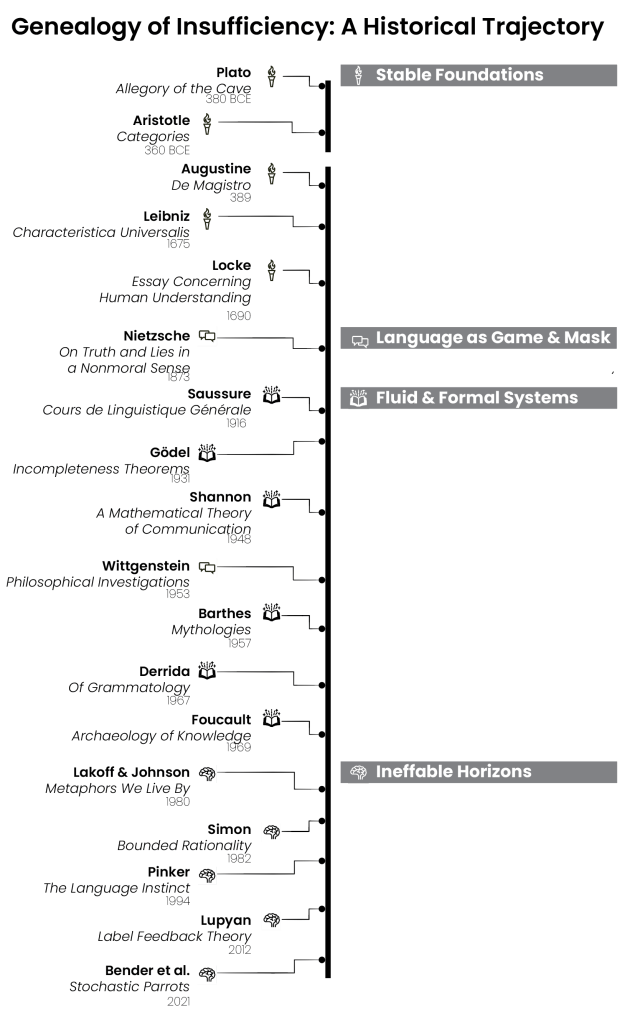
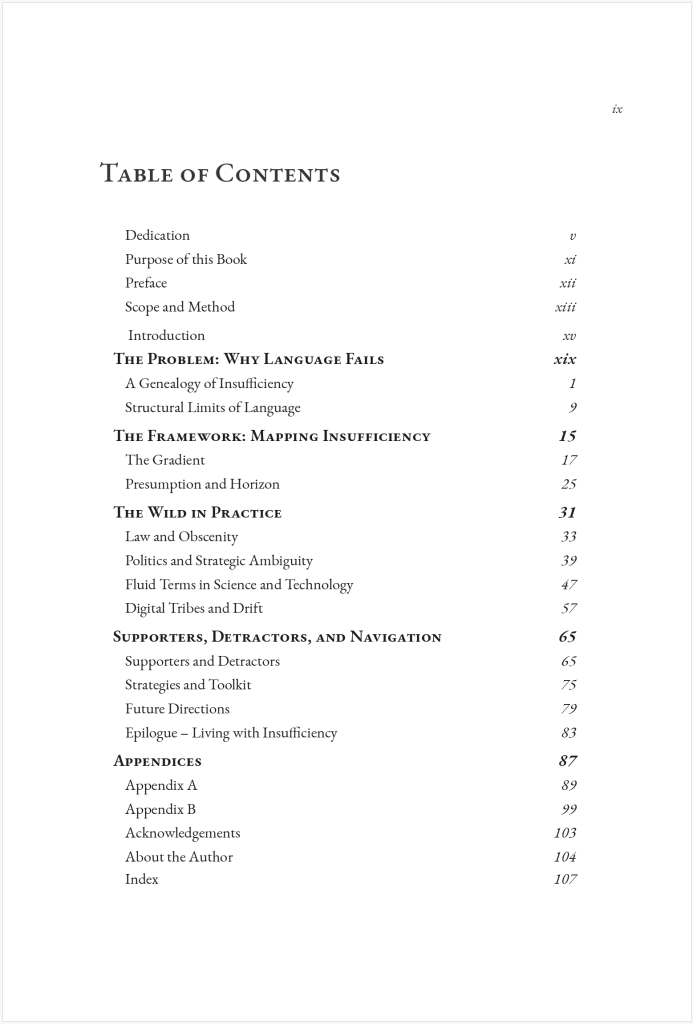
Image: Genealogy of Insufficiency: A Historical TrajectoryImage: Table of Contents
Karl Popper’s Paradox of Intolerance has become a kind of intellectual talisman, clutched like a rosary whenever fascists start goose-stepping into the town square. Its message is simple enough: to preserve tolerance, one must be intolerant of intolerance. Shine enough sunlight on bad ideas, and – so the pious hope – they’ll shrivel into dust like a vampire caught out at dawn.
If only.
The trouble with this Enlightenment fairy tale is that it presumes bad ideas melt under the warm lamp of Reason, as if ignorance were merely a patch of mildew waiting for the bleach of debate. But bad ideas are not bacteria; they are weeds, hydra-headed and delighting in the sun. Put them on television, and they metastasise. Confront them with logic, and they metastasise faster, now with a martyr’s halo.
Audio: NotebookLM podcast on this topic.
And here’s the part no liberal dinner-party theorist likes to face: the people most wedded to these “bad ideas” often don’t play the game of reason at all. Their critical faculties have been packed up, bubble-wrapped, and left in the loft decades ago. They don’t want dialogue. They want to chant. They don’t want evidence. They want affirmation. The Socratic method bounces off them like a ping-pong ball fired at a tank.
But let’s be generous. Suppose, just for a moment, we had Plato’s dream: a citizenry of Philosopher Kings™, all enlightened, all rational. Would democracy then work? Cue Arrow’s Impossibility Theorem, that mathematical killjoy which proves that even under perfect conditions – omniscient voters, saintly preferences, universal literacy – you still cannot aggregate those preferences into a system that is both fair and internally consistent. Democracy can’t even get out of its own way on paper.
Now throw in actual humans. Not the Platonic paragons, but Brexit-uncle at the pub, Facebook aunt with her memes, the American cousin in a red cap insisting a convicted felon is the second coming. Suddenly, democracy looks less like a forum of reasoned debate and more like a lottery machine coughing up numbers while we all pretend they mean “the will of the people.”
Democracy is the worst form of government, except for all the others.
And this is where the Churchill quip waddles in, cigar smoke curling round its bowler hat: “Democracy is the worst form of government, except for all the others.” Ah yes, Winston, do please save us with a quip so well-worn it’s practically elevator music. But the problem is deeper than taste in quotations. If democracy is logically impossible (Arrow) and practically dysfunctional (Trump, Brexit, fill in your own national catastrophe), then congratulating ourselves that it’s “better than the alternatives” is simply an admission that we’ve run out of imagination.
Because there are alternatives. A disinterested AI, for instance, could distribute resources with mathematical fairness, free from lobbyists and grievance-mongers. Nursery schools versus nursing homes? Feed in the data, spit out the optimal allocation. No shouting matches, no demagoguery, no ballots stuffed with slogans. But here the defenders of democracy suddenly become Derrida in disguise: “Ah, but what does fair really mean?” And just like that, we are back in the funhouse of rhetorical mirrors where “fair” is a word everyone loves until it costs them something.
So perhaps democracy doesn’t require an “educated populace” at all; that was always just sugar-paper wrapping. It requires, instead, a population sufficiently docile, sufficiently narcotised by the spectacle, to accept the carnival of elections as a substitute for politics. Which is why calling the devotees of a Trump, or any other demagogue, a gaggle of lemmings is both accurate and impolitic: they know they’re not reasoning; they’re revelling. Your contempt merely confirms the script they’ve already written for you.
Video: Short callout to Karl Popper and Hilary Lawson.
The philosopher, meanwhile, is left polishing his lantern, muttering about reason to an audience who would rather scroll memes about pedophile pizza parlours. Popper warned us that tolerance cannot survive if it tolerates its own annihilation. Arrow proved that even if everyone were perfectly reasonable, the maths would still collapse. And Churchill, bless him, left us a one-liner to make it all seem inevitable.
Perhaps democracy isn’t the worst form of government except for all the others. Perhaps it’s simply the most palatable form of chaos, ballots instead of barricades, polling booths instead of pitchforks. And maybe the real scandal isn’t that people are too stupid for democracy, but that democracy was never designed to be about intelligence in the first place. It was always about managing losers while telling them they’d “had their say.”
The Enlightenment promised us reason; what it delivered was a carnival where the loudest barker gets the booth. The rest of us can either keep muttering about paradoxes in the corner or admit that the show is a farce and start imagining something else.
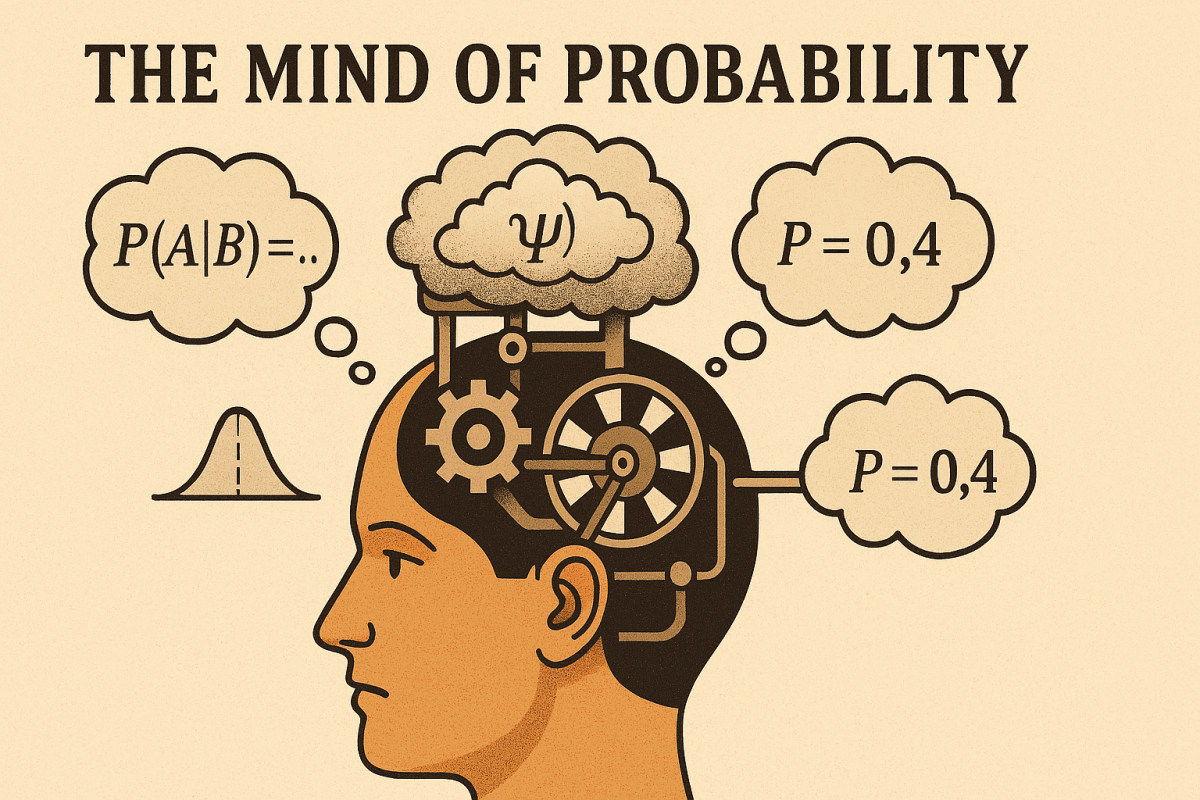
The contestation over the definition of probability is alive and well—like a philosophical zombie that refuses to lie down and accept the tranquilliser of consensus. Despite over three centuries of intense mathematical, philosophical, and even theological wrangling, no single, universally accepted definition reigns supreme. Instead, we have a constellation of rival interpretations, each staking its claim on the epistemological turf, each clutching its own metaphysical baggage.
Audio: NotebookLM podcast on this topic.
Let us survey the battlefield:
1. Classical Probability (Laplacean Determinism in a Tuxedo)
This old warhorse defines probability as the ratio of favourable outcomes to possible outcomes, assuming all outcomes are equally likely. The problem? That assumption is doing all the heavy lifting, like a butler carrying a grand piano up five flights of stairs. It’s circular: we define probability using equiprobability, which itself presumes a notion of probability. Charming, but logically suspect.
2. Frequentist Probability (The Empiricist’s Fantasy)
Here, probability is the limit of relative frequencies as the number of trials tends to infinity. This gives us the illusion of objectivity—but only in a Platonic realm where we can conduct infinite coin tosses without the coin disintegrating or the heat death of the universe intervening. Also, it tells us nothing about singular cases. What’s the probability this specific bridge will collapse? Undefined, says the frequentist, helpfully.
3. Bayesian Probability (Subjectivity Dressed as Rigor)
Bayesians treat probability as a degree of belief—quantified plausibility updated with evidence. This is useful, flexible, and epistemically honest, but also deeply subjective. Two Bayesians can start with wildly different priors and, unless carefully constrained, remain in separate probabilistic realities. It’s like epistemology for solipsists with calculators.
4. Propensity Interpretation (The Ontology of Maybes)
Karl Popper and his ilk proposed that probability is a tendency or disposition of a physical system to produce certain outcomes. Sounds scientific, but try locating a “propensity” in a particle collider—it’s a metaphysical ghost, not a measurable entity. Worse, it struggles with repeatability and relevance outside of controlled environments.
5. Logical Probability (A Sober Attempt at Rationality)
Think of this as probability based on logical relations between propositions—à la Keynes or Carnap. It aims to be objective without being empirical. The problem? Assigning these logical relations is no easier than choosing priors in Bayesianism, and just as subjective when it comes to anything meaty.
6. Quantum Probability (Schrödinger’s Definition)
In quantum mechanics, probability emerges from the squared modulus of a wave function—so this is where physics says, “Shut up and calculate.” But this doesn’t solve the philosophical issue—it just kicks the can into Hilbert space. Interpretations of quantum theory (Copenhagen? Many Worlds?) embed different philosophies of probability, so the contestation merely changes battlegrounds.
Current Status: War of Attrition
There is no universal agreement, and likely never will be. Probability is used successfully across the sciences, economics, AI, and everyday reasoning—but the fact that these wildly different interpretations all “work” suggests that the concept is operationally robust yet philosophically slippery. Like money, love, or art, we use it constantly but define it poorly.
In short: the contestation endures because probability is not one thing—it is a shape-shifting chimera that serves multiple masters. Each interpretation captures part of the truth, but none hold it entire. Philosophers continue to argue, mathematicians continue to formalise, and practitioners continue to deploy it as if there were no disagreement at all.
And so the probability of this contest being resolved any time soon? About zero. Or one. Depending on your interpretation.
The Structure of Scientific Revolutions was published in 1962. Written by Thomas Kuhn, it introduced the world to the concept of paradigm shifts in science — and, as it turns out, elsewhere. As I mentioned recently, I experienced a mishap, confounding it with Paul Feyerabend’s Against Method, first published in 1975. Both of these should be required reading FOR year 10 – or at least taught in summary.
I had read Feyerabend years ago but was only familiar with Kuhn from a distance. I’m clad we’ve become more intimate. These authors take different approaches to arrive at times in the same place. Kuhn takes a Modernist approach that he critiques and modifies. Feyerabend takes a Postmodernist path that sometimes cross.
Ah, the delightful dance of paradigms and anarchism in the hallowed halls of science! Let’s delve deeper into the intellectual pas de deux between Thomas Kuhn and Paul Feyerabend, those audacious thinkers who dared to challenge the sanctity of scientific methodology.
Kuhn’s Paradigm Shifts: The Scientific Waltz
Thomas Kuhn, in his seminal work The Structure of Scientific Revolutions, introduced us to the concept of paradigm shifts—a term now so overused that even corporate PowerPoint presentations aren’t spared. Kuhn posited that science doesn’t progress through a linear accumulation of knowledge but rather through a series of revolutionary upheavals. These upheavals occur when the prevailing scientific framework, or “paradigm,” becomes as outdated as last season’s fashion, unable to account for emerging anomalies. In Kuhn’s view, the scientific community clings to its paradigms with the tenacity of a dog to its bone, until the weight of anomalies forces a collective epiphany, leading to a paradigm shift. This cyclical process propels scientific advancement, albeit in a manner reminiscent of a drunken sailor’s stagger rather than a straight path.
Feyerabend’s Epistemological Anarchism: The Punk Rock of Science
Enter Paul Feyerabend, the enfant terrible of the philosophy of science, with his provocative manifesto Against Method. Feyerabend gleefully dismantled the notion of a universal scientific method, advocating for “epistemological anarchism.” He argued that the rigid adherence to methodological rules is about as useful as a chocolate teapot, stifling creativity and hindering progress. In Feyerabend’s anarchic utopia, “anything goes” in the pursuit of knowledge, and the scientific method is more of a loose suggestion than a strict protocol. His critique was not just a call for methodological diversity but a full-blown rebellion against the tyranny of scientific dogmatism.
A Comparative Analysis: Method to the Madness
While Kuhn and Feyerabend both challenged the orthodox views of scientific progress, their approaches were as different as chalk and cheese. Kuhn’s analysis was rooted in historical case studies, portraying scientific revolutions as communal shifts in perspective, akin to a collective midlife crisis. Feyerabend, on the other hand, took a more radical stance, suggesting that the very idea of a fixed scientific method is as mythical as unicorns. Where Kuhn saw periods of “normal science” punctuated by revolutionary shifts, Feyerabend saw a chaotic free-for-all, where progress is made not by following rules but by breaking them.
Implications for Scientific Practice: Order in Chaos
The implications of their critiques are profound. Kuhn’s work suggests that scientists should remain open to paradigm shifts, lest they become as obsolete as Betamax in a Netflix era. Feyerabend’s anarchism, while controversial, serves as a reminder that innovation often requires the audacity to defy convention. Together, they paint a picture of science not as a monolithic quest for truth but as a dynamic, often tumultuous, human endeavour.
Conclusion: The Legacy of Intellectual Rebellion
In conclusion, the works of Kuhn and Feyerabend invite us to view science through a more sceptical lens, questioning the sanctity of its methods and the rigidity of its paradigms. Their critiques serve as a clarion call for intellectual flexibility, urging us to embrace the chaos and complexity inherent in the pursuit of knowledge. After all, in the grand theatre of science, it’s often the most unconventional performances that leave a lasting impact.
Karl Popper coined the paradox of tolerance, but this was not his use case.
Societies and cultures tend to mediate and normalise to an implied equilibrium. They claim tolerance because members are generally conformant until someone isn’t, and then all hell breaks loose.
In religion, an example might be a claim that “We love everyone” until the everyone is gay, an addict, or some other miscreant. That’s when the hate starts. Then they deny the hate—so long as the person regains conformance status.
I don’t have much to say beyond this. It just resonated with me.
Whilst Popper is correct in saying that you may (seemingly) resolve conflicts if you ignore definition alignment and go with a subjective approach. Just assume you are talking about the same thing and find accord. This is problematic because once instantiated, it will be realised that there was no common centre, and so the next round commences.
In some ways this comports with my language insufficiency postion—these terms are undefinable, so waiting for full agreement will require an infinite amount of time—, but pretending that one can ignore this step is fool’s play.
One approach might be to atomise a concept such as justice, thereby attempting to resolve a portion, but I’ll posit that this atomic approach will yield protons, neutron, electron, and then quarks and subatomic particles and quantum strangeness, so all we’ve managed is to kick the can down the road.
The best this attempt at a pragmatic approach yields is a pregnant pause, but it won’t remain resolved. It’s easy to blame the instability on the dynamism of society—and this does likely exascerbate the issue—, but this issue is inherently unstable at the start. Like an isotope, it’s just ready for any disturbance.
As part of my indictment against language and its insufficiency to facilitate precise and accurate transmission of abstract concepts, I happened upon a quote by Karl Popper:
It is impossible to speak in such a way that you cannot be misunderstood.
—Karl Popper
“However, the problem still remains: what should we do in order to make our meaning clearer, if greater clarity is needed, or to make it more precise, if greater precision is needed? In the light of my exhortation the main answer to this question is: any move to increase clarity or precision must be ad hoc or ‘piecemeal’. If because of lack of clarity a misunderstanding arises, do not try to lay new and more solid foundations on which to build a more precise ‘conceptual framework’, but reformulate your formulations ad hoc, with a view to avoiding those misunderstandings which have arisen or which you can foresee. And always remember that it is impossible to speak in such a way that you cannot be misunderstood: there will always be some who misunderstand you. If greater precision is needed, it is needed because the problem to be solved demands it. Simply try your best to solve your problems and do not try in advance to make your concepts or formulations more precise in the fond hope that this will provide you with an arsenal for future use in tackling problems which have not yet arisen.
— Unended Quest: An Intellectual Autobiography, Karl Popper
Popper’s point here is more that some people won’t understand what you are saying, which differs from my concept that some ideas just can’t be conveyed. Some people will assume their interpretation is the true meaning, but this assumption may be incorrect. Even more problematic is when different people assume to know the true meaning, yet their definitions differ materially.
Charles makes another point commenting on this quote on his Thing Finder blog.
And there will be even more who deliberately choose to misunderstand you. The man in search of truth will always be at risk from the man of conviction.
Charles Bayless, Thing Finder blog
Some if not most of this deliberate misunderstanding is captured in Upton Sinclair’s quip:
It is difficult to get a man to understand something, when his salary depends upon his not understanding it!
—Upton Sinclair
But this still doesn’t capture the point the some concepts are actually nebulous; there is nothing there there.
I’ll leave this post with a quote from Le Petite Prince:
Language is the source of misunderstandings.
—Antoine de Saint-Exupéry
Indeed, language is simultaneously expanding and limiting, but like faith in technology, faith in language may lead to an untimely end.
To some extent or another, humans appear to need order—some more than others. Societies are a manifestation of order, and we’ve got subcultures for those who don’t fit in with the mainstream. Humans are also a story-telling lot, which helps to provide a sense of order. Metanarratives are a sort of origin story with a scintilla of aspiration toward some imagined semblance of progress.
Some people appear to be more predisposed to need to ride this metanarrative as a lifeboat. These people are typically Conservative, authority-bound traditionalists, but even the so-called Progressives need this thread of identity. The problem seems to come down to a sort of tolerance versus intolerance split, a split along the same divide as created by monotheism in the presence of polytheism.
Meet the new boss, same as the old boss.
Won’t Get Fooled Again — The Who
In a polytheistic world, when two cultures collided, their religious pantheons were simply merged. In a blink, a society might go from 70 gods to 130. On this basis, there was a certain tolerance. Monotheism, on the other hand, is intolerant—a winner takes all death match. The tolerant polytheists might say, sure, you’ve got a god? Great. He can sit over there by the elephant dude. Being intolerant like a petulant schoolboy, the monotheists would throw a tantrum at the thought that there might be other gods on the block. Monotheists won’t even allow demigods, though there is the odd saint or two.
This is a battle between absolutism and relativism. The relativist is always in a weaker arguing position because intolerant absolutists are convinced that their way is the only way, yet the tolerant relativists are always at risk of being marginalised. This is what Karl Popper was addressing with the Paradox of Tolerance.
In a functioning society, a majority of the metanarratives are adopted by the majority of its constituent. On balance, these metanarratives are somewhat inviolable and more so by the inclined authoritarians.
A problem is created when a person or group disagrees with the held views. The ones espousing these views—especially the Traditionals—become indignant. What do you mean there are more than two genders? You are either male or female. Can’t you tell by the penis?
I happened to read a tweet by the GOP declaring their stupidity:
America the Stupid
The Vice President, a living anachronism and proxy for the American Midwest Rust Belt superimposed on the Bible Belt, he tells his sheep that “The moment America becomes a socialist country is the moment that America ceases to be America…” Americans as a whole are pretty dim, and it seems to get dimmer the higher one ascends their government. Pence seems very firm in affirming a notion of American identity, but not accepting that identities change. He may become upset if he finds out that George Washington is dead—in fact, there are very few remnants of the original United States aside from some dirt, trees, and a few edifices—and the country is still the county. Some people have a difficult time grasping identity. It makes me wonder if he fails to recognise himself in the mirror after he gets his hair cut.
The idea behind deconstruction is to deconstruct the workings of strong nation-states with powerful immigration policies, to deconstruct the rhetoric of nationalism, the politics of place, the metaphysics of native land and native tongue… The idea is to disarm the bombs… of identity that nation-states build to defend themselves against the stranger, against Jews and Arabs and immigrants…
Jacques Derrida
Interesting to me is how people complain about this and that politically. Most of this is somewhat reflexive and as phatic as a ‘how are you?’, but some is more intentional and actioned. Occasionally, the energy is kinetic instead of potential, but the result is always the same: One power structure is replaced by another.
What you aspire to as revolutionaries is a new master. You will get one
Jacques Lacan
As Lacan noted, as people, we believe ourselves to be democratic, but most of us appear to be finding and then worshipping some authority figures who will promise us what we desire. We desire to have someone else in charge, who can make everything OK, someone who is in a sense an ideal parent. I don’t believe this to be categorical, but I do believe that there is a large contingent of people who require this.
As an aside, I’ve spent a lot of time (let’s call it a social experiment) in the company of social reprobates. What never ceases to amaze me is how these social outcasts seem to have a strong sense of right and wrong and how things should be. Conveniently, they exempt themselves from this scope, so if they steel to buy drugs, it’s OK, but if someone else gets caught, they should get what’s coming to them.
About a year ago I was chatting with a mate, and I shared an observation that the biggest substance abusers in high school—”the Man’s not going hold me down” cohort—are the biggest conservatives. A girl a few houses down from me became a stripper, but her political views are very Conservative, an avid Trump supporter.
One woman I know is a herion-addicted prostitute. In her eyes, she’s fine (sort of—without getting into psychoanalytics); other women are junkie whores. A heavy dose of assuaged cognitive dissonance is the prescription for this, but it confounds me.
Getting back to the original topic, people who need this order are resistant to deconstruction and other hallmark notions of poststructuralism. They need closure. This translates into a need for metanarratives. When confronted with the prospect of no Truth, they immediately need to find a substitute—speculatively, anyway, as denial and escalating commitment will kick into overdrive.
The same problem mentioned above comes into play here. A few years ago, there was an Occupy Wall Street group, and like atheists, there are myriad reasons why people participated. One of the commonest complaints by the power structure and the public at large is if you don’t like the status quo, what status should replace it. None of the above was never an acceptable response.
It doesn’t matter that in this universe we occupy there is more disorder than order, and entropy rules, pareidolia is the palliative. And religion remains an opiate of the masses.








 Philosophics