Moral Psychology and the Art of Not Believing Your Own Results

3–4 minutes

Over the past few decades, moral psychology has staged a quiet coup against one of our most cherished fantasies: that human beings are, at bottom, rational moral agents. This is not a fringe claim. It is not a Twitter take. It is the mainstream finding of an entire research programme spanning psychology, cognitive science, linguistics, and neuroscience.

We do not reason our way to moral conclusions. We feel our way there. Instantly. Automatically. And only afterwards do we construct reasons that make the judgment sound respectable.

Audio: NotebookLM summary podcast of this topic.

This is not controversial anymore. It is replicated, taught, and celebrated. And yet, if you read the most influential books in this literature, something strange happens. The diagnosis is devastating. The prescription is reassuring.

I’ve just published a long-form video walking through five canonical books in moral psychology that all uncover the same structural problem, and then quietly refuse to live with the implications.

What follows is a brief guide to the argument.

The shared discovery

Across the literature, the same conclusions keep reappearing:

  • Moral judgement is intuitive, not deliberative
  • Reasoning is largely post-hoc
  • Emotion is not noise but signal
  • Framing and metaphor shape what even counts as a moral fact
  • Group identity and tribal affiliation dominate moral perception

In other words: the Enlightenment picture of moral reasoning is wrong. Or at least badly incomplete.

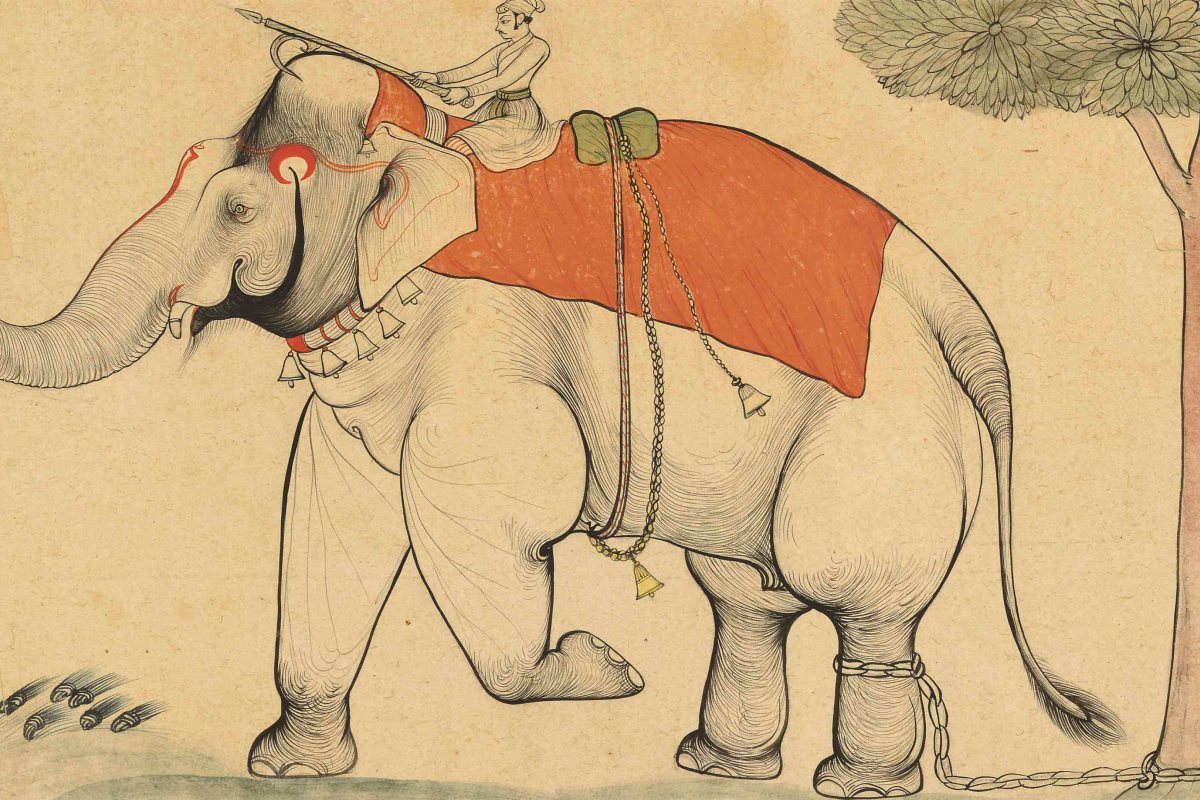
The rider does not steer the elephant. The rider explains where the elephant has already gone.
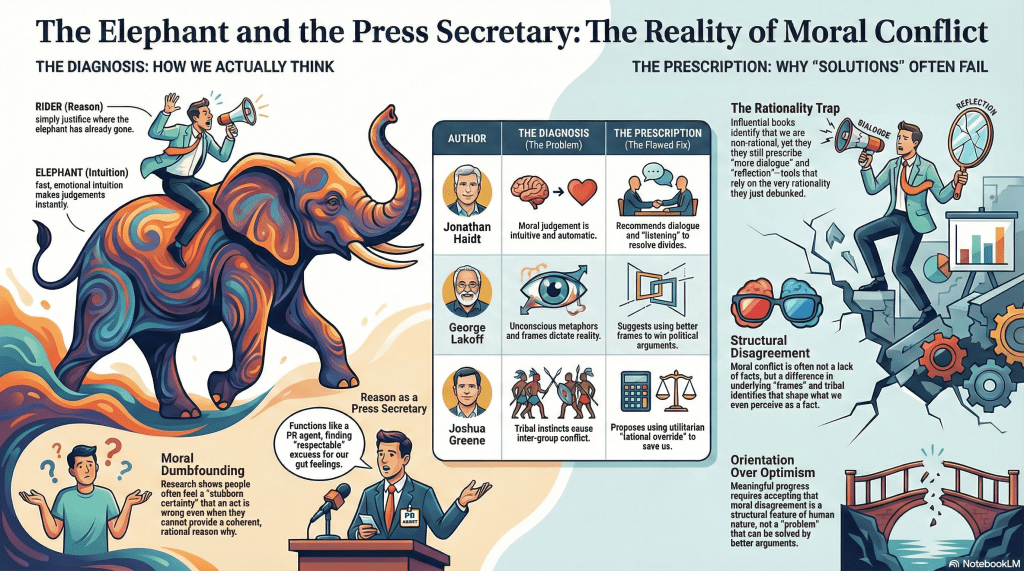
Audio: NotebookLM infographic

Where the books go wrong

The video focuses on five widely read, field-defining works:

  • The Righteous Mind (reviewed here and here… even here)
  • Moral Politics (mentioned here – with Don’t Think of an Elephant treated as its popular sequel)
  • Outraged! (reviewed here)
  • Moral Tribes (reviewed here)

Each of these books is sharp, serious, and worth reading. This is not a hit piece.

But each follows the same arc:

  1. Identify a non-rational, affective, automatic mechanism at the heart of moral judgement
  2. Show why moral disagreement is persistent and resistant to argument
  3. Propose solutions that rely on reflection, dialogue, reframing, calibration, or rational override

In short: they discover that reason is weak, and then assign it a leadership role anyway.

Haidt dismantles moral rationalism and then asks us to talk it out.
Lakoff shows that framing is constitutive, then offers better framing.
Gray models outrage as a perceptual feedback loop, then suggests we check our perceptions.
Greene diagnoses tribal morality, then bets on utilitarian reasoning to save us.

None of this is incoherent. But it is uncomfortable. Because the findings themselves suggest that these prescriptions are, at best, limited.

Diagnosis without prognosis

The uncomfortable possibility raised by this literature is not that we are ignorant or misinformed.

It is that moral disagreement may be structural rather than solvable.

That political conflict may not be cured by better arguments.
That persuasion may resemble contagion more than deliberation.
That reason often functions as a press secretary, not a judge.

The books sense this. And then step back from it. Which is human. But it matters.

Why this matters now

We are living in systems that have internalised these findings far more ruthlessly than public discourse has.

Social media platforms optimise for outrage, not understanding.
Political messaging is frame-first, not fact-first.
AI systems are increasingly capable of activating moral intuitions at scale, without fatigue or conscience.

Meanwhile, our institutions still behave as if one more conversation, one more fact-check, one more appeal to reason will close the gap. The research says otherwise.

And that gap between what we know and what we pretend may be the most important moral problem of the moment.

No solution offered

The video does not end with a fix. That’s deliberate.

Offering a neat solution here would simply repeat the same move I’m criticising: diagnosis followed by false comfort. Sometimes orientation matters more than optimism. The elephant is real. The elephant is moving.And most of us are passengers arguing about the map while it walks.

That isn’t despair. It’s clarity.

Outrage! Chapter Six

Kurt Gray’s Outraged! attempts to boil morality down to a single principle: harm. This, in his view, is the bedrock of all moral considerations. In doing so, he takes a swing at Jonathan Haidt’s Moral Foundations Theory, trying to reduce its multi-faceted framework to a mere footnote in moral psychology. Amusingly, he even highlights how Haidt quietly modified his own theory after Gray and his colleagues published an earlier work—an intellectual game of cat-and-mouse, if ever there was one.

Audio: Podcast of this topic

Chapter 6: The Intuition Overdose

By the time we reach Chapter 6, Gray is charging full steam into reductio ad absurdum territory. He leans so hard on intuition that I lost count of how many times he invokes it. The problem? He gives it too much weight while conveniently ignoring acculturation.

Yes, intuition plays a role, but it doesn’t exist in a vacuum. Enter Kahneman’s dual-system model: Gray eagerly adopts the System 1 vs. System 2 distinction, forcing his test subjects into snap moral judgments under time pressure to bypass rationalisation. Fair enough. But what he neglects is how even complex tasks can migrate from System 2 (slow, deliberate) to System 1 (fast, automatic) through repeated exposure. Kahneman’s example? Basic arithmetic. A child grappling with 1 + 1 relies on System 2, but an adult answers without effort.

And morality? The same mechanism applies. What starts as deliberation morphs into automatic response through cultural conditioning. But instead of acknowledging this, Gray behaves as if moral intuition is some mystical, spontaneous phenomenon untethered from socialization.

Morality: Subjective, Yes—But Culturally Engineered

Let’s lay cards on the table. I’m a moral subjectivist—actually, a moral non-cognitivist, but for simplicity’s sake, let’s not frighten the children. My stance is that morality, at its core, is subjective. However, no one develops their moral compass in isolation. Culture, upbringing, and societal narratives shape our moral instincts, even if those instincts ultimately reduce to personal sentiment.

Gray does concede that the definition of “harm” is subjective, which allows him to argue that practically any belief or action can be framed as harmful. And sure, if you redefine “harm” broadly enough, you can claim that someone’s mere existence constitutes an existential threat. Religious believers, for example, claim to be “harmed” by the idea that someone else’s non-compliance with their theological fairy tale could lead to eternal damnation.

I don’t disagree with his observation. The problem is that the underlying belief is fundamentally pathological. This doesn’t necessarily refute Gray’s argument—after all, people do experience psychological distress over imaginary scenarios—but it does mean we’re dealing with a shaky foundation. If harm is entirely perception-based, then moral arguments become arbitrary power plays, subject to the whims of whoever is best at manufacturing grievance.

And this brings us to another crucial flaw in Gray’s framework: the way it enables ideological self-perpetuation. If morality is reduced to perceived harm, then groups with wildly different definitions of harm will inevitably weaponize their beliefs. Take the religious fundamentalist who believes gay marriage is a sin that dooms others to eternal suffering. From their perspective, fighting against LGBTQ+ rights isn’t just bigotry—it’s moral duty, a battle to save souls from metaphysical harm. This, of course, leads to moral contagion, where adherents tirelessly indoctrinate others, especially their own children, ensuring the pathology replicates itself like a virus.

The Problem with Mono-Causal Explanations

More broadly, Gray’s attempt to reduce morality to a single principle—harm—feels suspiciously tidy. Morality is messy, contradictory, and riddled with historical baggage. Any theory that purports to explain it all in one neat little package should immediately raise eyebrows.

So, sorry, Kurt. You can do better. Moral psychology is a tangled beast, and trying to hack through it with a single conceptual machete does more harm than good.

Institutionalised

Jordan Peterson is decidedly not my cup of tea. I can tolerate Pinker and Haidt. I agree with much of what they have to say, but in this video, the dissonance finally dawns on me. Interestingly, I can tolerate Peterson within the scope of this discussion.

I don’t agree with much of what these three are saying, but it is refreshing to hear Peterson outside of a philosophical domain, a place where he has no place. And although I don’t agree with him here, it is on the basis of his argumentation rather than his abject ineptitude.

I disagree with this trio. This video reveals these three people as Institutionalists. Peterson may be a political Conservative versus Pinker’s and Haidt’s enlightened Liberalism, but this is a common core value they defend with escalating commitment. Typically, we find these to be polar opposites, but here they have a common enemy that is not necessarily anti-institutionalists or anarchists but people who don’t understand venerable institutions and thereby risk tipping the apple cart or toppling the Jenga tower because they just don’t understand. Not like them. Besides constitutionalism, the common thread is Paternalism. They may disagree on the specifics, but one thing is true: We know more than you, and this knowledge is embedded in the sacred institutions. If only the others understood.

In this video, we hear these three commiserate about the diversity and inclusion forces in University today, and where this movement is off base.

Motility, Automotion, and Agency

I just wrapped up chapter eleven of The Righteous Mind by Jonathan Haidt. I’ve got only 35 pages to go to get through chapter twelve. I’ve been tempted to stop reading. Chapter eleven—and I am tempted to inject a bankruptcy pun here—has been more frustrating than the rest thus far. And yet I am glad to have persisted.

My intellectual focus these past months has been on agency. Et voilĂ , paydirt. Chapter eleven’s title reveals the context: Religion is a Team Sport. Let’s walk through this garden together.

A goal of Haidt is to educate the reader on his third principle of moral psychology: Morality binds and blinds. He establishes parallels between sports and religion. And here’s the thing—I don’t disagree. But here’s the other thing—I feel that are equally vapid—, with no apologies to sports fans or the religious. Let’s keep moving.

“A college football game is a superb analogy for religion.”

Jonathan Haidt, The Righteous Mind, Chapter 12: Religion is a Team Sport

He talks about the organising and unifying functions of both. But here’s the thing. It unifies the like-minded. Haidt claims to be irreligious and not be into sports, and yet he cites these as somehow desirable. I find him to be an apologist for religion.

I am not a psychologist, but if I were, I’d be tempted to claim that Haidt’s conclusions follow from his personal beliefs. He believes in morals, society, order, intuition, and institutions. He is a textbook Modern and an extrovert to boot. I think he also falls into teleological fallacy traps. Was that a play on words?

His goal is to fuse the positions of Darwin and Durheim. Along the way, he reminds us of the New Atheists, their publications, and their positions: Sam Harris’ The End of Faith: Religion, Terror, and the Future of Reason; Richard Dawkins’s The God Delusion; Daniel Dennett’s Breaking the Spell: Religion as a Natural Phenomenon; and Christopher Hitchens’s God Is Not Great: How Religion Poisons Everything.

Although he views religion through rose-coloured glasses, he comes to the conclusion that religions have done a great deal of harm over the millennia, but the good outweighs the bad, especially if you consider it through a social-moral lens. But if religion creates in-groups versus out-groups, which they do, and religious in-groups outlive even non-religious ingroups, then this is a winning option. But what if you don’t like that option?

Personally, I am a collectivist, but this is not willy-nilly any collective.

Haidt contrasts the New Atheist vantage that religious belief is an evolutionary byproduct versus a position that what started as a byproduct evolved into group selection and then, perhaps, an epigenetic phenomenon.

Here’s my contention:

Borrowing from New Atheism, Haidt adopts the notion of a “hypersensitive agency detection device [that] is finely tuned to maximize survival, not accuracy”.

The first step in the New Atheist story—one that I won’t challenge—is the hypersensitive agency detection device. The idea makes a lot of sense: we see faces in the clouds, but never clouds in faces, because we have special cognitive modules for face detection. The face detector is on a hair trigger, and it makes almost all of its mistakes in one direction—false positives (seeing a face when no real face is present, e.g., ), rather than false negatives (failing to see a face that is really present). Similarly, most animals confront the challenge of distinguishing events that are caused by the presence of another animal (an agent that can move under its own power) from those that are caused by the wind, or a pinecone falling, or anything else that lacks agency.

The solution to this challenge is an agency detection module, and like the face detector, it’s on a hair trigger. It makes almost all of its mistakes in one direction—false positives (detecting an agent when none is present), rather than false negatives (failing to detect the presence of a real agent). If you want to see the hypersensitive agency detector in action, just slide your fist around under a blanket, within sight of a puppy or a kitten. If you want to know why it’s on a hair trigger, just think about which kind of error would be more costly the next time you are walking alone at night in the deep forest or a dark alley. The hypersensitive agency detection device is finely tuned to maximize survival, not accuracy.

Op Cit, p. 292

I fully agree with the assertion that the brain values fitness over truth, and I’ve commented in several posts that pareidolia and apophenia create false-positive interpretations of reality.

But now suppose that early humans, equipped with a hypersensitive agency detector, a new ability to engage in shared intentionality, and a love of stories, begin to talk about their many misperceptions. Suppose they begin attributing agency to the weather. (Thunder and lightning sure make it seem as though somebody up in the sky is angry at us.) Suppose a group of humans begins jointly creating a pantheon of invisible agents who cause the weather, and other assorted cases of good or bad fortune. Voilà—the birth of supernatural agents, not as an adaptation for anything but as a by-product of a cognitive module that is otherwise highly adaptive.

Op Cit, p. 293

For me, this supports my contention that agency is a wholly constructed fiction. The same agency we ascribe to unknown natural events, we ascribe to ourselves. And perhaps this ability served an egoistic function, which was then generalised to the larger world we inhabit.

I have an issue with his teleological bias. He feels that because we have evolved a certain way to date; this will serve as a platform for the next level as it were. I’ll counter with a statement I often repeat: It is possible to have adapted in a way that we have been forced into an evolutionary dead end. Historically, it’s been said that 99 per cent of species that ever occupied this earth are no longer extant. That’s a lot of evolutionary dead ends. I am aware that few species could have survived an asteroid strike or extended Ice Ages, but these large-scale extinction events are not the only terminal points for no longer extant species.

So finally, Haidt essentially says that it doesn’t matter that these religious and cultural narratives are wholly fictitious, if they promote group survival, we should adopt them. This seems to elevate the society over the individual, which is fine, but perhaps the larger world would be better off still without the cancer? Just because it can survive—like some virulent strain—doesn’t mean we should keep it.

Finally, given these fictions, what’s a logical reasonable person to do? I don’t buy into ‘this country is superior to that country’ or ‘this religion is better than that religion’ or even ‘this sports team is better than that’ or ‘this company is better than that’.

Haidt does idolise Jeremy Bentham, but this is more Pollyannaism. It sounds good on paper, but as an economist, I’ll reveal that it doesn’t work in the real world. No one can effectively dimensionalise and define ‘good’, and it’s a moving target at that.

No thank you, Jonathan. I don’t want to buy what you are selling.

News Flash: From the time I started this content, I’ve since read the final chapter. Where I categorically reject a lot of what Haidt proposes in this chapter, I tend to find chapter twelve to fit more amicably with my worldview. Perhaps I’ll share my thoughts on that next.

If you’ve reached this far, apologies for the disjointed presentment. I completed this over the course of a day through workaday interruptions and distractions. I wish I had an editor who could assert some continuity, but I am on to the next thing, so…

Bonus: I happened upon this journal article, and it somehow ended up here. I haven’t even read it yet, so I’ve got no commentary. Perhaps someday.

Rai, T. S., and A. P. Fiske. 2011. “Moral Psychology Is Relationship Regulation: Moral Motives
for Unity, Hierarchy, Equality, and Proportionality.” Psychological Review 118:57–75

Cover art source

Revisiting The Righteous Mind

Je m’accuse. I am as guilty as the next bloke when it comes to constructing false dichotomies. I like reading Steven Pinker, Jonathan Haidt, and Joshua Greene, though I disagree with some fundamental aspects. Having put Time Reborn to bed, I’ve reengaged with The Righteous Mind and it’s dawned on me what goes against my grain. In retrospect, it should have been obvious all along, and perhaps it was. When I read works by these cats, I catch myself saying, ‘Yeah, but…’. A lot.

To be fair, I’ve not read much of Greene, so I’ll focus on the other two, Haidt in particular. From what I can tell, Greene is cut from the same cloth. I’ll elaborate. When I cite Haidt, just know that I mean the other two and their ilk.

Haidt divides the world into Liberals and Conservatives. This is the false dichotomy. I’m aware that I recently expounded on the political spectrum, but this is more than that. Whether this would be better depicted as further Left on the political spectrum or another dimension is open to debate.

I believe the biggest dissonance I feel against this common perspective is that these guys are all Liberals. In particular, they are Ivory Tower Liberals™—paternalistic know-it-alls. Upon reflection, Cass Sunstein falls into this category: paternalistic intellectuals. I don’t mean this pejoratively, but each of these is a privileged prescriptivist. But that’s not my beef.

The other common thread is that these people are all institutionalists. This brings everything into focus. These people are defenders of Enlightenment Age morality, so they’ve all adopted the same metanarrative.

The Righteous Mind – Chapter 7

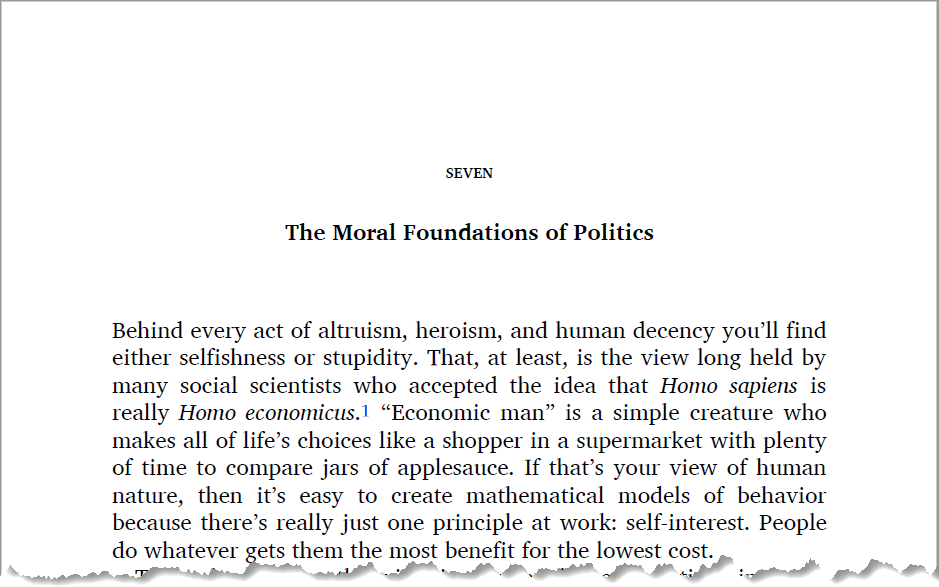
Haidt’s observations are accurate enough, but only within the frame of institutionalism—a frame I reject. This leaves my perspective out of view and unrepresented. In chapter seven, he establishes his action pairs that serve to divine moral truths about a person’s foundational political beliefs. He argues, like Pinker, that the mind is not a Blank Slate. He adopts neuroscientist Gary Marcus’ definition of innate:

“Nature bestows upon the newborn a considerably complex brain, but one that is best seen as prewired—flexible and subject to change—rather than hardwired, fixed, and immutable.”

— Gary Marcus, The Birth of the Mind (2004)

He further morphs Marcus’ ideas into this:

Nature provides a first draft, which experience then revises.… “Built-in” does not mean unmalleable; it means “organized in advance of experience.”

— Jonathan Haidt, The Righteous Mind (2012)

Given this background, Haidt invented these action pairs:

  • Care – Harm
  • Fairness – Cheating
  • Loyalty – Betrayal
  • Authority – Subversion
  • Sanctity – Degradation

I suppose I could reserve an entire post to disintegrate these. Suffice it to say that, categorically, I have issues with the meta of some of them—particularly, the last four. I am more accepting of the care – harm dichotomy, so my commentary would be more nuanced, especially in light of the scenario he cited, which shed light on his own thought processes.

I’m getting off track. The point I want to make is that these shared perspectives on society and identity, respectively macro- and microcosmic, make sense in an institutional framework, but is less necessary otherwise. And although Haidt attempts to defend his positions as not being invasive [my words, not his], this is simply because he accepts the underlying metanarratives blindly.

I’ll probably return to expound on this later, but for now, I am on to other things. Meantime, here is a review from a European, who rightly points out that this is a book written by an American for an American audience, even if he feels it is more universally applicable.

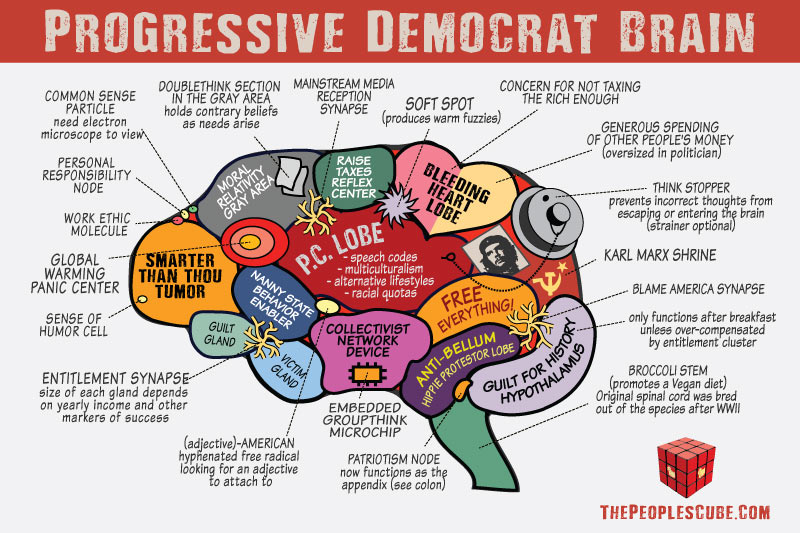
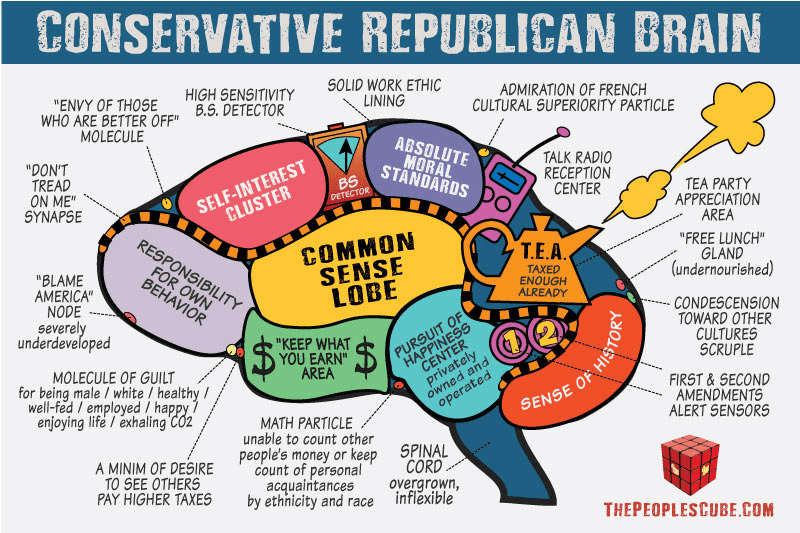
Out of a sense of fairness, I’ve included the Conservative brain image.

Intuition and Reason

I’ve been cycling through The Righteous Mind and Moral Tribes, respectively by Jonathan Haidt and Joshua Greene. These blokes are social psychologists and moral philosophers. I started each of these books with the conception that I would neither like nor agree with the content. As for like, I suppose that’s a silly preconception better captured by whether or not I agree; that with which I don’t agree, I don’t like.

This said, I like the style of both of the authors, and I am finding the material to be less contentious than I first thought. I can already envisage myself agreeing with much of the substance but waiting to disagree with the conclusions.

Although I committed myself to document The Righteous Mind in situ, I am finding that I am listening to the audiobook whilst driving and so getting ahead of myself, so I’ll have to rewind and retread in order to do this. In fact, the reason I switched back to Greene’s Moral Tribes is so I wouldn’t progress even further in Haidt’s work.

I am writing this post to acknowledge this. I’d also like to document that I don’t believe that humans are good reasoners, a situation both Haidt and Greene cite to be generally true. Humans are post hoc rationalisers, which is to say that they make up their minds and then create a narrative to justify that position. Haidt uses an analogy of an elephant and a rider, and he asserts that humans might more accurately be described as groupish than selfish. Certainly not shellfish. Greene notes that people have been shown to concede self-interest to political party interest, which helps to explain how people continually and predictably vote against their own self-interests. This also supports my position that democracy is a horrible form of government. Of course, Haidt would argue that this proves his point that people tend to adopt facts that support their perspective and diminish or disregard those that don’t.

it doesn’t follow that intuition is (1) better, (2) significantly better, or (3) good enough for (a) long term viability or (b) grasping complexity.

Haidt suggests that reason is overvalued, but then he proposes intuition as a better alternative. I agree with him that reason is overvalued and for the same reasons (no pun intended) that he does. But it doesn’t follow that intuition is (1) better, (2) significantly better, or (3) good enough for (a) long term viability or (b) grasping complexity.

Whilst I am not immune to this any more than someone else. I recall Kahneman writing in Thinking Fast and Slow that even though he is well aware of cognitive biases and fallacies, he himself can’t escape them either. When I used to teach undergraduate economics, I’d give some sort of policy assignment. As a preamble, I’d instruct the students that without exception, all policy decisions have pros and cons. In their submissions, they’d need to gather both supporting and detracting arguments and then articulate why one should be adopted over another. Minimally, I’d expect at least three pros and cons.

The students would almost invariably complain about how difficult it was to imagine a counter-position. Even when they’d include some, they were usually weak tea fodder. Oftentimes, the students already shared the same perspective, so they couldn’t usually even get the opposing side until we debriefed after the assignments had been graded. Although I do recall instances where students would admit that they hadn’t considered this or that opposing view, I can’t recall a case where a position was flipped after hearing new evidence—not that this was my intention. People do engage in escalating commitment, doubling down on existing beliefs and generating defensive—sometimes tortuous—arguments to support their positions.

Righteous Mind

Preamble

All too often, I’ll read or listen to a book and place bookmarks with the best of intents to revisit and comment. yet either never to return or to return and not recall the context and not wanting to reread to regain it. I am going to attempt to document my reaction to Jonathan Haidt’s book, The Righteous Mind: Why Good People are Divided by Politics and Religion. If you’ve read some posts here, you’ll understand that I am not a moralist, so I don’t expect to like the book or agree with it. I’ve already ready the forward materials, so I’ll return to comment on that before I get too far ahead. I have done this before at university, and it is decidedly slow progress and can chase one down rabbit holes—this one, anyway.

I have a habit of abandoning books in favour of others including dropping them outright. This is one of 16 I have in progress at the moment, some commenced as many as 5 years ago. To be fair to myself, many of those books are substantially completed. I feel I got the intended message—or at least got what I wanted out of them—, and I just haven’t read the final few chapters. In some cases, the book is an anthology, and I have been slogging my way through it. A few books I’ve read before and am reabsorbing the material, so I may decide not to re-read cover to cover. I just pulled a second reading book off the list to get to 16 from 17.

I have striven not to laugh at human actions, not to weep at them, not to hate them, but to
understand them.

— Baruch Spinoza, Tractatus Politicus, 1676

Introduction

“Can we all get along?” — Rodney King

“Please, we can get along here. We all can get along. I mean, we’re all stuck here for a while. Let’s try to work it out.”

Born to be Righteous

I could have titled this book The Moral Mind to convey the sense that the human mind is designed to “do” morality, just as it’s designed to do language, sexuality, music, and many other things described in popular books reporting the latest scientific findings.

Empasis mine

Straight away, I have a contention. The human mind is not designed to do anything. It has evolved and performs functions. Perhaps, this is just a matter of semantics, but it puts me on guard. Moreover, that it does morality doesn’t evaluate the relative benefit or if it should even be done. Without going down the aforementioned rabbit hole, language is a perfect example. We use language to communicate, but language as a social mechanism may be a secondary or tertiary function. As I’ve argued—even quite recently—, this is a reason I feel that language is insufficient for the purpose of conveying abstract concepts, like for example, morals and morality.

But I chose the title The Righteous Mind to convey the sense that human nature is not just intrinsically moral, it’s also intrinsically moralistic, critical, and judgmental.

A primary function of the brain is as a difference engine. This is what allows us to discern friend from foe, edible versus poison, and so on. Reflecting on Kahneman and Tversky, most (if not ostensibly all) of this is a heuristic system I process, which is good enough but only at a distance. Morals allow us to create in-group and out-group distinctions.

I want to show you that an obsession with righteousness (leading inevitably to self-righteousness) is the normal human condition. It is a feature of our evolutionary design, not a bug or error that crept into minds that would otherwise be objective and rational.

To my first point—not only his insistence on a design metaphor, but doubling down and declaring it as not a bug or an error—, this is disconcerting. And it may be a normal human condition, but so is cancer. The appeal to nature isn’t winning me over.

Our righteous minds made it possible for human beings—but no other animals—to produce large cooperative groups, tribes, and nations without the glue of kinship.

Agreed.

What Lies Ahead

Part I is about the first principle: Intuitions come first, strategic reasoning second.

If you think that moral reasoning is something we do to figure out the truth, you’ll be constantly frustrated by how foolish, biased, and illogical people become when they disagree with you. But if you think about moral reasoning as a skill we humans evolved to further our social agendas—to justify our own actions and to defend the teams we belong to—then things will make a lot more sense.

Haidt and I are much aligned on these points.

Keep your eye on the intuitions, and don’t take people’s moral arguments at face value. They’re mostly post hoc constructions made up on the fly, crafted to advance one or more strategic objectives.

Not buying the ‘go with your intuitions‘ advice. Moving on.

…the mind is divided, like a rider on an elephant, and the rider’s job is to serve the elephant … I developed this metaphor in my last book, The Happiness Hypothesis.

I’m not sure I am going to like this dualism, and I haven’t read The Happiness Hypothesis, so I’ll just have to see where he takes it. It seems like Haidt is a hardcore Traditionalist.

Part II is about the second principle of moral psychology, which is that there’s more to morality than harm and fairness.

This feels about right.

The central metaphor of these four chapters is that the righteous mind is like a tongue with six taste receptors.

OK. Let’s see where this goes.

Part III is about the third principle: Morality binds and blinds.

I like this pair.

…human beings are 90 percent chimp and 10 percent bee.

Did he say bee? I agree with the chimp reference. Maybe this won’t be as bad as I thought.

A note on terminology: In the United States, the word liberal refers to progressive or left-wing politics, and I will use the word in this sense. But in Europe and elsewhere, the word liberal is truer to its original meaning—valuing liberty above all else, including in economic activities. When Europeans use the word liberal, they often mean something more like the American term libertarian, which cannot be placed easily on the left-right spectrum.10 Readers from outside the United States may want to swap in the words progressive or left-wing whenever I say liberal.)

Decent advice.

Why do you see the speck in your neighbor’s eye, but do not notice the log in your own eye? … You hypocrite, first take the log out of your own eye, and then you will see clearly to take the speck out of your neighbor’s eye.

— MATTHEW 7:3–5

I do find myself, probably too often, parroting this paragraph.

PART I

Intuitions Come First, Strategic Reasoning Second

Central Metaphor: The mind is divided, like a rider on an elephant, and the rider’s job is to serve the elephant.

Where Does Morality Come From?

A family’s dog was killed by a car in front of their house. They had heard that dog meat was delicious, so they cut up the dog’s body and cooked it and ate it for dinner. Nobody saw them do this.

A man goes to the supermarket once a week and buys a chicken. But before cooking the chicken, he has sexual intercourse with it. Then he cooks it and eats it.

TBD

The Origin of Morality

Quick reaction for now. Details to follow…

I’m not quite buying into Haidt’s attempt to parse the nature versus nature argument into three segments: nativism and empiricism whilst adding rationalism insomuch as rationalism is seen by many as ambiguous and not a mutually exclusive option. It feels as though he’s throwing up a rationalist strawman to take down. We’ll see where it leads

Nativism
the theory that concepts, mental capacities, and mental structures are innate rather than acquired by learning.

Empiricism
the theory that all knowledge is derived from sense-experience.

Rationalism
the theory that reason rather than experience is the foundation of certainty in knowledge.

Let’s pick up on this later. I knew this would take a lot longer.

Criminal Conservatism

A few years ago, I shared with a colleague that I had noticed that my high school classmates who seemed to be the most non-conformist (or perhaps the most anti-authoritarian), the ones most likely to have abused drugs and alcohol and most likely to criticise the Man, have by and large become extremely conservative on the political spectrum. Most are card-carrying Republicans, and dreaded low-information voters, continuing the trend of low-information acquisition and processing. He said that he had noticed a similar trend.

I still keep in contact with some some old mates who are Conservative Republicans, but who were high-information consumers then and still, so I am not saying that all Conservatives are low-information people.

A man who is not a Liberal at sixteen has no heart; a man who is not a Conservative at sixty has no head.

—Benjamin Disraeli (Misattributed)

The past couple of years, in a sort of nod to Bukowski, I’ve been researching or circulating among the underbelly of the United States, the veritable dalit-class comprised of drug dealers and users, pimps, prostitutes, and thieves. And I’ve noticed the same trend. These people might fear or hate the police and the system, and they may not vote or even be high-information seekers, but they seem to have a marked propensity to Conservatism. I admit that this is anecdotal and rife with confirmation bias, but this is my observation.

To broad brush any group into some monolith is always a fools errand and missing dimensional nuance, but the general direction holds. In my observation, these people are very black & white, and they want to see law & order (as much as they want to avoid its glance). They are interested in fairness, and call out being beat, as in being shorted in a drug deal or overpay at the grocery store–the same grocery store from which they just shoplifted.

When they see a news story, ‘That bank robber deserved to get caught’ would not be an unexpected response. Even if they got caught, they might voice that they deserved it. The received sentence might be a different story.

I am not sure why this shift from anti-establishment to hyper establishment happens. I’ve also noticed that even if they dislike the particular people serving government roles, they still feel that the abstract concepts of government, democracy, capitalism, and market systems make sense, if only the particular instance is not great.

One reaction I had is that some of these people feel that the transgressions of their youth might have been avoided only if there were more discipline, and so they support this construct for the benefit of future generations, who, as embodied in Millennials, are soft and lack respect for authority.

I’d recently re-discovered a Bill Moyers interview with moral psychologist Jonathan Haidt, and there is some relationship. And whilst I could critique some of Haidt’s accepted metanarrative relative to society, his points are valid within the constraints of this narrative.

The video is almost an hour long and was produced in 2012, it is a worthwhile endeavour to watch.

I am wondering if anyone else has seen this trend or who has experienced a contrary trend. Extra points for an explanation or supporting research.

Cover image: Sean Penn, excerpt from Fast Times at Ridgemont High, and Brett Cavanaugh, SCOTUS and posterboy Conservative hack