I finished Mattias Desmet’s The Psychology of Totalitarianism, which I mentioned the other day. Unfortunately, my initial optimism was premature. Everything I enjoyed was front-loaded: the first four chapters set up a promising critique of mechanistic rationality and the collapse of shared meaning. Then the book turned into a long, therapeutic sermon. I should have stopped at Chapter 4 and saved myself the sunk-cost regret.
It isn’t that nothing follows; it’s just that what follows is so thin that the cost-benefit ratio goes negative. Once Desmet moves from diagnosis to prescription, the argument collapses into a psychologist’s worldview: an entire civilisation explained through mass neurosis and healed through better intuition. He builds his case on straw versions of reason, science, and modernity, so his ‘cure’ can look revelatory.
The trouble is familiar. Having dismantled rationalism, Desmet then installs intuition as its replacement – an epistemic monarchy by another name. His appeal to empathy and connection reads less like philosophy and more like professional self-promotion. The therapist can’t stop therapising; he privileges the psychological lens over every other possibility.
The result is a reductionist parascience dressed as social theory. The totalitarian mind, in Desmet’s telling, isn’t political or structural but psychological – a patient waiting for insight. I don’t doubt his sincerity, only his scope. It’s what happens when a discipline mistakes its vocabulary for the world.
Desmet’s project ultimately re-enchants what it claims to critique. He wants rationalism redeemed through feeling, order reborn through connection. Dis-Integrationism stops short of that impulse. It accepts fracture as the permanent condition – no higher synthesis, no therapeutic finale. Where Desmet sees totalitarianism as a collective pathology awaiting treatment, I see it as reason’s own reflection in the mirror: a system trying to cure itself of the only disease it knows, the need to be whole.
Kurt Gray’s Outraged! attempts to boil morality down to a single principle: harm. This, in his view, is the bedrock of all moral considerations. In doing so, he takes a swing at Jonathan Haidt’s Moral Foundations Theory, trying to reduce its multi-faceted framework to a mere footnote in moral psychology. Amusingly, he even highlights how Haidt quietly modified his own theory after Gray and his colleagues published an earlier work—an intellectual game of cat-and-mouse, if ever there was one.
Audio: Podcast of this topic
Chapter 6: The Intuition Overdose
By the time we reach Chapter 6, Gray is charging full steam into reductio ad absurdum territory. He leans so hard on intuition that I lost count of how many times he invokes it. The problem? He gives it too much weight while conveniently ignoring acculturation.
Yes, intuition plays a role, but it doesn’t exist in a vacuum. Enter Kahneman’s dual-system model: Gray eagerly adopts the System 1 vs. System 2 distinction, forcing his test subjects into snap moral judgments under time pressure to bypass rationalisation. Fair enough. But what he neglects is how even complex tasks can migrate from System 2 (slow, deliberate) to System 1 (fast, automatic) through repeated exposure. Kahneman’s example? Basic arithmetic. A child grappling with 1 + 1 relies on System 2, but an adult answers without effort.
And morality? The same mechanism applies. What starts as deliberation morphs into automatic response through cultural conditioning. But instead of acknowledging this, Gray behaves as if moral intuition is some mystical, spontaneous phenomenon untethered from socialization.
Let’s lay cards on the table. I’m a moral subjectivist—actually, a moral non-cognitivist, but for simplicity’s sake, let’s not frighten the children. My stance is that morality, at its core, is subjective. However, no one develops their moral compass in isolation. Culture, upbringing, and societal narratives shape our moral instincts, even if those instincts ultimately reduce to personal sentiment.
Gray does concede that the definition of “harm” is subjective, which allows him to argue that practically any belief or action can be framed as harmful. And sure, if you redefine “harm” broadly enough, you can claim that someone’s mere existence constitutes an existential threat. Religious believers, for example, claim to be “harmed” by the idea that someone else’s non-compliance with their theological fairy tale could lead to eternal damnation.
I don’t disagree with his observation. The problem is that the underlying belief is fundamentally pathological. This doesn’t necessarily refute Gray’s argument—after all, people do experience psychological distress over imaginary scenarios—but it does mean we’re dealing with a shaky foundation. If harm is entirely perception-based, then moral arguments become arbitrary power plays, subject to the whims of whoever is best at manufacturing grievance.
And this brings us to another crucial flaw in Gray’s framework: the way it enables ideological self-perpetuation. If morality is reduced to perceived harm, then groups with wildly different definitions of harm will inevitably weaponize their beliefs. Take the religious fundamentalist who believes gay marriage is a sin that dooms others to eternal suffering. From their perspective, fighting against LGBTQ+ rights isn’t just bigotry—it’s moral duty, a battle to save souls from metaphysical harm. This, of course, leads to moral contagion, where adherents tirelessly indoctrinate others, especially their own children, ensuring the pathology replicates itself like a virus.
The Problem with Mono-Causal Explanations
More broadly, Gray’s attempt to reduce morality to a single principle—harm—feels suspiciously tidy. Morality is messy, contradictory, and riddled with historical baggage. Any theory that purports to explain it all in one neat little package should immediately raise eyebrows.
So, sorry, Kurt. You can do better. Moral psychology is a tangled beast, and trying to hack through it with a single conceptual machete does more harm than good.
Full Disclosure: I don’t subscribe to pop psychology, pseudo-psychology, or psychology. But I repeat myself. Of course, that’s just what an INTP would say anyway. So predictable.
I was introduced to the MBTI (Myers-Briggs Type Indicator) in the late ’80s as an undergrad Psychology student and then in Organisational Behaviour classes. I read about the foundations in the ’90s when I read the works of Carl Jung’s, Archetypal psychology.
I take the test every few years, and I consistently come up as INT. The P and J flip now and again. The last test I took was a P. Some tests have added an A or T dimension. There are also sub-factors. I’ll get to those presently.
MBTI is a personality assessment tool designed to categorize individuals into one of 16 distinct personality types. Based on Carl Jung’s theory of psychological types, MBTI helps identify how people perceive the world and make decisions. Each personality type is derived from a combination of four dichotomies:
Extraversion (E) vs. Introversion (I) – Describes where individuals prefer to focus their energy. Extraverts are outward-focused, gaining energy from interaction, while Introverts are inward-focused, drawing energy from solitude.
Sensing (S) vs. Intuition (N) – Defines how people process information. Sensing types rely on concrete details and present realities, while Intuitive types focus on patterns, possibilities, and abstract thinking.
Thinking (T) vs. Feeling (F) – Describes how decisions are made. Thinking types prioritise logic and objectivity, while Feeling types consider values and emotional impact.
Judging (J) vs. Perceiving (P) – Describes lifestyle preferences. Judging types prefer structure and closure, whereas Perceiving types favour flexibility and keeping options open.
Cognitive Functions
Each type has a specific “cognitive function stack” that explains how these preferences play out in everyday life. These functions are divided into:
Dominant Function: The most natural and frequently used function.
Auxiliary Function: Supports the dominant function, offering balance.
Tertiary Function: Less developed but still important, often emerging later in life.
Inferior Function: The least developed function, which tends to show up awkwardly, especially under stress.
The eight cognitive functions are:
Introverted Thinking (Ti) – Internal analysis and logic refinement.
Extraverted Thinking (Te) – External organisation and efficiency.
Introverted Feeling (Fi) – Personal values and internal authenticity.
Extraverted Feeling (Fe) – Social harmony and emotional dynamics.
Introverted Sensing (Si) – Recalling past experiences and valuing tradition.
Extraverted Sensing (Se) – Engaging with the present moment and sensory details.
Introverted Intuition (Ni) – Focusing on future possibilities and deep insights.
Extraverted Intuition (Ne) – Exploring ideas and brainstorming possibilities.
Assertive (A) vs. Turbulent (T) Dimension
The A-T dimension adds a layer of emotional self-regulation to MBTI types. It describes how confident or self-critical individuals are in their decision-making and handling of stress.
Turbulent (T) types tend to be more self-critical, stress-prone, and driven by perfectionism and external validation.
Assertive (A) types are self-assured, less prone to stress, and comfortable with their decisions.
With this definition in place, I’ll save further commentary for a future post.
“Education is an admirable thing, but it is well to remember from time to time that nothing that is worth knowing can be taught.”
— Oscar Wilde
I’ve loved this quote since I first read it however many years ago. I used to have a plaque with this inscription hung on a wall. This quote came back to mind when I was reading more McGilchrist. I expect to post the summary of chapter nine of The Matter with Things by the end of the weekend. I’ve read it and am now extracting a summary. But I digress.
“Education is an admirable thing.” This is a testament to the left cerebral hemisphere, although it provides fodder for the right as well. Instruction is about categorisation and structure; language and rote; stuffing out brains with facts and trivia.
But “nothing worth knowing can be taught.” This is a right hemisphere conceit. It can’t be taught because it must be experienced.
One can’t teach allegory.
One can’t teach allusion.
One can’t teach metaphor.
One can teach simile.
One can teach poetry, but one can’t teach a poem.
One can teach art, but one can’t teach a work of art.
One can teach music, but one can’t teach the qualia of music. That’s a minor key. You’re supposed to feel sad there. That’s a major seventh chord, doesn’t that uplift you? And what about this raga?
What can’t be taught lay in the realm of intuition and feeling. Emotional response.
As a result of these recommendations, I’ve watched some 6 or more hours of video interviews with Iain, some of which are hosted on his own site, Channel McGilchrist, including this one. Before I get to the topic promised by the title of this post, I’ll say that I like Iain. I respect his intellect, his demeanour, and his approach. If you are a credentialist, his an Oxford-educated psychiatrist—so he’s no slouch.
Iain’s positions are well researched, informed, and articulated. I could listen to him for hours. In fact, I have. And yet I disagree with a fundamental position he takes on intuition. Allow me to build up to that.
My first recommendation was due to a reaction I shared that depicting left-right brain hemisphere as analytic-creative was overly reductionist and quaint. McGilchrist was recommended because he disagreed. But it turns out his disagreement was more in the way it was being portrayed. The answer was wrong because the question was wrong. In a nutshell, his contention is that we shouldn’t be asking what each hemisphere processes, but how it goes about processing. I agree with this.
we shouldn’t be asking what each hemisphere processes, but how it goes about processing
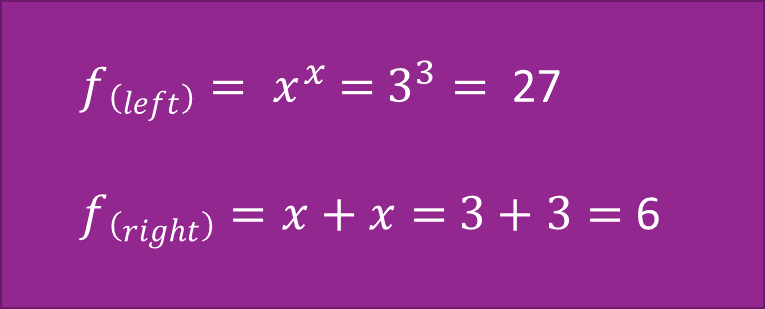
His point is that in cases where an experience (inputs) might be processed on one side versus another, the interpretation (outputs) would necessarily differ. To make a false analogy, the left brain might be performing an exponential function whilst the right brain might be performing an arithmetic function. So, if ƒ(left) = xx and ƒ(right) = x+x, then an input of 3 would yield 27 and 6, respectively. There is nothing wrong with either side, they just produce different results. In context, this difference might matter: How many feet across is that chasm I must leap. I say, ‘Oops’, as I am falling to my demise having underestimated the difference, having used the right rather than the left function.
False Analogy by the Numbers
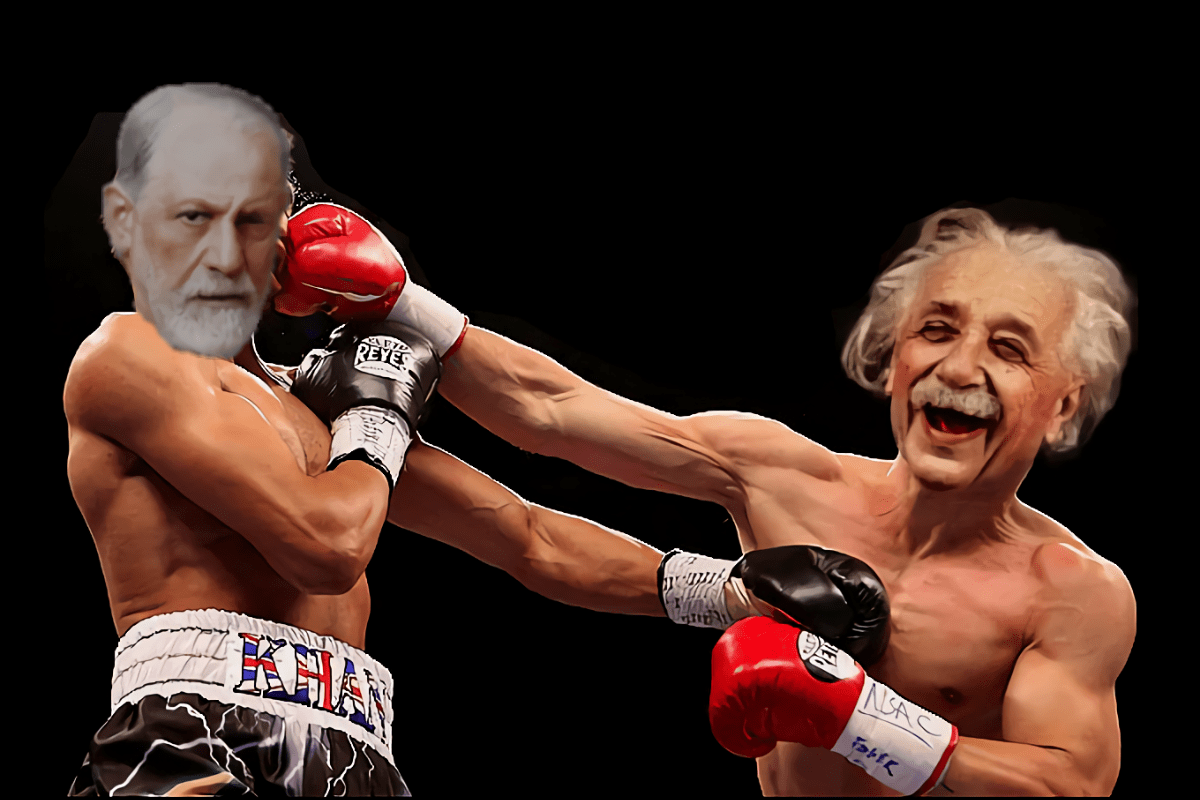
So where is this showdown you are wittering on about? A little more setup.
Science is stereotypically an analytic function, which is the say it requires a lot of left hemisphere processing. Psychology—and keep in mind that I cast psychology as pseudoscience, or para-science when I am being more charitable—elevates the notion of intuition as not only having value but of being largely ignored by science.
Those who have been following me for a while, know that I am also critical of Scientistm™, the blind-faith devotion to the current state of science as being some infallible truth. But neither am I an advocate for metaphysical claims. This is what I feel Psychology™ is trying to do with intuition. It feels like they are not only trying to inject a metaphysical claim; they are simultaneously making a normative claim that you should have (and trust) intuition; further, they are staking out the territory to be able to say an absence of this acceptance is pathological, so this is a power play. We’ve got the tea leaf readers taking up arms against science.
Of course, I am being hyperbolic and polemic for effect, but this division exists. Iain is not the first to attempt to elevate intuition. A central idea that Jonathan Haidt tries to sell the reader on in his book, The Righteous Mind, is that we need to be more accepting and trusting of intuition. Even Malcolm Gladwell pushed this point in Blink: The Power of Thinking Without Thinking.
I do think that this will escalate. Even if it doesn’t materialise into a full-scale war, people will take sides—they already have—, and we’ll see more us versus them fingerpointing. Whilst I am not fully on the side of science, my propensity is to lean in that direction.
UPDATE: Even before I post this, I discover that I am behind the times with this prediction. In searching for a suitable image for this post, I find the book Science and Pseudoscience in Clinical Psychology, which calls out pseudoscience presented as fact not only in the obvious realm of pop psychology but in the offices of practising psychologists. I have not read it, so I am not in a position to recommend it. I may get a copy for myself, if only just to have it on hand.
Before I end this, I also wish to anticipate a point of disagreement. I’ve encountered practitioners of ‘scientific psychology’ who vehemently defend their vocation as science. Without addressing this directly, let’s just raise the point that applying the scientific method and maths to a discipline doesn’t graduate it to become a science. I can apply this to Tarot or haruspicy. If fact, this is how, in general, social sciences became so-called soft sciences: ‘Look at me, mum. I’m using numbers’.
Where do you fall on the topic of intuition? Am I exaggerating and making mountains out of molehills?
Small Print (enlarged for texture): I’ve been approved as an Amazon.com Affiliate, so any links to Amazon are monetised. The purchase price to you remains unaffected, but I may be compensated for these purchases. If a purchase does not accrue to an affiliate, Amazon keeps the difference.
PSA: If you know of an affiliate you want to support—whether me or another—, purchaser through the affiliate. It costs you nothing and benefits the little guy.


 Philosophics