The Emissary Who Forgot to Bow: On Erasmus, Wells, and the Delusion of Universal Reason

15 minutes

I was having an inappropriate chat with ChatGPT and, per Feyerabend, I once again discovered that some of the best inspirations are unplanned. The conversation circled around to the conflicting narratives of Erasmus and Wells. Enter, Plato, McGilchrist, and the Enlightenment – all living rent-free in my head – and I end up with this.

Audio: NotebookLM podcast on this topic.

I. The Proverb and Its Presumption

Erasmus sits at his writing desk in 1500-something, cheerful as a man who has never once questioned the premises of his own eyesight, and pens what will become one of the West’s most durable little myths: ‘In the land of the blind, the one-eyed man is king’. It arrives packaged as folk wisdom, the sort of thing you’re meant to nod at sagely over a pint. And for centuries, we did. The proverb became shorthand for a comfortable fantasy: that advantage is advantage everywhere, that perception grants sovereignty, that a man with superior faculties will naturally ascend to his rightful place atop whatever heap he finds himself on.

It’s an Enlightenment dream avant la lettre, really – this breezy confidence that reason, sight, knowledge, insight will simply work wherever they’re deployed. The one-eyed man doesn’t need to negotiate with the blind. He doesn’t need their endorsement, their customs, their consent. He arrives, he sees, he rules. The proverb presumes a kind of metaphysical meritocracy, where truth and capability are self-authenticating, where the world politely arranges itself around whoever happens to possess the sharper tools.

Image: Midjourney didn’t coöperate with my prompt for a one-eyed king. Trust that this king has only one.

It’s the intellectual equivalent of showing up in a foreign country with a briefcase full of sterling and expecting everyone to genuflect. And like most folk wisdom, it survives because it flatters us. It tells us that our advantages – our rationality, our education, our painstakingly cultivated discernment – are universally bankable. That we, the seeing, need only arrive for the blind to recognise our superiority.

Erasmus offers this with no apparent irony. He hands us a proverb that whispers: your clarity is your crown.

II. Wells Wanders In

Four centuries later, H.G. Wells picks up the proverb, turns it over in his hands like a curious stone, and proceeds to detonate it.

The Country of the Blind (1904) is many things – a fable, a thought experiment, a sly dismantling of Enlightenment presumption – but above all it is an act of literary vandalism against Erasmus and everything his proverb smuggles into our collective assumptions. Wells sends his protagonist, Nuñez, tumbling into an isolated Andean valley where a disease has rendered the entire population blind for generations. They’ve adapted. They’ve built a culture, a cosmology, a complete lifeworld organised around their particular sensorium. Sight isn’t absent from their world; it’s irrelevant. Worse: it’s nonsense. The seeing man’s reports of ‘light’ and ‘sky’ and ‘mountains’ sound like the ravings of a lunatic.

Nuñez arrives expecting Erasmus’s kingdom. He gets a psychiatric evaluation instead.

The brilliance of Wells’s story isn’t simply that the one-eyed man fails to become king – it’s how he fails. Nuñez doesn’t lack effort or eloquence. He tries reason, demonstration, patient explanation. He attempts to prove the utility of sight by predicting sunrise, by describing distant objects, by leveraging his supposed advantage. None of it matters. The blind don’t need his reports. They navigate their world perfectly well without them. His sight isn’t superior; it’s alien. And in a culture that has no use for it, no linguistic scaffolding to accommodate it, no social structure that values it, his one eye might as well be a vestigial tail.

The valley’s elders eventually diagnose Nuñez’s problem: his eyes are diseased organs that fill his brain with hallucinations. The cure? Surgical removal.

Wells lets this hang in the air, brutal and comic. The one-eyed man isn’t king. He’s a patient. And if he wants to stay, if he wants to belong, if he wants to marry the girl he’s fallen for and build a life in this place, he’ll need to surrender the very faculty he imagined made him superior. He’ll need to let them fix him.

The story ends ambiguously – Nuñez flees at the last moment, stumbling back toward the world of the sighted, though whether he survives is left unclear. But the damage is done. Erasmus’s proverb lies in ruins. Wells has exposed its central presumption: that advantage is advantage everywhere. That perception grants authority. That reason, clarity, and superior faculties are self-evidently sovereign.

They’re not. They’re only sovereign where the culture already endorses them.

III. Plato’s Ghost in the Valley

If Wells dismantles Erasmus, Plato hovers over the whole scene like a weary ghost, half scolding, half despairing, muttering that he told us this would happen.

The Allegory of the Cave, after all, is the original version of this story. The philosopher escapes the cave, sees the sun, comprehends the Forms, and returns to liberate his fellow prisoners with reports of a luminous reality beyond the shadows. They don’t thank him. They don’t listen. They think he’s mad, or dangerous, or both. And if he persists – if he tries to drag them toward the exit, toward the light they can’t yet see – they’ll kill him for it.

Video: Plato’s Cave

Plato’s parable is usually read as a tragedy of ignorance: the prisoners are too stupid, too comfortable, too corrupted by their chains to recognise truth when it’s offered. But read it alongside Wells and the emphasis shifts. The cave-dwellers aren’t wrong, exactly. They’re coherent. They’ve built an entire epistemology around shadows. They have experts in shadow interpretation, a whole language for describing shadow behaviour, social hierarchies based on shadow-predicting prowess. The philosopher returns with reports of a three-dimensional world and they hear gibberish. Not because they’re defective, but because his truth has no purchase in their lifeworld.

Plato despairs over this. He wants the prisoners to want liberation. He wants truth to be self-authenticating, wants knowledge to compel assent simply by virtue of being knowledge. But the cave doesn’t work that way. The prisoners don’t want truth; they want comfort shaped like reality. They want coherence within the system they already inhabit. The philosopher’s sun is as alien to them as Nuñez’s sight is to the blind valley.

And here’s the kicker: Plato knows this. That’s why the allegory is tragic rather than triumphant. The philosopher does see the sun. He does apprehend the Forms. But his knowledge is useless in the cave. Worse than useless – it makes him a pariah, a madman, a threat. His enlightenment doesn’t grant him sovereignty; it exile him from the only community he has.

The one-eyed man isn’t king. He’s the lunatic they’ll string up if he doesn’t learn to shut up about the sky.

IV. The Enlightenment’s Magnificent Blunder

Once you’ve got Erasmus, Wells, and Plato in the same room, the Enlightenment’s central fantasy collapses like wet cardboard.

Humanity’s great Enlightenment wheeze – that baroque fantasy of Reason marching triumphantly through history like a powdered dragoon – has always struck me as the intellectual equivalent of selling snake oil in a crystal decanter. We were promised lucidity, emancipation, and the taming of ignorance; what we got was a fetish for procedural cleverness, a bureaucratisation of truth, and the ghastly belief that if you shine a bright enough torch into the void, the void will politely disclose its contents.

The Enlightenment presumed universality. It imagined that rationality, properly deployed, would work everywhere – that its methods were culture-neutral, that its conclusions were binding on all reasonable minds, that the shadows in Plato’s cave and the blindness in Wells’s valley could be cured by the application of sufficient light and logic. It treated reason as a kind of metaphysical bulldozer, capable of flattening any terrain it encountered and paving the way for Progress, Truth, and Universal Human Flourishing.

This was, to put it mildly, optimistic.

What the Enlightenment missed – what Erasmus’s proverb cheerfully ignores and what Wells’s story ruthlessly exposes – is that rationality is parochial. It’s not a universal solvent. It’s a local dialect, a set of practices that evolved within particular cultures, buttressed by particular institutions, serving particular ends. The Enlightenment’s rationality is Western rationality, Enlightenment rationality, rationality as understood by a specific cadre of 18th-century European men who happened to have the printing press, the political clout, and the colonial apparatus to export their epistemology at gunpoint.

They mistook their own seeing for sight itself. They mistook their own lifeworld for the world. And they built an entire civilisational project on the presumption that everyone else was just a less-developed version of them – prisoners in a cave, blind villagers, savages waiting to be enlightened.

The one-eyed man imagined himself king. He was actually the emissary who forgot to bow.

V. McGilchrist’s Neuroscientific Millinery

Iain McGilchrist sits in the same intellectual gravity well as Plato and Wells, only he dresses his thesis up in neuroscientific millinery so contemporary readers don’t bolt for the door. The Master and His Emissary is essentially a 500-page retelling of the same ancient drama: the emissary – our little Enlightenment mascot – becomes so enamoured of his own procedures, abstractions, and tidy schemas that he forgets the Master’s deeper, embodied, culturally embedded sense-making.

McGilchrist’s parable is neurological rather than allegorical, but the structure is identical. The left hemisphere (the emissary) excels at narrow focus, manipulation, abstraction – the sort of thing you need to count coins or parse grammar or build bureaucracies. The right hemisphere (the Master) handles context, pattern recognition, relational understanding – the sort of thing you need to navigate an actual lifeworld where meaning is messy, embodied, and irreducible to procedures.

The emissary is supposed to serve the Master. Left-brain proceduralism is supposed to be a tool deployed within the broader, contextual sense-making of the right brain. But somewhere along the way – roughly around the Enlightenment, McGilchrist suggests – the emissary convinced itself it could run the show. Left-brain rationality declared independence from right-brain contextuality, built an empire of abstraction, and wondered why the world suddenly felt thin, schizophrenic, oddly two-dimensional.

It’s Erasmus all over again: the presumption that the emissary with one eye should be king. The same tragic misunderstanding of how worlds cohere.

McGilchrist’s diagnosis is clinical, but his conclusion is damning. Western modernity, he argues, has become pathologically left-hemisphere dominant. We’ve let analytic thought pretend it’s sovereign. We’ve mistaken our schemas for reality, our maps for territory, our procedures for wisdom. We’ve built cultures that privilege manipulation over meaning, extraction over relationship, clarity over truth. And we’re baffled when these cultures feel alienating, when they produce populations that are anxious, depressed, disenchanted, starved for something they can’t quite name.

The emissary has forgotten the Master entirely. And the Master, McGilchrist suggests, is too polite – or too injured – to stage a coup.

In McGilchrist’s frame, culture is the Master. Strategy, reason, Enlightenment rationality – these are the emissary’s tools. Useful, necessary even, but never meant to govern. The Enlightenment’s mistake was letting the emissary believe his tools were all there was. It’s the same delusion Nuñez carries into Wells’s valley: the belief that sight, reason, superior faculties are enough. That the world will rearrange itself around whoever shows up with the sharper implements.

It won’t. The valley doesn’t need your eyes. The cave doesn’t want your sun. And the Master doesn’t answer to the emissary’s paperwork.

VI. The Triumph of Context Over Cleverness

So here’s what these three – Erasmus, Wells, Plato – triangulate, and what McGilchrist confirms with his neuroscientific gloss: the Enlightenment dream was always a category error.

Reason doesn’t grant sovereignty. Perception doesn’t compel assent. Superior faculties don’t self-authenticate. These things only work – only mean anything, only confer any advantage – within cultures that already recognise and value them. Outside those contexts, they’re noise. Gibberish. Hallucinations requiring surgical intervention.

The one-eyed man arrives in the land of the blind expecting a kingdom. What he gets is a reminder that kingdoms aren’t built on faculties; they’re built on consensus. On shared stories, shared practices, shared ways of being-in-the-world. Culture is the bedrock. Reason is just a tool some cultures happen to valorise.

And here’s the uncomfortable corollary: if reason is parochial, if rationality is just another local dialect, then the Enlightenment’s grand project – its universalising ambitions, its colonial export of Western epistemology, its presumption that everyone, everywhere, should think like 18th-century European philosophes – was always a kind of imperialism. A metaphysical land-grab dressed up in the language of liberation.

The Enlightenment promised illumination but delivered a blinding glare that obscures more than it reveals. It told us the cave was a prison and the valley was backward and anyone who didn’t see the world our way was defective, uncivilised, in need of correction. It never occurred to the Enlightenment that maybe – just maybe – other cultures had their own Masters, their own forms of contextual sense-making, their own ways of navigating the world that didn’t require our light.

Wells understood this. Plato suspected it. McGilchrist diagnoses it. And Erasmus, bless him, never saw it coming.

VII. The Enlightenment’s Paper Crown

The Enlightenment liked to imagine itself as the adult entering the room, flicking on the light-switch, and announcing that, at long last, the shadows could stop confusing the furniture for metaphysics. This is the kind of confidence you only get when your culture hasn’t yet learned the words for its own blind spots. It built an entire worldview on the hopeful presumption that its preferred modes of knowing weren’t just one way of slicing experience, but the gold standard against which all other sense-making should be judged.

Call it what it is: a provincial dialect masquerading as the universal tongue. A parochial habit dressed in imperial robes. The Enlightenment always smelled faintly of a man who assumes everyone else at the dinner table will be impressed by his Latin quotations. And when they aren’t, he blames the table.

The deeper farce is that Enlightenment rationality actually believed its tools were transferrable. That clarity is clarity everywhere. That if you wheel enough syllogisms into a space, the locals will drop their incense and convert on sight. Wells disabuses us of this; Plato sighs that he tried; McGilchrist clinically confirms the diagnosis. The emissary, armed with maps and measuring sticks, struts into the valley expecting coronation and is shocked – genuinely shocked – to discover that nobody particularly cares for his diagrams.

The Enlightenment mistake wasn’t arrogance (though it had that in liberal supply). It was context-blindness. It thought procedures could substitute for culture. It thought method could replace meaning. It thought mastery was a matter of getting the right answer rather than belonging to the right world.

You can all but hear the emissary stamping his foot.

VIII. The Anti-Enlightenment Position (Such as It Is)

My own stance is drearily simple: I don’t buy the Enlightenment’s sales pitch. Never have. The promise of universal reason was always a conjuring trick designed to flatter its adherents into thinking that their habits were Nature’s preferences. Once you stop confusing methodological neatness with metaphysical authority, the entire apparatus looks less like a cathedral of light and more like a filing system that got ideas above its station.

The problem isn’t that reason is useless. The problem is that reason imagines itself sovereign. Reason is a brilliant servant, a competent emissary, and an atrocious king. Culture is the king; context is the kingdom. Without those, rationality is just an embarrassed bureaucrat looking for a desk to hide behind.

This is why I keep banging on about language insufficiency, parochial cognition, and the delightful way our concepts disintegrate once you wander too far from the lifeworlds that birthed them. The Enlightenment thought the human mind was a searchlight. It’s closer to a candle in a draughty hall. You can still get work done with a candle. You just shouldn’t be telling people it can illuminate the universe.

So the anti-Enlightenment move isn’t a call to smash the instruments. It’s a call to read the room. To stop pretending the emissary is the Master. To stop assuming sight is a passport to sovereignty. To stop wandering into other cultures – other caves, other valleys, other hemispheres – with a ruler and a smirk, convinced you’re about to be crowned.

Underneath these brittle idols lies the far messier truth that cognition is parochial, language insufficient, and ‘rationality’ a parlour trick we perform to impress ourselves. I’m not proposing a new catechism, nor am I pining for some prelapsarian alternative. I’m simply pointing out that the Enlightenment promised illumination but delivered a blinding glare that obscures more than it reveals.

The task, then, is to grow comfortable with the dimness. To navigate by flicker rather than floodlight. To admit that the world was never waiting to be made ‘clear’ in the first place.

This doesn’t mean abandoning reason. It means remembering that reason is the emissary, not the Master. It means recognising that our schemas are provisional, our maps incomplete, our procedures useful only within the cultures that endorse them. It means learning to bow – to culture, to context, to the irreducible messiness of lifeworlds we don’t fully understand and can’t procedurally master.

The one-eyed man never was king. At best, he was an enthusiastic tourist with a very noisy torch. The sooner he stops shining it into other people’s faces, the sooner we can get on with the far more interesting business of navigating a world that never promised to be legible.

Not a kingdom of sight. Just a world where the emissary remembers his place.

The Reasonable Person: From Judge Judy to SCOTUS

3 minutes

When I was a child, the United States Supreme Court was still spoken of in hushed, reverent tones, as though nine robed sages in Washington were the Platonic guardians of justice. Impartiality was the word on everyone’s lips, and we were meant to believe that “the law” floated above the grubby realm of politics, as pure and crystalline as the Ten Commandments descending from Sinai.

Audio: NotebookLM podcast on this topic (MP3).

Even then, I didn’t buy it. The whole thing reeked of theatre. And the past few decades have proved that scepticism correct: the Court has become a pantomime. In this robed reality show, nine unelected lawyers cosplaying as oracles interpret the world for us, often by a razor-thin vote that splits exactly along partisan lines. Impartial? Please. A coin toss would be less predictable.

This is why I perked up when I heard Iain McGilchrist, in his recent interview with Curt Jaimungal, wax lyrical about rationality versus reasonableness. Schizophrenia, he tells us, is like a left hemisphere gone berserk, parsing the world in a literalist frenzy without the right hemisphere’s sense of context. The schizophrenic hears a voice in an empty room and, lacking the capacity for metaphor, deduces that it must be the neighbours whispering through the electrical socket. Rational, in its way, but absurd.

Video: Iain McGilchrist and Curt Jaimungal

McGilchrist’s corrective is “reasonableness,” which he casts as the quality of a wise judge: not a slave to mechanistic logic, but able to balance intuition, context, and experience. The problem, of course, is that “reasonable” is one of those delightful weasel words I keep writing about. It claims to be neutral – a universal standard, above the fray – but in practice, it’s just a ventriloquism act. “Reasonable” always turns out to mean what I, personally, consider obvious.

Enter Judge Judy, daytime television’s answer to jurisprudence. Watch her wag a finger and declare, “Any reasonable person would have kept the receipt!” And the studio audience – hand-picked to agree with her every twitch – erupts in applause. It’s reasonableness as spectacle, the mob dressed up as jurisprudence.

Now scale that performance up to SCOTUS. The “reasonable person” test is embedded deep in the common law tradition, but the reasonable person is not you, me, or anyone who has actually missed a bus, pawned a wedding ring, or heard a neighbour’s radio through thin walls. No, the reasonable person is an imaginary, well-groomed gentleman of property whose intuitions happen to dovetail nicely with the prejudices of the bench. The Court, like Judge Judy, insists it is Reason incarnate, when in truth it is reasonableness-by-consensus, a carefully curated consensus at that.

McGilchrist is right that rationality, stripped of context, can lead to absurdity. But in elevating “reasonableness” as if it were a transcendent virtue, he mistakes projection for philosophy. A judge is “reasonable” only when her intuitions rhyme with yours. And when they don’t? Suddenly, she’s a madwoman in robes, and her “reasonableness” is exposed as nothing more than taste disguised as universal law.

The “reasonable person” – whether invoked by the Supreme Court or by Judge Judy – is a ghost that conveniently resembles the speaker. We imagine we’re appealing to some objective standard, when in fact we’re gazing into a mirror. The tragedy of schizophrenia, as McGilchrist notes, is to take metaphor literally. The tragedy of law and politics is the opposite: to dress literal bias in metaphor, to call it “reason,” and to applaud ourselves for our wisdom while the stage set burns behind us.

The Matter with Things: Chapter Eleven Summary: Science’s Claims on Truth

Chapter eleven is the first of three chapters discussing truth from the perspective of science. These chapters are followed by truth as seen from other perspectives, namely, reason and intuition.

Check out the table of contents for this series of summaries. I continue to render interstitial commentaries in grey boxes with red text, so the reader can skip over and just focus on the chapter summary.

The author posits that in the West, most of us trust science to deliver the truth of the matter, as “science alone holds out the promise of stable knowledge on which we can rely to build our picture of the world“. He admits that it does have value, but it has inherent limitations and yet draws us in like moths to a flame. Here, he distinguishes between the discipline and practice of science and Scientism as it is practised by laypeople. Science understands its place and domain boundaries. Scientism is omnipotent with delusions of grandeur that will never be realised.

Some philosophically naĂŻve individuals become very exercised if they sense that the status of science as sole purveyor of truth is challenged

— Iain McGilchrist, The Matter with Things, chapter 10

Politicians who promote science as a bully pulpit prey on the public in a manner similar to bludgeoning them with religious notions.

Science is heavily dependent on the exercise of what the left hemisphere offers.

ibid.

The point the book makes is that like the turtles that go all the way down, science doesn’t have a grasp on what’s beyond the last turtle. Like trying to answer the toddler who can ask an infinite number of ‘why‘ questions, the scientist gets to a point of replying ‘that’s just the way things are’, or the equivalent of ‘it’s bedtime’.

Scientific models are simply extended metaphors. A challenge arises when a model seems to be a good fit and we forget about alternative possibilities getting locked into Maslow’s law of the instrument problem, where ‘to a man with a hammer, everything begins to look like a nail’. Moreover, the left hemisphere is fixated on instrumentation, so it’s always trying to presume a purpose behind everything. Nothing can just be.

This is likely where Scientism begins to trump science.

He quotes:

Dogmatism inevitably obscures the nature of truth.

— Alfred Whitehead

McGilchrist points out that a goal or promise of science is to be objective and take the subject out of the picture. Unfortunately, this is not possible as the necessity for metaphor ensures we cannot be extricated. Objectivity is legerdemain. We create a scenario and claim it to be objective, but there is always some subject even if unstated. He goes into length illuminating with historical characters.

The sciences do not try to explain, they hardly even try to interpret, they mainly make models 
 The justification of such a mathematical construct is solely and precisely that it is expected to work.

— John von Neumann

In fact, science itself is predicated on assumptions that have not and can not be validated through science.

In conclusion, McGilchrists wants to emphasise ‘that just because what we rightly take to be scientific truths are not ‘objective’ in the sense that nothing human, contingent and fallible enters into them, this does not mean they have no legitimate claim to be called true.’ ‘The scientific process cannot be free from assumptions, or values.’

Following this chapter are several pages containing dozens of plates of images.

The Matter with Things: Chapter Ten Summary: What Is Truth?

In this first chapter of the second section of The Matter with Things, Iain McGilchrist asks, What is Truth? Section two has a different focus than the first, which was focused on foundation building. From here on in, he wants to build on this foundation.

Check out the table of contents for this series of summaries. Note that I have rendered my interstitial commentaries in grey boxes with red text, so the reader can skip over and just focus on the chapter summary.

At first, he establishes that each hemisphere ‘thinks’ it knows the true truth and has the best vantage on reality. He makes it clear that a short chapter will not do the topic of truth the justice he feels it deserves and notes that others have written books on the matter. He just wants to make a few points and clarify his position.

As we discovered in the first section, the left and right hemispheres perceive the world differently. The right hemisphere experiences the world as it is presented in a Gestalt manner. This is contrasted by the left hemisphere which views the world as a symbolic re-presentation. It’s not unfair to say that the right hemisphere experiences the world directly whilst the left hemisphere views a cache of the world.

In this chapter, McGilchrist (Iain) attempts to convince the reader that one side is more correct or correct more often than the other and so is more veridical. As he says, the left hemisphere ‘is a good servant but a poor master’. Of course, if we had a third hemisphere [sic], we might think it could mediate the other two, but then we’d need a fourth and a fifth, ad infinitum to act as the new arbiter.

Spoiler Alert: The right hemisphere wins the battle on truth pretty much hands down.

He wants to make it clear to the reader that he is no strict idealist. There is a reality ‘out there’ apart from mental processes that objectively exists even in the absence of a subject. Reality is not exclusively a projection of the brain.

His choice rather relies on the correspondence theory of truth, which is to say that the hemisphere that conveys perceptions more correspondent to our perceived reality would be more veridical.

Here, I challenge his reasoning on two accounts. In the first place,each hemisphere may operate better in one context versus another. In the second case, there may be a consequential factor, which again distils down to context. In risk management, there are notions of probability of failure and consequence of failure. For example, a failure to recognise the truth of a matter (we’ll use truth as a proxy for ‘fact’), may be inconsequential. If I am assessing the probability of a pipe bursting in a nuclear facility and the pipe is connected to a sink to deliver tap water, the consequence of this failure is practically insignificant. But if I am assessing the probability of a pipe containing radioactive materials, even if the probability of failure is low, the consequence of failure may be catastrophic.

Evolutionarily speaking, if you mistake a garden hose for a venomous snake, the consequence of failure is trivial. Turn the tables, and mistake a snake for a garden hose, the consequence may be fatal. I am not attempting to claim that one hemisphere interprets the low consequence scenario and the other interprets the high. I simply want to raise this nuance.

He makes the point that if we compare some known authentic object to a recollection, we want to retain the one that is more accurate.

I see a similar challenge. Hypothetically, let’s say I present a red disc and manipulate the hemispheres to activate only one at a time, asking to recall the object. If the left says it’s red and the right says it’s a disc, which is more correct? Again, I am not claiming that this is a real scenario, but if one side possesses facts unavailable to the other side, we’ve got a problem in making a truth claim.

To reiterate, the left hemisphere is more analogous to a photograph or a video account whereas the right hemisphere is to be in the place that is being photographed. The right hemisphere is duratively presenced whilst the left is re-presented. We move from a nominative form to a verbial form of representing reality. This leads him to ask if ‘truth’ is a thing or a process.

He shifts to a linguistic argument. When people view ‘truth’ as a noun, as a thing, the expectation is that it is static. Moreover, the descriptors of truth are rendered mainly in the past tense—representation, fact, perfect, precise, certain, and concluded. He provides definitions. When viewed duratively, ‘truth’ becomes a process. It is an active relationship. It flows. It’s an intercourse.

We may not ever get to an agreed truth, but neither is every position valid. Interpreting a text, for example, may have several conflicting meanings, but the possible meanings are relatively finite.

Take a simple sentence such as, “The dog bit the hand that feeds him.” This could be meant literally or figuratively. We might imagine different dogs, hands and person to whom the hand is attached. Perhaps the hand is attached to a bonobo. Perhaps, it’s a robotic hand. These are among various possible interpretations, and we may not ever agree on the truth of the matter. However, we can rule out that a giraffe or a watermelon were central to this narrative for what it’s worth.

The bookgoes on to discuss the etymology of the word ‘truth’ and of its relationship to the word ‘true’ (faithful) which is further related to ‘trust’. I won’t exhaust his explanation.

He does discuss correspondence and coherence theories of truth and discounts others such as consensus theory and social constructivism. He cautions not to equate truth with correctness. This is a left hemisphere game insisting on dichotomising things.

The book declares the despite a general agreement on the source or nature of truth, there is something there, so don’t give up un it. In the end, he seems to settle for a Pragmatistic version Ă  la William James.

Personally, I feel he and others are over-invested in the nature of truth. And inflate its meaning over ‘fact’. To me, Capital-T Truth is an archetype, but it doesn’t otherwise exist. We have facts, and truth is sort of a perfect version of a fact. Love is in the same category, though I know Iain would disagree with this assertion. Of course, James dismissed semantic argument as petty and insisted that people simply know the truth of something. I’ve always found this take to be dismissive. I also feel that Pragmatism is too steeped in Empiricism and loses hold of the notion that what happened yesterday may not in fact manifest today or not in the same way.

I’ll also argue as others have before me that (besides being archetypal) the term is a redundant filler word. On a minuscule level, if I say ‘The cup is red’, saying ,’It’s true that the cup is red adds nothing’. The equation was already asserted. This leaves one to wonder what the purpose of it is.

Returnng to the asymmetry of the hemispheres he cautions up not to take a position that one of the other side is correct. Rather, even though there is an asymmetry in value, there is still a synthesis.

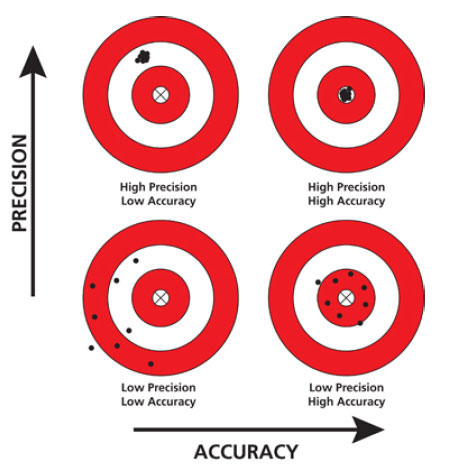
Iain uses the example of Newtonian and Einsteinian physics. At one point, they are practically synonymous and interchangeable. Only as we reach the speed of light does Newtonian physic exceed the bounds of its scope. He also educated the reader on the difference between precision and accuracy.

I like to view this in a musical context. If I play two notes together, say a B over an E, neither is more correct than the other. Notionally, I am playing an E5/B. This is neither an E or a B. The chord is the result of the two playing simultaneously. In this case E and B are both true and not true because the E5 is a synthesis. If I add a G# I get an E-major chord, subsequently adding a D renders an E7. In each of these cases, the truth of the notes, B, D, E, and G# remain true to their identity, but the fact is that the individuality is subsumed by the collective. This is the prevailing truth even though a person with perfect pitch can still individually identify the constituents of the chord. I don’t know if this is more confusion than necessary, but it helps me.

I’ve always like this illustration with target grouping, but this was not referenced by the book.

Image: Precision and Accuracy Chart

Interestingly, he cites Jay Zwicky’s definition: “Truth is the asymptotic limit of sensitive attempts to be responsible to our actual experience of the world 
 ‘sensitive attempts to be responsible’ means truth is the result of attention. (As opposed to inspection.) Of looking informed by love. Of really looking.” He accedes that there are degrees of truth.

Truth is the asymptotic limit of sensitive attempts to be responsible to our actual experience of the world

Jay Zwicky

This asymptosis is how I describe Truth in my Truth about Truth post.

As the chapter comes to a close, he leaves us with a twisted categorical syllogism,

  • [p1] All monkeys climb trees
  • [p2] The porcupine in a monkey
  • [ c ] The porcupine climes trees

This structure presents a valid argument. However, it is not sound. It follows the Socratic logical syntax:

  • [p1] M a P
  • [p2] S a M
  • [ c [ S a P

Because of our exposure to and experience with the external world, we can assess this argument to be unsound, which is to say untrue by observation. Without this context, we could not render this assessment. He discusses the way right- and left-hemisphere occluded subjects respond to this discrepancy. In summary, an isolated left hemisphere with defend the logical syntax over the lived experience.

In conclusion, the hemispheres take different paths to assess truth and often end up at different destinations. The left hemisphere sees truth as a thing whilst the right views it as a process.

John Vervaeke and Lex Fridman on the Meaning Crisis

jimoeba mentioned that he enjoyed an interview with Vervake and Fridman in a comment, so I thought I’d give it a listen. It turns out there are several including a 3-plus-hour version. Arbitrarily, I chose this one. Even if it’s not the particular interview on the meaning crisis, it gives me a sense of the two and their dynamics. I’m glad I listened to it. I like Vervaeke. I can’t say I’m much of a Fridman fan on first listen.

John Vervaeke and Lex Fridman interview: Human civilisation is facing a meaning crisis

This interview content provides an orientation of where Vervaeke is coming from. It helps to clarify his position. His claim seems to be that many people today identify as having no religion but being spiritual. By extension, he posits that this cohort is searching for meaning. I can’t disagree. What it tells me is that I am not in his target demographic. I have no religion, as I am an atheist. I have no spiritual void to fill. This is Vervaeke’s goal—to find something to perform the function of the religion without the, perhaps, baggage and dogma.

I sympathise with his goal. He brings up Nietzsche’s “God is dead” quote, famous or infamous depending on your worldview. Essentially, he wants to answer Nietzsche’s query of what to do now that it’s been revealed that humans created God, not the other way around. His aim is to replace the font of wisdom for this generation.

For me, wisdom is a heuristic, part of the Gestalt McGilchrist mentions. McGilchrist’s work is even referenced here. Of course, I interpret McGilchrist’s references in this space to be metaphorical. It seems that he views it as ‘real’. I’m not sure where Vervaeke places it. Somehow, I feel that if there is a spectrum, Vervaeke leans closer to McGilchrist than me, and that’s OK. They just happen to be wrong.

I still don’t get the need for meaning. I don’t feel despondent that there is no inherent meaning in anything, but we are free to invite or adopt one or many. I remember a Christian mate of mine who explained that people have a God-sized hole that can only be filled by God. Essentially, Vervaeke is making a similar claim, but his void is filled by wisdom. I suppose that I don’t feel I have a void doesn’t mean there isn’t one.

Search for Meaning

Ever since encountering Viktor Frankl’s Man’s Search for Meaning in my youth, I’ve pondered why people search for and indeed invent meaning. By meaning, I am speaking in terms of finding a higher purpose or some spiritual affinity rather than the meaning of why bad things happen, though there are undoubtedly some intersections of the concepts.

This lecture, Ep. 39 – Awakening from the Meaning Crisis – The Religion of No Religion, from a series by John Vervaeke was recommended to an associate in my social network by another trusted associate, and it’s got me going. I’ve long been a nihilist and existentialist. I am even partial to aspects of the philosophic framework of Zen Buddhism. But I’ve never felt there was some higher meaning or raison d’ĂȘtre that isn’t self-imposed. How else would it be imposed? A person may be indoctrinated, but in the end, ignorance is no excuse from self-imposition.

I guess I can’t quite understand what drives this search for meaning. As Vervaeke notes, even some noted atheists like Richard Dawkins have suggested that we should find a secular proxy for the religion—or the namesake religion of no religion. I understand the social function of religion as well as some psychological functions, but the disconnect for me is that I have no such drive. I am admittedly an introvert, so whilst I admit the need for social cohesion and coöperation, I don’t understand the fabrication of religions or the personal, not only belief in meaning, but a yearning for it and even a belief that one has found it.

some people don’t search for meaning so much as they feel they have discovered meaning, but when their discovered meaning doesn’t jibe with another’s discovered meaning, the result is a search to justify or reconcile this conflict

I am empathetic to people like Iain McGilchrist who asserts that there is exogenous meaning out there to be had. He’d probably also assert that asking for proof is a left-hemisphere cerebral request but that absent the imposition by the left hemisphere, one would just feel it and know it. I just can’t abide.

Vervaeke does touch on the postmodern critique of religion as a power play, which is how I feel about it, but this is about the social aspect and doesn’t touch on the personal search for meaning. What I can’t say is whether a person would have this drive to search for meaning if they were either absent socialisation or exposed only to people who are not going to suggest meaning. I understand that previous generations have shown this propensity, but are there cultures that don’t? And is there a common thread to those who do?

In the past, many cultures have asserted gods and higher powers (whether or not as a power play), but could this simply prompt the people to search for alternative meanings, perhaps having noticed the dissonance between certain dogma and their lived lives?

Interestingly, some people don’t search for meaning so much as they feel they have discovered meaning, but when their discovered meaning doesn’t jibe with another’s discovered meaning, the result is a search to justify or reconcile this conflict.

It’s late. Time to retire for the evening. I have none of these answers, but I will jot the questions down on my to-do list just above the search for meaning.

GOD BE IN MY HEAD

God be in my head,
And in my understanding;
God be in mine eyes,
And in my looking;
God be in my mouth,
And in my speaking;
God be in my heart,
And in my thinking;
God be at mine end,
And at my departing.

Podcast: Audio rendition of this page content

Sir Henry Walford Davies put this traditional prayer to music as a hymn. Iain McGilchrist recited it as a poem after a brief setup in an interview.

I am an atheist, and the closest I get to gods is through metaphor, allegory, or allusion. And I don’t engage in it, but I understand when others invoke it. And to be completely honest, I was multitasking when Iain was reciting, and I misheard it, and this miss was more profound for me.

God be in my head,
And in my understanding;
Don’t be in mine eyes,
And in my looking;

That’s what prompted me to seek it out and pen a post. In the original form, it’s more of an invocation. In my misinterpretation, I felt he was saying to keep God in your head as a metaphorical reference—as an archetype—, but God is not for the eyes and the looking. God is a matter of faith.

As for the rest, it flows the same. Speak as you understand it. Feel God in your heart, if you should so choose. Think about him if you wish. And carry this thought with you until the end if it brings you comfort.

Myself, I get no comfort from the notion. I don’t feel I need it, but it is a cultural phenomenon, so to be aware is a part of cultural and emotional intelligence.

I feel that I’ve always intuitively understood metaphor. I remember listening to Joseph Campbell in the 1980s as he was describing how one of his biggest challenges was to get people to understand the embodiment of metaphor and not just the vapidity of simple simile.

And there you have it.

Systematic Violence

As humans, we often leverage systems. They seem to make life easier. Whether a routine or a step-by-step instruction through an unknown process, a system can guide us. Systems are also connected, interactive entities, but that’s not for this segment. I am more interested in the loss of humanity that systematic processes and bureaucracy bring, so I am interested in imposed systems rather than systems we invent to find our keys and wallets.

Podcast: Audio rendition of this page content
Image: Spectrum of System versus Human

If we consider systematisation and humanity on a scale, we can see that any move toward systematisation comes at the expense of humanity. It might make logical sense to make this trade-off to some degree or another. The biggest hit to humanity is the one-size-fits-all approach to a problem. It removes autonomy or human agency from the equation. If a system can be that mechanised, then automate it. Don’t assign a human to do it. This is an act of violence.

As I’ve been reading and writing a lot about Iain McGilchrist’s work lately, I feel one can easily map this to left versus right cerebral hemisphere dominance. System-building is inherently human, but it’s in the domain of the left hemisphere. But my imposition of a system on another is violence—one might even argue that it’s immoral.

As with bureaucracy, these imposed systems are Procrustean beds. Everyone will fit, no matter what. And when human beings need to interact with systems, we can not only feel the lack of humanity, but our own humanity suffers at the same time.

A close friend of mine recently checked herself into a mental health facility. After a few days, she called and asked if I could bring her a change of clothes and some toiletries—deodorant, soap, and shampoo. She had some in her house, but the packaging needed to be unopened and factory sealed. I stopped at a shop to buy these items and I brought them to the facility.

At the reception area, I needed to be cross-referenced as an authorised visitor, so I was asked to show proof of my identity as if it mattered who was delivering clothing that was going to be checked anyway. No big deal, they recorded my licence number on a form and ask me to fill it out—name, phone number, and what I was delivering.

The form stated that any open consumable items would not be allowed. I signed the form. An attendant took the bag and told me that I needed to remove the ‘chemicals’, that they would not be delivered. I pointed to the lines on the form that read that this restriction was for open items and reinforced that I had just purchased these and showed her the sales receipt. She told me that the patient would need to obtain a doctor’s permission, and she assured me that the patients all had soap.

I’m sure she thought she was being compassionate and assertive. I experienced it as patronising. Me being me, I chided her lack of compassion and humanity, not a great match for a mental health attendant. In fact, it reminded me of a recent post I wrote on Warmth. In it, I suggested that service staff should at least fake conviviality. I take that back. Faux congeniality is patronising. She mimicked me. “Yes, systems are so inhumane, but here we follow a system.” My first thought was of Adolf Eichmann, who kept the trains on schedule without a care for the cargo. This is the violence inherent in systems.

Systems are not illogical. In fact, they are hyper-logical. And that’s the problem, logic is traded off at the expense of empathy. And one might have a strong argument for some accounting or financial system process, but I’ll retort that this should be automated. A human should not have to endure such pettiness.

I can tell that this will devolve quickly into a rant and so I’ll take my leave and not foist this violence upon you.

Schizoid Workplace

What is Schizophrenia?

Most people have heard the term schizophrenia. It’s a mental health pathology wherein people interpret reality abnormally. To oversimplify to make a point, in a ‘normal’ brain, the left and right hemispheres operate together to regulate bodily functions and to interpret the world we live in. In brief, schizophrenia is a condition where the left cerebral hemisphere overly dominates the right. Some might be led to believe that schizophrenics interpret reality irrationally, but the opposite is true. Schizophrenics are hyperrational to a fault.

Schizophrenia has been on the rise this past half century or so, but this might just be a symptom of Modernity, as cultures are also experiencing a leftward shift—a shift toward hyperrationality. Cultures have swung like a pendulum from left-hemisphere-dominance to right dominance and back through the ages, but we may be seeing an uncorrected swing further and further to the left, led by science, followed by commerce and politics, dangerously close to the territory of schizophrenia, if not already occupying this territory. Allow me to briefly summarise how the hemisphere function to help the reader understand what it means to be too far left or right.

Cerebral Bilateral Hemispheres

Most people experience the world—what some otherwise known as reality—with both cerebral hemispheres, and each hemisphere has a function. In a nutshell, the right hemisphere experiences reality holistically, which is to say that it views the world through a Gestalt lens. The right hemisphere is open and divergent. It is creative—generative. It knows no categories or subdivisions. All is one and connected. I like to refer to this as Zen. Many people can relate to this Zen notion. The right hemisphere is a creative and empathetic centre that only knows the world as it is presented—without words or naming. Intuition lives here. It distinguishes differences in the world in a manner similar to that of a preverbal child who can tell mum from a bowl of porridge without knowing the word for either. Children are right hemisphere creatures. As we mature toward adulthood, the function of the left hemisphere increases to offset the dominance of the right.

The left hemisphere is the sphere of intellect. Its function is to categorise, to create symbols—words, names, labels, icons, and so on. It doesn’t know how to create, intuit, or empathise. In fact, it doesn’t even experience the world as presented; it relies on re-presentation. To borrow from a computer analogy, when it experiences something in the world, it caches a symbol. Where the right hemisphere experiences a tree and just appreciates its ‘treeness’, and it doesn’t know that it’s a tree by name. It’s just another thing in the world. The left hemisphere, on the other hand, notices these things with ‘treeness’ and categorises them as trees—or des arbres, ĂĄrboles, BĂ€ume, 朚, ۯ۱۟ŰȘŰ§Ù† , à€Șà„‡à€Ąà€Œ, or whatever. And it reduces the tree to an icon, so it can file it away for later retrieval to compare with other tree-like inputs.

The left hemisphere is where difference, the sense of self, and ego come from

The left hemisphere is where difference, the sense of self, and ego come from. Where the right hemisphere is open and divergent, the left hemisphere is closed and convergent. It is particularly egotistical, stubborn, and always thinks it’s right if I can anthropomorphise analogically. The left hemisphere knows no nuance, and it doesn’t recognise connotation, metaphor, allegory, or allusion. Everything is literal.

The left hemisphere can use similes and understand that a man is like a tiger, but it takes the right hemisphere to know that a man is a tiger, has metaphorically embodied the tiger and assumed its form, say in the manner of indigenous Americans. Poetically, there is a difference between being a tiger and being like a tiger. The left will have none of this. The response to hearing ‘he was a tiger’ would either result in ‘no he isn’t, he’s a human’ or ‘someone must be talking about a male tiger’. The nuance would be lost.

At the risk of further digression, this is why a poem can’t be dissected for meaning—this despite so many valiant attempts by high school teachers and undergraduate professors. Dissecting a living poem is like dissecting a living animal. You might learn something, but at the risk of devitalisation—you’ve killed the subject. It’s like having to explain a joke. If you have to explain it, it didn’t work. You can’t explain a work of art or a piece of music. The best you can do is to describe it. Although we’re likely familiar with the adage, “A picture is worth a thousand words”, a thousand words is not enough to do more than summarise a picture. This sentiment is captured by Oscar Wilde when he wrote, “Education is an admirable thing, but it is well to remember from time to time that nothing that is worth knowing can be taught.” Education is a left-brain function, that can be stuffed like a sausage, but no amount of education can make someone feel a work of art, music, or poetry. This can only be experienced and is apart from language.

A Tree is not a Tree

As already noted, schizophrenics are hyperrational. They are devoid of the empathy and intuition afforded by the right hemisphere. So, they fail to connect the parts to a constructed whole. They presume that a whole is constructed of parts. This is the mistake of Dr Frankenstein, that he could construct a man from parts, but all he could manage is to construct a monster.

In the experienced world, there are only whole objects as experienced by the right hemisphere. As humans, we break them down for easier storage and retrieval, but this is like lossy compression if I can risk losing some in technical lingo.

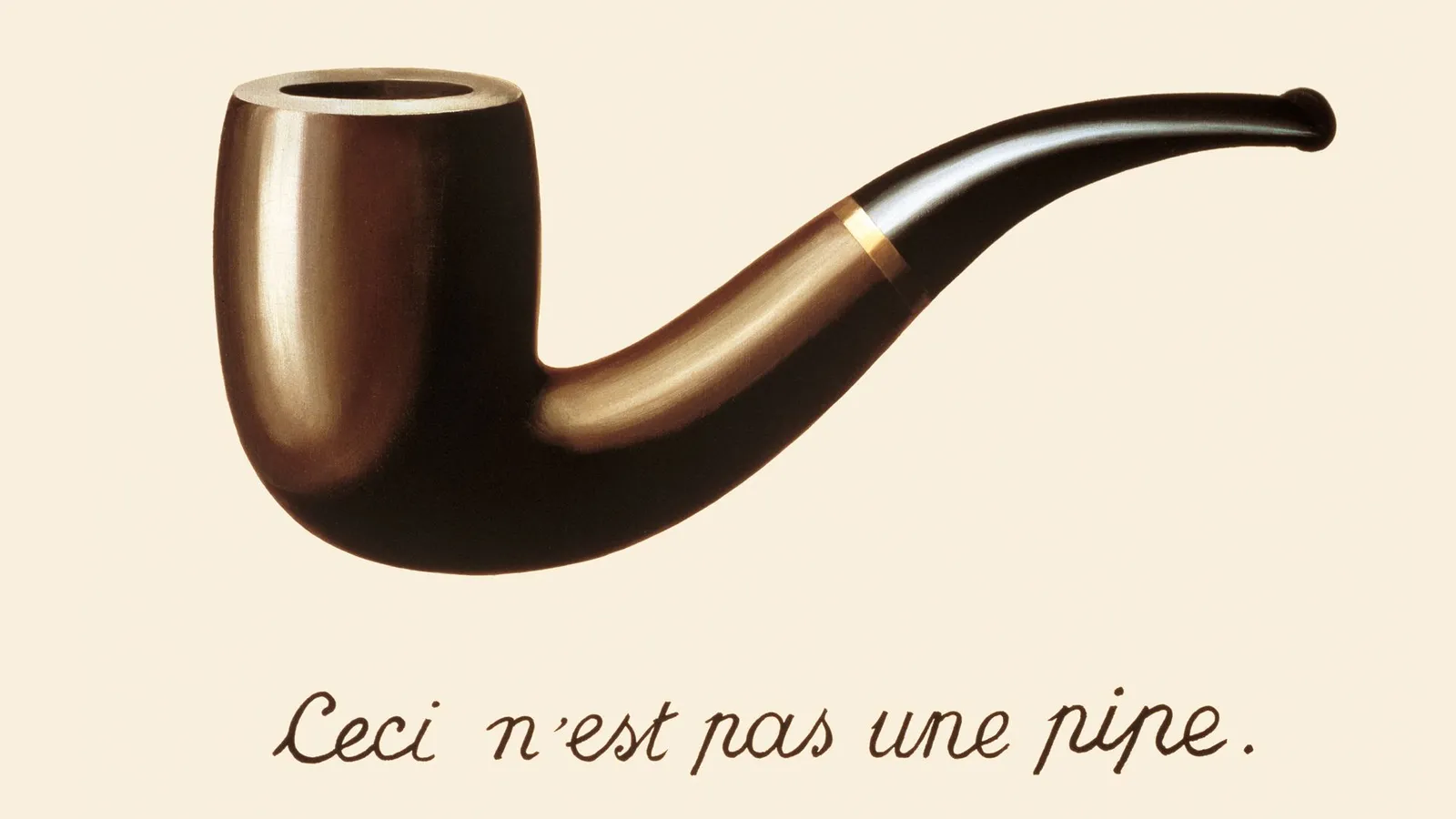
But a tree is not built from parts. It’s just a tree. We can articulate that a tree has a trunk and roots and branches and leaves and seeds and blooms, but it’s just a tree. The rest we impose on it with artificially constructed symbol language. This is what post-modern painter Rene Magritte was communicating with the “Ceci n’est pas une pipe” inscription in his work The Treachery of Images—This is not a pipe. He was not being cute or edgy or trying to be clever. He was making the point that the symbol is not the object.

In the manner that the image is not the pipe, it’s been said that to document a system is to make an inferior copy. The documented system is less optimal. This may feel counterintuitive. In fact, you may even argue that a documented system allows subsequent process participants to plug into the system to allow it to continue to operate into perpetuity. Whilst this is true, it comes at a cost. I’ll leave this here for you to ponder. The right hemisphere understands the difference. The document is not the process.

Getting Down to Business

If you’ve been following along, you may have already noticed that the left hemisphere looks and sounds a lot like the business world. Everything is systematised, structured, and ordered. We have all sorts of symbols and jargon, processes, and procedures. Everything is literal. There is no room for metaphor. There is no room for empathy. HR instructs that there be empathy, but they might as well instruct everyone to speak Basque or Hopi. In fact, it’s worse because at least Basque and Hopi can be learnt.

Sadly, this leftward shift isn’t limited to the world of commerce. It’s affected science, politics, and entire cultures. It’s caused these entities to abandon all that isn’t rational as irrational. But empathy and intuition are irrational. Science says if you can’t measure it and reproduce it, it’s not worth noting, but science is not the arbiter of the non-scientific realm. Business takes a similar position.

Politics of the Left (Hemisphere)

And politics creates categories: left and right, red and blue, black and white, men and women, gay and straight, and this and that. All of this is all left-hemisphere debate.

Categories and names are exclusive provinces of the left hemisphere. If you are hung up on an ideology, whether Democracy, Republicanism, Marxism, or Anarchism, you’re stuck in your left hemisphere. If you defend your positions with logic and words, you’re stuck in your left hemisphere. If you can’t imagine an alternative, you are really stuck in the left. I’ll stop here.

Science and Scientism

How did we get here and come to this? Science was receptive to right hemisphere influence up until about the 1970s. That’s where Scientism began to take hold. Scientism is when faith in science becomes a religion. I feel that many scientists today are less likely to hold a belief in Scientism as a religious belief. Paradoxically, I think this is more apt to be a faith held by non-scientists. Unfortunately, this faith is exploited by politics as exemplified by the recent trust in science campaign perpetrated by politicians, which is to say non-scientists with their own agenda, whether they practised Scientism or not.

The problem is that the left hemisphere has an outsized ego. It thinks it’s always right. In practice, it’s right about half the time. Because of its reliance on stored data and a ‘belief’ that it doesn’t need to fresh its data until it’s effectively overwhelmed and acquiesced. It fails to give enough weight to the experienced world, so that it shifts belief further and further left, which is to say further from reality as it is.

It trusts the symbol of the tree more than the tree itself. We may all be familiar with stories of cars driving down train tracks and off cliffs because the SAT-NAV user put more faith in their device than the world outside. This is the risk companies face as well, choosing to believe that the documented process is superior to the system in and of itself.

Getting on About?

You may be wondering what inspired me to write this and where I get my information. My realisation started in chapter 9 of The Matter with Things and was reinforced by this video interview by its author, Iain McGilchrist.

Actually, it started even before this with The Corporation, a Canadian documentary and companion book released in 2003. One of the points of The Corporation is to articulate the parallels between corporate behaviour relative to the definition of psychopathy as presented in The Diagnostic and Statistical Manual of Mental Disorders, henceforth DSM. Per Wikipedia, the DSM ‘is a publication by the American Psychiatric Association for the classification of mental disorders using a common language and standard criteria and is the main book for the diagnosis and treatment of mental disorders in the United States and is considered one of the “Bibles” of psychiatry’. Essentially, corporations ticked all the boxes.

Methodologically, this assertion is a bit weak, but it is at least sometimes entirely valid despite provoking an emotional trigger reaction. Nonetheless, this established corporations as pathological entities. But that is not my focus here. It simply tilled the soil for me to be more receptive to this topic. This topic is less about the legal fiction that is a corporation and more about the people embodied in it. From the height of the C-suite to the workaday staff, floor workers, warehouse workers, and the mailroom. Do they still have mailrooms? I digress.

I can’t claim to know what it is to be schizophrenic or schizoaffective, but I’ve known enough people who have these diagnoses. My brother was one of those. Although I use these and other labels, I am not a fan of labels, generally, especially psychological labels, specifically this label. Autism is another nonsensical label. Both fall into the realm of medical syndromes, which for the uninitiated is the equivalent of your kitchen junk drawer. It’s equivalent to the other choice when all others fail. I don’t want to go off on a tangent from the start, so I’ll leave it that these categories are overly broad and reflect intellectual laziness. There is no single schizophrenia or autism. There are many, but the distinction is lost in the category. The push to create an autism spectrum for DSM obscures the problem, but it helps for insurance purposes. As the saying goes, follow the money and you can gain clues to the driving force behind why this happened. I suppose you can also label me a conspiracy theorist. If I learned one thing in my undergrad Sociology classes, it’s to eschew labels.

Almost finished

Given the length of this segment, I am not going to summarise it here, save to say that this leftward shift in business and culture doesn’t have a good outlook. We are not only being replaced by machines, but we are also forced into becoming machines, and we aren’t even questioning it. All we need to do is to become more analytic, right?

What I suggest is to watch the six-minute video of Dr Iain McGilchrist discussing this topic, and if you really want a deep dive, read The Matter with Things, an almost three-thousand-page tome, to fill in the details.

Postscript

Here’s a music analogy to help to express why the whole is more important than the sum of the parts. If I want to learn to play a new piece, I will listen to the piece first. Depending on the length and genre, I may have to listen many times. In some cases, once or twice is enough, but let’s say this is at least somewhat complex and not some repetitive three-chord pop song. I’ll probably break the song into pieces or movements—verse, chorus, bridge, and whatever—, and then, I’ll learn each note and each pattern of notes, perhaps as musical phrases. Once I figure out the verse, I might either learn how the next verse differs or move on to the chorus and defer that verse-to-verse step. I’ll rinse and repeat until I’ve got through each of the sections. If I’ve had the luxury of hearing the piece, I’m at an advantage as far as tone, timbre, and dynamics are concerned; otherwise, I’d better hope these are all documented and that I interpret them in the manner they were intended. If the audience is familiar with a tune, they’ll notice the difference.

When I am practising, I need to get the mechanics down pat. All of what I’ve described thus far is left-hemisphere fare. It’s translating the symbolic representation of notes—like letters and words in writing—into an utterance. In this case, it’s a musical utterance. But once I am ready to perform the piece, it needs to be performed through the right hemisphere or it will feel mechanical and stilted.

I used to earn my living as an audio recording engineer and producer. Most of the time I was working with unknown artists recording demo records and trying to get a record deal. For the uninitiated, that usually translated into not having a large recording budget. Occasionally, we want, say string parts—violins, viola, cello, or whatever—but we couldn’t afford union players. We’d hire music students from USC or UCLA. These players would be more than willing to play for cheap in exchange for something to add to their portfolios or experience chops.

Somebody would transcribe the musical notation, and we’d give it to the string player. Of course, it could be a keyboard or wind or reed part, but I’ll stick to strings. Part of music is the vibe. This is something that can’t be captured in symbols. Revisiting Scientism and the left-hemisphere analogy, vibes can’t be real because they can’t be notated.

Almost invariably, if we got someone with Classical training, they could not get the vibe. The music was right in front of them. We’d play it for them on piano, maybe on a synthesiser, but they couldn’t get it—even if they were playing along to a reference track just trying to double the synth part. They would hit every note for the specified duration and dynamic, but it might have as well been the equivalence of a player piano or music box.  We could have played it on a synthesiser, but we might be seeking the nuance a real instrument would bring.

We never had the luxury of auditioning players or recording several players and grabbing the best parts. That’s for the bigger-budget artists who go through a half-dozen or more performers to get just the right one. When we got lucky, it was usually because we got someone from the jazz program. These cats seem to have a natural feel for vibe inaccessible to the classical performers.

In business, the classical performer is good enough, but for art, it wasn’t. Business might appreciate the difference if it happens to get it, but it won’t seek it, and it won’t pay for it. A pet peeve of mine is a quip in business I heard often—don’t let perfection be the enemy of the good. This is obviously a left-hemisphere sentiment based on Voltaire’s statement. Besides, even from a left hemisphere perspective, reciting, “Don’t let perfection be the enemy of the good” doesn’t mean you shouldn’t at least strive for good enough because I noticed that mark was missed often enough, too.

The Matter with Things: Part 1 Chapter Orientation

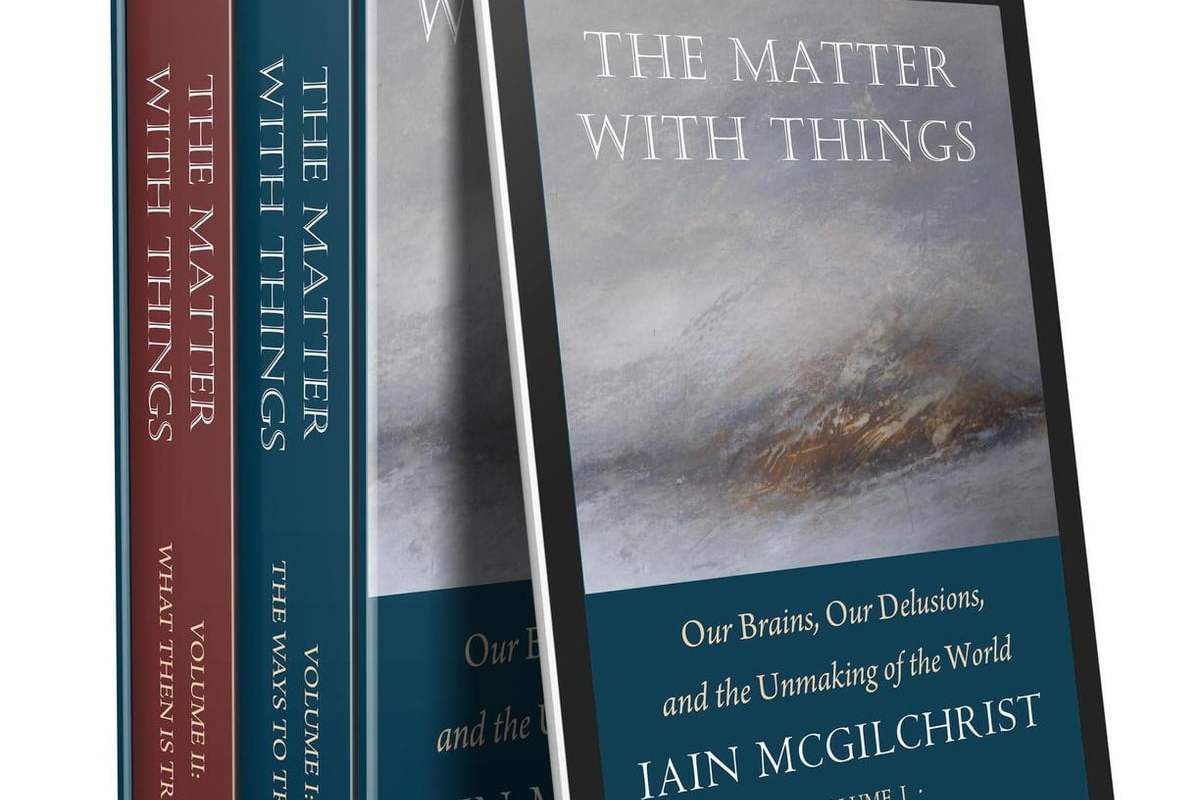
I can’t recommend Iain McGilchrist’s book, The Matter with Things, highly enough. I recommend reading The Master and His Emissary first. I didn’t figure this out until I started reading The Matter with Things, so I am reading them in parallel.

The book arrives as two volumes split into three sections. Part one is the foundation the rest of the book builds on. I’ve recently finished it and summarised each chapter, but I feel a high-level chapter orientation would be in order. Part one contains nine chapters:

  1. Some preliminaries: how we got here
  2. Attention
  3. Perception
  4. Judgment
  5. Apprehension
  6. Emotional and social intelligence
  7. Cognitive intelligence
  8. Creativity
  9. What schizophrenia and autism can tell us

Here’s the breakdown:

Some preliminaries: How we got here

As this book is a follow-up to The Master and His Emissary, published in 2008, Iain has already laid much of the foundation for it. Moreover, he doesn’t assume that you’ve already read The Master and His Emissary, and the work leading up to it, so this is what he outlines here as he drops hints of what’s to come in the chapters ahead.

Attention

This chapter reminds us that we cannot perceive what we don’t attend to, to pay attention to. The world outside just is, and we can attend to this or to that. From there, our perception will develop, perhaps, in turn, drawing out attention elsewhere.

As is a thread throughout, Iain uses various mental illnesses and split cerebral hemispheres to make his points. In this case, he tells us how neuro-atypical people have attention challenges, whether attending to the ‘wrong’ or otherwise inappropriate things or attending to too many things at once, flittering from this to that to the next thing without pause or resolution.

Perception

This chapter articulates how we perceive after attention has been focused. Perception is based on prior experience and knowledge combines with new sensory inputs.

Following the trend of people with hemisphere disturbances, Iain reminds us that people coming from different experiential places will perceive the same scenario differently. And if they are attending to the ‘wrong’ stimulus, their perception may be limited to that context, even if that micro-focused scope is otherwise correct.

Judgment

For some reason, Iain uses the American English spelling of Judgment, which in this case happens to be my preferred rendition, though my spell-checker disagrees.

In this chapter, we move from attention and perception to now being able to make judgements in this space. Of course, if we’ve attended to the ‘wrong’ thing leading to a variant perception, our judgment may be similarly out of order. Following the American trend, let’s say I am watching a baseball match, and the umpire calls a ball thrown out of the strike zone as a strike. If instead, my attention was distracted to another person in the stands picking his nose, my perception of the strike situation would be peripheral at best, and I would be in no place to make a judgment—about the pitch in any case. I may likely have plenty of judgment about the nose-picker.

In a nutshell, judgment is a left hemisphere function. The right hemisphere simply doesn’t care to judge. It’s a dispassionate observer taking in all without even categorising, let alone judging.

Apprehension

In this chapter, Iain explains that he is employing the term apprehension classically to mean to grasp or hold onto. This is a left hemisphere function as well. The right hemisphere is not grasping. Deficits in the right hemisphere don’t allow one to view the world in context as a whole. The left hemisphere will just see things are disconnected parts, so whilst we might grasp and apprehend, our comprehension is deficient. Without a robust big picture, we may just grasp at things indiscriminately.

Emotional and social intelligence

This chapter and the next are about intelligences. As the name suggests, this chapter is concerned with emotional and social intelligence. For me, I think of the Raymond character in Rain Man, itself the result of a misperception of the name Raymond for the phrase ‘Rain Man”. Raymond is devoid of emotional and social intelligence. He is limited to mechanistic cognitive intelligence and is a fine example of what one looks like without the other.

This chapter reminds us that the right hemisphere not only constructs our sense of self, but it also facilitates the construction of other selves, which allows us to empathise with others. It also allows us to assess intent. It allows us to see the value of the whole of society. Of which we are parts rather than thinking that we are simply parts that make up the whole. This is an important distinction. This is what happens with the ego of the left hemisphere denies the Gestalt of the right.

Cognitive intelligence

This second chapter on intelligence focuses on the cognitive variety. It’s what we think of when we consider IQ scores and such. It’s the reasoning part of the brain. It’s about rote learning and reciting trivia and perceived facts as re-presented by the left hemisphere.

Creativity

In this chapter on creativity, we are told that this is a right hemisphere function. To be creative, the best advice to keep the left hemisphere from engaging and interrupting. Creativity comes to us holistically. It is not the result of a process. It is an absence of process. Thinking and analysis are the antitheses of creativity. This is a case where less definitely is more.

What schizophrenia and autism can tell us

Each of the chapters touches on aspects of schizophrenia and other mental illnesses and situations where the hemispheres get disconnected or out of whack. In this chapter, Iain drives the point home with a focus on these cases and what it can tell us about these neuro-atypical conditions.  

People assume that schizophrenics and autism spectrum people are irrational, but this is precisely incorrect. In fact, it’s the opposite. These people are hyper-rational at the expense of empathy and social intelligence. It’s not a surprise that we are seeing more schizophrenics these days. Neither is it a surprise that we see a modern society that more and more resembles schizophrenia. But I digress.

Summary

This was only meant to give a high-level vantage to connect the chapters of part one of The Matter with Things. I give more comprehensive summaries on my blog. This will give you more of an idea, but my recommendation is to read the book itself as well as The Master and His Emissary which I recommend reading first. Don’t be like me.