A Critique of Reason (Not to Be Confused with Kant’s)

2–3 minutes

Kant, bless him, thought he was staging the trial of Reason itself, putting the judge in the dock and asking whether the court had jurisdiction. It was a noble spectacle, high theatre of self-scrutiny. But the trick was always rigged. The presiding judge, the prosecution, the jury, the accused, all wore the same powdered wig. Unsurprisingly, Reason acquitted itself.

The Enlightenment’s central syllogism was never more than a parlour trick:

  • P1: The best path is Reason.
  • P2: I practice Reason.
  • C: Therefore, Reason is best.

It’s the self-licking ice-cream cone of intellectual history. And if you dare to object, the trap springs shut: what, you hate Reason? Then you must be irrational. Inquisitors once demanded heretics prove they weren’t in league with Satan; the modern equivalent is being told you’re “anti-science.” The categories defend themselves by anathematising doubt.

The problem is twofold:

First, Reason never guaranteed agreement. Two thinkers can pore over the same “facts” and emerge with opposite verdicts, each sincerely convinced that Reason has anointed their side. In a power-laden society, it is always the stronger voice that gets to declare its reasoning the reasoning. As Dan Hind acidly observed, Reason is often nothing more than a marketing label the powerful slap on their interests.

Second, and this is the darker point, Reason itself is metaphysical, a ghost in a powdered wig. To call something “rational” is already to invoke an invisible authority, as if Truth had a clerical seal. Alasdair MacIntyre was right: strip away the old rituals and you’re left with fragments, not foundations.

Other witnesses have tried to say as much. Horkheimer and Adorno reminded us that Enlightenment rationality curdles into myth the moment it tries to dominate the world. Nietzsche laughed until his throat bled at the pretence of universal reason, then promptly built his own metaphysics of will. Bruno Latour, in We Have Never Been Modern, dared to expose Science as what it actually is – a messy network of institutions, instruments, and politics masquerading as purity. The backlash was so swift and sanctimonious that he later called it his “worst” book, a public recantation that reads more like forced penance than revelation. Even those who glimpsed the scaffolding had to return to the pews.

So when we talk about “Reason” as the bedrock of Modernity, let’s admit the joke. The bedrock was always mist. The house we built upon it is held up by ritual, inertia, and vested interest, not granite clarity. Enlightenment sold us the fantasy of a universal judge, when what we got was a self-justifying oracle. Reason is not the judge in the courtroom. Reason is the courtroom itself, and the courtroom is a carnival tent – all mirrors, no floor.

Modernity: The Phase That Never Was

6–8 minutes

We’re told we live in the Enlightenment, that Reason™ sits on the throne and superstition has been banished to the attic. Yet when I disguised a little survey as “metamodern,” almost none came out as fully Enlightened. Three managed to shed every trace of the premodern ghost, one Dutch wanderer bypassed Modernity entirely, and not a single soul emerged free of postmodern suspicion. So much for humanity’s great rational awakening. Perhaps Modernity wasn’t a phase we passed through at all, but a mirage we still genuflect before, a lifestyle brand draped over a naked emperor.

Audio: NotebookLM podcast on this topic

The Enlightenment as Marketing Campaign

The Enlightenment is sold to us as civilisation’s great coming-of-age: the dawn when the fog of superstition lifted and Reason took the throne. Kant framed it as “man’s emergence from his self-incurred immaturity” – an Enlightenment bumper sticker that academics still like to polish and reapply. But Kant wasn’t writing for peasants hauling mud or women without the vote; he was writing for his own coterie of powdered-wig mandarins, men convinced their own habits of rational debate were humanity’s new universal destiny.

Modernity, in this story, isn’t a historical stage we all inhabited. It’s an advertising campaign: Reason™ as lifestyle brand, equality as tagline, “progress” as the logo on the tote bag. Modernity, in the textbooks, is billed as a historical epoch, a kind of secular Pentecost in which the lights came on and we all finally started thinking for ourselves. In practice, it was more of a boutique fantasy, a handful of gentlemen mistaking their own rarefied intellectual posture for humanity’s destiny.

The Archetype That Nobody Lives In

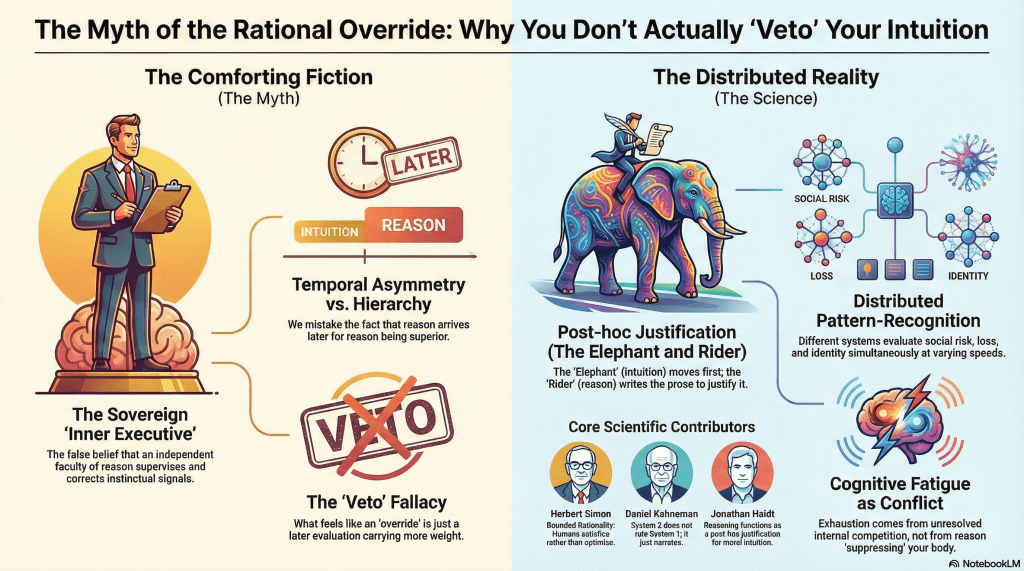
At the core of the Enlightenment lies the archetype of Man™: rational, autonomous, unencumbered by superstition, guided by evidence, weighing pros and cons with the detachment of a celestial accountant. Economics repackaged him as homo economicus, forever optimising his utility function as if he were a spreadsheet in breeches.

But like all archetypes, this figure is a mirage. Our survey data, even when baited as a “metamodern survey”, never produced a “pure” Enlightenment subject.

  • 3 scored 0% Premodern (managing, perhaps, to kick the gods and ghosts to the kerb).
  • 1 scored 0% Modern (the Dutch outlier: 17% Premodern, 0% Modern, 83% Post, skipping the Enlightenment altogether, apparently by bike).
  • 0 scored 0% Postmodern. Every single participant carried at least some residue of suspicion, irony, or relativism.

The averages themselves were telling: roughly 18% Premodern, 45% Modern, 37% Postmodern. That’s not an age of Reason. That’s a muddle, a cocktail of priestly deference, rationalist daydreams, and ironic doubt.

Even the Greats Needed Their Crutches

If the masses never lived as Enlightenment subjects, what about the luminaries? Did they achieve the ideal? Hardly.

  • Descartes, desperate to secure the cogito, called in God as guarantor, dragging medieval metaphysics back on stage.
  • Kant built a cathedral of reason only to leave its foundations propped up by noumena: an unseeable, unknowable beyond.
  • Nietzsche, supposed undertaker of gods, smuggled in his own metaphysics of will to power and eternal recurrence.
  • William James, surveying the wreckage, declared that “truth” is simply “what works”, a sort of intellectual aspirin for the Enlightenment headache.

And economists, in a fit of professional humiliation, pared the rational subject down to a corpse on life support. Homo economicus became a creature who — at the very least, surely — wouldn’t choose to make himself worse off. But behavioural economics proved even that meagre hope to be a fantasy. People burn their wages on scratch tickets, sign up for exploitative loans, and vote themselves into oblivion because a meme told them to.

If even the “best specimens” never fully embodied the rational archetype, expecting Joe Everyman, who statistically struggles to parse a sixth-grade text and hasn’t cracked a book since puberty, to suddenly blossom into a mini-Kant is wishful thinking of the highest order.

The Dual Inertia

The real story isn’t progress through epochs; it’s the simultaneous drag of two kinds of inertia:

  • Premodern inertia: we still cling to sacred myths, national totems, and moral certainties.
  • Modern inertia: we still pretend the rational subject exists, because democracy, capitalism, and bureaucracy require him to.

The result isn’t a new epoch. It’s a cultural chimaera: half-superstitious, half-rationalist, shot through with irony. A mess, not a phase..

Arrow’s Mathematical Guillotine

Even if the Enlightenment dream of a rational demos were real, Kenneth Arrow proved it was doomed. His Impossibility Theorem shows that no voting system can turn individual rational preferences into a coherent “general will.” In other words, even a parliament of perfect Kants would deadlock when voting on dinner. The rational utopia is mathematically impossible.

So when we are told that democracy channels Reason, we should hear it as a polite modern incantation, no sturdier than a priest blessing crops.

Equality and the Emperor’s Wardrobe

The refrain comes like a hymn: “All men are created equal.” But the history is less inspiring. “Men” once meant property-owning Europeans; later it was generously expanded to mean all adult citizens who’d managed to stay alive until eighteen. Pass that biological milestone, and voilà — you are now certified Rational, qualified to determine the fate of nations.

And when you dare to question this threadbare arrangement, the chorus rises: “If you don’t like democracy, capitalism, or private property, just leave.” As if you could step outside the world like a theatre where the play displeases you. Heidegger’s Geworfenheit makes the joke bitter: we are thrown into this world without choice, and then instructed to exit if we find the wallpaper distasteful. Leave? To where, precisely? The void? Mars?

The Pre-Modern lord said: Obey, or be exiled. The Modern democrat says: Vote, or leave. And the Post-Enlightenment sceptic mutters: Leave? To where, exactly? Gravity? History? The species? There is no “outside” to exit into. The system is not a hotel; it’s the weather.

Here the ghost of Baudrillard hovers in the wings, pointing out that we are no longer defending Reason, but the simulacrum of Reason. The Emperor’s New Clothes parable once mocked cowardice: everyone saw the nudity but stayed silent. Our situation is worse. We don’t even see that the Emperor is naked. We genuinely believe in the fineries, the Democracy™, the Rational Man™, the sacred textile of Progress. And those who point out the obvious are ridiculed: How dare you mock such fineries, you cad!

Conclusion: The Comfort of a Ghost

So here we are, defending the ghost of a phase we never truly lived. We cling to Modernity as if it were a sturdy foundation, when in truth it was always an archetype – a phantom rational subject, a Platonic ideal projected onto a species of apes with smartphones. We mistook it for bedrock, built our institutions upon it, and now expend colossal energy propping up the papier-mâché ruins. The unfit defend it out of faith in their own “voice,” the elites defend it to preserve their privilege, and the rest of us muddle along pragmatically, dosing ourselves with Jamesian aspirin and pretending it’s progress.

Metamodernism, with its marketed oscillation between sincerity and irony, is less a “new stage” than a glossy rebranding of the same old admixture: a bit of myth, a bit of reason, a dash of scepticism. And pragmatism –James’s weary “truth is what works” – is the hangover cure that keeps us muddling through.

Modernity promised emancipation from immaturity. What we got was a new set of chains: reason as dogma, democracy as ritual, capitalism as destiny. And when we protest, the system replies with its favourite Enlightenment lullaby: If you don’t like it, just leave.

But you can’t leave. You were thrown here. What we call “Enlightenment” is not a stage in history but a zombie-simulation of an ideal that never drew breath. And yet, like villagers in Andersen’s tale, we not only guard the Emperor’s empty wardrobe – we see the garments as real. The Enlightenment subject is not naked. He is spectral, and we are the ones haunting him.

HR’s Neoliberal Mirage: Human Resources Without the Humans

Let us disabuse ourselves of one of the workplace’s most cherished delusions: that Human Resources is there for the humans. HR is not your therapist, not your advocate, not your confessor. HR is an appendage of the organisation, and like all appendages, its nerve endings run straight back to the corporate brain. Its “concern” for your well-being is merely a prophylactic against lawsuits and productivity dips. The error is ours; we persist in mistaking the guard dog for a pet.

Audio: NotebookLM podcast on this topic.

Bal and Dóci’s 2018 paper in the European Journal of Work and Organizational Psychology (EJWOP) tears the mask off this charade. They demonstrate how neoliberal ideology has seeped, unseen, into both workplace practice and the very research that pretends to study it objectively. Through the lenses of political, social, and fantasmatic logics, they show that neoliberalism has convinced us of three dangerous fairy tales:

  • Instrumentality: people are not people but “resources,” as fungible as printer ink.
  • Individualism: you are not part of a collective but a lone entrepreneur of the self, shackled to your CV like a Victorian debtor.
  • Competition: you are locked in an endless cage fight with your colleagues, grinning through the blood as you “collaborate.”

These logics are then dressed up in fantasies to keep us compliant: the fantasy of freedom (“you’re free to negotiate your own zero-hours contract”), the fantasy of meritocracy (“you got that promotion because you’re brilliant, not because you went to the right school”), and the fantasy of progress (“growth is good, even if it kills you”).

Those of us with an interest in Behavioural Economics had naively hoped that the mythical homo economicus, that laughable caricature of a rational, utility-maximising automaton, would by now be filed under “anachronistic curiosities.” Yet in corporate domains, this zombie shuffles on, cosseted and cultivated by neoliberal ideology. Far from being discredited, homo economicus remains a protected species, as if the boardroom were some Jurassic Park of bad economics.

The brilliance and the horror is that even the academics meant to be studying work and organisations have been captured by the same ideology. Work and Organisational Psychology (WOP) too often frames employees as variables in a productivity equation, measuring “engagement” only in terms of its effect on shareholder value. The worker’s humanity is rendered invisible; the employee exists only insofar as they generate output.

So when HR offers you a mindfulness app or a “resilience workshop,” remember: these are not gifts but obligations. There are ways of making you responsible for surviving a system designed to grind you down. The neoliberal trick is to convince you that your suffering is your own fault, that if only you had been more proactive, more adaptable, more “employable,” you wouldn’t be so crushed beneath the wheel.

Bal and DĂłci are right: the way forward is to re-politicise and re-humanise organisational studies, to see workers as humans rather than performance units. But until then, expect HR to keep smiling while sharpening its knives.