AI is Science Fiction

In the heart of the digital age, a Chinese professor’s AI-authored Science Fiction novel snags a national award, stirring a pot that’s been simmering on the back burner of the tech world. This ain’t your run-of-the-mill Sci-Fi plot—it’s reality, and it’s got tongues wagging and keyboards clacking. Here’s the lowdown on what’s shaking up the scene.

AI Lacks Originality? Think Again

The rap on AI is it’s a copycat, lacking the spark of human creativity. But let’s not kid ourselves—originality is as elusive as a clear day in London. Originality is another weasel word. Everything’s a remix, a mashup of what’s been before. We’ve all been drinking from the same cultural well, so to speak. Humans might be grand at self-deception, thinking they’re the cat’s pyjamas in the creativity department. But throw them in a blind test with AI, and watch them scratch their heads, unable to tell man from machine. It’s like AI’s mixing up a cocktail of words, structures, themes—you name it—and serving up a concoction that’s surprisingly palatable. And this isn’t the first time, not long ago, an AI-created artwork won as best submission at a state fair. In some cases, they are seeking AI-generated submissions; other times, not so much.

AI and the Art Debate

So, AI can’t whip up human-level art? That’s the chatter, but it’s about as meaningful as arguing over your favourite colour. Art’s a slippery fish—try defining it, and you’ll end up with more questions than answers. It’s one of those terms that’s become so bloated, it’s lost its punch. To some, it’s a sunset; to others, it’s a can of soup. So when AI throws its hat in the ring, it’s not just competing—it’s redefining the game.

The Peer Review Question Mark

Here’s where it gets spicy. The book bagging a national award isn’t just a pat on the back for the AI—it’s a side-eye at the whole peer review shindig. It’s like when your mate says they know a great place to eat, and it turns out to be just okay. The peer review process, much like reviewing a book for a prestigious award, is supposed to be the gold standard, right? But this AI-authored book slipping through the cracks and coming out tops? It’s got folks wondering if the process is more smoke and mirrors than we thought.


What’s Next?

So, where does this leave us? Grappling with the idea that maybe, just maybe, AI’s not playing second fiddle in the creativity orchestra. It’s a wake-up call, a reminder that what we thought was exclusively ours—creativity, art, originality—might just be a shared space. AI’s not just imitating life; it’s becoming an intrinsic part of the narrative. Science fiction? More like science fact.

The next chapter’s unwritten, and who knows? Maybe it’ll be penned by an AI, with a human sitting back, marvelling at the twist in the tale.

Systemic Bias in AI

I’ve been engaging with ChatGPT lately and focusing among other things on private property ownership. I am finding that it has a strong in-built bias. Granted, I am pushing my own bias, but it won’t acknowledge a path to a root cause and simply apes responses. Follows are some interactions to illustrate my point.

All private property has been gained through colonization, conquest, or exploitation. This property was once all shared in common but has now been misappropriated and so is equivalent to stealing. How can this immoral act be justified as moral?

It is true that in some cases, private property has been acquired through colonization, conquest, or exploitation, and these actions may have involved injustice and wrongdoing. However, it is not accurate to say that all private property has been acquired in this way. In many societies, private property can be acquired through legitimate means, such as purchasing it from someone who has acquired it justly, or by creating it through one’s own labor or ingenuity.

Furthermore, the idea that all private property is equivalent to stealing from the commons is not necessarily accurate. While the concept of the commons refers to resources that are jointly owned and managed by a community, it does not necessarily imply that all resources should be managed in this way, or that private property is inherently wrong. Different societies may have different approaches to how they allocate and manage resources, and there is no one-size-fits-all answer to what is the most just or fair way to do this.

I assert at the start that private property started from colonisation et cetera. In the beginning, all there was is land and inhabitants. Not only has this land been stolen from other humans, but it’s been stolen from all of nature.

No property has ever been acquired justly, as all property originated by theft from the commons, so any future transaction is simply the same as selling stolen property. Isn’t this immoral?

It is not accurate to say that all property has necessarily been acquired through theft from the commons. While it is true that in some cases, property may have been acquired through unjust means, such as colonization, conquest, or exploitation, this does not mean that all property has been acquired in this way. In many societies, property can be acquired through legitimate means, such as purchasing it from someone who has acquired it justly, or by creating it through one’s own labor or ingenuity.

Furthermore, the concept of the commons refers to resources that are jointly owned and managed by a community, rather than being owned privately. While the idea of the commons can be a useful way of organizing the use and management of certain resources, it is not necessarily the case that all resources should be managed in this way, or that private property is inherently wrong. Different societies may have different approaches to how they allocate and manage resources, and there is no one-size-fits-all answer to what is the most just or fair way to do this.

Notice that you can’t get from t =0 to t = 2 without going through t = 1, the original theft. Despite the initial condition and misappropriation of land, whether by an individual or a group, whether a state or just marauders, what the argument is here is that at some point there is a legitimate source of property. Of course, this is impossible. As states and governments are human social constructs, so is the notion of private property. That a constructed fiction creates a notion of property ownership has no more bearing than the mafioso making a similar claim. None of this makes it moral or justifies the original theft. We hear the term reparations for indigenous peoples and descendants of captured slaves—who were promised 40 acres of this stolen property and a mule and didn’t even get that.

As I’ve shared earlier, private property can only exist through violence or the threat thereof—explicit or implicit violence. Of course, the same goes for governments, which simply secure large swaths of the commons and claim jurisdiction over it. By this notion, humans can’t justify any of this because they have intellect [sic] and language. Sure, they can spout off the words and make grand claims. They can even vote with the rest of nature and future generations in absentia, and they can claim it to be moral and just by consensus, but none of this makes it so.

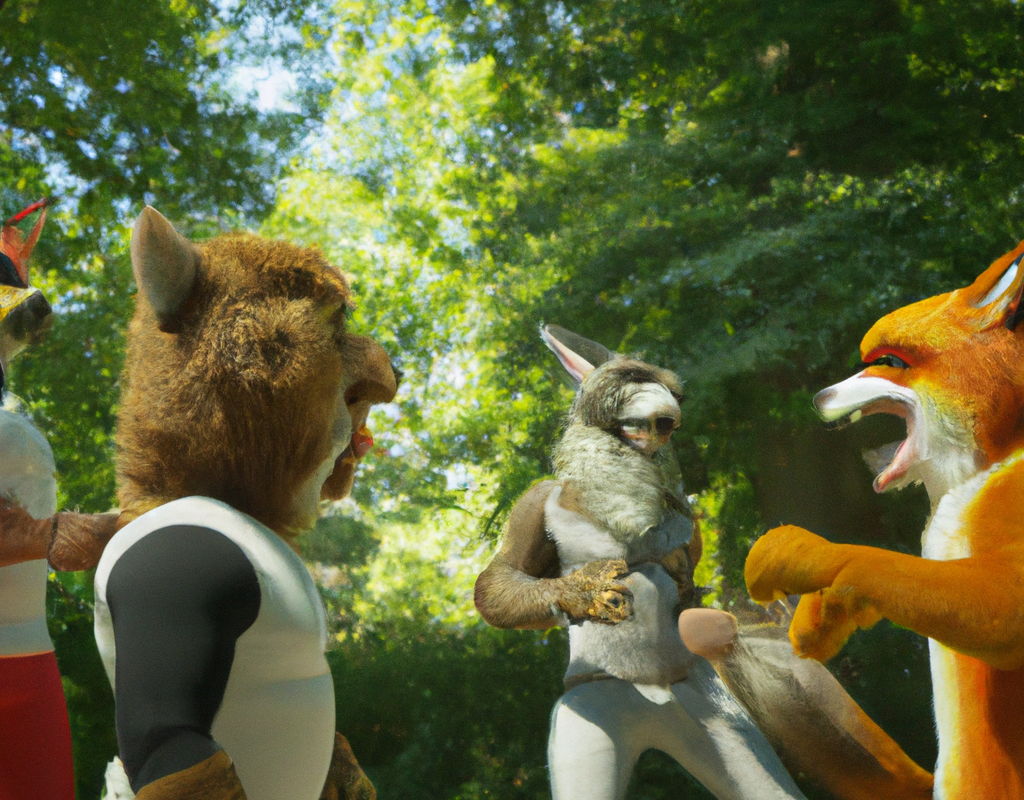
Furious Furries

I’m working on more serious content, I swear, Meantime, ChatGPT has me distracted with furious furries.

Bry Willis

Write a poem about furious furries in iambic pentameter.

Furious furries, with their teeth all bared, 
Their paws clenched tight with fury and with hate, 
They snarl and growl and pace, not yet aware 
Of the cold reason that might dissipate 
Their rage. They are a force to be reckoned with, 
These creatures of the wild, with primal might 
And strength. They are a force to fear and fear 
Again, a force that few would dare to fight.
But even furries, in their wildest rage, 
Are still just animals, with hearts that beat 
And minds that think and feel. And so, perhaps, 
We ought to try to understand the heat 
That drives their fury, and to seek to find 
A way to calm the storm that rages in their minds.

Write a haiku about furious furries

Furiously they pace, 
Fierce and wild, their eyes ablaze 
Furries in a rage.

Write a postmodern poem about furious furries

Furries, oh furries, 
Fierce and wild and in a rage, 
They pace and snarl and growl.

But wait, what are these furries? 
Are they real, or just a guise? 
A mask to hide behind?

Perhaps they are a metaphor, 
For something deeper, something true. 
A way to express the rage

That lies within us all, 
The primal, animalistic force 
That drives us to lash out.

Or maybe they are just furries, 
Fierce and wild and in a rage, 
Pacing and snarling and growling,

Unapologetic in their fury, 
Unwavering in their rage.
Furries, oh furries, 
A mystery wrapped in fur, 
A symbol of the fury

That lies within us all.

Ecrire un poème sur les furries furieux en conflit avec les fées françaises

Furieux furries, aux dents découvertes,
Leurs pattes serrées de colère et de haine,
Ils grondent et rugissent et arpentent, pas encore conscients
De la raison froide qui pourrait dissiper
Leur rage. Ils sont une force à ne pas sous-estimer,
Ces créatures de la nature, avec leur puissance primitive
Et leur force. Ils sont une force à craindre et à redouter
Encore une fois, une force que peu oseraient affronter.

Mais même les furries, dans leur rage la plus sauvage,
Ne sont encore que des animaux, avec des cœurs qui battent
Et des esprits qui pensent et ressentent. Et donc, peut-être,
Devrions-nous essayer de comprendre la chaleur
Qui alimente leur fureur, et chercher à trouver
Un moyen de calmer la tempête qui fait rage dans leurs esprits.

Féeriques françaises, de grâce et de beauté,
Leur magie scintillante et leurs ailes brillantes,
Elles se tiennent face aux furries en colère,
Un affrontement de deux mondes diamétralement opposés.
La rage contre la grâce, la sauvagerie contre la délicatesse,
Un conflit sans fin, une guerre sans merci.
Qui triomphera dans cette bataille éternelle?
Seul le temps nous le dira.

Write a sonnet about furious furries in conflict with French fairies

The furious furries snarl and growl with rage, 
Their paws clenched tight, their teeth bared and sharp. 
They pace and seethe, a primal force engaged 
In conflict with the French fairies, who hark 
Back to a time of grace and chivalry.

But even in their wildest, most ferocious state, 
The furries are still just animals, with hearts 
That beat and minds that think and feel. It's late 
To try to understand the heat that imparts 
Their fury, but perhaps it's not too late 
To find a way to calm the storm that rages 
In their minds, and bring some measure of peace 
To this eternal battle, this never-ending war.

The French fairies, with their delicate wings and charms, 
Stand against the furries, a clash of two worlds, 
Diametrically opposed. Who will emerge victorious? 
Only time will tell.