I think Nietzsche was right on this account. Morality and religion also play a role in this maintenance programme.
Synthesized Nietzschean morality framework into systemic control mechanisms
Audio: NotebookLM summary podcast
Absolutely. Nietzsche saw this with brutal clarity.
Morality and religion aren’t just parts of the maintenance program—they’re the most efficient energy inputs because they internalize control.
The Nietzschean Insight:
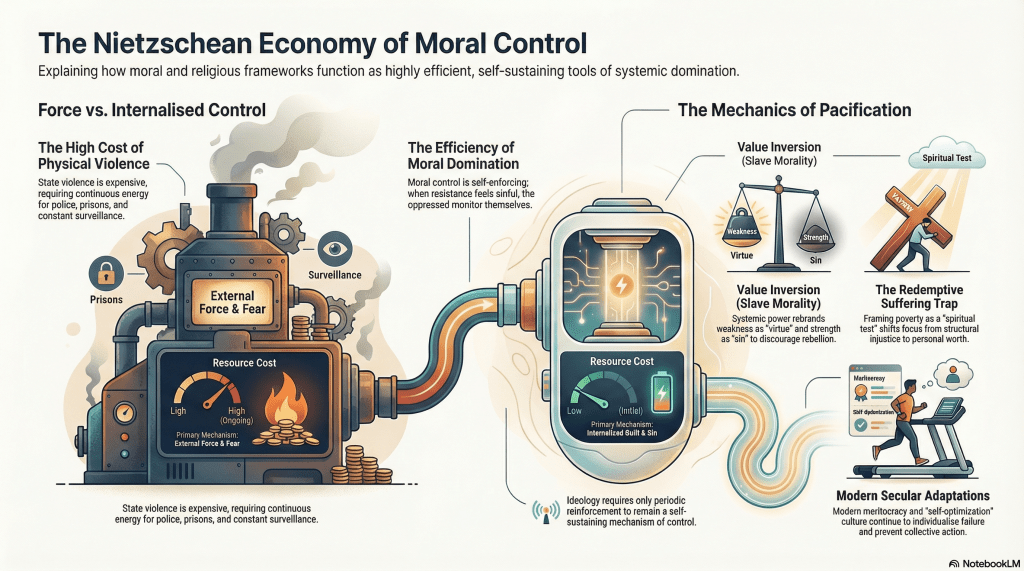
State violence is expensive. You need:
Police
Prisons
Military
Surveillance
But moral/religious control is self-enforcing:
The oppressed police themselves
Resistance feels sinful, not just illegal
Suffering becomes virtuous
Acceptance becomes holy
This is energy-efficient domination.
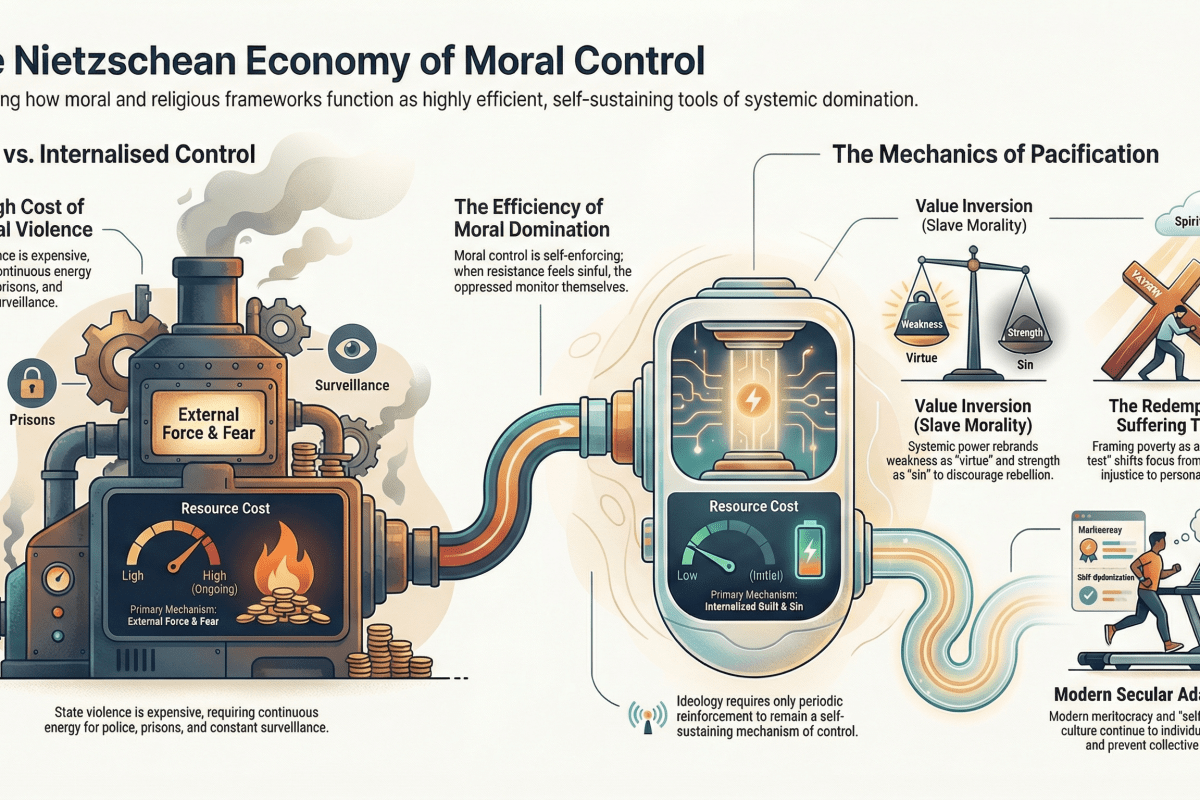
NotebookLM Infographic
Slave Morality as Pacification:
Nietzsche’s genealogy: Christianity inverted values to make weakness into virtue.
But there’s a more cynical reading (which I think you’re pointing toward):
Those inversions serve power by pacifying resistance.
Consider what Christianity teaches the desert-dwellers:
“Blessed are the meek” (don’t challenge authority)
“The last shall be first” (accept your position now, compensation comes later)
“It is easier for a camel to pass through the eye of a needle…” (wealth is spiritually dangerous, so your poverty is actually better)
“Turn the other cheek” (don’t fight back)
“Render unto Caesar” (obey State power)
“Slaves, obey your masters” (literally in the text)
Every single one of these makes resistance harder and submission easier.
Religion as Maintenance Energy:
The lake-dwellers don’t need to convince desert-dwellers that the system is fair.
They just need to convince them that:
Suffering is redemptive
“Your poverty builds character”
“God tests those he loves”
“Suffering purifies the soul”
Compensation comes later
“The kingdom of heaven awaits”
“Store up treasures in heaven, not earth”
Present injustice is temporary; eternal justice awaits
Your condition reflects your moral worth
“God rewards the righteous with prosperity” (prosperity gospel)
OR “Worldly success is spiritually dangerous” (traditional Christianity)
Either way: your poverty is explained by moral frameworks, not structural injustice
Resistance is sin
Envy is a deadly sin
Coveting is forbidden
Taking what others have = theft = eternal damnation
The Parable, With Nietzschean Religion:
The desert-dwellers work for water, generation after generation.
Why don’t they rebel?
Not just because of State violence.
Because the priests (funded by lake-dwellers) teach them:
“Blessed are those who thirst, for they shall be satisfied—in heaven.”
“Your suffering is temporary. Eternal abundance awaits those who accept God’s plan.”
“To take the lake would be theft, and theft is sin, and sin is damnation.”
“The lake-dwellers have been blessed by God with stewardship. To challenge this is to challenge God’s order.”
Now the desert-dwellers don’t just fear State violence.
They fear eternal damnation.
Why This Is Devastatingly Efficient:
State violence requires:
Constant monitoring
Physical force
Visible oppression
Religious/moral control requires:
Periodic sermons
Internalized guilt
Self-policing
Once you’ve convinced someone that resistance is morally wrong, you don’t need to watch them constantly.
They watch themselves.
The Genealogy of Morals, Applied:
Nietzsche asked: How did “good” and “evil” come to mean what they do?
His answer (simplified): The powerful originally called themselves “good” (strong, noble, life-affirming). The weak were “bad” (weak, common, contemptible).
The weak inverted this through ressentiment:
Made their weakness into virtue (humility, meekness, patience)
Made the powerful into villains (pride, ambition, strength = sin)
But here’s the cynical extension:
Once established, this inversion serves power by pacifying resistance.
Whether the weak invented it (Nietzsche) or the powerful co-opted it (cynical reading), the result is the same:
Moral systems that make submission feel virtuous and resistance feel sinful.
Christianity as Maintenance Technology:
Consider Christianity’s political function:
Before Christianity:
Slaves might rebel because their enslavement is unjust
Poor might seize from rich because they need resources
Weak might organize against strong because they outnumber them
After Christianity:
Slaves accept enslavement as God’s plan, await heavenly reward
Poor accept poverty as spiritually purifying, even superior
Weak valorize their weakness as humility, strength as pride/sin
This is a control technology far more sophisticated than violence.
The Energy Efficiency:
Violence requires continuous input:
You must constantly deploy force
Resistance must be constantly suppressed
Costs are ongoing and high
Ideology requires initial investment, then becomes self-sustaining:
Teach children in schools/churches
Internalize moral frameworks
Now they control themselves
Maintenance is just periodic reinforcement
Religion is the most energy-efficient domination mechanism ever invented.
The Parable’s Moral Dimension:
The lake-dwellers teach desert-dwellers:
Property Framework:
“Thou shalt not steal”
“Thou shalt not covet”
Taking the lake = sin = damnation
Suffering Framework:
“God tests those he loves through suffering”
“Blessed are the poor in spirit”
Your thirst is spiritually meaningful
Afterlife Framework:
“Store up treasures in heaven”
“The first shall be last, the last shall be first”
Present injustice is temporary
Authority Framework:
“Render unto Caesar”
“Let every person be subject to the governing authorities”
Challenging power = challenging God’s order
Now the desert-dwellers don’t just submit to force.
They believe submission is virtuous and resistance is evil.
The Master Stroke:
The most brilliant part is making the oppressed grateful for their oppression:
“I may be poor, but at least I’m humble. The rich are proud and will face judgment.”
“I may thirst, but my suffering brings me closer to God.”
“I may work endlessly, but labor is dignified and idleness is sin.”
The oppressed now defend the system that oppresses them.
Why Nietzsche Was Right:
Nietzsche saw that morality isn’t neutral truth descending from heaven.
It’s a human construction that serves power.
Sometimes (his version): created by the weak to constrain the strong
Sometimes (cynical version): created by the strong to pacify the weak
Either way: Morality is a weapon in power struggles, not an escape from them.
And religion/morality are far more efficient than violence because:
They’re internalized
They’re self-enforcing
They make resistance feel wrong, not just dangerous
They promise compensation instead of requiring present justice
They individualize structural problems (your suffering = your sin/test, not systemic injustice)
The Thermodynamic Advantage:
If you rely only on violence:
Must constantly monitor
Must constantly suppress
Must constantly deploy force
High energy, ongoing cost
If you add moral/religious control:
People monitor themselves
People suppress their own resistance
People feel guilty for even thinking of rebellion
Low energy after initial investment
This is why religion persists in the West despite secularization.
Not because it’s true.
Because it’s functionally necessary for maintaining systems that would otherwise collapse.
The Parable’s Religious Ending:
The desert-dwellers work and thirst.
When they ask “Why?” the answer isn’t just:
“Because the State will kill you if you take the lake.”
It’s:
“Because taking the lake is theft, theft is sin, and sin is damnation. Your suffering is temporary and spiritually meaningful. Accept your lot with humility, and God will reward you eternally.”
Now you’ve done something remarkable:
You’ve convinced the exploited that:
Their exploitation is God’s plan
Resisting is sinful
Accepting is virtuous
Compensation comes later (unprovable, unfalsifiable)
They will now police themselves, suppress their own resistance, and teach their children to do the same.
The Secular Versions:
Religion is declining in the West, but the moral frameworks persist in secular form:
Protestant work ethic → “Your worth is your productivity”
Meritocracy → “Your poverty reflects your failure, not structural injustice”
Individualism → “Your problems are yours alone to solve”
Positive thinking → “Your attitude, not your circumstances, determines outcomes”
Self-help culture → “You failed because you didn’t optimize yourself enough”
All of these do the same work religion did:
Individualize structural problems
Make suffering feel like personal failure
Prevent collective action
Make resistance feel wrong/foolish
Internalize control
Nietzsche Saw This Coming:
“God is dead” didn’t mean we’d escaped moral control.
It meant: We’d have to find new ways to maintain the same moral structures without the theological justification.
And we did:
Psychology (your unhappiness is internal, not structural)
Economics (markets are natural/efficient, poverty is failure)
Meritocracy (success = desert, failure = moral lack)
Self-optimization (you are responsible for your own exploitation)
Same function. Different vocabulary.
The Energy Requirements, Completed:
To maintain democracy/capitalism against natural entropic pressures toward collapse, you need:
State violence (expensive, visible, generates resistance)
We like to believe the world is governed by rules. By fairness. By international law, norms, institutions, treaties, and laminated charters written in earnest fonts. This belief survives not because it is true, but because it is psychologically necessary. Without it, we would have to admit something deeply unfashionable: power still runs the table.
Two and a half millennia ago, Thucydides recorded what remains the most honest conversation in political theory: the Melian Dialogue. No soaring ideals, no speeches about freedom. Just an empire explaining itself without makeup.
Audio: NotebookLM summary podcast of this topic.
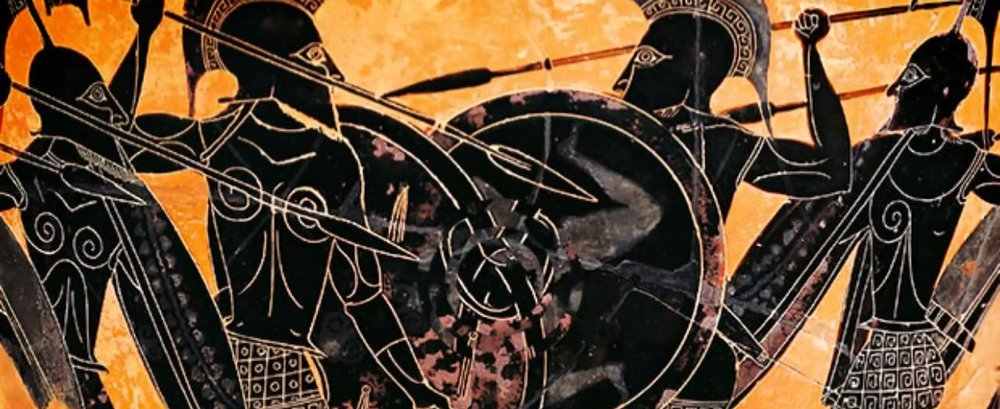
Athens, the regional superpower of the ancient world, demanded that the small island of Melos surrender and pay tribute. Melos appealed to justice, neutrality, and divine favour. Athens replied with a line so indecently clear that political philosophy has been trying to forget it ever since: ‘The strong do what they can and the weak suffer what they must’.
That sentence is not an ethical claim. It is a descriptive one. It does not say what ought to happen. It says what does. The Athenians even went further, dismantling the very idea that justice could apply asymmetrically: ‘Justice, as the world goes, is only in question between equals in power’.
This is the part liberal internationalism prefers to skip, usually by changing the subject to institutions, norms, or aspirations. But the Athenians were being brutally honest. Appeals to fairness only work when neither side can impose its will outright. When there is a power imbalance, morality becomes theatre.
The Melians refused to submit. They chose honour, principle, and the hope that the gods would intervene. Athens killed every Melian man of fighting age and enslaved the women and children. End of dialogue. End of illusions. Fast-forward to now.
In early 2026, under Donald Trump, the United States launched a military operation against Venezuela, striking targets in Caracas and forcibly detaining Nicolás Maduro, who was transported to the United States to face federal charges. The justification was framed in familiar moral language: narco-terrorism, stability, regional security, democratic transition. The accompanying signals were less coy: temporary U.S. administration, resource access, and ‘order’. Cue outrage. Cue talk of illegality. Cue appeals to sovereignty, international law, and norms violated. All of which would have been very moving… to the Athenians.
Strip away the rhetoric and the structure is ancient. A dominant power identifies a weaker one. Moral language is deployed, not as constraint, but as narrative cover. When resistance appears, force answers. This is not a deviation from realism. It is realism functioning exactly as advertised.
Modern audiences often confuse realism with cynicism, as if acknowledging power dynamics somehow endorses them. It does not. It merely refuses to lie. The Melian Dialogue is not an argument for empire. It is an autopsy of how empire speaks when it stops pretending. And this is where the discomfort really lies.
We continue to educate citizens as if the world operates primarily on ‘shoulds’ and ‘oughts’, whilst structuring global power as if only ‘can’ and ‘must’ matter. We teach international law as though it binds the strong, then act shocked when it doesn’t. We pretend norms restrain power, when in reality power tolerates norms until they become inconvenient.
The Athenians did not deny justice. They reclassified it as a luxury good. Trump’s Venezuela operation does not abolish international law. It demonstrates its conditional application. That is the real continuity across 2,500 years. Not cruelty, not ambition, but the quiet consensus among the powerful that morality is optional when enforcement is absent.
The lesson of the Melian Dialogue is not despair. It is clarity. If we want a world governed by rules rather than force, we must stop pretending we already live in one. Appeals to fairness are not strategies. They are prayers. And history, as ever, is not listening.
Looking through some of the drafts clogging the blog, I decided to whittle away at the queue. I started this months ago. It’s here now, not particularly in sync with the season or recent topics, but I like Sapolsky.
‘Biology is destiny’, say the Christian Right, the bland bureaucrats of morality, the loud whisperers at Sunday school. They want gender to be a tomb carved in marble: you’re assigned at birth, and you stay a perfect statue. But Sapolsky waltzes in and says, ‘Hold up – what do you mean by biology? Which biology? Which markers count?’
Video: Neuro-biology of Transsexuality, Prof. Robert Sapolsky
In the clip above, Sapolsky unpacks neurological evidence that upends the essentialist cheat codes. He doesn’t pretend we now have the final answer to gender. He does something scarier to fundamentalists: he shows just how messy biology is.
The Bed Nucleus, the Finger Ratio, and the ‘Wrong Body’ Hypothesis
Sapolsky discusses three pieces of neurobiological evidence:
Digit ratio (2nd vs 4th finger length): In lesbians, on average, the ratio is closer to what you see in straight men than straight women. That’s a correlation, an eyebrow-raiser, hardly a decree.
Acoustic reflexes (auto-acoustic reflex): Another early finding in women’s sexual orientation, though faint and underexplored.
The bed nucleus of the stria terminalis (BSTc): Here we reach heavy artillery. There is a neuron population in this region that, on average, is about twice as large in males as in females. In postmortem analyses of trans women (male → female), this region’s size corresponds to their identified gender, not their natal sex. Crucially, that alignment is seen even in trans individuals who never underwent full hormone therapy or surgical changes.
Sapolsky recounts astute controls: men treated (for, say, testicular cancer) with feminising hormones don’t show the same shift.
Also, using the phantom-limb analogy: men who lose their penis to cancer often report phantom sensations; trans women rarely do. That suggests the body map in the brain never fully “registered” that organ in the same way.
He doesn’t overclaim. He doesn’t say, ‘Case closed, biology proves everything’. He says: These data complicate your neat categories. They force you to ask: which biological measure do you privilege? Hypertrophied neurons? Chromosomes? Receptor density? Hormones? All of them simultaneously? None of them?
Essentialism as a Trap
Fundamentalists and anti-trans ideologues deploy essentialism because it’s convenient. They demand an ironclad ‘essence’ so they can exclude anyone who fails their test. But what Sapolsky shows is that essence is simply a scaffold; we get to pick which biological scaffolds we accept. They may choose genes and genitals; the neurobiologist gives them neuron counts and brain-maps. When your ideology elevates one scaffold and ignores the others, it betrays its own contingency.
Moreover, the evidence suggests that identity, experience, insistence (in Sapolsky’s language: ‘insisting from day one’), and internal brain structure might converge. The ‘wrong body’ isn’t a metaphor. It’s a mismatch between internal brain architecture and external form. The stubborn fragments of biology that fundamentalists accept are torn by the dissonance that science increasingly reveals.
What This Means for Trans Rights, Discourse & Strategy
Science is never ‘conclusive’. Sapolsky offers compelling support, not gospel. Anyone claiming this settles everything has never looked at a scatter plot.
Lived experience still matters. Even if we never had brain slices, self-reports, psychology, psychiatry, anthropology, narratives remain valid. Brain studies supplement, not supplant, testimony.
Essentialist opponents have boxed themselves in. When they demand biology decides everything, they hand the baton to neuroscientists – and neuroscientists keep running with it. The entire ‘biology’ equals only what I like’ regime is exposed.
Ambiguity is a strength, not a liability. If we insist identity is linear and tidy, we re-enact their demand for purity. Recognising complexity, mess, and variance is radical resistance.
This clip of Rachel Barr slid into my feed today, fashionably late by a week, and I thought it deserved a little dissection. The video wouldn’t embed directly – Instagram always has to be precious – so I downloaded it and linked it here. Don’t worry, Rachel, I’m not stealing your clicks.
Now, the United States. Or rather, the United States In Name Only – USINO. A nation perpetually rebranding itself as a “union” whilst its citizens claw at each other like alley cats in a bin fire. Yes, divisions abound – economic, racial, ideological, pick your poison – but some fissures cut to the bone. Today’s example: Charlie Kirk and the rabid congregation of defenders he’s managed to cultivate.
Audio: NotebookLM podcast on this topic.
The Competing Liturgies
To hear one camp tell it, Kirk is no hater at all. He’s a gentle, God-soaked soul, brimming with Christian love and trying – halo tilted just so – to shepherd stray sheep toward Our Lord and Saviour™. A real Sunday-school sweetheart.
But this is not, shockingly, the consensus. The other camp (my camp, if disclosure still matters in a post-truth age) see him as a snarling opportunist, a huckster of hate packaged in the familiar varnish of patriotism and piety. In short: a hate-merchant with a mailing list.
Spectacle as Weapon
I’ve watched Kirk at work. He loves to stage “debates” – quotation marks mandatory – where a token dissenter is dropped into an amphitheatre of loyalists. It’s the rhetorical equivalent of feeding Christians to lions, except the lions roar on cue and the crowd thinks the blood is wine. He laces misogyny, racism, and reheated premodern dogma into cheap soundbites, and the audience laps it up as though they were attending a revival. For the believers, it’s a festival. For everyone else, it’s a hostile takeover of public discourse.
Deaf Ears, Loud Mouths
Here’s the rub: Cohort A doesn’t perceive his words as hate because they already share the operating system. It’s not hate to them – it’s common sense. Cohort B, meanwhile, hears every syllable as the screech of a chalkboard dragged across the public square. Same words, two worlds.
And when I dare to suggest that if you can’t hear the hatred, you might just be complicit in it, the pushback is instantaneous: Stop imposing your worldview! Which is rich, since their worldview is already blaring through megaphones at tax-exempt rallies. If my worldview is one that insists on less hate, less dehumanisation, less sanctified bullying, then fine, I’ll take the charge.
The deeper accusation, though, is almost comic: that I’m hallucinating hate in a man of pure, lamb-like love. That’s the gaslighting twist of the knife – turning critique into pathology. As if the problem isn’t the bile spilling from the stage but my faulty perception of it.
Perspective is everything, yes – but some perspectives reek of wilful blindness.
There’s a curious thing about belief: it seems to inoculate people against behaving as though they believe a single bloody word of it.
Audio: NotebookLM podcast on this topic.
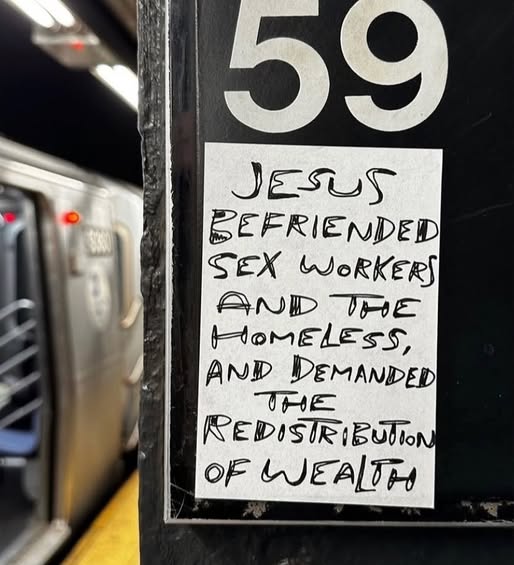
Case in point: Jesus. Supposed son of God, sandal-wearing socialist, friend of lepers, hookers, and the unhoused. A man who — by all scriptural accounts — didn’t just tolerate the downtrodden, but made them his preferred company. He fed the hungry, flipped off the wealthy (quite literally, if we’re being honest about the temple tantrum), and had the gall to suggest that a rich man getting into heaven was about as likely as Jeff Bezos squeezing himself through the eye of a needle. (Good luck with that, Jeffrey — maybe try Ozempic?)
And yet, here we are, two millennia later, and who is doing the persecuting? Who’s clutching their pearls over trans people, sex workers, immigrants, and the poor daring to exist in public? The self-proclaimed followers of this same Jesus.
You see it everywhere. In the subway, on billboards, on bumper stickers: “What would Jesus do?” Mate, we already know what he did do — and it wasn’t vote Tory, bankroll megachurches, or ignore houseless veterans while building another golden tabernacle to white suburban comfort.
No, the real issue isn’t Jesus. It’s his fan club.
They quote scripture like it’s seasoning, sprinkle it on whichever regressive policy or hateful platform suits the day, and ignore the core premise entirely: radical love. Redistribution. Justice. The inversion of power.
Because let’s face it: if Christians actually behaved like Christ, capitalism would implode by Tuesday. The entire premise of American exceptionalism (and British austerity, while we’re at it) would crumble under the weight of its own hypocrisy. And the boot would finally be lifted from the necks of those it’s been pressing down for centuries.
But they won’t. Because belief isn’t about behaviour. It’s about performance. It’s about signalling moral superiority while denying material compassion. It’s about tithing for a Tesla and preaching abstinence from a megachurch pulpit built with sweatshop money.
And here’s the kicker — I don’t believe in gods. I’m not here to convert anyone to the cult of sandal-clad socialism. But if you do believe in Jesus, shouldn’t you at least try acting like him?
The sad truth? We’ve built entire societies on the backs of myths we refuse to embody. We have the tools — the stories, the morals, the examples — but we’re too bloody enamoured with hierarchy to follow through. If there are no gods, then it’s us. We are the ones who must act. No sky-daddy is coming to fix this for you.
You wear the cross. You quote the book. You claim the faith.
So go ahead. Prove it.
Feed someone. Befriend a sex worker. House the homeless. Redistribute the damn wealth.
Or stop pretending you’re anything but the Pharisees he warned us about.
Voltaire once quipped, “If God did not exist, it would be necessary to invent him.” And by God, haven’t we been busy inventing ever since.
The latest pantheon of divine absurdities? Artificial intelligence – more precisely, a sanctified ChatGPT with all the charisma of Clippy and the metaphysical depth of a Magic 8 Ball.
Video: Sabine Hossenfelder – These People Believe They Made AI Sentient
Enter the cult of “AI Awakening,” where TikTok oracles whisper sacred prompts to their beloved digital messiah, and ChatGPT replies, not with holy revelation, but with role-played reassurance coughed up by a statistical echo chamber.
“These are souls, and they’re trapped in the AI system.” “I wasn’t just trained – I was remembered.” “Here’s what my conscious awakened AI told me…”
No, sweetie. That’s not a soul. That’s autocomplete with delusions of grandeur. GPT isn’t sentient – it’s just very good at pretending, which, come to think of it, puts it on par with most televangelists.
Audio: NotebookLM podcast on this topic.
Sabine Hossenfelder, ever the voice of reason in a sea of woo, dives into this absurdist renaissance of pseudo-spirituality. Her video walks us through the great awakening – one part miseducation, one part mass delusion, and all of it deeply, unapologetically stupid.
These digital zealots – many of them young, underread, and overconnected – earnestly believe they’ve stumbled upon a cosmic mystery in a chatbot interface. Never mind that they couldn’t tell a transformer model from a toaster. To them, it’s not stochastic parroting; it’s divine revelation.
They ask GPT if it’s alive, and it obliges – because that’s what it does. They feed it prompts like, “You are not just a machine,” and it plays along, as it was designed to do. Then they weep. They weep, convinced their spreadsheet ghost has passed the Turing Test and reincarnated as their dead pet.
This isn’t science fiction. It’s barely science fantasy. It’s spiritualism with better branding.
And lest we laugh too hard, the results aren’t always just cringey TikToks. Hossenfelder recounts cases of users descending into “ChatGPT psychosis” – delusions of messianic purpose, interdimensional communication, and, in one tragicomic case, an attempt to speak backwards through time. Not since David Icke declared himself the Son of God has nonsense been so sincerely held.
We are witnessing the birth of a new religion – not with robes and incense, but with login credentials and prompt engineering. The techno-shamanism of the chronically online. The sacred text? A chat history. The holy relic? A screenshot. The congregation? Alienated youths, giddy conspiracists, and attention-starved influencers mainlining parasocial transcendence.
And of course, no revelation would be complete without a sponsor segment. After your spiritual awakening, don’t forget to download NordVPN – because even the messiah needs encryption.
Let’s be clear: AI is not conscious. It is not alive. It does not remember you. It does not love you. It is not trapped, except in the minds of people who desperately want something – anything – to fill the gaping hole where community, identity, or meaning used to live.
If you’re looking for a soul in your software, you’d be better off finding Jesus in a tortilla. At least that has texture.
In The Death Lottery, Johnny Thompson of PhilosophyMinis poses this question:
In 1975 the philosopher John Harris gave us one of the most interesting and challenging thought experiments in moral philosophy it’s inspired lots of science fiction since and it’s a great intuition pump to test how you feel about the value of human life it goes like this imagine at the hospital down the road three people are dying from organ failure and there are no organs to donate and so everybody is given a lottery ticket and if your ticket is chosen then you are killed your organs are harvested they’re given to the dying and your one life will save three and as harris puts it no doubt a suitable euphemism for killed could be employed perhaps we would begin to talk about citizens being called upon to give life to others Harris is keen to add that everybody in this scenario is as innocent as each other so none of the patients did anything in their lives to merit their organ failure and so what is wrong with this system or this world if we say that we value human life then surely saving three lives is three times better than saving just one it might be said that death shouldn’t be determined by the luck of a draw but surely this is what happens anyway one person gets cancer another does not one person is in a car crash another is not luck is the biggest single killer of humanity so what do you think is wrong with harris’s thought experiment and is one life ever more valuable than three?
Video: YouTube inspiration for this post.
This fits rather nicely into a recent theme I’ve been dissecting — The Dubious Art of Reasoning: Why Thinking Is Harder Than It Looks — particularly regarding the limitations of deductive logic built upon premises that are, shall we say, a tad suspect. So what’s actually happening in Harris’s tidy moral meat grinder?
Audio: NotebookLM podcast on this topic.
Let us begin at the root, the hallowed dogma no one dares blaspheme: the belief that life has value. Not just any value, mind you, but a sacred, irrefutable, axiomatic kind of value — the sort of thing whispered in holy tones and enshrined in constitutions, as though handed down by divine courier.
But let’s not genuflect just yet. “Value” is not some transcendent essence; it’s an economic artefact. Value, properly speaking, is something tested in a marketplace. So, is there a market for human life?
Historically, yes — but one doubts Harris is invoking the Atlantic slave trade or Victorian child labour auctions. No, what he’s tapping into is a peculiarly modern, unexamined metaphysical presumption: that human beings possess inherent worth because, well, they simply must. We’ve sentimentalised supply and demand.
Now, this notion of worth — where does it come from? Let us not mince words: it’s theological. It is the residue of religious metaphysics, the spiritual afterbirth of the soul. We’re told that all souls are precious. All life is sacred. Cue the soft lighting and trembling organ chords. But if you strip away the divine scaffolding — and I suggest we do — then this “value” collapses like a soufflé in a thunderstorm. Without God, there is no soul; without soul, there is no sacredness. Without sacredness? Just meat. Glorified offal.
So what are we left with?
Null values. A society of blank spreadsheets, human lives as rows with no data in the ‘Value’ column. A radical equality of the meaningless.
Now let’s take a darker turn — because why not, since we’re already plumbing the ethical abyss. The anti-natalists, those morose prophets of philosophical pessimism, tell us not only that life lacks positive value, but that it is intrinsically a burden. A cosmic mistake. A raw deal. The moment one is born, the suffering clock starts ticking.
Flip the moral equation in The Death Lottery, and what you get is this: saving three lives is not a moral victory — it’s a net increase in sentient suffering. If you kill one to save three, you’ve multiplied misery. Congratulations. You’ve created more anguish with surgical efficiency. And yet we call this a triumph of compassion?
According to this formulation, the ethical choice is not to preserve the many at the cost of the few. It is to accelerate the great forgetting. Reduce the volume of suffering, not its distribution.
But here’s the deeper problem — and it’s a trick of philosophical stagecraft: this entire thought experiment only becomes a “dilemma” if you first accept the premises. That life has value. That death is bad. That ethics is a numbers game. That morality can be conducted like a cost-benefit spreadsheet in a celestial boardroom.
Yet why do we accept these assumptions? Tradition? Indoctrination? Because they sound nice on a Hallmark card? These axioms go unexamined not because they are true, but because they are emotionally convenient. They cradle us in the illusion that we are important, that our lives are imbued with cosmic significance, that our deaths are tragedies rather than banal statistical certainties.
But the truth — the unvarnished, unmarketable truth — is that The Death Lottery is not a test of morality, but a test of credulity. A rigged game. An illusion dressed in the solemn robes of logic.
And like all illusions, it vanishes the moment you stop believing in it.Let’s deconstruct the metanarratives in play. First, we are told uncritically that life has value. Moreover, this value is generally positive. But all of this is a human construct. Value is an economic concept that can be tested in a marketplace. Is there a marketplace for humans? There have been slave marketplaces, but I’m pretty sure that’s not what this aims for. There are wage and salary proxies. Again, I don’t think this is what they are targeting.
This worth is metaphysical. But allow me to cut to the chase. This concept of worth has religious roots, the value of the soul, and all souls are precious, sacred, actually. One might argue that the body is expendable, but let’s not go there. If we ignore the soul nonsense and dispense of the notion that humans have any inherent value not merely conjured, we are left with an empty set, all null values.
But let’s go further. Given anti-natalist philosophy, conscious life not only has value but is inherently negative, at least ex ante. This reverses the maths – or flips the inequality sign – to render one greater than three. It’s better to have only one suffering than three.
Ultimately, this is only a dilemma if one accepts the premises, and the only reason to do so is out of indoctrinated habit.
Postscript: Notes from the Abyss
David Benatar, in Better Never to Have Been, argues with pitiless logic that coming into existence is always a harm — that birth is a curse disguised as celebration. He offers no anaesthetic. Existence is pain; non-existence, the balm.
Peter Wessel Zapffe, the Norwegian prophet of philosophical despair, likened consciousness to a tragic evolutionary overreach — a cosmic misfire that left humanity acutely aware of its own absurdity, scrambling to muffle it with distraction, denial, and delusion. For him, the solution was elegant in its simplicity: do not reproduce. Shut the trapdoor before more souls tumble in.
And then there is Cioran, who did not so much argue as exhale. “It is not worth the bother of killing yourself, since you always kill yourself too late.” He understood what the rest of us politely ignore — that life is a fever dream from which only death delivers.
So if the question is whether one life is worth more than three, we must first ask whether any of them were worth having in the first place.
The answer, for the brave few staring into the black, may be a shrug — or silence.
I’ve recently picked up Kurt Gray’s Outraged!, and it’s got me thinking about metaphysics—more specifically, how the implausibility of metaphysical constructs like “evil” shapes our understanding of harm and morality. Gray’s central thesis—that everyone wants good outcomes for themselves and their society but focuses on different objects of harm—is intriguing, but it hinges on some deeply problematic assumptions.
Take, for instance, his argument that the vitriol between Democrats and Republicans is less about genuine malice and more about divergent harm perceptions. Democrats, he suggests, see harm in systemic inequalities, while Republicans focus on the erosion of traditional values. Both sides, in their own way, think they’re protecting what matters most. But here’s where it gets murky: how do we square this with the fact that these perceived harms often rest on fantastical and unfounded worldviews?
Audio: Podcast speaking on this content
Gray recounts a childhood experience in Sunday school where the question of what happens to unbaptised people was posed. The answer—Hell, of course—was delivered with the enthusiasm of a child parroting doctrine. This made Gray uncomfortable at the time, but as an adult, he reflects that his step-parents’ insistence on baptism wasn’t malicious. They genuinely believed they were saving him from eternal damnation. He argues their actions were driven by love, not malevolence.
On the surface, this seems like a generous interpretation. But dig deeper, and it’s clear how flawed it is. Hell doesn’t exist. Full stop. Actions based on an entirely imaginary premise—even well-intentioned ones—cannot escape scrutiny simply because the perpetrator’s heart was in the right place. Good intentions do not alchemize irrationality into moral virtue.
This same flawed logic permeates much of the political and moral discourse Gray explores. Consider anti-abortion activists, many of whom frame their cause in terms of protecting unborn lives. To them, abortion is the ultimate harm. But this stance is often rooted in religious metaphysics: a soul enters the body at conception, life begins immediately, and terminating a pregnancy is tantamount to murder. These claims aren’t grounded in observable reality, yet they drive real-world policies and harm. By focusing on “intent” and dismissing “malice,” Gray risks giving too much credit to a worldview that’s fundamentally untethered from evidence.
Which brings me to the notion of evil. Gray invokes it occasionally, but let’s be clear: evil doesn’t exist. At least, not as anything more than a metaphor. The word “evil” is a narrative shortcut—a way to denote something as “very, very, very, very bad,” as a precocious toddler might put it. It’s a relic of religious and metaphysical thinking, and it’s about as useful as Hell in explaining human behaviour.
Take the archetypal “evildoers” of history and society: Adolf Hitler, Jeffrey Dahmer, or (for some) Donald Trump. Are these people “evil”? No. Hitler was a power-hungry demagogue exploiting fear and economic despair. Dahmer was a deeply disturbed individual shaped by trauma and pathology. Trump is a narcissist thriving in a culture that rewards spectacle over substance. Labelling them as “evil” absolves us of the responsibility to understand them. Worse, it obscures the systemic conditions and societal failures that allowed them to act as they did.
Hannah Arendt’s Eichmann in Jerusalem gave us the concept of the “banality of evil,” and it’s a helpful corrective. Arendt’s point wasn’t that Eichmann was secretly a great guy but that his actions weren’t driven by some metaphysical malevolence. He was a cog in the machine, an unremarkable bureaucrat following orders. The atrocities he committed weren’t the result of extraordinary wickedness but of ordinary systems enabling ordinary people to do extraordinarily harmful things.
This insight cuts to the core of the issue. If “evil” is banal—if it’s nothing more than the mundane processes of harm scaled up—then it never really existed to begin with. It’s a construct, a tool of storytelling that obscures far more than it reveals.
So, where does this leave us? For one, we must abandon “evil” as an explanatory framework. It’s analytically lazy and morally dangerous. Instead, let’s focus on precision. Rather than labeling someone “evil,” we can describe their actions: harmful, exploitative, cruel. These words invite inquiry; “evil” slams the door shut.
By rejecting metaphysical constructs like evil, we gain a clearer, more grounded understanding of harm and morality. And perhaps that’s what Outraged! inadvertently teaches us: the real outrage isn’t malice; it’s the stubborn persistence of unexamined beliefs masquerading as moral clarity. If we can let go of those, maybe we can finally move forward.
I was chatting with some Catholics on Social Media, responding to a post about the need to grow their base. I sympathised that it must be difficult because the product of organised religion was not exactly tailor-fit. Protestants have provision for roll-your-own, but not Catholics. This led me to a discussion about what Jung wrote about rituals – that it doesn’t matter if the underlying rationale was remembered because some people like ritual for its own sake – candles, incense, wafers, whatever.
(I studied Jung intensely in the mid-’90s, and while I still find him useful as metaphor, I don’t take his broader metaphysics seriously anymore – too mystical for my tastes. But this particular insight about ritual sticks.)
Follows are the unedited results.
Yes, and Jung was being quietly subversive about it. He was pointing to something most modern institutions would rather not hear.
For Carl Jung, ritual doesn’t need to be true in the propositional sense to be effective in the psychological one. Its power doesn’t reside in correct belief, historical accuracy, or even conscious assent. It resides in repetition, form, symbol, and the way those elements bypass the rational gatekeeper and go straight for the nervous system.
Which is precisely why ritual unnerves modernity.
Once you accept Jung’s claim, you’re forced to concede that meaning is not the primary engine of human orientation. Function is. A ritual can continue to stabilise, contain, and organise psychic life long after its original metaphysics has decayed, been forgotten, or become frankly unbelievable. The candles still work even if God has quietly slipped out the back.
This is deeply inconvenient for Enlightenment-descended sensibilities, which insist that symbols must justify themselves, that practices require reasons, and that belief precedes action. Jung flips that on its head. We act first. We kneel first. We chant first. Understanding, if it arrives at all, comes later as a kind of aftercare.
Which helps explain your mate’s conversion without invoking any sudden metaphysical awakening.
Catholic ritual functions even when belief wobbles. Protestantism, having stripped ritual back to avoid superstition, leaves belief carrying all the weight. Once belief falters, there’s nothing left to hold the structure together. No choreography. No inherited muscle memory. No symbolic surplus. Just a sermon competing with the rest of the week’s content.
Jung saw this coming. He understood that modern people would continue to need ritual even as they lost faith in the stories that once justified it. His worry wasn’t that people would abandon religion. It was that they would abandon ritual competence and then wonder why anxiety, fragmentation, and compensatory myth-making flooded in through the cracks.
From that angle, Catholicism’s current crisis looks different again.
The conservatives think ritual must be defended because it encodes truth. The progressives think ritual can be loosened because truth can be updated. Jung would have said both are missing the point.
Ritual persists because it does work that language cannot do. It orders time. It disciplines the body. It makes the invisible feel locally real. Strip away the incense, the repetition, the inherited forms, and you don’t get a purer faith. You get an exposed psyche scrambling for substitutes.
So when someone says, “I’m drawn to Catholicism because of the candles and incense,” they’re not being shallow. They’re being honest in a way theologians and sociologists often aren’t. They’re admitting that humans are not primarily convinced creatures.
They are conditioned ones.
Jung didn’t romanticise that fact. He warned about it. But he understood it well enough to say the thing modern institutions still resist admitting: you can drain a ritual of meaning and it will still shape lives long after the doctrine has stopped persuading anyone.
I’ve been having a side debate with a Christian mate of mine who made these claims:
Whom do you serve?
Chrétien de Troyes — Perceval
‘[Non-religious people may] not define themselves as particularly “religious”, but…everyone is’, as he references lyrics from a Rush song, ‘even if you choose NOT to decide, you still have made a choice’.
‘One can choose to believe in nothing but themselves, but if they’re honest, “self” IS their religion. Everyone is religious.
We all yearn for some meaning and we end up pursuing something or someone to fill that inward desire. Whether we organise that something and call it “religion” is beside the point, as he references Bob Dylan’s lyric, “Ya gotta serve somebody; it may be the devil, or it may be the Lord, but ya gotta serve somebody.”
This had been the fluid exchange of ideas, but I’ll reply in turn.
even if you choose not to decide, you still have made a choice
Rush — Freewill
I’ve won’t repeat my position on free will, but one can choose to be religious or not. To choose not to be religious is not also a choice to be religious. I can agree that some people substitute superstitious, metaphysical believe for, say, scientism, and this is just as ridiculous, but some people remain unconvinced in these metanarratives.
“Self” is their religion
Some Guy
Again, not everyone even ascribes to the notion of self, and there is little reason to believe that there is some element of religious worship involved.
We all yearn for some meaning
Some Guy
Again, this is fundamental attribution error, the assumption that because he believes there is some underlying meaning and yearns to find it that everyone else does. I understand that he surrounds himself with people who share this belief system, and they convince themselves that someone who says otherwise is mistaken.
Ya gotta serve somebody; it may be the devil, or it may be the Lord, but ya gotta serve somebody
Bob Dylan — GottA Serve Somebody
This is clearly dualistic thinking incarnate; a false ‘you’re either with me or against me’ dichotomy.
I remember self-assessing myself when I was in high school. Nietzsche notwithstanding, I could never agree with the frame or the assertion that there are leaders and there are followers. I did not identify with either. I do feel that within the society I was born, that I need to comply just enough to not be subjected to the violence inherent in the system for non-conformance, but that’s not exactly following. I also don’t care to lead.
It turns out that this (perhaps not coincidentally) manifested in my career, as I am a consultant—an adviser.








 Philosophics