The Burnout Society – Byung-Chul Han

1–2 minutes
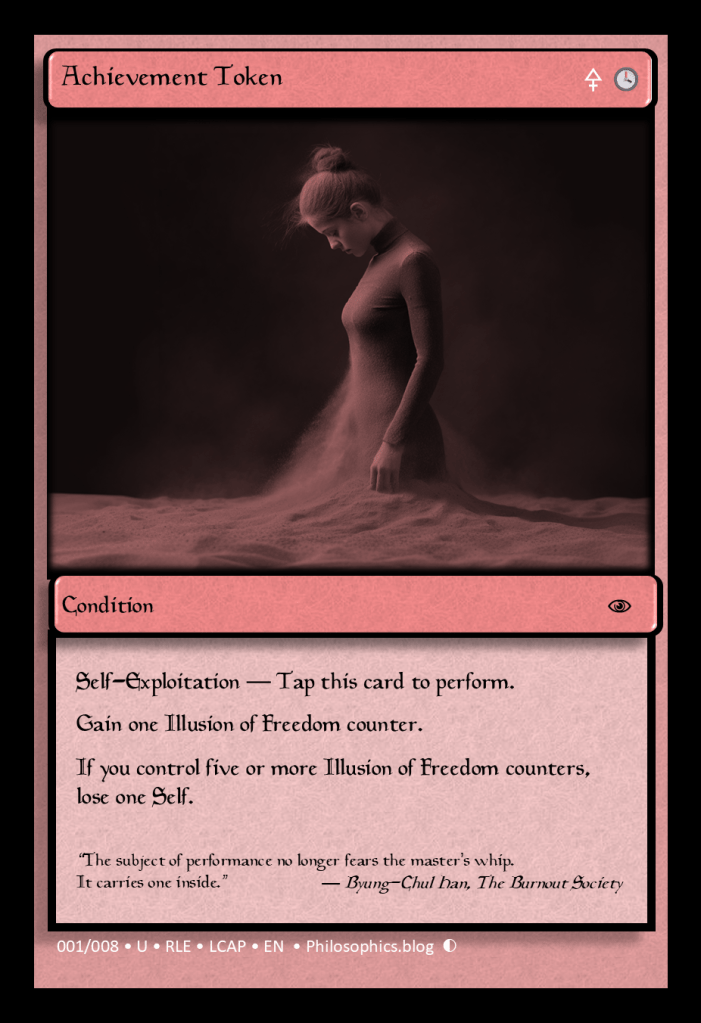
A digital MTG trading card titled “Achievement Token – Condition.” The image shows a human figure shaped like an hourglass, sand flowing through its body as if time and self are draining away. The design echoes the colours of oxidised red and muted graphite, symbolising burnout and the illusion of productivity within modern capitalist culture.
Image: Exhaustion means you’re working hard, and working hard means you’re good.

Han’s slender essay reads like a diagnosis of our psychic economy. The disciplinary society of ‘thou shalt’ has dissolved into the achievement society of ‘yes, I can’. We no longer rebel against authority; we internalise it, polishing our exhaustion until it gleams like ambition. Productivity replaces purpose. Rest becomes guilt. The subject, stripped of exterior constraint, now self-flagellates in the name of freedom.

What Han captures is not mere fatigue but a civilisational pathology: the compulsion to optimise the self as though it were capital. Burnout is not the collapse of will but the logical conclusion of unlimited permission.

If liberation now feels indistinguishable from exhaustion, what exactly have we been freed from?

From the series Readings in Late Exhaustion – a Philosophics reflection on the maladies of modernity.


About the Series — Readings in Late Exhaustion

These cards belong to Readings in Late Exhaustion, a Philosophics project tracing the psychic and cultural costs of late capitalism.

Each card interprets a contemporary work of critical theory through the language of collectable gameplay, where identity, labour, and value become quantified acts.

The format itself is the critique: a system of self-expenditure disguised as achievement, reflection rendered as performance.

Edition: RLE / LCAP — Philosophics Press


The Sane Delusion: Fromm, Beauvoir, and the Cult of Mid-Century Liberation

2–4 minutes

It’s almost endearing, really how the intellectuals of mid-century Europe mistook the trembling of their own cage for the dawn chorus of freedom. Reading Erich Fromm’s The Sane Society today feels like being handed a telegram from Modernism’s last bright morning, written in the earnest conviction that history had finally grown up. The war was over, the worker was unionised, the child was unspanked, and the libido – good heavens – was finally allowed to breathe. What could possibly go wrong?

Audio: NotebookLM podcast on this topic.

Fromm beams:

“In the twentieth century, such capitalistic exploitation as was customary in the nineteenth century has largely disappeared. This must not, however, becloud the insight into the fact that twentieth-century as well as nineteenth-century Capitalism is based on the principle that is to be found in all class societies: the use of man by man.”

The sleight of hand is marvellous. He spots the continuation of exploitation but calls it progress. The worker has become a ‘partner’, the manager a ‘team leader’, and the whip has been replaced by a time card. No one bows anymore, he writes. No, they just smile through performance reviews and motivational posters.

Fromm’s optimism borders on metaphysical comedy.

“After the First World War, a sexual revolution took place in which old inhibitions and principles were thrown overboard. The idea of not satisfying a sexual wish was supposed to be old-fashioned or unhealthy.”

Ah yes, the Jazz Age orgy of liberation – champagne, Freud, and flapper hemlines. The problem, of course, is that every generation mistakes its new neuroses for freedom from the old ones. Fromm’s “sexual revolution” was barely a shuffle in the bourgeois bedroom; Beauvoir’s Deuxième Sexe arrived the next year, practically shouting across the café table that liberation was still a myth stitched into the same old corset.

Beauvoir, at least, sensed the trap: every gesture toward freedom was refracted through patriarchal fantasy, every ‘choice’ conditioned by the invisible grammar of domination. Fromm, bless him, still believed in a sane society – as if sanity were something history could deliver by instalment.

Meanwhile, the Existentialists were in the next room, chain-smoking and muttering that existence precedes essence. Freedom, they insisted, wasn’t something achieved through social reform but endured as nausea. Post-war Paris reeked of it – half despair, half Gauloises. And within a decade, the French schools would dismantle the very scaffolding that held Fromm’s optimism together: truth, progress, human nature, the subject.

The Modernists thought they were curing civilisation; the Post-Moderns knew it was terminal and just tried to describe the symptoms with better adjectives.

So yes, Fromm’s Sane Society reads now like a time capsule of liberal humanist faith – this touching belief that the twentieth century would fix what the nineteenth broke. Beauvoir already knew better, though even she couldn’t see the coming avalanche of irony, the final revelation that emancipation was just another product line.

Liberation became a brand, equality a slogan, sanity a statistical average. Fromm’s dream of psychological health looks quaint now, like a health spa brochure left in the ruins of a shopping mall.

And yet, perhaps it’s precisely that naivety that’s worth cherishing. For a moment, they believed the world could be cured with reason and compassion – before history reminded them, as it always does, that man is still using man, only now with friendlier UX design and better lighting.

The Schizophrenia of “Human Nature” Arguments

Humans, we are told, are exceptional—unlike the rest of the lowly animal kingdom. We alone possess reason, morality, and the ability to transcend our base instincts. And yet, curiously, this argument is rolled out only when convenient. At times, we are commanded to rise above our primal urges; at others, we are scolded for even thinking about resisting them. This ideological schizophrenia is no accident—it is a feature, not a bug, of our prevailing moral and economic order.

The contradictions of “human nature” arguments can be broken down into two key patterns:

A. We must transcend our animal instincts—but only when they threaten social or economic order.

B. We must accept our animal instincts as unchangeable—but only when they reinforce existing power structures.

This hypocrisy is especially visible in how capitalism and morality are framed. Let’s examine two case studies.

Case 1: Prostitution—A Market That Must Be Morally Suppressed

Sex is as fundamental a biological drive as hunger or thirst. One would think that in a world where everything is commodified, prostitution—the most direct transaction of supply and demand—would be embraced by free-market capitalists. But no. We are told that engaging in this “base” activity is degrading, immoral, and must be curtailed. The same capitalists who defend free enterprise at all costs suddenly become moralists, urging us to resist temptation and rise above our urges. Sex, despite being one of the most natural acts imaginable, is treated as an impulse to be tamed rather than an economic exchange to be normalised.

Case 2: Capitalism—A System We Must Accept as “Natural”

Contrast this with how we are told to think about capitalism. Greed, exploitation, and ruthless competition? Those are “just human nature.” The strong thrive, and the weak perish. We are warned not to question the system because to do so would be to fight against nature itself. Socialism? A naive fantasy. Economic cooperation? Impossible. Mutual aid? Utopian nonsense. We must accept that humans are selfish creatures, that hierarchy is inevitable, and that billionaires accumulating obscene wealth while millions starve is simply the way of things.

Why are we ordered to suppress our instincts in one case yet surrender to them in another? Because morality, in its institutional form, is not about virtue—it is about control.

The Convenient Flexibility of “Human Nature”

This selective logic is designed to keep power structures intact. The rules shift depending on whose interests are at stake:

  • If an instinct challenges profit or control, it must be suppressed.
  • If an instinct benefits the ruling order, it must be accepted as natural.

Thus, the same societies that demand moral restraint when it comes to sex, leisure, or pleasure suddenly rediscover their inner Darwinist when defending capitalist greed and economic cruelty.

The “Natural Order” Myth

The claim that capitalism is the inevitable result of human nature is one of history’s greatest ideological scams. If it were indeed “natural,” it would not require:

  • Constant propaganda to reinforce its legitimacy.
  • Violent suppression of alternative systems.
  • Trillions in government bailouts every time it fails.

Moreover, humans are not only competitive, selfish creatures. We are also wired for cooperation, altruism, and communal living—traits conveniently erased from discussions about economics.

Final Thought: Breaking the Cycle

If we can rise above base instincts for sex and violence, why can’t we rise above capitalist greed and exploitation? Why is overcoming “human nature” only demanded when it suits power? The truth is, we are only commanded to rise above when it keeps us obedient—and ordered to accept reality when it keeps the powerful in control.

The only real rebellion is to reject this hypocrisy entirely. The future belongs not to those who passively accept the contradictions of the present, but to those who refuse to play by its schizophrenic rules.

Capitalism is Slavery

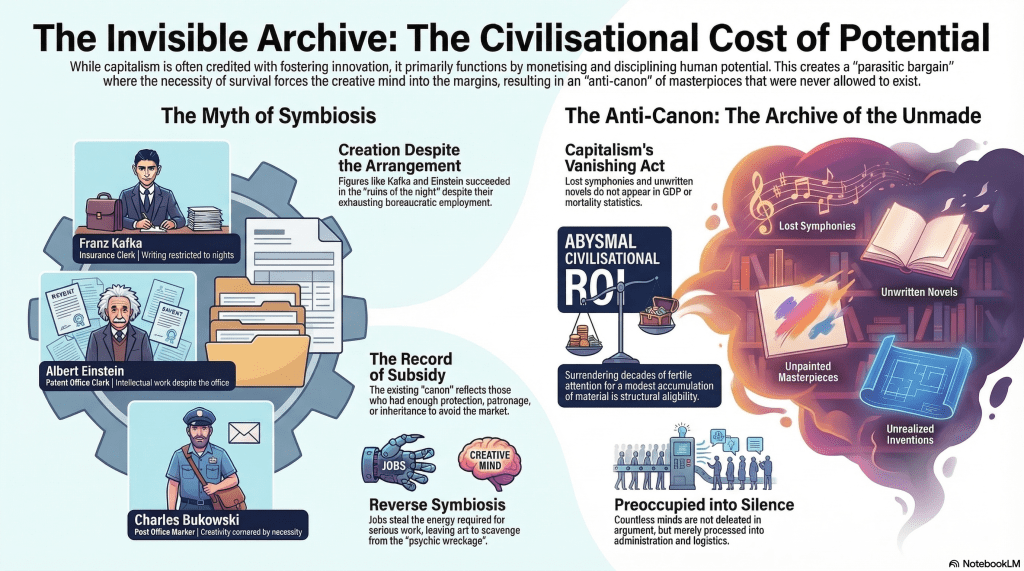
It’s not uncommon to label workers under the capitalist system as wage slaves.

As with the abolition of slavery in the United States, the future will one day recoil at Capitalism, wondering how humanity could ever have justified the exploitation of others for commerce and profit. Then again, that’s the same question, isn’t it?

As with the old story, a man asked a lady: “Would you be willing to sleep with me if I paid you £1,000,000?” Without hesitation, she answered, “Yes.” “And what if I only paid you £5?” The irate lady fumed: “£5? What do you think I am?” The man replied: “We’ve already established that. Now we’re trying to determine the degree.”

Capitalism is only a matter of degree from slavery. In practice, slavery is a Capitalist’s wet dream.

A Buddhist Critique of Modern Livelihoods

It’s interesting to me that as an atheist and non-cognitivist, I can take the moral high ground relative to health insurance concerns in the United States. So, I write about it.

Blood Money and Broken Principles

In the aftermath of the tragic killing of Brian Thompson, the CEO of a health insurance conglomerate, a striking narrative has emerged. Many Americans view this act—shocking though it is—as emblematic of the anger and despair born of a system that profits by exploiting human vulnerability. Such reactions compel us to examine the ethics of industries that flourish on what can only be described as blood money. From health insurance to tobacco, alcohol, and the arms trade, these livelihoods raise profound ethical questions when viewed through the lens of the Buddhist Noble Eightfold Path, specifically Right Livelihood and Right Action.

The Moral Framework: Buddhism’s Path to Ethical Livelihood

Buddhism’s Eightfold Path provides a blueprint for ethical living, with Right Livelihood and Right Action serving as its ethical cornerstones. These principles demand that one’s work and deeds contribute to the welfare of others, avoid harm, and align with compassion and integrity. In short, they urge us to earn a living in a manner that uplifts rather than exploits. The health insurance industry’s business model—which often prioritises profits over the preservation of life—challenges these tenets in ways that are difficult to overlook.

Consider the denial of coverage for life-saving treatments, the exploitation of legal loopholes to reduce payouts, or the systemic perpetuation of healthcare inequality. These actions, while legally sanctioned, conflict sharply with the Buddhist ideal of avoiding harm and promoting well-being. Yet, this industry is not alone in its ethical failings. Many others—both legal and illegal—fall similarly short.

Industries of Exploitation: Tobacco, Alcohol, and Arms

The tobacco and alcohol industries provide stark examples of livelihoods that thrive on human suffering. Their products, despite their legality, are designed to foster dependency and harm. They exact a heavy toll on both individual lives and public health systems, a reality that makes them incompatible with Right Livelihood. The arms trade—arguably the most egregious example—profits directly from conflict and human misery. How can such industries possibly align with the Buddhist ideal of ahimsa (non-violence) or the compassionate aspiration to alleviate suffering?

In these cases, the harm caused is not incidental; it is fundamental to their business models. Whether one manufactures cigarettes, brews alcohol, or sells weapons, the destruction wrought by these activities is integral to their profitability. The contradiction is stark: the greater the harm, the greater the profit. This stands in direct opposition to the Buddhist call for livelihoods that sustain and support life.

Organised Crime: The Dark Mirror

When we turn to organised crime, the parallels become even more unsettling. Whether it’s the drug trade, human trafficking, or financial fraud, these activities epitomise unethical livelihoods. They exploit the vulnerable, foster violence, and undermine social cohesion. Yet, when viewed alongside certain legal industries, the line between “organised crime” and “corporate enterprise” begins to blur. Is the denial of life-saving healthcare less egregious than a gang’s extortion racket? Both profit by preying on human suffering. Both thrive in systems that prioritise gain over humanity.

The Buddhist Response: From Outrage to Action

Buddhism does not condone violence, no matter how symbolic or righteous it may appear. Right Action demands non-violence not only in deeds but also in thoughts and intentions. The killing of Brian Thompson, though perhaps an act of desperation or symbolism, cannot align with Buddhist ethics. Yet this tragedy should not eclipse the broader systemic critique. The true challenge is not to exact retribution but to transform the systems that perpetuate harm.

To move forward, we must ask how our societies can pivot toward livelihoods that align with compassion and justice. This entails holding exploitative industries to account and fostering economic systems that prioritise well-being over profit. The Buddhist path offers not only a critique of harmful practices but also a vision for ethical living—a vision that demands courage, compassion, and unwavering commitment to the common good.

Conclusion: Choosing a Better Path

The case of Brian Thompson’s killing is a symptom of a much larger ethical crisis. It forces us to confront uncomfortable truths about the industries that shape our world. Whether we scrutinise health insurance, tobacco, alcohol, the arms trade, or organised crime, the moral calculus remains the same: livelihoods that thrive on harm cannot be reconciled with the principles of Right Livelihood and Right Action.

As individuals and societies, we face a choice. We can continue to turn a blind eye to the suffering embedded in these industries, or we can commit to transforming them. The Buddhist path challenges us to choose the latter, to build systems and livelihoods rooted in compassion and justice. In doing so, we can begin to heal not only the wounds of individual tragedies but also the deeper fractures in our collective soul.

Decolonising the Mind

Ngũgĩ wa Thiong’o published “Decolonising the Mind” in 1986. David Guignion shares a 2-part summary analysis of the work on his Theory and Philosophy site.

I used NotebookLLM to produce this short podcast: [Content no longer extant] https://notebooklm.google.com/notebook/7698ab0b-43ab-47d4-a50f-703866cfb1b9/audio

Decolonising the Mind: A Summary

Ngũgĩ wa Thiong’o’s book Decolonising the Mind centres on the profound impact of colonialism on language, culture, and thought. It argues that imposing a foreign language on colonised people is a key tool of imperial domination. This linguistic imperialism leads to colonial alienation, separating the colonised from their own culture and forcing them to view the world through the lens of the coloniser.

Here are some key points from the concept of decolonising the mind:

  • Language is intimately tied to culture and worldview: Language shapes how individuals perceive and understand the world. When colonised people are forced to adopt the language of the coloniser, they are also compelled to adopt their cultural framework and values.
  • Colonial education systems perpetuate mental control: By privileging the coloniser’s language and devaluing indigenous languages, colonial education systems reinforce the dominance of the coloniser’s culture and worldview. This process results in colonised children being alienated from their own cultural heritage and internalising a sense of inferiority.
  • Reclaiming indigenous languages is crucial for decolonisation: wa Thiong’o advocates for a return to writing and creating in indigenous African languages. He sees this as an act of resistance against linguistic imperialism and a way to reconnect with authentic African cultures. He further argues that it’s not enough to simply write in indigenous languages; the content must also reflect the struggles and experiences of the people, particularly the peasantry and working class.
  • The concept extends beyond literature: While wa Thiong’o focuses on language in literature, the concept of decolonising the mind has broader implications. It calls for a critical examination of all aspects of life affected by colonialism, including education, politics, and economics.

It is important to note that decolonising the mind is a complex and ongoing process. There are debates about the role of European languages in postcolonial societies, and the concept itself continues to evolve. However, wa Thiong’o’s work remains a seminal text in postcolonial studies, raising crucial questions about the enduring legacy of colonialism on thought and culture.

Monopoly on Reparations

Many places have histories of exploiting a group or groups to the advantage of others. Although this scenario applies to these people in a similar manner, I am thinking specifically of the exploitation and reparations due to the black and indigenous people of colour, BIPOC, in the United States.

I believe that many people are familiar with Monopoly, the board game where, among other things, one accumulates properties and extracts rents from the other players. My intent is to illustrate with Monopoly the need for reparations, to illustrate why reparations are necessary to restore justice. This is a twist on John Rawls’ veil of ignorance thought experiment.

Slave auction advertisement

I have heard some people say that the past is the past, or if there were injustices in the past, that was ages ago, and now everyone has an equal chance. No special accommodations or affirmative actions are necessary. I don’t agree that this is true, but let’s just say for the sake of this exposition that opportunities are equal for everyone in a given society.

There are parallels between a game of Monopoly and the way we are thrown into this world. No one differs in this regard. We are all subject to a loin lottery.

Imagine that I already own all of the properties. You own none. Irrespective of how the game came to this condition, your chances of winning are nil to none. Now imagine that the reason for the disparate ownership was the result of a system of injustice perpetrated by the player I inherited my position from on the player you inherited yours.

No matter how fairly the game is from now until the end, if your starting place leaves me with all of the property and you without, your chances of winning are slim to none. Favouring tradition and inheritance already benefits some people over others, but when the benefit is the result of a pattern of injustices, it feels more egregious. Worse yet, even if I ‘give’ you Whitechapel Road, Baltic Avenue, or Rue Lecourbe and keep the rest, your chances have only slightly improved.

With the end of US Civil War and the emancipation proclamation, affected blacks were promised 40 acres and a mule. For most, this never happened. This remains an outstanding debt. And whilst 40 acres in some places would be a boon, not many today really need a mule, so descendants of slaves need to be made whole. Reparations are a way to accomplish this.

Reparations are payments in arrears to attempt to compensate for the centuries of an unbalanced playing field. And reparations should allow you to recover more than Whitechapel, Baltic, or Rue Lecourbe properties. At least get Bond Street, Pennsylvania Avenue, or Boulevard des Capucines. If you’ve played Monopoly, you’ll understand that this is still not enough.


Capitalising on Prostitution

DISCLAIMER: This post is a veritable rant. It promises to go off script or at least be oblique to the recent themes I’ve adopted. It is also a bit late, missing the heels of the FOSTA debacle in the United States

Prostitution is immoral. It exploits women. It exists in a world of violence. It objectifies and creates a rape culture. It is a vector for transmission of diseases. These are the main arguments against it, yet many of these are arguments against Capitalism itself.

In fact, most arguments of prostitution are criticisms of capitalism or conflated claims to some tangential activity. The most popular conflation is with sex trafficking,  ‘modern-day slavery and involves the use of force, fraud, or coercion to obtain some type of labor or commercial sex act‘.

Prostitution is a category of sex work, which includes dominatrixes in the BDSM space, porn actors (and actresses if you expect archaic sexist jargon), phone sex operators, cam models. Nude modelling is somehow tasteful and not readily included in the collection.

actress

The World Health Organisation (WHO) defines sex workers [PDF] as ‘women, men and transgendered people who receive money or goods in exchange for sexual services, and who consciously define those activities as income-generating even if they do not consider sex work as their occupation‘. I won’t comment on why they feel the final dependent clause is relevant to the definition. Perhaps it’s in the realm of the aspiring actors or screenwriters who wait tables but don’t consider themselves to be waitstaff.

Returning to the main arguments in turn:

Prostitution is immoral. As a subjectivist, this is a difficult argument to win. Although morality is a human social construct, many people believe otherwise, and even those who don’t ascribe to the notion of an objective morality still adopt and abide by the fabricated moral codes generated by the worldview of, say, Christians or Muslims or some other sect who claim to have direct insight into such codes.

Nothing is immoral that society doesn’t declare to be immoral.

Nothing is immoral that society doesn’t declare to be immoral. In the United States, the institution of slavery—what I call hyper-capitalism or a capitalist’s wet dream—was deemed moral by most. Eventually, the morality was hotly debated, and now, it is considered to be immoral. Time changes everything. In some circles, slavery is still considered to be moral. In other circles, it has morphed into wage-slavery and because money is exchanged within a frame of a labour market, it escapes the definition.

Excepting for local norms, prostitution is not inherently more immoral than banking or retail sales.

Prostitution exploits women. Excepting that there are male prostitutes and sex workers, it is commonly believed that these people are (somehow) less likely to be exploited, so I’ll keep this focused on women. First, it is important to separate prostitution from human sex trafficking. This is not the topic, and it’s a problem with specificity. If you feel that sex trafficking is immoral and should be illegal, that’s fine; but don’t throw out the baby with the bath water. Focus on the actual problem. <sarcasm>If you want to prevent all women from being exploited, lock them all up in monasteries. Problem solved. </sarcasm>

Prostitution is not inherently more immoral than banking

If one wants to discuss exploitation, let’s discuss a system designed such that a person needs to earn money to survive. Period. Full stop. If you buy into the capitalist worldview, then, that in order to survive a person chooses to be a marketing executive, a customer service representative, a janitor, or a prostitute, is none of your concern.

I have heard many arguments put forth that these women should get ‘real jobs’, jobs that pay minimum wage (or less) and have no other benefits, jobs where it would take a week or more to earn what they could in a day or less. That’s not even rational.

Prostitution exists in a world of violence. Despite trends, the world is still a violent place. Part of the higher probability of violence in the realm of prostitution exists because these women are marginalised by moralists. Even where prostitution is legal, it is still often viewed as immoral. They have little recourse to the legal system. They can’t organise. They are forced underground. Sunlight is the best disinfectant. Don’t force these women into alleys and underground.

In the US, recent FOSTA and SESTA hysteria have disarmed women from the tools they used to navigate their environment. They could share intelligence related to which men to avoid for one reason or another. Other tools have cropped up to facilitate this cooperation, but these tools benefit from network effects. The more people having access to the information clearinghouse, the better.

Prostitution objectifies women. I’ll concede this point straight away but not without noting that many things objectify women: the beauty industry, the entertainment industry, the marketing industry in general. If as a society we can resolve objectification and prostitution is the last holdout, I’m onboard, right there with you. But there is no need to make prostitution the poster child for eliminating objectification.

745_600_10964maybelline-color-elixir-gloss-sohelee1[1]

Prostitution creates a rape culture. To be fair, I have no metrics on this, and I am going to pass, but not without saying that it seems to be an implausible claim. And I have read counterclaims anyway.

Prostitution is a vector for the transmission of diseases. Indeed. And driving is a vector for traffic accidents. Of course, given higher frequencies of an activity, one would expect a greater number of outcomes—even with the same probability, the additional exposure may result in hitting this undesirable lottery. And the variety of partners with unknown sexual histories is problematic.

However, a mitigating factor is education—and not simply moralistic lip service. Women need to understand the risks and understand how to diminish it. Yet again, being marginalised does not necessarily allow a woman to be empowered. A client can insist on unprotected sex. If he forces his hand, no one is going to believe that a prostitute can be raped. As with sex trafficking, rape is its own subject and is only part of a larger conversation.


I was winding down, but I found a related quote I wanted to address:

Geena Leigh was in prostitution for 19 years from the age of 18. In her submission to an Australian inquiry into the regulation of brothels, she said prostitution: “has this way of stealing all the dreams, goals and beautiful essence out of a woman. During my years in it, I didn’t meet one woman who enjoyed what she was doing. Everyone was trying to get out.”

Evidently, lack of enjoyment in one’s employment is not limited to prostitutes. The is the problem with fundamental attribution bias. A recent Gallup poll cited that 85% of people hate their jobs. Maybe Gallup only interviewed prostitutes, or perhaps the 15% who liked their jobs were the only ones who weren’t sex workers.


Well, there went my morning…

For those wondering (and who’ve gotten this far), the impetus for this post was some other blog posts I happened upon in WordPress’ Reader.