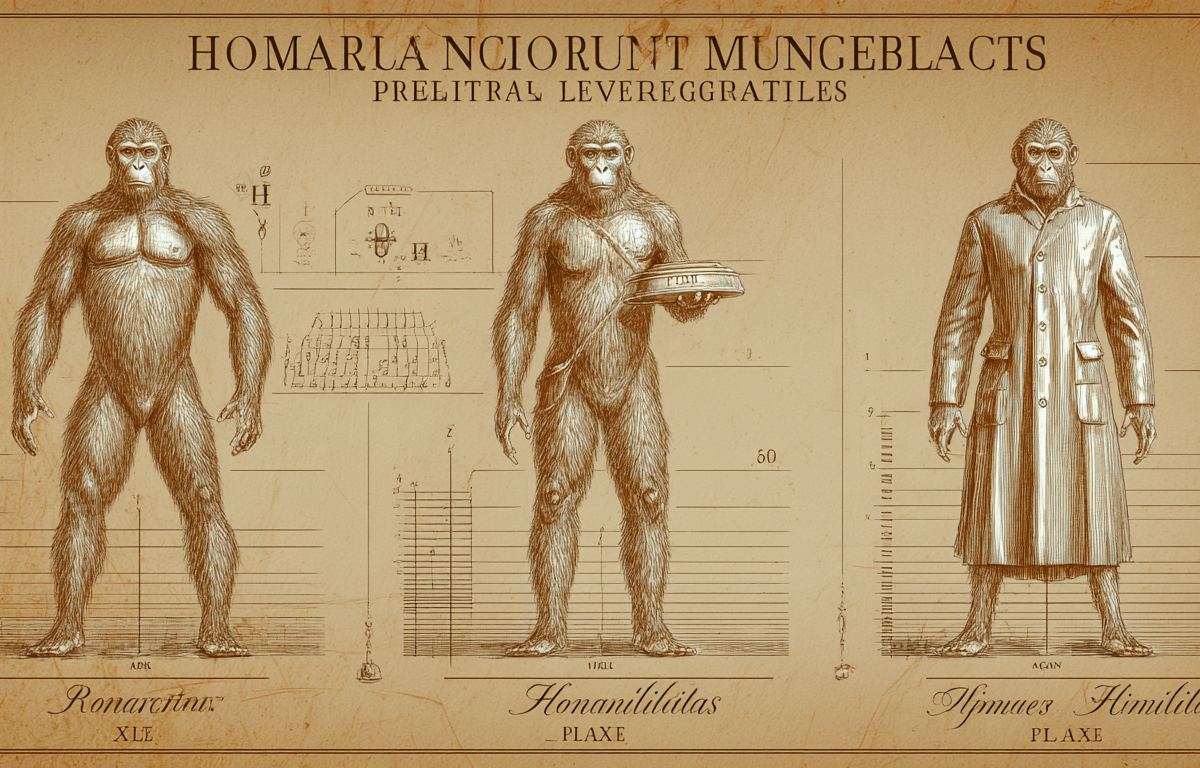
I’ve taken the day after Thanksgiving in the US to decompress with a less serious post before I get back to indexing. I came up with this concept whilst writing my essay on Homo Normalis, but I felt this was a bit too cheeky for a formal essay. This is where my thoughts led me.
A Brief Field Note from the Department of Bureaucratic Anthropology
Still reeling from the inability to fold some pan into homo, Palaeontologists are seemingly desperate for a new hominid. Some dream of discovering the ‘missing link’; others, more honest, just want something with a jawline interesting enough to secure a grant. So imagine the surprise when the latest species didn’t come out of the Rift Valley but out of an abandoned server farm somewhere outside Reading.
They’ve named it Homo Legibilis – the Readable Human. Not ‘H. normālis’ (normal human), not ‘H. ratiōnālis (rational human), but the one who lived primarily to be interpreted. A species who woke each morning with a simple evolutionary imperative: ensure one’s dataprints were tidy, current, and machine-actionable.
You’ll have seen their skeletons before, though you may not have recognised them as such. They often appear upright, mid-scroll, preserved in the amber of a status update. A remarkable creature, really. Lithe thumbs. Soft cranial matter. Eyes adapted for low-light environments lit primarily by advertisements.
Habitat
The species thrived in densely surveilled ecosystems: corporate intranets, public Wi-Fi, facial-recognition corridors, anywhere with sufficient metadata to form a lasting imprint. They built vast nests out of profiles, settings, dashboards. Territorial disputes were settled not through display or violence but through privacy-policy updates. Their preferred climate? Temperate bureaucracy.
Diet
Contrary to earlier assumptions, H. Legibilis did not feed on information. It fed on interpretation: likes, metrics, performance reviews, and algorithmic appraisal. Some specimens survived entire winters on a single quarterly report. Every fossil indicates a digestive tract incapable of processing nuance. Subtext passed through untouched.
Mating Rituals
Courtship displays involved reciprocal data disclosure across multiple platforms, often followed by rapid abandonment once sufficient behavioural samples were collected. One famous specimen is preserved alongside fourteen dating-app profiles and not a single functional relationship. Tragic, in a way, but consistent with the species’ priorities: be seen, not held.
Distinguishing Traits
Where Homo sapiens walked upright, Homo legibilis aimed to sit upright in a chair facing a webcam.
Its spine is subtly adapted for compliance reviews. Its hands are shaped to cradle an object that no longer exists: something called ‘a phone’. Ironically, some term these ‘mobiles’, apparently unaware of the tethers.
Researchers note that the creature’s selfhood appears to have been a consensual hallucination produced collaboratively by HR departments, advertising lobbies, and the Enlightenment’s long shadow. Identity, for H. legibilis, was not lived but administered.
Extinction Event
The fossil record ends abruptly around the Great Blackout, a period in which visibility – formerly a pillar of the species’ survival – became inconvenient. Some scholars argue the species didn’t perish but simply lost the will to document itself, making further study inconvenient.
Others suggest a quieter transformation: the species evolved into rumour, passing stories orally once more, slipping back into the anonymity from which its ancestors once crawled.
Afterword
A few renegade anthropologists insist Homo Legibilis is not extinct at all. They claim it’s still out there, refreshing dashboards, syncing calendars, striving to be neatly interpreted by systems that never asked to understand it. But these are fringe theories. The prevailing view is that the species perished under the weight of its own readability. A cautionary tale, really. When your survival strategy is to be perfectly legible, you eventually disappear the moment the lights flicker.





 Philosophics