Freedom: The Chains That Bind Us Together

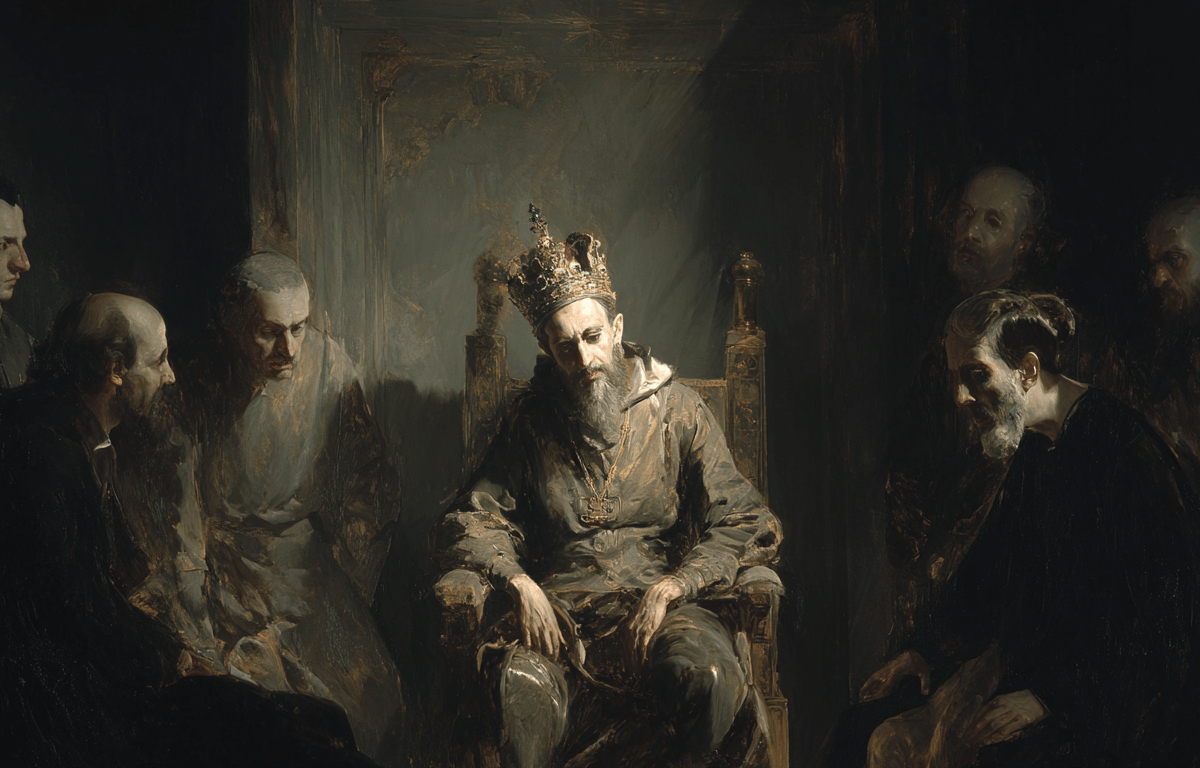
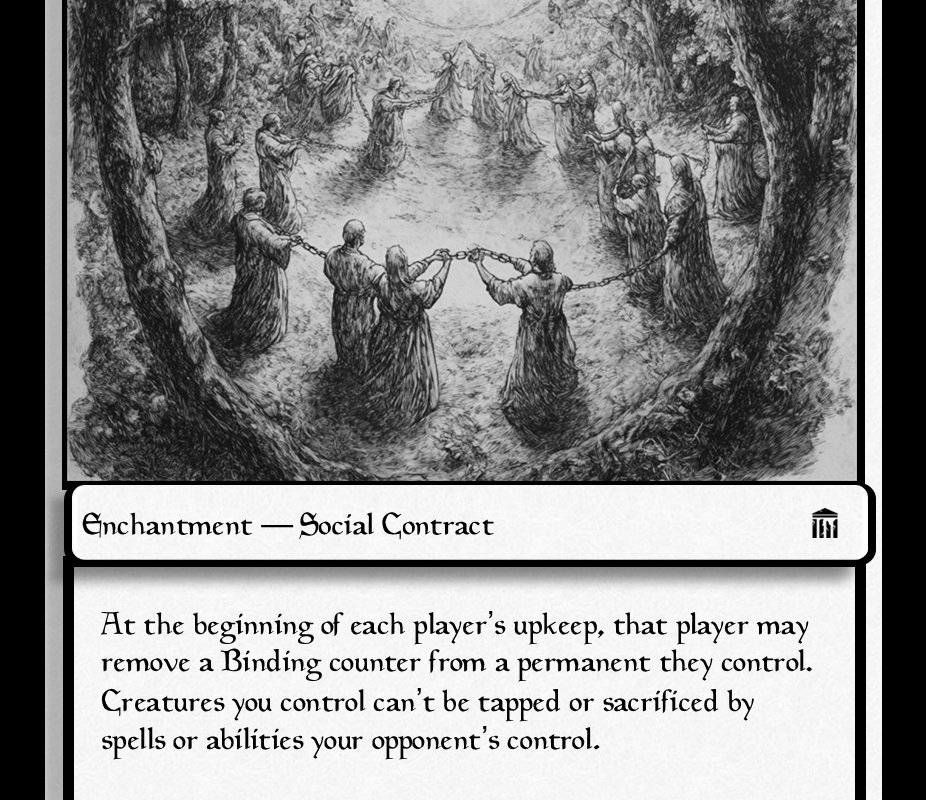
Black-and-white illustration of robed figures standing in a forest clearing, forming a circle by linking chains between their hands. The figures appear both united and restrained, illuminated by a pale, radiant light that suggests dawn or revelation. The mood is solemn yet transcendent, symbolising Rousseau’s paradox that freedom and constraint are inseparable. The image appears as a parody Magic: The Gathering card titled “Freedom,” subtitled “Enchantment — Social Contract,” with a quote from Jean-Jacques Rousseau: “To renounce liberty is to renounce being a man.” The art captures the tension between community, bondage, and liberation.

Freedom is a word so overused it’s practically anaemic. Everyone wants it; no one agrees on what it means. It’s been weaponised by tyrants and revolutionaries alike, invoked to justify both the breaking of chains and their reforging in a different metal.

Audio: NotebookLM podcast on this topic.

As I write this, I have just finished Erich Fromm’s A Sane Society. Without derailing this post, he cited a scenario – a description of work communities given in All Things Common, by Claire Huchet Bishop – where in post-WW2 France, a group formed a sort of workers’ coöperative – but it was more than that; it was an anarchosyndicalist experiment. As I read it, I had to cringe at the power ‘voluntary’ transfers that immediately got me thinking of Foucault’s biopower – as I often do. Saving this for a separate post.
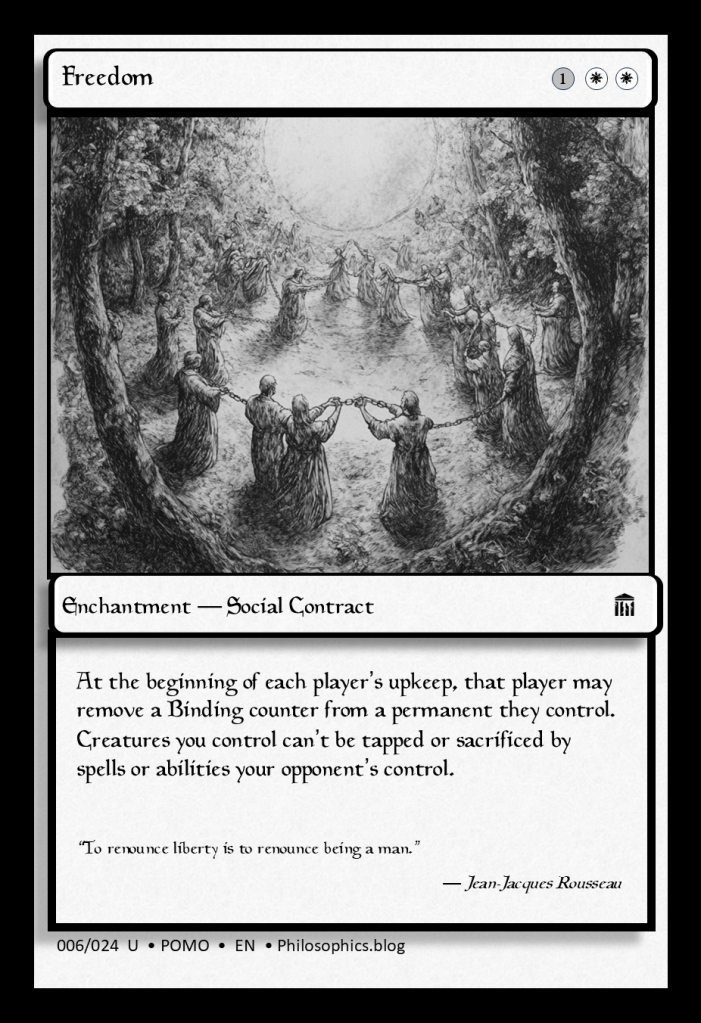
Black-and-white illustration of robed figures standing in a forest clearing, forming a circle by linking chains between their hands. The figures appear both united and restrained, illuminated by a pale, radiant light that suggests dawn or revelation. The mood is solemn yet transcendent, symbolising Rousseau’s paradox that freedom and constraint are inseparable. The image appears as a parody Magic: The Gathering card titled “Freedom,” subtitled “Enchantment — Social Contract,” with a quote from Jean-Jacques Rousseau: “To renounce liberty is to renounce being a man.” The art captures the tension between community, bondage, and liberation.
Image: Freedom: The Chains That Bind Us Together
Card 006 from the Postmodern Set – Philosophics.blog

This Critical Theory parody card, Freedom, draws its lineage from Jean-Jacques Rousseau, whose paradox still haunts the modern condition: “Man is born free, and everywhere he is in chains.” The card re-enchants that contradiction – an Enchantment – Social Contract that reminds us liberty isn’t a state but a negotiation.

The card reads:

At the beginning of each player’s upkeep, that player may remove a Binding counter from a permanent they control.
Creatures you control can’t be tapped or sacrificed by spells or abilities your opponent controls.

This is Rousseau’s dilemma made mechanical. Freedom is not absolute; it’s procedural. The upkeep represents the maintenance of the social contract—an ongoing renewal, not a one-time event. Every player begins their turn by negotiating what freedom costs. You may remove one Binding counter, but only if you recognise that binding exists.

The flavour text underlines Rousseau’s plea:

“To renounce liberty is to renounce being a man.”

Freedom, for Rousseau, wasn’t about doing whatever one pleased. It was about participating in the moral and civic order that gives action meaning. To exist outside that order is not liberty; it’s anarchy, the tyranny of impulse.

The card, therefore, resists the naïve libertarian reading of freedom as the absence of restraint. It instead depicts freedom as the capacity to act within and through shared constraints.

The art shows a ring of robed figures, hand in hand, their chains forming a circle beneath a clearing sky. It’s a haunting image: freedom through fellowship, bondage through unity. The circle symbolises Rousseau’s idea that true liberty emerges only when individuals subordinate selfish will to the general will – the common interest formed through collective agreement.

Yet there’s also a postmodern irony here: circles can be prisons too. The social contract can emancipate or suffocate, depending on who wrote its terms. The same chains that protect can also bind.

The monochrome aesthetic amplifies the ambiguity – freedom rendered in greyscale, neither utopia nor despair, but the space in between.

Rousseau’s notion of the social contract was revolutionary, but its dissonance still resonates: how can one be free and bound at the same time? He answered that only through the voluntary participation in a collective moral order can humans transcend mere instinct.

We might say that today’s democracies still operate under Freedom (Enchantment – Social Contract). We maintain our rights at the cost of constant negotiation: legal, social, linguistic. Every “Binding counter” removed is the product of civic upkeep. Stop maintaining it, and the enchantment fades.

The card hints at the price of this enchantment: creatures (citizens) can’t be tapped or sacrificed by opponents’ control. In other words, autonomy is secured only when the system prevents external domination. But systems fail, and when they do, the illusion of freedom collapses into coercion.

Rousseau earns a complicated respect in my philosophical canon. He’s not in my top five, but he’s unavoidable. His concept of freedom through the social contract anticipates both modern liberalism and its critique. He believed that genuine liberty required moral community – a notion now eroded by hyper-individualism.

Freedom, as I’ve rendered it here, isn’t celebration. It’s lamentation. The card is about the fragility of the social spell that keeps chaos at bay. We remove one binding at a time, hoping not to unbind ourselves entirely.

The Sane Society, Revisited: Why Work Still Drives Us Mad

4–6 minutes

Erich Fromm’s The Sane Society turns seventy this year, and like a ghost of reason past, it refuses to leave. His target was Capitalism™ – not merely as an economic system, but as a psychic infection. Replace the word factory with Zoom call, and his diagnosis reads like yesterday’s corporate newsletter. We’ve upgraded our machines but not our misery.

Aside from its psychobabble, The Sane Society, published in 1954, reads almost like it could have been written in 2024. I’d go out on a limb and claim it will still be relevant in 2054 – because Capitalism™ and the relationship it creates between humans and machines, and humans and other humans. It’s a divisive ideology. I’ve read a lot of content on employee engagement in the past decade. I’d been exposed to it in my Organisational Behaviour courses in the late ’80s. Things were going to change. We’d plotted a future.

Audio: NotebookLM podcast on this topic.

Only nothing material has changed. We pretended to notice the problem and fix it, but the people reporting the issue and the people in charge did not share a worldview. And the young managers who were taught about the challenge were either not promoted or changed their tune to facilitate their own promotion. Funny how the selection process favours groupthink over diversity of opinion.

Video: Apathetic Office Worker

On balance, most people tend to hate or be otherwise dissatisfied with their jobs. This is nothing new. It was true before Fromm’s book, and it is true now. I published a series of posts on prostitution in 2018 and discovered that escorts had better job satisfaction than the larger population. Let that sink in.

‘…the vast majority of the population work as employees with little skill required, and with almost no chance to develop any particular talents, or to show any outstanding achievements. While the managerial or professional groups have at least considerable interest in achieving something more or less personal, the vast majority sell their physical, or an exceedingly small part of their intellectual capacity to an employer to be used for purposes of profit in which they have no share, for things in which they have no interest, with the only purpose of making a living, and for some chance to satisfy their consumer’s greed.

Dissatisfaction, apathy, boredom, lack of joy and happiness, a sense of futility and a vague feeling that life is meaningless, are the unavoidable results of this situation. This socially patterned syndrome of pathology may not be in the awareness of people; it may be covered by a frantic flight into escape activities, or by a craving for more money, power, prestige. But the weight of the latter motivations is so great only because the alienated person cannot help seeking for such compensations for his inner vacuity, not because these desires are the “natural” or most important incentives for work.

Fromm, ever the optimist, thought alienation might be cured through self-awareness and communal values. The twentieth century politely ignored him, opting instead for mindfulness apps and performance reviews.

I’ve excised the psychobabble, but he continues…

‘But even the data on conscious job satisfaction are rather telling. In a study about job satisfaction on a national scale, satisfaction with and enjoyment of their job was expressed by 85 per cent of the professionals and executives, by 64 per cent of whitecollar people, and by 41 per cent of the factory workers. In another study, we find a similar picture: 86 per cent of the professionals, 74 per cent of the managerial, 42 per cent of the commercial employees, 56 per cent of the skilled, and 48 per cent of the semi-skilled workers expressed satisfaction.

‘We find in these figures a significant discrepancy between professionals and executives on the one hand, workers and clerks on the other. Among the former only a minority is dissatisfied—among the latter, more than half. Regarding the total population, this means, roughly, that over half of the total employed population is consciously dissatisfied with their work, and do not enjoy it. If we consider the unconscious dissatisfaction, the percentage would be considerably higher. Taking the 85 per cent of “satisfied” professionals and executives, we would have to examine how many of them suffer from psychologically determined high blood pressure, ulcers, insomnia, nervous tension and fatigue. Although there are no exact data on this, there can be no doubt that, considering these symptoms, the number of really satisfied persons who enjoy their work would be much smaller than the above figures indicate.

‘As far as factory workers and office clerks are concerned, even the percentage of consciously dissatisfied people is remarkably high. Undoubtedly the number of unconsciously dissatisfied workers and clerks is much higher. This is indicated by several studies which show that neurosis and psychogenic illnesses are the main reasons for absenteeism (the estimates for the presence of neurotic symptoms among factory workers go up to about 50 per cent). Fatigue and high labor turnover are other symptoms of dissatisfaction and resentment.’

In the twenty-first century, job dissatisfaction has increased even more. To me, it’s interesting to consider how many people harken back to the ‘good old days’, yet there is little evidence to support the view. Almost schizophrenically, others look to the promise of the future and technology, yet this is simply another narrative with no basis in fact.

The irony is that we’ve automated everything except fulfilment. Even our dissatisfaction has become efficient – streamlined, quantified, and monetised. Fromm warned that the sickness of society was its sanity. On that front, we’re positively thriving.

Stand by for more sanity to follow…

The Will to Be Ruled: Totalitarianism and the Fantasy of Freedom

1–2 minutes

The latest addition to the Anti-Enlightenment Project is now live on Zenodo:
The Will to Be Ruled: Totalitarianism and the Fantasy of Freedom

Modern liberal democracies still chant the Enlightenment’s refrain: the rational, self-governing individual acting freely within a moral order of their own design. It’s an elegant myth – until the self begins to wobble. Under economic, cultural, and epistemic strain, autonomy curdles into exhaustion, and exhaustion seeks relief in obedience.

Audio: NotebookLM podcast of this essay. Please note that this audio summarises the entire essay. As such, it’s also longer than most, coming in at just under 40 minutes. I listened to it, and I feel it does a good job of capturing the essences of the essay. Of course, you could read the essay more quickly, but the perspective may still be helpful.

This essay traces that drift – from the Enlightenment’s causa sui complex to the ecstatic submission that defines modern authoritarianism. Drawing on Fromm, Arendt, Adorno, Reich, Han, and Desmet, it explores how freedom’s rhetoric becomes its opposite: obedience moralised as virtue, conformity sold as courage, submission experienced as pleasure.

At its core, The Will to Be Ruled argues that totalitarianism is not the antithesis of Enlightenment reason but its fulfilment. Once the world is rendered intelligible only through rational mastery, the subject inevitably longs to be mastered in return.

The closing section introduces Dis-Integrationism – a philosophical stance that declines redemption, preferring maintenance over mastery. It offers no cure, only the small ethic of attentiveness: keeping the field responsive while the light fades.

Filed under the Anti-Enlightenment Project, this essay completes the current thematic triad alongside Objectivity Is Illusion and Against Agency.

NB: This essay was inspired in part by Desmet’s The Psychology of Totalitarianism and this video:

Video: The Modern World, Totalitarianism and the Brain with Iain McGilchrist & Mattias Desmet

Man in Capitalistic Society

This is Chapter 5 of Erich Fromm’s The Sane Society. I’ve had this on my bookshelf for quite a while and wasn’t sure how a 70-year-old book could have so much relevance, but it does. Granted, some of it is irrelevant, a victim of the period it was written. This happens.

What strikes me about this chapter is the historical perspective it provides on capitalism. I’m an academic economist. I taught undergraduate economics for the better part of a decade. I’ve read (and recommend reading) Marx’s Capital firsthand.

Audio: NotebookLM Podcast commentary on this content.

Fromm adds additional details here. Firstly, he notes that the capitalism that marked the early days of the Industrial Revolution—the seventeenth and eighteenth centuries—differed from that of the nineteenth and twentieth centuries. The earlier period still had cultural and moral tethers that became frayed or lost in later periods. Without regurgitating the chapter, I cite some themes:

“this underselling practice is grown to such a shameful height, that particular persons publicly advertise that they undersell the rest of the trade.”

People were not very keen on price cutting as a competitive mechanism.

They also note the unfair competitive advantage of the monied elites who could buy materials in cash instead of credit and could thereby undercut prices, who would have to account for paying interest rates or markups on credit.

Whilst in the twentieth century, regulating undercutting is seen as protectionism, the earlier centuries had no problems defending merchants. We do have laws on the ebooks that prevent dumping, but these are rarely enforced, and when they are, it’s a political rather than economic statement. In practice, but done in the name of economics are politics in the same manner as science was used as cover to implement policy during the COVID-19 debacle.

Montesquieu says “that machines which diminish the numbers of workers are ‘pernicious’.” This sentiment echoes the current sentiments about robotics and artificial intelligence.

Nineteenth-century capitalism saw man as the measure of all things supplanted by capital. This is the capitalism Marx rails against—profits over humanity and society, the pursuit of local maxima at the expense of global maxima. This is also where the goal of hypergrowth and growth for growth’s sake came into vogue, ushering us into the Modern Age of Modern ideals—science, progress, order, and so on.

I won’t exhaust the chapter here, but for what it is, it’s a relatively light read. Whether I comment on later chapters depends on whether they engage me. Cheers.

Are We Sane? Can a Society Be Sick?

These are the first two chapter titles of Erich Fromm’s The Sane Society. I suspect I’ll be reading this book twice for good measure. I’m four chapters in, with three to go, and eager for a deeper dive.

Despite being published in 1955, Fromm’s analysis remains strikingly relevant. Mark Fisher picks up a similar thread in Capitalist Realism: Is There No Alternative?, but whereas Fisher dissects the ideological stranglehold of late capitalism, Fromm, as a psychiatrist, turns the lens on human nature itself. He questions the very concept of normalcy—something we tend to accept uncritically, much like Michel Foucault would in the following generation.

I’ll hold off on any sweeping conclusions until I’ve finished the book (and, more likely, after a second read). But for now, consider this a tentative recommendation. Snow Crash was an amusing detour, but non-fiction is where I feel most at home.