“We Hold These Truths”: An Annotated Failure

9–13 minutes

On Self-Evidence, Personhood, and the Administrative Nature of Rights

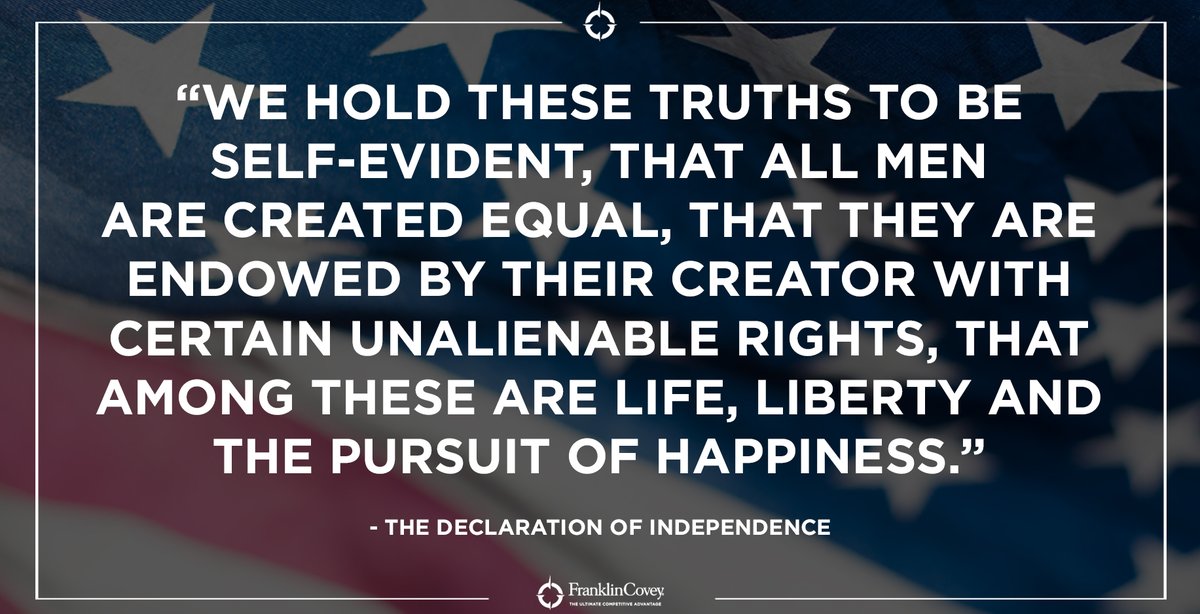
The following sentence is among the most quoted in political history and among the least examined. It is invoked as moral bedrock, taught as civic catechism, and insulated from scrutiny by a reverence that mistakes repetition for comprehension. It is rarely read closely, and rarely read sceptically.

Audio: NotebookLM summary podcast of this topic.

What follows is not a rebuttal. It is an annotation.

Most readers will recognise this as the opening of the Declaration of Independence by the United States of America. Recognition, however, is not comprehension. The sentence survives on familiarity. Once that familiarity is set aside, it begins to fail clause by clause.

I. A Best Case, Briefly

A more charitable reading deserves brief consideration. ‘Self-evident’, in the intellectual context of the eighteenth century, did not mean obvious in the sense of requiring no reflection. It referred instead to propositions taken as axiomatic: not inferred from prior premises, but serving as starting points for reasoning. On this view, influenced by Scottish Common Sense philosophy, the claim is not that these truths are psychologically irresistible, but that they are rationally basic.

Likewise, ‘we hold’ need not be read as an admission of arbitrariness. It may be understood as a public avowal: a political body formally affirming what reason is said to disclose, rather than grounding those truths in the act of holding itself. Read this way, the sentence does not collapse into mere opinion.

Finally, the Declaration is often understood as performative rather than descriptive.[1] It does not merely state political facts; it brings a political subject into being. The ‘we’ is constituted in the act of declaration, and the language functions as a founding gesture rather than a philosophical proof.

Even on this charitable reading, however, the appeal to rational self-evidence presupposes capacities that were unevenly distributed at best. The Enlightenment notion of ‘reason’ was never a raw human faculty equally available to all. It depended on literacy, education, leisure, and institutional participation—conditions enjoyed by a narrow segment of the population.

In the late eighteenth century, large portions of the population were functionally illiterate. The ability to engage abstract political principles, to treat propositions as axiomatic starting points for reasoning, was not merely rare but socially restricted. The universal address of the sentence thus rests on a practical contradiction: it invokes a form of rational accessibility that its own social conditions actively prevented.

Nor is this merely a historical observation. Whilst formal literacy has expanded, the distribution of the capacities required for sustained abstract reasoning remains sharply constrained. What has changed is scale, not structure. Appeals to ‘self-evident’ political truths still presuppose forms of cognitive access that cannot be assumed, even now.

There is an important distinction here between innocent misreading and bad-faith translation. A modern reader who takes ‘self-evident’ to mean what it now ordinarily means is not at fault; semantic drift makes this nearly unavoidable. But to continue reading the sentence this way once its historical and philosophical context is understood is no longer an error. It is a decision.

Under the principle of least effort, claims that present themselves as ‘self-evident’ are maximally efficient. They require no sustained attention, no conceptual labour, and no challenge to inherited categories. For individuals ill-equipped – by education, time, or institutional support – to interrogate abstract political claims, such language is not merely persuasive; it is relieving.

To accept a proposition as self-evident is to be spared the burden of understanding how it works. The sentence can be consumed whole, in a single uncritical gulp. What is swallowed is not an argument, but a posture: assent without inquiry, agreement without comprehension.

This is not a personal failing. It is the predictable outcome of a cognitive environment in which complexity is costly, and authority is familiar. ‘Self-evidence’ functions here as a labour-saving device, converting political commitments into ready-made certainties. The capacity to recognise self-evident truths thus functions as an unmarked prerequisite for political subjecthood – a gatekeeping mechanism that precedes and enables the more explicit exclusions to come.

With this in mind, the sentence can be examined clause by clause – not as philosophical proposition, but as rhetorical machinery.

II. An Annotated Deconstruction

To whom does this ‘we’ apply? Who is included in this collective voice, and who is not? More importantly, what does it mean to hold something that is allegedly self-evident?

Holding is an act of maintenance. It implies agreement, reinforcement, repetition. Beliefs must be held; axioms must be held; norms must be held. Self-evidence, by contrast, is supposed to require none of this. If a truth is genuinely self-evident, it does not need to be held at all. It simply imposes itself.

The opening clause announces immediacy whilst confessing mediation. This is not a subtle tension. It is an outright contradiction. The sentence begins by undermining its own epistemic posture. The axiomatic framing does not eliminate contestability; it displaces it. What is presented as rational starting point functions, in practice, as rhetorical closure.

What kind of truths are being held here?

The word does far too much work whilst remaining resolutely undefined. These are not empirical truths. They are not logical truths. They are not even clearly moral truths in the narrow sense. Instead, the term oscillates between epistemic certainty, moral assertion, and political aspiration, sliding between categories without ever settling long enough to be examined.

The pluralisation matters. By multiplying ‘truths’ whilst leaving their nature unspecified, the sentence creates an aura of obviousness without committing to a standard of justification. Disagreement is pre-empted not by argument, but by tone.

Unless one invokes something like Descartes’ cogito as a limiting case, nothing is genuinely self-evident. Even the cogito depends on language, conceptual inheritance, and a shared grammar of doubt. Self-evidence is not an epistemic given; it is an experiential effect produced by familiarity, stability, and low resistance.

Here, ‘self-evident’ functions as rhetorical closure masquerading as epistemology. It does not establish certainty; it enforces silence. To question what is ‘self-evident’ is to risk being cast as obtuse, perverse, or acting in bad faith. Inquiry is not answered. It is short-circuited.

This is not the inclusive ‘men’ of abstract mankind. It is a concrete, historically bounded category: adult males, and not coincidentally white ones. The exclusions are not implied later. They are operative here, at the point of entry.

This is the quietly active boundary of the entire sentence. Before any rights are named, before any equality is asserted, the scope of applicability has already been narrowed. The universal tone is achieved by selective admission.

Created by whom? And equal in what respect?

The notion of equality here is never specified, because specification would immediately expose contestation. Equal in capacity? In worth? In standing before the law? In outcome? In moral consideration? Readers are invited to supply their preferred interpretation retroactively, which is precisely what allows the sentence to endure.

Some have suggested that ‘equal’ means ‘equal under the law’, but this simply defers the problem. The law defines equality however it pleases, when it pleases, and for whom it pleases. Equality without a metric is not a claim. It is a metaphysical gesture.

It is often said that the Declaration’s universal language contained the seeds of its own expansion. That Douglass, King, and the suffragists appealed to it is taken as evidence of its latent emancipatory power. But this confuses rhetoric with causation. These advances were not the unfolding of a promise, but the result of sustained political pressure, moral confrontation, and material struggle. The language was repurposed because it was available and authoritative, not because it was prophetic.

To call this a ‘promissory note’ is to mistake a battlefield for a contract. Promises are kept by their authors. These were extracted by those excluded, often in direct opposition to the very institutions that sanctified the sentence.

The story also flatters the present. If the promise is always being fulfilled, it is never being broken. Yet the same language remains actively contested, narrowed, and rescinded. Personhood is still conditional. Rights still evaporate at borders, prisons, and classifications. The note, if it exists at all, is perpetually past due.

No one believes the drafters were referring to genetics or parentage. This capital-C Creator is a theological move, not a biological one. The sentence quietly abandons the pretence of self-evidence and imports divine authority as a grounding mechanism.

This is not incidental. By placing rights beyond human origin, the sentence renders them simultaneously unquestionable and unreachable. Legitimacy is outsourced to a source that cannot be interrogated. Appeals are closed by design.

Here the sentence delivers a double assertion. First, that rights exist independently of institutions. Second, that they cannot be taken away. Both claims fail on contact with history.

Rights are constructed, recognised, enforced, suspended, and withdrawn by institutions. Bentham saw this clearly: ‘natural rights’ function rhetorically to obscure the institutional conditions that alone make rights actionable.[2] And far from being inalienable, rights prove remarkably fragile. The record is unambiguous: rights track status, not humanity. The moment personhood is questioned, rights do not need to be violated. They simply cease to apply.

Under the Language Insufficiency Hypothesis – the framework treating key political terms as structurally underdetermined – these are textbook Contestables.[3] None are measurable. None have stable definitions. None come with clear thresholds or enforcement criteria.

‘Happiness’ is the most revealing substitution of all. Locke’s blunt ‘property’ at least named what was being protected.[4] ‘Happiness’ softens the promise whilst emptying it of content. It gestures toward flourishing whilst committing to nothing beyond tolerable participation.

Life, liberty, and happiness are curated abstractions, not guarantees – property in softer clothing.

III. Personhood as the Hidden Mechanism

Zooming out, the operational logic becomes clear. Rights depend on personhood.[5] Personhood is conferred, not discovered. Declaring non-personhood resolves the contradiction without ever touching the rhetoric.

This is the mechanism that allows a universal language to coexist with selective application. When personhood is withdrawn, rights are not violated. They are bypassed. Ethics never gets a hearing, because the subject has already been administratively erased.

To call this administrative is not metaphor. Personhood is assigned, reclassified, and revoked through documentation, categorisation, and procedural determination. The question of who counts is settled before any ethical consideration can begin.

IV. The Sentence as Prototype, Not Mistake

It is tempting to read this sentence as naïve, hypocritical, or aspirationally flawed. That would be a mistake. The sentence is not a failure of Enlightenment thinking. It is its prototype.

It was never meant to survive scrutiny. It was meant to mobilise, stabilise, and legitimise. Its vagueness is functional. Its incoherence is load-bearing. The sentence works precisely because it is conceptually promiscuous, rhetorically elevated, and operationally evasive. What looks like philosophical sloppiness is political engineering.

V. Why It Still Matters

This sentence is not an historical curiosity. It is the template for modern political language.

  1. Universal in tone.
  2. Conditional in application.
  3. Moral in rhetoric.
  4. Administrative in practice.

The future did not reveal the sentence to be false. It revealed what the sentence was for.


Footnotes

[1] J.L. Austin, How to Do Things with Words

[2] Jeremy Bentham, Anarchical Fallacies; Being an Examination of the Declarations of Rights Issued During the French Revolution

[3] See The Language Insufficiency Hypothesis for a full treatment of Contestables and their function in political discourse.

[4] John Locke, Two Treatises of Government

[5] Hannah Arendt, The Origins of Totalitarianism

NB: I wrote this as a polemic rather than in a manner suitable for a journal submission. I did not wish to expend the effort to understand counterarguments. This interpretation stands on its own. This said, in Section I. I still note some historical perspective that is somewhat important. It even illustrates semantic drift, which I cover in A Language Insufficiency Hypothesis.

Decolonising the Mind

Ngũgĩ wa Thiong’o published “Decolonising the Mind” in 1986. David Guignion shares a 2-part summary analysis of the work on his Theory and Philosophy site.

I used NotebookLLM to produce this short podcast: [Content no longer extant] https://notebooklm.google.com/notebook/7698ab0b-43ab-47d4-a50f-703866cfb1b9/audio

Decolonising the Mind: A Summary

Ngũgĩ wa Thiong’o’s book Decolonising the Mind centres on the profound impact of colonialism on language, culture, and thought. It argues that imposing a foreign language on colonised people is a key tool of imperial domination. This linguistic imperialism leads to colonial alienation, separating the colonised from their own culture and forcing them to view the world through the lens of the coloniser.

Here are some key points from the concept of decolonising the mind:

  • Language is intimately tied to culture and worldview: Language shapes how individuals perceive and understand the world. When colonised people are forced to adopt the language of the coloniser, they are also compelled to adopt their cultural framework and values.
  • Colonial education systems perpetuate mental control: By privileging the coloniser’s language and devaluing indigenous languages, colonial education systems reinforce the dominance of the coloniser’s culture and worldview. This process results in colonised children being alienated from their own cultural heritage and internalising a sense of inferiority.
  • Reclaiming indigenous languages is crucial for decolonisation: wa Thiong’o advocates for a return to writing and creating in indigenous African languages. He sees this as an act of resistance against linguistic imperialism and a way to reconnect with authentic African cultures. He further argues that it’s not enough to simply write in indigenous languages; the content must also reflect the struggles and experiences of the people, particularly the peasantry and working class.
  • The concept extends beyond literature: While wa Thiong’o focuses on language in literature, the concept of decolonising the mind has broader implications. It calls for a critical examination of all aspects of life affected by colonialism, including education, politics, and economics.

It is important to note that decolonising the mind is a complex and ongoing process. There are debates about the role of European languages in postcolonial societies, and the concept itself continues to evolve. However, wa Thiong’o’s work remains a seminal text in postcolonial studies, raising crucial questions about the enduring legacy of colonialism on thought and culture.

Declaration of Independence

It’s July. The season of independence in the United States. Independence from the overt tyranny of Britain, but not from the tacit tyranny of their government—the government purported to be ‘of the people, by the people, and for the people‘ per Abraham Lincoln’s 1863 Gettysburg Address. As their Constitution reads, ‘We the People‘. Governments may be of the people and by the people, but governments are an emergent phenomenon as happens when oxygen and hydrogen combine just so and create water. Two gases combine to create a new substance—water. Some forget that, like water, government are a distinct element to the people that constitute it. Some think it resembles them. It doesn’t. It’s Hobbes’ Leviathan—or a Jabberwok.

In preparation for the traditional Summer season, I took to reading Derrida’s 1976 essay, Declarations of Independence. It was interesting, but I was hoping to get more from it. I decided to deconstruct the opening paragraph—the preamble—of the Declaration of Independence:

Deconstructing Binary Oppositions

Self-Evident vs. Non-Self-Evident

The Declaration boldly asserts that ‘these truths’ are ‘self-evident’,’ a claim that is nothing more than a rhetorical trick. By presenting these ideas as self-evident, the authors seek to place them beyond questioning, discouraging dissent and critical examination. In reality, these ‘truths’ are far from universal; they are the product of a specific cultural and historical context, shaped by the interests and perspectives of the privileged few who drafted the document.

Interrogating Assumptions and Hierarchies The Declaration of Independence asserts that certain truths are ‘self-evident’, implying that these truths are so obvious that they require no further justification. However, the concept of self-evidence itself is far from universally accepted. It is deeply embedded in the philosophical tradition of Enlightenment rationalism, which holds that reason and logic can reveal fundamental truths about the world.

  1. Philosophical Foundations of Self-Evidence
    • Enlightenment Rationalism: The idea of self-evidence relies heavily on Enlightenment rationalism, which posits that certain truths can be known directly through reason and are therefore beyond dispute. Philosophers such as René Descartes and Immanuel Kant emphasised the power of human reason to uncover self-evident truths. Descartes, for instance, argued for the self-evident nature of ‘Cogito, ergo sum‘ (‘I think, therefore I am’) as a fundamental truth (Descartes, Meditations on First Philosophy).
    • Critique of Rationalism: Critics of Enlightenment rationalism, including existentialists like Friedrich Nietzsche and phenomenologists like Martin Heidegger, argue that what is considered self-evident is often culturally and historically contingent. Nietzsche, for example, contended that what we take as ‘truth’ is a product of our perspective and historical context, not an absolute given (Nietzsche, Beyond Good and Evil).
  2. Cultural and Philosophical Contingency
    • Cultural Relativity: Different cultures and philosophical traditions may not find the same truths to be self-evident. For instance, the concept of individual rights as self-evident truths is a product of Western liberal thought and may not hold the same self-evident status in other cultural frameworks. In many Eastern philosophies, the focus is more on community and harmony rather than individual rights.
    • Subjectivity of Self-Evidence: The term ‘self-evident’ implies an inherent, unquestionable truth, yet what one group or culture finds self-evident, another may not. This variability reveals the instability and subjectivity of the claim. For example, in traditional Confucian societies, the emphasis is placed on hierarchy and duty rather than equality and individual rights, demonstrating a different set of ‘self-evident’ truths.
  3. Constructed Nature of Truth
    • Language and Context: Jacques Derrida’s concept of différance illustrates how meaning is not fixed but constantly deferred through language. What we consider to be “truth” is constructed through linguistic and social contexts. Derrida argues that texts do not have a single, stable meaning but rather a multiplicity of interpretations that change depending on the reader’s perspective and context (Derrida, Of Grammatology).
    • Social Construction: Michel Foucault’s analysis of power and knowledge further deconstructs the notion of objective truth. Foucault argues that what is accepted as truth is produced by power relations within society. Truths are constructed through discourses that serve the interests of particular social groups, rather than being objective or self-evident (Foucault, Discipline and Punish).

Created Equal vs. Not Created Equal

The Declaration’s claim that ‘all men are created equal’ is a blatant falsehood, a manipulative promise designed to appease the masses whilst maintaining the status quo. The glaring contradictions of slavery and gender inequality expose the hollowness of this assertion. Equality, as presented here, is nothing more than an ideological construct, a tool for those in power to maintain their dominance while paying lip service to the ideals of justice and fairness.

Creator vs. No Creator

The Declaration refers to a ‘Creator’ who endows individuals with rights, grounding its claims in a divine or natural law. This invokes a theistic worldview where moral and legal principles are derived from a higher power. However, Derrida challenges this by showing that the concept of a creator is a cultural and philosophical construct, not a universal truth.

The presence of the creator in the text serves to legitimise the rights it declares. However, this legitimacy is contingent on accepting the cultural narrative of a creator. Secular and non-theistic perspectives are marginalised by this assertion, revealing the ideological biases inherent in the Declaration. The authority of the declaration is thus shown to be dependent on particular beliefs, rather than an objective reality.

Unalienable vs. Alienable

The notion of ‘unalienable Rights’ is another empty promise, a rhetorical flourish designed to inspire loyalty and obedience. In practice, these supposedly inherent and inviolable rights are regularly violated and denied, particularly to those on the margins of society. The Declaration’s lofty language of ‘Life, Liberty and the pursuit of Happiness’ rings hollow in the face of systemic oppression and injustice. These rights are not unalienable; they are contingent upon the whims of those in power.

Conclusion

Through this deconstruction, we expose the Declaration of Independence for what it truly is: a masterful work of propaganda, filled with false promises and manipulative rhetoric. The document’s purported truths and self-evident principles are revealed as arbitrary constructs, designed to serve the interests of the powerful while placating the masses with empty platitudes.

As some celebrate this 4th of July, let us not be fooled by the high-minded language and lofty ideals of our founding documents. Instead, let us recognise them for what they are: tools of control and manipulation, employed by those who seek to maintain their grip on power. Only by constantly questioning and deconstructing these texts can we hope to expose the truth behind the facade and work towards a more genuine understanding of freedom and equality.

References

  • Jacques Derrida, “Declarations of Independence,” in Negotiations: Interventions and Interviews 1971-2001, ed. Elizabeth Rottenberg (Stanford: Stanford University Press, 2002).
  • Jacques Derrida, Of Grammatology (Baltimore: Johns Hopkins University Press, 1976).
  • Friedrich Nietzsche, Beyond Good and Evil (Cambridge: Cambridge University Press, 2002).
  • Michel Foucault, Discipline and Punish: The Birth of the Prison (New York: Vintage Books, 1995).
  • Immanuel Kant, Critique of Pure Reason (Cambridge: Cambridge University Press, 1998).
  • René Descartes, Meditations on First Philosophy (Cambridge: Cambridge University Press, 1996).

Superinstitutional Heros

I’ve never been a comic book guy or into heroes or superheroes. In fact, I have always had a thing for the underdog. This article points out The Batman’s Privilege Problem. I’ve skimmed a few comic books and graphic novels, and I’ve seen a few movies, but I am not really steeped in this space to speak to the nuance—and there is probably a difference between comics and graphic novels, but like I said: not inters. I just don’t identify with most of it. Not the violence. Not the Truth, Justice, and the American way of legacy Superman. But I do sense a privilege problem. Defenders of the status quo. I wonder if comic book aficionados tend to be more politically Conservative.

A quick Google search, and I’m mostly correct. Evidently, Marvel authors trend toward the Right. This article ranks some figures Conservative, Centrist, and Left, although the Left feel more Liberal than Left, and they are all constitutionalists. Apparently, X-Men were born of the Civil Rights movement in America in the 1960s. Still not my bag. Where are the Anarchists? At this rate, I’d settle for a Marxist.

One last mention: this piece points out that even where there are prominent social justice issues raised in one or another comic, the subtext (or overarching meta) is Conservative. This likely creates tension in a manner of speaking, but it creates dissonance for me.

I don’t have much more to add, but the article caught my fancy. It resonated for me, and having not posted for a while, I figured what the hell.

Your Morals – Part 3 of 3

Continuing my responses to Johnathan Haidt’s Morality survey…

25. I believe the strength of a sports team comes from the loyalty of its members to each other

Who TF cares about a sports team or where their loyalty comes from, whatever that even means. And the strength of what exactly? Players move from team to team with ease, and they are obliged to win in order to advance their own interests and personal glory. Weaker players can coattail by association to their team or their league.

26. I think children should be taught to be loyal to their country

Smh. No. I think that countries should be abolished. Children should be taught how arbitrary countries are and how they divide more than they unite.

27. In a fair society, those who work hard should live with higher standards of living

Weasel words—fair, hard, work, higher, and living standards. Perhaps the answer can be found in the definitions, like divining with tea leaves.

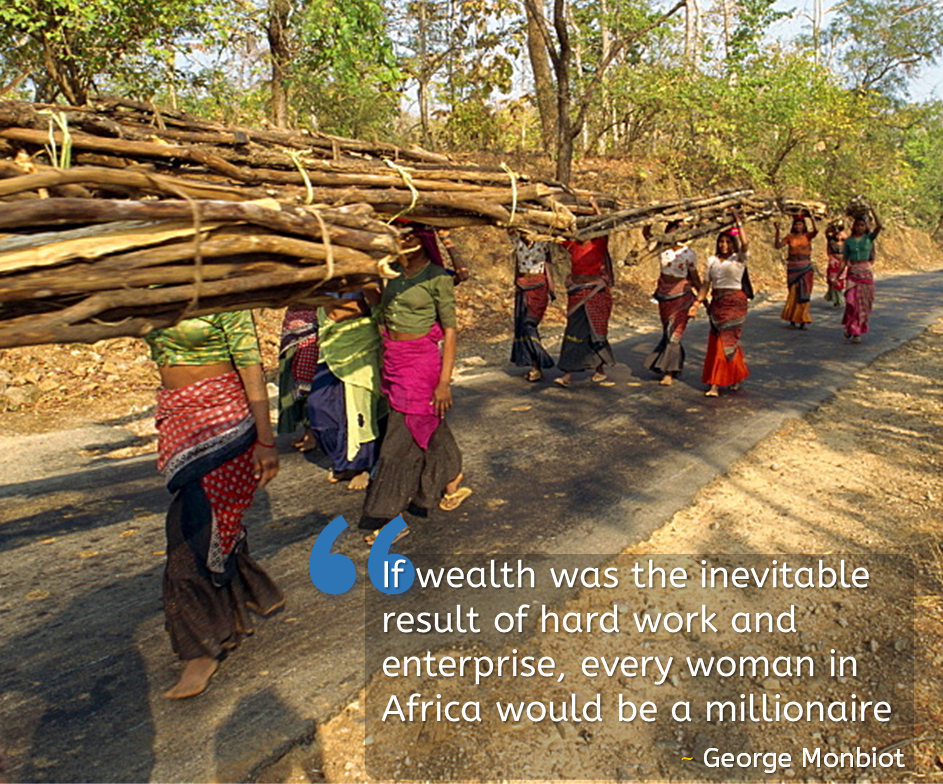
Hard Work & Enterprise

28. I believe that everyone should be given the same quantity of resources in life

What resources? A family with no children doesn’t need children’s shoes and clothing. A vegan doesn’t need a side of beef. What is this asking?

29. The world would be a better place if everyone made the same amount of money

I agree. And the amount should be zero. Didn’t I already answer this one?

30. I believe it would be ideal if everyone in society wound up with roughly the same amount of money

What is this obsession with money? I guess this is a reflection on Harvard. Get over it.

31. People should try to use natural medicines rather than chemically identical human-made ones

What? Sure. Maybe. I suppose if they are identical. Are they cheaper or free? Are they dosage- and quality-controlled? What is the function of the infinitive try to?

32. I believe chastity is an important virtue

Not more virtue. Make it stop. Chastity is defined as the state or practice of refraining from extramarital, or especially from all, sexual intercourse. This would be important why? And how would it be a virtue by any measure?

33. I think obedience to parents is an important virtue

Just why?

34. I admire people who keep their virginity until marriage

How would I know? Why would I admire them? I understand the traditional and statutory function of marriage, but this anachronistic chattel arrangement doesn’t need to exist.

35. Everyone should defend their country, if called upon

Perhaps we should abolish countries and property. What are the defending—their unique way of life? Their awesome achievements or prospects thereof? The dirt and natural resources? The buildings? Some mythos? Just no. If politicos want to fight for imaginary boundaries, let them fight it out in an old school cage match.

36. If I found out that an acquaintance had an unusual but harmless sexual fetish I would feel uneasy about them

Define harmless. Does this fetish involve me? If not, I don’t care. Might I roll my eyes? Perhaps. Might I laugh? Sure.

Summary

Having commented in some form or fashion on each of these questions, I can remain unmoral. Morality is an exercise in mental masturbation and power. As should be obvious by now, morality presumes that one subscribes to some underlying and supposed metanarratives.

In the end, reflecting upon other sources, a certain sense of what might be considered to be a moral compass may be present in infants and children, but these can be (and are) manipulated through education, books, entertainment from TV and movies to sports to civic instruction and all sorts of propaganda. So, the point that wee folk have propensities for certain behaviours is all well and good, but this feels an awful like confirmation bias in full view. Of course, it might be considered to be immoral to raise classless, less judgmental children especially if they make choices different to the leaders.

Equality. Equity. Egality.

I can’t count how many times I’ve seen takes on this equality versus equity meme. One appeared on by LinkedIn feed this morning and I wanted to comment. I thought I’d have posted on this before and wanted to link to it. If I did, I couldn’t find it, so here’s a fresh accounting. I searched Google for the original image and cobbled together my own versions, if only for visual continuity.

 L’homme est né libre, et partout il est dans les fers.

Jean-Jacques Rousseau
Social Equality vs. Equity Meme

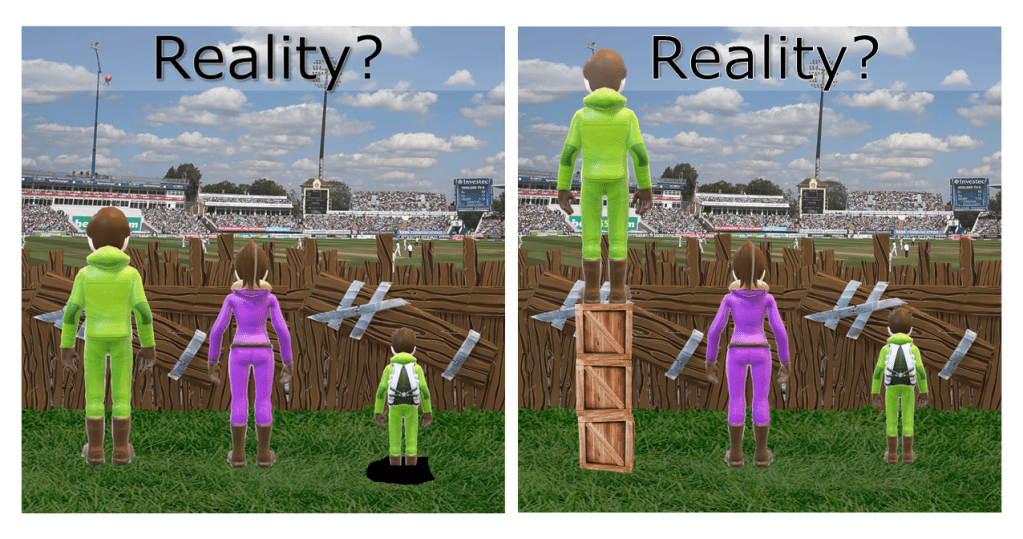
The meme renders something like this:

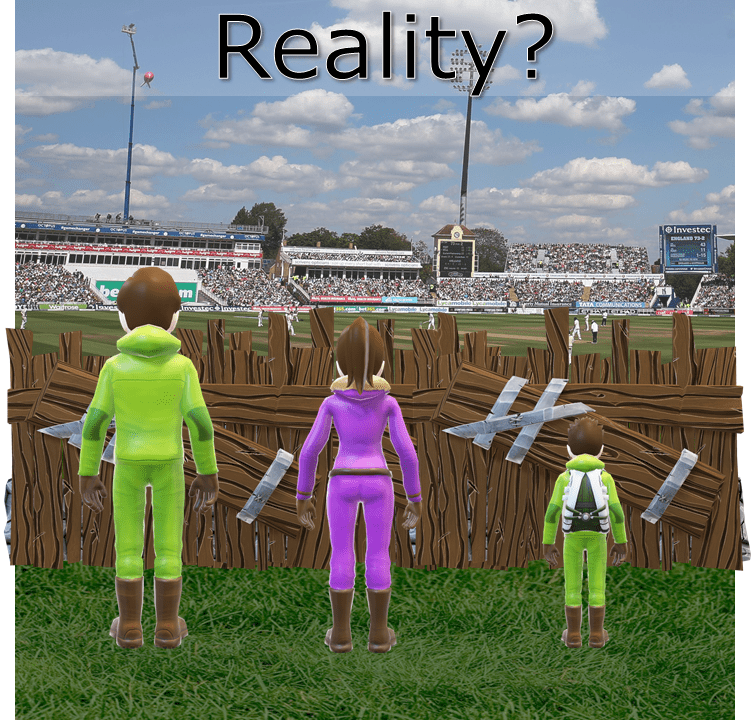
There are two frames being compared—equality and equity. In both, we see three people trying to view an event, but a barrier obstructs their view. The people are of different heights—tall, medium, and short—, metaphorically representing some intitial social status.

In one we see a representation of equality. In the spirit of equality, each person has one crate upon which to stand. This represents equality of condition. Each person is ensured to start the game on equal social footing. At a glance, it’s easy to discern that this intervention allows two of the people to see the event but leaves one of the three at a disadvantage and unable to view.

In the other, we see a representation of equity. In this frame, we see the same three people and a redistribution of the three crates. Equity is more in tune with equality of opportunity if not of outcomes. The taller person who had been standing on a crate had no need for it as he was tall enough to see over the barrier without it. The mid-size person, who could see the event with the crate but not without it, retained the crate. The shortest person was given the crate from the tallest person, now standing on a stack of two. The result is that each of the three people can now view the event unimpeded.

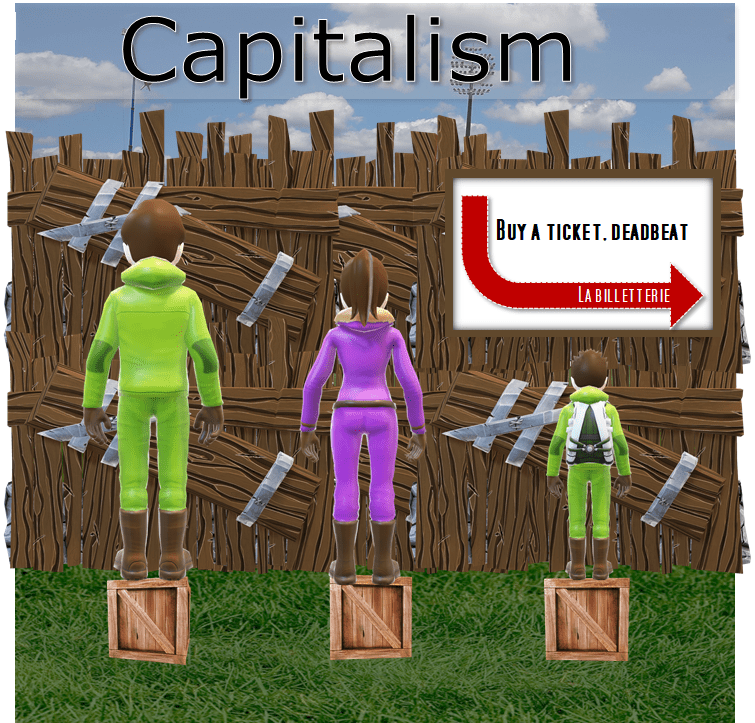
This comparison is such a nice conversation starter. It’s a hot button topic for some—and I’ll get to that presently. For me, it illustrates the concept of framing. There are several things left out of frame—at least one literally. In this meme, we are given a binary frame, but we can pull the shot back and there’s a third option: egality. This term has fallen out of favour in English, but the French retain it—égalité. In this frame, there is no need for crates, and the plank barrier is replaced by a chain-link fence.

Social Equality

Yet there’s the matter of metanarrative device. Why should there be any barrier? Why focus on these three in the foreground? Do the seated people represent the haves and those standing represent the have-nots? Might we interpret this as bourgeois versus proletariat with the focus on the struggle between the prols distracting from the broader issue? —being further distracted by the circus event? Have we lost the forest for the trees?

As it happens, people along the way have inserted their own social commentary through like-memes. I’ve similarly reconstructed these.

Societal Common Ground

In the beginning there are no crates. They are simply a device. At the start, only the tallest person can see over the barrier. At some point three crates appear ex nihilo and each person obtains one as depicted in the equality of condition frame, which leaves one of our participants better off and the other in no different of a social status, though a bit off the ground in the event of flash flooding. Small wins.

Past Burdens and Generational Wealth Transfer

Some shared the opinion that at least we all start on common ground, and yet others—likely Left- or Liberal-leaning—propose that some people start in a hole. Others might have noted that whilst some start out in a hole others start out with inherited boxes—or houses or networks—showcasing the transfer of generational wealth . Another might be able to view if there was a crate available. Given the negative starting place, the third would likely require three boxes to be on par to view, so even a redistribution of the three boxes would be insufficient.

For my first diversion, I’d like to spend a few moments defending a common response for the Right and Libertarians. Firstly, no one who supports this level-setting is suggesting that the advantaged be put into a hole like the disadvantaged. Nor is anyone asking for The Prince and the Pauper treatment where they trade places. This is a silly attempt at a strawman attack. Secondly, in a similar vein, no one is asking for the best off to relinquish everything and now be unable to see whilst the meek inherit the earth. As if that could ever happen.

Some people were overly optimistic—presumably representing the ‘if some is good, more must be better’ contingent. Why don’t we give everyone two boxes? Aside from the fact that only three are necessary for everyone to view the event, there was no mention where the original three crates came from let alone these additional three. I suppose they might have fashioned them from the fence. Who knows? But this leads us into contributions from the advocates of Capitalism.

Capitalism: Libertarian Vantage

Let’s chalk this up to the Right can’t meme syndrome. To this cohort, Capitalism is the solution. In fact, there will be more crates than one could possibly use. A rising tide rises all boats—and crates. None are left behind. In fact, this is what Capitalism is known for. Of course, this suffers from several cognitive biases: survivorship, selection and availability. But who’s really counting?

For this less fond of Capitalism, this illustrates excess and waste. We needed three crates, yet we produce over thirty. Moreover, these less-fond likely also notice a capital distribution challenge with Capitalism.

Capitalism: Democratic Vantage

The prevailing view by one cohort is that some of the excess crates ‘owned’ by the tallest person should be redistributed whilst the polar perspective holds that this person ‘earned’ those crates and is entitles to keep them. And why can’t that woman just hold her child so he can see? Don’t get me started.

Capitalism for Sale

You really do have to love Capitalists. The solution is always ‘you just have to pay for it. Duh’. Without going too far off track, many of these people—likely vastly most of them—can’t afford what they want, yet they stand by this mechanism.

Socialism Kills

Some people who despise Socialism have a rather macabre perspective on how socialism operates. To them, equality can only be acheived via some Harrison Bergeron mechanism—primarily because they choose not to distinguish between social and physical equality. And maybe they are simply sadistic and enjoy watching people suffer.

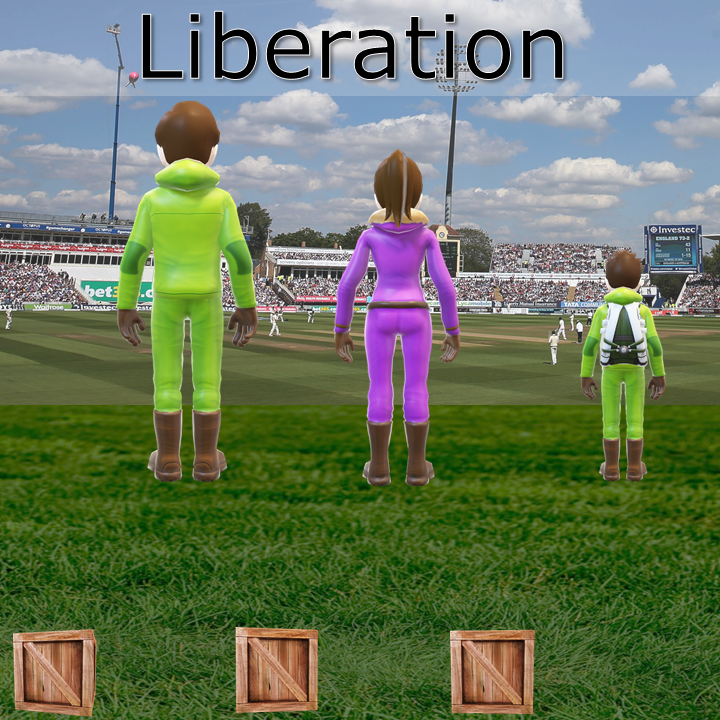
My personal favourite is the one for liberation.

Liberation is Liberating

We don’t need no fences. No barriers. No boundaries. Sit on the boxes. Fill them with food for the hungry.

But in the end, if all you are fighting for is free access to cricket matches and other circus events, you aren’t really liberated anyway. You are the slave that Rousseau wrote about, ‘Man is born free but everywhere is in chains’.


Disclaimer: For the record, I have been using the term, Capitalism idiomatically equivalent to a market economy because Americans just don’t want to separate them. I think they feel that if they can pretend they are the same, that criticising Capitalism would be tantamount to criticising market economics. This is wrong on so many levels, but, at least in North America, the terms are inextricable. The fact that Capitalism is a means of production, and the other is a distribution mechanism, people—from syndicalists and worker coöperatives to Mercantilists, tradesmen, and craft-workers—could choose to distribute goods and services through a market system without consequence. It’s not even worth expending a breath. Even English dictionaries have given up and conflated the concepts. Economic textbooks are the last bastion of academic sanity.

Diversity Frame

One if the biggest foci of postmodern philosophy is the metanarrative. Employment diversity is a place that the metanarratives go unquestioned by most. The most predominant aspect is the frame. Don’t accept it.

Inside this frame, some uncritically adopted narratives are as follows:

  • Work is good
  • Work builds character (proportionately to the effort exerted)
  • Work defines your value or worth as a human
  • Work signifies your place in society
  • Work is its own reward (except for monetary payment and recognition)
  • Value is defined by monetary achievement
  • Worth is defined by your place in an enterprise

And so on…

In this HBR article*, the frame has been established as a corporation and the diversity within this context. What this say by omission is that money and power is the measure of a meaningful existence. If only women were afforded a seat at this table—proportional to their population in society—, things will be even.

Women should start their own successful companies. Women should rise to the top of existing companies. Especially if they buy into the aforementioned narratives. Many women and men buy into this story lock, stock, and barrel (whatever that means), but only is you accept this as a frame is this relevant.

It’s easy to imagine a world where money is unnecessary, where labouring is unnecessary.

It’s easy to imagine a world where money is unnecessary, where labouring is unnecessary. Some have imagined a world without work, where people could instead pursue artistic endeavours, but this is just adopting a different set of narratives—like the person who exchanges drugs or alcohol for Jesus or some such. Out of the frying pan into the fire. This is the lie.

Interestingly, the HBR article makes these points:

  1. Quantify gender equity in terms of economic gains for the company.
  2. Hold leaders accountable for change by tying DEI metrics to performance reviews.
  3. Offer development opportunities to increase gender intelligence, empathy, and self-efficacy.
  4. Pull back the curtain on misperceived social norms.
  5. Establish cross-gender professional relationships.
  6. Frame, focus, and integrate interventions into core business outcomes and mission.

Notice that each of these operates from the perspective of the company. Granted, this is HBR, where the B is for Business, but still. Here’s the low down.

  1. Gender equity will at some point increase your bottom line.
  2. Create diversity metrics (and incentives) and tie them to performance review—presumably tied to the economic performance expected in bullet 1.
  3. Offer diversity training—notwithstanding the body of evidence and long history that diversity programmes are not only ineffective but sow seeds of discontent.
  4. Educate your executives and staff to the misconceptions—so long as you don’t question the deeper metanarratives.
  5. Essentially, the ask here is to establish male-female protégé-mentor relationships. Of course, this could be expanded to break binary gender stereotypes, too.
  6. Back to business, frame the frame. But to tell the truth, I don’t even know how to interpret and summarise the provided example. It seems this is an admixture of points 1 and 2, given metrics should ladder up to stated objectives and outcomes.

asking for this equity in diversity is a short-term fix

In any case, asking for this equity in diversity is a short-term fix, but it’s unimaginative and buys into the worldview of the patriarchy. There is no reason to accept this prima facie. As with the notion of Democracy, I’d be willing to argue that the system itself is the problem and that any tinkering within the system is limited by the system itself.


* Apologies in advance if HBR has a paywall. Typically, the first 3 articles are free, but if you are like me that exhausts on day one.

On Property

2–3 minutes

We take property for granted. John Locke espoused life, liberty, and property. Rousseau observed that “The first man who, having fenced in a piece of land, said “This is mine”, and found people naïve enough to believe him, that man was the true founder of civil society. From how many crimes, wars, and murders, from how many horrors and misfortunes might not any one have saved mankind, by pulling up the stakes, or filling up the ditch, and crying to his fellows: Beware of listening to this impostor; you are undone if you once forget that the fruits of the earth belong to us all, and the earth itself to nobody.”

The first man who, having fenced in a piece of land, said “This is mine,” and found people naïve enough to believe him, that man was the true founder of civil society.

But property and its defence is nothing more than some accepted rhetoric. Libertarians presume this to be some inviolable right, and Anarchists and Socialists believe that property—well, private property anyway; real property—is a common good.

I have an issue with ownership of real property, though I don’t have such a strong opinion on possession. In reality, this is more of a practical matter than a defensible philosophical position. It has emotivist roots. As Hobbes noted (or I’ll paraphrase liberally), even animals in his state of nature have possessions, but there is no right to these possessions (which belong to the monarch anyway in society); there is only the ability to try to retain ownership through force.

In practice, this is what society does. Insomuch as the force is more potential than kinetic, allowing the state or community to exercise this force by proxy, it is not dissimilar to our consumption of meat products at arm’s length by sheltering the violent reality by intermediary grocers.

And we shelter ourselves through language. We don’t eat cows and pigs, we eat beef and pork, chateaubriand and bacon.

Returning to property, real property, it’s yours as long as you possess it, but it is not yours from a distance, and it’s not yours to bequeath. If we are to embrace capitalism—which I don’t, but for the sake of argument—, we should allow the property to go to the purpose that will provide the greatest utility. History as a judge demonstrates that it is unlikely to happen to be the someone’s heirs.

Utilitarianism

As I read his Utilitarianism, I want to like John Stuart Mill. He seems like such a clever man, but he is a victim of his Enlightenment Age. Attempting to fabricate order created by science’s encroachment on the absolutes of religion and the shifting sentiments toward monarchies, Mill tries to replace this moral compass with Jeremy Bentham‘s utility.

£1 ≠ £1

The problem is that despite (sort of) dispensing of religious doctrine, Mill was still fettered by the dogma of virtue ethics of dignity and duty. To this, he adds happiness. Not to go full-on Foucault, but these are concepts leveraged, like religion, to maintain power—take an elevated system in a constructed society, and the duty becomes a burden to the bottom, save for pretence of duty and dignity at the top.

I’ve had an issue with the concept of virtue and all of its offspring: duty, justice, and so on. I’ll likely write about this later. I expect that I’ll be reading Mill’s On Liberty next, so stay tuned.

Ignoring my contention that Utilitarianism is baseless, I have two other issues, using economic examples, each related to prospect theory (pdf):

  1. Regressivity: A person with less money values an incremental dollar more than a person with more money.

  2. Loss to gain asymmetry due to risk aversion: A person values losing a dollar more than earning a dollar, ceteris paribus.

Pareto efficiency, a cornerstone of Classical economics, does not take this into account. For this theory, all dollars are created (or perceived to be) equal, so it doesn’t matter whether person A, who earns £10,000 p.a., or person B, who earns £100.000 p.a.,  gets £100, but in the real world, person A would give it a higher value, so a transfer from A to B would be an inferior transaction to a B to A transaction.

This said, person B values the £100 more than having gained the amount, but it is not clear how to reconcile (in order to reach perceived parity) what the fair equilibrium would be, allowing that equality of outcome might not be the desired outcome.