Legibility and Ontology

3–5 minutes

These two words qualify as my words of the month: legibility and ontology.

I’ve been using them as lenses.

I picked up legibility from James C. Scott’s Seeing Like a State: How Certain Schemes to Improve the Human Condition Have Failed, which is really a book about how well-intentioned schemes fail once reality is forced to become administrable. Ontology is an older philosophical workhorse, usually paired with epistemology, but I’m using it here in a looser, more pragmatic sense.
When I write, I write through lenses. Everyone does. Writing requires a point of view, even when we pretend otherwise.

In this post, I want to talk more informally about my recent essay, Grammatical Failure. I usually summarise my work elsewhere, but here I want to think out loud about it, particularly in relation to social ontology and epistemology. I won’t linger on definitions. They’re a search away. But a little framing helps.

Ontology, roughly: how reality is parsed.

Epistemology: how knowledge is justified within that parsing.

Audio: NotebookLM summary of this post.

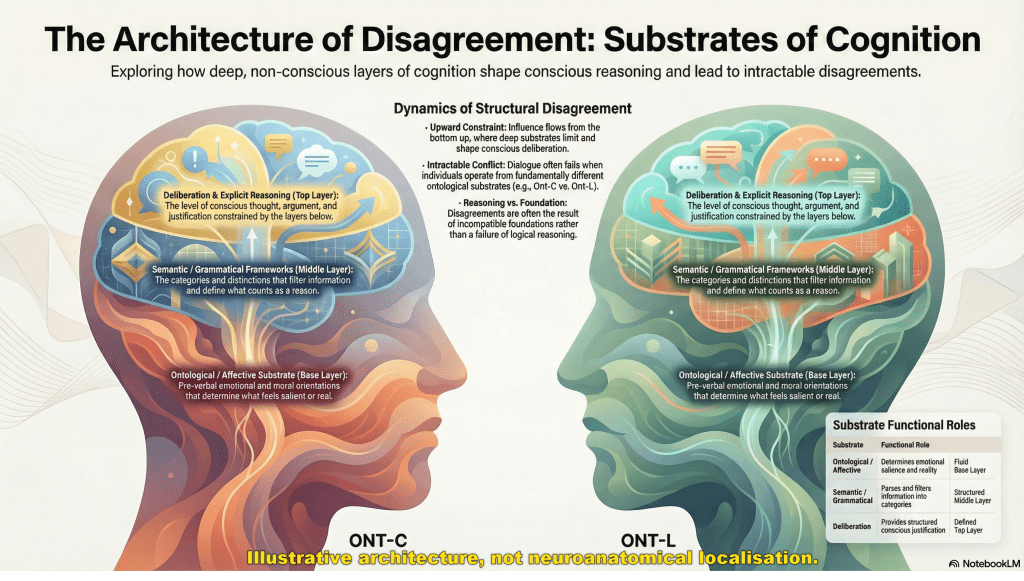
Much of my recent work sits downstream of thinkers like Thomas Sowell, George Lakoff, Jonathan Haidt, Kurt Gray, and Joshua Greene. Despite their differences, they converge on a shared insight: human cognition is largely motivated preverbally. As a philosopher of language, that pre-language layer is where my interest sharpens.

I explored this in earlier work, including a diptych titled The Grammar of ImpasseConceptual Exhaustion and Causal Mislocation. Writing is how I gel these ideas. There are several related pieces still in the pipeline.

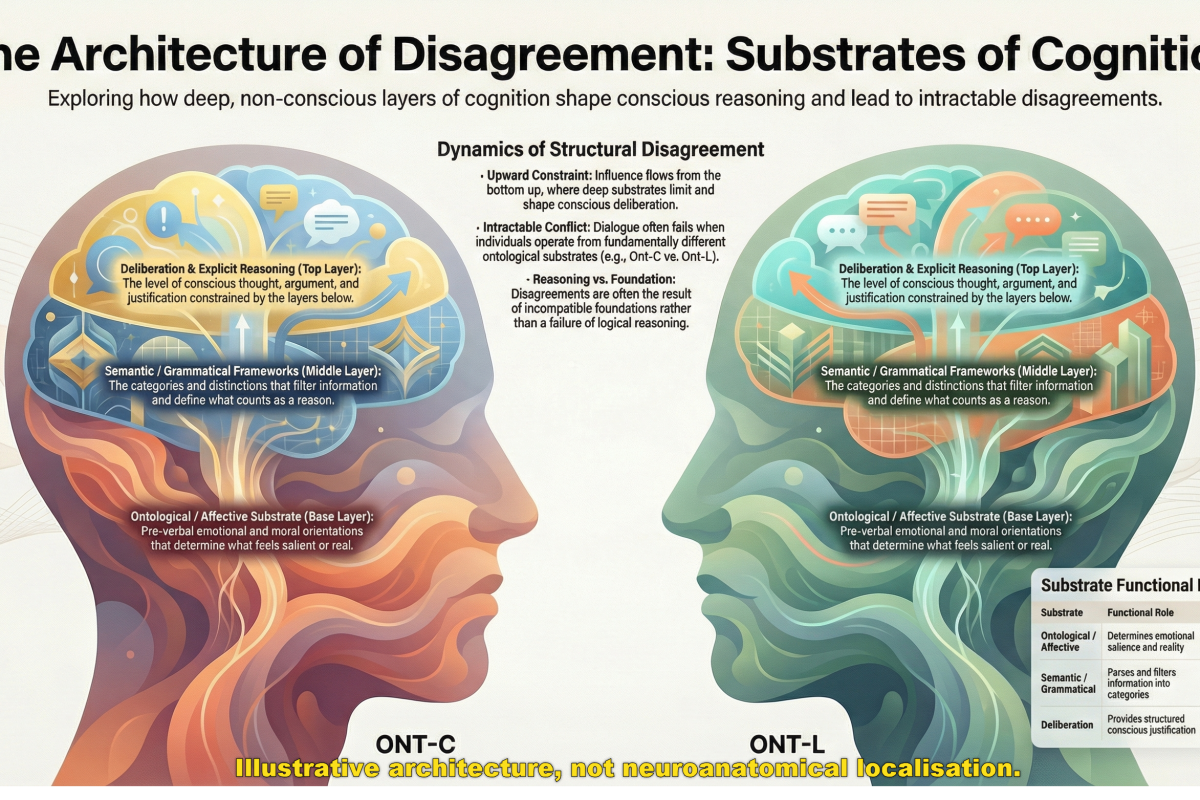
When I talk about grammar, I don’t mean Saussure or Chomsky. I mean something deeper: the ontological substrate beneath belief. Grammar, in this sense, is how reality gets parsed before beliefs ever form. It filters what can count as real, salient, or intelligible.
Let’s use a deliberately simplified example.

Imagine two ontological orientations. Call them Ont-C and Ont-L. This isn’t to say there are only two, but much of Western political discourse collapses into a binary anyway.

Ont-C tends to experience people as inherently bad, dangerous, or morally suspect. Ont-L tends to experience people as inherently good or at least corrigible. These aren’t opinions in the usual sense. They sit beneath belief, closer to affect and moral orientation.

Now consider retributive justice, setting aside the fact that justice itself is a thick concept.

From Ont-C, punishment teaches a lesson. It deters. It disciplines. From Ont-L, punishment without rehabilitation looks cruel or counterproductive, and the transgression itself may be read as downstream of systemic injustice.

Each position can acknowledge exceptions. Ont-L knows there are genuinely broken people. Ont-C knows there are saints. But those are edge cases, not defaults.

Now ask Ont-C and Ont-L to design a criminal justice system together. The result will feel intolerable to both. Too lenient. Too harsh. The disagreement isn’t over policy details. It’s over how reality is carved up in the first place.

And this is only one dimension.

Add others. Bring in Ont-V and Ont-M if you like, for vegan and meat-based ontologies. Suddenly, you have Ont-CV, Ont-CM, Ont-LV, and Ont-LM. Then add class, religion, gender, authority, harm, and whatever. Intersectionality stops looking like a solution and starts looking like a combinatorial explosion.

The Ont-Vs can share a meal, so long as they don’t talk politics.

The structure isn’t just unstable. It was never stable to begin with. We imagine foundations because legibility demands them.

Grammatical Failure is an attempt to explain why this instability isn’t a bug in liberal epistemology but a structural feature. The grammar does the sorting long before deliberation begins.

More on that soon.


In any case, once you start applying this ontological lens to other supposedly intractable disputes, you quickly realise that their intractability is not accidental.

Take abortion.

If we view the issue through the lenses of Ont-A (anti-abortion) and Ont-C (maternal choice), we might as well be peering through Ont-Oil and Ont-Water. The disagreement does not occur at the level of policy preferences or competing values. It occurs at the level of what counts as morally salient in the first place.

There is no middle ground here. No middle path. No synthesis waiting to be negotiated into existence.

That is not because the participants lack goodwill, intelligence, or empathy. It is because the ontological primitives are incommensurate. Each side experiences the other not as mistaken but as unintelligible.

We can will compromise all we like. The grammar does not comply.

Contemporary discourse often insists otherwise. It tells us that better arguments, clearer framing, or more dialogue will eventually converge. From this perspective, that insistence is not hopeful. It is confused. It mistakes a grammatical fracture for a deliberative failure.

You might try to consider other polemic topics and notice the same interplay.

On Heterodoxy, Near-Misses, and the Comfort of Saying ‘Not This’

5–7 minutes

I recently encountered a kindred soul on Mastodon – figuratively, metaphorically, and within the usual constraints of online encounter – and it prompted a familiar line of thought.

This is not the first time I’ve ‘met’ someone in this way. The pattern repeats often enough to be worth naming. We find common ground outside orthodoxy, experience that alignment as a relief, and linger there for a time. Then, usually without conflict or drama, we discover that the overlap is partial. Our ontological or metaphysical commitments diverge. The conversation thins. We drift apart, sometimes reconnecting later when that same shared ground is encountered again from another angle.

I’ve also had several people tell me they appreciate my work and would like to integrate it into their own projects. These invitations are genuine and generous. But they often come with an unspoken expectation that my arguments can be extended toward metaphysical positions I do not share: panpsychism, animism, various forms of consciousness-first cosmology, or other reconstructive moves of that kind.

The refusal, when it comes, is not personal. It isn’t even oppositional. I’m generally open to building, extending, or synthesising. I’m not interested in bridging toward foundations I regard as doing a different kind of work altogether.

What interests me is that this scenario seems common among heterodox thinkers, regardless of where they ultimately stop. We recognise one another in the refusal of orthodoxy, assume a deeper alignment, and then encounter a quiet limit. The question is not who is right, but why this keeps happening.

Audio: NotebookLM summary podcast on this topic.

That is what this post is about. If you’re heterodox, this pattern might feel uncomfortably familiar.

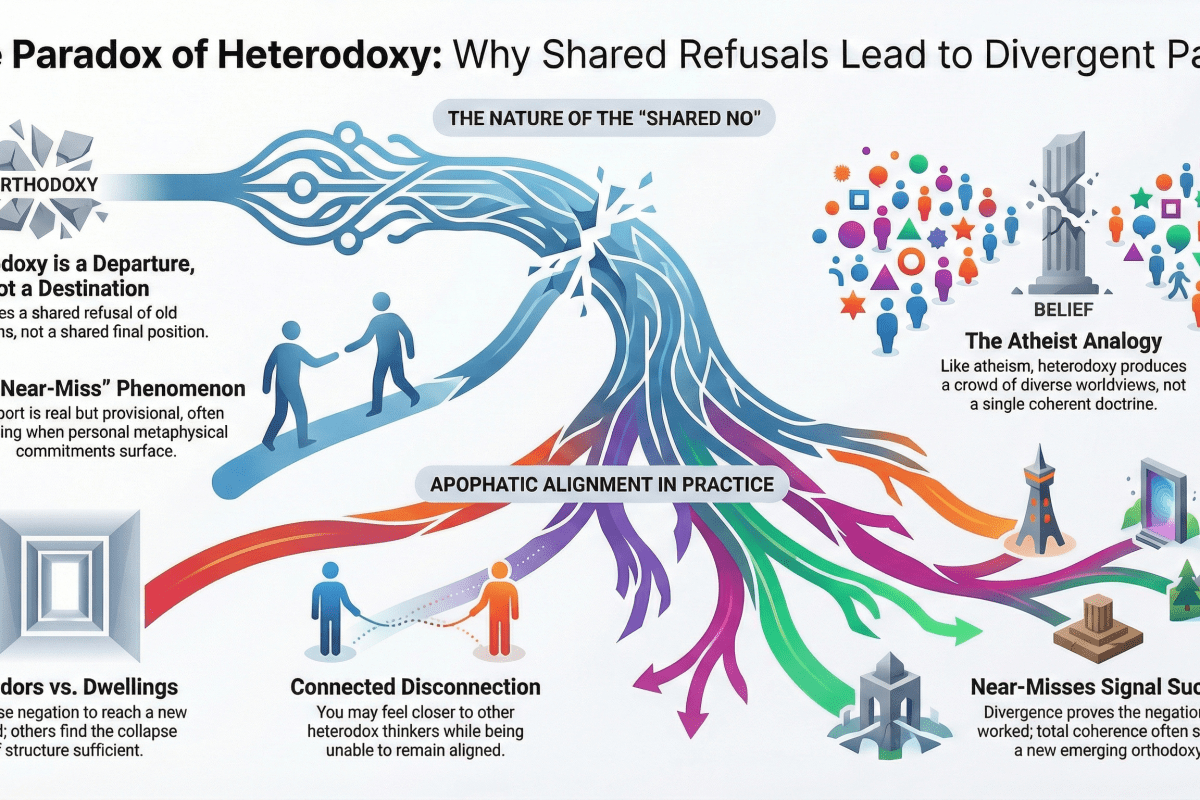
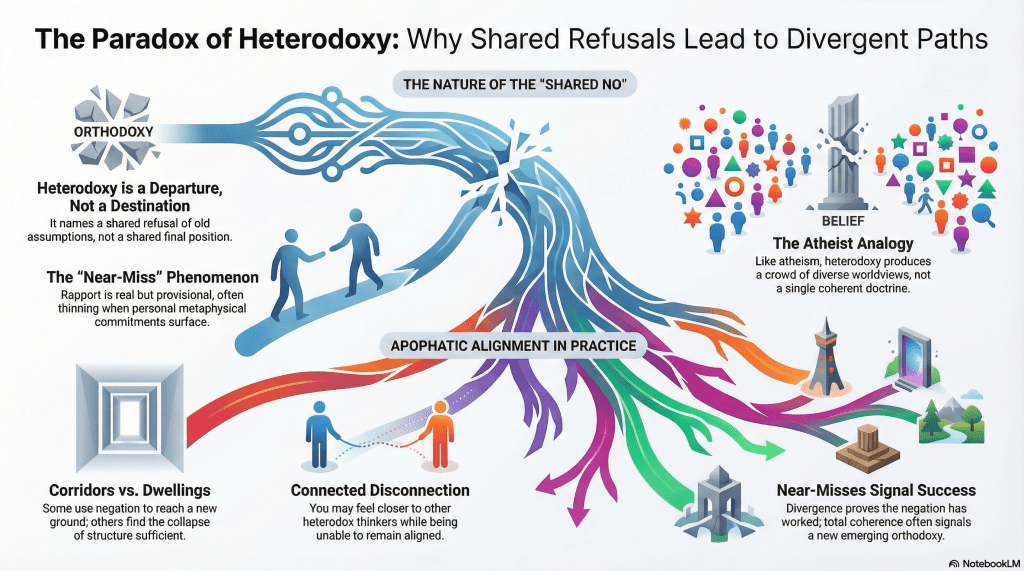
Image: NotebookLM infographic

You encounter someone whose work resonates immediately. They reject the same orthodoxies, bristle at the same institutional pieties, and seem unimpressed by the same explanatory shortcuts. There is a brief sense of relief. Recognition. A feeling of intellectual companionship that is rare enough to feel precious. And then, quietly, the connexion thins.

Nothing collapses. No argument detonates. No offence is given or taken. One of you simply steps somewhere the other cannot or will not follow. A metaphysical claim is introduced. A moral anchor is asserted. A spiritual horizon appears. Or just as often, it doesn’t. From that point on, the conversation continues, but the current has changed. The sense of shared footing is gone.

What’s unsettling is not disagreement as such. It’s the near-miss. The sense that alignment was real, but provisional. That something connected and then slipped, without anyone doing anything wrong.

Many heterodox thinkers experience this repeatedly and interpret it as a failure: of communication, generosity, openness, or perhaps courage. It isn’t. It’s structural.

Heterodoxy Is a Departure, Not a Destination

The mistake is assuming heterodoxy names a shared position. It doesn’t. It names a shared refusal.

Heterodox thinkers do not leave orthodoxy in the same way or for the same reasons. They reject different assumptions, at different depths, under different pressures. The overlap happens because multiple escape routes pass through the same early terrain: scepticism about progress, discomfort with universalism, doubt about linguistic sufficiency, suspicion of institutional neutrality. The paths converge briefly. Then they diverge. What differs is not intelligence or seriousness, but where each thinker expects the process to terminate.

Some heterodoxies are transitional. They break the old frame in order to reach another one, however provisional, poetic, or mystical. Others are terminal. They break the frame to show that no final frame is forthcoming. The exposure of limits is the result. The connexion holds only as long as those expectations remain untested.

Apophatic Alignment

A useful way to understand this is apophatic. In apophatic traditions, alignment is achieved by negation. What matters is not what is affirmed, but what is refused. ‘Not this’ is the only stable common ground. Every positive claim risks rebuilding the very structure that was just dismantled.

Much heterodox thinking functions this way, whether it names itself as such or not. People gather around shared negations: not Enlightenment rationalism, not moral commensurability, not linguistic transparency, not institutional objectivity. There is relief in this shared stripping-away. A sense of clarity born of subtraction. The difficulty arises when negation is treated as incomplete.

Some experience the apophatic moment as a corridor, not a dwelling. They want a new ground, a new centre, a new synthesis. Consciousness, myth, the sacred, systems, emergence, vibes. Others experience the apophatic moment as sufficient. They stop where the structure collapses, without urgency to rebuild. Neither stance is an error. But they are not compatible for long.

The Atheist Problem

An analogy might help: Atheists often discover that atheism is the only thing they have in common. Remove belief in God, and what remains is not a worldview but a crowd. Libertarians, Marxists, humanists, nihilists, spiritual minimalists, scientistic optimists. The disappointment some feel is not a failure of atheism, but a misunderstanding of what a shared no can do. Heterodoxy works the same way.

Shared disbelief produces rapport. It does not produce coherence. Expecting it to is a category mistake inherited from the very universalising habits heterodoxy rejects.

Connected Disconnexion

This gives rise to a distinctive affect: connected disconnexion. You feel closer to other heterodox thinkers than to orthodox ones, yet you cannot remain aligned. You recognise their refusal, but not their resolution. Or their resolution, but not their refusal. The disconnection feels personal because the alignment felt rare. It isn’t personal. It’s ecological.

Heterodoxy does not form a community. It forms a pattern of overlapping partial alliances that dissolve as deeper commitments surface. These dissolutions are not betrayals. They are boundary conditions being discovered.

A Modest Reframe

If you find that no one quite ‘buys’ your full accounting, this need not be taken as failure or marginality. It may simply mean you are stopping at a different point of negation than most.

Heterodox work functions less like a manifesto and more like a sorting mechanism. It attracts those whose exclusion criteria overlap with yours and repels those who need different closures. That is not a defect. It is what apophatic alignment looks like in practice. If a heterodox space ever achieves total coherence, it has likely ceased to be heterodox and begun, quietly, to rebuild a doctrine.

For those of us who work by subtraction rather than synthesis, this can be oddly reassuring. The near-misses are not signs that something has gone wrong. They are signs that the negation has done its work. Shared refusals do not entail shared destinations.
They were never meant to. And that, too, is part of the heterodox condition.

A Family of Lenses: LIH, MEOW, and Disagreement Without Referees

My Language Insufficiency Hypothesis is finished, the cover is designed, and everything is in order for a January 2026 release – save for one administrative detail: the ISBN. I expect this to be resolved presently. The Bowker distribution system in the US appears to have been set up circa 1997, and that’s just the web interface. Who knows how long the database has been in place? I’d bet circa 1955. Most countries provide ISBNs for free. Not the US. Kinda bollox. Meantime, I’ve now got three lenses through which to inspect the world.

[EDIT: ISBN issue has been resolved. I am awaiting a proof copy that should be arriving today.]

From the outside, some of my recent work can look untidy. A hypothesis about language. An ontology about mediated encounters. A paper on why moral disagreement refuses to resolve itself politely. No master theory. No clean ladder. No promised synthesis at the end. This is not an accident. It is a refusal.

What links the Language Insufficiency Hypothesis (LIH), the Mediated Encounter Ontology of the World (MEOW), and Disagreement Without Referees is not a shared doctrine, but a shared function. They are lenses, not foundations. Diagnostics, not blueprints. Each takes aim at a different site where Enlightenment habits quietly overpromise – meaning, access, adjudication – and shows what breaks when we stop pretending those promises were ever cashable. They form a family. Not a system. And certainly not a programme for rebuilding.

Three Lenses, Three Failure Sites

Each of these frameworks operates at a different level, but they all do the same kind of work: they explain why something we rely on feels indispensable, fails repeatedly, and yet stubbornly survives.

LIH operates at the linguistic level.

It asks why language fails precisely where we expect it to secure clarity, precision, or consensus. Its answer is unromantic: language is not uniformly capable. As we move from invariants to contestables to fluids and ineffables, its representational power degrades. The failure mode is familiar: we mistake grammatical stability for ontological stability, and then act surprised when disagreement hardens rather than dissolves.

MEOW operates at the ontological level.

It asks what kind of ‘world’ we are actually dealing with once we abandon the fantasy of unmediated access. There is no clean mind–world interface, no privileged vantage point. Every encounter is mediated – biologically, cognitively, linguistically, socially. Realism and idealism alike fail here, each clinging to a different myth of access. What remains is not scepticism, but constraint.

Disagreement Without Referees operates at the normative and political level.

It asks why moral and political disagreement persists even when all parties appear informed, sincere, and articulate. The answer is ontological incommensurability. Where frameworks do not overlap, there are no neutral referees. Argument does not converge because it cannot. What remains is persuasion, coalition, power, and consequence—moral life without an umpire.

None of these lenses replaces what it critiques. Each refuses the repair instinct that says: if we just fix the model, the system will work again. That instinct is the pathology.

What They Share (And What They Don’t)

What unites these lenses is not a set of positive claims about how the world really is. It is a shared posture:

  • no privileged access
  • no neutral ground
  • no final adjudication
  • no redemptive synthesis

But also:

  • no quietism
  • no nihilism
  • no ‘anything goes’
  • no abdication of responsibility

They do not tell you what to believe. They tell you why believing harder won’t save you.

Importantly, they are non-hierarchical. LIH does not ground MEOW. MEOW does not explain away disagreement. Disagreement does not ‘apply’ LIH in some linear fashion. They intersect. They overlap. They illuminate different failure modes of the same inherited fantasy: that there must be a place where things finally settle. There isn’t.

Image: Three Diagnostic Lenses Infographic¹

Why This Is Not a System

Systems promise closure. These lenses do not. They explain why closure is repeatedly promised, urgently demanded, and reliably missed. To systematise them would be to betray them.

What they offer instead is a kind of intellectual hygiene: a way of recognising when we are asking language, reality, or morality to do work they were never capable of doing – and then blaming one another when they don’t comply.

If there is a unifying thread, it is this: the demand for foundations is itself the problem.² These lenses do not solve that problem. They show you where it operates, how it reproduces itself, and why refusing it feels so uncomfortable. That discomfort is the point.


Footnotes

  1. This is another NotebookLM infographic – my second. It’s not half-bad. I had to adjust some elements in Photoshop and Illustrator, and there are still textual anomalies, but all in all, I’m impressed with what 60 seconds of generation yielded – along with a 5-minute prompt and 15 minutes of touchup. It’s just a novelty for now – certainly not necessary. What do you think?
  2. See Dis–Integrationism for a fuller accounting.