More precisely, I need less sleep and longer days – preferably twice as long. I’ve been writing almost non-stop for the better part of a week: fourteen- to sixteen-hour days, fuelled by irritation and the stubborn belief that if I just keep reading, something will finally click into place.
I’m not complaining. This is a virtuous cycle. Reading leads to writing. Writing demands more reading. Eventually, the loop closes into something that looks suspiciously like progress.
Audio: Short NotebookLM summary podcast on this topic.
Still, there’s a bottleneck.
Because some of this work – the work I’m most excited about – I’m deliberately not publishing yet. Journals, bless their glacial hearts, don’t much care for prior publication. So ideas sit in limbo for six to eighteen months, locked in a room like argumentative houseplants, slowly growing sideways.
From the perspective of someone who thinks in public, this is maddening.
Now add AI to the mix.
This is where things get dangerous.
I’ll feed ChatGPT a thesis, a skeletal structure, notes, and references. I ask what I’m missing. It obliges – often helpfully – by pointing me toward adjacent thinkers and relevant literature, complete with page numbers. From there, I verify, hunt down the sources, skim, read, discard, or integrate.
And every so often, I stumble across something that makes me swear out loud.
This week, it was Bernard Williams.
I’ve cited Ethics and the Limits of Philosophy before. But this time, I actually sat down and read it properly. Which immediately prompted the thought:
Why didn’t I read this sooner?
Williams dismantles moral objectivity with the calm precision of someone who knows the Enlightenment project has already lost – he just hasn’t told everyone yet. Thick and thin moral concepts, locality, non-extensibility, the collapse of universal moral reason at scale – yes, yes, yes. He published this in 1985. Fine. I’ll survive.
But then I went further.
Williams shows that morality fails between people at scale. I argue that it fails within a single person over time.
That became my second paper.
And this is where things went off the rails.
Because in the course of writing that paper, I dipped into Hart’s The Concept of Law and Endicott’s Vagueness in Law. These are not fringe polemics. These are law textbooks. For law students. People allegedly trained to parse language for a living.
And what I found was… astonishing.
Let me paraphrase the admissions:
First:
Image: When the law is vague, judicial decisions may be unconstrained by the law.
Endicott: “By upsetting the standard view of adjudication, the book reaches conclusions that some people find horrible: when the law is vague, judicial decision- making will in some cases be unconstrained by the law. It is impossible in principle for judges always to treat like cases alike. Predictability in the law is to some extent unattainable. Moreover, I argue in Chapter 9,2 that vagueness cannot be eliminated from law. These conclusions might seem to imply that the rule of law is, at least to some extent, conceptually impossible.”
Then:
Image: Vagueness is inevitable. Deal with it.
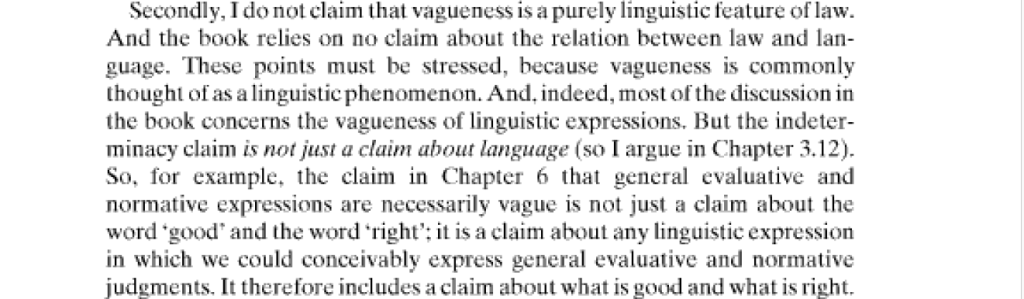
Endicott: “Secondly, I do not claim that vagueness is a purely linguistic feature of law. And the book relies on no claim about the relation between law and language. These points must be stressed, because vagueness is commonly thought of as a linguistic phenomenon. And. indeed, most of the discussion in the book concerns the vagueness of linguistic expressions. But the indeterminacy claim is not just a claim about language (so I argue in Chapter 3.12). So. for example, the claim in Chapter 6 that general evaluative and normative expressions are necessarily vague is not just a claim about the word ‘good’ and the word ‘right1: it is a claim about any linguistic expression in which we could conceivably express general evaluative and normative judgments. It therefore includes a claim about what is good and what is right.”
Then, almost casually:
Image: Whether law is morally valuable to a community is not my concern. Justice and the rule of law may be political virtues — or not. I don’t defend them here.
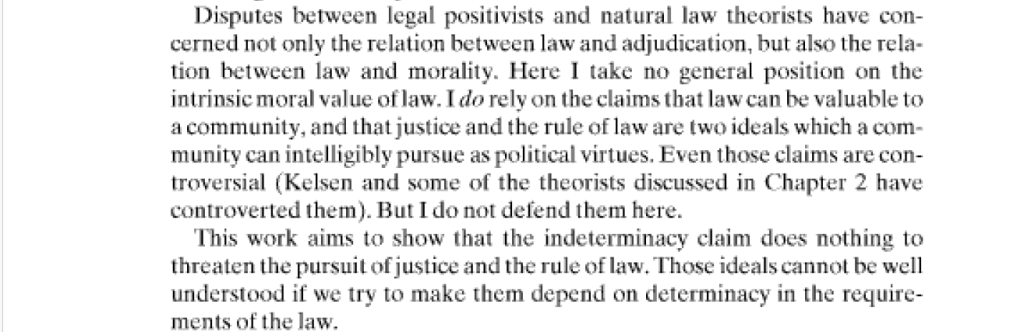
Endicott: “Disputes between legal positivists and natural law theorists have concerned not only the relation between law and adjudication, but also the relation between law and morality. Here I take no general position on the intrinsic moral value of law. I do rely on the claims that law can be valuable to a community, and that justice and the rule of law are two ideals which a com- munity can intelligibly pursue as political virtues. Even those claims are controversial (Kelsen and some of the theorists discussed in Chapter 2 have controverted them ). But I do not defend them here. This work aims to show that the indeterminacy claim does nothing to threaten the pursuit of justice and the rule of law. Those ideals cannot be well understood if we try to make them depend on determinacy in the requirements of the law.”
Say what?
Read together – not even uncharitably – the message is clear:
Law is indeterminate. Indeterminacy is unavoidable. And whether law is good, just, or valuable is… optional.
The subtext isn’t even hiding.
Law is a power structure first. If it happens to align with justice, fairness, or communal value, well, lovely. A bonus. Champagne all round.
This does not sit well with a sceptical cynic.
What really broke me, though, wasn’t the argument itself. Philosophers make grim claims all the time. What broke me was the silence around it.
How does this pass under the radar?
How do cohorts of law students – drilled in textual analysis, trained to read footnotes like tea leaves – not trip over this elephant stampede? How do they graduate believing they’re upholding inalienable rights, rather than participating in a managed system of coercion that occasionally behaves itself?
Self-preservation, I suppose. Wilful ignorance. Professional cosplay.
I’ve seen this before.
As an economist, ask the wrong foundational question, and you’re instantly radioactive. Persona non grata. Careers don’t end with explosions — they end with polite silence and no invitations.
I probably should have committed to heterodox philosophy from the start. Or stayed a musician.
I remember leaving graduate school, putting on a suit, and feeling like I was wearing a costume. Cosplay, before we had the word. “Business professional” as a role, not an identity.
I’ve always felt intellectually capable of doing whatever I set out to do. My temperament, however, has never agreed to play along.
Which is perhaps why diagnosing ontologies comes so naturally. Once you see the scaffolding, you can’t unsee it – whether it’s metaphysics, jurisprudence, or a corporate department pretending it has a mission.
Then David Graeber came along with Bullshit Jobs, and I remember thinking: Thank God. It’s not just me.
So yes. I need a break.
I need sleep. I need silence. I need to stop reading law books that accidentally admit they’re about power and then act surprised when someone notices.
What followed was a case study in how not to communicate.
LinkedIn, that self-parody of professional virtue signalling, is essentially a digital networking séance: a place where narcissism wears a tie. So I expected a reaction – just not one quite so unintentionally revealing.
Audio: NotebookLM podcast on this topic.
But First…
Before I get too engaged, I want to share one of my favourite interactions: After I informed a commenter that I was a trained economist who taught undergraduate economics for the better part of a decade and had read many seminal economic books and journals firsthand, he replied, ‘No wonder you don’t know anything about economics’.
It reminded me of Oscar Wilde’s quip:
Education is an admirable thing, but it is well to remember from time to time that nothing that is worth knowing can be taught.
— Oscar Wilde
I think he may have taken this point too far.
The Post
I posted this:
Capitalism doesn’t kill with guns or gulags. It kills with forms, policy, and plausible deniability. The machine is efficient precisely because no one feels responsible. When an insurance executive cuts ‘unprofitable’ coverage, it’s not an atrocity – it’s ‘cost optimisation’.
Four assertions that, if anything, were restrained. And yet, of roughly 6,600 impressions, 150 people commented – and only ten actually clicked through to read the article itself. Two, perhaps, reached the source post.
So, fewer than one-tenth of one per cent engaged with the argument. The rest engaged with their projections.
The Anatomy of Reaction
From this data set, one can discern a familiar pattern – social media’s endemic form of discourse dementia. People no longer respond to content, but to keywords. They hear ‘capitalism’ and proceed to recite preloaded scripts from whichever Cold War memory palace they inhabit.
Their replies fall neatly into categories.
1. The Purists and Apologists
These are the theologians of the market. They defend a sacred true capitalism – pure, fair, competitive – untainted by corruption or collusion. Every failure is blamed on heresy: ‘That’s not capitalism, that’s bureaucracy’.
This is theology masquerading as economics. The purity argument is its own circular proof: if capitalism fails, it was never real capitalism to begin with.
I eventually replied with a meme that captured the absurdity perfectly:
« Yeah, bruh! Cancer is not the problem. The problem is stage 4 cancer. What we need is stage 2 cancer. »
Image: Mentioned Meme
That’s the logic of ‘real capitalism’. A belief that malignancy can be cured by downgrading it.
2. The Cold Warriors and Whatabouters
When all else fails, shout Stalin. ‘Move to Cuba’, they say, as if the modern world were still divided between the Berlin Wall and McDonald’s.
These people argue from the long-term memory of the twentieth century because their short-term memory has been erased by ideology. The result is political dementia – functioning recall of ghosts, total blindness to the present.
3. The Moral Traditionalists
‘Capitalism created the highest living standards in history’, they proclaim, ignoring that the same sentence could be said of feudalism by a duke.
They confuse correlation for causation: prosperity under capitalism equals prosperity because of capitalism. It’s a comforting fable that erases the costs – colonialism, exploitation, environmental collapse—folded into that narrative of progress.
4. The Diagnosticians and Dismissers
When all argument fails, the fallback is pathology: ‘You’re confused,’ ‘You’re a cancer’, ‘Take this nonsense to Bluesky‘.
Ad hominem is the last refuge of the intellectually cornered. It converts disagreement into diagnosis. It’s a defence mechanism masquerading as discourse.
5. The Bureaucracy Confusionists
This group misread ‘forms and policy’ as an attack on government, not markets. For them, only the state can be bureaucratic. They cannot conceive of corporate violence without a uniform.
That’s precisely the blindness the post was about – the quiet procedural cruelty embedded in systems so efficient no one feels responsible.
6. The Realists and Partial Allies
A handful of commenters admitted the system was broken – just not fatally. ‘Capitalism has gone astray’, they said. ‘It’s not capitalism; it’s profiteering’.
This is capitalism’s soft apologetics: acknowledging illness while refusing to name the disease. These are the reformists still rearranging chairs on the Titanic.
7. The Human-Nature Essentialists
‘The problem isn’t capitalism – it’s people’.
Ah yes, anthropology as absolution. The rhetorical sleight of hand that converts design flaws into human nature. It’s a comforting determinism: greed is eternal, therefore systems are blameless.
This, too, proves the thesis. Capitalism’s most effective mechanism is the internalisation of guilt. You blame yourself, not the structure.
8. The Paranoids and Projectionists
For these, critique equals conspiracy. ‘The Marxists are oppressing your freedom’. ‘Bank accounts frozen in Canada’. ‘Social credit scores!’
They live in a world where any question of fairness is a plot to install a totalitarian state. Their fear is algorithmic; it needs no source.
9. The Systemic Observers
A few – precious few – saw the argument clearly. They understood that capitalism’s violence is procedural, not personal. That its atrocities come with signatures, not bullets. That the “cost optimisation” logic of insurance or healthcare is not an aberration – it’s the system functioning as designed.
These voices are proof that rational discourse isn’t extinct – merely endangered.
Discourse Dementia
What this episode reveals is not a failure of capitalism so much as a failure of cognition. The audience no longer hears arguments; it hears triggers. People don’t read – hey recognise.
The reflexive replies, the off-topic tangents, the moral panic – all of it is capitalism in miniature: fast, efficient, transactional, and devoid of empathy.
Social media has become the bureaucratic form of thought itself – automated, unaccountable, and self-reinforcing. Nobody reads because reading doesn’t scale. Nobody engages because attention is a commodity.
Capitalism doesn’t just kill with forms. It kills with feeds.
Coda: The Light That Blinds
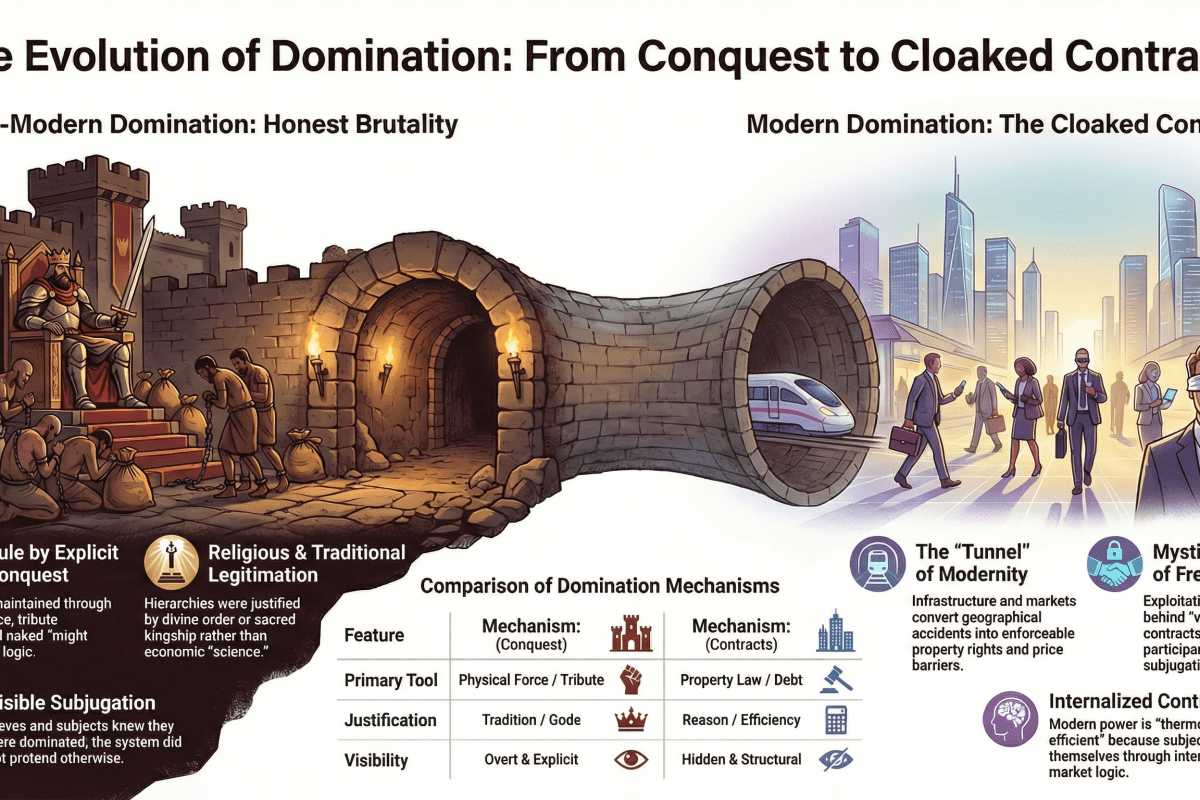
The Enlightenment promised clarity – the clean line between reason and superstition, order and chaos, subject and object. Yet, from that same light emerged the bureaucrat, the executive, and the algorithm: three perfect children of reason, each killing with increasing efficiency and decreasing intent.
Capitalism is merely the administrative arm of this lineage – the economic expression of the Enlightenment’s original sin: mistaking quantification for understanding. When discourse itself becomes procedural, when conversation turns into cost-benefit analysis, thought ceases to be an act of care and becomes an act of compliance.
The tragedy isn’t that we’ve lost meaning. It’s that we’ve automated it. The machine hums on, self-justifying, self-optimising, self-absolving.
Your post is a confession that anti-capitalism kills with guns and gulags. Give me capitalism over socialism any day.
Well, you should move to Cuba or any other socialist paradise… end of issue.
How can you be taken seriously when you conflate an entire economic system with health insurance? And for someone to say that overt murder, a la Stalin, is “decency”? That speaks for itself.
That is not capitalism. That is bureaucracy.
Healthcare isn’t free and everyone has the same right to make or not to make money.
Sounds more like socialism. Do it our way or we will freeze your bank account, take your job, and make sure you get nothing till you comply (proof was during covid)
Capitalism has made us the desired destination for those living in socialistic societies
BEURACRACY. The word your looking for is BEURACRACY not capitalism. There is no form of government more beurocratic than communism, except socialism. If you wonder why that is, communism doesn’t have to hide it’s authoritarianism like socialism does.
Socialism/Communism killed over 100 million the last century the old fashioned way;: bullets, starvation, torture, etc. Capitalism lifted 1 billion people out of poverty
Pathetic – misleading statement. Yes there are many problems, and mistakes that should be corrected. But as a physician, can guarantee before this medical system starting to ignore viruses, far more people were killed yearly under socialist or communist medical systems than capitalism. Wake up – care was not denied because many procedures and higher levels of care were unreachable to most!!!
How is the Government any different? You get what they say you get without the option of voting with your feet/checkbook. I’ll take my chances in the free market EVERY TIME.
This post is fiction from the start. Capitalism does NOT kill. Communism/Socialism does though.
Are you implying the ponderous inactivity of the socialist apparat is not worse than what we encounter with capitalistic motivated organizations? Learn the facts.
Capitalism works well enough–better than any other alternatives. It degrades when government sticks its nose into private transactions to provide cover for lethargy and inefficiency. Responsibility moves from the person with whom one deals to a great nothingness of indifference. [truncated for brevity]
Private insurance has its faults but so does government insurance they are different but just as challenging
Any business that deals directly with Human tragedy (Casualty, Medical, Health, et al) should be held to both a different and higher standard in “cost optimization” than other businesses. To say that someone’s chemo should be spreadsheeted in the same columns as someone’s second home 80 feet from the beach is proof that capitalism is dead and scorched earth profiteering is now the new normal.
The argument should not be about capitalism vs. communism, but rather about human beings. Are humans creative/gifted enough to take care of themselves and produce surplus for the helpless few, or helpless sheep, majority to be fed and controlled by elites? But for your edification Bry, as you are critic of capitalism, try communism for a season, to balance your critique.
Bry WILLIS how long have you been this confused about basic economics and government policy?
Most people stop using the “I know you are, but what am I” basis for their arguments by the age of seven or eight. But it appears to still be your basis for discourse.
I wish you better luck seeing and understanding things for what they actually are vice how you wish they were.
The rules come from a socialist regime. The Marxists are oppressing your freedom. Not rhe FREE market and free enrerprises. What are you talking about….
That is is not capitalism. that is CRONY capitalism when feather merchants spread so much hoo-ha that nobody can get anything done.
Bry WILLIS look up social credit. Bank accounts under this government in Canada, have already been frozen, for dare disagreeing with them
This man feels our health insurance system represents capitalism? We better have a more in depth talk about how American health insurance works.
This has nothing to do with “capitalism”. If you choose to use the English language to communicate, understand the intended meanings of the words. We use contract law in our country regarding insurance coverage. It has little to do with capitalism. In fact, Obamacare stripped any semblance of capitalism from the process and replaced it with pricing manipulation, regulations, subsidies and other such “adjustments” to what used to be a capitalistic system. Blame the regulations, and lack of government enforcement, not “capitalism”. No winder NYC elected Momdani.
Ask those in China, N. Korea, and Russia how socialism/communism works for them.
Next you will have Gen AI and Agentic AI declining claims so that management can just point to the AI and no one has to feel bad for cutting off life saving care.
You’re a cancer. Capitalism created the best living standards the world ever seen. The socialist show up and corrupt it with all these social programs that don’t work and that’s where we’re at. You’re killing the future. You’re an idealist that never had to live in the real work and built anything and you’ll be the one who’s bitching when you’re on relief.
The only system that placed people in gulags was socialism all under the banner of democracy.
This is pure nonsense. Take stuff like this on Bluesky
As I’ve said 4,000 times before, Capitalism requires robust competition in the market and zero collusion, price fixing, and market manipulation in order for it to function in its truest form and most beneficial economic impact to society as a whole (instead of 2%) and to be truly considered superior to other forms. None of those conditions exists in today’s capitalism (as practiced) and it has devolved into scorched earth profiteering which has a totally different definition and is practiced in a different way. Today’s profiteering by Corporations, which includes actions and behaviors that are counter-productive to capitalism, and that they hide under the guise of capitalism, acts as a malignant cancer on true capitalism and its inevitable result is, over time, a greater demand by society for socialist response as a counter measure. If Capitalism were working as it should, (and it’s not) that demand by society for socialist action would be highly diminished instead of enhanced.
Capitalism is not the “marriage of business and government” — that’s called oligarchy or, as the WEF calls it, “stakeholder capitalism”, also known as aristocracy. This is the current operating model of Canada, for example, wherein regulation and subsidy and tax”relief” is used to protect monopolies they are favorable to the sitting government.
Before we go any further, please share your definition of capitalism.
Such bureaucracy is worse with socialism, with even less individual freedom because the almighty centralized state maintains tight control over everything.
Another socialist complaining about tainted money. Bry, the money “taint” yours to spend. It belongs to those who earned it.
More like government bureaucracy
Notes and References
1.The Procedural Violence of Systems. David Graeber’s The Utopia of Rules (2015) and Bullshit Jobs (2018) remain essential on the bureaucratic face of modern capitalism — where compliance replaces conscience and inefficiency becomes profitable.
2.Markets as Mythology. Karl Polanyi’s The Great Transformation (1944) describes how “self-regulating” markets were never natural phenomena but products of state violence and enclosure. What contemporary defenders call “real capitalism” is, in Polanyi’s terms, a historical fiction maintained through continuous coercion.
3.The Logic of the Machine. Bernard Stiegler’s Technics and Time (1994–2001) and Automatic Society (2015) provide the philosophical frame for capitalism’s algorithmic mutation: automation not just of production, but of attention and thought.
4.Bureaucracy and Death. Max Weber’s early insight into rationalisation—the conversion of moral action into procedural necessity—reaches its necropolitical extreme in Achille Mbembe’s Necropolitics (2003), where the administration of life and death becomes a managerial function.
5.Language, Responsibility, and the Loss of Agency. Hannah Arendt’s Eichmann in Jerusalem (1963) diagnosed “the banality of evil” as precisely the condition described in the post: atrocity performed through paperwork, not passion. The executive who denies coverage is merely performing policy.
6.Attention as Commodity. Guy Debord’s Society of the Spectacle (1967) and Byung-Chul Han’s In the Swarm (2017) both chart the transformation of discourse into spectacle, and thought into metrics — the perfect capitalist apotheosis: outrage without substance, visibility without understanding.
7.On Reflex and Recognition. Friedrich Nietzsche’s Genealogy of Morals (1887) prefigures this pathology in his account of herd morality and ressentiment — a collective psychology where reaction replaces reflection.
Further Reading / Contextual Essays
The Ethics of Maintenance: Against the Myth of Natural Purpose A dismantling of the Enlightenment’s faith in progress. Maintenance, not innovation, becomes the moral task once teleology collapses. This essay lays the groundwork for understanding capitalism as an entropy accelerator disguised as improvement.
Against Agency: The Fiction of the Autonomous Self Explores how neoliberal ideology weaponises Enlightenment individualism. The myth of “self-made” success functions as capitalism’s moral camouflage — the narrative counterpart to plausible deniability.
The Illusion of Light: Thinking After the Enlightenment The core text of the Anti-Enlightenment corpus. A philosophical excavation of modernity’s central delusion: that illumination equals truth. Traces the lineage from Cartesian clarity to algorithmic opacity.
Objectivity Is Illusion (The Language Insufficiency Hypothesis) An inquiry into the failure of language as a medium for truth claims. Introduces the Effectiveness–Complexity Gradient, showing how every human system — political, linguistic, economic — eventually collapses under the weight of its own abstractions.
The Discipline of Dis-Integration A philosophy of maintenance over progress. Argues that dis-assembly — not construction — is the proper epistemic gesture in an age of exhaustion.
Propensity(Ridley Park, 2024) The fictional mirror to these essays. A speculative novel examining the behavioural mechanics of optimisation, obedience, and systemic cruelty — a narrative form of “cost-optimisation ethics.”
I’ve recently decided to take a sabbatical from what passes for economic literature these days — out of a sense of self-preservation, mainly — but before I hermetically sealed myself away, I made a quick detour through Jorge Luis Borges’ The Library of Babel (PDF). Naturally, I emerged none the wiser, blinking like some poor subterranean creature dragged into the daylight, only to tumble headlong into David Graeber’s Bullshit Jobs.
This particular tome had been languishing in my inventory since its release, exuding a faint but persistent odour of deferred obligation. Now, about a third of the way in, I can report that Graeber’s thesis — that the modern world is awash with soul-annihilatingly pointless work — does resonate. I find myself nodding along like one of those cheap plastic dashboard dogs. Yet, for all its righteous fury, it’s more filler than killer. Directionally correct? Probably. Substantively airtight? Not quite. It’s a bit like admiring a tent that’s pitched reasonably straight but has conspicuous holes large enough to drive a fleet of Uber Eats cyclists through.
An amusing aside: the Spanish edition is titled Trabajos de mierda (“shitty jobs”), a phrase Graeber spends an entire excruciating section of the book explaining is not the same thing. Meanwhile, the French, in their traditional Gallic shrug, simply kept the English title. (One suspects they couldn’t be arsed.)
Chapter One attempts to explain the delicate taxonomy: bullshit jobs are fundamentally unnecessary — spawned by some black magic of bureaucracy, ego, and capitalist entropy — whilst shit jobs are grim, thankless necessities that someone must do, but no one wishes to acknowledge. Tragically, some wretches get the worst of both worlds, occupying jobs that are both shit and bullshit — a sort of vocational purgatory for the damned.
Then, in Chapter Two, Graeber gleefully dissects bullshit jobs into five grotesque varieties:
Flunkies, whose role is to make someone else feel important.
Goons, who exist solely to fight other goons.
Duct Tapers, who heroically patch problems that ought not to exist in the first place.
Box Tickers, who generate paperwork to satisfy some Kafkaesque demand that nobody actually reads.
Taskmasters, who either invent unnecessary work for others or spend their days supervising people who don’t need supervision.
Naturally, real-world roles often straddle several categories. Lucky them: multi-classed in the RPG of Existential Futility.
Graeber’s parade of professional despair is, admittedly, darkly entertaining. One senses he had a great deal of fun cataloguing these grotesques — like a medieval monk illustrating demons in the margins of a holy text — even as the entire edifice wobbles under the weight of its own repetition. Yes, David, we get it: the modern economy is a Potemkin village of invented necessity. Carry on.
If the first chapters are anything to go by, the rest of the book promises more righteous indignation, more anecdotes from anonymous sad-sacks labouring in existential oubliettes, and — if one is lucky — perhaps a glimmer of prescription hidden somewhere amidst the diagnosis. Though, I’m not holding my breath. This feels less like an intervention and more like a well-articulated primal scream.
Still, even in its baggier moments, Bullshit Jobs offers the grim pleasure of recognition. If you’ve ever sat through a meeting where the PowerPoint had more intellectual integrity than the speaker or spent days crafting reports destined for the corporate oubliette marked “For Review” (translation: Never to Be Seen Again), you will feel seen — in a distinctly accusatory, you-signed-up-for-this sort of way.
In short: it’s good to read Graeber if only to have one’s vague sense of societal derangement vindicated in print. Like having a charmingly irate friend in the pub lean over their pint and mutter, “It’s not just you. It’s the whole bloody system.”
I’m not sure I’ll stick with this title either. I think I’ve caught the brunt of the message, and it feels like a diversion. I’ve also got Yanis Varoufakis’ Technofeudalism: What Killed Capitalism on the shelf. Perhaps I’ll spin this one up instead.
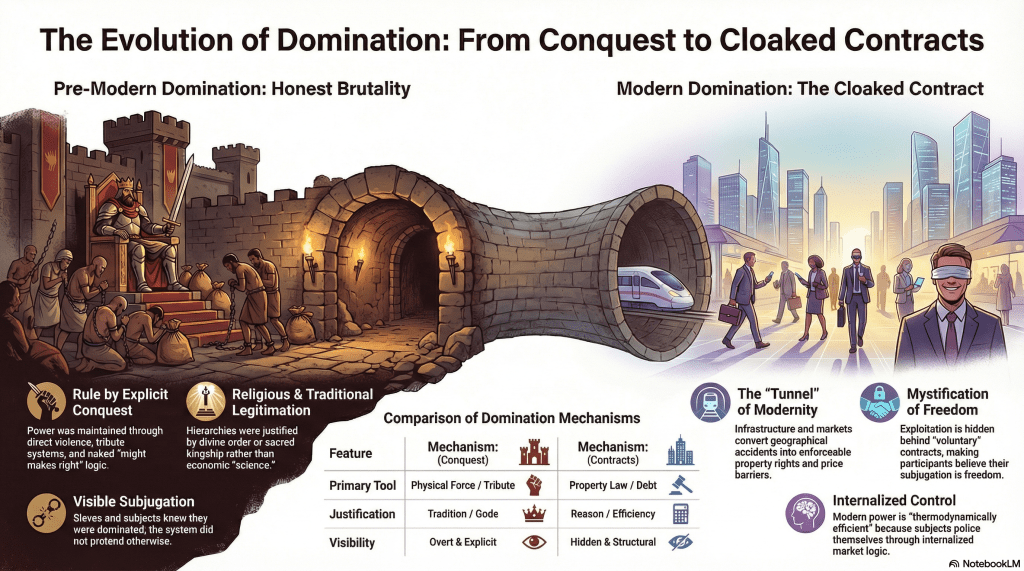
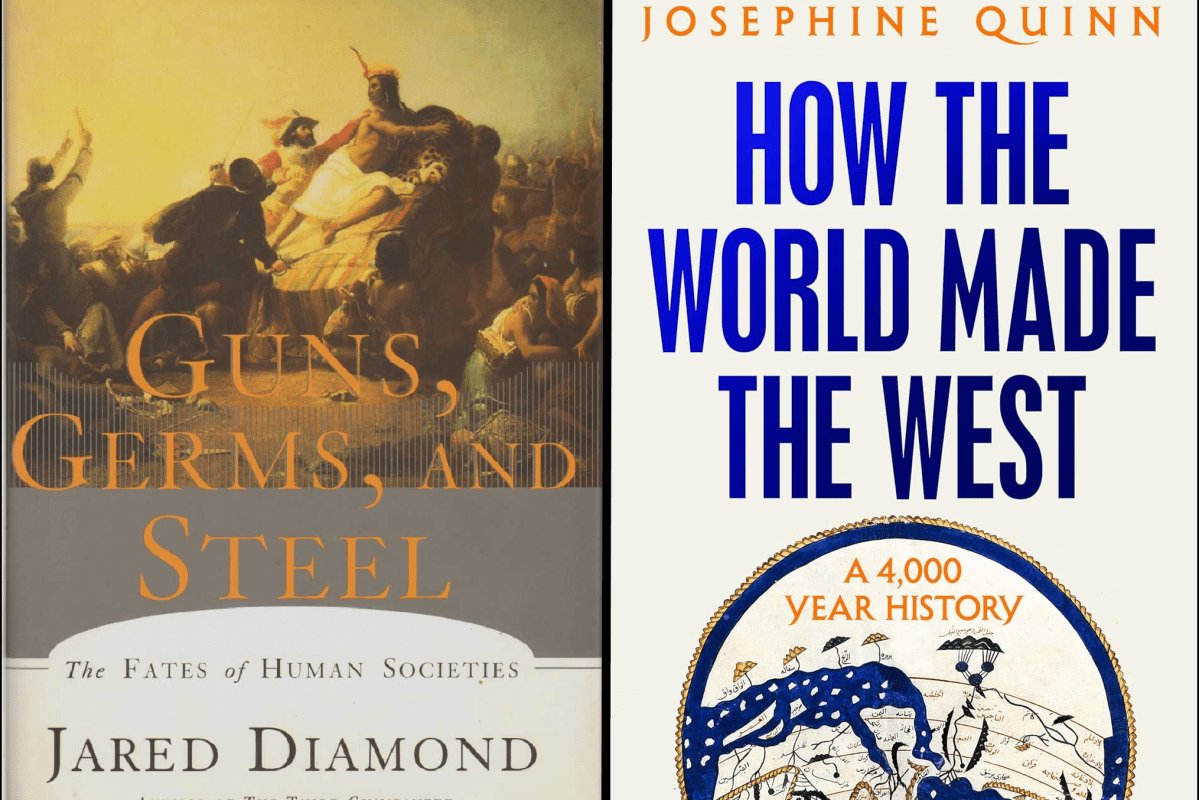
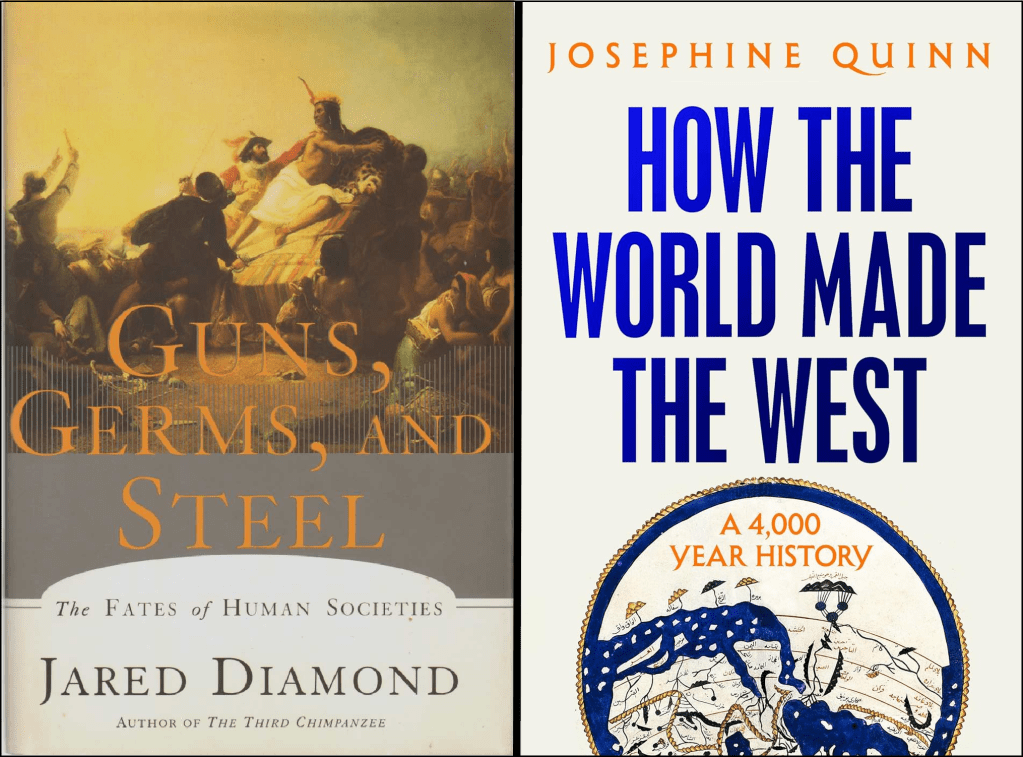
I am reading Jared Diamond’s Guns, Germs, and Steel: The Fates of Human Societies, the first and likely most famous of an informal trilogy. I thought I had already read it, but I think I only saw the PBS show. Having recently finished Josephine Quinn’s How the World Made the West, I wanted to revisit this perspective. The two books are presented in different styles and represent different perspectives, but they seem to be complementary.
Where Diamond focuses on environmental factors (an oft-voiced critique), Quinn focuses on human agency.
Diamond takes a bird’ s-eye view, looking for universal patterns and systemic explanations, whilst Quinn adopts a granular, specific approach, highlighting the fluidity and contingency of history.
Diamond deconstructs European dominance by attributing it to environmental luck, but his narrative risks sidelining the agency of colonised peoples. Quinn critiques the very idea of Western dominance, arguing that the concept of the West itself is a myth born of appropriation and exchange.
Rather than being wholly opposed, Diamond and Quinn’s approaches might be seen as complementary. Diamond provides the structural scaffolding – the environmental and geographic conditions that shape societies – whilst Quinn fills in the cultural and human dynamics that Diamond often glosses over. Together, they represent two sides of the historiographical coin: one focusing on systemic patterns, the other on the messiness of cultural particularities.