The Hard Problem Was Never Consciousness

3–5 minutes

It Was Language All Along.

This whole misadventure began sometime in 2018, when I started documenting what has now metastasised into the Language Insufficiency Hypothesis. If I weren’t typing this, I’d be doing the honourable thing and finishing the index, but here we are, procrastinating with purpose. I had a suspicion, even then, that language was up to something. Something slippery. Something evasive. At first, it was just a motley catalogue of weasel words that refused to sit still long enough to be given a meaning. I should have taken the hint when the list kept expanding like a Victorian railway: terminally over-budget and convinced of its own grandeur.

But, naturally, I pressed on.

Audio: NotebookLM summary podcast and conversation around this topic.

At the time I had that slow-burn itch about identity, selfhood, free will, agency – you know, the usual metaphysical tat we’re reared on like a Victorian child raised on laudanum. It wasn’t that these things didn’t exist; it was that the words simply couldn’t bear the conceptual load we’d been piling onto them. And so I found myself in the company of philosophers who either tried to rescue these terms (Dennett, ever the valiant firefighter with a damp match), complicate them (Searle, constructing houses of cards under wind machines), or dissolve them outright (Parfit, smiling serenely as the rest of us panic).

Meanwhile, Strawson was somewhere in the corner insisting experience is all there is, Putnam was in his perennial retraction phase, and I was merely trying to keep my own conceptual apparatus from collapsing like an undercooked soufflé.

I’ll admit I had a long-standing soft spot for Dennett’s consciousness-as-emergence hypothesis. It made a certain intuitive sense at the time: pile up enough neural machinery, sprinkle in some feedback loops, and consciousness would bubble up like steam from a kettle. It felt elegant. It felt mechanistically honest. And, crucially, it made perfect sense within the inherited Realist framework I was still tacitly lugging around. Of course, experience ’emerges’ from physical processes if you start from a worldview already partitioned into physical substrates and mental phenomena waiting to be accounted for. Dennett wasn’t wrong so much as operating within the same architectural error the rest of us had been marinating in. Once I began reframing the whole encounter through mediation rather than emergence, the elegance dissolved. What had looked like metaphysics turned out to be a conceptual afterimage generated by a language that couldn’t model its own limitations.

And then there was Chalmers.

Ah, the ‘hard problem’. I lost count of how many times it surfaced. Like mould. Or a debt collector. Chalmers’ dilemma – how physical processes give rise to experience – is purportedly the Mount Everest of metaphysics. Yet the more I thought about it, the more it reeked of a linguistic parlour trick. A conceptual magic eye puzzle: stare long enough and a unicorn appears, provided you’ve surrendered your scepticism and a good measure of oxygen.

The problem isn’t that consciousness is ‘hard’. The problem is that the linguistic scaffolding we’re using was never built for this terrain. ‘Experience’. ‘Physical’. ‘Mental’. ‘Explain’. These words pretend to be steel beams when they’re actually damp cardboard.

What remains isn’t a cosmic riddle but a linguistic artefact. A conceptual false path carved by centuries of grammatico-metaphysical enthusiasm – the unfortunate habit of mistaking grammatical symmetry for metaphysical necessity.

Which brings me to the present, having at last gelled the LIH and published the Mediated Encounter Ontology of the World – a relational metaphysics that has the decency not to hallucinate substances it can’t justify. MEOW clears the fog rather neatly: the so-called ‘hard problem’ is only ‘hard’ because we continue to treat ‘mind’ and ‘world’ as two independent substances requiring metaphysical reconciliation. Together, LIH and MEOW provide a double exposure of the problem: LIH shows why the language fails; MEOW shows what the language was failing to describe.

So here we are. I’d like to reconsider Chalmers through the dual lenses of LIH and MEOW – not to ‘solve’ the hard problem, but to show it was never the right problem to begin with. The difficulty isn’t consciousness; it’s the language we’re forced to use, the same language that refuses to sit still, the same language that keeps trying to trick us into mistaking grammatical symmetry for metaphysical necessity.

In a coming post, I intend to pry open that illusion with a crowbar. Delicately, of course. One must be civilised about these things.

Because if language is insufficient – and it is – then perhaps what Chalmers discovered was not the abyss of consciousness, but the limit of the dictionary.

Conscious of Consciousness

Let us begin with the heresy: consciousness is not a thing. It is not a light bulb switched on in the mind. It is not a theatre with a little homunculus watching the play unfold. It is not a ghost in the machine, nor even a particularly welcome tenant. Consciousness is a conjuring trick – one so convincing that even the conjurer forgets it is an act.

Video: Related Topic: IAI Joscha Bosch on Consiousness

If that unsettles you, good. Welcome to the simulacrum.

The Wetness of Mind

We often hear that consciousness is “emergent,” but the term is used so promiscuously that it risks becoming decorative. So let us be specific. Consciousness, if it is emergent, is emergent as wetness is from H2O: not in the hydrogen or the oxygen, but in their relationship when bonded just so. Joscha Bach and others argue that consciousness arises not from the bits, but from the dance – the recursive feedback loops and predictive models running atop the neural substrate.

Audio: NotebookLM podcast on this topic.

In this view, the self is not the pilot but the dashboard. It is the user interface the brain conjures to coordinate action, interpret input, and maintain internal coherence. Not because it’s real, but because it’s useful. You are a GUI with delusions of grandeur.

The Cast of Theorists

Let us now parade the usual suspects:

  • Joscha Bach: Consciousness is a virtual self-model, emergent from recursive, computational feedback. Not the product of neurons firing per se, but of their ability to simulate a stable identity across time.
  • Thomas Metzinger: There is no self. Only a Phenomenal Self-Model (PSM) which becomes phenomenally transparent when the system no longer recognises it as a model. Consciousness is the experience of this hallucinated self.
  • Daniel Dennett: Dismantles the notion of a “central experiencer” with his Multiple Drafts Model. Consciousness is a narrative, a distributed process where drafts of experience compete, are edited, and retroactively interpreted.
  • David Chalmers: Waves his flag at the Hard Problem of consciousness. You can explain behaviour, memory, attention—but not experience itself. He flirts with dualism and panpsychism while insisting there’s a gap science cannot yet close.
  • Giulio Tononi: Gives us Integrated Information Theory (IIT) and the elusive metric Φ (phi). Consciousness is the degree to which information is unified within a system. Your brain is conscious because its parts can’t be reduced without losing coherence.
  • Karl Friston: The prophet of Free Energy Minimisation. Consciousness is an emergent property of systems that seek to reduce prediction error. The brain is a Bayesian engine, and the self is its best guess about how to survive.

So What Is Consciousness?

A hallucination. A recursive illusion. A predictive dashboard. A statistical artefact. A phi score. A phenomenally transparent model. Take your pick.

None of these theories fully agree, but most converge on one elegant horror: you are not what you think you are. The sense of being a continuous, stable, indivisible “I” is a construction. A simulation. The dream from which there is no waking because waking is part of the dream.

This is not despair; it is clarity. Just as wetness does not cry when told it is not a substance, the self need not mourn its own illusion. It is a marvellous fiction, worth inhabiting.

Conclusion: Through the Mirror

To be conscious of consciousness is to stand in the hall of mirrors and realise none reflect the original—because there is no original. The mirror is the thing.

But if the theatre is empty, the play goes on. Scripts are written, models simulated, selves performed. And perhaps, in this strange recursion, we find not meaning, but the possibility of coherence.

So raise a glass to the illusion. May your predictive model stay optimised, your narrative stay plausible, and your hallucinated self remain just this side of transparent.


For further hallucinatory episodes, consult your local philosopher, neuroscientist, or AI researcher. Side effects may include derealisation, epistemic vertigo, and mild enlightenment.

Can Zombies Ever Be Conscious?

In the world of consciousness studies, few topics spark as much heated debate as the possibility of philosophical zombies—hypothetical beings that behave exactly like humans but lack subjective experience, or qualia. On the surface, zombies seem like an interesting thought experiment, but they quickly turn into a battleground for deeper issues about the nature of consciousness itself.

This post explores two key perspectives in this debate: Daniel Dennett’s functionalist critique of zombies and a recent scientific paper that argues zombies are biologically impossible. While both reject the possibility of zombies, they do so for different reasons, and the discussion leaves room for future possibilities that could disrupt the current consensus.

Dennett’s Zombies and Zimboes: Consciousness as Function

Daniel Dennett, one of the most influential philosophers of mind, is known for his no-nonsense rejection of philosophical zombies. Dennett argues that if something behaves exactly like a conscious being, it is conscious. For him, there is no hidden metaphysical property—such as subjective experience—that separates a “zombie” from a conscious human. Consciousness, in his view, is entirely explainable by physical processes and functional behaviour.

Dennett extends his argument with the concept of zimboes, satirical creatures that not only act like conscious beings but can even reflect on their states, claiming to be conscious, despite supposedly lacking any inner experience. For Dennett, if a being can behave as though it has introspective awareness and engage in the full spectrum of human behaviour, there’s no meaningful distinction between that being and a conscious person.

In short, Dennett collapses the distinction between zombies and conscious beings. If something passes all the behavioural and functional tests of consciousness, it might as well be conscious. Zombies, as typically conceived, are simply an illusion—a misunderstanding of what consciousness is.

A Biological Rejection: Zombies Are Impossible

On the other hand, a more recent paper offers a different, biologically grounded argument against zombies. The authors propose that consciousness is the result of self-organising systems. In this view, biological organisms maintain their survival through adaptive behaviours constrained by policies—rules that govern how they react to environmental stimuli. These policies require a first-order self: a basic form of consciousness that allows an organism to navigate and interpret its environment.

The authors argue that without this first-order self, an organism would not be able to exhibit the fitness-driven behaviours needed for survival. Therefore, zombies—beings that behave like humans without consciousness—are biologically impossible. For these researchers, consciousness is not just a side effect of complex behaviour; it’s a necessary condition for such behaviour. Their framework dissolves the so-called “hard problem” of consciousness, asserting that subjective experience, or qualia, arises directly from the qualitative nature of self-organising systems.

In their view, zombies cannot exist because behaviour as complex as that of conscious beings requires consciousness.

The Open Question: What About Future Technology?

However, there is a tension between these two perspectives, particularly when we consider future possibilities in technology and artificial intelligence. Both Dennett and the authors of the biological paper argue that zombies—whether defined as Dennett’s “behaviourally indistinguishable” beings or the biologically impossible entities proposed by the paper—are not real. But could this change?

What if advanced AI or synthetic biological systems could simulate human behaviour so perfectly that they effectively become zombies—performing all the actions and behaviours we associate with consciousness, but lacking any subjective experience? Dennett might still argue that these systems are conscious, as long as they behave as though they are. But the biological view complicates this, since it ties consciousness directly to the survival and adaptive behaviours of self-organising systems.

Could a highly advanced AI system bypass the need for subjective experience while still exhibiting complex, adaptive behaviour? If so, it would challenge the current consensus and potentially create a new class of entities—artificial zombies—that neither behave nor function like traditional conscious beings but still perform human-like actions.

I Wonder What’s Next?

This philosophical conflict leaves us with an intriguing, open-ended question: are zombies truly impossible, or are they merely improbable given our current understanding of biology and consciousness? Dennett’s view seems to collapse the distinction between behaviour and consciousness, while the biological argument insists that the two are inseparable. But both positions could be challenged by future technologies that mimic human consciousness without having it.

Could we one day create a true zombie—a being that acts like us, thinks like us, but is as empty inside as a rock? The debate remains open, and as our understanding of consciousness and artificial intelligence deepens, so too will our exploration of the zombie question.

For now, the answer to whether zombies can exist seems to depend on what you believe consciousness really is.

VIDEO: Response to Response on Sapolsky v. Dennett Debate

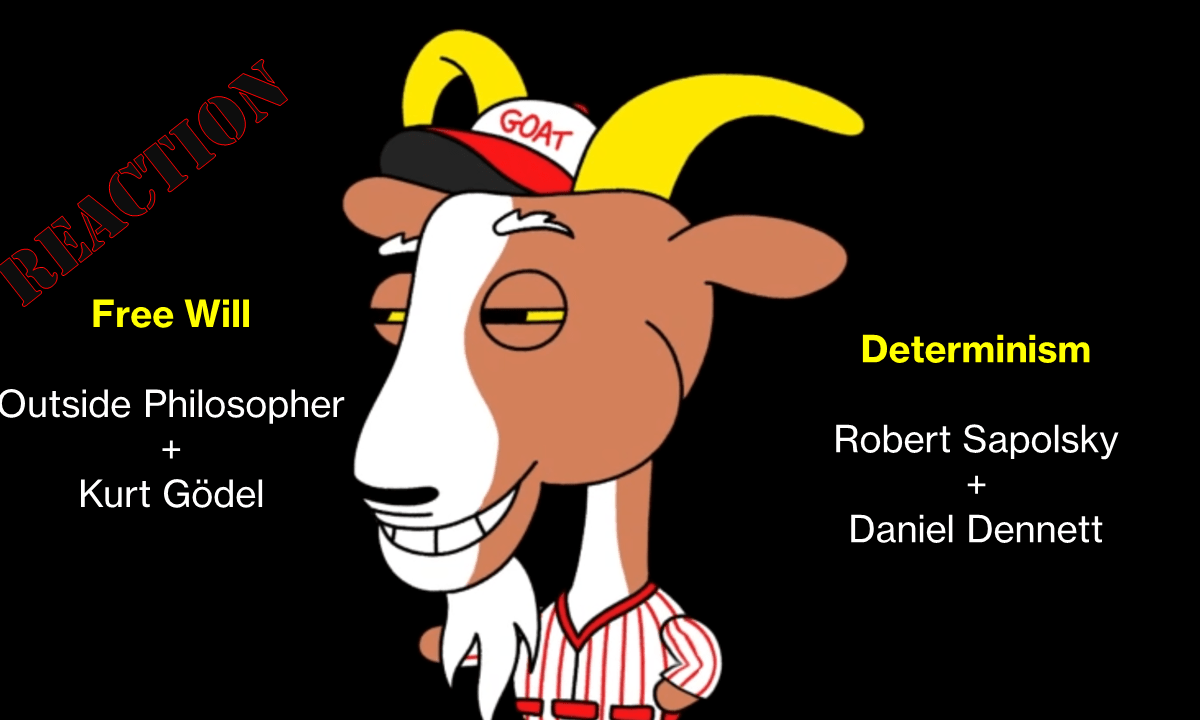
It’s been a minute since I’ve posted a video. Restart the clock. In this video, I critique Outside Philosopher’s critique of the debate between Robert Sapolsky and Daniel Dennett on Free Will and Determinism. He attempts to leverage Gödel’s Uncertainty Principle in his defence.

Feel free to leave comments on YouTube or below. Cheers.

Blaming and Naming

When I was writing my review of Elbow Room, this categorical syllogism came to mind:

P1: All agents are responsible

P2: I am an agent

C: Therefore, I am responsible

Now I want to unpack it.

Podcast: Audio rendition of this page content

The first premise is that all agents are responsible. Of course, this hinges on how one defines agent and responsibility. It also depends on the scope, especially of the agent but to some extent also the scope of responsibility.

Leveraging the Causa Sui argument, the agent is a social construct and can only be responsible to what extent s/he has been programmed as well as the ability to maintain and process the programming effectively—so without bugs to continue with the parlance.

If the agent is immature or defective, expectations of responsibility are diminished.

If certain inputs were not given, there is no reason to assume a related command would be executed. This is why so much time and energy is spent on programming and evaluating children.

This first premise is predicated on the pathological need to blame. Unwritten behind the responsibility claim is that I feel compelled to blame. Blame requires responsibility, so if I want to blame someone, they must be responsible. In any given circumstances, I may feel the urge to blame anyone, so all agents [eligible people] are worthy of blame. There is no particular reason to exclude myself, so I too am blameworthy. What’s good for the goose is good for the gander, eh?

Goose and Gander. Strike that pose.

As PF Strawson said, even if moral responsibility couldn’t possibly exist, it would be invented because people need to blame. This is in line with Voltaire’s commentary on God.

Si Dieu n’existait pas, il faudrait l’inventer.
If God did not exist, it would be necessary to invent him.

Voltaire

We can all look around and see how pervasive the god delusion is. Moral responsibility is even more insidious. In principle, moral gods were invented for just this purpose. An omnipresent judge was needed to keep the big house in check.

Where I Stand

From my perspective, I do feel that a person in the space of Dennett’s elbow room can have responsibility. Being a non-cognitivist, I have more difficulty accepting the arbitrary imposition of morality, but I understand the motivation behind it.

The problem I have is that mechanisms to ensure that the inputs and processes are all in order and there are no superseding instructions are not in place. Moreover, if the superseding instruction does not comport with the will of the power structure, it will be marginalised or ignored. This is a limitation of morality being a social construct, and none of this gets past the ex nihilo problem causa sui invokes, so we end up cursing the computer we’ve invented. O! monster of Frankenstein. O! Pygmalion.

Elbow Room

Daniel Dennet is quite the prolific writer. He first published Elbow Room back in 1984. He published an updated version in 2015. I like Dan. He is a master storyteller and has a mind like a trap, archiving decades (and centuries) of information. The approach he takes is thoughtful and methodical, and I tend to agree with most of his positions. This isn’t one of them. Interestingly, I recently reviewed John Martin Fischer’s contribution to Four Views on Free Will, which is sympathetic to his position.

Dennett is a compatibilist. I am an incompatibilist—an impossibility, really—, but I wanted to understand his line of argumentation. Like Fischer, Dennett wants to claim that an agent does possess enough elbow room—wiggle room—to be able to be granted free will or moral responsibility, depending on where you prefer to draw the line.

Dennett tends to agree with my position that free will is a semantic pseudo-problem, but he doesn’t mind calling enough ‘good enough’. Given a situation and circumstances, we have enough latitude to consider any actions to be free—with the usual exemptions for non compos mentis situations, cognitive deficits, and duress. He minimises the impact of genetics and upbringing as insignificant.

Basically, he argues that what latitude we do have is sufficient and what more could one want? Anything more would be unnecessary and excessive. Of course, this is just him drawing an arbitrary line at a point he feels comfortable, claiming that anyone asking for more is being unrealistically unreasonable. This feels a bit like a preemptive ad hominem defence. If you want this, then you are just foolish and selfish.

Dennett does agree with the notion that the world might be deterministic, but even so, we are proximately special. He also leans on the observation that people seem hardwired for blame, so there must be something behind this—instead of considering that humans seem hardwired for many things, not all of which are socially beneficial.

We want to hold people responsible, so by extension, we need to consider ourselves to be responsible.

P1: All agents are responsible

P2: I am an agent

C: Therefore, I am responsible

But the problem is in the definition of agency (as well as the scope and meaning of responsibility and the assignment of responsibility to agents.

In the end, I remain unconvinced, primarily that he fails to overcome the Causa Sui argument.

Moral Responsibility

Can we be held morally responsible for our actions? Yes, says Daniel Dennett. No, says Gregg Caruso. Reader, you decide

Aeon Article, 4 October 2018

Caruso: [Dan,] you have famously argued that freedom evolves and that humans, alone among the animals, have evolved minds that give us free will and moral responsibility. I, on the other hand, have argued that what we do and the way we are is ultimately the result of factors beyond our control, and that because of this we are never morally responsible for our actions, in a particular but pervasive sense – the sense that would make us truly deserving of blame and praise, punishment and reward. While these two views appear to be at odds with each other, one of the things I would like to explore in this conversation is how far apart we actually are. I suspect that we may have more in common than some think – but I could be wrong. To begin, can you explain what you mean by ‘free will’ and why you think humans alone have it?

Gregg Caruso

Dennett: A key word in understanding our differences is ‘control’. [Gregg,] you say ‘the way we are is ultimately the result of factors beyond our control’ and that is true of only those unfortunates who have not been able to become autonomous agents during their childhood upbringing. There really are people, with mental disabilities, who are not able to control themselves, but normal people can manage under all but the most extreme circumstances, and this difference is both morally important and obvious, once you divorce the idea of control from the idea of causation. Your past does not control you; for it to control you, it would have to be able to monitor feedback about your behaviour and adjust its interventions – which is nonsense.

In fact, if your past is roughly normal, it contains the causal chains that turned you into an autonomous, self-controlling agent. Lucky you. You weren’t responsible for becoming an autonomous agent, but since you are one, it is entirely appropriate for the rest of us to hold you responsible for your deeds under all but the most dire circumstances. 

Daniel Dennett

if your past is roughly normal, it contains the causal chains that turned you into an autonomous, self-controlling agent

Dan Dennett

So commences this debate. The argument unfolds largely on semantic grounds. Even here, one can see the debate over the distinction between control and causation. I understand what Dennett is attempting to parse here, but I object on the grounds of causa sui.

I recommend reading the Aeon article as there is much more than this distinction, but it does remain a semantic issue. I started a post on backwards- and forward-looking perspectives, that better articulate Caruso’s perspective, but I am also working on other things. This was quicker to post and I wanted to keep a bookmark anyway, so it’s a win-win.

How come why? What for?

Video: Why? – “What for?” or “How Come?” — Daniel Dennett

As a rule, I don’t have much faith in humans. It would be apparent if you read some of my posts. I find most people to be akin to vapid sports fans: Hooray for my team—whether that team is political party or persuasion, science, religion, and whatever. Not a lot of critical thinking or reasoning. I believe Geuss mentioned that most people are just trying to make it to the next day and acquire more stuff—at least more stuff than the neighbour. Social media is a turn for the worse. Luckily and thankfully, there are exceptions to this rule.

Engaging in a CS Peirce forum that I was invited to because of some interactions I had in a postmodern forum, I asked for the source of a Peirce claim made by another Lee Smolin.

When you explain a system by referencing the laws, that’s not the end of the explanation; you have to—we must explain how the laws came to be and why there are these laws and not other laws.

Lee Smolin on CS Peirce

At 8:43, Smolin cites Peirce by saying ‘that when you explain a system by referencing the laws, that’s not the end of the explanation; you have to—we must explain how the laws came to be and why there are these laws and not other laws—and he goes on to say this is 1893…’

Video: Are the laws of the universe immutable and unchanging?

Not being a direct quote, I was experiencing difficulty finding the source of the citation, so I asked in the Peirce group. As I am wont to do, I added that I didn’t buy into the assertion, but if I could find the source I could gather more context.

I don’t buy into the assertion that in describing a system one needs to provide an origin story, so I was hoping to discover context to determine whether it’s Smolin or Peirce to have an issue with.

I was given a citation that didn’t happen to be accurate,

A second member chimed in that of course one needs an ‘original state’, so I clarified that it was not the original state that I held issue with. It was the narrative behind it—the story of the origin, not the origin itself.

He responded, ‘That’s Deacon!’ More precisely, the response was as follows:

YES!!!!!!! That’s Deacon!!!!

I’m not even schooled in Peirce, and now I’m getting his classmates.

To my origin clarification, I also added this bit:

I feel that ‘reasons’ or ‘whys’ are less important than ‘how’. In fact, I feel that ‘why’ is often used in English as a synonym to ‘how’ in many contexts.

So when asks ‘Why are you late?’ they are really asking ‘How it is that you’ve arrived late?’ or ‘How come you’re late?’ Why feels like a metaphysical stand-in for how.

…to which he responds with the top clip by Dan Dennett making my same point a decade ago—or I suppose that I am making his same point a decade later.

It seems that I’m late to the party yet again. This is becoming a trend.

Under the Influence

Galen Strawson is my latest male crush. With almost everything I read or hear from him, I say, ‘that’s what I think’, over and over and over again. So I thought I’d share some of my journey to now. I made a post about female influences not too long ago. This is a bit different.

My first obsession, let’s say was the Beatles. I can’t pinpoint precisely when, but when I was a child, it’s been said that I would sing ‘she’s got a chicken to ride’ when it came on to AM radio. I asked for or bought all of their albums, and read everything about them that a kid could get his hands on back in the day. This obsession lasted for years and overlaps some of my next interests. My interests were in John Lennon’s political interests and George Harrison’s spiritual interests. I didn’t really find Paul McCartney or Ringo Starr very interesting beyond their musical abilities. And to be honest, I also got all of the Stones, Led Zeppelin, Pink Floyd, and so on. At my peak, I had over a thousand vinyl records—all lost in a house fire because vinyl and heat are generally incompatible. Paper didn’t fare much better, as I lost hundreds of books, too. A lesson in impermanence.

I am a bit of a nonconformist, a contrarian, and a polemicist

In grades 5 to 8, National Socialism and World War II were fascinating to me. Not Hitler, per se, though I do recall reading Mein Kampf at the time. There was just something about the sense of unity. Upon reflection, I realised that this meant me conforming to some other trend, and that was no longer interesting, as I am a bit of a nonconformist, a contrarian, and a polemicist, so there was that.

At some point, I came across Voltaire’s Candide and it just struck me. This may have commenced me on my path to becoming somewhat of a francophile. I extended my interest into the language and culture. My WWII phase has already primed that pump. I remember reading Dumas, Hugo, and some Descartes.

After I graduated, I was a recording engineer and musician. I remember reading Schoenberg’s Structural Function of Harmony and being enamoured with Dvořák and Stravinsky. I was influenced by many musicians, engineers, and producers, but there was just something about Schoenberg.

I went through a Kafka phase—that eventually included Donald Barthelme. His Absurdism was a nice foundation for my subsequent interest in Camus. It was something that just resonated with me. After Kafka, I discovered Dostoyevsky and consumed everything of his I could get my hands on.

I took from Jung and Campbell the importance of metaphor

In the 1990s, I discovered Carl Jung and eventually Joseph Campbell and a few years I spent reading Jung’s Complete Works and peripheral material related to Archetypal and Depth Psychology. I absorbed the material. I took from Jung and Campbell the importance of metaphor, but it never really resonnated beyond this.

Somehow, this experience led me to the Existentialism of Sartre (and Camus and Beauvoir). At the same time something clicked with me, I was always put off by the teleological imperative these guys seemed to insist upon—Sartre’s political involvement and Camus’ insistence on Art. These were their paths—and I certainly had an interest in Art and Politics—, but I felt this was too prescriptive.

For a brief time, I really liked Hume (and Spinoza), but then I discovered Nietzche and felt compelled to read his major works. It all made sense to me. It still does. Nietsche set me up for Foucault with his power relationships and the sense that morality, good, and evil are all socially constructed and contextual.

And Nietzsche brought me to Foucault and his lens of Power. These two still resonate with me. I investigated a lot of postmodern thinkers after this.

Nietzsche brought me to Foucault and his lens of Power

Daniel Dennett came next. He seems brilliant, and I tend to agree with most of what he says. I was still absorbing. Where biologist Robert Sapolsky gets philosophical, it’s about the same.

But Galen Strawson is different. And I have a lot of catching up to do in my reading of his direct work. The difference is that with these prior influences, I was absorbing and synthesising—creating my own perspectives and worldview. By the time I am finding Strawson, with every encounter, I am ticking off boxes.

  • That’s what I think
  • That’s what I think
  • That’s what I think
  • That’s what I think

Only, he started publishing in the 1960s. I could have been reading his work all along. Since I agree with 99.999 per cent of what I get from him and he is such a deep thinker, I am looking for two things:

  1. Something that expands rather than confirms
  2. Some spaces to operate that he has missed or ignored

As I continue on my Anti-Agency project and gather more inputs and perspectives, I’ll be considering a lot of Strawson. Here’s a clip I really enjoyed. I am thinking of doing a sort of reaction piece, but whether or not that happens, here’s the source.

[Video] Galen Strawson — Is Free Will a Necessary Illusion?

Spoiler Alert: I believe that free will is a cognitive bias related to apophenia. It’s a Gestalt heuristic.