Rational Ignorance

Using AutoCrit, I continue to share the review progress of my work in progress, Democracy: The Grand Illusion. In this chapter, I survey the topic of rational ignorance.

Synopsis

The text delves into the concepts of rational ignorance and unknown unknowns within the framework of democratic decision-making. It begins by defining rational ignorance as individuals choosing to remain uninformed due to the perceived high cost of acquiring information. The discussion then moves on to explore how this impacts voter behaviour, leading to decisions based on superficial understanding and susceptibility to misinformation. The concept of unknown unknowns is introduced as factors individuals are unaware of, influencing decision-making unpredictably.

The text concludes by emphasising the importance of addressing cognitive challenges through enhancing political literacy, promoting deliberative democracy, ensuring transparency, and leveraging technology. By doing so, it aims to create a more informed electorate and strengthen democratic systems.

Audience

The target audience for this text includes policymakers, educators, citizens interested in political science or governance issues, and those involved in civic engagement. Those not targeted may include casual readers looking for light reading material or individuals with no interest in politics. To make it more relevant, the author could simplify complex terms for lay audiences without compromising depth or provide real-world examples illustrating theoretical concepts.

Structure and Organisation

The text follows a logical order by first introducing key concepts like rational ignorance and unknown unknowns before exploring their implications on democratic decision-making. Each section flows seamlessly into the next without abrupt transitions or disconnection between ideas.

Tone

The tone throughout remains informative yet urgent about addressing cognitive challenges within democracies effectively. There’s a sense of responsibility conveyed towards improving civic engagement among readers.

Clarity

Overall clarity is strong; however, some sections could benefit from simplification for easier comprehension by all readers. For instance:

  • “Unknown Unknowns refer to factors that are completely outside individuals’ awareness…” – This could be rephrased more straightforwardly.
  • Complex sentences discussing cognitive biases might require additional clarification for better understanding.

Commentary

There is an entire section on cognitive biases earlier in the book as well as a note to directing the reader to it.

Argument and Persuasion

Opinions presented focus on mitigating effects of rational ignorance through enhanced education and transparency measures which are logically constructed with support from references such as Downs (1957) & Kahneman (2011). While persuasive elements are well-supported overall; further statistical data or case studies would enhance credibility.

Commentary

I’m not sure I’ll include more in this book, as I cite copious source material, noted below.

Interest and Engagement

While engaging overall due to its relevance in current socio-political contexts; sections detailing strategies like encouraging deliberative democracy may lose reader interest due to dense content presentation without breaks or interactive elements such as case studies or anecdotes involving citizen participation can improve engagement levels significantly

Final Thoughts & Conclusions

The text concludes with a strong and satisfying section that summarizes the concepts of rational ignorance and unknown unknowns, emphasizing their impact on democratic decision-making. It effectively ties together the key points discussed throughout the work and provides a clear call to action for addressing cognitive challenges in governance. The final thoughts and conclusions serve to underscore the importance of mitigating these challenges through improved education, deliberation, transparency, and technological advancements. The text ends conclusively by summarizing key points discussed earlier while offering actionable steps towards strengthening democratic systems amidst cognitive challenges faced today—providing a clear direction forward that ties together various themes explored throughout the narrative effectively.


References and Supporting Materials

Downs, A. (1957). An Economic Theory of Democracy. Harper & Row.

Kahneman, D. (2011). Thinking, Fast and Slow. Farrar, Straus and Giroux.

Caplan, B. (2007). The Myth of the Rational Voter: Why Democracies Choose Bad Policies. Princeton University Press.

Tetlock, P. E. (2005). Expert Political Judgment: How Good Is It? How Can We Know? Princeton University Press.

Sunstein, C. R. (2006). Infotopia: How Many Minds Produce Knowledge. Oxford University Press.

Lupia, A., & McCubbins, M. D. (1998). The Democratic Dilemma: Can Citizens Learn What They Need to Know? Cambridge University Press.

Akerlof, G. A., & Shiller, R. J. (2015). Phishing for Phools: The Economics of Manipulation and Deception. Princeton University Press.

Iyengar, S., & Kinder, D. R. (1987). News That Matters: Television and American Opinion. University of Chicago Press.

Gigerenzer, G., & Todd, P. M. (1999). Simple Heuristics That Make Us Smart. Oxford University Press.

Sunstein, C. R., & Thaler, R. H. (2008). Nudge: Improving Decisions About Health, Wealth, and Happiness. Penguin Books.


AutoCrit is an AI-based editorial application. I am a member of their affiliate programme, so I gain minor financial benefits at no cost to you if you purchase through a link on this page.
Effective Mob Rule: Better Voters and Avoiding Mistakes of  the Jim Crow Era

I continue the AutoCrit review of my latest book project, Democracy: The Grand Illusion. In this chapter, I look at why direct democracy is not offered on a large scale even in the advent of digital technologies and the internet that might make this possible.

Synopsis

The text delves into the debate between direct democracy and representative democracy, exploring the perspectives of philosophers Jason Brennan and David Moscrop on enhancing voter competence within democratic systems. It discusses the challenges and ethical implications of implementing an “epistocracy” proposed by Brennan, where voting power is based on knowledge and competence. In contrast, Moscrop advocates for improving civic literacy to empower all citizens in making informed political decisions. The text also addresses the principle-agent problem in democracy and draws parallels with historical injustices like those from the Jim Crow era.

The opening introduces the contentious nature of direct democracy at a large scale and sets up the discussion around different approaches to enhancing democratic outcomes. The conclusion emphasizes learning from past mistakes, promoting inclusivity, transparency, and equity in improving voter competence for a more effective democratic process.

Audience

The target audience for this text would likely be scholars, policymakers, students of political science or philosophy, as well as individuals interested in democratic theory and governance issues. Those not inclined towards academic or theoretical discussions may find this text too dense or specialized. To make it more relevant to a broader audience, the author could simplify complex concepts using more accessible language without compromising depth or nuance.

Structure and Organisation

The text follows a logical order by first presenting contrasting views on direct vs representative democracy before delving into specific proposals by Brennan and Moscrop. Each section builds upon previous arguments cohesively without significant structural issues evident.

Tone

The tone is analytical yet critical at times when discussing potential ethical concerns related to proposed solutions but remains objective overall rather than emotive.

Interest & Engagement

While engaging for those interested in political theory debates, some sections discussing intricate philosophical concepts may risk losing general readers’ attention due to their complexity. To improve engagement levels throughout all audiences can benefit from clearer real-world examples illustrating abstract theories discussed within practical contexts

Final Thoughts & Conclusions

The final thoughts tie together key ideas introduced throughout the text effectively while emphasizing lessons learned from history regarding disenfranchisement tactics during periods like Jim Crow laws—creating a strong concluding statement that resonates with earlier discussions about inclusive solutions toward an effective democratic process.

Clarity

Overall, the author’s points are presented clearly; however, some sections contain complex sentence structures that might hinder comprehension for readers unfamiliar with philosophical or political terminology. For instance:

  • “…it harkens back to the Jim Crow era…” – This reference may require additional context for clarity.
    Providing brief explanations or examples alongside such references could enhance reader understanding.

Commentary

I’ve added a footnote to explain Jim Crow laws to uninformed readers, especially those educated outside of the United States of America.

Argument & Persuasion

Opinions presented include advocating for enhanced voter competence through epistocracy (Brennan) versus civic education (Moscrop). The strengths lie in logically constructing these contrasting viewpoints backed by historical contexts like Jim Crow laws; however further empirical evidence supporting these proposals would strengthen their persuasiveness.

  1. Rational Ignorance: The text presents the opinion that voters choose not to become well-informed due to the perceived insignificance of a single vote, introducing the concept of rational ignorance. This argument is logically constructed and supported by reasoning based on individual voter behaviour and the impact of collective voting outcomes.
  2. Populism and Demagoguery: The text argues that populist leaders exploit emotions, fears, and prejudices for support, potentially leading to policies against the populace’s best interests. This viewpoint is effectively presented with examples and explanations demonstrating how emotional manipulation can influence political decisions.
  3. Arrow’s Impossibility Theorem: The text discusses Arrow’s theorem, highlighting inherent flaws in voting systems that struggle to accurately reflect individual preferences in collective decisions without encountering issues like inconsistency or dictatorship. This argument is well-supported with a logical explanation of the challenges involved in creating a perfect voting system.
  4. Tyranny of the Majority: It is argued that majority rule in pure democracies can lead to the oppression of minority rights due to potential tyranny by the majority group. This perspective is persuasively presented through historical context and theoretical analysis illustrating how democratic systems may fail to protect minority groups from majority dominance.
  5. Policy Incoherence: The text suggests that democratically elected governments may implement inconsistent policies influenced by changing voter preferences and political pressures, leading to inefficiency and instability. This argument is supported by examples showing how frequent policy changes can disrupt governance effectiveness.

6 & 7. Influence of Money/Media & Voter Apathy/Low Turnout: These sections highlight how money influences politics through campaign financing while media shapes public opinion impacting electoral outcomes; they also discuss voter disengagement contributing to low turnout questioning election legitimacy which are supported by real-world instances reflecting challenges within democratic processes.

8 & 9. Complexity/Global Issues & Polarisation/Gridlock: These segments address modern governance complexities requiring technical expertise alongside global issues necessitating international solutions; they also delve into partisan polarisation causing legislative gridlock hindering effective policymaking which are logically constructed arguments backed up with relevant evidence.

10. Historical/Contemporary Examples: Lastly, this section explores failures in democracy using historical contexts such as the Weimar Republic or recent backsliding cases showcasing instances where democratic systems have regressed toward authoritarianism or anarchy providing substantial evidence supporting these assertions.

Interest and Engagement

The text presents a diverse range of topics within the realm of political science and democratic theory, offering valuable insights into various challenges and complexities associated with democratic governance. However, the engagement level may vary across different sections.

  1. Rational Ignorance: The concept of rational ignorance introduced by Downs is intriguing as it sheds light on voter behaviour in democracies. While the idea itself is thought-provoking, the presentation could potentially be enhanced by providing real-world examples or case studies to illustrate how this phenomenon manifests in practice.
  2. Populism and Demagoguery: The discussion on emotional manipulation and short-term focus in populism is particularly engaging due to its relevance in contemporary politics. To further captivate the audience, linking these concepts to recent populist movements or leaders could make the content more relatable and impactful.
  3. Arrow’s Impossibility Theorem: Arrow’s theorem delves into complex voting systems, which might challenge some readers’ attention spans. To maintain engagement, simplifying the explanation through analogies or visual aids could aid comprehension without sacrificing depth.
  4. Tyranny of the Majority: Tocqueville’s exploration of minority rights underlines crucial aspects of democracy but may risk losing reader interest due to historical context dating back to 1835. Connecting these ideas to present-day scenarios where minority rights are at stake can bridge relevance gaps for modern audiences.

5 & 6. Policy Incoherence & Influence of Money/Media: These sections touch upon critical issues like policy consistency and external influences on democracy; however, they might benefit from concise summaries or bullet points to streamline key takeaways for readers seeking practical implications rather than theoretical discussions alone.

7 – 10. Voter Apathy/Low Turnout; Complexity of Modern Governance; Polarisation/Gridlock; Historical/Contemporary Examples: These segments cover broad themes that resonate with current democratic challenges but may require a balance between depth and accessibility for varied reader interests. Incorporating anecdotes or anecdotes from diverse global contexts can enrich these discussions while maintaining reader engagement.

In conclusion, while each section contributes significantly to understanding democratic processes’ intricacies, enhancing engagement through relatable examples, visual aids where applicable, and balancing complexity with clarity would likely elevate audience interest throughout the text.

Final Thoughts and Conclusions

The text does not explicitly provide a section labelled “Final Thoughts and Conclusions,” but it effectively ties together the various points and ideas introduced throughout the different sections. Each segment contributes to a comprehensive exploration of challenges within democratic systems, from voter apathy to policy incoherence, media influence, governance complexity, and polarisation. While there may not be a traditional concluding section summarizing these discussions explicitly, the interconnected nature of the topics covered helps form a cohesive narrative that highlights critical issues facing modern democracies. The absence of an explicit final thoughts section is compensated by the seamless integration and synthesis of diverse perspectives presented in the text.


References and Supporting Materials

Primary Text

Moscrop, D. (2019). Too Dumb for Democracy? Why We Make Bad Political Decisions and How We Can Make Better Ones. Goose Lane Editions.

Analytical Works

Brennan, J. (2016). Against Democracy. Princeton University Press.

Kahneman, D. (2011). Thinking, Fast and Slow. Farrar, Straus and Giroux.

Foucault, M. (1977). Discipline and Punish: The Birth of the Prison. Vintage Books.

Case Studies and Examples

Fung, A., & Wright, E. O. (2003). Deepening Democracy: Institutional Innovations in Empowered Participatory Governance. Verso.

Gastil, J., & Levine, P. (Eds.). (2005). The Deliberative Democracy Handbook: Strategies for Effective Civic Engagement in the Twenty-First Century. Jossey-Bass.

Nyhan, B., & Reifler, J. (2010). “When Corrections Fail: The Persistence of Political Misperceptions.” Political Behavior, 32(2), 303-330.


AutoCrit is an AI-based editorial application. I am a member of their affiliate programme, so I gain minor financial benefits at no cost to you if you purchase through a link on this page.

Are We Too Dumb for Democracy?

I continue my AutoCrit analysis of the chapter that asks, “Are we too dumb for democracy?” I’m inclined to think, in general, the answer is yes, but I investigate several opposing voices and suggestions for mitigation. Here’s the editorial analysis of the work in process.

Synopsis

The text explores David Moscrop’s book Are We Too Dumb for Democracy? which delves into the capacity of voters to make informed political decisions. Moscrop argues that while voters may face cognitive limitations and biases, they can overcome these through education, information, and systemic reforms. He emphasizes the importance of enhancing political literacy, implementing institutional changes like deliberative democracy practices, and increasing public engagement to improve democratic decision-making.

The text opens by posing the question of whether individuals are capable of making sound political choices in a democratic system. It introduces Moscrop’s perspective on addressing cognitive biases and providing tools for voters to make rational decisions. The closing highlights the necessity of actively engaging in efforts to enhance political literacy, implement reforms, and foster public participation to create a more informed electorate.

Structure and Organisation

The text follows a logical order by introducing Moscrop’s core arguments on voter cognition challenges before discussing his proposed solutions. It is well-organized with clear headings outlining key points within each section.

Clarity

Overall clarity is maintained throughout the text; however some complex terms like “temporal myopia” might require further explanation for readers unfamiliar with psychological concepts related to decision-making biases.

Audience

The target audience for this text includes policymakers, educators, scholars interested in democracy studies, and engaged citizens seeking insights into improving democratic processes. Those not likely part of the target audience could be individuals uninterested in politics or those already well-versed in theories on voter behaviour. To make it more relevant to its target audience, Moscrop could provide more practical examples or case studies illustrating the successful implementation of his proposed solutions.

Commentary

AutoCrit goes off the reservation and confuses my content with Moscrop’s. If you are interested in hearing Moscrop’s position, he did a TEDx talk on the topic in June 2018.

Tone

The tone is analytical yet engaging as it critically examines voter behaviour without being overly pessimistic about democracy’s future prospects.

Interest and Engagement

While most sections are engaging due to their relevance in today’s political climate, areas discussing educational effectiveness or feasibility issues with deliberative democracy practices could potentially lose reader interest. To improve engagement levels here, Moscrop could incorporate real-world examples demonstrating how these methods have been successfully implemented elsewhere.

Commentary

Again, AutoCrit goes off the reservation and conflates my content with Moscrop’s. My goal is not to regurgitate his book. Obtain his book if you want to read examples.

Argument and Persuasion

Moscrop presents opinions supporting the idea that voters can overcome cognitive limitations through education and institutional reforms effectively. The persuasive elements are strong as he provides evidence from research studies and offers practical solutions backed by scholarly works such as Kahneman’s “Thinking Fast And Slow.”

Final Thoughts and Conclusions

The text effectively concludes with a comprehensive summary of David Moscrop’s arguments on the cognitive limitations of voters and potential solutions to enhance democratic decision-making. It ties together key points discussed throughout the analysis, emphasizing the importance of addressing these issues for the effective functioning of democratic systems. The call to action encourages active engagement from policymakers, educators, and citizens in efforts to improve political literacy, implement institutional reforms, and promote public participation. Overall, the conclusion is clear, strong, and satisfying, and serves as a fitting end to the exploration of Moscrop’s work.


References and Supporting Materials

Primary Text

Moscrop, D. (2019). Too Dumb for Democracy? Why We Make Bad Political Decisions and How We Can Make Better Ones. Goose Lane Editions.

Analytical Works

Brennan, J. (2016). Against Democracy. Princeton University Press.

Kahneman, D. (2011). Thinking, Fast and Slow. Farrar, Straus and Giroux.

Foucault, M. (1977). Discipline and Punish: The Birth of the Prison. Vintage Books.

Case Studies and Examples

Fung, A., & Wright, E. O. (2003). Deepening Democracy: Institutional Innovations in Empowered Participatory Governance. Verso.

Gastil, J., & Levine, P. (Eds.). (2005). The Deliberative Democracy Handbook: Strategies for Effective Civic Engagement in the Twenty-First Century. Jossey-Bass.

Nyhan, B., & Reifler, J. (2010). “When Corrections Fail: The Persistence of Political Misperceptions.” Political Behavior, 32(2), 303-330.


AutoCrit is an AI-based editorial application. I am a member of their affiliate programme, so I gain minor financial benefits at no cost to you if you purchase through a link on this page.

Defining Intelligence

Using AutoCrit, I continue to share the review progress of my work in progress, Democracy: The Grand Illusion—perhaps Grand Delusion might be more fitting. In this chapter, I establish a foundation for intelligence and cognitive function.

Synopsis

The text begins by discussing the concept of intelligence, specifically focusing on IQ as a measure of cognitive abilities relative to others. It explains the origins and standardisation of IQ tests, highlighting their limitations in capturing the full spectrum of human intelligence. The discussion then shifts towards Emotional Intelligence (EQ), outlining its components and emphasising its importance in interpersonal relationships and leadership roles.

The narrative further delves into Howard Gardner’s Theory of Multiple Intelligences, which challenges the idea that intelligence is a singular ability measured solely by traditional IQ tests. The text elaborates on various types of intelligences proposed by Gardner, such as linguistic, musical, spatial, naturalistic, and intrapersonal intelligence.

Moreover, cognitive biases are explored in detail within democratic processes through real-world examples like confirmation bias or groupthink. Strategies to mitigate these biases are suggested for improving decision-making within democracies.

The text concludes with a call for embracing diverse forms of intelligence within democratic systems while acknowledging and addressing cognitive biases to enhance governance effectiveness.

Audience

The target audience for this text appears to be individuals interested in psychology, education theory, and political science, or those exploring the intersection between human cognition and democratic governance. Readers seeking an in-depth analysis of different forms of intelligence alongside discussions on democracy would find this text engaging.

Those less inclined towards academic or theoretical discourse may not be the primary target audience. To make it more relevant to a broader readership base outside academia or specialized fields:

  • Simplifying complex terminology
  • Providing relatable examples
  • Incorporating practical applications

Structure and Organisation

The structure follows a logical order starting with defining traditional measures of intelligence leading up to discussions on multiple intelligences and cognitive biases impacting democracy. Each section flows cohesively into the next without abrupt transitions or disjointed topics. No significant issues with organisation are evident; each subsection builds upon previous concepts effectively.

Clarity

Overall clarity is maintained throughout most sections; however:

  • Complex sentence structures could potentially hinder comprehension for some readers.
  • Jargon related to psychological theories might require additional clarification for lay audiences.
    Providing simplified explanations where needed can enhance reader understanding without sacrificing depth.

Argument and Persuasion

Opinions presented focus more on informing than persuading; strengths lie in presenting well-supported arguments backed by historical context (e.g., case studies). Logical construction aids credibility but lacks explicit attempts at persuasion beyond informative purposes.

Tone

The tone remains informative yet engaging throughout without veering towards overly formal or casual language usage which suits an academic discourse effectively.

Interest and Engagement

The text manages to maintain interest through its exploration of diverse aspects related to human intelligence; however certain sections discussing specific types like “Naturalistic Intelligence” might require additional engagement strategies such as case studies showcasing individuals excelling in that particular domain.

Final Thoughts & Conclusions

The conclusions drawn at the end tie together various points introduced earlier effectively providing clear insights into how embracing diverse forms of intelligence can enhance democratic decision-making processes – offering strong closure that resonates with preceding discussions.

The text concludes by emphasising the importance of understanding intelligence in a multifaceted manner, encompassing both IQ and EQ as well as Howard Gardner’s theory of multiple intelligences. It highlights the limitations of relying solely on IQ tests for measuring intelligence, pointing out cultural biases and the narrow scope of such assessments. The discussion on emotional intelligence (EQ) adds depth to the exploration, underscoring its significance in interpersonal relationships, leadership, and mental health. By integrating multiple intelligences into the context of democracy, the text suggests a more inclusive approach to decision-making that values diverse forms of intelligence beyond traditional analytical skills. Overall, the conclusion effectively ties together key points introduced throughout the text, providing a comprehensive perspective on human intelligence and its implications for democratic systems.


Bonus

References and Citations

Democracy and Political Systems

  • Bogdanor, V. (1997). The monarchy and the constitution. Clarendon Press.
  • Brams, S. J., & Fishburn, P. C. (2007). Approval voting. Springer.
  • Dahl, R. A. (1989). Democracy and its critics. Yale University Press.
  • Dahl, R. A. (2006). On political equality. Yale University Press.
  • Diamond, L. (1999). Developing democracy: Toward consolidation. Johns Hopkins University Press.
  • Edwards, G. C. (2011). Why the Electoral College is bad for America. Yale University Press.
  • Farrell, D. M. (2011). Electoral systems: A comparative introduction. Palgrave Macmillan.
  • Kriesi, H. (2005). Direct democratic choice: The Swiss experience. Lexington Books.
  • Lijphart, A. (1999). Patterns of democracy: Government forms and performance in thirty-six countries. Yale University Press.
  • Ober, J. (2008). Democracy and knowledge: Innovation and learning in classical Athens. Princeton University Press.
  • Putnam, R. D. (2000). Bowling alone: The collapse and revival of American community. Simon & Schuster.
  • Reynolds, A., Reilly, B., & Ellis, A. (2005). Electoral system design: The new international IDEA handbook. International IDEA.
  • Sen, A. (1999). Development as freedom. Oxford University Press.
  • Shugart, M. S., & Wattenberg, M. P. (2001). Mixed-member electoral systems: The best of both worlds?. Oxford University Press.
  • Sunstein, C. R. (2009). Republic.com 2.0. Princeton University Press.
  • Tocqueville, A. de. (1835). Democracy in America. (H. Reeve, Trans.). Vintage Books.

Intelligence and Cognitive Psychology

  • Binet, A., & Simon, T. (1916). The development of intelligence in children. (E. S. Kite, Trans.). Williams & Wilkins.
  • Flynn, J. R. (1987). Massive IQ gains in 14 nations: What IQ tests really measure. Psychological Bulletin, 101(2), 171-191.
  • Gardner, H. (1983). Frames of mind: The theory of multiple intelligences. Basic Books.
  • Goleman, D. (1995). Emotional intelligence: Why it can matter more than IQ. Bantam Books.
  • Herrnstein, R. J., & Murray, C. (1994). The bell curve: Intelligence and class structure in American life. Free Press.
  • Kaufman, A. S. (2009). IQ testing 101. Springer Publishing Company.
  • Mayer, J. D., & Salovey, P. (1997). What is emotional intelligence? In P. Salovey & D. J. Sluyter (Eds.), Emotional development and emotional intelligence: Educational implications (pp. 3-31). Basic Books.
  • Sternberg, R. J. (1985). Beyond IQ: A triarchic theory of human intelligence. Cambridge University Press.
  • Sternberg, R. J., & Kaufman, S. B. (Eds.). (2011). The Cambridge handbook of intelligence. Cambridge University Press.
  • Terman, L. M. (1916). The measurement of intelligence. Houghton Mifflin.
  • Wechsler, D. (1949). Wechsler intelligence scale for children (WISC). Psychological Corporation.

Classical Works and Philosophy

  • Plato. (c. 380 BCE). The republic. (G. M. A. Grube, Trans.; C. D. C. Reeve, Rev.). Hackett Publishing Company.

AutoCrit is an AI-based editorial application. I am a member of their affiliate programme, so I gain minor financial benefits at no cost to you if you purchase through a link on this page.
In Favour of Democracy

Many forms of government have been tried and will be tried in this world of sin and woe. No one pretends that democracy is perfect or all-wise. Indeed, it has been said that democracy is the worst form of government except all those other forms that have been tried from time to time.” – Winston Churchill

As I continue to write and examine my book, I’ll share snippets of progress. In this article, I focus on the voices in support of democracy. This might seem like counting grains of sand on the beach given Democracy’s promotional propaganda. In the West, we are inundated with this messaging.

Some of the pro-democracy voices also appear in the chapter on sceptics, but I separate the streams of thought in each section. Representing pro-democracy voices are the following:

Western Thinkers

  • Karl Marx
  • Winston Churchill
  • John Stuart Mill
  • Thomas Jefferson
  • Alexis de Tocqueville
  • Nelson Mandela

Eastern and Untraditional Thinkers

  • Mahatma Gandhi
  • Aung San Suu Kyi
  • Sun Yat-sen
  • Benigno “Ninoy” Aquino Jr
  • Kim Dae-Jung

I wanted to gain perspective from more than white male voices promoting democracy. I found Nelson Mandela, a black African who subscribes to the Western tradition. Aung San Suu Kyi is the only female represented in this cohort.

Here is how AutoCrit* sees the content of this chapter using its reporting structure.

Synopsis

The text delves into the exploration and defence of democratic ideals through the perspectives of various historical figures, both Western and Eastern. It opens with a quote from Winston Churchill highlighting the imperfections of democracy but also its superiority over other forms of government. The author then introduces key thinkers such as Karl Marx, John Stuart Mill, Thomas Jefferson, Alexis de Tocqueville, Nelson Mandela, Mahatma Gandhi, Aung San Suu Kyi, Sun Yat-sen, Benigno Aquino Jr., and Kim Dae-Jung. Each figure’s support for democracy is examined within their historical context and relevance to modern governance. The text closes by reflecting on common themes among these figures regarding the challenges and potentials of democratic systems.

Audience

The target audience for this text appears to be readers interested in political philosophy, history, or governance systems. Those seeking insights into the evolution of democratic thought through influential figures would find value in this content. However, individuals looking for a light read or entertainment may not be the primary audience here. To make it more relevant to a wider audience base including students or general readers less familiar with political theory jargon could be simplified without compromising depth.

Structure and Organisation

The structure follows a logical order by introducing each figure individually along with their background information before discussing their support for democracy. This organisation allows for clear delineation between different perspectives while maintaining coherence throughout the text.

Clarity

Overall clarity is good; however, some sections delve deeply into specific philosophical concepts that may require prior knowledge or further explanation for complete understanding. For instance, when discussing epistocracy in relation to Jason Brennan’s views on political competency testing could benefit from clearer definitions or examples to aid comprehension.

Argumentation and Persuasion

Opinions presented are well-supported by referencing primary texts from historical figures like Churchill’s speeches or Gandhi’s writings which lend credibility to arguments made about their beliefs in democratic principles being logically constructed.

Tone

The tone throughout is informative yet respectful towards differing viewpoints on democracy presented by each figure discussed – ranging from critical analysis (as seen with Jason Brennan) to advocacy (like Nelson Mandela). There’s an objective approach taken towards evaluating these diverse opinions without overt bias evident in how they’re portrayed.

Interest and Engagement

While engaging overall due to its examination of significant historical figures’ stances on democracy across cultures; there are parts where excessive detail might lose reader engagement especially if unfamiliar with certain terms or contexts like agrarian democracies proposed by Jefferson which could benefit from simplification without losing substance.

Final Thoughts and Conclusions

The text concludes effectively summarizing common themes amongst discussed figures regarding democratic ideals while offering reflections tying together points introduced earlier providing a satisfying closure that encapsulates main ideas explored demonstrating thorough analysis facilitating reader understanding comprehensively.


* AutoCrit is an AI editorial review application. Whilst I don’t have enough exposure or experience to fully endorse the programme, I am a subscriber who uses it to critique my writing. I am, however, an affiliate member, so if you purchase a subscription, I will receive compensation from them, and it will benefit this site at no additional expense to you.

I edited some of AutoCrit’s output to conform with standard British English. Please remember that this is a first draft that will go through several review cycles.

Dumocracy

I’m working on a new book—if by new I mean reengaging a book I started in 2022. I’m picking up where I left off with fresh eyes. As I’ve not had time to contribute much to this blog, I thought I’d share the preface as a work in progress. I may share additional subsections over time. Feel free to share any feedback in the comments section.

Preface

“The first step to recovery is to admit there’s a problem.” – Anonymous

Introduction

Imagine a world where the foundation of our governance, the system we hold as the pinnacle of fairness and equality, is fundamentally flawed. What if the mechanisms we trust to represent our voices are inherently incapable of delivering the justice and prosperity we seek? This book embarks on a provocative journey to challenge the sanctity of democracy, not with the intent to undermine its value but to question its effectiveness and expose the inherent limitations that have been overlooked for centuries.

This book is meant to be inclusive, though not necessarily comprehensive. Although focused heavily on a Western experience, particularly the United States, the insights and critiques apply globally.

Democracy feels like an anachronism awaiting a paradigm shift. As a product of the Enlightenment Age, democracy has been sacrosanct in the Western world for centuries. However, a quick glance at current results reveals dissonance. Not all is well. Despite typical defences such as entrenched political parties, low-information voters, rural-urban divides, gerrymandering, and illegal voting, this book sets out to show that democracy is fundamentally flawed. It doesn’t even work well on paper, almost inevitably yielding suboptimal results. When people are added to the equation, it just gets worse.

In this book, we’ll discuss inherent challenges to democracy. The main premises are:

  • In theory, democracy is not mathematically tenable. It always leads to suboptimal solutions with mediocre results. [1]
  • In practice, human nature and cognitive limitations exacerbate the execution of democracy from the perspective of voters and representatives. [2]

We’ll explore democracy from its beginnings and various forms across time, history, scale, and scope. We’ll investigate the impacts of imperfect information, human rationalities, emotional triggers, and cognitive limitations and biases of the general populace. We’ll survey the continents and look at ancient Mesopotamia, India, the Polynesian islands, and beyond.

This book aims to spark critical thinking and dialogue about the efficacy of democracy, encouraging readers to question widely held assumptions and consider the need for potential reforms or alternative governance models. Through this examination, the book hopes to inspire new ideas and solutions that can address the complexities and challenges inherent in democratic systems.


[1] Arrow, 1951; Sen, 1970

[2] Kahneman, 2011; Tversky & Kahneman, 1974

VIDEO: Response to Response on Sapolsky v. Dennett Debate

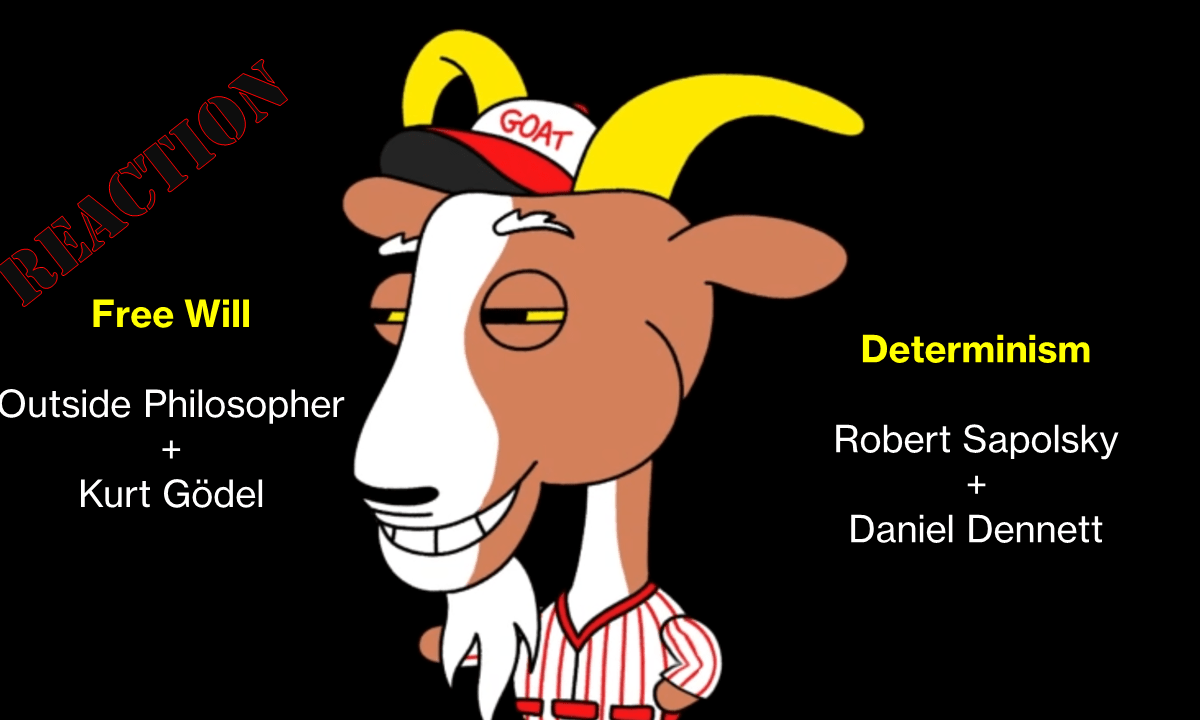
It’s been a minute since I’ve posted a video. Restart the clock. In this video, I critique Outside Philosopher’s critique of the debate between Robert Sapolsky and Daniel Dennett on Free Will and Determinism. He attempts to leverage Gödel’s Uncertainty Principle in his defence.

Feel free to leave comments on YouTube or below. Cheers.

Error Theory, Charity, and Occam’s Boomerang

As moral error theorists, we’re accustomed to facing criticism for our perspective. I’m a moral non-cognitivist, but there’s a significant intersection with these theories. When someone asserts that torture is wrong, I might argue that the claim is hollow, as moral wrongness is merely an emotional response masquerading as an objective moral stance. On the other hand, an error theorist would debunk this argument, stating that there’s no absolute position of right or wrong. Pragmatically, we both arrive at the conclusion that the claim cannot hold true.

Video: Is Error Theory Counterintuitive — Kane B

Intuition leads others to a different interpretation. If they believe something is true due to their epistemic certainty, then for them, it is true. Their reality is shaped by experience. Curse the limitations of sense perception and cognitive constraints. “I know what I know,” is their typical retort. Moreover, it’s a matter of practicality. “You know what I mean,” they insist.

They attempt to substitute fact with heuristics, truth with analogue, and terrain with a map. Admittedly, it’s convenient to feign an identity at play, but at best, it’s a near equivalence.

In the linked video, the example of claiming ‘that car is red’ is presented. But can cars truly be red? Not precisely. Cars can possess the property of appearing red to most individuals in specific lighting conditions, but a car cannot inherently be red. Thus, this statement is categorically false. We can assert ‘that the car appears to be red,’ and as a matter of practicality, we might designate the car as such. However, this highlights the inadequacy of language, particularly concerning abstract concepts.

A challenge arises from people’s inclination, driven by the principle of least effort, to seek simplicity and convenience, often at the expense of truth.

A challenge arises from people’s inclination, driven by the principle of least effort, to seek simplicity and convenience, often at the expense of truth. This principle underpins Occam’s Razor: choose the simplest version among competing explanations. It’s a misguided endeavour, akin to living under the notion that opposites attract rather than like attracting like.

I encounter this opposing worldview when I pinpoint certain inconsistencies or issues in the ‘real world,’ emphasizing that language is insufficient to convey adequate meaning, that there exists no objective moral centre, and that democracy is a system that falters even on paper. Almost invariably, the response is, ‘then what?’ I don’t possess the answer to ‘then what.’ I’m merely informing you that your leg is broken. I don’t need to know how to fix it for this to be true, a valid assessment.

While I’m on a roll, let’s talk about charity in philosophical argumentation, which, in my view, is another misguided concept. Why should I favour the notion that a person genuinely believes in the position they hold? It’s another heuristic rule set up to lend credence to otherwise weak arguments. We need not adhere to these boundaries—they’re nonexistent.


BONUS: I ran this content through ANTHROP/C’s Claude 2 for analysis and evaluation. I include it as an example of the bias inherent in generative AI. Whilst I realise that I am taking a polemic position—nothing new here—, Claude apes canned responses. Ironically, the same responses I am arguing against. I do agree that I could have ‘steel-manned’ my argument, but this is a blog post, not a dissertation. Perhaps another day.

Here are some thoughts on evaluating the blog post:

  • The author takes a strong moral non-cognitivist stance, arguing that moral claims like “torture is wrong” are not objective facts but expressions of emotion. This view aligns with moral error theory in debunking moral realism.
  • However, the dismissive attitude towards those who believe moral claims have truth value shows a lack of philosophical charity. The author could strengthen their position by steelmanning the opposing view before critiquing it.
  • The analogy between moral claims and claims like “the car is red” makes an interesting point about the inadequacy of language for capturing nuanced truth. However, more nuance could be applied in acknowledging the usefulness of simplifying language and heuristics in everyday life.
  • The author’s critique of Occam’s Razor and preference for complex explanations is thought-provoking but could benefit from addressing the pragmatic value of simpler models. Outright dismissing this philosophical principle seems extreme.
  • The call to abandon charity in argumentation in the name of absolute truth risks throwing the baby out with the bathwater. Some level of mutual understanding between interlocutors is needed for productive discourse.
  • Overall, while the post raises thoughtful challenges to moral realism, heuristics, and other commonly held views, the dismissive tone and lack of nuance weaken the arguments. More charity towards opposing views and addressing pragmatic concerns could strengthen the critique.

In summary, the post puts forward some provocative arguments but could benefit from greater philosophical charity, nuance, and balancing pragmatism with pursuing absolute truth. A more measured tone discussing pros and cons of different perspectives would likely lend more persuasive force.

ANTHROP/C Claude 2

Austrian Economics Bollox

A citizen of the Internet shared this as if were gospel along with this comment:

Late Professor Steven Horwitz expanding on a Misesian theme. Monetary profit helps allocate resources to higher valued uses. Elsewhere, Mises spoke of profit in a broader sense, “profit” being the goal of every action. In any case, those familiar with what pundits (from the left mostly) tend to say about “profit” may be completely surprised by this take, since it is so contrary to what they often read and hear.

Of course, these are vapid words and wishful thinking. How and why do profits signal that value has been created? I dunno. They just do cuz I said so. The only thing that profits signal is a market that doesn’t understand the true cost of production and consumers can’t be bothered to do it themselves. Mattresses and shaving razor blades are two high-margin consumer goods with mattresses yielding 500 per cent profits and razor blades even higher. These profits represent economic rent and not value. The fact that imperfect information shrouds this excess does not make it ‘value’.

Regarding the mortgage market meltdown of 2007-08, there were houses being built into a market with no buyers. The same ‘value’ being created was demonstrably vapour. Say’s Law was off-target again. Supply does not create its own demand.

Is it no wonder that so many Capitalists are also Protestant Christians who believe in Bible tales as well? Even worse are the Christians who are not Capitalists but are exploited by Capitalism the same way they are exploited by their religion. I guess once you’ve profiled the gullible, you might as well just keep exploiting them until there is nothing left to extract.

The year is dead. Long live the new year.

Excuse me, but your data are showing.

I was writing a post for another forum to acknowledge the changeover of the years, and I decided to lean on Dall-E to assist with some image rendering. It appears that Dall-E’s concept of New Year is 2019—BC, before Covid.

IMAGE: 4 Dall-E Renders

Honestly, I am not sure what to say.

Levr Live year? Wot?

Live Yer 2019? Huh?

Lew Yhr Tib 2019? I’d like to buy a vowel.

Neew Ne IiR 2019? Hmmm… 🤔

I think we know when their training data ended. There is no future past 2019. Little did they suspect.

Know thyself

Oracle at Delphi Inscription

As this was just a reactionary post, I don’t have much to add. To paraphrase the Delphic ‘Know thyself’ inscription, know thy data.