Curved Histories: Irreversibility and Inertia After Empire

1–2 minutes

NB: This is an idea I had kicking around, but it’s not really in my ballpark. Given my backlog, I don’t think I’ll pursue this. If anyone in the post-colonial space finds it interesting or adaptable, please pick it up as a kernel and run with it.

Thesis

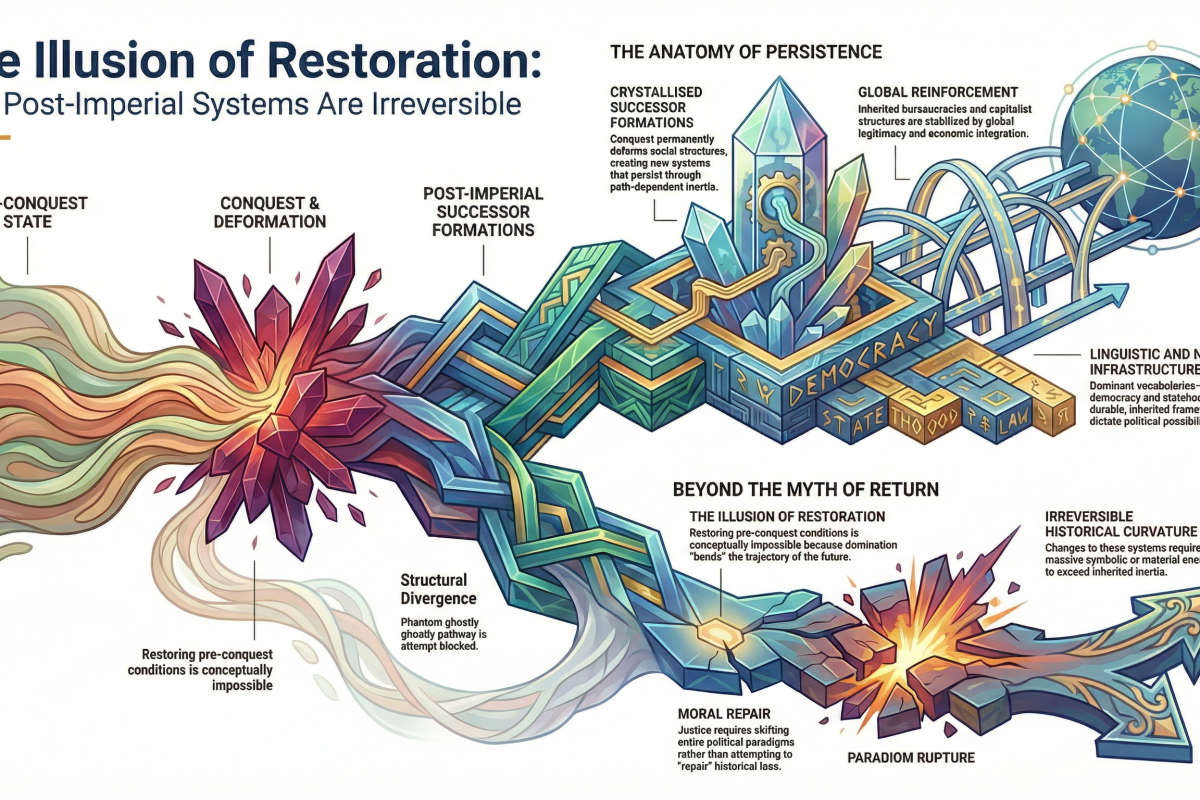
Post-imperial political orders do not restore pre-conquest social ontology but instead crystallise into historically irreversible successor formations whose institutional, linguistic, and normative structures persist through path-dependent inertia reinforced by global systems of legitimacy. Consequently, projects of restitution or decolonial restoration misrecognise the temporal dynamics of domination and must be reconceived as ethical and political negotiation within curved historical trajectories that can be altered only through paradigm-level rupture rather than moral repair.

Audio: NotebookLM summary podcast on this topic.

Abstract

This argues that post-imperial political transformation cannot be understood through narratives of restoration, restitution, or completed decolonisation. Conquest generates not only territorial dispossession but durable deformation of social ontology, producing successor formations structured by inherited administrative forms, linguistic infrastructures, and normative vocabularies – most prominently democracy, capitalism, and bureaucratic statehood – that persist through path-dependent institutional inertia. These structures endure not as static remnants but as dynamically stabilised systems reinforced by global regimes of legitimacy, economic integration, and mnemonic continuity.

Against both liberal accounts of reconciliation and radical imaginaries of full decolonial return, the analysis develops a framework of historical curvature and rupture. Domination bends the trajectory of possible futures, rendering restoration of a pre-conquest condition conceptually incoherent while leaving open the possibility of paradigm-level transformation when sufficient political, material, or symbolic energy accumulates to exceed inherited inertia. Justice after empire must therefore be reconceived not as repair of historical loss but as ethical and political negotiation within irreversibly transformed temporal horizons. This reframing clarifies persistent tensions surrounding sovereignty, restitution, and legitimacy in post-imperial orders and provides a diagnostic account of why decolonisation remains structurally incomplete despite formal independence.
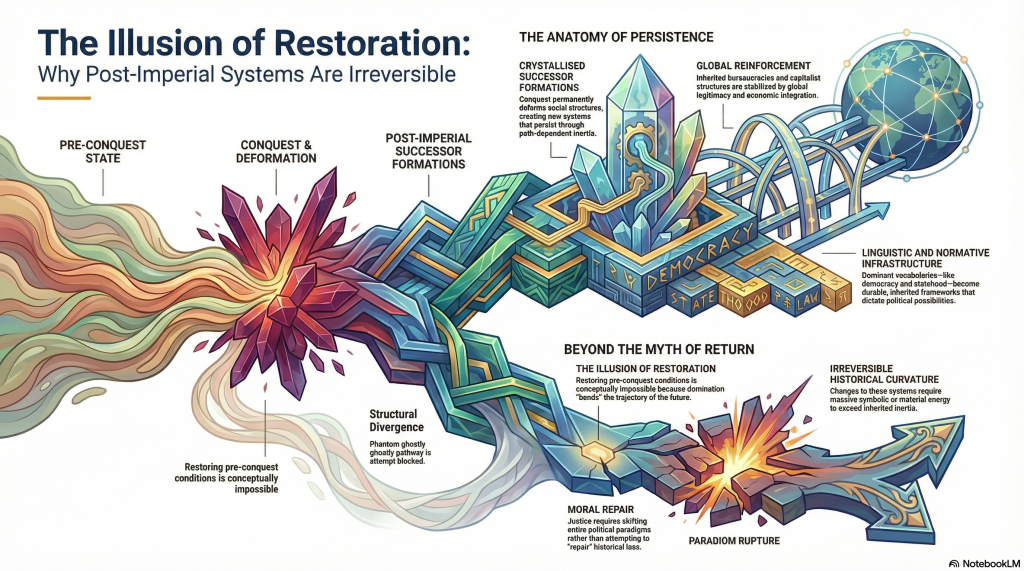
Infographic

The Prison of Process

3–4 minutes

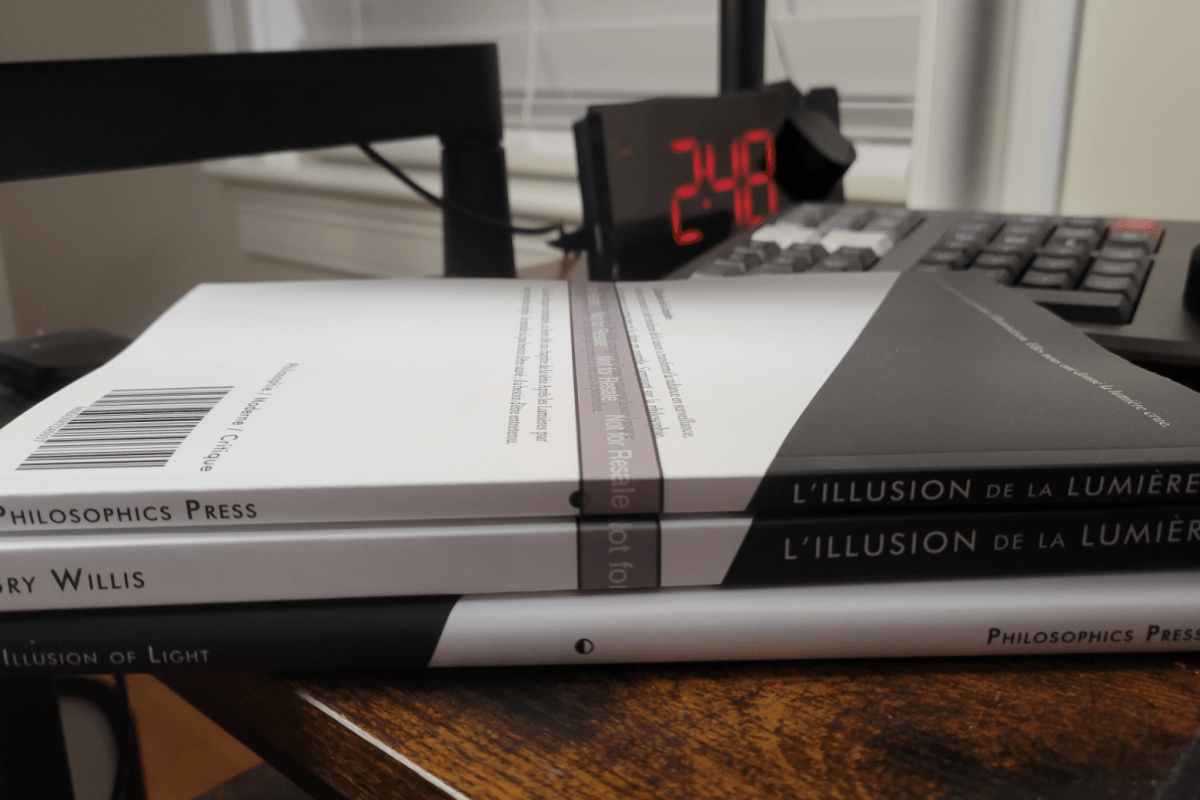
This is the proof copy of The Illusion of Light. I reviewed it, approved it, and signalled ‘good to go’. This is being printed and distributed through KDP. I’ve used them before. They’ve been reliable.

EDIT: On the upside, I’ve been notified that the hardback version is available, but it doesn’t appear to be available in France and Canada, two target regions. Hopefully, it becomes available outside of the U.S. soon.

Until now.

My approval triggered a workflow. I know workflows. I used to design them. I also know how dumb they can be.

KDP’s process flagged an error: the text on the spine might not be on the spine. ‘Might’. Theoretically. It could be offset, cut off, or printed on a fold. I understand their reasoning – high-speed printers, mechanical variance, and return risk. I also understand statistics, and a single observation doesn’t make a trend. But anyone with eyes can see at least a couple of millimetres of clearance at the top and bottom. This isn’t a case of ‘maybe’. It’s fine.

What fascinates me here is the ritual of compliance. Once a process is codified, it becomes self-justifying. The rule exists; therefore, it must be obeyed. There is no appeal to reason – only to the flowchart.

In the 1980s, when I was an audio engineer recording to two-inch magnetic tape, some of us liked to record hot, pushing the levels just past the recommended limits. You learned to ride the edge, to court distortion without collapse. That’s how I designed the spine text. Within tolerance. With headroom.

The problem is that modern systems don’t tolerate edges. There’s no “override” button for informed judgment. My remediation path is to shrink the type by half a point, resubmit, and pretend the machine was right.

What’s absurd is the timing. The same system that generated the proof approved this layout days ago. An automated OCR scan could have caught this phantom error earlier. Instead, the machine waits until the human signs off, then throws a flag so the process can justify its existence.

KDP is still faster and saner than IngramSpark. But this is capitalism distilled: survival by being marginally less incompetent than your competitor. Optimisation, not in the sense of best possible, but of barely better than worst acceptable.

The lesson, as always, is that processes begin as aids and end as prisons. The workflow, like the Enlightenment, believes itself rational. But the longer it runs, the less it serves the human at the console and the more it worships its own perfection.

Want to talk about meta? This underscores the contents of the book itself. What the Enlightenment once called Reason, modernity now calls Process. Both pretend to neutral objectivity while enshrining obedience as virtue. The bureaucracy of light has become digital – its catechism written in checkboxes, its priests replaced by automated validators. Every workflow promises fairness; each only codifies submission. The real danger isn’t that machines will replace judgment, but that we will stop noticing when they already have.


The Story Continues: Behind the Scenes

Image: Screenshot of Illustrator layout

I’ve reduced the font size on the spine from 14 points to 13.5. It still technically bleeds over a guideline. I hope I am not forced to reduce it to 13. A reason for text on the spine is to make it visible. Hopefully, the black-and-white vertical separation will help in this regard. Fingers crossed.

Waiting for a New Book: Illusions of Light

2–3 minutes

This is not the announcement of a new book – The Illusion of Light: Thinking after the Enlightenment.

I hate the business of business. I am wrapping up another book project, but it’s been delayed by the government shutdown in the United States. I want a Library of Congress number (LCCN), but submissions must wait for an employed person to assign it.

Too clever by half and smarter than the average bear, I thought I could release an audiobook version first; audiobooks don’t need an LCCN. To be honest, neither do books. As some do with ‘Patent Pending’, I could follow suit. The book receives an LCCN, but it isn’t printed on the copyright page with the other administrivia.

My idea worked – partially. I rendered an audio version and published it – though it won’t be available until the start of November. Even so, I need distributors. It’s always something.

Meanwhile, I’m sharing an excerpt for your listening pleasure. Read along if you please.

Audio: The Illusion of Light: Thinking after the Enlightenment; Preface — Reading by Residual Light

Preface – Reading by Residual Light

To read these essays is to move slowly from the glare into the dimmer spaces where things regain texture. The Enlightenment taught us to equate light with truth, but illumination has always been double-edged: it clarifies outlines whilst erasing depth. What disappears in the brightness are the gradients – the in-between shades where thought and feeling meet, where contradiction still breathes.

The half-light is not a retreat from knowledge; it is where knowledge stops mistaking itself for salvation. It is the hour before dawn and after dusk, when perception is most alert, and everything seems both clearer and less certain. That is the discipline these essays practice: a sustained attentiveness to what persists when certainty burns away.

This project does not ask readers to abandon reason, only to notice what it has excluded. It invites a kind of intellectual night vision – the patience to see without spotlight, the willingness to sit with what does not resolve. In the half-light, the world no longer arranges itself around the human gaze; it reveals itself as unmastered, partial, alive. Here, we will learn to dwell in that half-light – not as a retreat from knowledge, but as a discipline of seeing what the Enlightenment’s glare erased.

The Enlightenment promised that truth would make us free. Perhaps it made us efficient instead. What these pages attempt is smaller and slower: a freedom measured not in control but in composure – the ability to live with what cannot be fixed, to keep tending meaning after its foundations have collapsed.

If there is light here, it is not the triumphant blaze of discovery but the ambient glow that remains after something ends. It’s the light of screens left on overnight, of cities at rest, of the mind still thinking long after certainty has gone to sleep.

Step carefully. Let your eyes adjust. The world looks different when it stops pretending to be illuminated.

The rest of the story…

I consider The Illusion of Light to be a sort of capstone project to the Anti-Enlightenment Project. It provides both a perspective and insights into the essays that constitute it.

Democracy: The Idiot’s Opiate, The Sequel Nobody Asked For

Yesterday, I suggested democracy is a mediocre theatre production where the audience gets to choose which mediocre understudy performs. Some readers thought I was being harsh. I wasn’t.

A mate recently argued that humans will always be superior to AI because of emergence, the miraculous process by which complexity gives rise to intelligence, creativity, and emotion. Lovely sentiment. But here’s the rub: emergence is also how we got this political system, the one no one really controls anymore.

Like the human body being mostly non-human microbes, our so-called participatory government is mostly non-participatory components: lobbyists, donors, bureaucrats, corporate media, careerists, opportunists, the ecosystem that is the actual organism. We built it, but it now has its own metabolism. And thanks to the law of large numbers, multiplied by the sheer number of political, economic, and social dimensions in play, even the human element is diluted into statistical irrelevance. At any rate, what remains of it has lost control – like the sorcerer’s apprentice.

People like to imagine they can “tame” this beast, the way a lucid dreamer thinks they can bend the dream to their will. But you’re still dreaming. The narrative still runs on the dream’s logic, not yours. The best you can do is nudge it; a policy tweak here, a symbolic vote there, before the system digests your effort and excretes more of itself.

This is why Deming’s line hits so hard: a bad system beats a good person every time. Even if you could somehow elect the Platonic ideal of leadership, the organism would absorb them, neutralise them, or spit them out. It’s not personal; it’s structural.

And yet we fear AI “taking over,” as if that would be a radical departure from the status quo. Newsflash: you’ve already been living under an autonomous system for generations. AI would just be a remodel of the control room, new paint, same prison.

So yes, emergence makes humans “special.” It also makes them the architects of their own inescapable political microbiome. Congratulations, you’ve evolved the ability to build a machine that can’t be turned off.

Metamorphosis Inverted

What if the real horror isn’t waking as a beetle, but as a man?

In Kafka’s Metamorphosis, Gregor Samsa wakes to find himself transformed into a giant beetle—a cockroach, a vermin, an intrusion of the inhuman into the domestic. The horror is obvious: loss of agency, social death, the grotesque made literal. It’s the nightmare of devolution, of becoming something other, something filthy.

But perhaps we’ve misunderstood the true absurdity.

Audio: NotebookLM podcast on this topic.

What if the real nightmare is the opposite? Not a man waking as an insect, but an insect waking in a human body—forced to contend with taxes, performance reviews, dinner parties, and the crushing weight of being legible to others. Imagine a beetle, content in its instinctual certainty, finding itself hurled into the howling contradiction of human subjectivity.

Suddenly, it must interpret signs, participate in rituals, conform to decorum, all while performing a pantomime of “meaning.” It’s not the exoskeleton that’s horrifying – it’s the endless internal monologue. The soul-searching. The unbearable tension of being expected to have purpose.

We call Gregor’s fate tragic because he can no longer function in a world built for humans. But isn’t that the human condition already? An endless, futile negotiation between the raw fact of existence and the stories we invent to make it bearable.

Gregor becomes insect. We were never anything but.

Death by Tiger, Death by Document: Reflections on Nexus Chapter 3

As I continue to react to Harari’s Nexus, I can’t help but feel like a curmudgeon. Our worldviews diverge so starkly that my critique begins to feel like a petty grudge—as though I am inconsolable. Be that as it may, I’ll persist. Please excuse any revelatory ad hominems that may ensue.

Audio: Podcast of the page contents

Harari is an unabashed Zionist and unapologetic nationalist. Unfortunately, his stories, centred on Israel and India, don’t resonate with me. This is fine—I’m sure many people outside the US are equally weary of hearing everything framed from an American perspective. Still, these narratives do little for me.

Patriotism and property are clearly important to Harari. As a Modernist, he subscribes to all the trappings of Modernist thought that I rail against. He appears aligned with the World Economic Forum, portraying it as a noble and beneficial bureaucracy, while viewing AI as an existential threat to its control. Harari’s worldview suggests there are objectively good and bad systems, and someone must oversee them. Naturally, he presents himself as possessing the discernment to judge which systems are beneficial or detrimental.

In this chapter, Harari recounts the cholera outbreak in London, crediting it with fostering a positive bureaucracy to ensure clean water sources. However, he conflates the tireless efforts of a single physician with the broader bureaucratic structure. He uses this example, alongside Modi’s Clean India initiative, to champion bureaucracy, even as he shares a personal anecdote highlighting its flaws. His rhetorical strategy seems aimed at cherry-picking positive aspects of bureaucracy, establishing a strawman to diminish its negatives, and then linking these with artificial intelligence. As an institutionalist, Harari even goes so far as to defend the “deep state.”

Earlier, Harari explained how communication evolved from Human → Human to Human → Stories. Now, he introduces Human → Document systems, connecting these to authority, the growing power of administrators, and the necessity of archives. He argues that our old stories have not adapted to address the complexities of the modern world. Here, he sets up religion as another bogeyman. As a fellow atheist, I don’t entirely disagree with him, but it’s clear he’s using religion as a metaphor to draw parallels with AI and intractable doctrines.

Harari juxtaposes “death by tiger” with “death by document,” suggesting the latter—the impersonal demise caused by bureaucracy—is harder to grapple with. This predates Luigi Mangione’s infamous response to UnitedHealthcare’s CEO Brian Thompson, highlighting the devastating impact of administrative systems. Harari also briefly references obligate siblicide and sibling rivalry, which seem to segue into evolution and concepts of purity versus impurity.

Echoing Jonathan Haidt, Harari explores the dynamics of curiosity and disgust while reinforcing an “us versus them” narrative. He touches on the enduring challenges of India’s caste system, presenting yet another layer of complexity. Harari’s inclination towards elitism shines through, though he occasionally acknowledges the helplessness people face when confronting bureaucracy. He seems particularly perturbed by revolts in which the public destroys documents and debts—revealing what feels like a document fetish and an obsession with traceability.

While he lauds AI’s ability to locate documents and weave stories by connecting disparate content, Harari concludes the chapter with a segue into the next: a discussion of errors and holy books. Once again, he appears poised to draw parallels that serve to undermine AI. Despite my critiques, I’m ready to dive into the next chapter.

Decolonising the Mind

Ngũgĩ wa Thiong’o published “Decolonising the Mind” in 1986. David Guignion shares a 2-part summary analysis of the work on his Theory and Philosophy site.

I used NotebookLLM to produce this short podcast: [Content no longer extant] https://notebooklm.google.com/notebook/7698ab0b-43ab-47d4-a50f-703866cfb1b9/audio

Decolonising the Mind: A Summary

Ngũgĩ wa Thiong’o’s book Decolonising the Mind centres on the profound impact of colonialism on language, culture, and thought. It argues that imposing a foreign language on colonised people is a key tool of imperial domination. This linguistic imperialism leads to colonial alienation, separating the colonised from their own culture and forcing them to view the world through the lens of the coloniser.

Here are some key points from the concept of decolonising the mind:

  • Language is intimately tied to culture and worldview: Language shapes how individuals perceive and understand the world. When colonised people are forced to adopt the language of the coloniser, they are also compelled to adopt their cultural framework and values.
  • Colonial education systems perpetuate mental control: By privileging the coloniser’s language and devaluing indigenous languages, colonial education systems reinforce the dominance of the coloniser’s culture and worldview. This process results in colonised children being alienated from their own cultural heritage and internalising a sense of inferiority.
  • Reclaiming indigenous languages is crucial for decolonisation: wa Thiong’o advocates for a return to writing and creating in indigenous African languages. He sees this as an act of resistance against linguistic imperialism and a way to reconnect with authentic African cultures. He further argues that it’s not enough to simply write in indigenous languages; the content must also reflect the struggles and experiences of the people, particularly the peasantry and working class.
  • The concept extends beyond literature: While wa Thiong’o focuses on language in literature, the concept of decolonising the mind has broader implications. It calls for a critical examination of all aspects of life affected by colonialism, including education, politics, and economics.

It is important to note that decolonising the mind is a complex and ongoing process. There are debates about the role of European languages in postcolonial societies, and the concept itself continues to evolve. However, wa Thiong’o’s work remains a seminal text in postcolonial studies, raising crucial questions about the enduring legacy of colonialism on thought and culture.

The Violence of Bureaucracy

Right. So another rabbit hole. Several things I have come across recently have mentioned the concept of bureaucracy as violence. There was a reference by David Graeber and some journal articles I happened upon. I have so much going on that I don’t have time to give the topic justice, but I wanted to employ this post as a reminder—along with the host of other reminders to which I need to attend.

Let’s start with some definitions.

Violence

The intentional use of physical force or power, threatened or actual, against oneself, another person, or against a group or community, that either results in or has a high likelihood of resulting in injury, death, psychological harm, maldevelopment or deprivation.

Parsing the salient parts, I distil the meaning for my intents and purposes to be the intentional use of physical force or power, threatened or actual, against oneself, another person, or against a group or community, that either results in or has a high likelihood of resulting in injury, death, psychological harm, maldevelopment or deprivation.

For further clarity, we arrive at a

Violence is the intentional use of power, against another person that results in psychological harm or deprivation

Bureaucracy

Management or administration marked by hierarchical authority among numerous offices and by fixed procedures.

Ostensibly, my train of thought is that bureaucracy is a deontological structure meant to standardise and normalise a process. Problems arise by the facts that (1) one size doesn’t fit all and (2) it’s a system thinking challenge likely missing dimensions—if the domain is even appropriately defined and accounted for at the start. This is where bureaucracy intersects violence.

bureaucracy becomes a Procrustean bed

In my mind, bureaucracy becomes a Procrustean bed. Speaking of bed… Fais dodo.

EDIT: In a manner of speaking, I might suggest that normalisation, as a rule, is violence, but I haven’t exactly thought it through. I am not particularly comfortable with the notion of self, so against whom would this violence be perpetrated? Nonetheless, this Procrustean notion still springs to mind—as a moulding. Some might consider it to be character-building. But his lot would either deny the violence or consider it to be a worthwhile crucible. But it’s only a crucible when this character outcome comports with their accepted ideal. The only leeway given is in consideration of those with poor childhoods leading to delinquency. This does not diminish the bloodlust for justice, but it allows for blame to be cast, if not on the perpetrator then on the parents or guardians. I digress.

Hannah Arendt spoke of the Banality of Evil. In a manner, the violence that is bureaucracy is just this sort of metaphoric evil. This 7-minute summary (that could have been 4 if not for the stammering and pauses) is about just this point. In my experience, most bureaucracy is of the sort Arendt write about. I feel that this presenter is a bit more conservative about where he might draw this line.

I’ll exit this post with an observation/rant. I was shopping the other day, and I had one item. There was a short queue situated between a cashier and a self-checkout kiosk. We customers seemed to be dequeuing fine when a frontend supervisor appeared to instruct us to choose a register. I was second in the queue so his interaction with the person ahead of me went something like this:

Employee: Are you going to use the self-checkout?

Customer: Yes

Employee: [Looks at the kiosk]

Customer: Unless this register becomes available first.

Customer: [Cocks head incredulously]

Employee: You need to choose one.

At that moment, the cashier freed, and she took the vacancy. Thankfully—as my mind pondered how illogical this policy was (if indeed there was a policy) and how poorly the maths skills of whoever created it—, the self-service registered became available. Crisis averted.

The takeaway in the story is that blood pressure was unnecessarily elevated because of this bureaucratic rule. This is trivial. I won’t bore you with more anecdotes. Besides, I’m pretty sure, you’ve experienced this violence to one degree or another—whether at work, in commerce, interacting with government workers, or who knows what.