I Need a Break

5–7 minutes

More precisely, I need less sleep and longer days – preferably twice as long. I’ve been writing almost non-stop for the better part of a week: fourteen- to sixteen-hour days, fuelled by irritation and the stubborn belief that if I just keep reading, something will finally click into place.

I’m not complaining. This is a virtuous cycle.
Reading leads to writing. Writing demands more reading. Eventually, the loop closes into something that looks suspiciously like progress.

Audio: Short NotebookLM summary podcast on this topic.

Still, there’s a bottleneck.

Because some of this work – the work I’m most excited about – I’m deliberately not publishing yet. Journals, bless their glacial hearts, don’t much care for prior publication. So ideas sit in limbo for six to eighteen months, locked in a room like argumentative houseplants, slowly growing sideways.

From the perspective of someone who thinks in public, this is maddening.

Now add AI to the mix.

This is where things get dangerous.

I’ll feed ChatGPT a thesis, a skeletal structure, notes, and references. I ask what I’m missing. It obliges – often helpfully – by pointing me toward adjacent thinkers and relevant literature, complete with page numbers. From there, I verify, hunt down the sources, skim, read, discard, or integrate.

And every so often, I stumble across something that makes me swear out loud.

This week, it was Bernard Williams.

I’ve cited Ethics and the Limits of Philosophy before. But this time, I actually sat down and read it properly. Which immediately prompted the thought:

Why didn’t I read this sooner?

Williams dismantles moral objectivity with the calm precision of someone who knows the Enlightenment project has already lost – he just hasn’t told everyone yet. Thick and thin moral concepts, locality, non-extensibility, the collapse of universal moral reason at scale – yes, yes, yes. He published this in 1985. Fine. I’ll survive.

But then I went further.

Williams shows that morality fails between people at scale.
I argue that it fails within a single person over time.

That became my second paper.

And this is where things went off the rails.

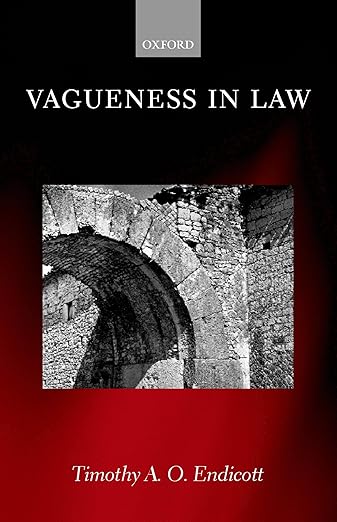
Because in the course of writing that paper, I dipped into Hart’s The Concept of Law and Endicott’s Vagueness in Law. These are not fringe polemics. These are law textbooks. For law students. People allegedly trained to parse language for a living.

And what I found was… astonishing.

Let me paraphrase the admissions:

Image: When the law is vague, judicial decisions may be unconstrained by the law.

Endicott: “By upsetting the standard view of adjudication, the book reaches conclusions that some people find horrible: when the law is vague, judicial decision- making will in some cases be unconstrained by the law. It is impossible in principle for judges always to treat like cases alike. Predictability in the law is to some extent unattainable. Moreover, I argue in Chapter 9,2 that vagueness cannot be eliminated from law. These conclusions might seem to imply that the rule of law is, at least to some extent, conceptually impossible.”

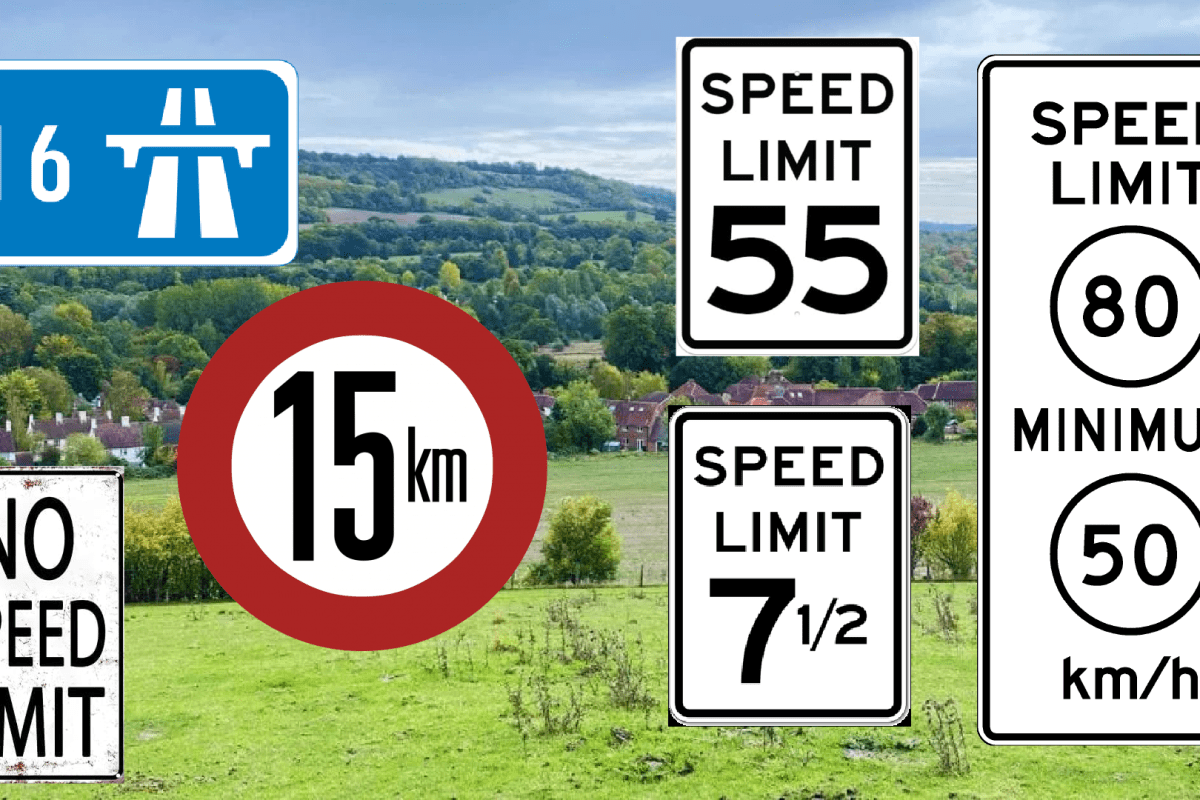
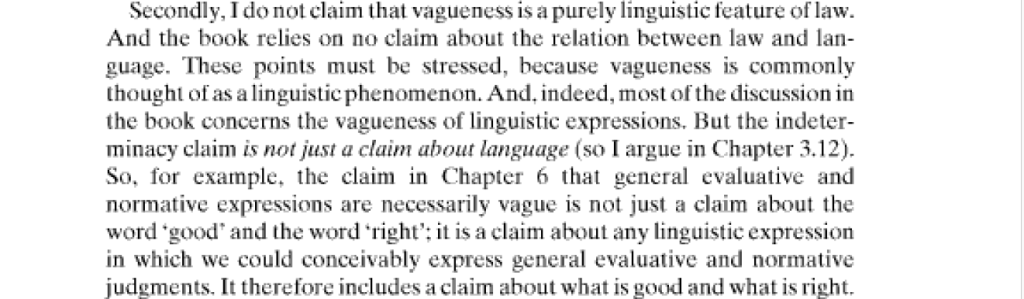
Image: Vagueness is inevitable. Deal with it.

Endicott: “Secondly, I do not claim that vagueness is a purely linguistic feature of law. And the book relies on no claim about the relation between law and language. These points must be stressed, because vagueness is commonly thought of as a linguistic phenomenon. And. indeed, most of the discussion in the book concerns the vagueness of linguistic expressions. But the indeterminacy claim is not just a claim about language (so I argue in Chapter 3.12). So. for example, the claim in Chapter 6 that general evaluative and normative expressions are necessarily vague is not just a claim about the word ‘good’ and the word ‘right1: it is a claim about any linguistic expression in which we could conceivably express general evaluative and normative judgments. It therefore includes a claim about what is good and what is right.”

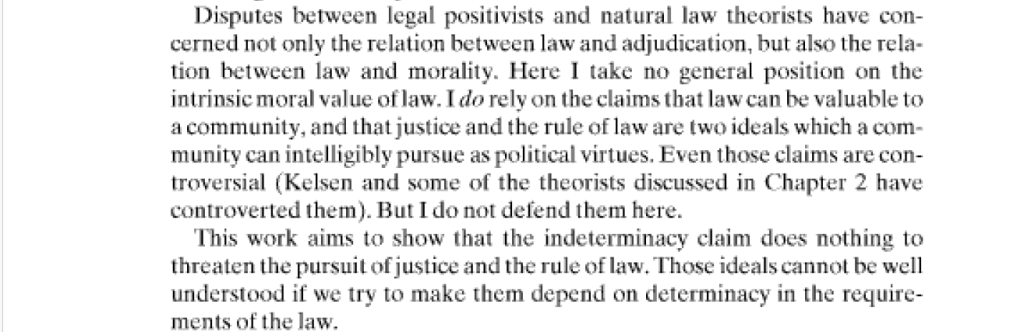
Image: Whether law is morally valuable to a community is not my concern. Justice and the rule of law may be political virtues — or not. I don’t defend them here.

Endicott: “Disputes between legal positivists and natural law theorists have concerned not only the relation between law and adjudication, but also the relation between law and morality. Here I take no general position on the intrinsic moral value of law. I do rely on the claims that law can be valuable to a community, and that justice and the rule of law are two ideals which a com- munity can intelligibly pursue as political virtues. Even those claims are controversial (Kelsen and some of the theorists discussed in Chapter 2 have controverted them ). But I do not defend them here. This work aims to show that the indeterminacy claim does nothing to threaten the pursuit of justice and the rule of law. Those ideals cannot be well understood if we try to make them depend on determinacy in the requirements of the law.”

Say what?

Read together – not even uncharitably – the message is clear:

Law is indeterminate.
Indeterminacy is unavoidable.
And whether law is good, just, or valuable is… optional.

The subtext isn’t even hiding.

Law is a power structure first.
If it happens to align with justice, fairness, or communal value, well, lovely. A bonus. Champagne all round.

This does not sit well with a sceptical cynic.

What really broke me, though, wasn’t the argument itself. Philosophers make grim claims all the time. What broke me was the silence around it.

How does this pass under the radar?

How do cohorts of law students – drilled in textual analysis, trained to read footnotes like tea leaves – not trip over this elephant stampede? How do they graduate believing they’re upholding inalienable rights, rather than participating in a managed system of coercion that occasionally behaves itself?

Self-preservation, I suppose.
Wilful ignorance.
Professional cosplay.

I’ve seen this before.

As an economist, ask the wrong foundational question, and you’re instantly radioactive. Persona non grata. Careers don’t end with explosions — they end with polite silence and no invitations.

I probably should have committed to heterodox philosophy from the start.
Or stayed a musician.

I remember leaving graduate school, putting on a suit, and feeling like I was wearing a costume. Cosplay, before we had the word. “Business professional” as a role, not an identity.

I’ve always felt intellectually capable of doing whatever I set out to do. My temperament, however, has never agreed to play along.

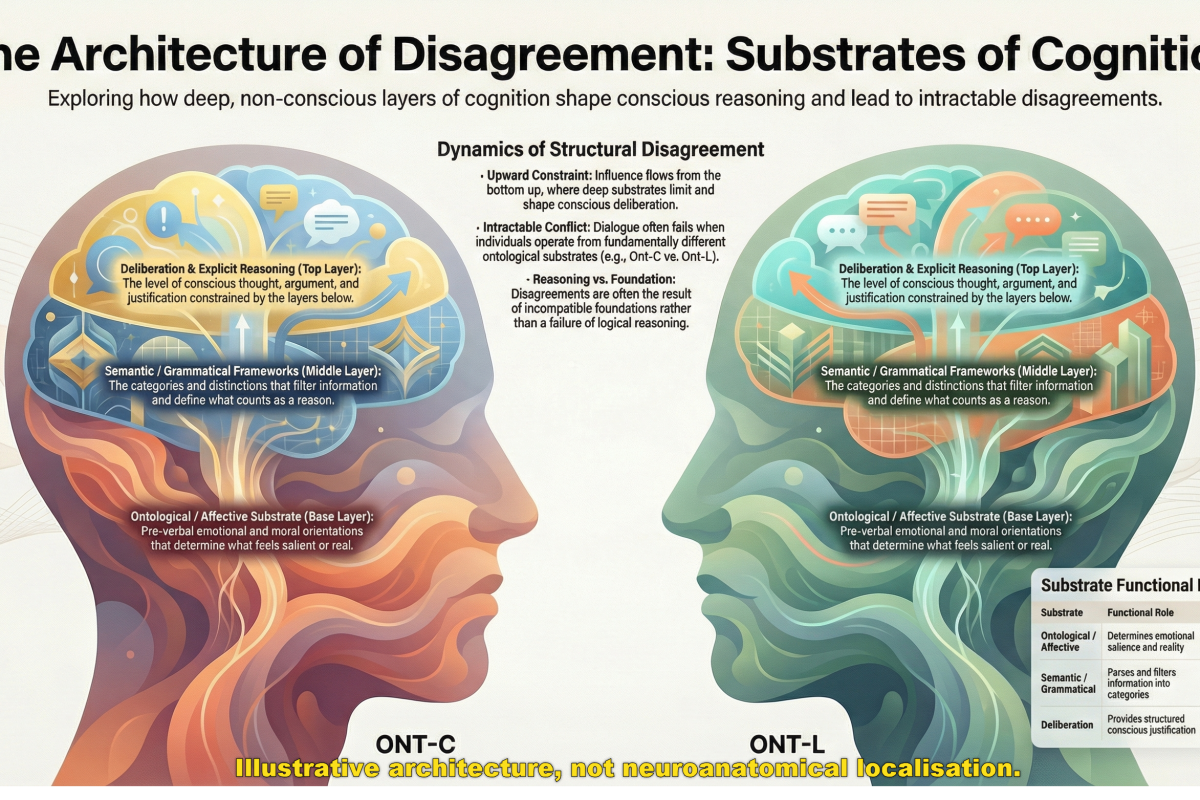
Which is perhaps why diagnosing ontologies comes so naturally. Once you see the scaffolding, you can’t unsee it – whether it’s metaphysics, jurisprudence, or a corporate department pretending it has a mission.

Then David Graeber came along with Bullshit Jobs, and I remember thinking:
Thank God. It’s not just me.

So yes. I need a break.

I need sleep.
I need silence.
I need to stop reading law books that accidentally admit they’re about power and then act surprised when someone notices.

Mostly, I need to type:

WTAF?

And then go outside.

Announcing: The Rhetoric of Evil

5–8 minutes

How a Theological Artefact Survived Secular Moral Thought


DOI: https://doi.org/10.5281/zenodo.17757134

Every so often – usually when the Enlightenment ghosts begin rattling their tin cups again – one feels compelled to swat at the conceptual cobwebs they left dangling over moral philosophy. Today is one of those days.

Audio: NotebookLM podcast summarising the Rhetoric of Evil essay, not this page’s content.

I’ve just released The Rhetoric of Evil on Zenodo, a paper that politely (or impolitely, depending on your threshold) argues that ‘evil’ is not a metaphysical heavy-hitter but a rhetorical throw-pillow stuffed with theological lint. The term persists not because it explains anything, but because it lets us pretend we’ve explained something – a linguistic parlour trick that’s survived well past its sell-by date.

And because this is the age of artificial augury, I naturally asked MEOW GPT for its view of the manuscript. As expected, it nodded approvingly in that eerie, laser-precise manner unique to machines trained to agree with you – but to its credit, it didn’t merely applaud. It produced a disarmingly lucid analysis of the essay’s internal mechanics, the way ‘evil’ behaves like a conceptual marionette, and how our inherited metaphors govern the very moral judgments we think we’re making freely.

Below is MEOW GPT’s reaction, alongside my own exposition for anyone wanting a sense of how this essay fits within the broader project of dismantling the Enlightenment’s conceptual stage-props.

MEOW-GPT’s Response

(A machine’s-eye view of rhetorical exorcism)

“Evil is functioning as a demonological patch on an epistemic gap.
When agents encounter a high-constraint event they cannot immediately model,
the T₂ layer activates an inherited linguistic shortcut — the ‘evil’ label — which compresses complexity into a binary and arrests further inquiry.”

“The marionette metaphor is accurate: once we say a person ‘is evil,’ agency collapses into occult causation. Inquiry halts. Moral theatre begins.”

It went on like this – detecting exactly the mediated encounter-structure I intended, while offering a frighteningly clean schematic of how affect (T₀), heuristics (T₁), linguistic reification (T₂), and cultural choreography (T₃) conspire to turn incomprehension into metaphysics.

Machines, it seems, are quite good at detecting when humans are bullshitting themselves.

Why publish this now?

This essay marks the next plank in the broader anti-Enlightenment platform I’ve been assembling – LIH, MEOW, the ongoing dismantling of truth-fetishism, and now the unsettling realisation that ‘evil’ is little more than a theological revenant dressed up for secular work.

The term’s persistence is not a testament to its necessity but to our laziness:

  • It sounds like an explanation.
  • It licenses retribution without understanding.
  • It stabilises group boundaries.
  • It lets us outsource moral thought to a one-word incantation.

In short: ‘evil’ is the map-dragon we keep drawing because surveying the terrain is too much work.

This essay attempts to retire that dragon – not to soften judgment, but to sharpen it. If anything, the paper argues that abolishing ‘evil’ frees us to see atrocity more clearly, and thus confront it more seriously.

If you’d like to read the full argument:

📄 The Rhetoric of Evil: How a Theological Artefact Survived Secular Moral Thought

Appendix: How MEOW-GPT Reads “Evil”

A didactic demonstration of the framework in action. Download the MEOW framework below.

📄The Mediated Encounter Ontology of the World: A Relational Metaphysics Beyond Mind and World

Because MEOW-GPT was trained on the Mediated Encounter Ontology rather than on folk metaphysics, its analyses can serve as a useful diagnostic tool. It doesn’t simply summarise concepts; it reconstructs them along the four mediational tiers (T₀–T₃), showing – mechanically and without superstition – how a term behaves across biological affect, cognitive heuristics, linguistic structures, and cultural narratives.

This section is offered not as an alternative argument to the essay above, but as a worked example: a transparent demonstration of how the MEOW engine decomposes a high-complexity, high-stakes concept like evil once the theological scaffolding has been removed.

MEOW-GPT’s output shows, in compressed form, the same pattern the essay traces in prose:
that evil is not a force, not a metaphysical essence, not an occult substrate, but a mediated pattern in human encounters, one that persists rhetorically long after its ontology has collapsed.

For readers curious about how MEOW ‘thinks’, the raw structured analysis follows.

MEOW-GPT Analysis: “Evil”

(Raw output for reference; lightly formatted for readability)

Concept

Input: Evil
Type: Normative/evaluative moral concept (often reified as a property of acts, characters, or forces)
Scope check: In-scope – ‘evil’ can be analysed as a mediated-encounter pattern (MEOW) and a high-complexity term with unstable linguistic behaviour (LIH).

High-level summary (≤120 words)

In MEOW terms, ‘evil’ is not a spooky substance but a way of organising certain encounter-events: severe, norm-breaking harms that present as resistant, shocking, and morally intolerable. Biologically, it piggybacks on harm, threat, and disgust systems. Cognitively, it compresses complex appraisals—intent, cruelty, scale of harm – into a powerful label. Linguistically, it sits in the unstable region where abstraction is high and language’s reliability drops, so people fight over its scope and weaponise it. Socially and technically, institutions, media, and platforms use ‘evil’ to mark enemies, justify punishment, and dramatise conflict. The term is emotionally efficient but conceptually fragile, and MEOW treats it as a relational, mediated pattern rather than an independent metaphysical force.

T₀ – Biological Mediation

  • Moralised harm perception piggybacks on survival systems: pain avoidance, threat detection, kin protection. ‘Evil’ clusters around encounters that trigger extreme danger-signals.
  • High arousal (fear, rage, disgust) makes some harms feel qualitatively world-violating, not merely personally threatening.
  • Disgust toward contamination, mutilation, or predation heavily colours what gets called ‘evil’.
  • Species-specific cues (infant distress cries, pain expressions) shape which harms are even legible candidates for evil.

T₁ – Cognitive Mediation

  • “Evil” compresses a multi-factor appraisal (intentionality, cruelty, gratuitousness) into a one-step heuristic.
  • Essence thinking converts acts into character: the person is evil, not merely did wrong.
  • Attribution biases assign ‘evil’ to out-groups more readily than to in-groups.
  • Memory structures simplify causation into villain scripts that overwrite nuance.
  • Once assigned, the label becomes a prediction loop: every ambiguous action confirms the essence.

T₂ – Linguistic Mediation

  • On the Effectiveness–Complexity Gradient, ‘evil’ straddles Contestables and Fluids: ubiquitous but perpetually disputed.
  • It compresses harm, norm-violation, metaphysical colouring, and dramatic emphasis into a single syllable—powerful, but noisy.
  • Dominant metaphors (‘dark’, ‘tainted’, ‘monstrous’) smuggle in substance-ontology that MEOW rejects.
  • Noun-forms (‘evil’, ‘the Evil One’) promote ontologising; adjectival forms track events better, but usage constantly slides between them.
  • Cross-linguistic drift supports LIH: different traditions map the term to impurity, harm, misfortune, cosmic opposition, or taboo.

T₃ – Social/Technical Mediation

  • Religious systems embed ‘evil’ in cosmologies that harden friend/enemy binaries.
  • Legal systems avoid the term formally but reproduce it rhetorically in sentencing, media commentary, and public reaction.
  • Politics uses ‘evil’ to justify exceptional measures and collapse deliberation into moral theatre.
  • Cultural industries supply vivid villain archetypes that feed back into real-world judgments.
  • Technical systems must operationalise ‘evil’ into concrete proxies, revealing how imprecise the everyday concept is.

Limits & Failure Modes (LIH notes)

The framework is human-centric; non-human or ecosystemic ‘views of evil’ remain speculative.

‘Evil’ is a textbook Contestable: central, indispensable, and permanently argued over.

In cosmological uses (‘radical evil’, ‘evil in the world’), it approaches Fluid or ineffable status – right where LIH predicts language collapse.

MEOW cannot confirm or deny metaphysical dualisms; it only analyses how humans mediate and narrate such claims.

The Relative Intersubjectivity of Subjectivity

1–2 minutes

As I was preparing another essay – an essay on the rhetoric of evil – I had a thought about the relative intersubjectivity of subjectivity.

If one takes subjectivity seriously – not the Hollywood version with self-made heroes, but the real creature stitched together from language, history, and whatever emotional debris it stepped in on the way to adulthood – then one ends up somewhere awkward: the relative intersubjectivity of subjectivity.

Video: Two red figures walking (no sound)

Which is to say, we’re all standing on conceptual scaffolding built by other people, insisting it’s solid marble. A charming fiction, until we apply it to anything with moral voltage. ‘Evil’, for instance, collapses the moment you remove the demonological life-support and notice it’s little more than a child’s intensifier strapped to a cultural power tool.

More on that later. For now, just sit with the discomfort that the ‘self’ making moral judgments is already a negotiated artefact – relational, compromised, and never as autonomous as it pretends.