Modernity: The Phase That Never Was

6–8 minutes

We’re told we live in the Enlightenment, that Reason™ sits on the throne and superstition has been banished to the attic. Yet when I disguised a little survey as “metamodern,” almost none came out as fully Enlightened. Three managed to shed every trace of the premodern ghost, one Dutch wanderer bypassed Modernity entirely, and not a single soul emerged free of postmodern suspicion. So much for humanity’s great rational awakening. Perhaps Modernity wasn’t a phase we passed through at all, but a mirage we still genuflect before, a lifestyle brand draped over a naked emperor.

Audio: NotebookLM podcast on this topic

The Enlightenment as Marketing Campaign

The Enlightenment is sold to us as civilisation’s great coming-of-age: the dawn when the fog of superstition lifted and Reason took the throne. Kant framed it as “man’s emergence from his self-incurred immaturity” – an Enlightenment bumper sticker that academics still like to polish and reapply. But Kant wasn’t writing for peasants hauling mud or women without the vote; he was writing for his own coterie of powdered-wig mandarins, men convinced their own habits of rational debate were humanity’s new universal destiny.

Modernity, in this story, isn’t a historical stage we all inhabited. It’s an advertising campaign: Reason™ as lifestyle brand, equality as tagline, “progress” as the logo on the tote bag. Modernity, in the textbooks, is billed as a historical epoch, a kind of secular Pentecost in which the lights came on and we all finally started thinking for ourselves. In practice, it was more of a boutique fantasy, a handful of gentlemen mistaking their own rarefied intellectual posture for humanity’s destiny.

The Archetype That Nobody Lives In

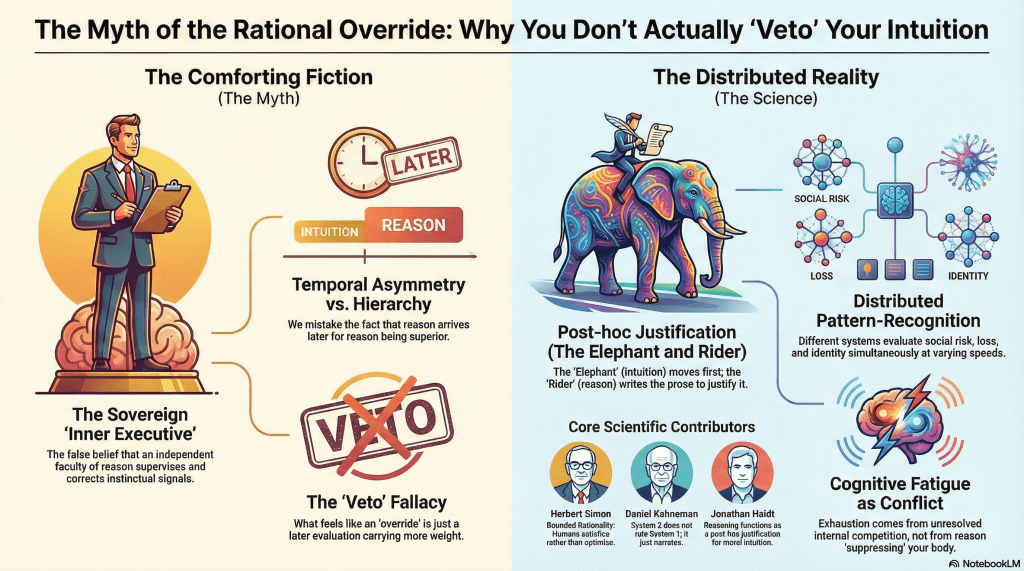
At the core of the Enlightenment lies the archetype of Man™: rational, autonomous, unencumbered by superstition, guided by evidence, weighing pros and cons with the detachment of a celestial accountant. Economics repackaged him as homo economicus, forever optimising his utility function as if he were a spreadsheet in breeches.

But like all archetypes, this figure is a mirage. Our survey data, even when baited as a “metamodern survey”, never produced a “pure” Enlightenment subject.

  • 3 scored 0% Premodern (managing, perhaps, to kick the gods and ghosts to the kerb).
  • 1 scored 0% Modern (the Dutch outlier: 17% Premodern, 0% Modern, 83% Post, skipping the Enlightenment altogether, apparently by bike).
  • 0 scored 0% Postmodern. Every single participant carried at least some residue of suspicion, irony, or relativism.

The averages themselves were telling: roughly 18% Premodern, 45% Modern, 37% Postmodern. That’s not an age of Reason. That’s a muddle, a cocktail of priestly deference, rationalist daydreams, and ironic doubt.

Even the Greats Needed Their Crutches

If the masses never lived as Enlightenment subjects, what about the luminaries? Did they achieve the ideal? Hardly.

  • Descartes, desperate to secure the cogito, called in God as guarantor, dragging medieval metaphysics back on stage.
  • Kant built a cathedral of reason only to leave its foundations propped up by noumena: an unseeable, unknowable beyond.
  • Nietzsche, supposed undertaker of gods, smuggled in his own metaphysics of will to power and eternal recurrence.
  • William James, surveying the wreckage, declared that “truth” is simply “what works”, a sort of intellectual aspirin for the Enlightenment headache.

And economists, in a fit of professional humiliation, pared the rational subject down to a corpse on life support. Homo economicus became a creature who — at the very least, surely — wouldn’t choose to make himself worse off. But behavioural economics proved even that meagre hope to be a fantasy. People burn their wages on scratch tickets, sign up for exploitative loans, and vote themselves into oblivion because a meme told them to.

If even the “best specimens” never fully embodied the rational archetype, expecting Joe Everyman, who statistically struggles to parse a sixth-grade text and hasn’t cracked a book since puberty, to suddenly blossom into a mini-Kant is wishful thinking of the highest order.

The Dual Inertia

The real story isn’t progress through epochs; it’s the simultaneous drag of two kinds of inertia:

  • Premodern inertia: we still cling to sacred myths, national totems, and moral certainties.
  • Modern inertia: we still pretend the rational subject exists, because democracy, capitalism, and bureaucracy require him to.

The result isn’t a new epoch. It’s a cultural chimaera: half-superstitious, half-rationalist, shot through with irony. A mess, not a phase..

Arrow’s Mathematical Guillotine

Even if the Enlightenment dream of a rational demos were real, Kenneth Arrow proved it was doomed. His Impossibility Theorem shows that no voting system can turn individual rational preferences into a coherent “general will.” In other words, even a parliament of perfect Kants would deadlock when voting on dinner. The rational utopia is mathematically impossible.

So when we are told that democracy channels Reason, we should hear it as a polite modern incantation, no sturdier than a priest blessing crops.

Equality and the Emperor’s Wardrobe

The refrain comes like a hymn: “All men are created equal.” But the history is less inspiring. “Men” once meant property-owning Europeans; later it was generously expanded to mean all adult citizens who’d managed to stay alive until eighteen. Pass that biological milestone, and voilà — you are now certified Rational, qualified to determine the fate of nations.

And when you dare to question this threadbare arrangement, the chorus rises: “If you don’t like democracy, capitalism, or private property, just leave.” As if you could step outside the world like a theatre where the play displeases you. Heidegger’s Geworfenheit makes the joke bitter: we are thrown into this world without choice, and then instructed to exit if we find the wallpaper distasteful. Leave? To where, precisely? The void? Mars?

The Pre-Modern lord said: Obey, or be exiled. The Modern democrat says: Vote, or leave. And the Post-Enlightenment sceptic mutters: Leave? To where, exactly? Gravity? History? The species? There is no “outside” to exit into. The system is not a hotel; it’s the weather.

Here the ghost of Baudrillard hovers in the wings, pointing out that we are no longer defending Reason, but the simulacrum of Reason. The Emperor’s New Clothes parable once mocked cowardice: everyone saw the nudity but stayed silent. Our situation is worse. We don’t even see that the Emperor is naked. We genuinely believe in the fineries, the Democracy™, the Rational Man™, the sacred textile of Progress. And those who point out the obvious are ridiculed: How dare you mock such fineries, you cad!

Conclusion: The Comfort of a Ghost

So here we are, defending the ghost of a phase we never truly lived. We cling to Modernity as if it were a sturdy foundation, when in truth it was always an archetype – a phantom rational subject, a Platonic ideal projected onto a species of apes with smartphones. We mistook it for bedrock, built our institutions upon it, and now expend colossal energy propping up the papier-mâché ruins. The unfit defend it out of faith in their own “voice,” the elites defend it to preserve their privilege, and the rest of us muddle along pragmatically, dosing ourselves with Jamesian aspirin and pretending it’s progress.

Metamodernism, with its marketed oscillation between sincerity and irony, is less a “new stage” than a glossy rebranding of the same old admixture: a bit of myth, a bit of reason, a dash of scepticism. And pragmatism –James’s weary “truth is what works” – is the hangover cure that keeps us muddling through.

Modernity promised emancipation from immaturity. What we got was a new set of chains: reason as dogma, democracy as ritual, capitalism as destiny. And when we protest, the system replies with its favourite Enlightenment lullaby: If you don’t like it, just leave.

But you can’t leave. You were thrown here. What we call “Enlightenment” is not a stage in history but a zombie-simulation of an ideal that never drew breath. And yet, like villagers in Andersen’s tale, we not only guard the Emperor’s empty wardrobe – we see the garments as real. The Enlightenment subject is not naked. He is spectral, and we are the ones haunting him.

HR’s Neoliberal Mirage: Human Resources Without the Humans

Let us disabuse ourselves of one of the workplace’s most cherished delusions: that Human Resources is there for the humans. HR is not your therapist, not your advocate, not your confessor. HR is an appendage of the organisation, and like all appendages, its nerve endings run straight back to the corporate brain. Its “concern” for your well-being is merely a prophylactic against lawsuits and productivity dips. The error is ours; we persist in mistaking the guard dog for a pet.

Audio: NotebookLM podcast on this topic.

Bal and Dóci’s 2018 paper in the European Journal of Work and Organizational Psychology (EJWOP) tears the mask off this charade. They demonstrate how neoliberal ideology has seeped, unseen, into both workplace practice and the very research that pretends to study it objectively. Through the lenses of political, social, and fantasmatic logics, they show that neoliberalism has convinced us of three dangerous fairy tales:

  • Instrumentality: people are not people but “resources,” as fungible as printer ink.
  • Individualism: you are not part of a collective but a lone entrepreneur of the self, shackled to your CV like a Victorian debtor.
  • Competition: you are locked in an endless cage fight with your colleagues, grinning through the blood as you “collaborate.”

These logics are then dressed up in fantasies to keep us compliant: the fantasy of freedom (“you’re free to negotiate your own zero-hours contract”), the fantasy of meritocracy (“you got that promotion because you’re brilliant, not because you went to the right school”), and the fantasy of progress (“growth is good, even if it kills you”).

Those of us with an interest in Behavioural Economics had naively hoped that the mythical homo economicus, that laughable caricature of a rational, utility-maximising automaton, would by now be filed under “anachronistic curiosities.” Yet in corporate domains, this zombie shuffles on, cosseted and cultivated by neoliberal ideology. Far from being discredited, homo economicus remains a protected species, as if the boardroom were some Jurassic Park of bad economics.

The brilliance and the horror is that even the academics meant to be studying work and organisations have been captured by the same ideology. Work and Organisational Psychology (WOP) too often frames employees as variables in a productivity equation, measuring “engagement” only in terms of its effect on shareholder value. The worker’s humanity is rendered invisible; the employee exists only insofar as they generate output.

So when HR offers you a mindfulness app or a “resilience workshop,” remember: these are not gifts but obligations. There are ways of making you responsible for surviving a system designed to grind you down. The neoliberal trick is to convince you that your suffering is your own fault, that if only you had been more proactive, more adaptable, more “employable,” you wouldn’t be so crushed beneath the wheel.

Bal and DĂłci are right: the way forward is to re-politicise and re-humanise organisational studies, to see workers as humans rather than performance units. But until then, expect HR to keep smiling while sharpening its knives.

Best Ever

I’m not sure I need to ask why people over-value things familiar to them. Is there such a thing and a Pangloss Syndrome: We all live in the best of all possible worlds? For most people, it seems, their nation is the best nation, the best county, province, or state, the best city, town, or village. Perhaps I’m over reaching, but we do tend to value these things as remarkably better than average, and isn’t it nice that we weren’t born somewhere else?

I’m not sure if this affinity runs stronger in different political mindsets, Liberals versus Conservatives or such. Anecdotally, I could see Conservatives hanging on the memory of the good old days, if only it weren’t for X, Y, or Z, this would truly be a great [insert geolocational reference]. Liberals, instead, hang on to the prospect of tweaking a nice foundation and progressively shaping it.

Our village is better than the adjacent ones—except for the ones out of financial reach, but those are populated with those wealthier people, and who could tolerate them; our team is the best team—better luck next year; our schools are the best schools—they try harder.

Behavioural economics demonstrates that people value things they own— endowment effect: even if they didn’t choose the item; even if they had valued it less just moments before they took possession of it. This might likely be explained as an product of evolution, but it feels to have gotten out of hand.

Irrationality

1–2 minutes

I’ve not read nearly at a pace as I’ve done in prior years, and I’ve got a million excuses. I did recently start and stop Quine’s Pursuit of Truth, but I’ve just picked up Irrationality: A History of the Dark Side of Reason.

EDIT: I’ve since finished this book and posted a review on Goodreads.

As a former behavioural economist, it’s good to see the expansion of the position that the Enlightenment brought the Western world an Age of Reason, but it failed to see how little capacity most humans have for reason even regarding mundane affairs.

Have you ever stopped to consider that literally half of the population has less than average intelligence?

Some guy

Fundamental attribution bias is clearly at play, as the authors of these Enlightenment works were high-intellect individuals. I respect greatly the likes of Locke, Hume, Montesquieu, Rousseau, and their near contemporaries, but the world they envisaged was based on an invalid premise.

In the realm of governance, one might try to argue that Plato was trying to address this in his admonishment of democracy in favour of The Republic, but he, too, was incorrect, essentially not seeing principle-agent problems as well as predicating a system on the notion of virtue—naive, to say the least.

I’ve been tremendously busy in my day job, so I haven’t been able to contribute here as much as I’d like, but I’ve taken time to jot down this.

Happiness and how to defeat it (part 1)

Some Utilitarians claim that humans are happiness maximisers or at least a large component of utility is happiness. Besides happiness (nor pleasure) is not everyone’s goal. Utility maximisation has a near-term bias, and preference theory leaves a lot to be desired.

Utilitarians are not hedonists, per se, but perhaps this is only moderated by the downsides attributed to excess.

Happiness is not a goal…it’s a by-product of a life well lived.

Eleanor Roosevelt

Some people defer happiness in their engagements of so-called labours of love. Stereotypical entrepreneurs, forego near-term happiness in the hope of some future benefit. Given the low probability of even a remotely positive outcome, this is taking a lottery mentality. In the US, much entrepreneurship is reserved for the children of the affluent. This is a hobby, and they typically have several safety nets for the almost inevitable ensuing failure.

In any case, if happiness is a goal, rational choice and homo economicus have surely gone missing.

Four Nobel Truths

Buddhism has its Four Noble Truths:

  • Life is suffering
  • Suffering is due to attachment
  • There is a way to overcome attachment
  • Follow the Eightfold Path

Happiness-seeking is precisely what will ensure unhappiness. One might even argue that this is the general malaise evident in Western society. As Daniel Kahneman, Richard Thaler, and others have pointed out, people rather satisfice, a strategy of getting to good enough. Perhaps this is not letting perfection be enemy of the good, or perhaps this is somehow realising the asymptotic path of diminishing returns ahead.

Happiness should not be a goal; it’s a side-effect, a result of pursuing one’s interests. And happiness is ephemeral. We’re likely all aware of the person who was asking for just one thing to achieve happiness is quickly seeking the next thing because happiness comes with an expiration date.

Meaningless

4–6 minutes

Whether in English or in French, I don’t believe Foucault ever uttered the words, ‘It is meaningless to speak in the name of – or against – Reason, Truth, or Knowledge‘*, but I don’t think he’d disagree with the sentiment.


“All my analyses are against the idea of universal necessities in human existence.”

Michel Foucault

Foucault was a postmodernist, and on balance, political Conservatives (Rightists?) dislike the notion of postmodernism. Evidently, a lot of Postmodernists are also Leftists (Progressives or Liberals in the US), so somehow critics such as Jordan Peterson conflate the two clearly distinct concepts.

A basis for Conservatism is the notion of an objective truth, and despite recent sociopolitical trends, they at least say they are guardians or truth and purveyors of knowledge. Conservatives (OK, so I am broad-brushing here) are staunch individualists who believe strongly in possession and property, of material, of an objective reality. Fundamentally, the are aligned to a monotheistic god or at least some discernible (and objective) moral compass.

On the Left, especially post-Enlightenment, they’ve substituted God with some anthropomorphic Nature. In fact, they find comfort in natural laws and human nature. Science is often their respite because science is objective. Isn’t it? Leftists are friends or Reason, and one can’t acquire enough knowledge. Moderation need not apply here; the more the merrier.

This being said, evidently, many on the Left seem to have abandoned this comfort zone. Of course, this may be because the Left-Right dichotomy doesn’t capture the inherent nuance, and so they were miscategorised—perhaps, much in the same manner as persons are miscategorised in a binary gender system. No. It must be something else.

In any case, both side claim to the parties of knowledge, reason, and truth because the opposing parties are clearly abject morons. There is no hint of irony in the situation where each side claims some objective notion of truth—whether divinely granted or self-evidently reasoned—, yet they can’t resolve what the true truth is. If only the other side were more rational.

By now, we are well aware of the demise of homo economicus, the hyper-rational actor foundational to modern economic theory. In reality, humans are only rational given the loosest definitions, say, to (in most cases) know enough to get in the shade on a 37.2°C day. However, as behavioural economist Dan Ariely noted by the title of his book, people are Predictably Irrational. Ariely is just standing on the shoulders of Kahneman and Tversky and Richard Thaler. My point is that humans are only marginally rational.

As I’ve written elsewhere, truth is nothing more than a rhetorical endpoint. It is hardly objective. It’s a matter of opinion. Unfortunately, systems of government and jurisprudence require this objective truth. In truth—see what I did there?—, social fabric requires a shared notion of truth.

A shared notion doesn’t imply that this notion is objective, but if it’s not objective, how does one resolve differences of opinion as to which is the better truth. Without establishing a frame and a lens, this is impossible. The problem is that frames and lenses are also relative. Whether the members accept a given frame or lens is also a matter of rhetoric. It’s turtles all the way down.

Turtles all the way down

Even if all members agree on all parameters of truth at day 0, there is nothing to prevent opinion changes or from new members not to share these parameters. Such is always the problem with social contract theory. [How does one commit to a contract s/he is born into with little recourse to rescind the contract, renegotiate terms, or choose a different contract option. The world is already carved up, and the best one can do is to jump from the frying pan into the fire.]

In the end, the notion of truth is necessary, but it doesn’t exist. Playing Devil’s advocate, let’s say that there is a single purveyor of Truth; let’s just say that it’s the monotheistic Abrahamic God of Judeo-Christian beliefs. There is no (known) way to ascertain that a human would have the privilege to know such a truth nor, if s/he were to encounter, say, a burning bush of some sort, that this entity would be conveying truth; so, we aren’t really in a better place. Of course, we could exercise faith and just believe, but this is a subjective action. We could also take Descarte’s line of logic and declare that a good God would not deceive us—sidestepping that this ethereal being was good, as advertised. I’m afraid it’s all dead ends here, too.

And so, we are back to where we started: no objective truth, limited ability to reason, and some fleeting notion of knowledge. We are still left with nothing.

Enter the likes of Jordan Peterson, he with his fanciful notion of metaphysics and morality—a channeller of Carl Jung. His tactic is to loud dog the listener and outshout them indignantly. His followers, already primed with a shared worldview, are adept (or inept) cheerleaders ready to uncritically echo his refrain. To them, his virtue-ethical base, steeped in consequentialism awash in deontology, Peterson speaks the truth.

He also potentiates the selfish anti-collective germ and rage of the declining white man. He’s sort of a less entertaining Howard Stern for the cleverer by half crowd. He gives a voice to the voiceless—or perhaps the thoughtless. He uses ‘reason’ to back his emotional pleas. He finds a voice in the wilderness where white Western males are the oppressed. If only they hadn’t been born centuries earlier—albeit with iPhones and microwaves.

Those would be the days.

* I believe this phrase attributed to Foucault was a paraphrase by philosopher Todd May.

Utilitarianism

As I read his Utilitarianism, I want to like John Stuart Mill. He seems like such a clever man, but he is a victim of his Enlightenment Age. Attempting to fabricate order created by science’s encroachment on the absolutes of religion and the shifting sentiments toward monarchies, Mill tries to replace this moral compass with Jeremy Bentham‘s utility.

£1 ≠ £1

The problem is that despite (sort of) dispensing of religious doctrine, Mill was still fettered by the dogma of virtue ethics of dignity and duty. To this, he adds happiness. Not to go full-on Foucault, but these are concepts leveraged, like religion, to maintain power—take an elevated system in a constructed society, and the duty becomes a burden to the bottom, save for pretence of duty and dignity at the top.

I’ve had an issue with the concept of virtue and all of its offspring: duty, justice, and so on. I’ll likely write about this later. I expect that I’ll be reading Mill’s On Liberty next, so stay tuned.

Ignoring my contention that Utilitarianism is baseless, I have two other issues, using economic examples, each related to prospect theory (pdf):

  1. Regressivity: A person with less money values an incremental dollar more than a person with more money.

  2. Loss to gain asymmetry due to risk aversion: A person values losing a dollar more than earning a dollar, ceteris paribus.

Pareto efficiency, a cornerstone of Classical economics, does not take this into account. For this theory, all dollars are created (or perceived to be) equal, so it doesn’t matter whether person A, who earns ÂŁ10,000 p.a., or person B, who earns ÂŁ100.000 p.a.,  gets £100, but in the real world, person A would give it a higher value, so a transfer from A to B would be an inferior transaction to a B to A transaction.

This said, person B values the £100 more than having gained the amount, but it is not clear how to reconcile (in order to reach perceived parity) what the fair equilibrium would be, allowing that equality of outcome might not be the desired outcome.