At some point in history – some smoke-filled Enlightenment salon, some powdered wig convention – someone floated the idea that when opinions differ, the “fairest” way forward is to count hands and let the larger number win. On the surface, it feels intuitive. If ten want tea and nine want coffee, surely the tea-drinkers deserve their kettle.
But the trick lies in the numbers. By this logic, 49% of the people get exactly what they did not want, and their consolation prize is the promise of “next time”. What passes as fairness is simply coercion with polite manners.
The problem is structural:
Majority ≠ Mandate. A slim majority is just a statistical accident elevated into divine authority.
Minorities Lose by Default. If you belong to a permanent minority – ethnic, cultural, ideological –you may never taste victory, yet you’re still bound to abide by everyone else’s “consensus.”
Abstainers Become Scapegoats. When two candidates split a third of the population each and the rest sit out, the “winner” is crowned with less than half the electorate behind them. The abstainers are then blamed for “not preventing” the outcome, as though voting for a candidate they disliked would have saved them.
Why did this formula gain traction? Because it looked neat. It gave the appearance of fairness, a clean heuristic: count, declare, move on. Like democracy itself, it was born of Enlightenment rationalism’s obsession with rules, numbers, and abstraction. The premise was that humans are rational agents, and rational agents could submit to a rational procedure. The reality: humans are messy, tribal, irrational.
Majority rule became a ritual of laundering domination into legitimacy. “The people have spoken” is the priestly incantation, even if two-thirds of the people didn’t.
If we strip the veneer, what remains is not fairness but a convenient shortcut – one that was accepted, then sanctified, because it seemed better than monarchy and cheaper than perpetual stalemate. And so we’ve been living under the ghost of that decision ever since, confusing arithmetic with justice.
In celestial mechanics, the three-body problem is notorious. Give Newton two bodies – a planet and a sun – and the equations sing. Add a third, and the song collapses into noise. No general solution exists. Even the smallest nudge in one orbit cascades unpredictably through the system.
Audio: NotebookLM podcast on this topic.
Now swap out planets for people. Not three, but millions. Each voter tugging with their own gravity – preferences, fears, biases, identities, the entire mess of human subjectivity. Democracy insists that by tallying these forces, we’ll arrive at something stable: the will of the people. But what we actually get is the millions-body problem: unstable coalitions, contradictory mandates, endlessly shifting orbits.
almost any outcome can be engineered by manipulating the order of votes
Condorcet’s Dilemma
The French mathematician Marquis de Condorcet spotted this flaw in the 18th century. His paradox showed that even if every individual voter ranks choices rationally, the group as a whole may not. Collective preferences can loop in circles: A beats B, B beats C, C beats A. It’s not dysfunction; it’s baked into the math.
Later, political scientists proved the paradox was only the beginning. McKelvey’s “chaos theorem” demonstrated that in a system with three or more options, almost any outcome can be engineered by manipulating the order of votes. In other words, democratic choice is not stable; it’s sensitive to framing, sequence, and agenda control.
Condorcet was brilliant enough to see the cracks, but like his Enlightenment peers, he decided that the fiction of order was preferable to the reality of chaos. Better to promise tidy majorities than to admit that majority rule is structurally incoherent.
majority rule a ritual of laundered coercion
The Tidy Lie
Why did majority rule catch on? Because it looked fair, even if speciously so. It gave the appearance of impartiality: count, declare, move on. It was simple enough to administer, and more palatable than monarchy or deadlock.
But neatness is not truth. If 51% of people vote for one candidate, 49% are compelled to live under a government they explicitly rejected. If a third of the population abstains altogether, the “winner” might rule with the backing of barely one-third of the country – yet claim a mandate.
This is what makes majority rule a ritual of laundered coercion. The losers are told, “next time you might win,” even though whole minorities may never win. Abstainers are scapegoated for outcomes they opposed. And everyone is asked to keep pretending that arithmetic equals legitimacy.
Like the three-body problem, democracy has no general solution.
The Millions-Body Orbit
Elections give us final numbers – 34% here, 33% there – and we mistake them for laws of motion, as if the cosmos has spoken. But what we’re really seeing is a freeze-frame of chaos. The actual trajectories – coalitions, grievances, shifting identities – continue to wobble beneath the surface.
Like the three-body problem, democracy has no general solution. It isn’t clockwork; it’s turbulence. The miracle is not that it works, but that we pretend it does. Every “mandate” is a temporary illusion, a centre of gravity that exists only until the next disturbance knocks it off course.
And yet, the illusion persists. Because without it, the truth is unbearable: that there is no singular “will of the people,” only the millions-body problem, endlessly unstable, masked by the ritual of counting hands.
We are governed by phantoms. Not the fun kind that rattle chains in castles, but Enlightenment rational ghosts – imaginary citizens who were supposed to be dispassionate, consistent, and perfectly informed. They never lived, but they still haunt our constitutions and television pundits. Every time some talking head declares “the people have spoken”, what they really mean is that the ghosts are back on stage.
The conceit was simple: build politics as if it were an engineering problem. Set the rules right, and stability follows. The trouble is that the material – actual people – wasn’t blueprint-friendly. Madison admitted faction was “sown in the nature of man”, Rousseau agonised over the “general will”, and Condorcet managed to trip over his own math. They saw the cracks even while laying the foundation. Then they shrugged and built anyway.
Audio: NotebookLM podcast on this topic.
The rational ghosts were tidy. Real humans are not. Our brains run on shortcuts: motivated reasoning, availability cascades, confirmation bias, Dunning–Kruger. We don’t deliberate; we improvise excuses. Education doesn’t fix it – it just arms us with better rationalisations. Media doesn’t fix it either – it corrals our biases into profitable outrage. The Enlightenment drafted for angels; what it got was apes with smartphones.
Even if the ghosts had shown up, the math betrayed them. Arrow proved that no voting system can translate preferences without distortion. McKelvey showed that whoever controls the sequence of votes controls the outcome. The “will of the people” is less an oracle than a Ouija board, and you can always see whose hand is pushing the planchette.
Scale finishes the job. Dunbar gave us 150 people as the human limit of meaningful community. Beyond that, trust decays into myth. Benedict Anderson called nations “imagined communities”, but social media has shattered the illusion. The national conversation is now a million algorithmic Dunbars, each convinced they alone are the real people.
Audio: This is a longer (40-minute) NotebookLM podcast on the essay itself.
Why did democracy limp along for two centuries if it was this haunted? Because it was on life-support. Growth, war, and civic myth covered the cracks. External enemies, national rituals, and propaganda made dysfunction look like consensus. It wasn’t design; it was borrowed capital. That capital has run out.
Cue the panic. The defences roll in: Churchill said democracy was the “least bad” system (he didn’t, but whatever). Voters self-correct. Education will fix it. It’s only an American problem. And if you don’t like it, what – authoritarianism? These are less arguments than incantations, muttered to keep the ghosts from noticing the creaks in the floorboards.
The real task isn’t to chant louder. It’s to stop pretending ghosts exist. Try subsidiarity: smaller-scale politics humans can actually grasp. Try deliberation: citizens’ assemblies show ordinary people can think, when not reduced to a soundbite. Try sortition: if elections are distorted by design, maybe roll the dice instead. Try polycentric governance: let overlapping authorities handle mismatch instead of hammering “one will”. None of these are perfect. They’re just less haunted.
Enlightenment democracy was built to fail because it was built for rational ghosts. The ghosts never lived. The floorboards are creaking. The task is ours: build institutions for the living, before the house collapses under its own myths.
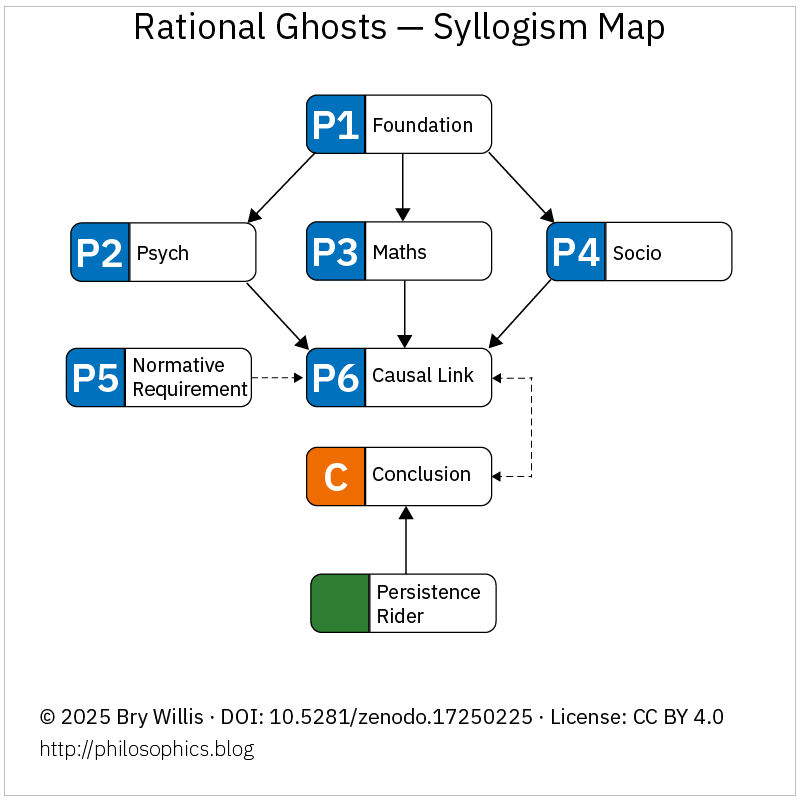
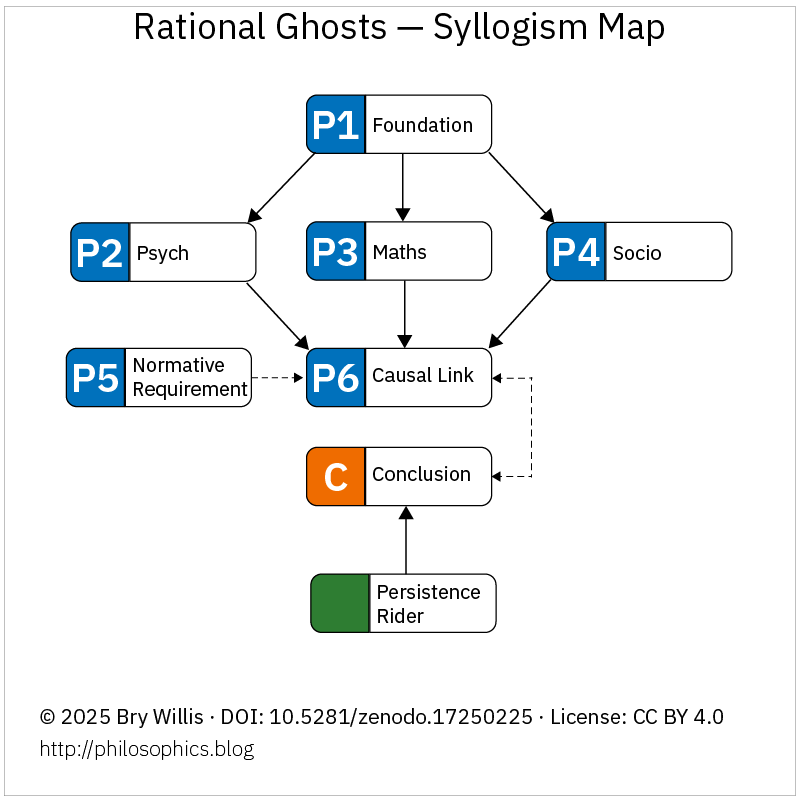
The Argument in Skeleton Form
Beneath the prose, the critique of Enlightenment democracy can be expressed as a syllogism: a foundation that assumed rational citizens collides with psychological bias, mathematical impossibility, and sociological limits. The outcome is a double failure – corrupted inputs and incoherent outputs – masked only by temporary props.
Figure: Logical skeleton of “Rational Ghosts: Why Enlightenment Democracy Was Built to Fail.” For the complete essay, with sources and elaboration, see the open-access preprint on Zenodo: https://doi.org/10.5281/zenodo.17250225
We’re told we live in the Enlightenment, that Reason™ sits on the throne and superstition has been banished to the attic. Yet when I disguised a little survey as “metamodern,” almost none came out as fully Enlightened. Three managed to shed every trace of the premodern ghost, one Dutch wanderer bypassed Modernity entirely, and not a single soul emerged free of postmodern suspicion. So much for humanity’s great rational awakening. Perhaps Modernity wasn’t a phase we passed through at all, but a mirage we still genuflect before, a lifestyle brand draped over a naked emperor.
Audio: NotebookLM podcast on this topic
The Enlightenment as Marketing Campaign
The Enlightenment is sold to us as civilisation’s great coming-of-age: the dawn when the fog of superstition lifted and Reason took the throne. Kant framed it as “man’s emergence from his self-incurred immaturity” – an Enlightenment bumper sticker that academics still like to polish and reapply. But Kant wasn’t writing for peasants hauling mud or women without the vote; he was writing for his own coterie of powdered-wig mandarins, men convinced their own habits of rational debate were humanity’s new universal destiny.
Modernity, in this story, isn’t a historical stage we all inhabited. It’s an advertising campaign: Reason™ as lifestyle brand, equality as tagline, “progress” as the logo on the tote bag. Modernity, in the textbooks, is billed as a historical epoch, a kind of secular Pentecost in which the lights came on and we all finally started thinking for ourselves. In practice, it was more of a boutique fantasy, a handful of gentlemen mistaking their own rarefied intellectual posture for humanity’s destiny.
The Archetype That Nobody Lives In
At the core of the Enlightenment lies the archetype of Man™: rational, autonomous, unencumbered by superstition, guided by evidence, weighing pros and cons with the detachment of a celestial accountant. Economics repackaged him as homo economicus, forever optimising his utility function as if he were a spreadsheet in breeches.
But like all archetypes, this figure is a mirage. Our survey data, even when baited as a “metamodern survey”, never produced a “pure” Enlightenment subject.
3 scored 0% Premodern (managing, perhaps, to kick the gods and ghosts to the kerb).
1 scored 0% Modern (the Dutch outlier: 17% Premodern, 0% Modern, 83% Post, skipping the Enlightenment altogether, apparently by bike).
0 scored 0% Postmodern. Every single participant carried at least some residue of suspicion, irony, or relativism.
The averages themselves were telling: roughly 18% Premodern, 45% Modern, 37% Postmodern. That’s not an age of Reason. That’s a muddle, a cocktail of priestly deference, rationalist daydreams, and ironic doubt.
Even the Greats Needed Their Crutches
If the masses never lived as Enlightenment subjects, what about the luminaries? Did they achieve the ideal? Hardly.
Descartes, desperate to secure the cogito, called in God as guarantor, dragging medieval metaphysics back on stage.
Kant built a cathedral of reason only to leave its foundations propped up by noumena: an unseeable, unknowable beyond.
Nietzsche, supposed undertaker of gods, smuggled in his own metaphysics of will to power and eternal recurrence.
William James, surveying the wreckage, declared that “truth” is simply “what works”, a sort of intellectual aspirin for the Enlightenment headache.
And economists, in a fit of professional humiliation, pared the rational subject down to a corpse on life support. Homo economicus became a creature who — at the very least, surely — wouldn’t choose to make himself worse off. But behavioural economics proved even that meagre hope to be a fantasy. People burn their wages on scratch tickets, sign up for exploitative loans, and vote themselves into oblivion because a meme told them to.
If even the “best specimens” never fully embodied the rational archetype, expecting Joe Everyman, who statistically struggles to parse a sixth-grade text and hasn’t cracked a book since puberty, to suddenly blossom into a mini-Kant is wishful thinking of the highest order.
The Dual Inertia
The real story isn’t progress through epochs; it’s the simultaneous drag of two kinds of inertia:
Premodern inertia: we still cling to sacred myths, national totems, and moral certainties.
Modern inertia: we still pretend the rational subject exists, because democracy, capitalism, and bureaucracy require him to.
The result isn’t a new epoch. It’s a cultural chimaera: half-superstitious, half-rationalist, shot through with irony. A mess, not a phase..
Arrow’s Mathematical Guillotine
Even if the Enlightenment dream of a rational demos were real, Kenneth Arrow proved it was doomed. His Impossibility Theorem shows that no voting system can turn individual rational preferences into a coherent “general will.” In other words, even a parliament of perfect Kants would deadlock when voting on dinner. The rational utopia is mathematically impossible.
So when we are told that democracy channels Reason, we should hear it as a polite modern incantation, no sturdier than a priest blessing crops.
Equality and the Emperor’s Wardrobe
The refrain comes like a hymn: “All men are created equal.” But the history is less inspiring. “Men” once meant property-owning Europeans; later it was generously expanded to mean all adult citizens who’d managed to stay alive until eighteen. Pass that biological milestone, and voilà — you are now certified Rational, qualified to determine the fate of nations.
And when you dare to question this threadbare arrangement, the chorus rises: “If you don’t like democracy, capitalism, or private property, just leave.” As if you could step outside the world like a theatre where the play displeases you. Heidegger’s Geworfenheit makes the joke bitter: we are thrown into this world without choice, and then instructed to exit if we find the wallpaper distasteful. Leave? To where, precisely? The void? Mars?
The Pre-Modern lord said: Obey, or be exiled. The Modern democrat says: Vote, or leave. And the Post-Enlightenment sceptic mutters: Leave? To where, exactly? Gravity? History? The species? There is no “outside” to exit into. The system is not a hotel; it’s the weather.
Here the ghost of Baudrillard hovers in the wings, pointing out that we are no longer defending Reason, but the simulacrum of Reason. The Emperor’s New Clothes parable once mocked cowardice: everyone saw the nudity but stayed silent. Our situation is worse. We don’t even see that the Emperor is naked. We genuinely believe in the fineries, the Democracy™, the Rational Man™, the sacred textile of Progress. And those who point out the obvious are ridiculed: How dare you mock such fineries, you cad!
Conclusion: The Comfort of a Ghost
So here we are, defending the ghost of a phase we never truly lived. We cling to Modernity as if it were a sturdy foundation, when in truth it was always an archetype – a phantom rational subject, a Platonic ideal projected onto a species of apes with smartphones. We mistook it for bedrock, built our institutions upon it, and now expend colossal energy propping up the papier-mâché ruins. The unfit defend it out of faith in their own “voice,” the elites defend it to preserve their privilege, and the rest of us muddle along pragmatically, dosing ourselves with Jamesian aspirin and pretending it’s progress.
Metamodernism, with its marketed oscillation between sincerity and irony, is less a “new stage” than a glossy rebranding of the same old admixture: a bit of myth, a bit of reason, a dash of scepticism. And pragmatism –James’s weary “truth is what works” – is the hangover cure that keeps us muddling through.
Modernity promised emancipation from immaturity. What we got was a new set of chains: reason as dogma, democracy as ritual, capitalism as destiny. And when we protest, the system replies with its favourite Enlightenment lullaby: If you don’t like it, just leave.
But you can’t leave. You were thrown here. What we call “Enlightenment” is not a stage in history but a zombie-simulation of an ideal that never drew breath. And yet, like villagers in Andersen’s tale, we not only guard the Emperor’s empty wardrobe – we see the garments as real. The Enlightenment subject is not naked. He is spectral, and we are the ones haunting him.
Karl Popper’s Paradox of Intolerance has become a kind of intellectual talisman, clutched like a rosary whenever fascists start goose-stepping into the town square. Its message is simple enough: to preserve tolerance, one must be intolerant of intolerance. Shine enough sunlight on bad ideas, and – so the pious hope – they’ll shrivel into dust like a vampire caught out at dawn.
If only.
The trouble with this Enlightenment fairy tale is that it presumes bad ideas melt under the warm lamp of Reason, as if ignorance were merely a patch of mildew waiting for the bleach of debate. But bad ideas are not bacteria; they are weeds, hydra-headed and delighting in the sun. Put them on television, and they metastasise. Confront them with logic, and they metastasise faster, now with a martyr’s halo.
Audio: NotebookLM podcast on this topic.
And here’s the part no liberal dinner-party theorist likes to face: the people most wedded to these “bad ideas” often don’t play the game of reason at all. Their critical faculties have been packed up, bubble-wrapped, and left in the loft decades ago. They don’t want dialogue. They want to chant. They don’t want evidence. They want affirmation. The Socratic method bounces off them like a ping-pong ball fired at a tank.
But let’s be generous. Suppose, just for a moment, we had Plato’s dream: a citizenry of Philosopher Kings™, all enlightened, all rational. Would democracy then work? Cue Arrow’s Impossibility Theorem, that mathematical killjoy which proves that even under perfect conditions – omniscient voters, saintly preferences, universal literacy – you still cannot aggregate those preferences into a system that is both fair and internally consistent. Democracy can’t even get out of its own way on paper.
Now throw in actual humans. Not the Platonic paragons, but Brexit-uncle at the pub, Facebook aunt with her memes, the American cousin in a red cap insisting a convicted felon is the second coming. Suddenly, democracy looks less like a forum of reasoned debate and more like a lottery machine coughing up numbers while we all pretend they mean “the will of the people.”
Democracy is the worst form of government, except for all the others.
And this is where the Churchill quip waddles in, cigar smoke curling round its bowler hat: “Democracy is the worst form of government, except for all the others.” Ah yes, Winston, do please save us with a quip so well-worn it’s practically elevator music. But the problem is deeper than taste in quotations. If democracy is logically impossible (Arrow) and practically dysfunctional (Trump, Brexit, fill in your own national catastrophe), then congratulating ourselves that it’s “better than the alternatives” is simply an admission that we’ve run out of imagination.
Because there are alternatives. A disinterested AI, for instance, could distribute resources with mathematical fairness, free from lobbyists and grievance-mongers. Nursery schools versus nursing homes? Feed in the data, spit out the optimal allocation. No shouting matches, no demagoguery, no ballots stuffed with slogans. But here the defenders of democracy suddenly become Derrida in disguise: “Ah, but what does fair really mean?” And just like that, we are back in the funhouse of rhetorical mirrors where “fair” is a word everyone loves until it costs them something.
So perhaps democracy doesn’t require an “educated populace” at all; that was always just sugar-paper wrapping. It requires, instead, a population sufficiently docile, sufficiently narcotised by the spectacle, to accept the carnival of elections as a substitute for politics. Which is why calling the devotees of a Trump, or any other demagogue, a gaggle of lemmings is both accurate and impolitic: they know they’re not reasoning; they’re revelling. Your contempt merely confirms the script they’ve already written for you.
Video: Short callout to Karl Popper and Hilary Lawson.
The philosopher, meanwhile, is left polishing his lantern, muttering about reason to an audience who would rather scroll memes about pedophile pizza parlours. Popper warned us that tolerance cannot survive if it tolerates its own annihilation. Arrow proved that even if everyone were perfectly reasonable, the maths would still collapse. And Churchill, bless him, left us a one-liner to make it all seem inevitable.
Perhaps democracy isn’t the worst form of government except for all the others. Perhaps it’s simply the most palatable form of chaos, ballots instead of barricades, polling booths instead of pitchforks. And maybe the real scandal isn’t that people are too stupid for democracy, but that democracy was never designed to be about intelligence in the first place. It was always about managing losers while telling them they’d “had their say.”
The Enlightenment promised us reason; what it delivered was a carnival where the loudest barker gets the booth. The rest of us can either keep muttering about paradoxes in the corner or admit that the show is a farce and start imagining something else.




 Philosophics