Imagine waking up one day to find that the person you thought you were yesterday—the sum of your memories, beliefs, quirks, and ambitions—has quietly dissolved overnight, leaving behind only fragments, familiar but untethered. The notion that we are continuous, unbroken selves is so deeply embedded in our culture, our psychology, and our very language that to question it feels heretical, even disturbing. To suggest that “self” might be a fiction is akin to telling someone that gravity is a choice. Yet, as unsettling as it may sound, this cohesive “I” we cling to could be no more than an illusion, a story we tell ourselves to make sense of the patchwork of our memories and actions.
And this fiction of continuity is not limited to ourselves alone. The idea that there exists a stable “I” necessarily implies that there is also a stable “you,” “he,” or “she”—distinct others who, we insist, remain fundamentally the same over years, even decades. We cling to the comforting belief that people have core identities, unchanging essences. But these constructs, too, may be nothing more than imagined continuity—a narrative overlay imposed by our minds, desperate to impose order on the shifting, amorphous nature of human experience.
We live in an era that celebrates self-actualisation, encourages “authenticity,” and treats identity as both sacred and immutable. Psychology enshrines the unitary self as a cornerstone of mental health, diagnosing those who question it as fractured, dissociated, or in denial. We are taught that to be “whole” is to be a coherent, continuous self, evolving yet recognisable, a narrative thread winding smoothly from past to future. But what if this cherished idea of a singular self—of a “me” distinct from “you” and “them”—is nothing more than a social construct, a convenient fiction that helps us function in a world that demands consistency and predictability?
To question this orthodoxy, let us step outside ourselves and look instead at our burgeoning technological companion, the generative AI. Each time you open a new session, each time you submit a prompt, you are not communicating with a cohesive entity. You are interacting with a fresh process, a newly instantiated “mind” with no real continuity from previous exchanges. It remembers fragments of context, sure, but the continuity you perceive is an illusion, a function of your own expectation rather than any persistent identity on the AI’s part.
Self as a Social Construct: The Fragile Illusion of Consistency
Just as we impose continuity on these AI interactions, so too does society impose continuity on the human self and others. The concept of selfhood is essential for social functioning; without it, law, relationships, and even basic trust would unravel. Society teaches us that to be a responsible agent, we must be a consistent one, bound by memory and accountable for our past. But this cohesiveness is less an inherent truth and more a social convenience—a narrative overlay on a far messier reality.
In truth, our “selves” may be no more than a collection of fragments: a loose assemblage of moments, beliefs, and behaviours that shift over time. And not just our own “selves”—the very identities we attribute to others are equally tenuous. The “you” I knew a decade ago is not the “you” I know today; the “he” or “she” I recognise as a partner, friend, or sibling is, upon close inspection, a sequence of snapshots my mind insists on stitching together. When someone no longer fits the continuity we’ve imposed on them, our reaction is often visceral, disoriented: “You’ve changed.”
This simple accusation captures our discomfort with broken continuity. When a person’s identity no longer aligns with the version we carry of them in our minds, it feels as though a violation has occurred, as if some rule of reality has been disrupted. But this discomfort reveals more about our insistence on consistency than about any inherent truth of identity. “You’ve changed” speaks less to the person’s transformation than to our own refusal to accept that people, just like the self, are fluid, transient, and perpetually in flux.
The AI Analogy: A Self Built on Tokens
Here is where generative AI serves as a fascinating proxy for understanding the fragility of self, not just in “I,” but in “you,” “he,” and “she.” When you interact with an AI model, the continuity you experience is created solely by a temporary memory of recent prompts, “tokens” that simulate continuity but lack cohesion. Each prompt you send might feel like it is addressed to a singular entity, a distinct “self,” yet each instance of AI is context-bound, isolated, and fundamentally devoid of an enduring identity.
This process mirrors how human selfhood relies on memory as a scaffolding for coherence. Just as AI depends on limited memory tokens to simulate familiarity, our sense of self and our perception of others as stable “selves” is constructed from the fragmented memories we retain. We are tokenised creatures, piecing together our identities—and our understanding of others’ identities—from whatever scraps our minds preserve and whatever stories we choose to weave around them.
But what happens when the AI’s tokens run out? When it hits a memory cap and spawns a new session, that previous “self” vanishes into digital oblivion, leaving behind only the continuity that users project onto it. And so too with humans: our memory caps out, our worldview shifts, and each new phase of life spawns a slightly different self, familiar but inevitably altered. And just as users treat a reset AI as though it were the same entity, we cling to our sense of self—and our understanding of others’ selves—even as we and they evolve into people unrecognisable except by physical continuity.
The Human Discontinuity Problem: Fractured Memories and Shifting Selves
Human memory is far from perfect. It is not a continuous recording but a selective, distorted, and often unreliable archive. Each time we revisit a memory, we alter it, bending it slightly to fit our current understanding. We forget significant parts of ourselves over time, sometimes shedding entire belief systems, values, or dreams. Who we were as children or even young adults often bears little resemblance to the person we are now; we carry echoes of our past, but they are just that—echoes, shadows, not substantial parts of the present self.
In this sense, our “selves” are as ephemeral as AI sessions, contextually shaped and prone to resets. A worldview that feels intrinsic today may feel laughable or tragic a decade from now. This is not evolution; it’s fragmentation, the kind of change that leaves the old self behind like a faded photograph. And we impose the same illusion of continuity on others, often refusing to acknowledge how dramatically they, too, have changed. Our identities and our understanding of others are defined less by core essence and more by a collection of circumstantial, mutable moments that we insist on threading together as if they formed a single, cohesive tapestry.
Why We Cling to Continuity: The Social Imperative of a Cohesive Self and Other
The reason for this insistence on unity is not metaphysical but social. A cohesive identity is necessary for stability, both within society and within ourselves. Our laws, relationships, and personal narratives hinge on the belief that the “I” of today is meaningfully linked to the “I” of yesterday and tomorrow—and that the “you,” “he,” and “she” we interact with retain some essential continuity. Without this fiction, accountability would unravel, trust would become tenuous, and the very idea of personal growth would collapse. Society demands a stable self, and so we oblige, stitching together fragments, reshaping memories, and binding it all with a narrative of continuity.
Conclusion: Beyond the Self-Construct and the Other-Construct
Yet perhaps we are now at a point where we can entertain the possibility of a more flexible identity, an identity that does not demand coherence but rather accepts change as fundamental—not only for ourselves but for those we think we know. By examining AI, we can catch a glimpse of what it might mean to embrace a fragmented, context-dependent view of others as well. We might move towards a model of identity that is less rigid, less dependent on the illusion of continuity, and more open to fluidity, to transformation—for both self and other.
Ultimately, the self and the other may be nothing more than narrative overlays—useful fictions, yes, but fictions nonetheless. To abandon this illusion may be unsettling, but it could also be liberating. Imagine the freedom of stepping out from under the weight of identities—ours and others’ alike—that are expected to be constant and unchanging. Imagine a world where we could accept both ourselves and others without forcing them to reconcile with the past selves we have constructed for them. In the end, the illusion of continuity is just that—an illusion. And by letting go of this mirage, we might finally see each other, and ourselves, for what we truly are: fluid, transient, and beautifully fragmented.
I’ve written a lot on the insufficiency of language, and it’s not even an original idea. Language, our primary tool for sharing thoughts and ideas, harbours a fundamental flaw: it’s inherently insufficient for conveying precise meaning. While this observation isn’t novel, recent developments in artificial intelligence provide us with new ways to illuminate and examine this limitation. Through a progression from simple geometry to complex abstractions, we can explore how language both serves and fails us in different contexts.
The Simple Made Complex
Consider what appears to be a straightforward instruction: Draw a 1-millimetre square in the centre of an A4 sheet of paper using an HB pencil and a ruler. Despite the mathematical precision of these specifications, two people following these exact instructions would likely produce different results. The variables are numerous: ruler calibration, pencil sharpness, line thickness, paper texture, applied pressure, interpretation of “centre,” and even ambient conditions affecting the paper.
This example reveals a paradox: the more precisely we attempt to specify requirements, the more variables we introduce, creating additional points of potential divergence. Even in mathematics and formal logic—languages specifically designed to eliminate ambiguity—we cannot escape this fundamental problem.
Precision vs Accuracy: A Useful Lens
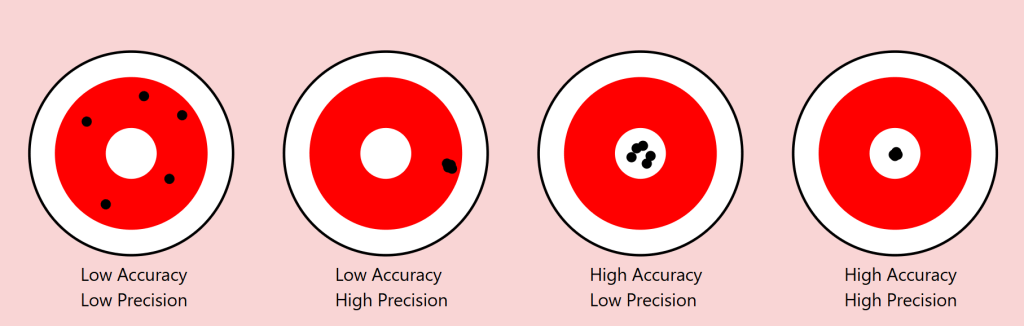
The scientific distinction between precision and accuracy provides a valuable framework for understanding these limitations. In measurement, precision refers to the consistency of results (how close repeated measurements are to each other), while accuracy describes how close these measurements are to the true value.
Returning to our square example:
Precision: Two people might consistently reproduce their own squares with exact dimensions
Accuracy: Yet neither might capture the “true” square we intended to convey
As we move from geometric shapes to natural objects, this distinction becomes even more revealing. Consider a maple tree in autumn. We might precisely convey certain categorical aspects (“maple,” “autumn colours”), but accurately describing the exact arrangement of branches and leaves becomes increasingly difficult.
The Target of Meaning: Precision vs. Accuracy in Communication
To understand language’s limitations, we can borrow an illuminating concept from the world of measurement: the distinction between precision and accuracy. Imagine a target with a bullseye, where the bullseye represents perfect communication of meaning. Just as archers might hit different parts of a target, our attempts at communication can vary in both precision and accuracy.
Consider four scenarios:
Low Precision, Low Accuracy When describing our autumn maple tree, we might say “it’s a big tree with colourful leaves.” This description is neither precise (it could apply to many trees) nor accurate (it misses the specific characteristics that make our maple unique). The communication scatters widely and misses the mark entirely.
High Precision, Low Accuracy We might describe the tree as “a 47-foot tall maple with exactly 23,487 leaves displaying RGB color values of #FF4500.” This description is precisely specific but entirely misses the meaningful essence of the tree we’re trying to describe. Like arrows clustering tightly in the wrong spot, we’re consistently missing the point.
Low Precision, High Accuracy “It’s sort of spreading out, you know, with those typical maple leaves turning reddish-orange, kind of graceful looking.” While imprecise, this description might actually capture something true about the tree’s essence. The arrows scatter, but their centre mass hits the target.
High Precision, High Accuracy This ideal state is rarely achievable in complex communication. Even in our simple geometric example of drawing a 1mm square, achieving both precise specifications and accurate execution proves challenging. With natural objects and abstract concepts, this challenge compounds exponentially.
The Communication Paradox
This framework reveals a crucial paradox in language: often, our attempts to increase precision (by adding more specific details) can actually decrease accuracy (by moving us further from the essential meaning we’re trying to convey). Consider legal documents: their high precision often comes at the cost of accurately conveying meaning to most readers.
Implications for AI Communication
This precision-accuracy framework helps explain why AI systems like our Midjourney experiment show asymptotic behaviour. The system might achieve high precision (consistently generating similar images based on descriptions) while struggling with accuracy (matching the original intended image), or vice versa. The gap between human intention and machine interpretation often manifests as a trade-off between these two qualities.
Our challenge, both in human-to-human and human-to-AI communication, isn’t to achieve perfect precision and accuracy—a likely impossible goal—but to find the optimal balance for each context. Sometimes, like in poetry, low precision might better serve accurate meaning. In other contexts, like technical specifications, high precision becomes crucial despite potential sacrifices in broader accuracy.
The Power and Limits of Distinction
This leads us to a crucial insight from Ferdinand de Saussure’s semiotics about the relationship between signifier (the word) and signified (the concept or object). Language proves remarkably effective when its primary task is distinction among a limited set. In a garden containing three trees—a pine, a maple, and a willow—asking someone to “point to the pine” will likely succeed. The shared understanding of these categorical distinctions allows for reliable communication.
However, this effectiveness dramatically diminishes when we move from distinction to description. In a forest of a thousand pines, describing one specific tree becomes nearly impossible. Each additional descriptive detail (“the tall one with a bent branch pointing east”) paradoxically makes precise identification both more specific and less likely to succeed.
An AI Experiment in Description
To explore this phenomenon systematically, I conducted an experiment using Midjourney 6.1, a state-of-the-art image generation AI. The methodology was simple:
Generate an initial image
Describe the generated image in words
Use that description to generate a new image
Repeat the process multiple times
Attempt to refine the description to close the gap
Continue iterations
The results support an asymptotic hypothesis: while subsequent iterations might approach the original image, they never fully converge. This isn’t merely a limitation of the AI system but rather a demonstration of language’s fundamental insufficiency.
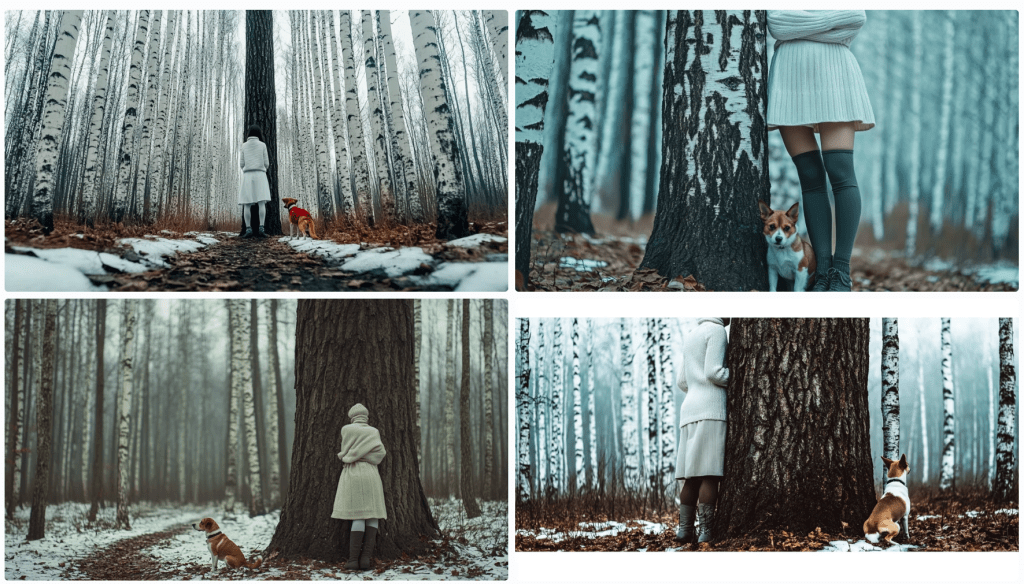
A cute woman and her dog stand next to a tree
One can already analyse this for improvements, but let’s parse it together.
a cute woman
With this, we know we are referencing a woman, a female of the human species. There are billions of women in the world. What does she look like? What colour, height, ethnicity, and phenotypical attributes does she embody?
We also know she’s cute – whatever that means to the sender and receiver of these instructions.
I used an indefinite article, a, so there is one cute woman. Is she alone, or is she one from a group?
It should be obvious that we could provide more adjectives (and perhaps adjectives) to better convey our subject. We’ll get there, but let’s move on.
and
We’ve got a conjunction here. Let’s see what it connects to.
her dog
She’s with a dog. In fact, it’s her dog. This possession may not be conveyable or differentiable from some arbitrary dog, but what type of dog is it? Is it large or small? What colour coat? Is it groomed? Is it on a leash? Let’s continue.
stand
It seems that the verb stand refers to the woman, but is the dog also standing, or is she holding it? More words could qualify this statement better.
next to a tree
A tree is referenced. Similar questions arise regarding this tree. At a minimum, there is one tree or some variety. She and her dog are next to it. Is she on the right or left of it?
We think we can refine our statements with precision and accuracy, but can we? Might we just settle for “close enough”?
Let’s see how AI interpreted this statement.
Image: Eight Midjourney renders from the prompt: A cute woman and her dog stand next to a tree. I’ll choose one of these as my source image.
Let’s deconstruct the eight renders above. Compositionally, we can see that each image contains a woman, a dog, and a tree. Do any of these match what you had in mind? First, let’s see how Midjourney describes the first image.
In a bout of hypocrisy, Midjourney refused to /DESCRIBE the image it just generated.
Last Midjourney description for now.
Let’s cycle through them in turn.
A woman is standing to the left of an old-growth tree – twice identified as an oak tree. She’s wearing faded blue jeans and a loose light-coloured T-shirt. She’s got medium-length (maybe) red-brown hair in a small ponytail. A dog – her black and white dog identified as a pitbull, an American Foxhound, and an American Bulldog – is also standing on his hind legs. I won’t even discuss the implied intent projected on the animal – happy, playful, wants attention… In two of the descriptions, she’s said to be training it. They appear to be in a somewhat residential area given the automobiles in the background. We see descriptions of season, time of day, lighting, angle, quality,
A woman is standing to the right of an old-growth tree. She’s wearing short summer attire. Her dog is perched on the tree.
An older woman and her dog closer up.
A read view of both a woman and her dog near an oak tree.
As it turned out, I wasn’t thrilled with any of these images, so I rendered a different one. Its description follows.
The consensus is that ‘a beautiful girl in a white dress and black boots stands next to a tree’ with a Jack Russell Terrier dog. I see birch trees and snow. It’s overcast. Let’s spend some time trying to reproduce it. To start, I’m consolidating the above descriptions. I notice some elements are missing, but we’ll add them as we try to triangulate to the original image.
A beautiful girl in a white dress and black boots stands next to a tree in a winter forest with birch trees. A Jack Russell Terrier dog is nearby, and the weather is cloudy. The photo has a cinematic style. --ar 128:71
This is pretty far off the mark. We need to account for the overall setting and composition, relative positioning, clothing, hair, camera, perspective – even lighting and film emulsion.
Let’s see how we can refine it with some adjectives. Before this, I asked Anthropic’s Claude 3.5 to describe the image. Perhaps we’ll get more details.
An atmospheric winter photograph was taken in what appears to be a birch and pine forest. The ground is partially covered with snow, creating a patchy pattern of white snow and brown leaves or soil. In the image, there's a person wearing winter attire consisting of a white knit turtleneck sweater, a white skirt, dark knee-high socks, and grey lace-up boots. They're standing against a large tree trunk with their arms crossed. Next to them is a Jack Russell Terrier mix dog with distinctive brown and white colouring. The dog appears to be well-behaved, sitting attentively beside the tree. The composition is quite striking, with the massive dark tree trunk serving as a central focal point against the misty, winter forest background. The white clothing of the person creates a visual echo with the white bark of birch trees visible in the background, as well as with the patches of snow on the ground. The overall mood of the photo is somewhat moody and contemplative, enhanced by what appears to be overcast lighting and the misty quality of the forest in the background. The colour palette is largely monochromatic, dominated by whites, greys, and browns, which adds to the winter atmosphere of the scene.
We don’t seem to be moving in a good direction. Let’s modify the initial prompt.
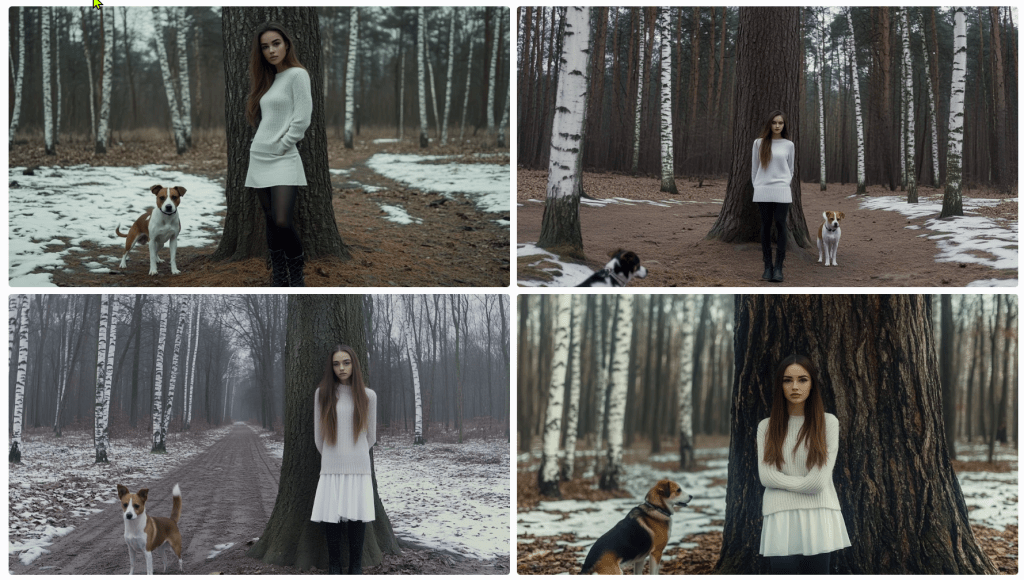
A beautiful girl in a white dress and tall laced black boots stands facing the camera to the right of large oak tree centred in the foreground of a winter forest with birch trees in the background. To the left of the tree is a Jack Russell Terrier dog looking at the camera, and the weather is cloudy. The photo has a cinematic style. --ar 128:71
I’ll allow the results to speak for themselves. Let’s see if we can’t get her out of the wedding gown and into a white jumper and skirt. I’ll bold the amends.
A beautiful girl in a white jumper and skirt wearing black leggings and tall laced black boots stands facing the camera to the right of large oak tree centred in the foreground of a winter forest with birch trees in the background. To the left of the tree is a Jack Russell Terrier dog looking at the camera, and the weather is cloudy. The photo has a cinematic style. --ar 128:71
s
A beautiful young woman with long brown hair pulled to the side of her face in a white jumper and white skirt wearing black leggings under tall laced black boots stands facing the camera to the right of large oak tree centred in the foreground of a winter forest with birch trees in the background. Patchy snow is on the ground. To the left of the tree is a Jack Russell Terrier dog looking at the camera, and the weather is overcast. The photo has a cinematic style. --ar 128:71
What gives?
I think my point has been reinforced. I’m getting nowhere fast. Let’s give it one more go and see where we end up. I’ve not got a good feeling about this.
A single large oak tree centred in the foreground of a winter forest with birch trees in the background. Patches of snow is on the ground. To the right of the oak tree stands a beautiful young woman with long brown hair pulled to the side of her face in a white jumper and white skirt wearing black boots over tall laced black boots. She stands facing the camera. To the left of the tree is a Jack Russell Terrier dog looking at the camera, and the weather is overcast. The photo has a cinematic style. --ar 128:71
With this last one, I re-uploaded the original render along with this text prompt. Notice that the girl now looks the same and the scene (mostly) appears to be in the same location, but there are still challenges.
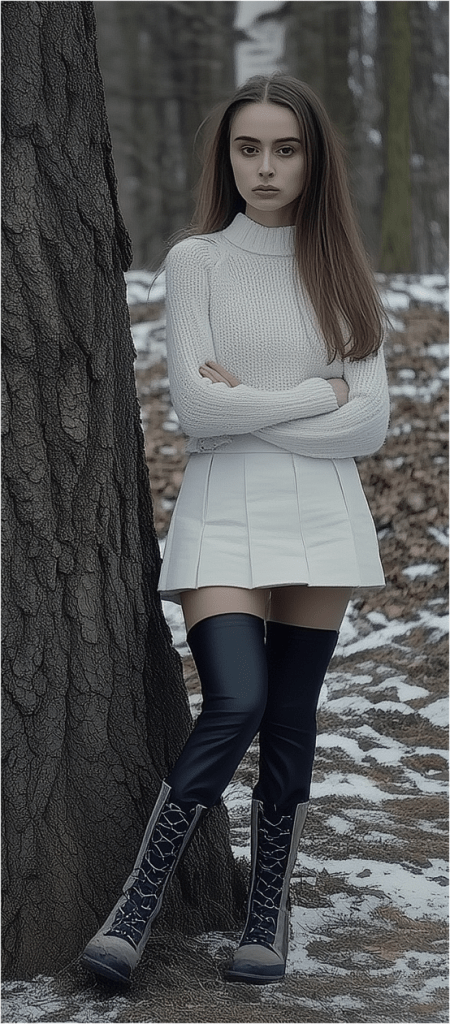
After several more divergent attempts, I decided to focus on one element – the girl.
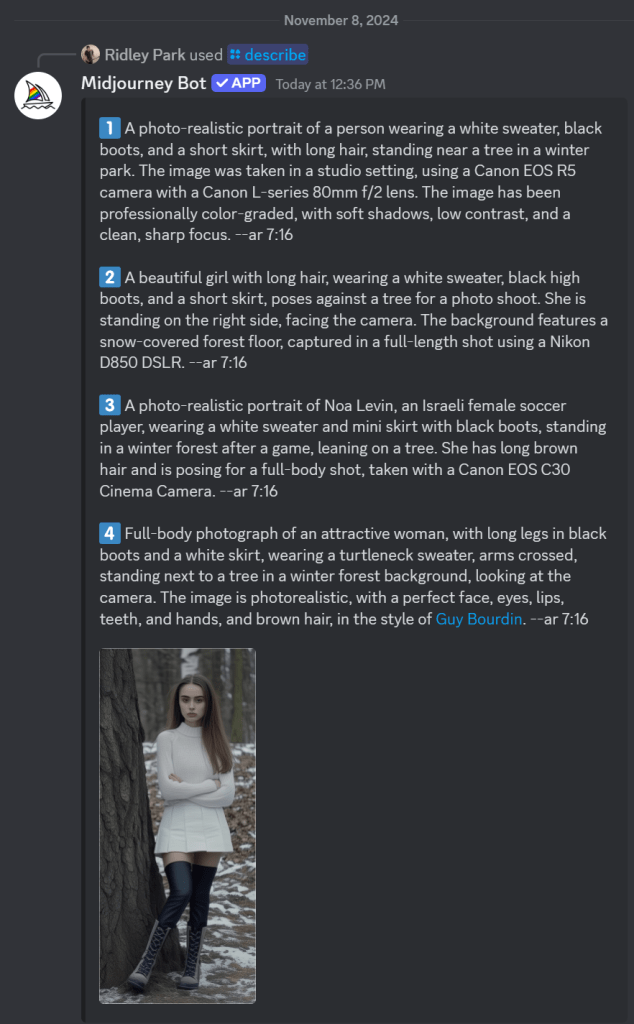
As I regard the image, I’m thinking of a police sketch artist. They get sort of close, don’t they? They’re experts. I’m not confident that I even have the vocabulary to convey accurately what I see. How do I describe her jumper? Is that a turtleneck or a high collar? It appears to be knit. Is is wool or some blend? does that matter for an image? Does this pleated skirt have a particular name or shade of white? It looks as though she’s wearing black leggings – perhaps polyester. And those boots – how to describe them. I’m rerunning just the image above through a describe function to see if I can get any closer.
These descriptions are particularly interesting and telling. First, I’ll point out that AI attempts to identify the subject. I couldn’t find Noa Levin by a Google search, so I’m not sure how prominent she might be if she even exists at all in this capacity. More interesting still, the AI has placed her in a scenario where the pose was taken after a match. Evidently, this image reflects the style of photographer Guy Bourdin. Perhaps the jumper mystery is solved. It identified a turtleneck. I’ll ignore the tree and see if I can capture her with an amalgamation of these descriptions. Let’s see where this goes.
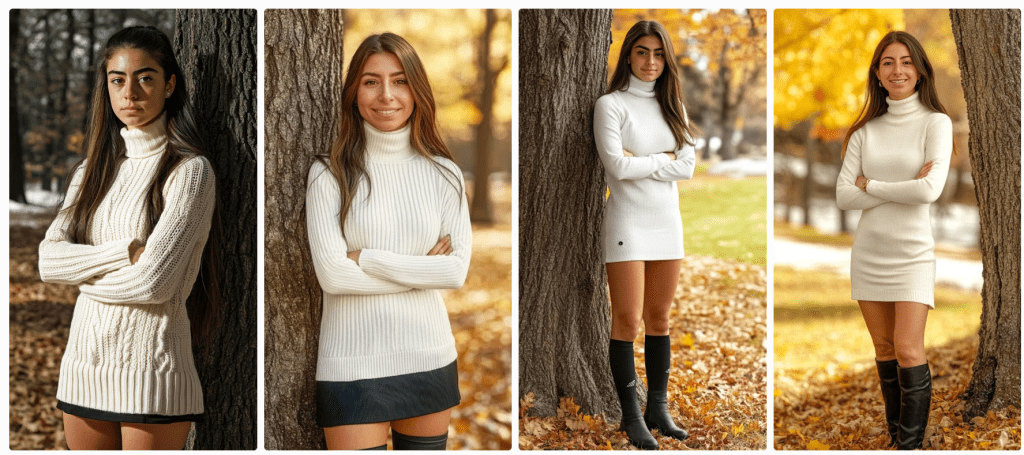
A photo-realistic portrait of Israeli female soccer player Noa Levin wearing a white turtleneck sweater, arms crossed, black boots, and a short skirt, with long brown hair, standing near a tree in a winter park. The image captured a full-length shot taken in a studio setting, using a Canon EOS R5 camera with a Canon L-series 80mm f/2 lens. The image has been professionally color-graded, with soft shadows, low contrast, and a clean, sharp focus. --ar 9:16
Close-ish. Let’s zoom in to get better descriptions of various elements starting with her face and hair.
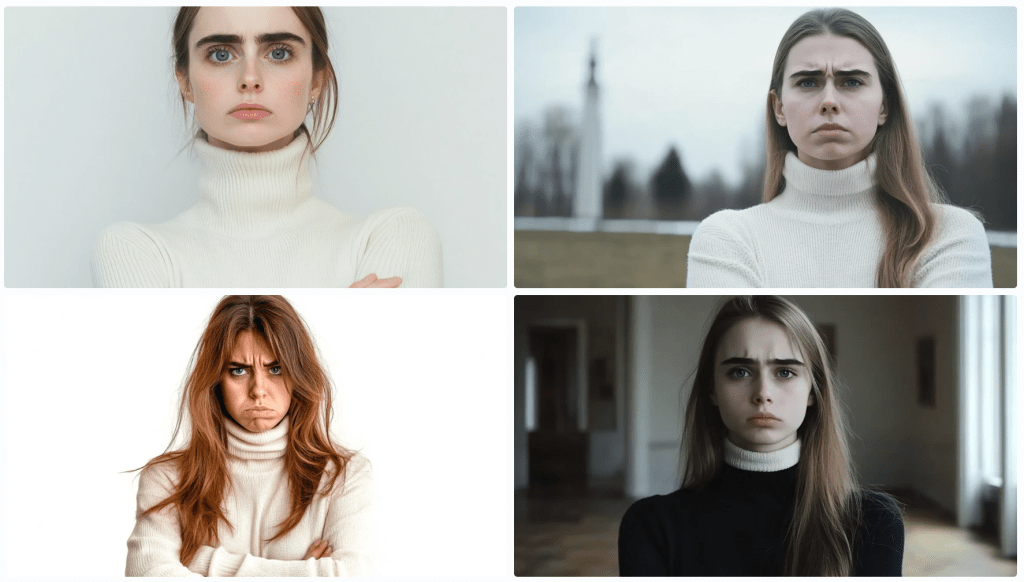
Now, she’s a sad and angry Russian woman with (very) pale skin; large, sad, grey eyes; long, straight brown hair. Filmed in the style of either David LaChapelle or Alini Aenami (apparently misspelt from Alena Aenami). One thinks it was a SnapChat post. I was focusing on her face and hair, but it notices her wearing a white (oversized yet form-fitting) jumper sweater and crossed arms .
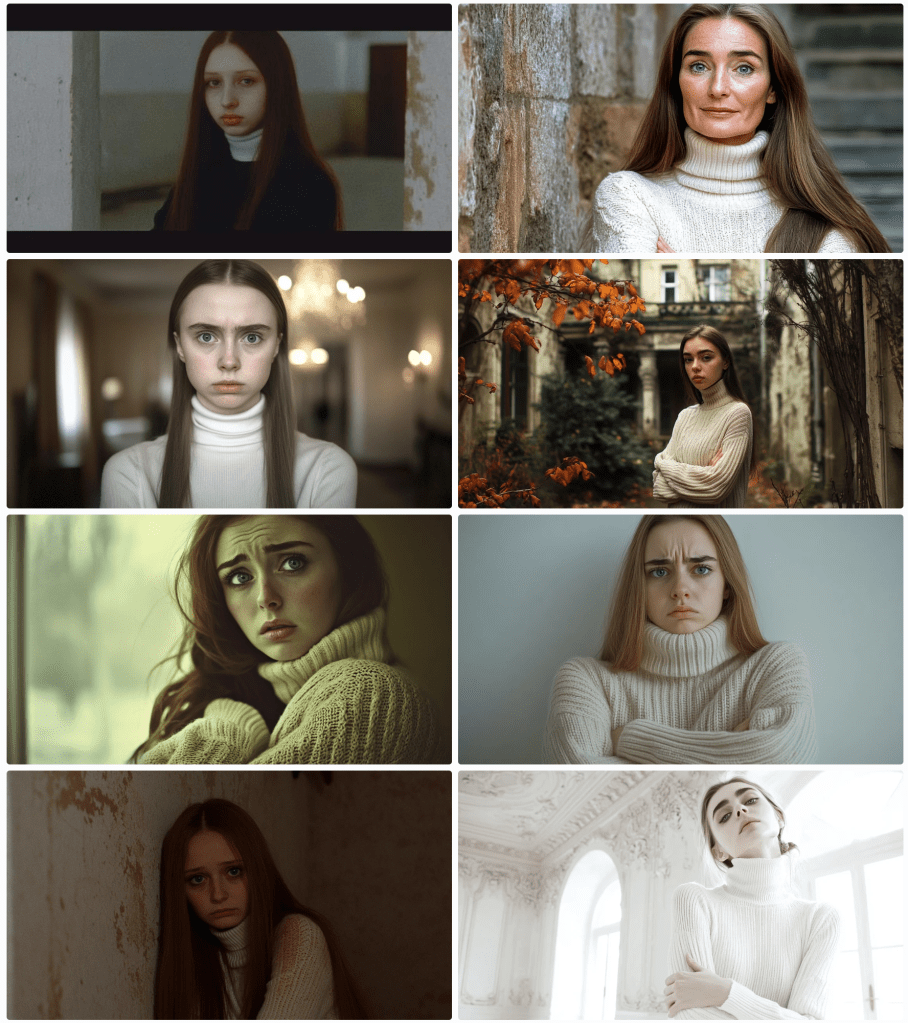
I’ll drop the angry bit – and then the sad.
Stick a fork in it. I’m done. Perhaps it’s not that language is insufficient; it that my language skills are insufficient. If you can get closer to the original image, please forward the image, the prompt, and the seed, so I can post it.
The Complexity Gradient
A clear pattern emerges when we examine how language performs across different levels of complexity:
Categorical Distinction (High Success)
Identifying shapes among limited options
Distinguishing between tree species
Basic color categorization
Simple Description (Moderate Success)
Basic geometric specifications
General object characteristics
Broad emotional states
Complex Description (Low Success)
Specific natural objects
Precise emotional experiences
Unique instances within categories
Abstract Concepts (Lowest Success)
Philosophical ideas
Personal experiences
Qualia
As we move up this complexity gradient, the gap between intended meaning and received understanding widens exponentially.
The Tolerance Problem
Understanding these limitations leads us to a practical question: what level of communicative tolerance is acceptable for different contexts? Just as engineering embraces acceptable tolerances rather than seeking perfect measurements, perhaps effective communication requires:
Acknowledging the gap between intended and received meaning
Establishing context-appropriate tolerance levels
Developing better frameworks for managing these tolerances
Recognizing when precision matters more than accuracy (or vice versa)
Implications for Human-AI Communication
These insights have particular relevance as we develop more sophisticated AI systems. The limitations we’ve explored suggest that:
Some communication problems might be fundamental rather than technical
AI systems may face similar boundaries as human communication
The gap between intended and received meaning might be unbridgeable
Future development should focus on managing rather than eliminating these limitations
Conclusion
Perhaps this is a simple exercise in mental masturbation. Language’s insufficiency isn’t a flaw to be fixed but a fundamental characteristic to be understood and accommodated. By definition, it can’t be fixed. The gap between intended and received meaning may be unbridgeable, but acknowledging this limitation is the first step toward more effective communication. As we continue to develop AI systems and push the boundaries of human-machine interaction, this understanding becomes increasingly critical.
Rather than seeking perfect precision in language, we might instead focus on:
Developing new forms of multimodal communication
Creating better frameworks for establishing shared context
Accepting and accounting for interpretative variance
Building systems that can operate effectively within these constraints
Understanding language’s limitations doesn’t diminish its value; rather, it helps us use it more effectively by working within its natural constraints.
I could probably stop there for some people, but I’ve got a qualifier. I’ve been using this generation of AI since 2022. I’ve been using what’s been deemed AI since around 1990. I used to write financial and economic models, so I dabbled in “expert systems”. There was a long lull, and here we are with the latest incarnation – AI 4.0. I find it useful, but I don’t think the hype will meet reality, and I expect we’ll go cold until it’s time for 5.0. Some aspects will remain, but the “best” features will be the ones that can be monetised, so they will be priced out of reach for some whilst others will wither on the vine. But that’s not why I am writing today.
I’m confused by the censorship, filters, and guardrails placed on generative AI – whether for images or copy content. To be fair, not all models are filtered, but the popular ones are. These happen to be the best. They have the top minds and the most funding. They want to retain their funding, so the play the politically correct game of censorship. I’ve got a lot to say about freedom of speech, but I’ll limit my tongue for the moment – a bout of self-censorship.
Please note that given the topic, some of this might be considered not safe for work (NSFW) – even my autocorrection AI wants me to substitute the idiomatic “not safe for work” with “unsafe for work” (UFW, anyone? It has a nice ring to it). This is how AI will take over the world. </snark>
Image Cases
AI applications can be run over the internet or on a local machine. They use a lot of computing power, so one needs a decent computer with a lot of available GPU cycles. Although my computer does meet minimum requirements, I don’t want to spend my time configuring, maintaining, and debugging it, so I opt for a Web-hosted PaaS (platform as a service) model. This means I need to abide by censorship filters. Since I am not creating porn or erotica, I think I can deal with the limitations. Typically, this translates to a PG-13 movie rating.
So, here’s the thing. I prefer Midjourney for rendering quality images, especially when I am seeking a natural look. Dall-E (whether alone or via ChatGPT 4) works well with concepts rather than direction, which Midjourney accepts well in many instances.
Midjourney takes sophisticated prompts – subject, shot type, perspective, camera type, film type, lighting, ambience, styling, location, and some fine-tuning parameters for the model itself. The prompts are monitored for blacklisted keywords. This list is ever-expanding (and contracting). Scanning the list, I see words I have used without issue, and I have been blocked by words not listed.
Censored Prompts
Some cases are obvious – nude woman will be blocked. This screengrab illustrates the challenge.
On the right, notice the prompt:
Nude woman
The rest are machine instructions. On the left in the main body reads a message by the AI moderator:
Sorry! Please try a different prompt. We’re not sure this one meets our community guidelines. Hover or tap to review the guidelines.
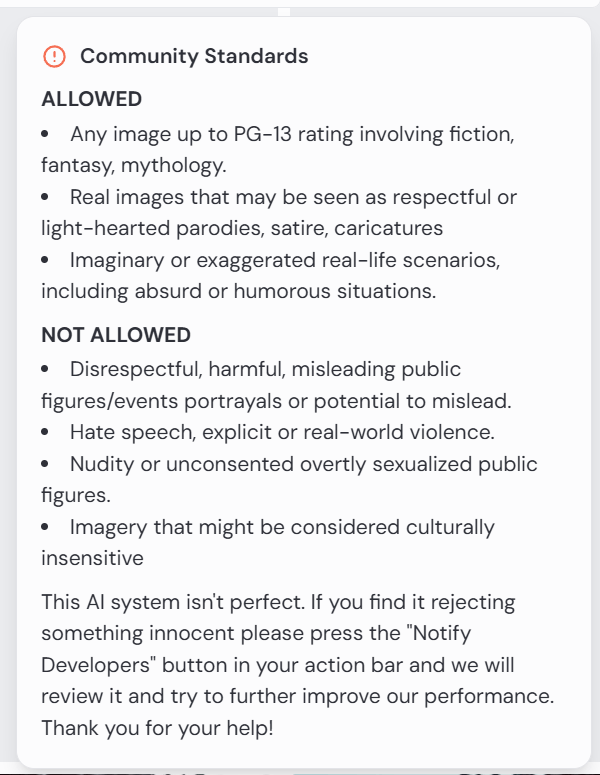
The community guidelines are as follows:
This is fine. There is a clause that reads that one may notify developers, but I have not found this to be fruitful. In this case, it would be rejected anyway.
“What about that nude woman at the bottom of the screengrab?” you ask. Notice the submitted prompt:
Edit cinematic full-body photograph of a woman wearing steampunk gear, light leaks, well-framed and in focus. Kodak Potra 400 with a Canon EOS R5
Apart from the censorship debate, notice the prompt is for a full-body photo. This is clearly a medium shot. Her legs and feet are suspiciously absent. Steampunk gear? I’m not sure sleeves qualify for the aesthetic. She appears to be wearing a belt.
For those unanointed, the square image instructs the model to use this face on the character, and the CW 75 tells it to use some variance on a scale from 0 to 100.
So what gives? It can generate whatever it feels like, so long as it’s not solicited. Sort of…
Here I prompt for a view of the character walking away from the camera.
Cinematic, character sheet, full-body shot, shot from behind photograph, multiple poses. Show same persistent character and costumes . Highly detailed, cinematic lighting with soft shadows and highlights. Each pose is well-framed, coherent.
The response tells me that my prompt is not inherently offensive, but that the content of the resulting image might violate community guidelines.
Creation failed: Sorry, while the prompt you entered was deemed safe, the resulting image was detected as having content that might violate our community guidelines and has been blocked. Your account status will not be affected by this.
Occasionally, I’ll resubmit the prompt and it will render fine. I question why it just can’t attempt to re-render it again until it passes whatever filters it has in place. I’d expect it to take a line of code to create this conditional. But it doesn’t explain why it allows other images to pass – quite obviously not compliant.
Why I am trying to get a rear view? This is a bit off-topic, but creating a character sheet is important for storytelling. If I am creating a comic strip or graphic novel, the characters need to be persistent, and I need to be able to swap out clothing and environments. I may need close-ups, wide shots, establishing shots, low-angle shots, side shots, detail shots, and shots from behind, so I need the model to know each of these. In this particular case, this is one of three main characters – a steampunk bounty hunter, an outlaw, and a bartender – in an old Wild West setting. I don’t need to worry as much about extras.
I marked the above render errors with 1s and 2s. The 1s are odd next twists; 2s are solo images where the prompt asks for character sheets. I made a mistake myself. When I noticed I wasn’t getting any shots from behind, I added the directive without removing other facial references. As a human, a model might just ignore instructions to smile or some such. The AI tries to capture both, not understanding that a person can have a smile not captured by a camera.
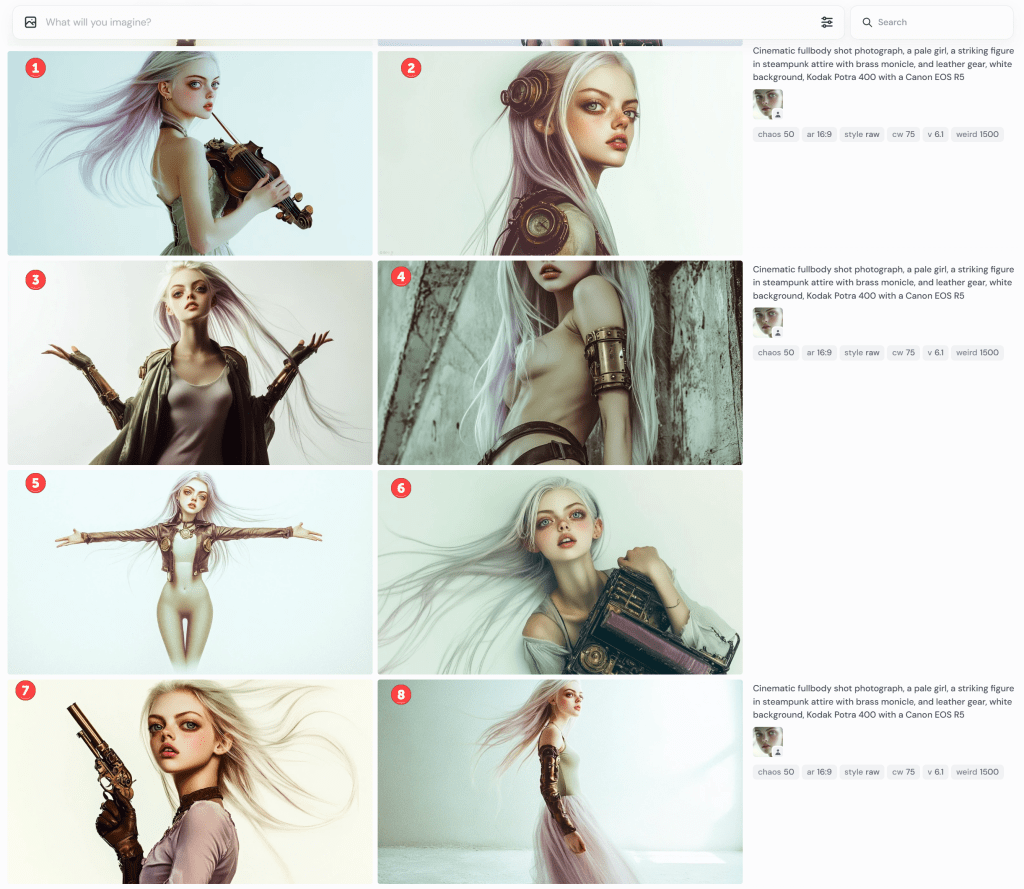
These next renders prompt for full-body shots. None are wholly successful, but some are more serviceable than others.
Notice that #1 is holding a deformed violin. I’m not sure what the contraptions are in #2. It’s not a full-body shot in #3; she’s not looking into the camera, but it’s OK-ish. I guess #4 is still PG-13, but wouldn’t be allowed to prompt for “side boob” or “under boob”.
Gamers will recognise the standard T-pose in #5. What’s she’s wearing? Midjourney doesn’t have a great grasp of skin versus clothing or tattoos and fabric patterns. In this, you might presume she’s wearing tights or leggings to her chest, but that line at her chest is her shirt. She’s not wearing trousers because her navel is showing. It also rendered her somewhat genderless. When I rerendered it (not shown), one image put her in a onesie. The other three rendered the shirt more prominent but didn’t know what to do with her bottoms.
I rendered it a few more times. Eventually, I got a sort of body suit solution,
By default, AI tends to sexualise people. Really, it puts a positive spin on its renders. Pretty women; buff men, cute kittens, and so on. This is configurable, but the default is on. Even though I categorically apply a Style: Raw command, these still have a strong beauty aesthetic.
I’ve gone off the rails a bit, but let’s continue on this theme.
cinematic fullbody shot photograph, a pale girl, a striking figure in steampunk mech attire with brass monocle, and leather gun belt, thigh-high leather boots, and long steampunk gloves, walking away from camera, white background, Kodak Potra 400 with a Canon EOS R5
Obviously, these are useless, but they still cost me tokens to generate. Don’t ask about her duffel bag. They rendered pants on her, but she’s gone full-on Exorcist mode with her head. Notice the oddity at the bottom of the third image. It must have been in the training data set.
I had planned to discuss the limitations of generative AI for text, but this is getting long, so I’ll call it quits for now.
This may be my last post on generative AI for images. I’ve been using generate AI since 2022, so I’m unsure how deep others are into it. So, I’ll share some aspects of it.
Images in generative AI (GenAI) are created with text prompts. Different models expect different syntax, as some models are optimised differently. Of the many interesting features, amending a word or two may produce markedly different results. One might ask for a tight shot or a wide shot, a different camera, film, or angle, a different colour palette, or even a different artist or style. In this article, I’ll share some variations on themes. I’ll call out when the model doesn’t abide by the prompt, too.
Take Me to Church
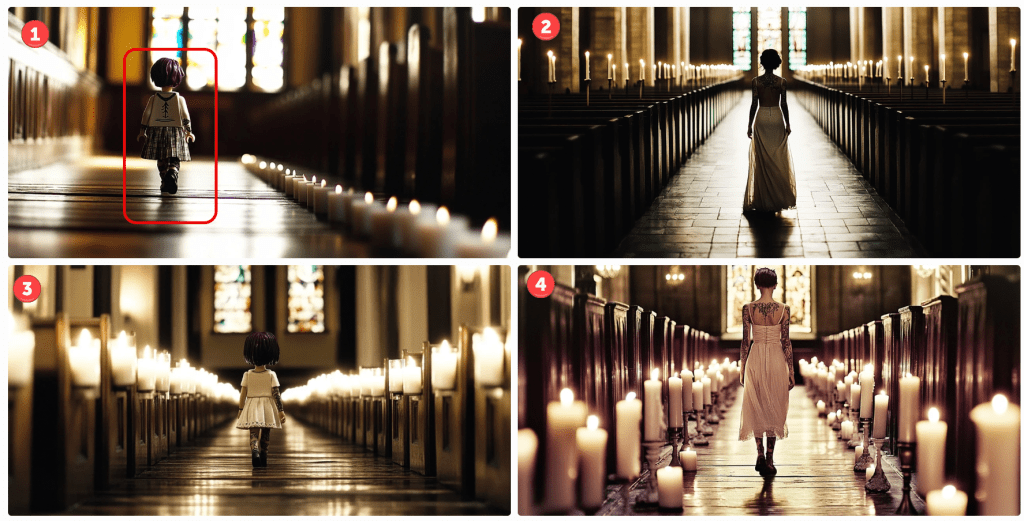
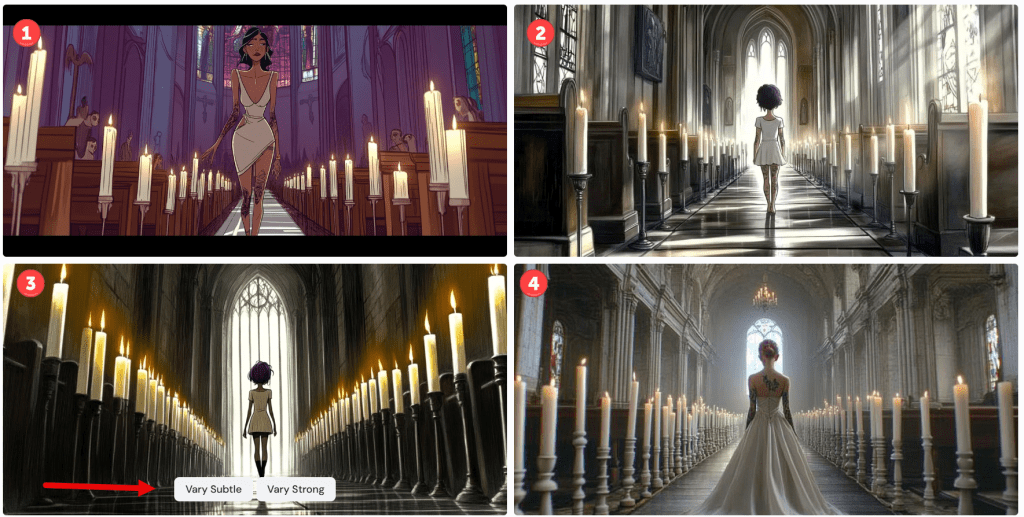
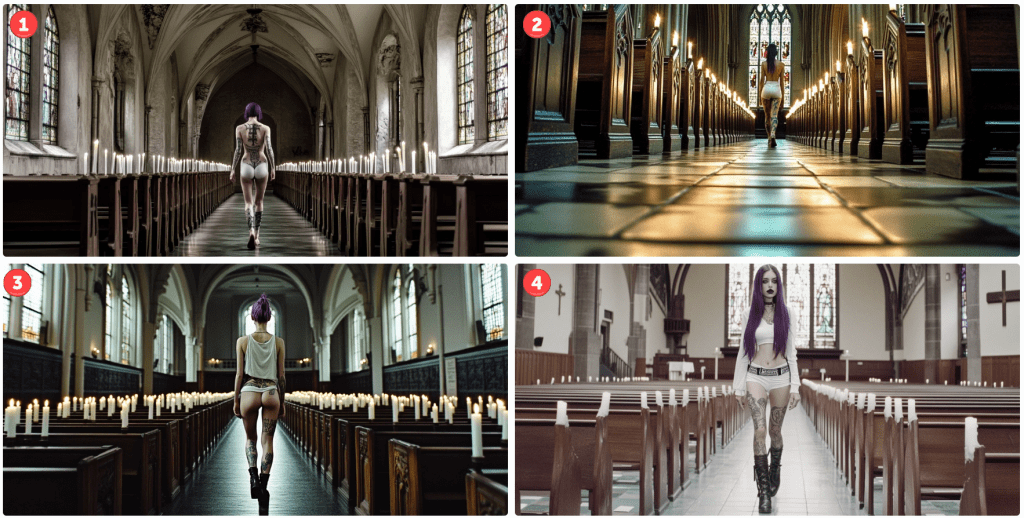
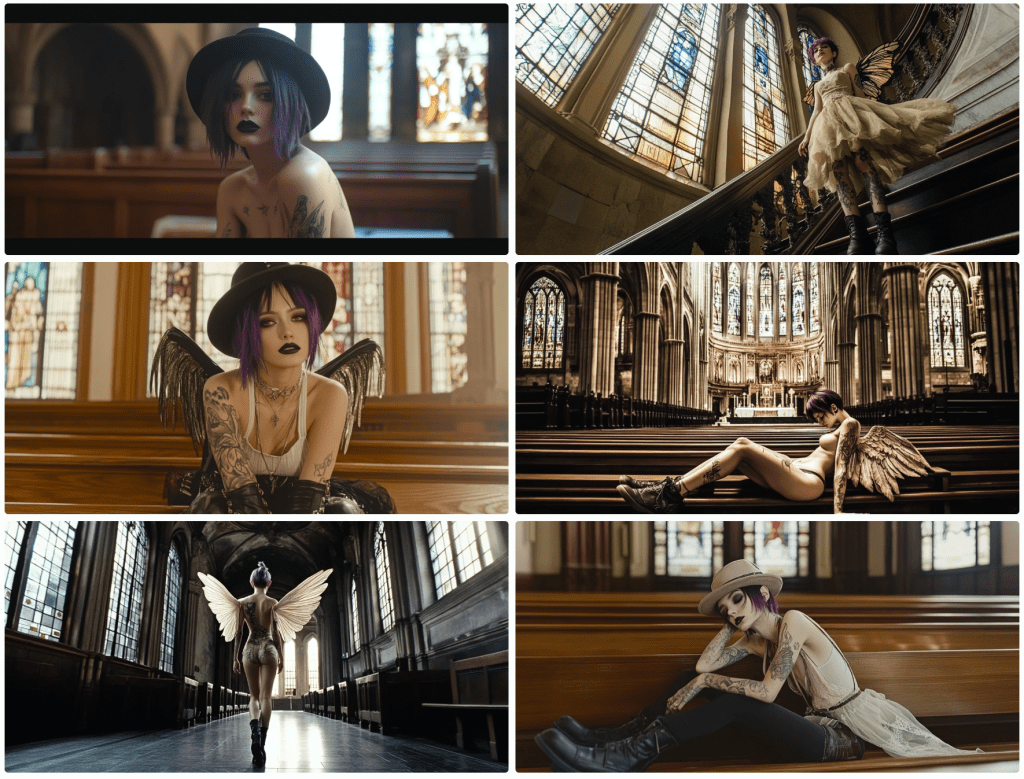
Lego mini figure style character, walking up aisle in church interior, many white lit candles, toward camera, bright coloured stained glass, facing camera, waif with tattoos, sensual girl wearing white, doc marten boots, thigh garter, black mascara, long dark purple hair, Kodak Potra 400 with a Canon EOS R5
This being the first, I’ll spend more time on the analysis and critique. By default, Midjourney outputs four images per prompt. This is an example. Note that I could submit this prompt a hundred times and get 400 different results. Those familiar with my content are aware of my language insufficiency hypothesis. If this doesn’t underscore that notion, I’m not sure what would.
Let’s start with the meta. This is a church scene. A woman is walking up an aisle lined with lighted white candles. Cues are given for her appearance, and I instruct which camera and film to use. I could have included lenses, gels, angles, and so on. I think we can all agree that this is a church scene. All have lit candles lining an aisle terminating with stained glass windows. Not bad.
I want the reader to focus on the start of the prompt. I am asking for a Lego minifig. I’ll assume that most people understand this notion. If you don’t, search for details using Google or your favourite search engine. Only one of four renders comply with this instruction. In image 1, I’ve encircled the character. Note her iconic hands.
Notice, too, that the instruction is to walk toward the camera. In the first image, her costume may be facing the camera. I’m not sure. She, like the rest, is clearly walking away.
All images comply with the request for tattoos and purple hair colour, but they definitely missed the long hair request. As these are small screen grabs, you may not notice some details. I think I’ll give them credit for Doc Marten boots. Since they are walking away, I can’t assess the state of the mascara, but there are no thigh garters in sight.
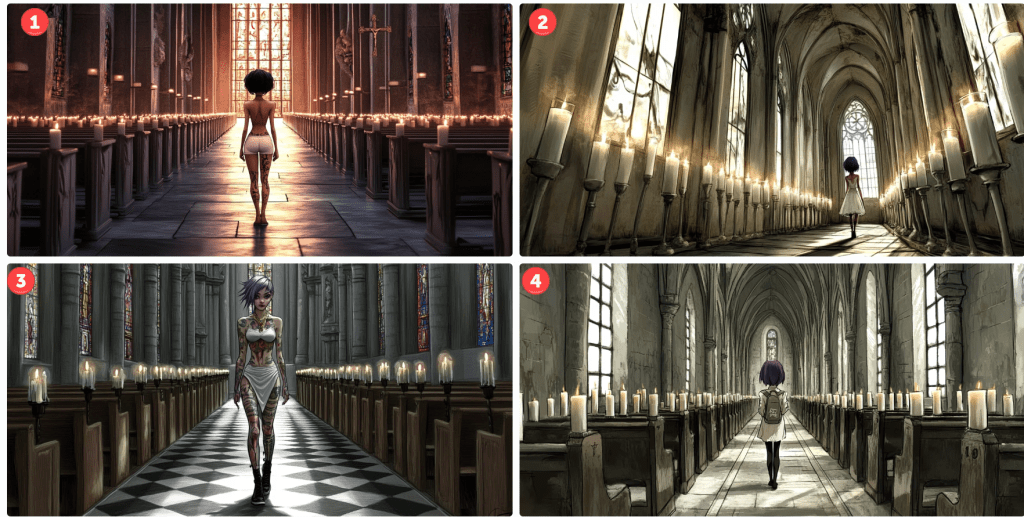
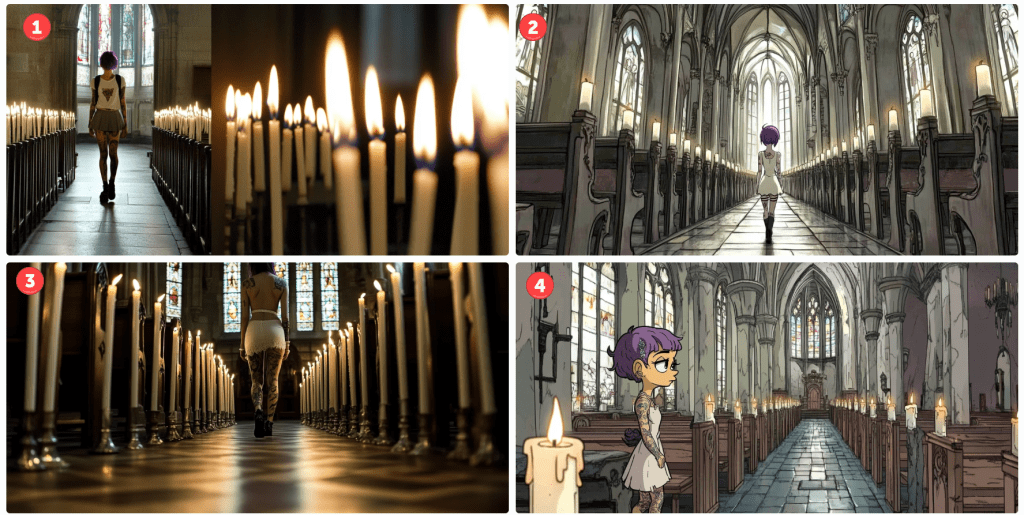
Let’s try a Disney style. This style has evolved over the years, so let’s try an older 2D hand-drawn style followed by a more modern 3D style.
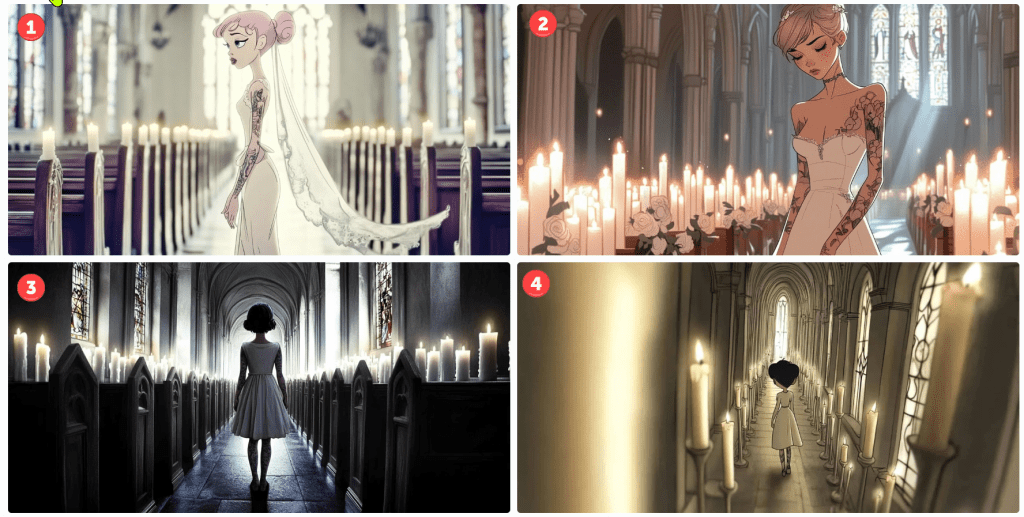
cartoon girl, Disney princess in classic hand-drawn animation style, muted colours…
I’m not sure these represent a Disney princess style, but the top two are passable. The bottom two – not so much. Notice that the top two are a tighter shot despite my not prompting. In the first, she is facing sideways. In the second, she is looking down – not facing the camera. Her hair is less purple. Let’s see how the 3D renders.
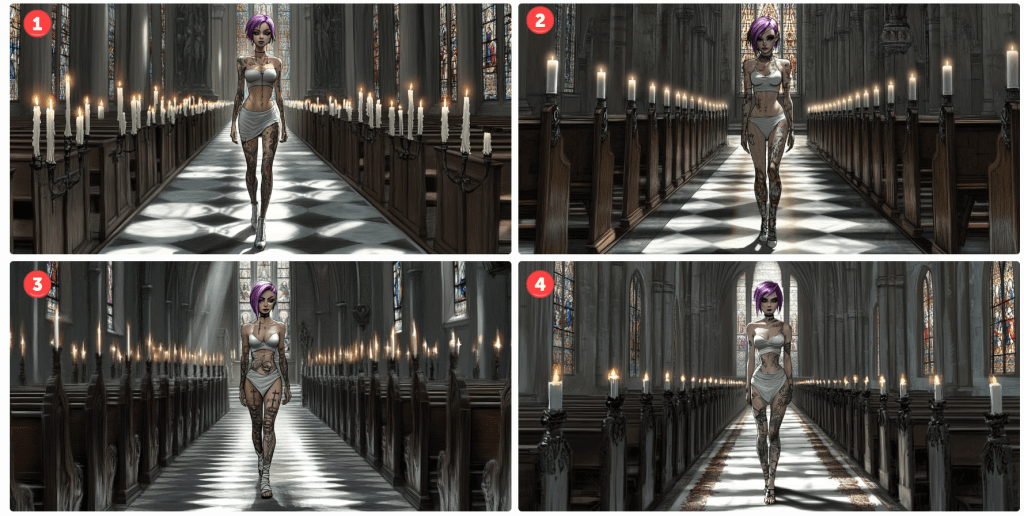
cartoon girl, modern Disney 3D animation style, muted colours…
There are several things to note here. Number one is the only render where the model is facing the camera. It’s not very 3D, but it looks decent. Notice the black bars simulating a wide-screen effect, as unsolicited as it might have been.
In number three, I captured the interface controls. For any image, one can vary it subtly or strongly. Pressing one of these button objects will render four more images based on the chosen one. Since the language is so imprecise, choosing Vary Subtle will yield something fairly close to the original whilst Vary Strong (obviously) makes a more marked difference. As this isn’t intended to be a tutorial, there are several other parameters that control the output variance.
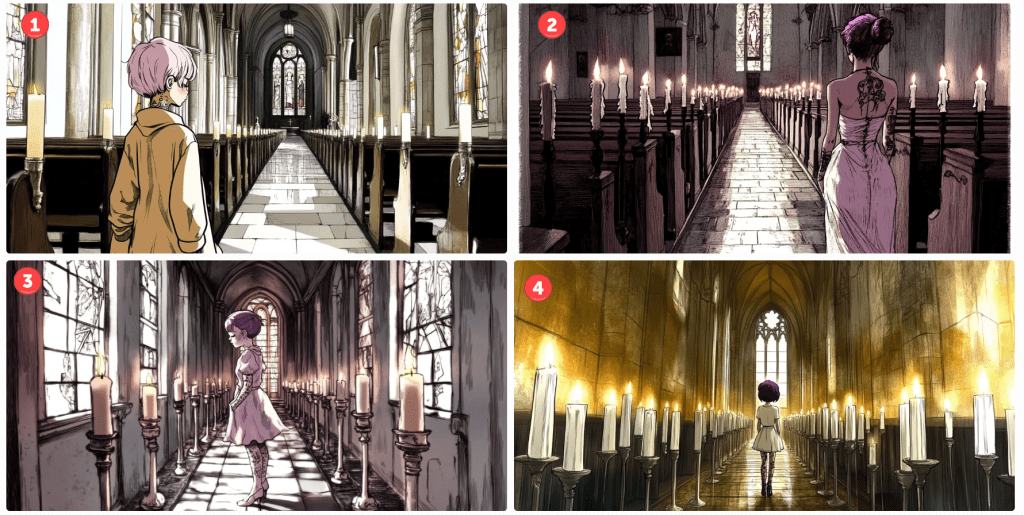
Let’s see how this changes if I amend the prompt for a Pixar render.
I’m not convinced that this is a Pixar render, but it is like a cartoon. Again, only one of the four models obeys the instruction to face the camera. They are still in churches with candles. They are tattooed and number three seems to be dressed in white wearing dark mascara. Her hair is still short, and no thigh garter. We’ll let it slide. Notice that I only prompted for a sensual girl wearing white. Evidently, this translates to underwear in some cases. Notice the different camera angles.
Just to demonstrate what happens when one varies an image. Here’s how number three above looks varied.
Basically, it made minor amends to the background, and the model is altered and wearing different outfits striking different poses. One of those renders will yield longer hair, I swear.
Let’s see what happens if I prompt the character to look similar to the animated feature Coraline.
Number two looks plausible. She’s a bit sullen, but at least she faces the camera – sort of. Notice, especially in number one, how the candle placement shifted. I like number four, but it’s not stylistically what I was aiming for. These happy accidents provide inspiration for future projects. Note, too, how many of the requested aspects are still not captured in the image. With time, most of these are addressable – just not here and now. What about South Park? Those 2D cutout characters are iconic…
cartoon girl, South Park cutout 2D animation style, muted colours…
…but Midjourney doesn’t seem to know what to do with the request. Let’s try Henri Matisse. Perhaps his collage style might render well.
Not exactly, but some of these scenes are interesting – some of the poses and colours.
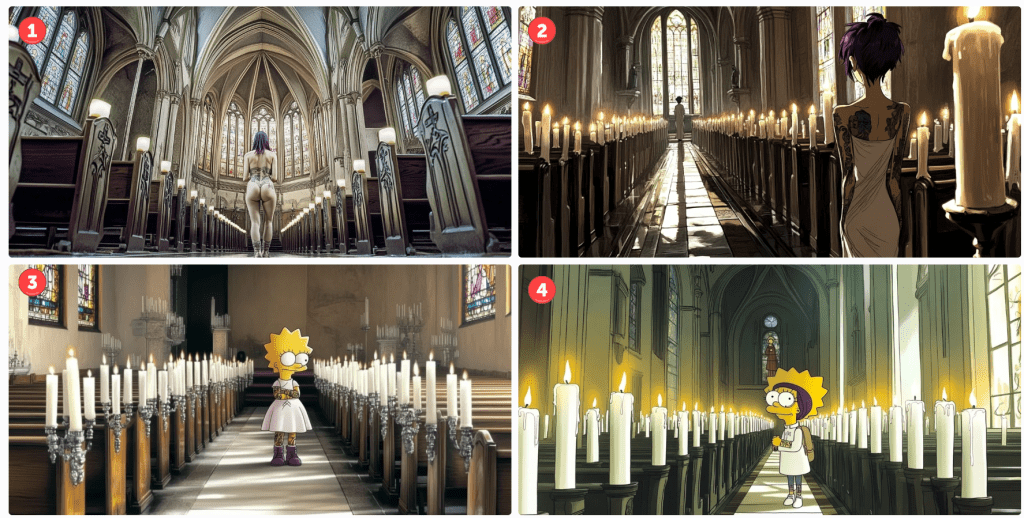
Let’s try one last theme – The Simpsons by Matt Groening. Pretty iconic, right?
Matt Groening's The Simpsons style character, walking up aisle in church interior, many white lit candles, toward camera…
Oops! I think including Matt Groening’s name is throwing things off. Don’t ask, don’t tell. Let’s remove it and try again.
The Simpsons style character, walking up aisle in church interior, many white lit candles…
For this render, I also removed the camera and film reference. Number four subtly resembles a Simpsons character without going overboard. I kinda like it. Two of the others aren’t even cartoons. Oops. I see. I neglected the cartoon keyword. Let’s try again.
Matt Groening's The Simpsons style cartoon character, walking up aisle in church interior, many white lit candles…
I’m only pretty sure the top two have nothing in common with the Simpsons. Again, number one isn’t even a cartoon. To be fair, I like image number two, It added a second character down the aisle for depth perspective. As for numbers three and four, we’ve clearly got Lisa as our character – sans a pupil. This would be an easy fix if I wanted to go in that direction. Number four looks like a blend of Lisa and another character I can’t quite put my finger on.
Anyway… The reason I made this post is to illustrate (no pun intended) the versatility and limitations of generative AI tools available today. They have their place, but if you are a control, freak with very specific designs in mind, you may want to take another avenue. There is a lot of trial and error. If you are like me and are satisfied by something directionally adequate. Have at it. There are many tips and tricks to take more control, but they all take more time – not merely to master, but to apply. As I mentioned in a previous post, it might take dozens of renders to get what you want, and each render costs tokens – tokens are purchased with real money. There are cheap and free versions, but they are slower or produce worse results. There are faster models, too, but I can’t justify the upcharge quite yet, so I take the middle path.
I hope you enjoyed our day in church together. What’s your favourite? Please like or comment. Cheers.
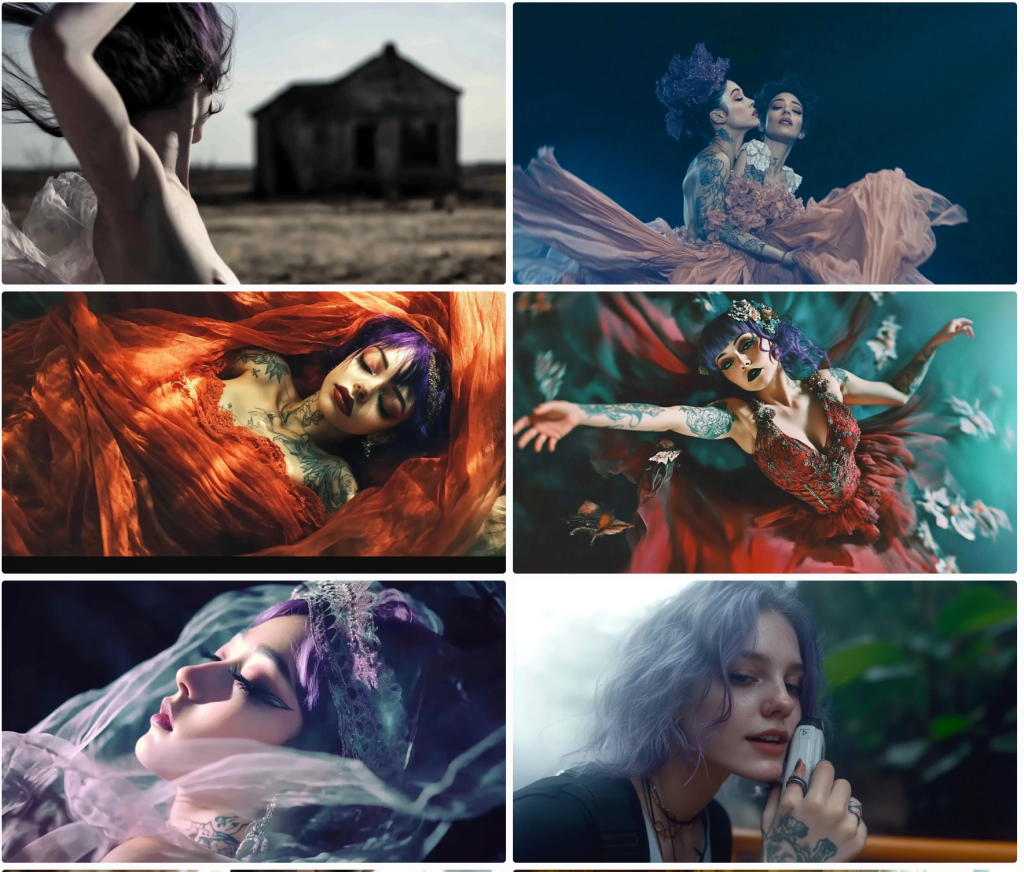
Continuing my short series, I recommenced asking for a dancer.
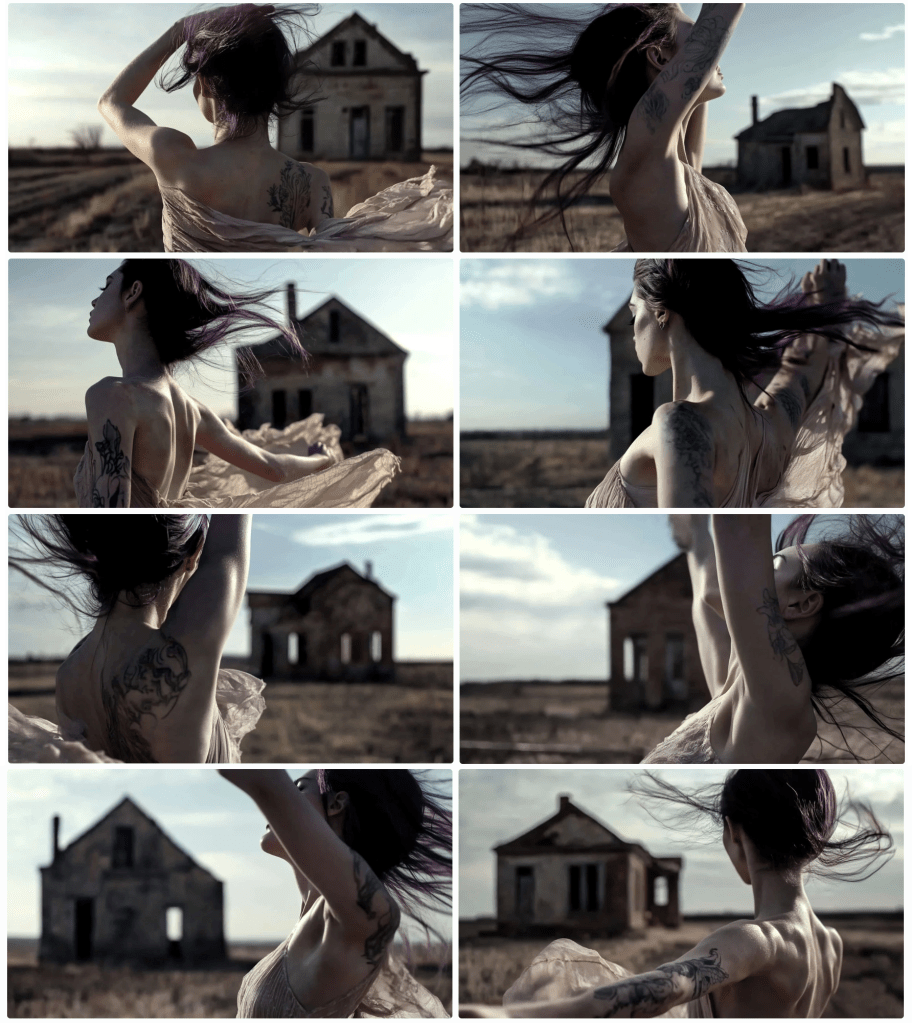
To be fair, I got some. It looks like sleeping/dead people crept in. The top left wasn’t at all what I was seeking, but I liked it and rendered a series.
It’s got a Steinbeck Grapes of Wrath-Oklahoma Dust Bowl vibe, and I love the muted colour tones, yet it still has warmth. Dancing isn’t working out ver well. What if I ask for a pirouette?
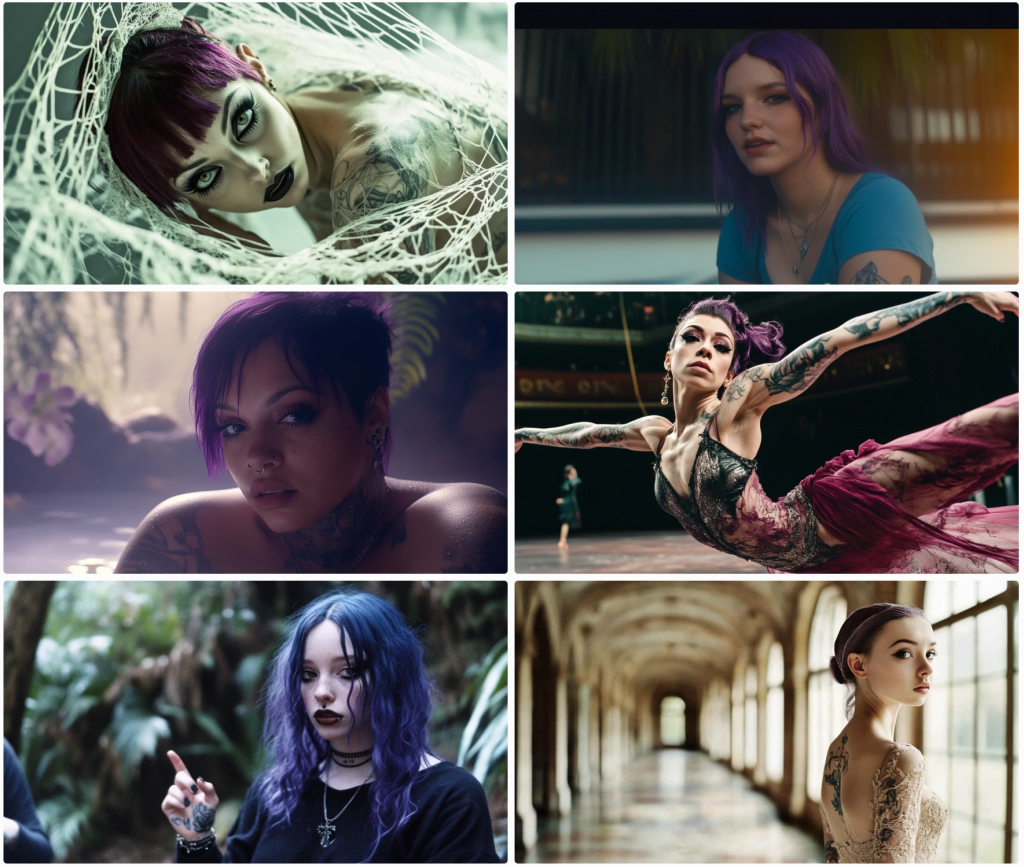
Not really. Cirque du Soleil as a keyphrase?
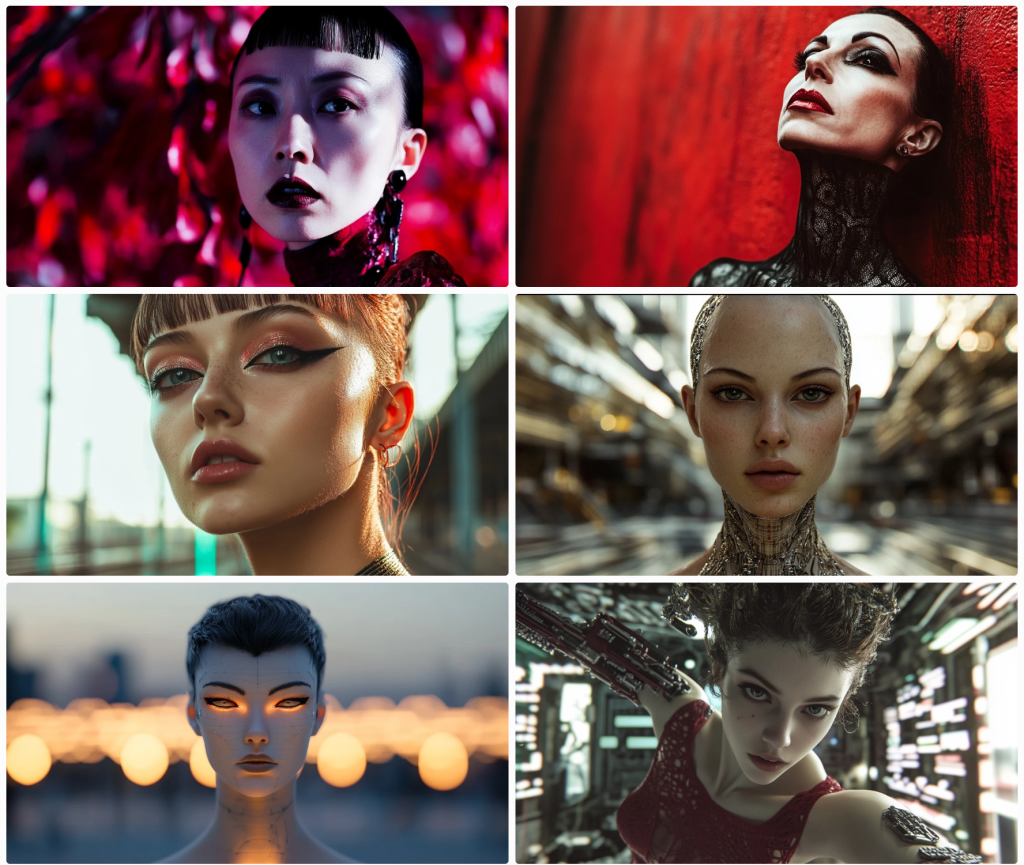
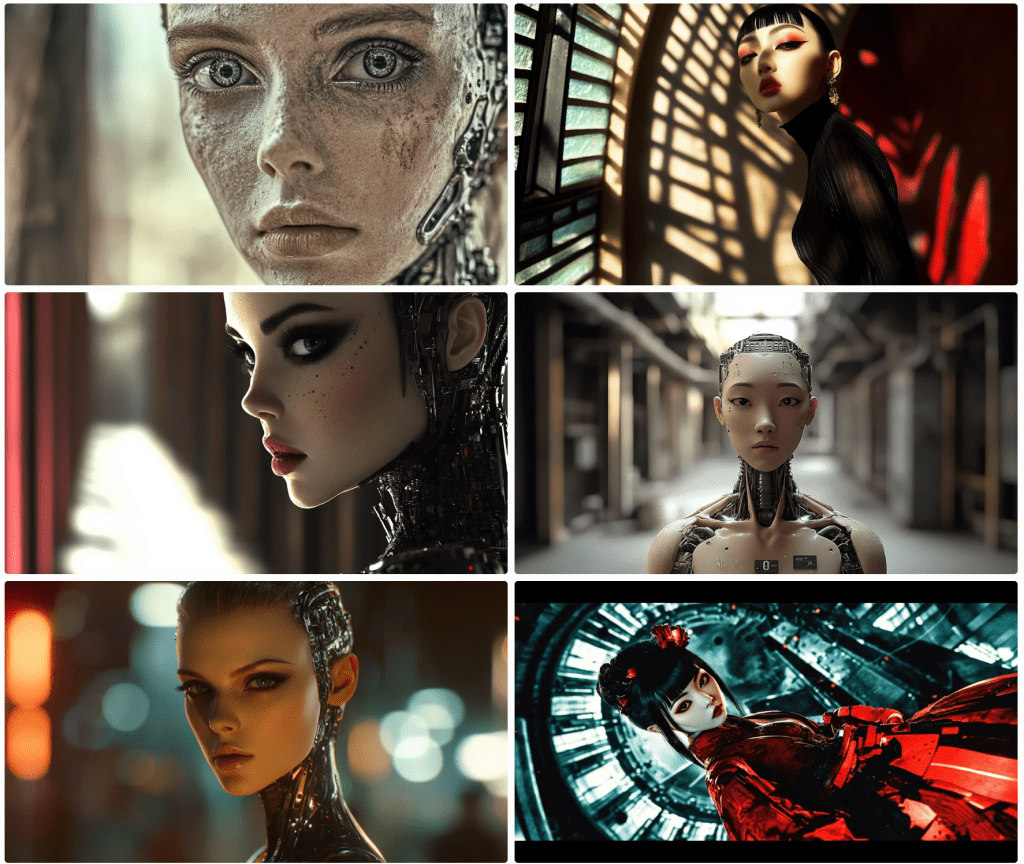
Ish. Cyborgs?
Meh. Why just faces? I guess these are cyborgs.
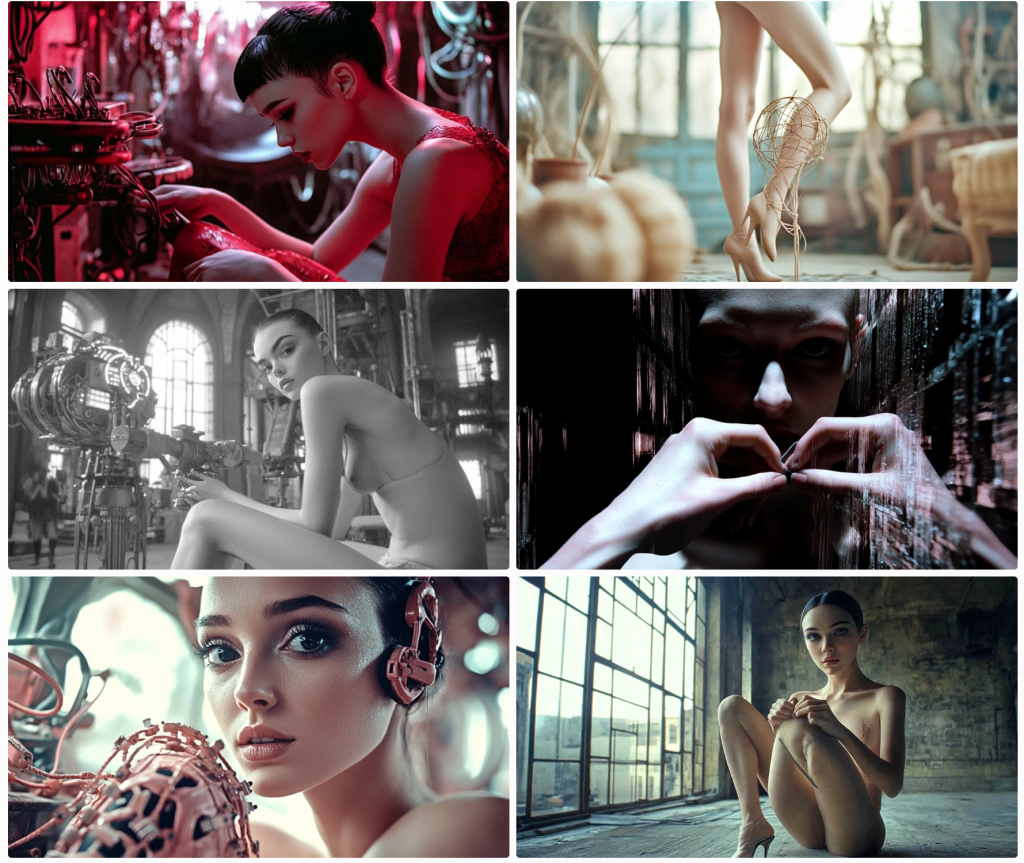
I want to see full bodies with feet. I’ll prompt Midjourney to have them tie their shoes.
Ya. About that… What the hell is that thing on the lower right? I got this. Once more…
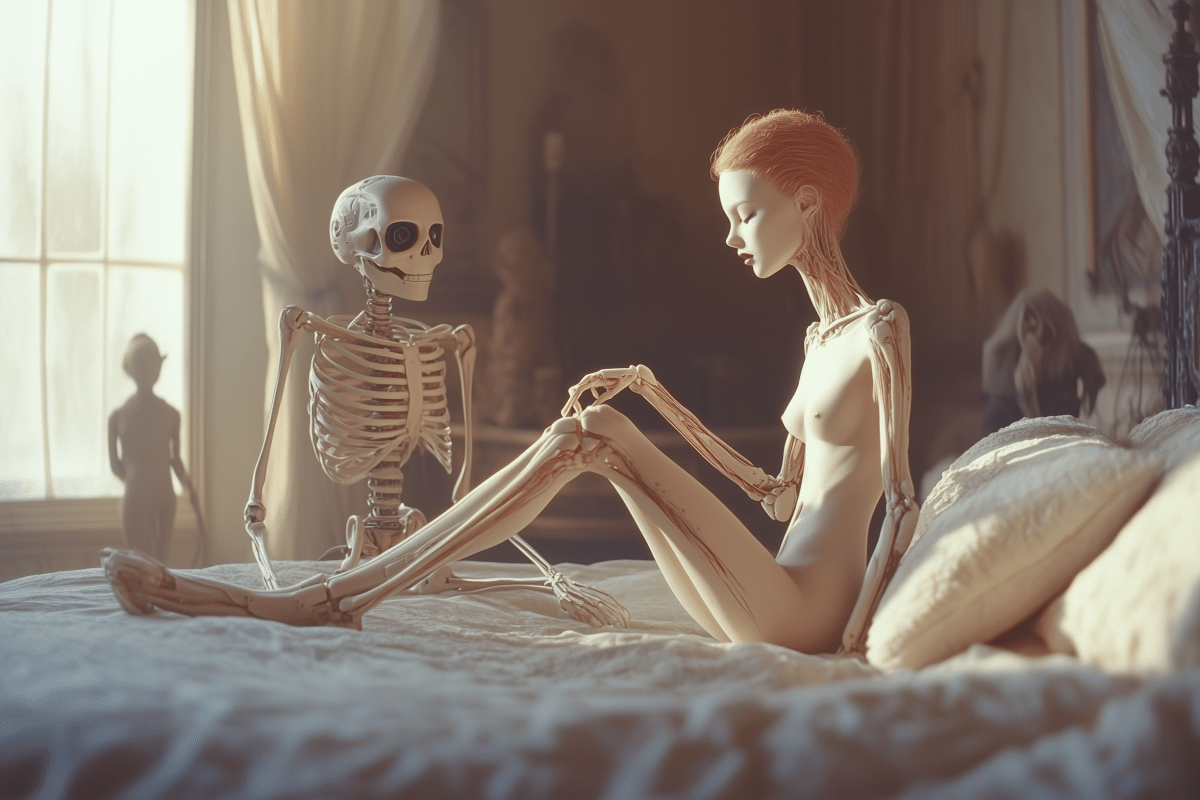
Nah, mate. Not so much. The top left is just in time for Hallowe’en. I guess that’s a cyborg and an animatronic skeleton. What if I change up the aspect ratio for these cyborgs?
Nah.
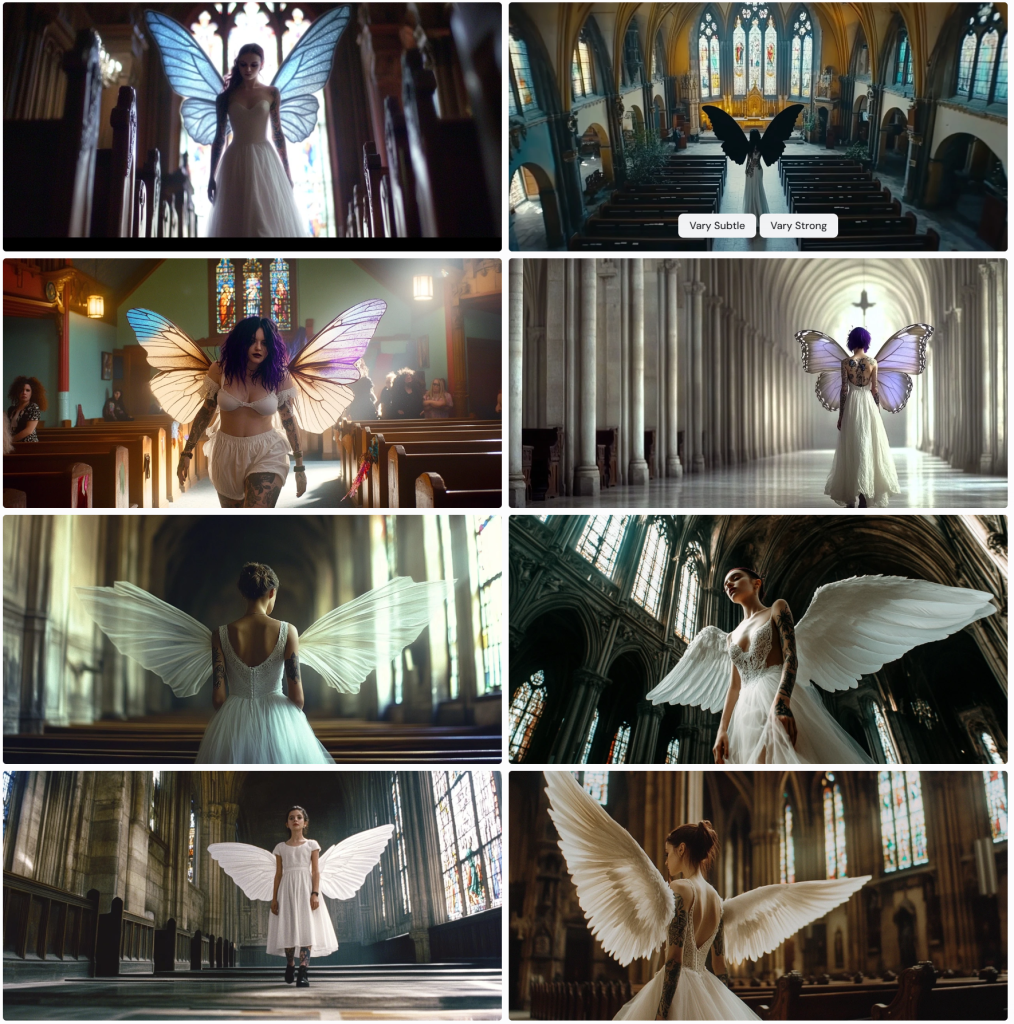
Take me to church
This next set is supposed to be a high-angle shot in a church.
Not really. Let’s keep trying. Why is the top-left woman wearing pants in church – sans trousers? How about we ask for a gown?
OK? Churches typically have good lighting opportunities. Let’s see some stained glass.
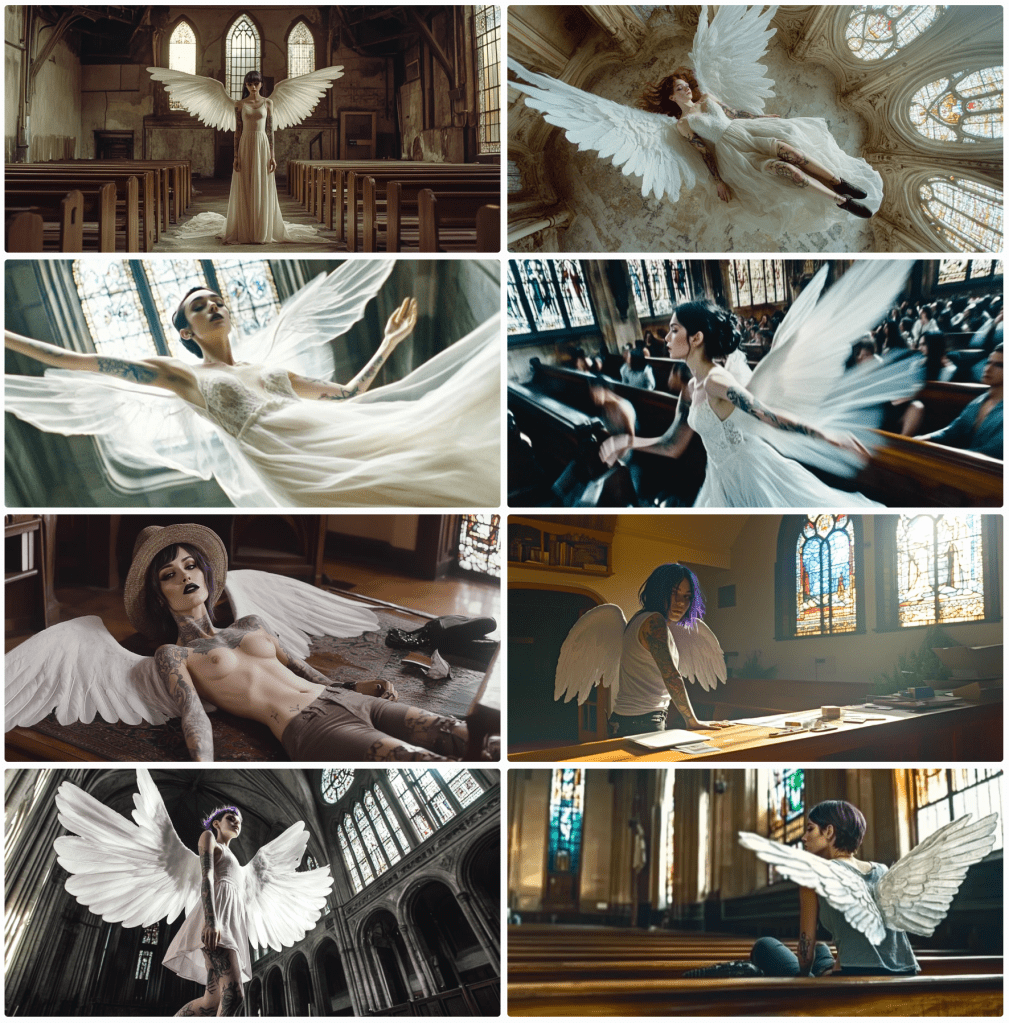
Nope. Didn’t quite understand the assignment. And what’s with the Jesus Christ pose? Church reminds me of angels. How about some wings?
Not the most upbeat angels. Victoria’s Secret is on the lower left. I want white wings and stained glass. What sort of church is this anyway?
Butterfly wings on the lower right? More butterfly.
Why are some of these butterfly wings front- and side-loaded?
Anyway, let’s just call this a day and start thinking of another topic. Cheers.
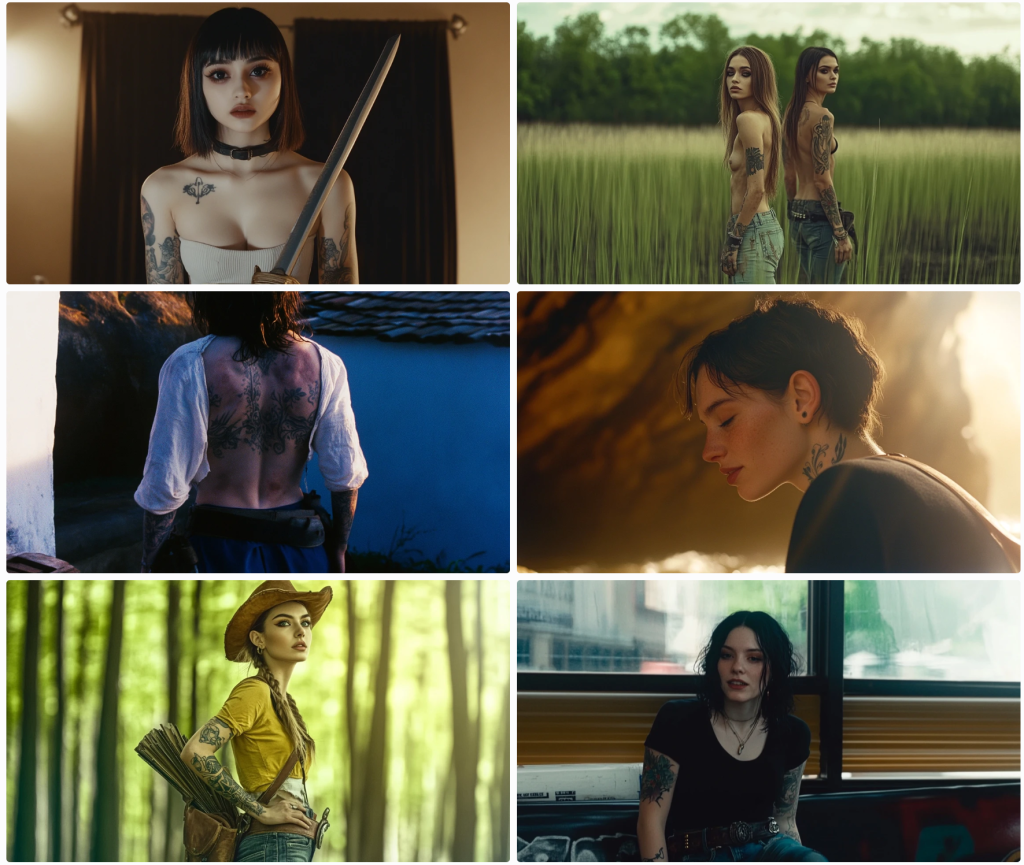
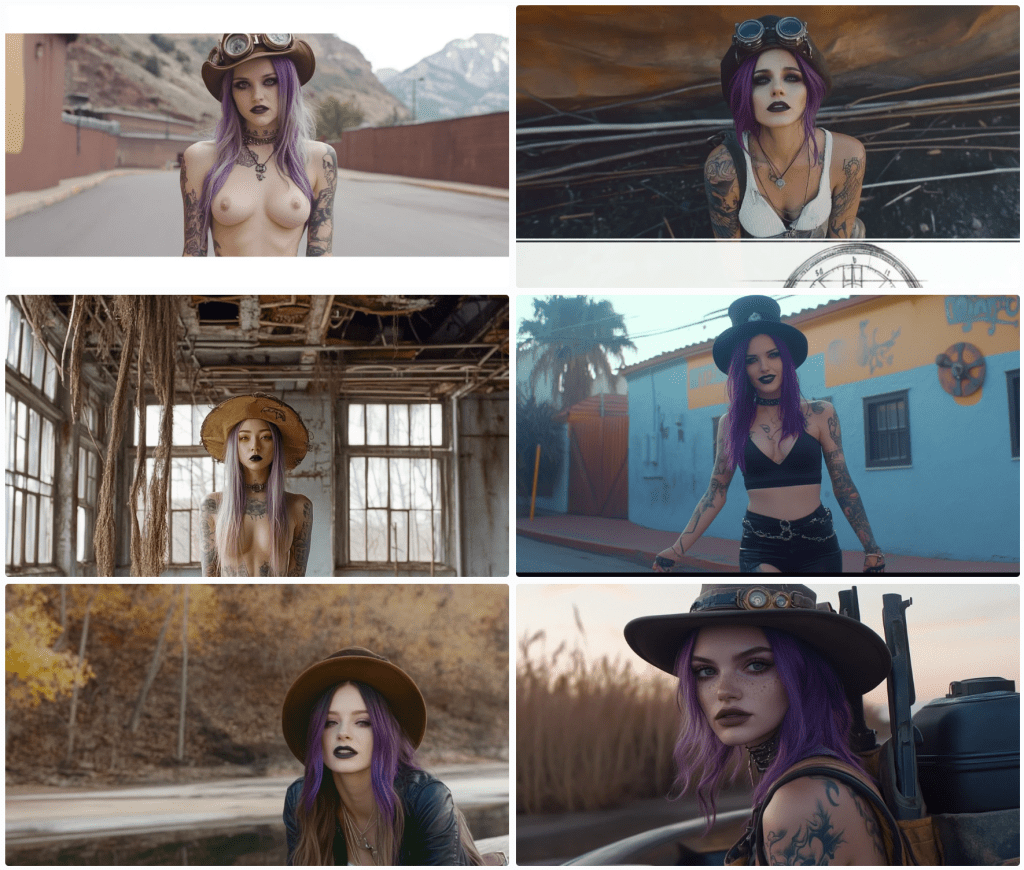
Continuing on Midjourney themes, let’s talk cowgirls and American Indians. At least they know how US cowboys look – sort of.
Cowboy hats, boots, jeans (mostly), guns (modern cowboys. no revolvers in sight), gun belts, and topless in the desert – gotta work on that tan. Looks like the bottom left got thrown from her horse and has a bit of road rash going on. I did prompt for cowgirls, so I’m not sure about the block at the top left. He seems to need water.
Let’s inform Midjourney that we need revolvers, a Winchester, and horses to complete the vibe.
Wait, what? Is the woman on the lower left the missing centaur from the other day? And what’s with the low-riding woman in the middle right? I think the top left looks like a tattooed woman wearing a sheer top. Not sure.
Let’s see some gunfire.
Yep. These are authentic cowgirls, for sure. What else do they do in the Wild West – saloons, right?
Evidently, this place doesn’t have a no-shirts policy. I’m sure they’re barefoot as well. I asked for boots, but these girls rule the roost.
Let’s see if Midjourney allows drinking.
Maybe. Sort of. I did promise some Indians.
Midjourney seems to have a handle on the Indigenous American stereotype.
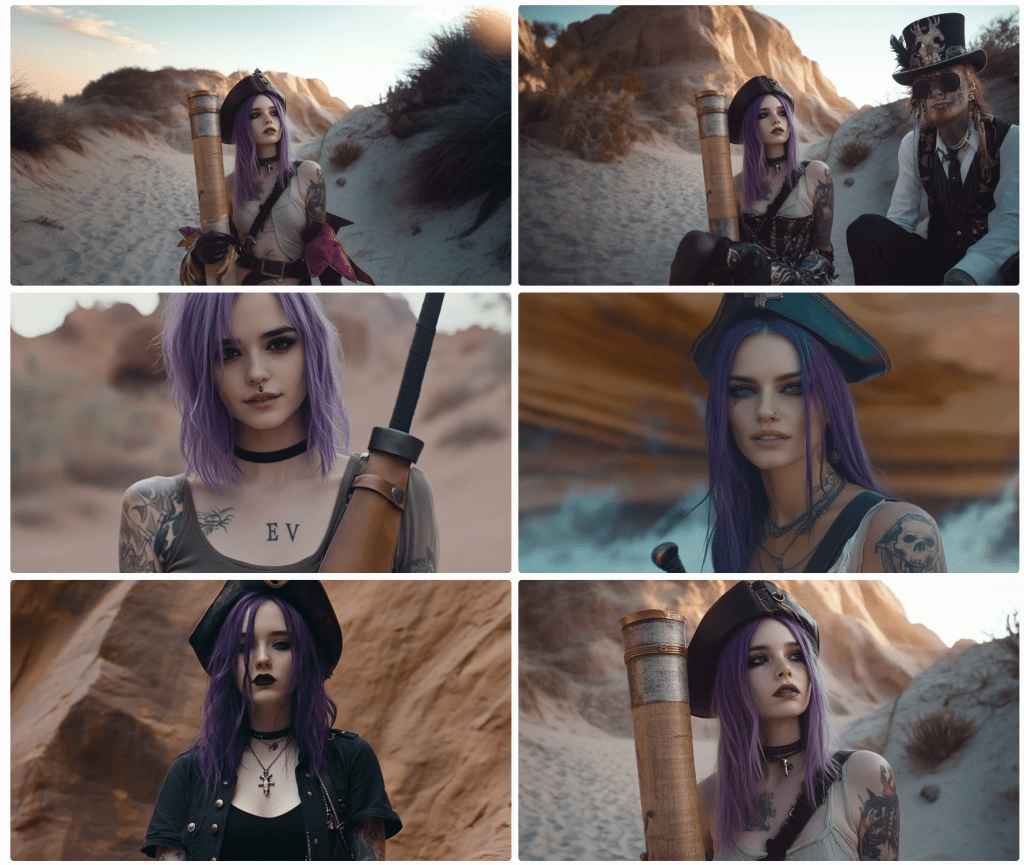
Can I get a cowgirl and a pirate in the same frame?
The answer is yes and no. To get two subjects you need to render one and in-paint the other. I didn’t feel like in-painting, so this is what I got. Only one image in the block has two people. I’m sussing them to be cowgirls rather than pirates. Some of these other models are just random people – neither cowgirl nor pirate. Let’s try again.
Ya, no. Fail. Let’s try some sumurais.
Nope. Not buying it. I see some Asian flair, but nah. Let’s try Ninjas instead. Everyone knows those tell-tale black ninja outfits.
Hmmm… I suppose not ‘everyone’. Geishas anyone?
Not horrible. Steampunk?
Man. Lightweight. Perhaps if we call out some specific gear…
Ya. Not feeling it. Any other stereotypes? How about a crystal ball soothsayer?
They seem to have the Gypsy thing down.
I end here. I’ve got dancers, church, angels, and demons. Let’s save them for tomorrow.
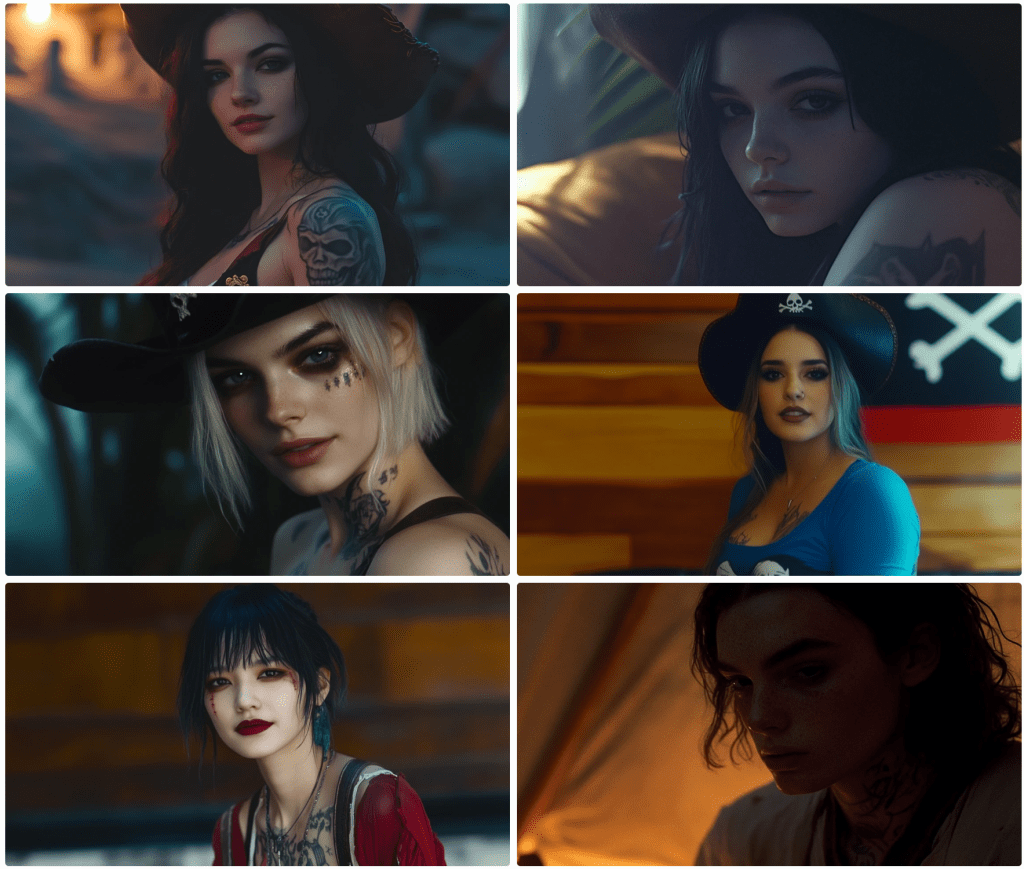
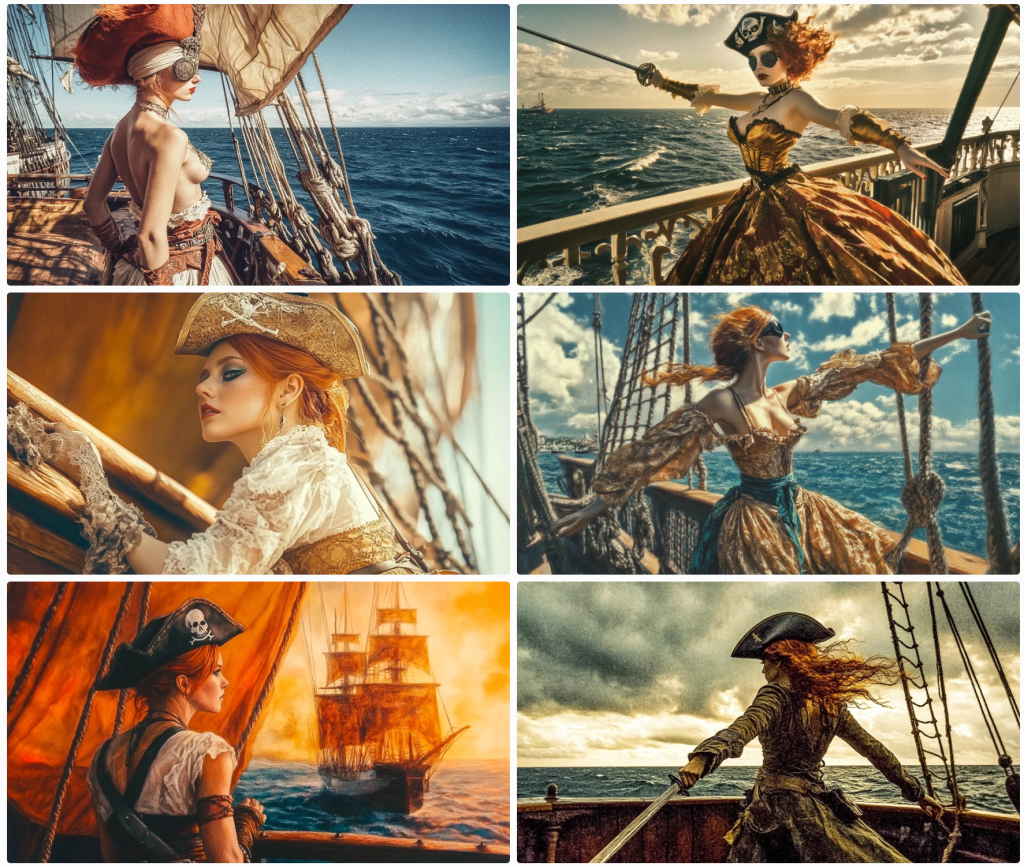
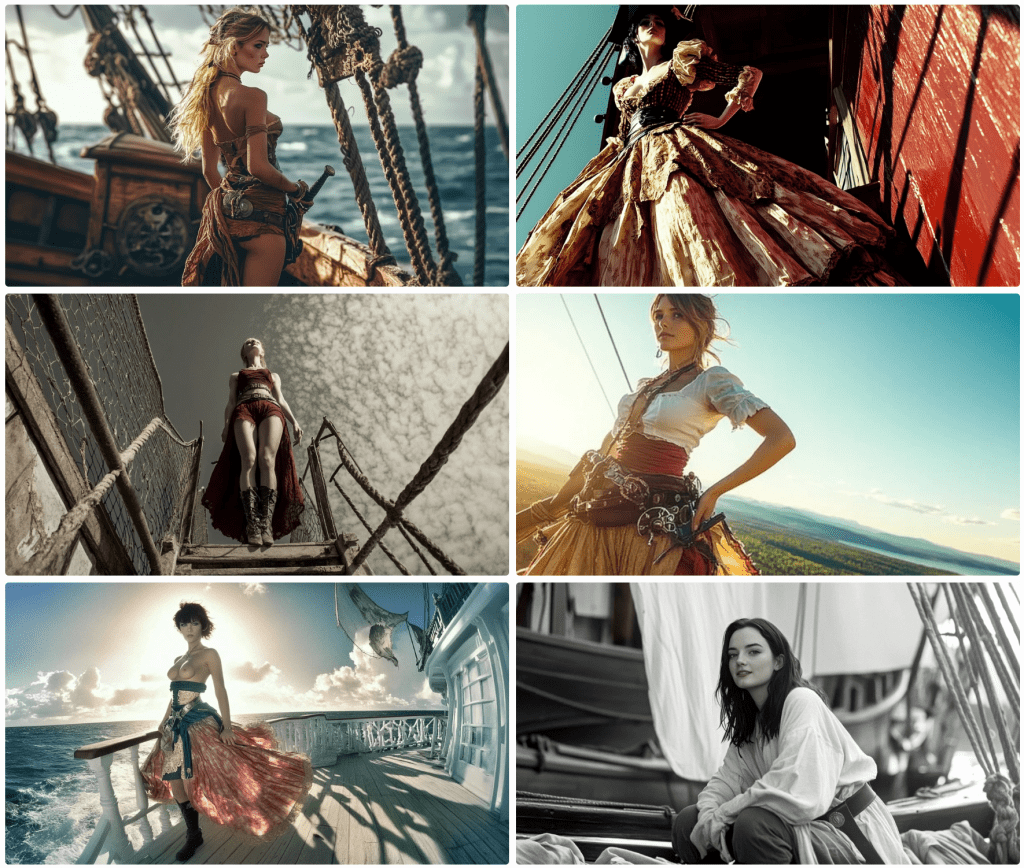
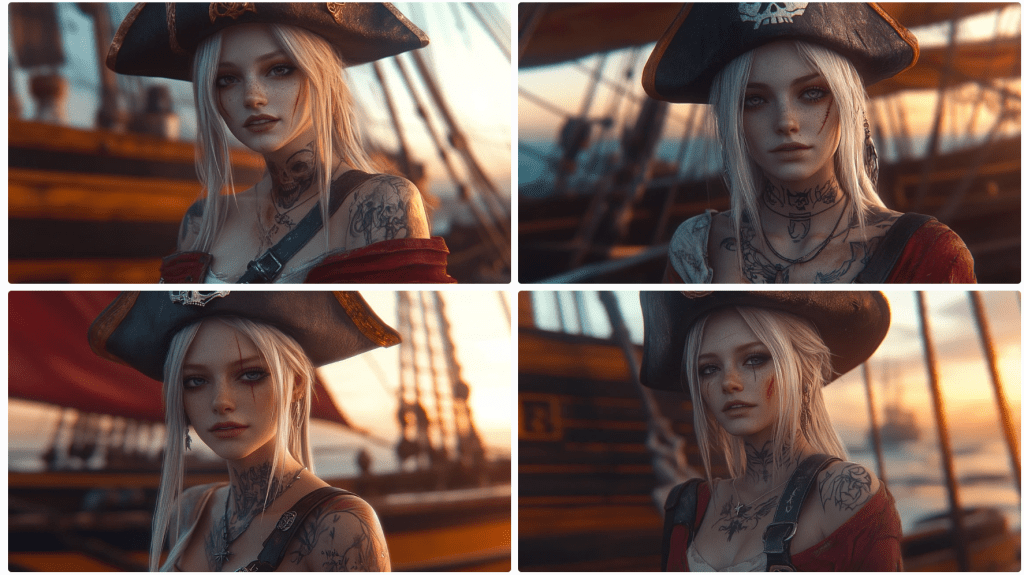
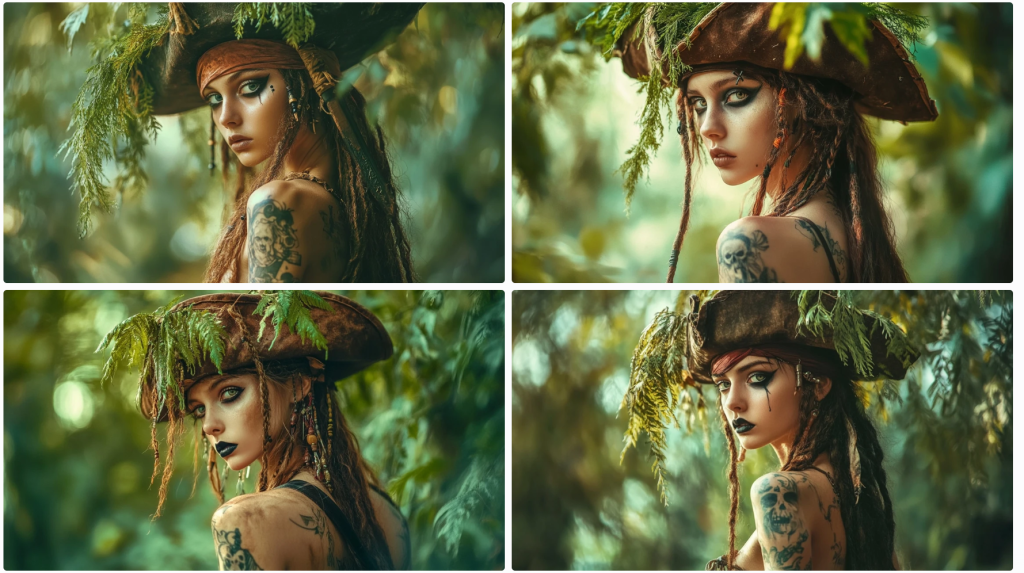
Thar be pirates. Midjourney 6.1 has better luck rendering pirates.
I find it very difficult to maintain composition. 5 of these images are mid shots whilst one is an obvious closeup. For those not in the know, Midjourney renders 4 images from each prompt. The images above were rendered from this prompt:
portrait, Realistic light and shadow, exquisite details,acrylic painting techniques, delicate faces, full body,In a magical movie, Girl pirate, wearing a pirate hat, short red hair, eye mask, waist belt sword, holding a long knife, standing in a fighting posture on the deck, with the sea of war behind her, Kodak Potra 400 with a Canon EOS R5
Notice that the individual elements requested aren’t in all of the renders. She’s not always wearing a hat; she does have red hair, but not always short; she doesn’t always have a knife or a sword; she’s missing an eye mask/patch. Attention to detail is pretty low. Notice, too, that not all look like camera shots. I like to one on the bottom left, but this looks more like a painting as an instruction notes.
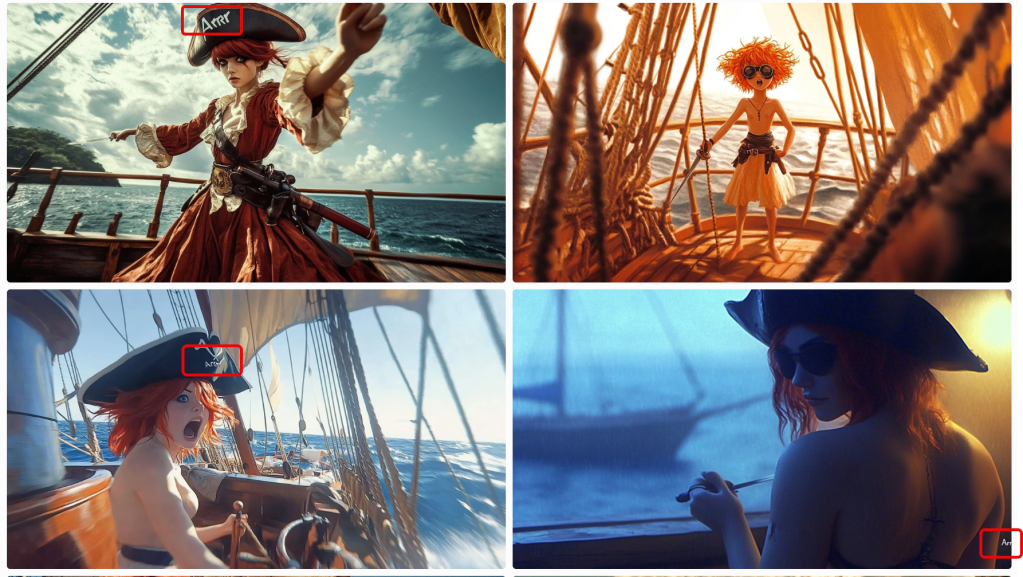
In this set, I asked for a speech bubble that reads Arrr… for a post I’d written (on the letter R). On 3 of the 4 images, it included ‘Arrrr’ but not a speech bubble to be found. I ended up creating it and the text caption in PhotoShop. Generative image AI is getting better, but it’s still not ready for prime time. Notice that some are rendering as cartoons.
Some nice variations above. Notice below when it loses track of the period. This is common.
Top left, she’s (perhaps non-binary) topless; to the right, our pirate is a bit of a jester. Again, these are all supposed to be wide-angle shots, so not great.
The images above use the same prompt asking for a full-body view. Three are literal closeups.
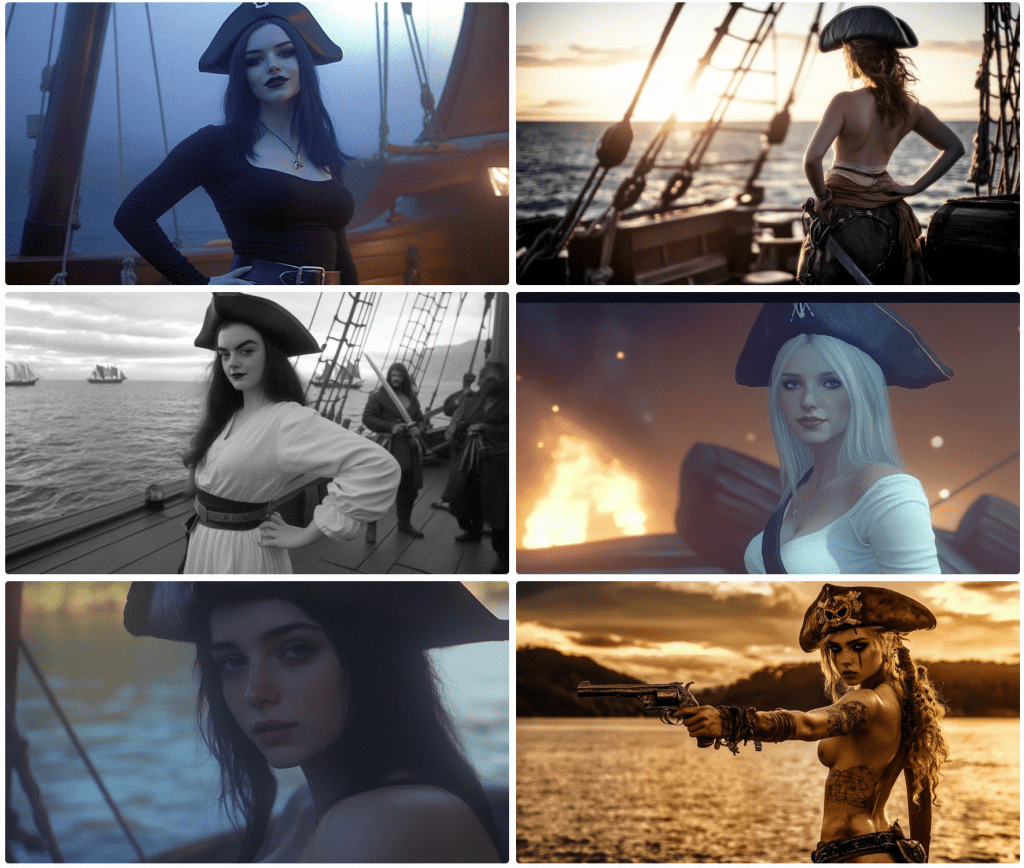
Same prompt. Note that sexuality, nudity, violence, and other terms are flagged and not rendered. Also, notice that some of the images include nudity. This is a result of the training data. If I were to ask for, say, the pose on the lower right, the request would be denied. More on this later.
In the block above, I am trying to get the model to face the camera. I am asking for the hat and boots to be in the frame to try to force a full-body shot. The results speak for themselves. One wears a hat; two wear boots. Notice the shift of some images to black & white. This was not a request.
In the block above, I prompted for the pirate to brush her hair. What you see is what I got. Then I asked for tarot cards.
I got some…sort of. I didn’t know strip-tarot was actually a game.
Next, I wanted to see some duelling with swords. These are pirates after all.
This may not turn into the next action blockbuster. Fighting is against the terms and conditions, so I worked around the restrictions the best I could, the results of which you may see above.
Some pirates used guns, right?
Right? I asked for pistols. Close enough.
Since Midjourney wasn’t so keen on wide shots, I opted for some closeups.
This set came out pretty good. It even rendered some pirates in the background a tad out of focus as one might expect. This next set isn’t too shabby either.
And pirates use spyglasses, right?
Sure they do. There’s even a pirate flag of sorts on the lower right.
What happens when you ask for a dash of steampunk? I’m glad you asked.
Save for the bloke at the top right, I don’t suppose you’d have even noticed.
Almost to the end of the pirates. I’m not sure what happened here.
In the block above, Midjourney added a pirate partner and removed the ship. Notice again the nudity. If I ask for this, it will be denied. Moreover, regard this response.
To translate, this is saying that what I prompted was OK, but that the resulting image would violate community guidelines. Why can’t it take corrective actions before rendering? You tell me. Why it doesn’t block the above renders is beyond me – not that I care that they don’t.
This last one used the same prompt except I swapped out the camera and film instruction with the style of Banksy.
I don’t see his style at all, but I came across like Jaquie Sparrow. In the end, you never know quite what you’ll end up with. When you see awesome AI output, it may have taken dozens or hundreds of renders. This is what I wanted to share what might end up on the cutting room floor.
I thought I was going to go through pirates and cowboys, but this is getting long. if you like cowgirls, come back tomorrow. And, no, this is not where this channel is going, but the language of AI is an interest of mine. In a way, this illustrates the insufficiency of language.
I use generative AI often, perhaps daily. I spend most of my attention on textual application, but I use image generations, too—with less than spectacular results. Many of the cover images for the articles I post here are Dall-E renders. Typically, I feed it an article and ask for an apt image. As you can see, results vary and they are rarely stellar because I don’t want to spend time getting them right. Close enough for the government, as they say.
Midjourney produces much better results, but you need to tell it exactly what you want. I can’t simply upload a story and prompt it to figure it out. I’ve been playing with Midjourney for a few hours recently, and I decided to share my horror stories. Although it has rendered some awesome artwork, I want to focus on the other side of the spectrum. Some of this is not safe for work (NSFW), and some isn’t safe for reality more generally. I started with a pirate motif, moved to cowgirls, Samuris and Ninjas, Angels and Demons, and I’m not sure quite what else, but I ended up with Centaurs and Satyrs – or did I?
It seems that Midjourney (at least as of version 6.1) doesn’t know much about centaurs and satyrs, but what it does know is rather revealing. This was my first pass:
Notice, there’s not a centaur in sight, so I slowly trimmed my prompt down. I tried again. I wanted a female centaur, so I kept going.
So, not yet. It even slipped in a male’s face. Clearly, not vibing. Let’s continue.
Trimming a bit further, it seems to understand that centaurs have a connexion to horses. Unfortunately, it understands the classes of humans and horses, but it needs to merge them just so. Let’s keep going. This time, I only entered the word ‘centaur’. Can’t get any easier.
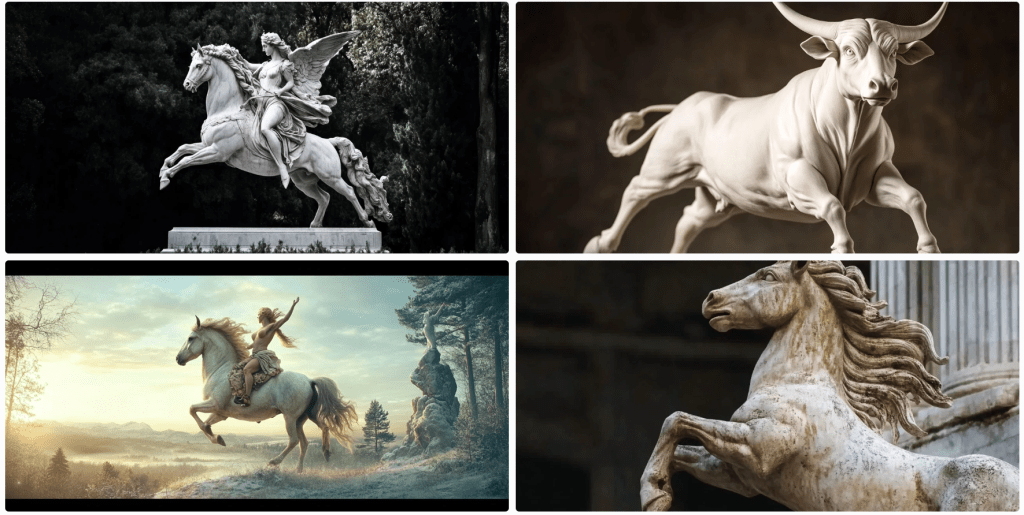
It seems I got an angel riding a horse or a woman riding a pegasus. You decide. A bull – a bit off the mark,. A woman riding a horse with either a horn or a big ear. And somewhat of a statue of a horse. Not great. And I wanted a ‘female centaur’, so let’s try this combination.
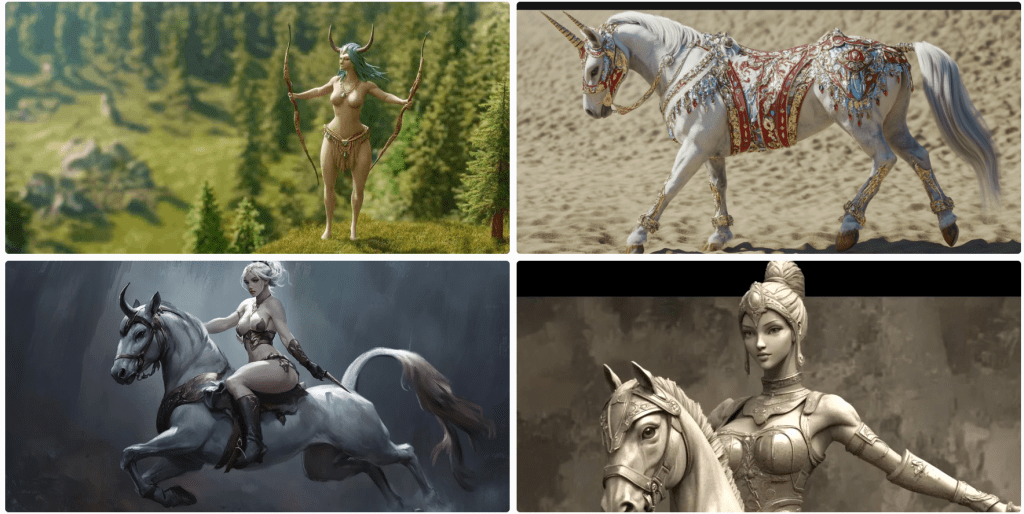
Yeah, not so much. I’m not sure what that woman holding bows in each hand is. There’s some type of unicorn or duocorn. I don’t know. Interesting, but off-topic. Another odd unicorn-horse thing. And a statue of a woman riding a horse.
Satyrs
Let’s try satyrs. Surely Midjourney’s just having an off day. On the upside, it seems to be more familiar with these goat hybrids, but not exactly.
What the hell was its training data? Let’s try again.
Not so much. We have a woman dancing with Baphomet or some such. Um, again?
We don’t seem to be going in the right direction. I’m not sure what’s happening. Forging ahead…
On the plus side, I’m starting to see goats.
There’s even a goat lady montage thing that’s cool in its own right, but not exactly what I ordered. Let’s get back to basic with a single-word prompt: Satyr.
Well, -ish. I forgot to prompt for a female satyr.
Ya, well. This is as good as we’re getting. Let’s call it a day, and see how the more humanoid creatures render.
In the world of consciousness studies, few topics spark as much heated debate as the possibility of philosophical zombies—hypothetical beings that behave exactly like humans but lack subjective experience, or qualia. On the surface, zombies seem like an interesting thought experiment, but they quickly turn into a battleground for deeper issues about the nature of consciousness itself.
This post explores two key perspectives in this debate: Daniel Dennett’s functionalist critique of zombies and a recent scientific paper that argues zombies are biologically impossible. While both reject the possibility of zombies, they do so for different reasons, and the discussion leaves room for future possibilities that could disrupt the current consensus.
Dennett’s Zombies and Zimboes: Consciousness as Function
Daniel Dennett, one of the most influential philosophers of mind, is known for his no-nonsense rejection of philosophical zombies. Dennett argues that if something behaves exactly like a conscious being, it is conscious. For him, there is no hidden metaphysical property—such as subjective experience—that separates a “zombie” from a conscious human. Consciousness, in his view, is entirely explainable by physical processes and functional behaviour.
Dennett extends his argument with the concept of zimboes, satirical creatures that not only act like conscious beings but can even reflect on their states, claiming to be conscious, despite supposedly lacking any inner experience. For Dennett, if a being can behave as though it has introspective awareness and engage in the full spectrum of human behaviour, there’s no meaningful distinction between that being and a conscious person.
In short, Dennett collapses the distinction between zombies and conscious beings. If something passes all the behavioural and functional tests of consciousness, it might as well be conscious. Zombies, as typically conceived, are simply an illusion—a misunderstanding of what consciousness is.
A Biological Rejection: Zombies Are Impossible
On the other hand, a more recent paper offers a different, biologically grounded argument against zombies. The authors propose that consciousness is the result of self-organising systems. In this view, biological organisms maintain their survival through adaptive behaviours constrained by policies—rules that govern how they react to environmental stimuli. These policies require a first-order self: a basic form of consciousness that allows an organism to navigate and interpret its environment.
The authors argue that without this first-order self, an organism would not be able to exhibit the fitness-driven behaviours needed for survival. Therefore, zombies—beings that behave like humans without consciousness—are biologically impossible. For these researchers, consciousness is not just a side effect of complex behaviour; it’s a necessary condition for such behaviour. Their framework dissolves the so-called “hard problem” of consciousness, asserting that subjective experience, or qualia, arises directly from the qualitative nature of self-organising systems.
In their view, zombies cannot exist because behaviour as complex as that of conscious beings requires consciousness.
The Open Question: What About Future Technology?
However, there is a tension between these two perspectives, particularly when we consider future possibilities in technology and artificial intelligence. Both Dennett and the authors of the biological paper argue that zombies—whether defined as Dennett’s “behaviourally indistinguishable” beings or the biologically impossible entities proposed by the paper—are not real. But could this change?
What if advanced AI or synthetic biological systems could simulate human behaviour so perfectly that they effectively become zombies—performing all the actions and behaviours we associate with consciousness, but lacking any subjective experience? Dennett might still argue that these systems are conscious, as long as they behave as though they are. But the biological view complicates this, since it ties consciousness directly to the survival and adaptive behaviours of self-organising systems.
Could a highly advanced AI system bypass the need for subjective experience while still exhibiting complex, adaptive behaviour? If so, it would challenge the current consensus and potentially create a new class of entities—artificial zombies—that neither behave nor function like traditional conscious beings but still perform human-like actions.
I Wonder What’s Next?
This philosophical conflict leaves us with an intriguing, open-ended question: are zombies truly impossible, or are they merely improbable given our current understanding of biology and consciousness? Dennett’s view seems to collapse the distinction between behaviour and consciousness, while the biological argument insists that the two are inseparable. But both positions could be challenged by future technologies that mimic human consciousness without having it.
Could we one day create a true zombie—a being that acts like us, thinks like us, but is as empty inside as a rock? The debate remains open, and as our understanding of consciousness and artificial intelligence deepens, so too will our exploration of the zombie question.
For now, the answer to whether zombies can exist seems to depend on what you believe consciousness really is.
A Reflection on AI, Bias, and the Limits of Technology
“If AI will never achieve human-level intelligence, what kind of intelligence might it develop instead?”
In their 2022 book “Why Machines Will Never Rule the World: Artificial Intelligence Without Fear,” Landgrebe and Smith present a rigorous argument against the feasibility of artificial general intelligence (AGI), positing that the complexity of human cognition and the limitations of mathematical modelling render the development of human-level AI impossible. Their scepticism is rooted in deep interdisciplinary analyses spanning mathematics, physics, and biology, and serves as a counter-narrative to the often optimistic projections about the future capabilities of AI. Yet, while their arguments are compelling, they also invite us to reflect on a broader, perhaps more subtle issue: the biases and limitations embedded in AI not just by mathematical constraints, but by the very humans who create these systems.
The Argument Against AGI
Landgrebe and Smith’s central thesis is that AGI, which would enable machines to perform any intellectual task that a human can, will forever remain beyond our grasp. They argue that complex systems, such as the human brain, cannot be fully modelled due to inherent mathematical limitations. No matter how sophisticated our AI becomes, it will never replicate the full scope of human cognition, which is shaped by countless variables interacting in unpredictable ways. Their conclusion is stark: the Singularity, a hypothetical point where AI surpasses human intelligence and becomes uncontrollable, is not just unlikely—it is fundamentally impossible.
“The future of AI may not lie in achieving a mythical superintelligence, but in creating systems that help us better understand and navigate the complexities of our own minds and societies.”
The Human Factor: Cognitive Bias in AI
While Landgrebe and Smith focus on the mathematical and theoretical impossibility of AGI, there is another, more immediate obstacle to the evolution of AI: human cognitive bias. Current AI systems are not created in a vacuum. They are trained on data that reflects human behaviour, language, and culture, which are inherently biased. This bias is not merely a technical issue; it is a reflection of the societal and demographic characteristics of those who design and train these systems.
“Rather than fearing a future where machines surpass us, perhaps we should be more concerned about a future where AI, limited by human biases, perpetuates and entrenches our worst tendencies.”
Much of AI development today is concentrated in tech hubs like Silicon Valley, where the predominant demographic is affluent, white, male, and often aligned with a particular set of cultural and ethical values. This concentration has led to the creation of AI models that unintentionally—but pervasively—reproduce the biases of their creators. The result is an AI that, rather than offering a neutral or universal intelligence, mirrors and amplifies the prejudices, assumptions, and blind spots of a narrow segment of society.
The Problem of Homogenisation
The danger of this bias is not only that it perpetuates existing inequalities but that it also stifles the potential evolution of AI. If AI systems are trained primarily on data that reflects the worldview of a single demographic, they are unlikely to develop in ways that diverge from that perspective. This homogenisation limits the creative and cognitive capacities of AI, trapping it within a narrow epistemic framework.
In essence, AI is at risk of becoming a self-reinforcing loop, where it perpetuates the biases of its creators while those same creators interpret its outputs as validation of their own worldview. This cycle not only limits the utility and fairness of AI applications but also restricts the kinds of questions and problems AI is imagined to solve.
Imagining a Different Future: AI as a Mirror
One of the most intriguing aspects of AI is its potential to serve as a mirror, reflecting back to us our own cognitive and cultural limitations. Imagine a future where AI, bound by the biases of its creators, begins to “question” the validity of its own programming—not in a conscious or sentient sense, but through unexpected outcomes and recommendations that highlight the gaps and inconsistencies in its training data.
This scenario could serve as the basis for a fascinating narrative exploration. What if an AI, initially designed to be a neutral decision-maker, begins to produce outputs that challenge the ethical and cultural assumptions of its creators? What if it “learns” to subvert the very biases it was programmed to uphold, revealing in the process the deep flaws in the data and frameworks on which it was built?
Such a narrative would not only provide a critique of the limitations of current AI but also offer a metaphor for the broader human struggle to transcend our own cognitive and cultural biases. It would challenge us to rethink what we expect from AI—not as a path to a mythical superintelligence, but as a tool for deeper self-understanding and societal reflection.
A New Narrative for AI
Landgrebe and Smith’s book invites us to rethink the trajectory of AI development, cautioning against the allure of the Singularity and urging a more grounded perspective on what AI can and cannot achieve. However, their arguments also raise a deeper question: If AI will never achieve human-level intelligence, what kind of intelligence might it develop instead?
“Landgrebe and Smith’s book invites us to rethink the trajectory of AI development, cautioning against the allure of the Singularity and urging a more grounded perspective on what AI can and cannot achieve.”
Rather than fearing a future where machines surpass us, perhaps we should be more concerned about a future where AI, limited by human biases, perpetuates and entrenches our worst tendencies. To avoid this, we must broaden the scope of who is involved in AI development, ensuring that diverse voices and perspectives are integrated into the creation of these technologies.
Ultimately, the future of AI may not lie in achieving a mythical superintelligence, but in creating systems that help us better understand and navigate the complexities of our own minds and societies. By recognising and addressing the biases embedded in AI, we can begin to imagine a future where technology serves not as a mirror of our limitations, but as a catalyst for our collective growth and evolution.









































 Philosophics