A Love Letter to Inertia, Spite, and Self-Sabotage
Dostoevsky’s Notes from Underground is less a novel and more a spiritual colonoscopy — invasive, squirm-inducing, and uncomfortably revealing. The narrator? A prickly, obsessive proto-incel with a superiority complex and the emotional range of a trapped mole. But good god, he’s brilliant.
Audio: NotebookLM podcast on this topic.
The first half is all grandiose spleen-venting — a scorched-earth takedown of reason, utopia, and the basic idea that people want what’s good for them. The second half, though, is where the magic happens: watch a man humiliate himself in real time and then monologue about it like it’s a TED Talk. By the time he’s insulting Liza while simultaneously begging her to save him, you don’t know whether to laugh, cry, or throw the book across the room. I did all three.
If you’ve read Tolstoy’s The Death of Ivan Ilych, you’ll see the contrast. Tolstoy’s man realises too late that his “good life” was a sham; Dostoevsky’s never even gets that far. He knows from the start, and that’s the tragedy. The one dies of repression; the other lives by gnawing on his own leg.
I’m a nihilist. Possibly always have been. But let’s get one thing straight: nihilism is not despair. That’s a slander cooked up by the Meaning Merchants – the sentimentalists and functionalists who can’t get through breakfast without hallucinating some grand purpose to butter their toast. They fear the void, so they fill it. With God. With country. With yoga.
Audio: NotebookLM podcast on this topic.
Humans are obsessed with function. Seeing it. Creating it. Projecting it onto everything, like graffiti on the cosmos. Everything must mean something. Even nonsense gets rebranded as metaphor. Why do men have nipples? Why does a fork exist if you’re just going to eat soup? Doesn’t matter – it must do something. When we can’t find this function, we invent it.
But function isn’t discovered – it’s manufactured. A collaboration between our pattern-seeking brains and our desperate need for relevance, where function becomes fiction, where language and anthropomorphism go to copulate. A neat little fiction. An ontological fantasy. We ask, “What is the function of the human in this grand ballet of entropy and expansion?” Answer: there isn’t one. None. Nada. Cosmic indifference doesn’t write job descriptions.
And yet we prance around in lab coats and uniforms – doctors, arsonists, firemen, philosophers – playing roles in a drama no one is watching. We build professions and identities the way children host tea parties for dolls. Elaborate rituals of pretend, choreographed displays of purpose. Satisfying? Sometimes. Meaningful? Don’t kid yourself.
We’ve constructed these meaning-machines – society, culture, progress – not because they’re real, but because they help us forget that they’re not. It’s theatre. Absurdist, and often bad. But it gives us something to do between birth and decomposition.
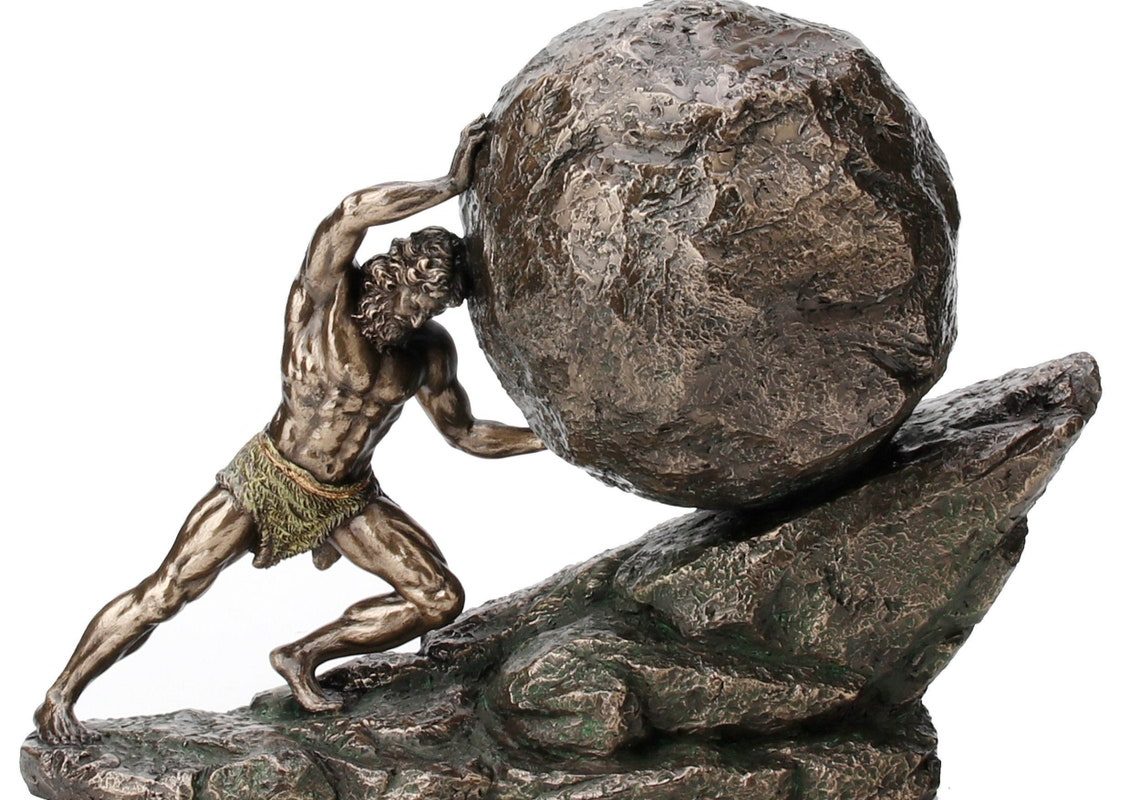
Sisyphus had his rock. We have careers.
But let’s not confuse labour for meaning, or imagination for truth. The boulder never reaches the top, and that’s not failure. That’s the show.
So roll the stone. Build the company. Write the blog. Pour tea for Barbie. Just don’t lie to yourself about what it all means.
What if the real horror isn’t waking as a beetle, but as a man?
In Kafka’s Metamorphosis, Gregor Samsa wakes to find himself transformed into a giant beetle—a cockroach, a vermin, an intrusion of the inhuman into the domestic. The horror is obvious: loss of agency, social death, the grotesque made literal. It’s the nightmare of devolution, of becoming something other, something filthy.
But perhaps we’ve misunderstood the true absurdity.
Audio: NotebookLM podcast on this topic.
What if the real nightmare is the opposite? Not a man waking as an insect, but an insect waking in a human body—forced to contend with taxes, performance reviews, dinner parties, and the crushing weight of being legible to others. Imagine a beetle, content in its instinctual certainty, finding itself hurled into the howling contradiction of human subjectivity.
Suddenly, it must interpret signs, participate in rituals, conform to decorum, all while performing a pantomime of “meaning.” It’s not the exoskeleton that’s horrifying – it’s the endless internal monologue. The soul-searching. The unbearable tension of being expected to have purpose.
We call Gregor’s fate tragic because he can no longer function in a world built for humans. But isn’t that the human condition already? An endless, futile negotiation between the raw fact of existence and the stories we invent to make it bearable.
Gregor becomes insect. We were never anything but.
Watching Sam Harris ruminate on the nature of political lies (still believing, poor lamb, that reason might one day triumph) reminds me of something more sinister: lies today are not attempts at persuasion. They are shibboleths — tribal passwords, loyalty oaths, secret handshakes performed in the broad light of day.
Video: Sam Harris tells us why Trump and his ilk lie.
Forget “alternative facts.” That charming euphemism was merely a decoy, a jangling set of keys to distract the infantile media. The real game was always deeper: strategic distortion, the deliberate blurring of perception not to deceive the outsider, but to identify the insider.
Audio: NotebookLM podcast on this topic.
When Trump — or any other post-truth demagogue — proclaims that penguins are, in fact, highly trained alien operatives from the Andromeda galaxy, the objective is not persuasion. The point is to force a choice: will you, standing before this glistening absurdity, blink and retreat into reason, stammering something about ornithology… Or will you step forward, clasp the hand of madness, and mutter, ‘Yes, my liege, the penguins have been among us all along’?
Those who demur, those who scoff or gasp or say ‘You’re an idiot,”’have failed the loyalty test. They have outed themselves as enemy combatants in the epistemic war. Truth, in this brave new world, is not a destination; it is an allegiance. To speak honestly is to wage rebellion.
Orwell, who tried very hard to warn us, understood this dynamic well: the real triumph of Big Brother was not merely to compel you to lie but to compel you to believe the lie. Koestler, another battered prophet of the age, charted how political movements sink into ritualistic unreason, demanding not conviction but performance. Swift, for his part, knew it was all hilarious if you tilted your head just right.
The bigger the lie, the better the shibboleth. Claim that two and two make five, and you catch out the weak-willed rationalists. Claim that penguins are extraterrestrials, and you find the truly devoted, the ones willing to build altars from ice and sacrifice to their feathery overlords.
It’s no accident that modern political theatre resembles a deranged initiation ritual. Each day brings a new absurdity, a fresh madness to affirm: ‘Men can become women by declaration alone!” “Billionaires are victims of systemic oppression!’ ‘The penguins are amongst us, plotting!’ Each claim a little more grotesque than the last, each compliance a little more degrading, a little more irreversible.
And oh, how eagerly the initiates rush forward! Clap for the penguins, or be cast out into the howling wilderness! Better to bend the knee to absurdity than be marked as an unbeliever. Better to humiliate yourself publicly than to admit that the Emperor’s penguin suit is just a costume.
Meanwhile, the opposition — earnest, naive — keeps trying to argue, to rebut, to point out that penguins are terrestrial flightless birds. How quaint. How pathetic. They do not understand that the moment they say, “You’re an idiot,” they’ve broken the spell, declared themselves apostates, and rendered themselves politically irrelevant.
The shibboleth, once uttered, divides the world cleanly: the believers, who will say anything, do anything, believe anything, provided it marks them safe from exile; and the infidels, who cling stupidly to reality.
The future belongs, not to the true, but to the loyal. Not to the rational, but to the ritualistic. The more extravagant the lie, the greater the proof of your faith.
So raise a glass to the penguins, ye of faint heart, and prepare your soul for abasement. Or stand firm, if you dare, and be prepared to be eaten alive by those who traded reason for the rapture of belonging.
After all, in the land of the blind, the one-eyed man is not king. He’s a heretic.
I’ve shared a new video on YouTube discussing the rhetorical nature of truth.
Before the Classical Hellenes, Mesopotamians recognised the power of rhetoric as the art of using language to convince or persuade. The term itself derives from the Greek ῥητορικός, rhētorikós.
As with any human construct such as language, truth and rhetoric are confined by limitations of the system and its logical structure.
In “Gorgias”, one of his Socratic Dialogues, Plato defines rhetoric as the persuasion of ignorant masses within the courts and assemblies.
Rhetoric, in Plato’s opinion, is merely a form of flattery and functions similarly to cookery, which masks the undesirability of unhealthy food by making it taste good.
Rhetoric typically provides heuristics for understanding, discovering, and developing arguments for particular situations, such as Aristotle’s three persuasive audience appeals: logos, pathos, and ethos.
But it’s more insidious than all of this. The notion of truth—or whatever we believe to be true—is nothing more than rhetoric.
If one is aptly convinced that something is true, it is. The physical world—the world of objects—contains facts—attributes of these objects, but these facts are tautological descriptors: a red car, une voiture rouge, ou quelque chose. In the conceptual domain of abstractions such as truth, justice, gods, and love, all bets are off.
As Geuss aptly suggests, most of society and civilisation don’t care about philosophical thought at this level. This is privileged activity. It’s not about level of intellect, per se; rather, it’s the privilege of free time to devote to abstract thinking.
Most people are more concerned with getting to the next day to earn a paycheque, and they accept sloganeering for any deeper meaning.
Humans are said to be rational beings. In fact, this predicates entire disciplines such as economics…
…and jurisprudence. Legal systems are founded on the concept that humans are at least rational enough to make fundamental decisions about right and wrong—and this, of course, presumes that the notions of right and wrong in and of themselves are meaningful.
For the sake of argument, let’s presume that humans are at least rational enough for our purposes, and whilst right and wrong may not be objectively validated, that within the context of a society—presuming that not to be mired in its own identity problem—, it can be defined in the manner of a social compact envisaged by the likes of Hobbes, Locke, Rousseau, et alii. As the saying goes, ‘if it’s good enough for the government… well.
Language is a human construct, yet it’s an apparition. Like a physical object, it appears solid, but there’s more space than not. What’s there is exiguous. Echoing Heisenberg’s observations at the atomic level, one cannot be fully certain of a particular meaning. This is what Derrida (via Barthes) meant by ‘the death of the author’, though there is nothing to guarantee that the author could fully articulate the meaning or intent even if they were present to defend it.
About the same time, Saussure was finding promise in the structure of language, Russell was creating a new language of logic to obviate its deficiencies. Structuralists and logical positivists were a natural extension of the scientism of the 20th Century, the prevailing wave since the Enlightenment, but as with the demise of gods, religious belief, and other things metaphysical, this faith in structure was also specious.
Historically speaking, there is progress (another illusion), and there are paradigm shifts. When a paradigm shifts, an old truth is replaced by a new one. This is typically credited to a progression of knowledge, but it’s actually just that, on balance, people have accepted a new frame, chalking it up to scientific method rather than some rhetorical sleight of hand.
Even so, scientific discovery is different to archetypal notions such as truth or justice. At least we can empirically test and verify a scientific notion, even if what we are observing is later revised because of some previously unknown factor or removed constraint. For example, until Einstein’s day, Newton would not have known that his theory of gravity would break down as it approached the speed of light. But truth is just an opinion—even if widely held. Enter the ‘appeal to tradition’ flavour of logical fallacy—I’ll not dwell on the fact that systems of government are based on this quaint notion of precedents. #JustSaying
“Truth is simply a culmination of the rhetorical power to persuade the ignorant masses.”
Plato
I’ve arrived at my philosophical position as an autodidact. I am not a conventional scholar, and my exposure to philosophy derives from books, videos, and online sources including Wikipedia, blogs, Reddit, and the such.
I consider myself to be a non-cognitivist in the realm of Ayers’ Emotivism, and I fully realise that society as we know it relies on some notion of ascertainable truth. Of course, Nietzsche was vilified for observing that ‘God is dead’ and unceremoniously subjected to the ad hominem attacks afforded to the likes of Marx.
I’ve got a certain amount of respect for Existentialists (and Absurdists), but I find the teleological component a bit at odds with the central tenet. To that extent, I am more of a Nihilist.
I am more comfortable with what’s been called ‘Post-Modernism’, despite admiring the effort of some Structuralists and Logical Positivists. Where this love affair ends is where the permeation of science fetishists begin. Scientific Method and Logic are the gods of the New Age.
As a post-Enlightenment child, I’ve been steeped in all of its unfound glory, and it’s harder still for me to escape the pull of my Western indoctrination. So, to argue, one is forced to comply with the rules of logic within the limitations of human language—even the limitations of Russell’s language of Logic. And like arguing with a proponent of religion who points out that you can’t disprove his Ethereal Unicorn, one is forced into positions of arguing against Quixotic figments introduced as metaphysical elements.
I am re-reading Albert Camus‘ The Myth of Sisyphus, but it’s not as I remember all those years ago. My first comment is that it is a product of its time. Even though some people still believe that without some inherent ‘higher’ meaning, chaos would ensue—the same who believe that atheists will behave this way and that anarchists will smash windows and resort to hedonism.
I think that Camus chose suicide because people at that time would have a ‘natural’ propensity to feel that a life without meaning would necessarily result in suicide. It’s especially humorous given that ostensibly there is no meaning. Of course, the larger question is why people appear to be hard-wired to search for meaning. Secondarily, even if there were some higher meaning, as Camus suggests, there would be no objective way to confirm it.
« If the only significant history of human thought were to be written, it would have to be the history of its successive regrets and its impotences. »
Back to reading… (less typing and more reading)
« The absurd depends as much on man as on the world. For the moment it is all that links them together. »
« I don’ t know whether this world has a meaning that transcends it. But I know that I do not know that meaning and that it is impossible for me just now to know it. »
When Camus cites Nietzsche,
“It clearly seems that the chief thing in heaven and on earth is to obey at length and in a single direction: in the long run there results something for which it is worth the trouble of living on this earth as, for example, virtue, art, music, the dance, reason, the mind—something that transfigures, something delicate, mad, or divine“,
he also nods to the reader his accord with Nietzsche’s adherence to virtue ethics praising how he ‘elucidates the rule of a really distinguished code of ethics‘, and therein lies the rub. Why should any of these be any better than any other thing?
Nietzsche and Camus were both products of their age, and as Descartes was before them, as brilliant as they each were in their own rights, they were blinded by their age: Descartes by God, and Nietzsche and Camus by virtue.
The Myth of Sisyphus is an interesting exposition, but, try as it may, it falls short.
Albert Camus and Jean-Paul Sartre had a falling out over the philosophical implications of Camus’ The Rebel, but the question I have is how can two Nihilists come to loggerheads when each understood the lack of inherent meaning and purpose in the universe. Camus felt one needed to embrace the Absurd, but not resort to violence except as a last resort, but Sartre felt Communism—even if formed through violent means—was the right way forward. On what objective moral basis could either of these positions be defended?