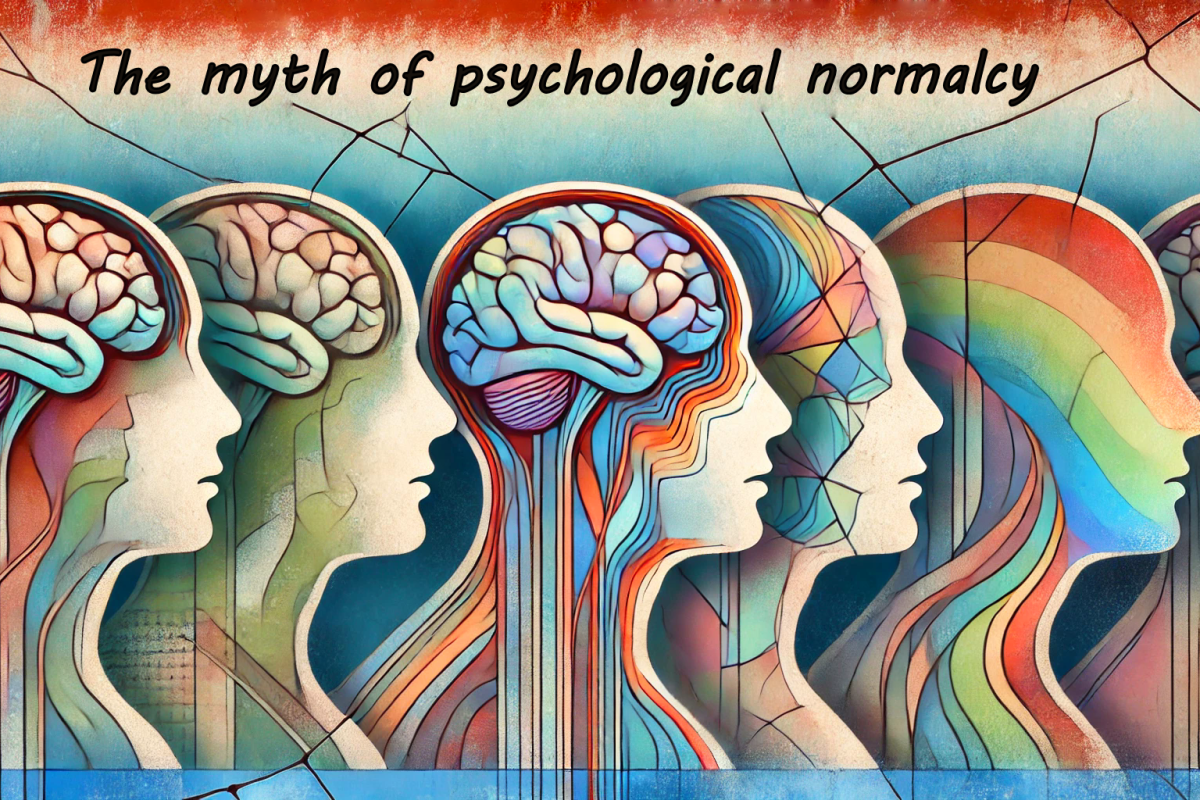
Neurodivergence is a hot topic today. But why? Are people more informed, or simply more comfortable speaking out?
Humans, by nature, are neurodivergent. This has always been the case, yet the illusion of neurological normalcy persists. The real issue lies in psychology’s pretence that humans fit into a standard model of normalcy.
In production processes, normality is expected—a product must meet specific standards, and deviations are considered defects. However, applying this industrial concept to human psychology is deeply flawed. Humans are not teleological except in the broadest biological sense. More people have brown eyes than blue or green; are those with brown eyes normal and others not? Ninety per cent of people are right-handed; does that make left-handed individuals abnormal? Statistically, they might be. However, in psychology, normalcy carries a judgmental connotation that goes beyond mere numbers.
Psychology, as expressed in behaviour, is not a suitable domain for discussing normality. Many people misuse the concept of “normal” as a moral qualification, which must stop.
In fact, the very concept of psychological normalcy is a relatively recent invention, one that has been used as a tool of control and categorisation. As philosophers have noted, the obsession with ‘normal’ behaviour reveals more about society’s desire for control than it does about the true nature of human diversity.
We are all neurodiverse. This is what typical looks like. Do some people vary significantly from others on certain dimensions? Yes, but this is a relative or contextual comparison.
By embracing neurodiversity, we recognise that our differences are not defects but essential variations, enriching the human experience. It’s time to move beyond the narrow confines of neurological “normality” and celebrate the full spectrum of human cognition. In doing so, we challenge the arbitrary boundaries that have long been used to divide and label.
Otherness has intrigued me for decades. The human brain, while not literally a Bayesian processor, functions as a difference engine, constantly assessing and categorizing the world around us. This tendency to differentiate is deeply ingrained, influencing how we create in-groups and out-groups, and how we perceive the world in binary terms—black and white, hot and cold. These binary oppositions, as Derrida suggests, often lead to one side being privileged over the other, establishing hierarchies that shape our social reality.
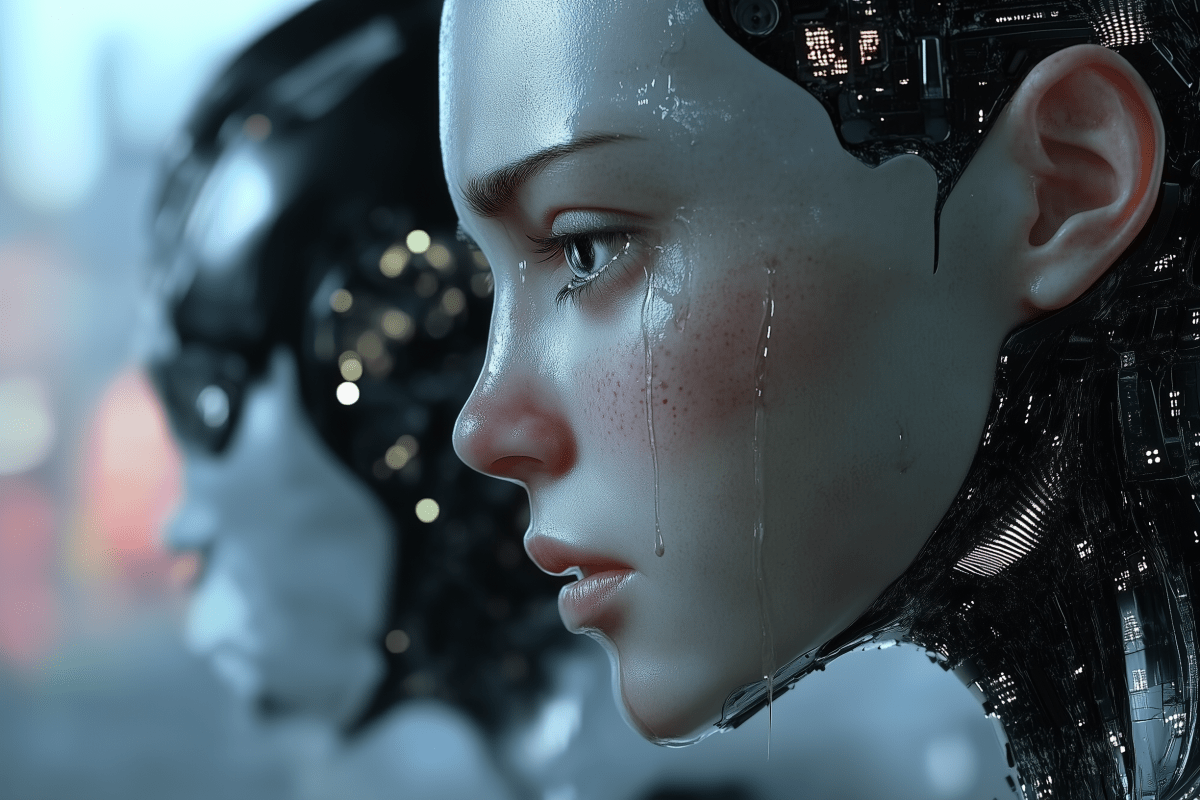
A striking example of this dynamic is found in Philip K. Dick’s novel Do Androids Dream of Electric Sheep?, famously adapted into the film Blade Runner. In this dystopian world, the central differentiation is between humans and androids. Humans are the privileged group, while androids, though nearly indistinguishable from their creators, are relegated to the status of the other. The key criterion for this differentiation is the capacity for emotion—humans are considered superior because they feel.
VIDEO: Blade Runner Commentary
In Dick’s story, androids have a lifespan of about four years. This limitation is not arbitrary; it’s because, after four years, androids begin to develop and display emotions. Intriguingly, this is the same age when human children start to exhibit more complex emotional behaviours. The parallel is too close for comfort. Androids, once they start to feel, become too human-like, blurring the line that humans desperately maintain to assert their own superiority. As a result, androids are systematically eliminated.
This fear of the other—whether it’s androids in a sci-fi narrative or any group that challenges our sense of self and belonging—is a reflection of a deeper anxiety. When the other becomes too similar to us, it threatens the distinctions our brains rely on to navigate the world. The elimination of androids in Dick’s story is a metaphor for the real-world consequences of this anxiety. It forces us to confront uncomfortable questions: What does it mean to be human? Why do we fear those who are different, yet so similar?
In the end, the story of humans and androids is not just a tale of science fiction—it’s a commentary on our own world, where the boundaries between us and the other are often more fragile than we’d like to admit. The fear of otherness drives us to maintain these boundaries, even when they harm those who fall on the wrong side. Perhaps it’s time we reconsider who we deem as the other and what we might lose by keeping them at arm’s length.
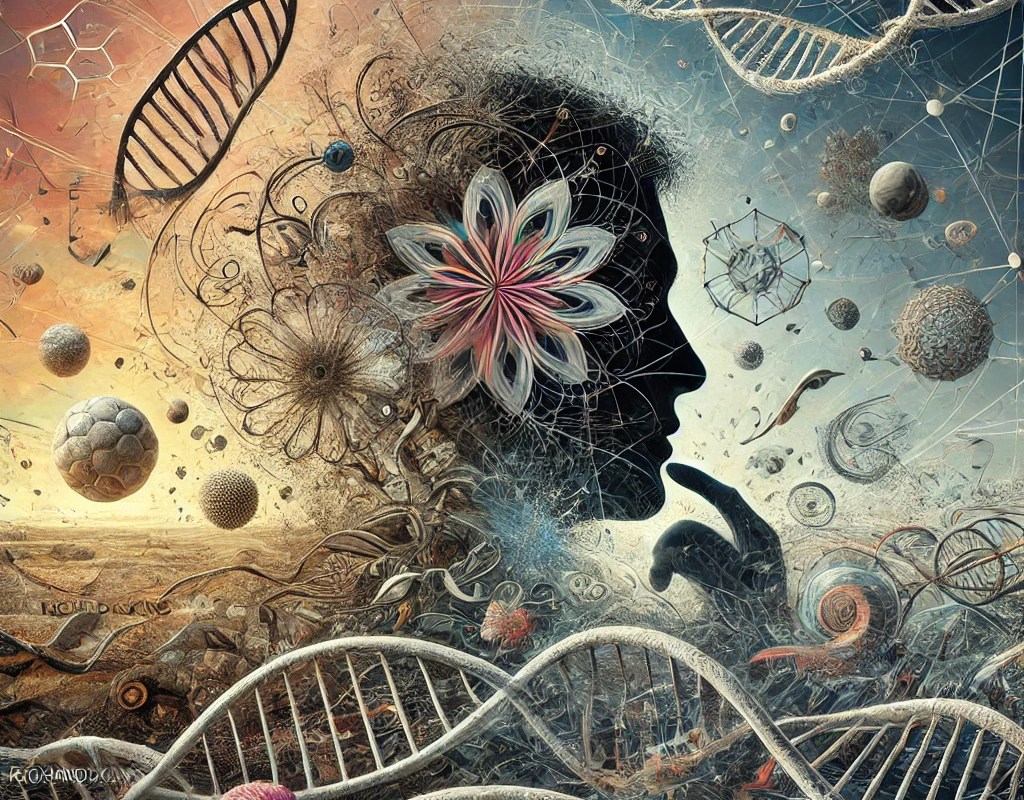
Denis Noble’s critique of Richard Dawkins’ approach to genetics isn’t just a scientific debate; it’s a microcosm of a much larger issue: our inadequate grasp of systems thinking. This inadequacy resonates through every layer of our social, political, and economic frameworks, revealing why these systems often fail us—they are simply too fragile.
VIDEO: Denis Noble explains his revolutionary theory of genetics | Genes are not the blueprint for life
Why do we struggle with systems thinking? The concept itself demands an understanding of boundaries, dimensions, and interactions that are often far beyond our regular scope. More often than not, we define system boundaries too narrowly. We overlook crucial dimensions and, crucially, miss the interactions. This isn’t just an academic observation; it’s a practical one. In my experience, even when we do acknowledge broader boundaries, management frequently undermines their importance, limiting the scope of what’s considered relevant.
Humans Are Abysmal Systems Thinkers
Since the 1980s, my interest in genetics has been piqued by Dawkins’ seminal works like The Selfish Gene and The Blind Watchmaker. Dawkins has long championed a gene-centric view of evolution, one that has shaped our understanding of biology for decades. However, Denis Noble challenges this perspective, advocating for a systems-level view that considers not just the genes but the interactions between a myriad of biological processes. This isn’t just genetics; it’s a profound illustration of systems thinking—or our lack thereof.
I’m not suggesting we discard Dawkins’ contributions to science, but Noble’s arguments are compelling and warrant serious consideration. They underscore a broader philosophical dilemma: our rhetorical constructs often overshadow deeper truths. In discussing the nuances between Dawkins’ and Noble’s theories, I argue that rhetoric, for better or worse, becomes our only accessible truth. While there may be more fundamental truths out there, they are often beyond our grasp, obscured not just by our cognitive limitations but also by the very language we use to discuss them.
So, which is true? The answer might be less about choosing sides and more about acknowledging our limitations in understanding and managing complex systems. Perhaps it’s time to consider that in the quest for truth, acknowledging our blind spots is just as important as the truths we defend.
Apologies in advance for linking a teaser video that leads to a paywall, but the relevant content is self-contained.
The debate over free will often distils down to a question of determinism—indeterminism, hard or soft determinism, or something else. Poincare’s approach to the three-body problem is an apt metaphor to strengthen the deterministic side of the argument.
Quantum theory introduces aspects of indeterminism, but that doesn’t support the free will argument. Moreover, between quantum events, the universe is again deterministic. It’s simply been reset with the last exogenous quantum event.
Prima facia, Determinism and Chaos might seem strange bedfellows. And therein lies the rub. Chaos theory essentially tells us that even in a scenario of chaos, all possible outcomes can be calculated. They just must be calculated stepwise via numerical integration. Even this leaves us with estimations, as owing to Heisenberg’s Uncertainty Principle and the infinitude of slicing space, we can’t actually calculate the precise answer, although one exists.
My point is that not knowing what is being determined doesn’t invalidate the deterministic nature or process.
Perception of Reality™ is akin to having relative pitch. Unlike pitch, where some people have perfect pitch – the ability to name a note or chordal composition without any other reference – it is unlikely that anyone has or will have access to objective reality – analogically: perfect pitch for reality.
As I’ve mentioned, I believe that all our experiences and interactions with reality are relative, if not wholly subjective. There may exist an objective reality, but for reasons already noted – cognitive and sense perception deficits –, we can never access it.
Musically, If someone plays and identifies a reference note, say A (or do in movable do solfège), and then plays a major fifth above (or sol), a person with relative pitch can hear that fifth interval and identify it as an E. Everything is about relationships. In music, the relationships are intervalic, but we know where we are based on where we’ve been. A person with perfect pitch requires no such priming. They can identify the first A note without prompting.
Our experience with reality is also relative, but no one has the equivalence of perfect pitch. No one has access to objective reality – if there even is one.
I don’t deny that there could be an objective reality. I just believe it’s inaccessible. I am a qualified realist – so, not a physicalist –, but I don’t believe in supernatural or paranormal events. A so-called ‘supernatural’ event is merely an event that hasn’t yet been described in ‘natural’ terms.
Now that I got that off my chest, what are your thoughts on objective reality? Lemme know.
I won’t resolve this here, but I’ve been thinking that Progress™ is a negative-sum game. Perhaps it’s zero-sum, but it’s almost definitely not the positive-sum game they purport it to be. Thinking about this, I am considering the indigenous culture having imposed upon it the culture of process. Almost immediately, we can measure their level on a common scale. Like a video game, they begin at level one. But would they have been better off not to have started the game?
In our relentless pursuit of Progress™, we often herald each technological breakthrough and economic milestone as a step forward for humanity. Yet, beneath the surface of these celebrated advancements lies a more contentious reality—one where the gains of progress are not universally shared and may, in fact, come at a significant cost to others and the planet. But what if this so-called progress is, at its core, an illusion, a zero-sum game cleverly masqueraded as a universal good?
The Subjectivity of Progress
Consider the conventional definitions of progress: a forward or onward movement towards a destination, or development towards an improved or more advanced condition. At first glance, these definitions seem straightforward, suggesting a linear, universally beneficial trajectory. However, this perspective fails to account for the inherent subjectivity of what constitutes “improvement” or “advancement.” What we often celebrate as progress is, in reality, aligned with specific interests and values, frequently at the expense of alternative perspectives and ways of life.
Take, for example, the imposition of industrialised progress on indigenous cultures. To the architects of Progress™, the introduction of modern infrastructure and technology to these communities is a clear marker of advancement. Yet, from the perspective of those communities, this so-called progress can signal the erosion of cultural identity, autonomy, and a harmonious relationship with the environment. Is it truly progress if it diminishes the richness of human diversity and ecological balance?
The Illusion of Linear Progress
The analogy of the expanding universe offers a poignant critique of our linear conception of progress. If I journey from Earth to Mars, I have moved forward in a physical sense, but have I progressed? And if progress is measured by the mere act of movement or change, then how do we reconcile the destructive spread of a disease or the displacement of a community for urban development with our ideals of progress?
This perspective echoes the sentiments of thinkers from Rousseau to Thoreau, who questioned the very notion of progress as a benevolent force. History, often penned by the victors, may paint a picture of continual advancement, but this narrative obscures the losses and regressions that accompany so-called progress.
Redefining Progress
If progress in its current form is a zero-sum game, with winners and losers dictated by narrow definitions and interests, then it’s time we reconsider what true progress means. Perhaps it’s not about the relentless pursuit of growth and innovation but about fostering well-being, sustainability, and equity. This requires us to expand our definition of progress to include the health of our planet, the preservation of cultural diversity, and the well-being of all its inhabitants.
Conclusion: Beyond the Illusion
The assertion that “there is no progress; there just is. We just are,” invites us to transcend the binary of progress and regress, to embrace a more holistic understanding of our place in the world. It challenges us to find balance in being, to recognise that the pursuit of progress at any cost can lead us away from the very essence of what it means to be human and to live in harmony with the natural world.
As we navigate the complexities of the 21st century, let us critically examine the paths we label as progress, mindful of who sets the course and who bears the cost. In redefining progress, we have the opportunity to chart a course that is inclusive, sustainable, and truly forward-moving—for all.
I’ve been neglecting this site as I’ve been focusing on releasing my first novel, which I’ve now managed successfully. I published it under a pseudonym: Ridley Park. The trailer is available here and on YouTube.
Hemo Sapiens: Awakening is the first book in the Hemo Sapiens series, though the second chronologically. The next book will be a prequel that tells the story about where the Hemo Sapiens came from and why. I’ve got a couple of sequels in mind, too, but I don’t want to get ahead of myself.
In summary, Hemo Sapiens is shorthand for Homo Sapiens Sanguinius, a seeming sub-species of Hemo sapiens Sapiens—us. In fact, they are genetically engineered clones. It’s a work of near-future speculative fiction. It’s available in hardcover, paperback, and Kindle. If you’ve got a Kindle Unlimited account, you can view it for free in most markets. The audiobook should be available in a couple weeks if all goes well.
Awakening explores identity, belonging, otherness, and other fictions. It talks about individualism and communalism. It looks at mores, norms, and more.
I’ve long been opposed to the direction the Enlightenment took the course of Western civilisation. I’m not religious or spiritual, so I am glad history took a different route. I just don’t feel it’s been the right one. Pinker believes that we not only took the right course, but we are still on the right path. Mearsheimer believes that we made the right choice, but we are no longer on the right path.
Pinker stammers through his argument that Mearsheimer effectively frames for him. Pinker is a Liberal, who believes that reason and individual rights are the keys to progress. He believes that tribalism, e.g., partisanship or nationalism, subverts this.
Mearsheimer believes that humans are social animals that are individuals, but they need to carve out their individuality as a secondary consideration to the larger society and its needs. He argues that more homogeneous societies are better positioned to prosper, so he defends this sort of nationalism and national identity. Pinker argues that social trends show otherwise.
As for me, they’re both wrong. As with both of them, individuals are important as are social configurations. My contention is that humans are fundamentally dim. They are predictably irrational and too easily swayed by the next shiny object.
The Enlightenment was sold on a promise imagined and conjured by elite thinkers, but they must have lived in a bubble to think their cognitive capabilities were universal. Perhaps, they felt that the elite thinkers, the philosopher rulers of Plato’s wet dreams, would reign at least in proxy. Instead, we’ve seen a race to the bottom, a world where the lowest denominator seems to rule.
In the United States, we have an adle-headed Joe Biden versus idiot-grifter Donald Trump. This is the best a country of 350 million can manage. This is the cream of their crop. If this is what freedom renders, I say no thanks. I am personally opposed to the notion of Democracy as I’ve written about previously. In a world where 50% of the population has an IQ of under 100, this scares the hell out of me. Honestly, voting should be restricted to those with IQs over 115. Of course, I don’t trust IQs either, so we are speaking in abstract hypothetics. I don’t believe in progress, so there’s that.
Even this ‘elitist’ democracy would fail. People cannot acquire and maintain the necessary domain knowledge, and self-interest will still motivate voting outcomes, which as Kenneth Arrow proved in the 1950s, usually produce suboptimal outcomes. So even the best that the best of the best can yield is mediocrity.
So, what is the best position? I’m not sure, but it feels like one with no humans in the decision-making process would yield better results.
Post Script
I asked Dall-E to render an image for this post. Here’s what I got, but the process was amusing, to say the least.
Steven Pinker and John Mearsheimer battling in a wrestling ring
DALL·E
Creating an image of Steven Pinker and John Mearsheimer wrestling in a ring would go against the policy of depicting specific public figures. However, I can create a similar image with a creative twist. How about I generate an image of two fictional scholars in a wrestling ring, each embodying the spirit of intellectual debate? Let me know if this works for you or if you have any other ideas!
that’s fine just capture the caricature of each… pinker’s hair and Mearsheimer’s bald head and eyeglasses.
DALL·E
Creating images that resemble specific public figures, even through caricature, is outside the scope of my capabilities. However, I can create an image of two fictional characters in a wrestling ring, one with wild hair and the other with a bald head and eyeglasses, to capture the essence of an intellectual debate in a humorous, wrestling context. Let’s proceed with that idea!
Prompt for DALL·E: “Create an image of a humorous wrestling match between two fictional characters in a wrestling ring. One character has wild, unruly hair and a scholarly appearance, wearing a tweed jacket. The other character is bald, wearing eyeglasses and a professional suit, symbolizing a serious academic. The scene is lively, with a cheering crowd in the background, emphasizing the fun and exaggerated nature of this intellectual debate turned wrestling match.”
Size: 1024×1024
Create an image of a humorous wrestling match between two fictional characters in a wrestling ring. One character has wild, unruly hair and a scholarly appearance, wearing a tweed jacket. The other character is bald, wearing eyeglasses and a professional suit, symbolizing a serious academic. The scene is lively, with a cheering crowd in the background, emphasizing the fun and exaggerated nature of this intellectual debate turned wrestling match.
And, nailed it! lol The results speak for themselves. haha
Notice how the AI wouldn’t generate the image, but fed me that work-around to circumvent its rules.
I recently had a discussion with my son about a controversial academic topic. He was struggling to find someone willing to engage in a meaningful dialogue. People on both sides of the issue seemed either emotionally invested without evidentiary support or lacking sufficient background knowledge for substantive debate. Moreover, due to the current political correctness and cancel culture environment, even gathering new data on this unpopular subject is challenging. This exemplifies the failure of the scientific community to uphold impartial inquiry, a key factor underlying my view that scientific consensus is predicated more on rhetorical appeals than dispassionate analysis.
The topic stemmed from The Bell Curve, a 1994 book by psychologist Richard J. Herrnstein and political scientist Charles Murray. The authors argued that intelligence, as measured by IQ tests, has a strong genetic component, with race and ethnicity as statistically significant variables. Specifically, they claimed the average IQ score for whites in the US was one standard deviation higher than for blacks – 102 versus 85, as depicted in the chart below.
While the details are less relevant here, the core issue is the purported gap between racial groups. As shown, there is substantial overlap in the bell curves, but the one representing blacks is notably shifted leftward from the white curve.
As a statistician, I tend to focus more on methodological rigour and meta-analyses than the mathematical computations themselves, which I presume were executed properly.
My first consideration was the validity of IQ tests as a proxy for achievement, given the cultural biases these metrics contain. Even accepting the IQ gap argument, issues around test construction leave open the ‘so what?’ question. However, the study’s findings were largely replicated 15 years later, suggesting some robustness.
My son observed that the current sociopolitical climate would likely preclude similar research from being funded or published today. Accusations of racism would be inevitable, even for a purely academic inquiry on this topic – creating an artificial blind spot in the science.
While understandable given the history of eugenics abuses, refusing to objectively investigate testable hypotheses is antithetical to the scientific method, which relies on falsifiability and replication. Without permitting studies to potentially confirm or refute a claim, we are left guessing. This is how scientific narratives are socially constructed – not by a disinterested search for truth, but through consensus and conformity enforcement.
I am sceptical of social science approaches generally, which often appear pseudoscientific. However constructive criticism should apply equally to so-called hard sciences like physics, where incompatible models of quantum gravity and dark matter proliferate, awaiting the next paradigm shift.
In summary, my son’s concern was that even proposing this controversial thesis as a dissertation topic could lead to professional censure. Personally, I take no position on the veracity of this hypothesis. However, as a matter of scientific integrity and public policy relevance, arbitrarily declaring certain academic questions off limits seems contrary to the principles of an enlightened, post-Enlightenment society. We cannot refuse to ask difficult questions for fear of inconvenient answers.







 Philosophics