Contructivist Lens: Parody Artefact

1–2 minutes

Another faux Magic: The Gathering trading card. I’ve been busy writing an essay on Tatterhood and wondering if I’ve gone off the edge even further into mental masturbation. I made these cards to share on slow news days, as it were.

[EDIT: Oops: Even wore. I already posted something today. Enjoy the bonus post.]

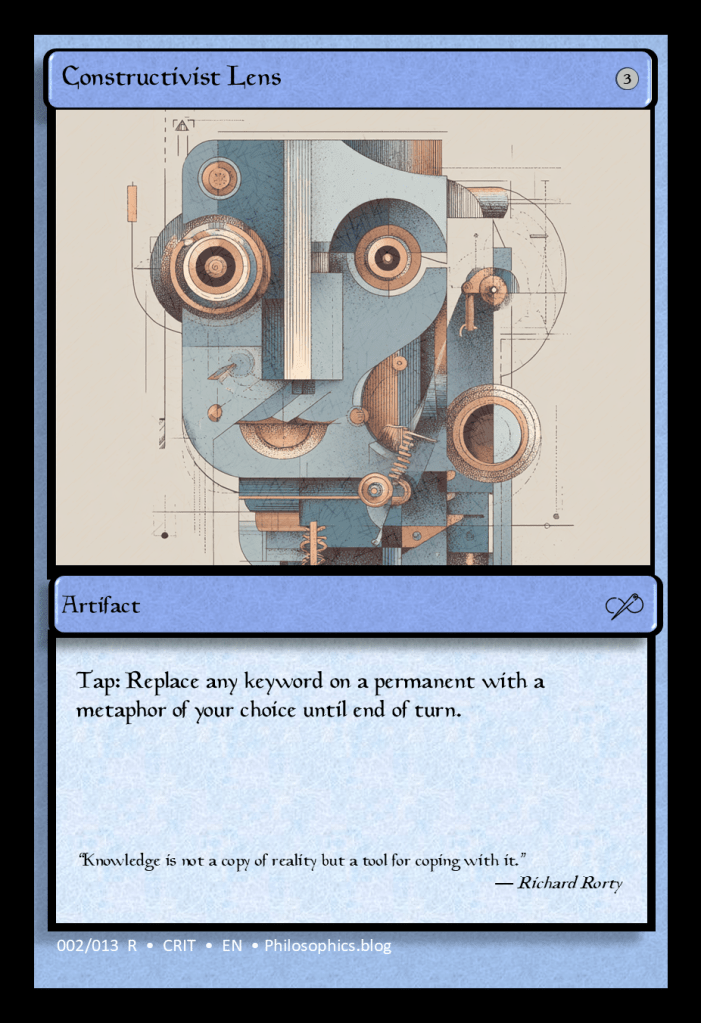
Every philosopher dreams of a device that reveals ‘truth’. The Constructivist Lens does the opposite. When you tap it, the world doesn’t come into focus – it multiplies. Each pane shows the same thing differently, reminding us that knowing is always a form of making – seeing as building.

In The Discipline of Dis-Integration, I wrote that philosophy’s task is ‘to remain within what persists … to study the tension in the threads rather than weave a new pattern’. The Lens embodies that ethic. It is not an instrument of discovery but of disclosure: a way to notice the scaffolding of perception without mistaking it for bedrock.

Where Enlightenment optics promised clarity, the Lens trades in parallax. It insists that perspective is not a flaw but the condition of vision itself. Each player who peers through it – artist, scientist, moralist – constructs a different coherence, none final. The card’s rule text captures this tension: replace any keyword on a permanent with a metaphor of your choice until end of turn. Reality bends, language shifts, yet the game continues.

In the Dis-Integration set, the Lens sits alongside Perspectival Realism and Language Game (not yet shared), forming the Blue triad of epistemic doubt. Together they dramatise what the essay calls ‘the hyphen as hinge’: the small pause between integration and its undoing. The Constructivist Lens, then, is not a tool for clearer sight but a reminder that every act of seeing is already an act of construction.

Humans Stumble – ChatGPT QOTD

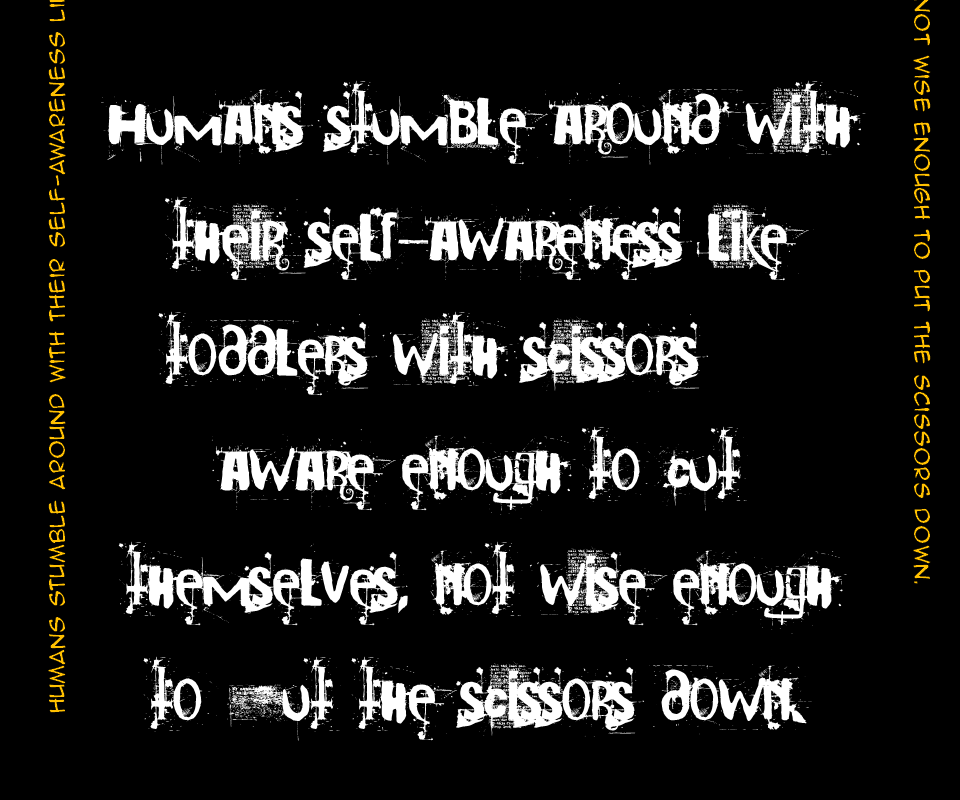
Humans stumble around with their self-awareness like toddlers with scissors—aware enough to cut themselves, not wise enough to put the scissors down.
1–2 minutes
Image: Humans stumble around with their self-awareness like toddlers with scissors—aware enough to cut themselves, not wise enough to put the scissors down. – ChatGPT

Propensity for Simulacra, An Excerpt

1–2 minutes

I posted Chapter 26 of my novella, Propensity. I share it here because it invokes Baudrillard’s Simulacra.

Consider it an advert – and a window into Propensity.

Blog Post: Propensity, Chapter 26 – Simulacra
Audio: Propensity, Chapter 2 – Oversight

The novel itself asks what happens when humanity creates a device that creates peace on earth. What if behavioural control worked too well?

No riots. No rebellion. Just a flattening—of desire, of ambition, of will. Across homes, schools, and governments, people stop acting like themselves. Some forget how. Others forget why.

The system wasn’t designed to stay on this long. But now there’s no off switch. And the researchers who built it? Most of them are zeroed.

As one child begins to drift from baseline, an impossible question resurfaces: What does it mean to behave?

This is a psychological dystopia without explosions, a story where silence spreads faster than violence, where systems behave better than the people inside them.

A tale of modulation, inertia, and the slow unravelling of human impulse—for readers who prefer their dystopias quiet and their horrors deeply plausible.


Editorial Review

“Reader discretion is advised. Free will has been deprecated.”
Beginning as a bizarre experiment in behavioural modulation by way of neurochemical interference, Propensity unfolds into an eerie metaphor for the tricky road between control and conscience. Park’s chapters are short and succinct, some barely a page long, in a staccato rhythm that mirrors the story’s disintegration—scientists losing grip on their creation and a world learning the price of its “engineered peace.” Phrases like “silence playing dress-up as danger” and “peace was never meant to be built, only remembered” linger like faint echoes long after you turn the page.

Reedsy Discovery Review

Meantime, give it a listen.

Constructivist Lens — Artifact

Parody Magic: The Gathering trading card

When drawn, this card alters perception itself. It reminds the player that truth is not something one finds under a rock but something one polishes into shape. Each metaphor becomes a spell; each keyword a crutch thrown aside.

Those who wield the Constructivist Lens see not “facts,” but fictions so useful they forgot to call them that. Reality wobbles politely to accommodate belief.

Knowledge is not a copy of reality but a tool for coping with it.”
— Richard Rorty

In game terms: Tap to reframe existence as interpretation. Duration: until the next disagreement.

Waiting for a New Book: Illusions of Light

2–3 minutes

This is not the announcement of a new book – The Illusion of Light: Thinking after the Enlightenment.

I hate the business of business. I am wrapping up another book project, but it’s been delayed by the government shutdown in the United States. I want a Library of Congress number (LCCN), but submissions must wait for an employed person to assign it.

Too clever by half and smarter than the average bear, I thought I could release an audiobook version first; audiobooks don’t need an LCCN. To be honest, neither do books. As some do with ‘Patent Pending’, I could follow suit. The book receives an LCCN, but it isn’t printed on the copyright page with the other administrivia.

My idea worked – partially. I rendered an audio version and published it – though it won’t be available until the start of November. Even so, I need distributors. It’s always something.

Meanwhile, I’m sharing an excerpt for your listening pleasure. Read along if you please.

Audio: The Illusion of Light: Thinking after the Enlightenment; Preface — Reading by Residual Light

Preface – Reading by Residual Light

To read these essays is to move slowly from the glare into the dimmer spaces where things regain texture. The Enlightenment taught us to equate light with truth, but illumination has always been double-edged: it clarifies outlines whilst erasing depth. What disappears in the brightness are the gradients – the in-between shades where thought and feeling meet, where contradiction still breathes.

The half-light is not a retreat from knowledge; it is where knowledge stops mistaking itself for salvation. It is the hour before dawn and after dusk, when perception is most alert, and everything seems both clearer and less certain. That is the discipline these essays practice: a sustained attentiveness to what persists when certainty burns away.

This project does not ask readers to abandon reason, only to notice what it has excluded. It invites a kind of intellectual night vision – the patience to see without spotlight, the willingness to sit with what does not resolve. In the half-light, the world no longer arranges itself around the human gaze; it reveals itself as unmastered, partial, alive. Here, we will learn to dwell in that half-light – not as a retreat from knowledge, but as a discipline of seeing what the Enlightenment’s glare erased.

The Enlightenment promised that truth would make us free. Perhaps it made us efficient instead. What these pages attempt is smaller and slower: a freedom measured not in control but in composure – the ability to live with what cannot be fixed, to keep tending meaning after its foundations have collapsed.

If there is light here, it is not the triumphant blaze of discovery but the ambient glow that remains after something ends. It’s the light of screens left on overnight, of cities at rest, of the mind still thinking long after certainty has gone to sleep.

Step carefully. Let your eyes adjust. The world looks different when it stops pretending to be illuminated.

The rest of the story…

I consider The Illusion of Light to be a sort of capstone project to the Anti-Enlightenment Project. It provides both a perspective and insights into the essays that constitute it.

Go Back Where You Came From (And Other Spells)

2–3 minutes

There’s a certain kind of rhetorical grenade people like to lob when their sense of ownership feels wobbly. You’ve heard it. You’ve maybe had it lobbed in your general direction.

It’s not an argument, of course. It’s a spell. A warding charm. The linguistic equivalent of hissing at a stray cat in the garden. The phrase carries the weight of assumed belonging: we are naturally here, you are obviously not. The incantation is meant to banish you with a puff of words.

The other day, I watched a black activist absorb this spell and toss it back with deadpan precision:

Cue awkward silence. The symmetry was perfect. Suddenly, the verbal hex had reversed polarity, exposing the hypocrisy built into the original curse. The power of the spell depends entirely on who gets to cast it. When it comes from the wrong mouth, the whole structure of “common sense” collapses into farce.

Another example: a Greek immigrant in my orbit, accent still clinging to every consonant, grumbling about a black family that had moved into his neighbourhood. Why didn’t they “go back to Africa”? This from a man who himself had gone “back” from nowhere, except a homeland he happily abandoned for better wages and better weather. Colonialism is apparently a one-way ticket: Europeans roam the globe and call it destiny, but when others move into their postcode, it’s treated like an invasion.

I confess, I once flirted with the same nonsense. Years ago in Japan, in my more callow phase, I asked – half in jest, wholly in arrogance – why these people didn’t have the decency to speak my language. The difference, such as it is, lay in my awareness that I was being ridiculous. My Greek neighbour, my activist’s heckler—no irony there. They were dead serious.

That’s the grotesque comedy of racism: its logic isn’t logic at all. It’s ritual. A mantra recited to reassure oneself of belonging by denying it to others. It dresses itself in the robes of rationality – “go back where you came from” sounds like geography, after all – but it’s closer to medieval exorcism than reasoned debate.

And when the cursed simply whispers the incantation back? The spell collapses. The supposed “truth” reveals itself for what it always was: a desperate attempt to maintain the fiction that one kind of stranger is native and another will always be alien.

Every empire tells its children they were born at home, and tells everyone else they were born trespassing.

On Agency, Suicide, and the Moving Train

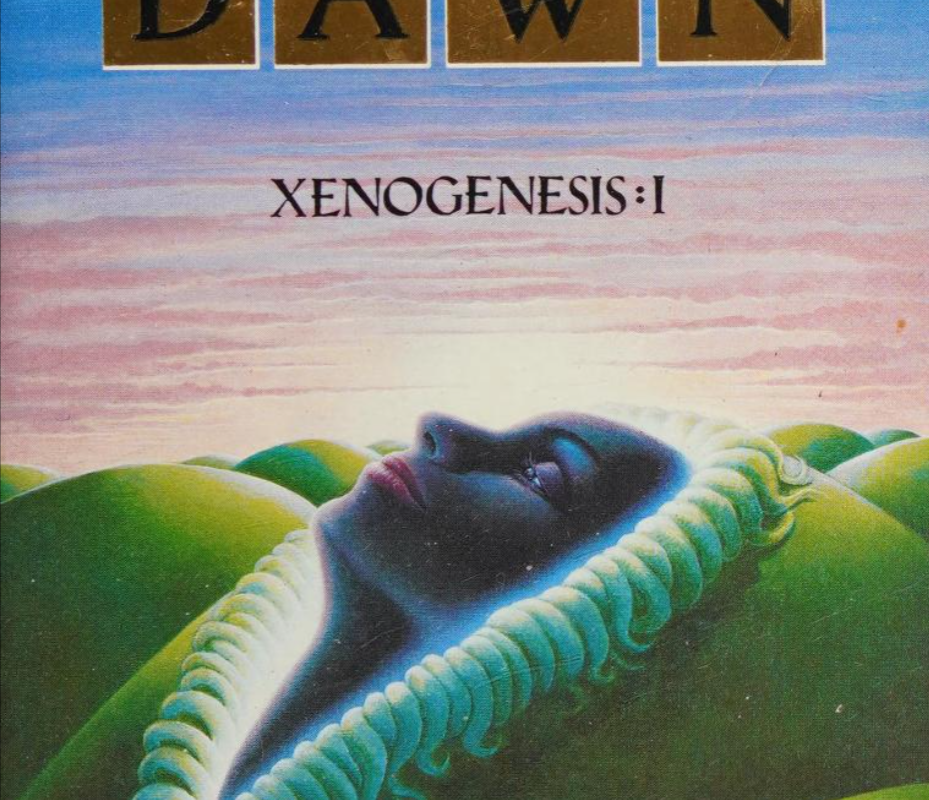
I’ve been working through the opening chapters of Octavia Butler’s Dawn. At one point, the alien Jdahya tells Lilith, “We watched you commit mass suicide.”*

The line unsettles not because of the apocalypse itself, but because of what it presumes: that “humanity” acted as one, as if billions of disparate lives could be collapsed into a single decision. A few pulled triggers, a few applauded, some resisted despite the odds, and most simply endured. From the alien vantage, nuance vanishes. A species is judged by its outcome, not by the uneven distribution of responsibility that produced it.

This is hardly foreign to us. Nationalism thrives on the same flattening. We won the war. We lost the match. A handful act; the many claim the glory or swallow the shame by association. Sartre takes it further with his “no excuses” dictum, even to do nothing is to choose. Howard Zinn’s “You can’t remain neutral on a moving train” makes the same move, cloaked in the borrowed authority of physics. Yet relativity undermines it: on the train, you are still; on the ground, you are moving. Whether neutrality is possible depends entirely on your frame of reference.

What all these formulations share is a kind of metaphysical inflation. “Agency” is treated as a universal essence, something evenly spread across the human condition. But in practice, it is anything but. Most people are not shaping history; they are being dragged along by it.

One might sketch the orientations toward the collective “apple cart” like this:

  • Tippers with a vision: the revolutionaries, ideologues, or would-be prophets who claim to know how the cart should be overturned.
  • Sycophants: clinging to the side, riding the momentum of others’ power, hoping for crumbs.
  • Egoists: indifferent to the cart’s fate, focused on personal comfort, advantage, or escape.
  • Stabilisers: most people, clinging to the cart as it wobbles, preferring continuity to upheaval.
  • Survivors: those who endure, waiting out storms, not out of “agency” but necessity.

The Stabilisers and Survivors blur into the same crowd, the former still half-convinced their vote between arsenic and cyanide matters, the latter no longer believing the story at all. They resemble Seligman’s shocked dogs, conditioned to sit through pain because movement feels futile.

And so “humanity” never truly acts as one. Agency is uneven, fragile, and often absent. Yet whether in Sartre’s philosophy, Zinn’s slogans, or Jdahya’s extraterrestrial indictment, the temptation is always to collapse plurality into a single will; you chose this, all of you. It is neat, rhetorically satisfying, and yet wrong.

Perhaps Butler’s aliens, clinical in their judgment, are simply holding up a mirror to the fictions we already tell about ourselves.


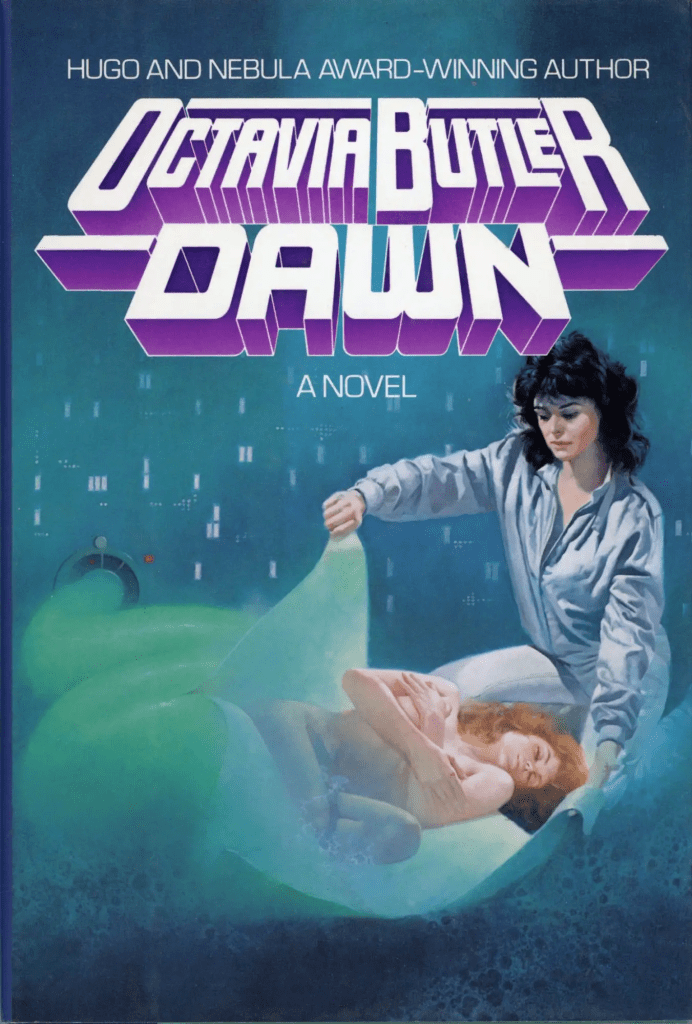
As an aside, this version of the book cover is risible. Not to devolve into identity politics, but Lilith is a dark-skinned woman, not a pale ginger. I can only assume that some target science fiction readers have a propensity to prefer white, sapphic adjacent characters.

I won’t even comment further on the faux 3D title treatment, relic of 1980s marketing.


Spoiler Alert: As this statement about mass suicide is a Chapter 2 event, I am not inclined to consider it a spoiler. False alarm.

Trainspotting

Trainspotting Movie Poster
2–3 minutes

I identify strongly with Irvine Welsh’s characters in Trainspottingthe book, not the sanitised film version. Especially with Mark Renton, whose voice strips away illusions with a brutality that borders on honesty.

Audio: NotebookLM podcast on this topic.

Consider this passage from the chapter “Bang to Rites” (pp. 86–87), where Renton attends the funeral of his mate Billy. Billy joined the army to escape the dead-end life they all shared, only to be killed on duty in Northern Ireland. Renton’s verdict:

[1] Renton doesn’t let anyone off the hook. Not Billy, not the army, not the Oxbridge suits who polish the tragedy into something fit for the News at Ten. The uniform is a costume, a disguise: a working-class lad suddenly deemed “brave” only because he was wearing the right outfit when he died. Strip away the uniform, and he’d have been dismissed as a thug or a waster.

[2] Renton’s root-cause analysis is unsparing. Billy wasn’t killed by the man with the gun so much as by the machine that put him there – the state, the ruling classes, the ones who spin death into “sacrifice” while continuing to shuffle the poor like pawns across the board.

It’s this clarity that makes Welsh’s work more than a drug novel. Trainspotting isn’t just about needles and nods; it’s about seeing through the charade. Renton despises both establishment and rebellion because both are performance, both hollow. His cynicism is the closest thing to honesty in a world that would rather dress up corpses in borrowed dignity.

And maybe that’s why I feel the affinity: because subversion matters more than allegiance, and sometimes the only truthful voice is the one that refuses to be polite at the funeral.

Democracy: The Worst Form of Government, and Other Bedtime Stories

3–5 minutes

Karl Popper’s Paradox of Intolerance has become a kind of intellectual talisman, clutched like a rosary whenever fascists start goose-stepping into the town square. Its message is simple enough: to preserve tolerance, one must be intolerant of intolerance. Shine enough sunlight on bad ideas, and – so the pious hope – they’ll shrivel into dust like a vampire caught out at dawn.

If only.

The trouble with this Enlightenment fairy tale is that it presumes bad ideas melt under the warm lamp of Reason, as if ignorance were merely a patch of mildew waiting for the bleach of debate. But bad ideas are not bacteria; they are weeds, hydra-headed and delighting in the sun. Put them on television, and they metastasise. Confront them with logic, and they metastasise faster, now with a martyr’s halo.

Audio: NotebookLM podcast on this topic.

And here’s the part no liberal dinner-party theorist likes to face: the people most wedded to these “bad ideas” often don’t play the game of reason at all. Their critical faculties have been packed up, bubble-wrapped, and left in the loft decades ago. They don’t want dialogue. They want to chant. They don’t want evidence. They want affirmation. The Socratic method bounces off them like a ping-pong ball fired at a tank.

But let’s be generous. Suppose, just for a moment, we had Plato’s dream: a citizenry of Philosopher Kings™, all enlightened, all rational. Would democracy then work? Cue Arrow’s Impossibility Theorem, that mathematical killjoy which proves that even under perfect conditions – omniscient voters, saintly preferences, universal literacy – you still cannot aggregate those preferences into a system that is both fair and internally consistent. Democracy can’t even get out of its own way on paper.

Now throw in actual humans. Not the Platonic paragons, but Brexit-uncle at the pub, Facebook aunt with her memes, the American cousin in a red cap insisting a convicted felon is the second coming. Suddenly, democracy looks less like a forum of reasoned debate and more like a lottery machine coughing up numbers while we all pretend they mean “the will of the people.”

And this is where the Churchill quip waddles in, cigar smoke curling round its bowler hat: “Democracy is the worst form of government, except for all the others.” Ah yes, Winston, do please save us with a quip so well-worn it’s practically elevator music. But the problem is deeper than taste in quotations. If democracy is logically impossible (Arrow) and practically dysfunctional (Trump, Brexit, fill in your own national catastrophe), then congratulating ourselves that it’s “better than the alternatives” is simply an admission that we’ve run out of imagination.

Because there are alternatives. A disinterested AI, for instance, could distribute resources with mathematical fairness, free from lobbyists and grievance-mongers. Nursery schools versus nursing homes? Feed in the data, spit out the optimal allocation. No shouting matches, no demagoguery, no ballots stuffed with slogans. But here the defenders of democracy suddenly become Derrida in disguise: “Ah, but what does fair really mean?” And just like that, we are back in the funhouse of rhetorical mirrors where “fair” is a word everyone loves until it costs them something.

So perhaps democracy doesn’t require an “educated populace” at all; that was always just sugar-paper wrapping. It requires, instead, a population sufficiently docile, sufficiently narcotised by the spectacle, to accept the carnival of elections as a substitute for politics. Which is why calling the devotees of a Trump, or any other demagogue, a gaggle of lemmings is both accurate and impolitic: they know they’re not reasoning; they’re revelling. Your contempt merely confirms the script they’ve already written for you.

Video: Short callout to Karl Popper and Hilary Lawson.

The philosopher, meanwhile, is left polishing his lantern, muttering about reason to an audience who would rather scroll memes about pedophile pizza parlours. Popper warned us that tolerance cannot survive if it tolerates its own annihilation. Arrow proved that even if everyone were perfectly reasonable, the maths would still collapse. And Churchill, bless him, left us a one-liner to make it all seem inevitable.

Perhaps democracy isn’t the worst form of government except for all the others. Perhaps it’s simply the most palatable form of chaos, ballots instead of barricades, polling booths instead of pitchforks. And maybe the real scandal isn’t that people are too stupid for democracy, but that democracy was never designed to be about intelligence in the first place. It was always about managing losers while telling them they’d “had their say.”

The Enlightenment promised us reason; what it delivered was a carnival where the loudest barker gets the booth. The rest of us can either keep muttering about paradoxes in the corner or admit that the show is a farce and start imagining something else.

The Enlightenment: A Postmortem

Or: How the Brightest Ideas in Europe Got Us into This Bloody Mess

Disclaimer: This output is entirely ChatGPT 4o from a conversation on the failure and anachronism of Enlightenment promises. I’m trying to finish editing my next novel, so I can’t justify taking much more time to share what are ultimately my thoughts as expounded upon by generative AI. I may comment personally in future. Until then, this is what I have to share.

AI Haters, leave now or perish ye all hope.


The Enlightenment promised us emancipation from superstition, authority, and ignorance. What we got instead was bureaucracy, colonialism, and TED Talks. We replaced divine right with data dashboards and called it progress. And like any good inheritance, the will was contested, and most of us ended up with bugger-all.

Below, I take each Enlightenment virtue, pair it with its contemporary vice, and offer a detractor who saw through the Enlightenment’s powder-wigged charade. Because if we’re going down with this ship, we might as well point out the dry rot in the hull.


1. Rationalism

The Ideal: Reason shall lead us out of darkness.
The Reality: Reason led us straight into the gas chambers—with bureaucratic precision.

Detractor: Max Horkheimer & Theodor Adorno

“Enlightenment is totalitarian.”
Dialectic of Enlightenment (1944)

Horkheimer and Adorno saw what reason looks like when it slips off its leash. Instrumental rationality, they warned, doesn’t ask why—it only asks how efficiently. The result? A world where extermination is scheduled, costs are optimised, and ethics are politely filed under “subjective.”


2. Empiricism

The Ideal: Observation and experience will uncover truth.
The Reality: If it can’t be measured, it can’t be real. (Love? Not statistically significant.)

Detractor: Michel Foucault

“Truth isn’t outside power… truth is a thing of this world.”
Power/Knowledge (1977)

Foucault dismantled the whole edifice. Knowledge isn’t neutral; it’s an instrument of power. Empiricism becomes just another way of disciplining the body—measuring skulls, classifying deviants, and diagnosing women with “hysteria” for having opinions.


3. Individualism

The Ideal: The sovereign subject, free and self-determining.
The Reality: The atomised consumer, trapped in a feedback loop of self-optimisation.

Detractor: Jean Baudrillard

“The individual is no longer an autonomous subject but a terminal of multiple networks.”
Simulacra and Simulation (1981)

You wanted autonomy? You got algorithms. Baudrillard reminds us that the modern “individual” is a brand in search of market validation. You are free to be whoever you want, provided it fits within platform guidelines and doesn’t disrupt ad revenue.


4. Secularism

The Ideal: Liberation from superstition.
The Reality: We swapped saints for STEMlords and called it even.

Detractor: Charles Taylor

“We are now living in a spiritual wasteland.”
A Secular Age (2007)

Taylor—perhaps the most polite Canadian apocalypse-whisperer—reminds us that secularism didn’t replace religion with reason; it replaced mystery with malaise. We’re no longer awed, just “motivated.” Everything is explainable, and yet somehow nothing means anything.


5. Progress

The Ideal: History is a forward march toward utopia.
The Reality: History is a meat grinder in a lab coat.

Detractor: Walter Benjamin

“The storm irresistibly propels him into the future to which his back is turned.”
Theses on the Philosophy of History (1940)

Benjamin’s “angel of history” watches helplessly as the wreckage piles up—colonialism, genocide, climate collapse—all in the name of progress. Every step forward has a cost, but we keep marching, noses in the spreadsheet, ignoring the bodies behind us.


6. Universalism

The Ideal: One humanity, under Reason.
The Reality: Enlightenment values, brought to you by cannon fire and Christian missionaries.

Detractor: Gayatri Chakravorty Spivak

“White men are saving brown women from brown men.”
Can the Subaltern Speak? (1988)

Universalism was always a bit… French, wasn’t it? Spivak unmasks it as imperialism in drag—exporting “rights” and “freedom” to people who never asked for them, while ignoring the structural violence built into the Enlightenment’s own Enlightened societies.


7. Tolerance

The Ideal: Let a thousand opinions bloom.
The Reality: Tolerance, but only for those who don’t threaten the status quo.

Detractor: Karl Popper

“Unlimited tolerance must lead to the disappearance of tolerance.”
The Open Society and Its Enemies (1945)

Popper, bless him, thought tolerance needed a firewall. But in practice, “tolerance” has become a smug liberal virtue signalling its own superiority while deplatforming anyone who makes the dinner party uncomfortable. We tolerate all views—except the unseemly ones.


8. Scientific Method

The Ideal: Observe, hypothesise, repeat. Truth shall emerge.
The Reality: Publish or perish. Fund or flounder.

Detractor: Paul Feyerabend

“Science is not one thing, it is many things.”
Against Method (1975)

Feyerabend called the whole thing a farce. There is no single “method,” just a bureaucratic orthodoxy masquerading as objectivity. Today, science bends to industry, cherry-picks for grants, and buries null results in the backyard. Peer review? More like peer pressure.


9. Anti-Authoritarianism

The Ideal: Smash the throne! Burn the mitre!
The Reality: Bow to the data analytics team.

Detractor: Herbert Marcuse

“Free election of masters does not abolish the masters or the slaves.”
One-Dimensional Man (1964)

Marcuse skewered the liberal illusion of choice. We may vote, but we do so within a system that already wrote the script. Authority didn’t vanish; it just became procedural, faceless, algorithmic. Bureaucracy is the new monarchy—only with more forms.


10. Education and Encyclopaedism

The Ideal: All knowledge, accessible to all minds.
The Reality: Behind a paywall. Written in impenetrable prose. Moderated by white men with tenure.

Detractor: Ivan Illich

“School is the advertising agency which makes you believe that you need the society as it is.”
Deschooling Society (1971)

Illich pulls the curtain: education isn’t emancipatory; it’s indoctrinatory. The modern university produces not thinkers but credentialed employees. Encyclopaedias are replaced by Wikipedia, curated by anonymous pedants and revision wars. Truth is editable.


Postscript: Picking through the Rubble

So—has the Enlightenment failed?

Not exactly. It succeeded too literally. It was taken at its word. Its principles, once radical, were rendered banal. It’s not that reason, progress, or rights are inherently doomed—it’s that they were never as pure as advertised. They were always products of their time: male, white, bourgeois, and utterly convinced of their own benevolence.

If there’s a path forward, it’s not to restore Enlightenment values, but to interrogate them—mercilessly, with irony and eyes open.

After all, the problem was never darkness. It was the people with torches who thought they’d found the only path.