I’ve been reengaging with philosophy, though my positions haven’t changed recently. My last change was to shift from being a qualified material realist to a qualified idealist in the shape of Analytic Idealism. In most matters I can think of, I am an anti-realist, which is to say concepts like truth and morality are not objective; rather they are mind-dependent.
I’ve long been on record of taking the stance that Capital-T Truth, moral truths, are derived rhetorically. There is no underlying Truth, only what we are aggregately convinced of, by whatever route we’ve taken. As a moral non-cognitivist, I am convinced that morality is derived through emotion and expressed or prescribed after a quick stop through logic gates. Again, there is nothing objective about morality.
Truth and morality are subjective and relative constructs. They resonate with us emotionally, so we adopt them.
Were I a theist — more particularly a monotheist —, I might be inclined to be emotionally invested in some Divine Command theory, where I believe that some god may have dictated these moral truths. Of course, this begs the question of how these so-called “Truths” were conveyed from some spirit world to this mundane world. I have no such conflict.
But let’s ask how an atheist might believe in moral realism. Perhaps, they might adopt a Naturalistic stance: we have some natural intuition or in-built moral mechanism that is not mind-dependent or socially determined. I am not a naturalist and I don’t take a universalist approach to the world, so this doesn’t resonate with me. I can agree that we have an in-built sense of fairness, and this might become a basis for some aspects of morality, but this is still triggered by an emotional response that is mind-dependent.
Another curious thing for me is why non-human animals cannot commit immoral acts. Isn’t this enough to diminish some moral universal? In the end, they are an extension of language by some definition. No language, not even a semblance of morality.
Anyway, there’s nothing new here. I just felt like creating a philosophical post as I’ve been so distracted by my health and writing.
Identity is a fiction; it doesn’t exist. It’s a contrivance, a makeshift construct, a label slapped on to an entity with some blurry amalgam of shared experiences. But this isn’t just street wisdom; some of history’s sharpest minds have said as much.
“There are no facts, only interpretations.”
— Friedrich Nietzsche
Think about Hume, who saw identity as nothing more than a bundle of perceptions, devoid of any central core. Or Nietzsche, who embraced the chaos and contradictions within us, rejecting any fixed notion of self.
Edmund Dantes chose to become the Count of Monte Cristo, but what choice do we have? We all have control over our performative identities, a concept that Judith Butler would argue isn’t limited to gender but applies to the very essence of who we are.
“I don’t feel that it is necessary to know exactly what I am. The main interest in life and work is to become someone else that you were not in the beginning.”
— Michel Foucault
But here’s the kicker, identities are a paradox. Just ask Michel Foucault, who’d say our sense of self is shaped not by who we are but by power, society, and external forces.
You think you know who you are? Well, Erik Erikson might say your identity’s still evolving, shifting through different stages of life. And what’s “normal” anyway? Try to define it, and you’ll end up chasing shadows, much like Derrida’s deconstruction of stable identities.
“No such things as selves exist in the world: Nobody ever was or had a self.”
— Thomas Metzinger
“He seemed like a nice man,” how many times have we heard that line after someone’s accused of a crime? It’s a mystery, but Thomas Metzinger might tell you that the self is just an illusion, a by-product of the brain.
Nations, they’re the same mess. Like Heraclitus’s ever-changing river, a nation is never the same thing twice. So what the hell is a nation, anyway? What are you defending as a nationalist? It’s a riddle that echoes through history, resonating with the philosophical challenges to identity itself.
“I never can catch myself at any time without a perception, and never can observe anything but the perception.”
— David Hume
If identity and nations are just made-up stories, what’s all the fuss about? Why do people get so worked up, even ready to die, for these fictions? Maybe it’s fear, maybe it’s pride, or maybe it’s because, as Kierkegaard warned, rationality itself can seem mad in a world gone astray.
In a world where everything’s shifting and nothing’s set in stone, these fictions offer some solid ground. But next time you’re ready to go to the mat for your identity or your nation, take a minute and ask yourself: what the hell am I really fighting for? What am I clinging to?
Servile compliance and vigilante justice are the core messages underlying Small Town. Comply, or else…
Watching the video, Try That in a Small Town by Jason Aldean, I was left pondering: Are there no convenience store robberies in small towns, or are petrol station and liquor store robberies exempt from scrutiny? Most mass school shootings happen in small towns. Am I missing something through the bravado?
I guess the works of the likes Truman Capote and Flannery O’Connor are lost to this generation, and the message of the Borg has faded into history.
Don’t dare be different or speak your mind about anything meaningful. Sure, serve ham over turkey on Thanksgiving. Be a rebel, but don’t complain about low wages or political subjugation…unless it’s what the local consensus believes.
But tightly-knit small towns will make sure that justice prevails even if it’s the extra-judicial flavour.
This video is divisive to the country as a whole at the expense of some small-town jingoism.
Many lives were changed in 2019 as fentanyl replaced heroin as the opiate of the masses on the streets of Philadelphia. Ten times more potent than heroin, fentanyl lasts half the time between fixes. It cost many lives.
But look deeper. Look away from the streets and towards the medical-industrial complex. The state of pain management is in its infancy. In some hundred years we’ll look back on this period and cringe in the same manner as when we regard bloodletting and humours. We have myriad solutions, but as many cases have none. Opiates fill some of this void, whether by prescription or on the streets, but even this only masks the symptoms.
The goal is not always to obviate physical pain, but for some mental torment feels as real. Those with mental anguish are marginalised whilst the rest are accused of overreacting. It all in their heads, too. Drug-seekers. Mental illness. Bollox.
Medical science in this arena is in its Infancy. Not quite yet toddlers, but they won’t admit it. Better to blame the patients and victims. Better to make it a moral issue. Public health regulations are in the same state of maturity. Hubris kills. Capitalism kills. Calvinistis protestant work ethic kills. Fetanyl kills, too.
Ninety per cent of fetanyl is cut with Xylazine, tranq, a veterinary tranquiliser. This makes fetanyl cheaper and is reported by some to extend the euphoric effects, but it’s not an opioid, so interventions are different to opiate-induced overdose.
Xylazine renders the user to sleep, but it doesn’t stop withdrawal symptoms. Addicts awaken to need another fix. If there isn’t enough opiate, one may awaken already in withdrawal.
Whilst heroin might last eight hours between fixes, fentanyl lasts closer to four. The addict needs to seek twice as often.
But I’m rambling. I’ve been in hospital since 9 March. It’s still difficult to focus. My girlfriend died the next day, on the 10th. She overdosed on a chemical cocktail of fentanyl, alcohol, and who knows what.
Her pain was psychological, but that’s a topic for another day. She was in recovery. This is where some are most susceptible to overdose.
When I was 17 years old, I shouted out into an empty room into a blank canvas that I would defeat the forces of evil. And for the next 10 years of my life, I suffered the consequences… with illness, autoimmunity, and psychosis.
As I got older, I realised that there were no real winners or no real losers in physiological warfare. But there were victims, and there were students.
It wasn’t David verses Goliath; it was a pendulum eternally awaying between the dark and the light. And the brighter the light shone, the darker the shadow it cast. It was never a battle for me to win. It was an eternal dance.
And like a dance, the more rigid I became, the harder it got. The more I cursed my clumsy footsteps, the more I suffered.
And so I got older and I learned to relax, and I learned to soften, and that dance got easier.
It is this eternal waltz that separates human beings from angels, from demons, from gods. And I must not forget, we must not forget that we are human beings.
Hi Ren provides personal insights into the struggle between one’s self and shadow self through performance art, music, and poetry.
Language insufficiency or the inability of language to facilitate accurate or precise communication has been a notion I’ve stressed for years. In fact, I have another post with a similar title,
Conceptual language is likely to have been formed for a purpose different to social communication. It may have been formed to facilitate internal dialogue. This language was not written and may not have even been words as we know them, but we could parse and reflect upon our experiences in this world. Eventually, we developed speech and then writing systems to share communication. We went on to develop speculative and conditional language, visions of possible futures and answers to ‘what-if’ queries.
My intent is not to create a piece with academic rigour, though I might wish to. I may not even deign to link to references I’ve accumulated over the years. They are in memory, but it takes time and effort,especially when one isn’t purposefully accumulating citations.
I was prompted to write at 4am when I read in a story that Google CEO Sundar Pichai was taking “full responsibility for the decisions that led us” to twelve-thousand-odd layoffs at the company he helms. But what is the responsibility he cites? It’s meaningless. What can it mean—that he’s sorry? Responsibility is a weasel word. That and a dollar won’t buy you a cup of coffee at Starbucks. And on one hand, he can say that at least these people were employed with income in the first place, but thqat is little consolation for the expectation of longevity. Here’s a lesson in impermenance and trust. We tend to trust companies, but the trust is rather hope. We hope they don’t let us down. Hope is another weasel word, as is trust. Trust me.
About 40% of words employed…are phatic or filler words with little objective communication value
About forty per cent of words employed in a typical day are phatic or filler words with little objective communication value, though some provide a social function. This may be superfluous, this is not insufficiency. Insufficiency stems from not being to articulate what one wants to say or the expectation to understand what is being conveyed to you. In fact, people tend to overvalue what they hear or read.
In most cases, this may not matter. As long as the content of a transmitted idea contains enough value to convey a message, this is good enough for everyday communication. “Look out! There’s a car turning into your lane.” “I’m hungry. There’s a restaurant.” “That was a good movie.” “Let’s meet at four o’clock.” In fact, much can be communicated without words—in gestures and facial expressions. It might even be argued that these vectors carry as much if not more communication content than the words we use.
IMAGE: Communication without words
“There.” I point to a drive-through restaurant ahead on the road. “I’m hungry.”
I could probably omit the there exclamation and just point. Here, words are sufficient, even if they may be redundant. There are challenges even at the fundamental level. Notably, aesthetic concepts are often nebulous.
“That restaurant is good.”
What does this statement mean to convey? Essentially, it means that I, the speaker, has been to the referenced restaurant and liked at least some of the food they tasted: “[The food at] that restaurant is good.” Perhaps, they are referring to the staff or the atmosphere. It depends on what good is qualifying. It also depends on a shared definiton of good. This is a insufficiency.
Of course, this insufficiency can be mitigated fairly quickly. Once you understand the ‘tastes’ of your interlocutor, you can parse whether the goodness also applies to you. If you don’t happen to like, say, Indian food and that is the restaurant being referenced, then you can dismiss the comment as phatic. If you don’t prefer satire, you might want to chalk up a statement like ‘M3GAN was a good movie’ to a sharing of personal information rather than a recommendation.”
Perhaps the biggest insufficiency is in the communication of abstract concepts, a category where aesthetics also sits. These are concepts such as God, love, and justice. Iain McGilchrist seems to feel that although these words may be insufficient, we all know what they mean. These are right brain notions that the left hemisphere just can’t rightly categorise. Though this might be a left brain argument, I am going to disagree by degrees.
My (hopefully not strawman) argument is that we do have subjective notions of what these things are, but the communication value is still diminished and in some cases insufficient. If my statement means to convey justice as {A, C, D, X} and the receiver understands justice to mean {A, B, C, Y, Z}, then the only shared aspect is {A,C}. If that is the only portion contextual to the conversation at hand, that’s fine. Communication has been sucessful. But is the message was meant to emphasise {Z}, then the communication is insufficient.
It could be that further conversation reveals this, but often times, a shared definition is assumed. When I say “I want justice” or “I take responsibility”, I have a notion of went denotative and connotative elements I have in mind. I expect the the receiver of my statement shares these elements.
In the case of the statement by Pichai, his notion of responsibility is clearly divergent from mine. This might fall back on some notion of blame, but he has no real repurcussions for his action. Perhaps reputationally, but like politicians, CEOs of large companies are already expected to be sociopaths with empty words, so he’s appologised with no weight, and for most people that’s good enough. The people who have been affected are just as unemployed as before. He may have arranged for a severance package, but in the case of the family referenced in the article, this means nothing because they have 60-days to become employed or they will be forced to leave the United States as a conditiopn of their H1B visa.
On a personal level, I was recently chatting with an Indian mate with an H1B visa who had just been hired after having been layed off by another company. He was racing against this 60-day clock. He had received a verbal offer, but once the company discovered that he needed sponsorship for his via, they offered him $30,000 less per year because they knew he had no bargaining power. This is just an editorial aside, so I won’t go down the rabbit hole of wage slavery, but know that I recognise the relationship and the exploitation in it.
When I have time, perhaps I’ll flesh out this notion and provide additional support. Of course, I also know that I am shovelling against the tide owing to the insufficiency of language. I won’t even start on the related topic of the rhetoric of truth.
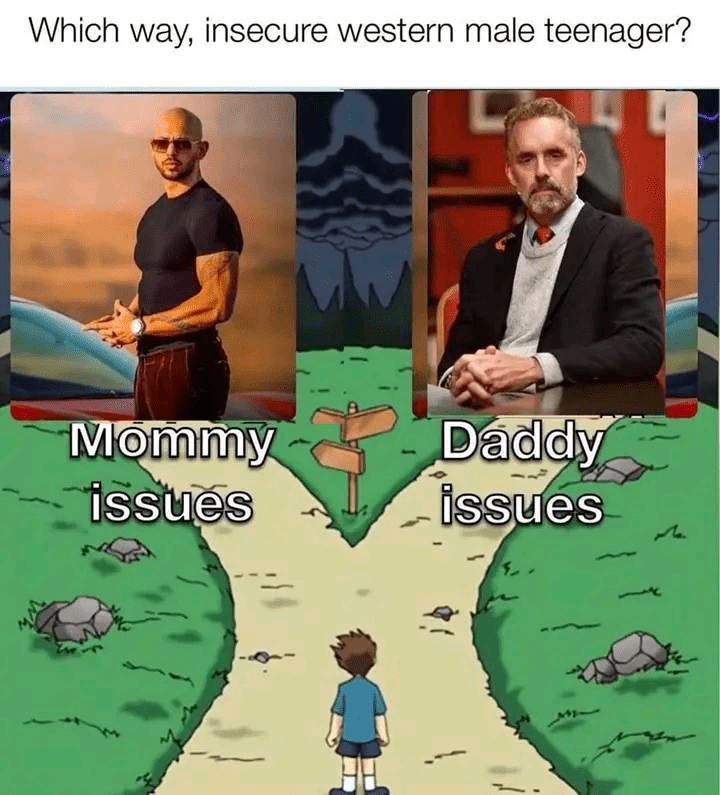
Some people seem to need to find meaning, yet they arrive from different experiences. These days, many insecure Western males appear to meet in a particular place that leaves them to make a decision. Of course, there is no decision because, in a Freudian-Jungian way, they arrive with issues and baggage. This dictates which path will be chosen—Andrew Tate or Jordan Peterson. Why not both?
This is not a commentary on a lack of free will, though that may come into play. It’s more a general lack of degrees of freedom when one arrives from such a place and has these two characters (caricatures?) as options for role models. In each case, overcompensation is evident.
It’s a slow news day and I’ve been otherwise occupied. I don’t have much to add, but I felt sharing this meme would fill space and time.
A citizen of the Internet shared this as if were gospel along with this comment:
Late Professor Steven Horwitz expanding on a Misesian theme. Monetary profit helps allocate resources to higher valued uses. Elsewhere, Mises spoke of profit in a broader sense, “profit” being the goal of every action. In any case, those familiar with what pundits (from the left mostly) tend to say about “profit” may be completely surprised by this take, since it is so contrary to what they often read and hear.
Of course, these are vapid words and wishful thinking. How and why do profits signal that value has been created? I dunno. They just do cuz I said so. The only thing that profits signal is a market that doesn’t understand the true cost of production and consumers can’t be bothered to do it themselves. Mattresses and shaving razor blades are two high-margin consumer goods with mattresses yielding 500 per cent profits and razor blades even higher. These profits represent economic rent and not value. The fact that imperfect information shrouds this excess does not make it ‘value’.
Regarding the mortgage market meltdown of 2007-08, there were houses being built into a market with no buyers. The same ‘value’ being created was demonstrably vapour. Say’s Law was off-target again. Supply does not create its own demand.
Is it no wonder that so many Capitalists are also Protestant Christians who believe in Bible tales as well? Even worse are the Christians who are not Capitalists but are exploited by Capitalism the same way they are exploited by their religion. I guess once you’ve profiled the gullible, you might as well just keep exploiting them until there is nothing left to extract.
In this first chapter of the second section of The Matter with Things, Iain McGilchrist asks, What is Truth? Section two has a different focus than the first, which was focused on foundation building. From here on in, he wants to build on this foundation.
Check out the table of contents for this series of summaries. Note that I have rendered my interstitial commentaries in grey boxes with red text, so the reader can skip over and just focus on the chapter summary.
At first, he establishes that each hemisphere ‘thinks’ it knows the true truth and has the best vantage on reality. He makes it clear that a short chapter will not do the topic of truth the justice he feels it deserves and notes that others have written books on the matter. He just wants to make a few points and clarify his position.
As we discovered in the first section, the left and right hemispheres perceive the world differently. The right hemisphere experiences the world as it is presented in a Gestalt manner. This is contrasted by the left hemisphere which views the world as a symbolic re-presentation. It’s not unfair to say that the right hemisphere experiences the world directly whilst the left hemisphere views a cache of the world.
In this chapter, McGilchrist (Iain) attempts to convince the reader that one side is more correct or correct more often than the other and so is more veridical. As he says, the left hemisphere ‘is a good servant but a poor master’. Of course, if we had a third hemisphere [sic], we might think it could mediate the other two, but then we’d need a fourth and a fifth, ad infinitum to act as the new arbiter.
Spoiler Alert: The right hemisphere wins the battle on truth pretty much hands down.
He wants to make it clear to the reader that he is no strict idealist. There is a reality ‘out there’ apart from mental processes that objectively exists even in the absence of a subject. Reality is not exclusively a projection of the brain.
His choice rather relies on the correspondence theory of truth, which is to say that the hemisphere that conveys perceptions more correspondent to our perceived reality would be more veridical.
Here, I challenge his reasoning on two accounts. In the first place,each hemisphere may operate better in one context versus another. In the second case, there may be a consequential factor, which again distils down to context. In risk management, there are notions of probability of failure and consequence of failure. For example, a failure to recognise the truth of a matter (we’ll use truth as a proxy for ‘fact’), may be inconsequential. If I am assessing the probability of a pipe bursting in a nuclear facility and the pipe is connected to a sink to deliver tap water, the consequence of this failure is practically insignificant. But if I am assessing the probability of a pipe containing radioactive materials, even if the probability of failure is low, the consequence of failure may be catastrophic.
Evolutionarily speaking, if you mistake a garden hose for a venomous snake, the consequence of failure is trivial. Turn the tables, and mistake a snake for a garden hose, the consequence may be fatal. I am not attempting to claim that one hemisphere interprets the low consequence scenario and the other interprets the high. I simply want to raise this nuance.
He makes the point that if we compare some known authentic object to a recollection, we want to retain the one that is more accurate.
I see a similar challenge. Hypothetically, let’s say I present a red disc and manipulate the hemispheres to activate only one at a time, asking to recall the object. If the left says it’s red and the right says it’s a disc, which is more correct? Again, I am not claiming that this is a real scenario, but if one side possesses facts unavailable to the other side, we’ve got a problem in making a truth claim.
To reiterate, the left hemisphere is more analogous to a photograph or a video account whereas the right hemisphere is to be in the place that is being photographed. The right hemisphere is duratively presenced whilst the left is re-presented. We move from a nominative form to a verbial form of representing reality. This leads him to ask if ‘truth’ is a thing or a process.
He shifts to a linguistic argument. When people view ‘truth’ as a noun, as a thing, the expectation is that it is static. Moreover, the descriptors of truth are rendered mainly in the past tense—representation, fact, perfect, precise, certain, and concluded. He provides definitions. When viewed duratively, ‘truth’ becomes a process. It is an active relationship. It flows. It’s an intercourse.
We may not ever get to an agreed truth, but neither is every position valid. Interpreting a text, for example, may have several conflicting meanings, but the possible meanings are relatively finite.
Take a simple sentence such as, “The dog bit the hand that feeds him.” This could be meant literally or figuratively. We might imagine different dogs, hands and person to whom the hand is attached. Perhaps the hand is attached to a bonobo. Perhaps, it’s a robotic hand. These are among various possible interpretations, and we may not ever agree on the truth of the matter. However, we can rule out that a giraffe or a watermelon were central to this narrative for what it’s worth.
The bookgoes on to discuss the etymology of the word ‘truth’ and of its relationship to the word ‘true’ (faithful) which is further related to ‘trust’. I won’t exhaust his explanation.
He does discuss correspondence and coherence theories of truth and discounts others such as consensus theory and social constructivism. He cautions not to equate truth with correctness. This is a left hemisphere game insisting on dichotomising things.
The book declares the despite a general agreement on the source or nature of truth, there is something there, so don’t give up un it. In the end, he seems to settle for a Pragmatistic version à la William James.
Personally, I feel he and others are over-invested in the nature of truth. And inflate its meaning over ‘fact’. To me, Capital-T Truth is an archetype, but it doesn’t otherwise exist. We have facts, and truth is sort of a perfect version of a fact. Love is in the same category, though I know Iain would disagree with this assertion. Of course, James dismissed semantic argument as petty and insisted that people simply know the truth of something. I’ve always found this take to be dismissive. I also feel that Pragmatism is too steeped in Empiricism and loses hold of the notion that what happened yesterday may not in fact manifest today or not in the same way.
I’ll also argue as others have before me that (besides being archetypal) the term is a redundant filler word. On a minuscule level, if I say ‘The cup is red’, saying ,’It’s true that the cup is red adds nothing’. The equation was already asserted. This leaves one to wonder what the purpose of it is.
Returnng to the asymmetry of the hemispheres he cautions up not to take a position that one of the other side is correct. Rather, even though there is an asymmetry in value, there is still a synthesis.
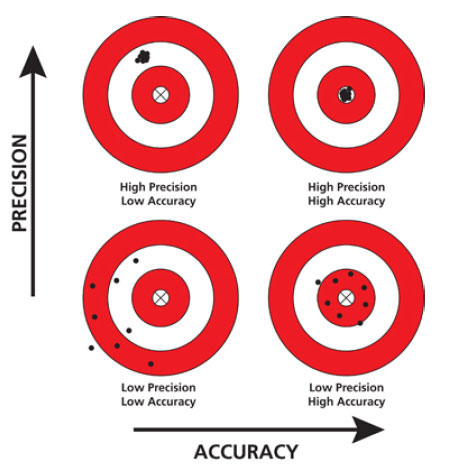
Iain uses the example of Newtonian and Einsteinian physics. At one point, they are practically synonymous and interchangeable. Only as we reach the speed of light does Newtonian physic exceed the bounds of its scope. He also educated the reader on the difference between precision and accuracy.
I like to view this in a musical context. If I play two notes together, say a B over an E, neither is more correct than the other. Notionally, I am playing an E5/B. This is neither an E or a B. The chord is the result of the two playing simultaneously. In this case E and B are both true and not true because the E5 is a synthesis. If I add a G# I get an E-major chord, subsequently adding a D renders an E7. In each of these cases, the truth of the notes, B, D, E, and G# remain true to their identity, but the fact is that the individuality is subsumed by the collective. This is the prevailing truth even though a person with perfect pitch can still individually identify the constituents of the chord. I don’t know if this is more confusion than necessary, but it helps me.
I’ve always like this illustration with target grouping, but this was not referenced by the book.
Image: Precision and Accuracy Chart
Interestingly, he cites Jay Zwicky’s definition: “Truth is the asymptotic limit of sensitive attempts to be responsible to our actual experience of the world … ‘sensitive attempts to be responsible’ means truth is the result of attention. (As opposed to inspection.) Of looking informed by love. Of really looking.” He accedes that there are degrees of truth.
Truth is the asymptotic limit of sensitive attempts to be responsible to our actual experience of the world
As the chapter comes to a close, he leaves us with a twisted categorical syllogism,
[p1] All monkeys climb trees
[p2] The porcupine in a monkey
[ c ] The porcupine climes trees
This structure presents a valid argument. However, it is not sound. It follows the Socratic logical syntax:
[p1] M a P
[p2] S a M
[ c [ S a P
Because of our exposure to and experience with the external world, we can assess this argument to be unsound, which is to say untrue by observation. Without this context, we could not render this assessment. He discusses the way right- and left-hemisphere occluded subjects respond to this discrepancy. In summary, an isolated left hemisphere with defend the logical syntax over the lived experience.
In conclusion, the hemispheres take different paths to assess truth and often end up at different destinations. The left hemisphere sees truth as a thing whilst the right views it as a process.
Children are ethically indisposed to think it’s wrong to eat animals. This article from the Journal of Environmental Psychology published a year ago looks into the schism and cognitive dissonance assuaging mechanisms in play.
This study relied on a small sample size (n=176), between the ages of 4 and 7 years living in a metropolitan area located in the southeastern region of the United States. The sample was otherwise diverse.
As this study was limited in geographic scope (see WIERD on a tangential note), it noted that eating habits vary by culture. For example, eating horse (or dog) meat is not condoned in the United States, but it is acceptable in many other places.
In summary, the childer were shown cards each with a picture of an item, whether a French fry, a horse, a cat, a fish, a tomato, and so on. At the start, they were asked to identify the item represented on the card. Next, they were asked to put the card into one of two bins, each decorated to approximate an animal or vegetation. Finally, they were asked to sort the cards into two areas, one represented by false teeth indicating edible products and a rubbish bin representing inedible items.
The subjects did a fair job of identifying the card items. They had very high image recognition of these particular animals. On the lower end of recognition were hamburger (ground beef patty), almonds, and shrimp. There was a difference between the older children and the younger children, but this may relate to the added acculturation their age would bring.
Without delving deeply into details, in this study, most 6- and 7-year-olds classified chicken, cows, and pigs as not OK to eat. The interesting cognitive trick is that these children also classified these derivative food items as non-animals thus removing the cognitive dissonance. No longer classified as an animal, their ethical framework remained internally coherent.
In discussing the results, many children were ill-informed about the source of various food products. Language games obscured the source. No one should eat a cow, but beef is fine—a hamburger is fine. Hot dogs grow on trees, don’t they?
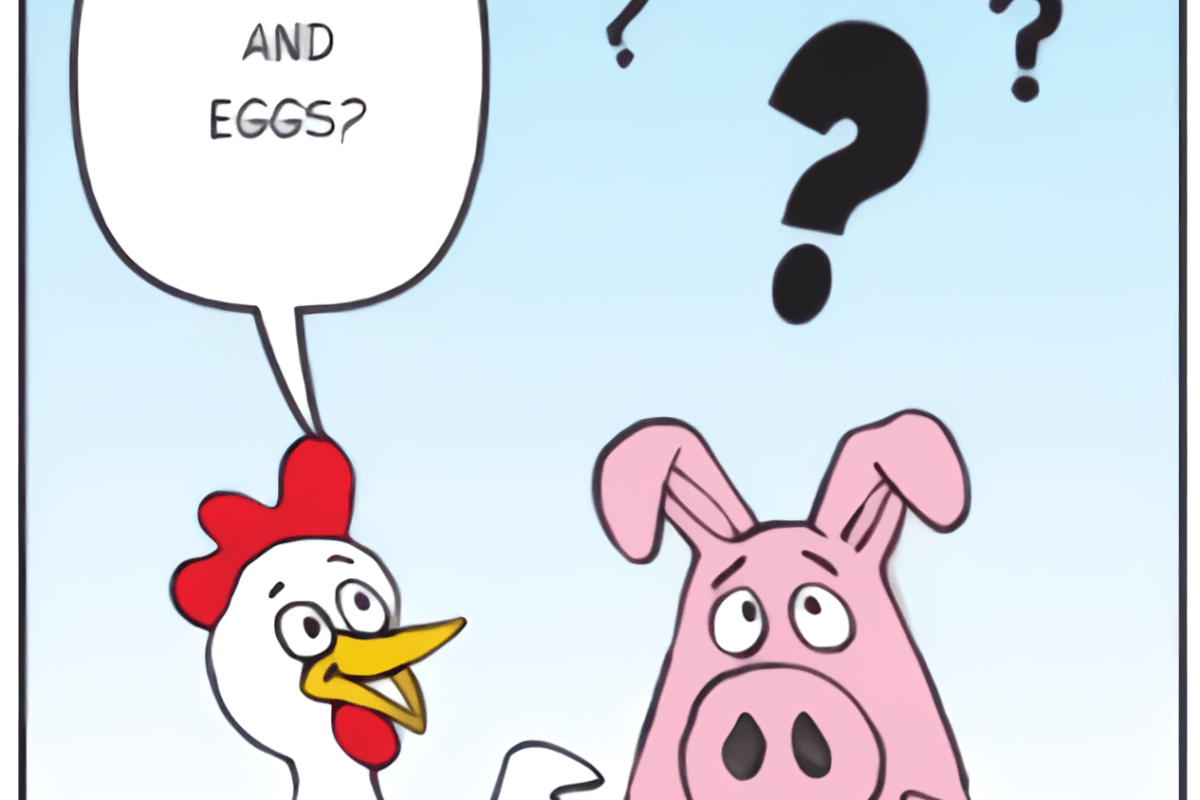
This reminds me of the story wherein a chicken and a pig are conversing, and the chicken suggests that it and the pig go into the restaurant business. The pig considers the proposition and declines by the rationale that it would be committed but the chicken would only be involved. Children may believe that hot dogs are a by-product like eggs, fur, or feathers—don’t get me started on the down used in pillows, jackets, and comforters—rather than grasping that the animals yield these products at the expense of their lives.
Some people grow up and realise the inconsistency of their ethics and actions, but they find any number of ways to reconcile their actions, noting that the activity is normal and natural.
FULL: DISCLOSURE: For the record, I eat chicken, turkey (on festive holidays in lieu of chicken), and I eat beef (that’s cows, for the uninformed). I also consume some animal byproducts, i.e., chicken eggs and cheese. I also wear leather. I was a vegetarian for about three years until I opted to become a chickenatarian. My life partners goaded me into eating beef, and so I’ve since added that. In all cases, I feel bad for eating defenceless, sentient beings. I’m not sure it serves as any consolation that I limit my consumption to these three animals—or even if it were only one. For the record, I don’t particularly like the taste of turkey or beef, but it’s not offensive like pork, coffee, or alcohol. Chicken, I like. Sorry chickens.
Video: Homer Simpson’s (not so) ethical dilemma
For the record, this is post number 500 on Philosophics. Perhaps I should write a post about it.










 Philosophics