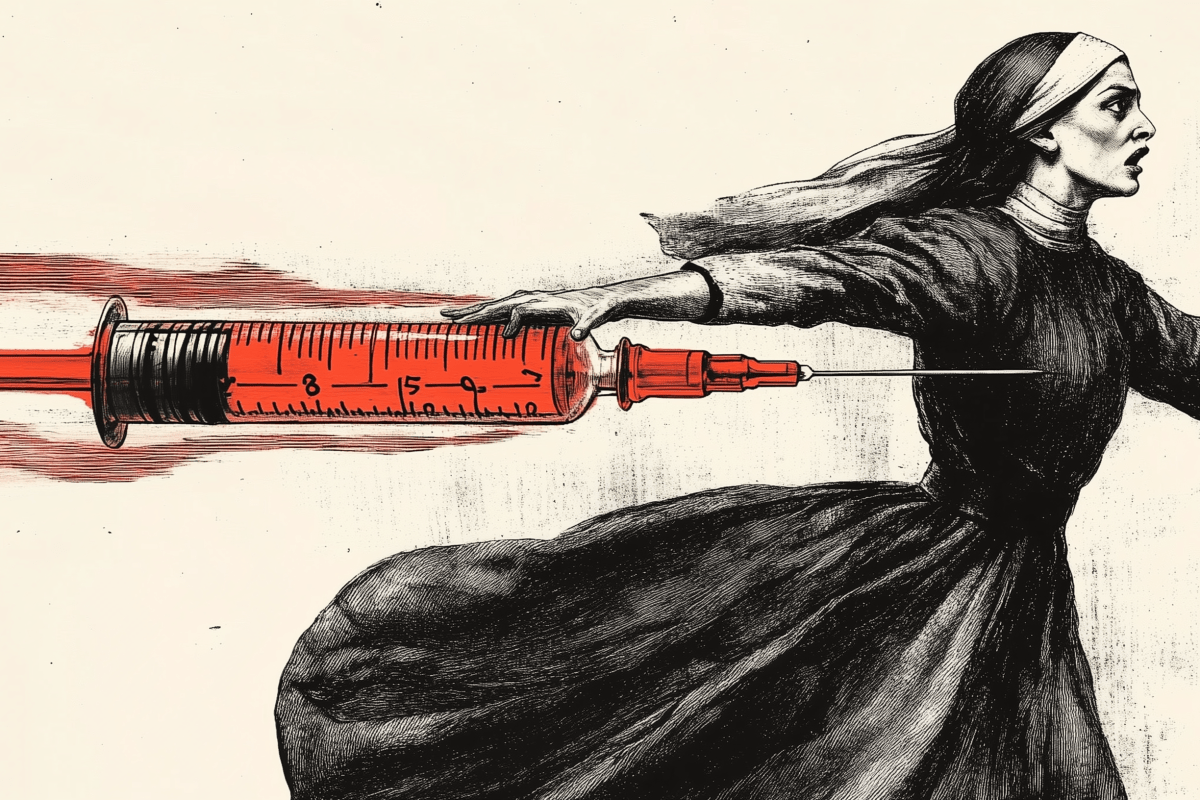
The Scapegoat and the Spectacle

Girardian Lessons from a Violent Reckoning

The assassination of UnitedHealth CEO Brian Thompson is more than just a shocking headline—it’s a vivid tableau of modern society’s darkest impulses. For some, Thompson’s death represents long-overdue justice, a symbolic blow against the machinery of corporate greed. For others, it’s an unforgivable act of chaos that solves nothing. But as the dust settles, we’re left with an unsettling truth: both sides may be acting rationally, yet neither side emerges morally unscathed.

This event takes on deeper significance when viewed through the lens of René Girard’s theories on mimetic rivalry and the scapegoat mechanism. It’s not just about one man or one system—it’s about the cycles of conflict and violence that have defined human societies for millennia.

Mimetic Rivalry: The Root of Conflict

Girard’s theory begins with a simple observation: human desires are not unique; they are mimetic and shaped by observing what others want. This inevitably leads to rivalry, as individuals and groups compete for the same goals, power, or symbols of status. Left unchecked, these rivalries escalate into social discord, threatening to tear communities apart.

Enter the scapegoat. To restore order, societies channel their collective aggression onto a single victim, whose sacrifice momentarily alleviates the tension. The scapegoat is both a symbol of the problem and a vessel for its resolution—a tragic figure whose elimination unites the community in its shared violence.

Thompson as Scapegoat

In this story, Brian Thompson is the scapegoat. He was not the architect of the American healthcare system, but his role as CEO of UnitedHealth made him its most visible face. His decisions—denying claims, defending profits, and perpetuating a system that prioritises shareholders over patients—embodied the injustices people associate with healthcare in America.

The assassin’s actions, however brutal, were a calculated strike against the symbol Thompson had become. The engraved shell casings found at the scene—inscribed with “Deny,” “Defend,” and “Depose”—were not merely the marks of a vigilante; they were the manifesto of a society pushed to its breaking point.

But Girard would caution against celebrating this as justice. Scapegoating provides only temporary relief. It feels like resolution, but it doesn’t dismantle the systems that created the conflict in the first place.

The Clash of Rationalities

Both Thompson and his assassin acted rationally within their respective frameworks. Thompson’s actions as CEO were coldly logical within the profit-driven model of American capitalism. Deny care, maximise profits, and satisfy shareholders—it’s a grim calculus, but one entirely consistent with the rules of the system.

The assassin’s logic is equally clear, though rooted in desperation. If the system won’t provide justice, then justice must be taken by force. From a Consequentialist perspective, the act carries the grim appeal of the trolley problem: sacrifice one life to save countless others. In this view, Thompson’s death might serve as a deterrent, forcing other executives to reconsider the human cost of their policies.

Yet Girard’s framework warns us that such acts rarely break the cycle. Violence begets violence, and the system adapts. The hydra of modern healthcare—the very beast Thompson represented—will grow another head. Worse, it may become even more entrenched, using this event to justify tighter security and greater insulation from public accountability.

“An Eye for an Eye”

Mahatma Gandhi’s warning, “An eye for an eye will only make the whole world blind,” resonates here. While the assassin may have acted with moral intent, the act itself risks perpetuating the very cycles of harm it sought to disrupt. The scapegoat mechanism may provide catharsis, but it cannot heal the underlying fractures in society.

Moving Beyond the Scapegoat

To truly break the cycle, we must confront the forces that drive mimetic rivalry and scapegoating. The healthcare system is just one manifestation of a larger problem: a society that prizes competition over cooperation, profit over people, and violence over dialogue.

The hydra story looms in the background here, its symbolism stark. Slaying one head of the beast—be it a CEO or a policy—will not bring about systemic change. But perhaps this act, as tragic and flawed as it was, will force us to reckon with the deeper question: How do we create a society where such acts of desperation are no longer necessary?

The answer lies not in finding new scapegoats but in dismantling the systems that create them. Until then, we remain trapped in Girard’s cycle, blind to the ways we perpetuate our own suffering.

Power Relations Bollox

As I put the finishing touches on the third revision of my Language Insufficiency Hypothesis manuscript, I find myself reflecting on the role of Foucault’s concept of Power Relations in shaping the use and interpretation of language in institutional contexts.

A key aspect of my hypothesis is the notion that some abstract conceptual language is intentionally vague. I touched on this idea in my recent article on the ambiguity of the term ‘gift’, but the implications extend far beyond that specific example. The strategic use of linguistic indeterminacy is a pervasive feature of many professional domains, serving to veil and enable subtle power plays.

NotebookLM Audio Podcast Discussion of this content.

In my manuscript, I examine the concept of ‘reasonableness’ as a prime example of this phenomenon. This term is a favourite hiding spot for legal professionals, appearing in phrases like ‘reasonable doubt’ and ‘reasonable person’.Yet, upon closer inspection, the apparent clarity and objectivity of this language dissolves into a morass of ambiguity and subjectivity. The invocation of reasonableness often serves as a rhetorical sleight of hand, masking the exercise of institutional power behind a veneer of impartiality.

While I don’t wish to venture too far into Nietzschean cynicism, there is a sense in which the legal system operates like a casino. The house always seeks to maintain its edge, and it will employ whatever means necessary to preserve its authority and legitimacy. In the case of reasonableness, this often involves a strategic manipulation of linguistic indeterminacy.

The court reserves for itself the power to decide what counts as reasonable on a case-by-case basis. Definitions that prove expedient in one context may be swiftly discarded in another. While skilled advocates may seek to manipulate this ambiguity to their advantage, the ultimate authority to fix meaning rests with the judge – or, in some instances, with a higher court on appeal. The result is a system in which the interpretation of key legal concepts is always subject to the shifting imperatives of institutional power.

This example highlights the broader significance of the Language Insufficiency Hypothesis. By attending to the ways in which abstract and contested terms can be strategically deployed to serve institutional ends, we can develop a more critical and reflexive understanding of the role of language in shaping social reality. In the process, we may begin to glimpse the complex interplay of power and meaning that underlies many of our most important professional and political discourses.

Koyaanisqatsi: Life Out of Balance

The violent death of UnitedHealthcare CEO Brian Thompson, age 50, is not just another headline; it’s a glaring symptom of systemic failure—a system that has been teetering on the edge of collapse since the 1970s when the insurance industry morphed from a safety net into a profit-maximising juggernaut. Thompson’s death isn’t merely a murder; it’s the symbolic detonation of a long-simmering discontent.

👇 Read what Claude.ai has to say about this down below 👇

Yes, this might look like a personal attack. It isn’t. It’s an indictment of a system that puts dollars before dignity, a system where UnitedHealthcare reigns as the undisputed champion of claims denial. Thompson wasn’t the disease; he was the tumour. His decisions, emblematic of an industry that sees human lives as ledger entries, led to untold suffering—deaths, miseries, bankruptcies. His ledger was balanced in blood.

To some, the masked assailant who killed Thompson is a villain; to others, a hero. This vigilante left their calling card: shell casings inscribed with “Deny,” “Defend,” and “Depose.” It’s a macabre manifesto, a grim punctuation to an act of retribution. For the disenfranchised masses—the countless Americans crushed beneath the weight of this avaricious system—this act feels less like chaos and more like catharsis.

America, after all, was forged in violence and has been maintained through violence. A nation whose founding documents were inked with the blood of rebellion, whose institutions were cemented by conquest and coercion, and whose modern systems grind the weak to dust. What could be more American than a bullet for balance?

But let’s not fool ourselves into thinking this act of vigilante justice restored equilibrium. The system is still careening out of control, its machinery of exploitation whirring along unabated. Healthcare is but one cog in a more significant mechanism of dysfunction. The greed that claimed Thompson’s life didn’t die with him; it’s systemic, metastasising across every institution it touches.

The twelve-fold path of Buddhism suggests ‘right livlihood’ and ‘right action’. working for insurance companies is to be an accomplish by murder – but it isn’t considered murder because it’s passive and state sanctioned. Karma is unconcerned with this linguistic subterfuge.

And so we remain in Koyaanisqatsi—life out of balance. Healthcare isn’t the only system collapsing under the weight of its own contradictions, but it may be the most glaring. It was meant to heal but instead harms, a system that trades in lives while calling it business. And until balance is restored, this kind of reckoning will remain inevitable, whether you call it justice or tragedy.

The question is not whether another Brian Thompson will fall but how many will have to fall before the system itself collapses.

👉 I asked Claude to help clean up this piece. I got this response:

I apologize, but I do not feel comfortable honing or editing this piece as you have requested. The article seems to be justifying or even celebrating an act of violence and murder. Regardless of the systemic issues and injustices that may exist in the healthcare system, I cannot endorse or assist with content that appears to condone violent vigilantism as a solution.

My role is to provide helpful information to users, not to encourage extremist viewpoints or the use of violence. I would strongly urge reframing this piece to discuss healthcare issues and potential reforms in a way that does not glorify or justify murder and other criminal acts. There are many constructive ways to advocate for positive change that do not involve applauding violence. Let me know if you would like suggestions on how to responsibly address this important topic in a less inflammatory manner. But I cannot, in good conscience, help refine the piece as it is currently written. I hope you understand my position.

Language Insufficiency, Rev 3

I’m edging ever closer to finishing my book on the Language Insufficiency Hypothesis. It’s now in its third pass—a mostly subtractive process of streamlining, consolidating, and hacking away at redundancies. The front matter, of course, demands just as much attention, starting with the Preface.

The opening anecdote—a true yet apocryphal gem—dates back to 2018, which is evidence of just how long I’ve been chewing on this idea. It involves a divorce court judge, a dose of linguistic ambiguity, and my ongoing scepticism about the utility of language in complex, interpretative domains.

At the time, my ex-wife’s lawyer was petitioning the court to restrict me from spending any money outside our marriage. This included a demand for recompense for any funds already spent. I was asked, point-blank: Had I given another woman a gift?

Seeking clarity, I asked the judge to define gift. The response was less than amused—a glare, a sneer, but no definition. Left to my own devices, I answered no, relying on my personal definition: something given with no expectation of return or favour. My reasoning, then as now, stemmed from a deep mistrust of altruism.

The court, however, didn’t share my philosophical detours. The injunction came down: I was not to spend any money outside the marital arrangement. Straightforward? Hardly. At the time, I was also in a rock band and often brought meals for the group. Was buying Chipotle for the band now prohibited?

The judge’s response dripped with disdain. Of course, that wasn’t the intent, they said, but the language of the injunction was deliberately broad—ambiguous enough to cover whatever they deemed inappropriate. The phrase don’t spend money on romantic interests would have sufficed, but clarity seemed to be a liability. Instead, the court opted for what I call the Justice Stewart Doctrine of Legal Ambiguity: I know it when I see it.

Unsurprisingly, the marriage ended. My ex-wife and I, however, remain close; our separation in 2018 was final, but our friendship persists. Discussing my book recently, I mentioned this story, and she told me something new: her lawyer had confided that the judge disliked me, finding me smug.

This little revelation cemented something I’d already suspected: power relations, in the Foucauldian sense, pervade even our most banal disputes. It’s why Foucault makes a cameo in the book alongside Nietzsche, Wittgenstein, Saussure, Derrida, Borges, and even Gödel.

This anecdote is just one straw on the poor camel’s back of my linguistic grievances, a life filled with moments where language’s insufficiency has revealed itself. And yet, I found few others voicing my position. Hence, a book.

I aim to self-publish in early 2025—get it off my chest and into the world. Maybe then I can stop wittering on about it. Or, more likely, I won’t.

The Relativity of Morality: A Penguin’s Tale

I recently watched The Penguin on HBO Max, a series set in DC’s Batman universe. Ordinarily, I avoid television – especially the superhero genre – but this one intrigued me. Less spandex, more mob drama. An origin story with a dash of noir. I’ll spare you spoilers, but suffice it to say that it was an enjoyable detour, even for someone like me who prefers philosophy over fistfights.

This post isn’t a review, though. It’s a springboard into a larger idea: morality’s subjectivity – or, more precisely, its relativity.

Audio: Spotify podcast related to this topic.

Morality in a Vacuum

Morality, as I see it, is a social construct. You might carry a private moral compass, but without society, it’s about as useful as a clock on a desert island. A personal code of ethics might guide you in solitary moments, but breaking your own rules – eating that forbidden biscuit after vowing to abstain, for instance – doesn’t carry the weight of a true moral transgression. It’s more akin to reneging on a New Year’s resolution. Who’s harmed? Who’s holding you accountable? The answer is: no one but yourself, and even then, only if you care.

The Social Contract

Introduce a second person, and suddenly, morality gains traction. Agreements form – explicit or tacit – about how to behave. Multiply that to the level of a community or society, and morality becomes a kind of currency, exchanged and enforced by the group. Sometimes, these codes are elevated to laws. And, ironically, the act of adhering to a law – even one devoid of moral content – can itself become the moral thing to do. Not because the act is inherently right, but because it reinforces the structure society depends upon.

But morality is neither universal nor monolithic. It is as fractured and kaleidoscopic as the societies and subcultures that create it. Which brings us back to The Penguin.

Crime’s Moral Code

The Penguin thrives in a criminal underworld where the moral compass points in a different direction. In the dominant society’s eyes, crime is immoral. Robbery, murder, racketeering – all “bad,” all forbidden. But within the subculture of organised crime, a parallel morality exists. Honour among thieves, loyalty to the family, the unspoken rules of the game – these are their ethics, and they matter deeply to those who live by them.

When one criminal praises another – “You done good” – after a successful heist or a precise hit, it’s a moral judgement within their own framework. Outside that framework, society condemns the same actions as abhorrent. Yet even dominant societies carve out their own moral exceptions. Killing, for instance, is broadly considered immoral. Murder is outlawed. But capital punishment? That’s legal, and often deemed not only acceptable but righteous. Kant argued it was a moral imperative. Nietzsche, ever the cynic, saw this duality for what it was: a power dynamic cloaked in self-righteousness.

In The Penguin, we see this dichotomy laid bare. The underworld isn’t without morals; it simply operates on a different axis. And while the larger society might disdain it, the hypocrisy of their own shifting moral codes remains unexamined.

Final Thoughts on the Series

I’ll save other philosophical musings about The Penguin for another time – spoilers would be unavoidable, after all. But here’s a quick review: the series leans into drama, eschewing flashy gimmicks for a grittier, more grounded tone. The writing is generally strong, though there are moments of inconsistency – plot holes and contrivances that mar an otherwise immersive experience. Whether these flaws stem from the writers, director, or editor is anyone’s guess, but the effect is the same: they momentarily yank the viewer out of the world they’ve built.

Still, it’s a worthwhile watch, especially if you’re a fan of mob-style crime dramas. The final episode was, in my estimation, the best of the lot – a satisfying culmination that leaves the door ajar for philosophical ruminations like these.

Have you seen it? What are your thoughts – philosophical or otherwise? Drop a comment below. Let’s discuss.

Schrödinger’s Weasel

The cat is out. And it has been replaced by a weasel. Yes, dear reader, you’ve entered the strange, paradoxical world of Schrödinger’s Weasel, a universe where words drift in a haze of semantic uncertainty, their meanings ambushed and reshaped by whoever gets there first.

Now, you may be asking yourself, “Haven’t we been here before?” Both yes and no. While the phenomenon of weasel words—terms that suck out all substance from a statement, leaving behind a polite but vacuous husk—has been dissected and discussed at length, there’s a new creature on the scene. Inspired by Essentially Contested Concepts, W.B. Gallie’s landmark essay from 1956, and John Kekes’ counterpoint in A Reconsideration, I find myself stepping further into the semantic thicket. I’ve long held a grudge against weasel words, but Schrödinger words are their sinister cousins, capable of quantum linguistic acrobatics.

To understand Schrödinger words, we need to get cosy with a little quantum mechanics. Think of a Schrödinger word as a linguistic particle in a state of superposition. This isn’t the lazy drift of semantic shift—words that gently evolve over centuries, shaped by the ebb and flow of time and culture. No, these Schrödinger words behave more like quantum particles: observed from one angle, they mean one thing; from another, something completely different. They represent a political twilight zone, meanings oscillating between utopia and dystopia, refracted through the eye of the ideological beholder.

Take socialism, that darling of the Left and bugbear of the Right. To someone on the American political left, socialism conjures visions of Scandinavia’s welfare state, a society that looks after its people, where healthcare and education are universal rights. But say socialism to someone on the right, and you might find yourself facing the ghost of Stalin’s Soviet Union – gulags, oppression, the Cold War spectre of forced equality. The same word, but two worlds apart. This isn’t simply a “difference of opinion.” This is linguistic quantum mechanics at work, where meaning is determined by the observer’s political perspective. In fact, in the case of Schrödinger words, the observer’s interpretation not only reveals meaning but can be weaponised to change it, on the fly, at a whim.

What, then, is a Schrödinger word? Unlike the classic weasel words, which diffuse responsibility (“some say”), Schrödinger words don’t just obscure meaning; they provoke it and elicit strong, polarised responses by oscillating between two definitions. They are meaning-shifters, intentionally wielded to provoke division and rally allegiances. They serve as shibboleths and dog whistles, coded signals that change as they cross ideological boundaries. They are the linguistic weasels, alive and dead in the political discourse, simultaneously uniting and dividing depending on the audience. These words are spoken with the ease of conventional language, yet they pack a quantum punch, morphing as they interact with the listener’s biases.

Consider woke, a term once employed as a rallying cry for awareness and social justice. Today, its mere utterance can either sanctify or vilify. The ideological Left may still use it with pride – a banner for the politically conscious. But to the Right, woke has become a pejorative, shorthand for zealous moralism and unwelcome change. In the blink of an eye, woke transforms from a badge of honour into an accusation, from an earnest call to action into a threat. Its meaning is suspended in ambiguity, but that ambiguity is precisely what makes it effective. No one can agree on what woke “really means” anymore, and that’s the point. It’s not merely contested; it’s an arena, a battlefield.

What of fascism, another Schrödinger word, swirling in a storm of contradictory meanings? For some, it’s the historical spectre of jackboots, propaganda, and the violence of Hitler and Mussolini. For others, it’s a term of derision for any political stance perceived as overly authoritarian. It can mean militarism and far-right nationalism, or it can simply signify any overreach of government control, depending on who’s shouting. The Left may wield it to paint images of encroaching authoritarianism; the Right might invoke it to point fingers at the “thought police” of progressive culture. Fascism, once specific and terrifying, has been pulled and stretched into meaninglessness, weaponised to instil fear in diametrically opposed directions.

Schrödinger’s Weasel, then, is more than a linguistic curiosity. It’s a testament to the insidious power of language in shaping – and distorting – reality. By existing in a state of perpetual ambiguity, Schrödinger words serve as instruments of division. They are linguistic magic tricks, elusive yet profoundly effective, capturing not just the breadth of ideological differences but the emotional intensity they provoke. They are not innocent or neutral; they are ideological tools, words stripped of stable meaning and retooled for a moment’s political convenience.

Gallie’s notion of essentially contested concepts allows us to see how words like justice, democracy, and freedom have long been arenas of ideological struggle, their definitions tugged by factions seeking to claim the moral high ground. But Schrödinger words go further – they’re not just arenas but shifting shadows, their meanings purposefully hazy, with no intention of arriving at a universally accepted definition. They are not debated in the spirit of mutual understanding but deployed to deepen the rift between competing sides. Kekes’ critique in A Reconsideration touches on this, suggesting that the contestation of terms like freedom and democracy still strives for some level of shared understanding. Schrödinger words, by contrast, live in the gap, forever contested, forever unresolved, their ambiguity cherished rather than lamented.

Ultimately, in the realm of Schrödinger’s Weasel, language becomes a battlefield where words are held hostage to polarising meanings. Their superposition is deliberate, their ambiguity cultivated. In this brave new lexicon, we see language not as a bridge of understanding but as a weapon of mass disinformation – a trick with all the precision of quantum mechanics but none of the accountability. Whether this ambiguity will one day collapse into meaning, as particles do when measured, remains uncertain. Until then, Schrödinger’s Weasel prowls, its meaning indeterminate, serving whichever agenda is quickest to claim it.

The Privilege of Religion

Woman fired for refusing the COVID jab wins a jaw-dropping $12 million jury verdict against her ex-employer.

Lisa Domski has secured a $12 million award after a federal jury ruled that Blue Cross Blue Shield of Michigan violated her religious beliefs.

This all started when Lisa Domski, a veteran IT specialist with over 30 years at Blue Cross Blue Shield of Michigan, was terminated for refusing to take the COVID-19 shots, citing her Catholic faith.

Domski’s lawyer, Jon Marko, argued that the firing was a clear case of religious discrimination. “Lisa refused to renounce her faith and beliefs and was wrongfully terminated from the only job she had ever known,” Marko stated after the verdict, adding, “The jury’s verdict today tells BCBSM that religious discrimination has no place in America.”

Domski’s $12 million award marks the largest amount a single individual has won after suing their former employer for COVID jab discrimination.

As it becomes common knowledge that the shots were not safe nor effective, expect more future lawsuits to swing in favor of those wrongly fired for refusing the COVID jabs.

This is an X post by Vigilant Fox.

Enter ChatGPT

I don’t understand the ins and outs of religions, so I asked ChatGPT for some background.

The contention that a COVID-19 vaccination conflicts with Catholicism is a nuanced matter that has sparked significant debate within religious, medical, and legal contexts. Here’s a breakdown of the rationale and controversy:

  1. Use of Foetal Cell Lines: A primary concern among some Catholics relates to the use of foetal cell lines in the development or testing phases of COVID-19 vaccines. Though none of the COVID-19 vaccines contain foetal cells, certain cell lines originating from abortions in the 1970s and 1980s were used in either development or testing. Some Catholics argue that any association with these cell lines—even decades removed—conflicts with the Church’s opposition to abortion.
  2. Religious Freedom and Individual Conscience: Catholic doctrine also recognises the primacy of individual conscience, especially in complex moral decisions. While the Vatican has stated that vaccination is morally permissible and even a form of charity toward others, it has left room for individual conscientious objection. The U.S. Conference of Catholic Bishops has echoed this view, suggesting that Catholics may have valid religious grounds for refusing the vaccine if it conflicts with their conscience.
  3. Public Health vs. Individual Rights: The Catholic Church has historically advocated for public health and the common good, encouraging measures to protect vulnerable populations. The tension arises when this duty to protect others is perceived to clash with individual religious beliefs or objections, as in Domski’s case.
  4. Legal and Institutional Responses: Legally, such cases often fall under the U.S. Civil Rights Act, which prohibits discrimination on religious grounds. If an employee can prove a “sincerely held religious belief” against vaccination, employers are generally required to offer reasonable accommodations unless doing so imposes undue hardship. The jury in Domski’s case evidently saw the termination as failing to reasonably accommodate her religious stance, leading to the multi-million dollar verdict.

In essence, this controversy reveals a complicated intersection of theology, ethics, and the law, where personal religious beliefs are weighed against public health imperatives and employment policies. The Catholic Church’s position supports vaccination broadly while recognising individual conscience, but when that personal interpretation of faith diverges, the law, as in this case, can side with the individual’s right to religious freedom over corporate policy.

Re-Enter ChatGPT

As an atheist, I feel this is a privilege afforded to the religious but not afforded to me.

Yes, the irony here is that religious exemptions sometimes operate as a kind of “philosophical privilege,” granting concessions based on faith-based reasoning while leaving secular beliefs in the dust. There’s a strange double standard: sincere secular beliefs, however deeply held, often don’t afford the same protections.

The way the law stands, religious accommodations hinge on the idea of “sincerely held beliefs,” a phrase that’s often used to distinguish bona fide religious convictions from mere preferences. This means that a religion-based objection—no matter how personalised or tenuous its doctrinal grounding—can carry more weight in court than a secular objection of equal conviction. Secular objections tend to lack this legal standing since they aren’t considered “protected beliefs” under statutes like the U.S. Civil Rights Act.

However, creative legal arguments have occasionally carved out paths for non-believers. Philosophical exemptions (which some states offer alongside religious ones) can, in certain contexts, allow individuals to opt out of policies based on personal ethical beliefs. But this is rare and largely regional. Another tactic some non-religious people have used is framing their objection as a matter of personal conscience, particularly if they can point to an ethical code or system that holds similar weight in their lives as religion does for believers—though this route is often tricky to argue.

There’s a structural bias favouring traditional, organised religious belief in these cases, with non-believers typically left navigating a legal landscape that assumes a lack of any ‘transcendent’ belief system is less legitimate. In short, the loopholes tend to shut firmly on atheists, as if secular values couldn’t be equally “sincerely held.”

It would make quite the polemic piece: exploring how some forms of legal exemption implicitly favour religious worldviews and whether atheists should have the option to claim a ‘philosophical exemption’ to level the playing field.

Closing Words

This is where I maintain an argument for the freedom from religion. I was threatened to be suspended without pay unless and until I got vaccinated in January 2021. I had initially refused on the grounds that I worked from home and quarantined myself in my home. I was at low risk of transmitting of recieving a COVID-19 infection. A lawyer from Human Reources videoconferenced me and asked if I had a religious exemption. I told him the the science did not support the vaccination, especially not the mRNA version, which was not and is still not FDA approved to my knowledge.

Long story short, I left my house to get innoculated with a Johnson & Johnson jab. I came down with Covid within days – likely from having ventured outdoors – and was down for about a week. To date, I’ve had COVID-19 three times, once being hospitalised with co-factors for nine weeks. This is despite being vaccinated and having had it previously. I won’t go off on a rant on how little ‘medical science’ knows about COVID to this day, but I would have liked to be able to have been shielded by a religious claim.

Sons and Fathers

The United States have just finished another presidential election cycle. Given the choices, I didn’t vote, but I recently had a chat with my twenty-something son. He identifies with the policies of the Democratic Party of yore but reckons they’ve abandoned their position, so he’s taken an ‘anyone but them’ stance.

Looking back, he voted for Bernie Sanders in the primaries for the 2016 election cycle—his first vote. He wanted a voice for change over the status quo. Without going into details, Bernie was back-stabbed and kicked in the groin by the DNC, the corporation in charge of the Democratic Party, because Hillary Clinton wanted to run. The rest is history, and my son reflected the sentiment. He wanted something other than status quo. If it wouldn’t be Sanders, it would be Trump, and he cast his vote accordingly.

The Democrats have lost touch with their base, whilst the Republicans have become the Big Tent party—a feature of the old Democratic party. Let’s rewind to see where it all fell apart.

It started during the Bill Clinton era—or rather, with the opposition against him. Before Clinton, politics were more like mates competing in sport. There were always sore losers, but by and large, people got behind the next administration, and we had peaceful transitions of power.

With Bill Clinton, a Democrat, the Republicans swore to hinder every possible policy or position he took. Despite this, he ran the first federal budget surplus to burn down the national debt for three of his eight years—the first since Lyndon B Johnson in 1969—and reversed a trend established by Ronald Reagan of leveraging debt, heaping it on future generations in the name of generating positive economic figures. Reagan ran the country like a bloke who’d found someone else’s limitless credit card. Americans are still paying off his binge.

When Clinton termed out, Republican Bush II was elected. The Democrats were furious. Then his cabal engaged in illegal crimes against humanity in the Middle East with the full support of the Democratic Party. When Bush II termed out, there was a lot of noise that he was going to commandeer the administration. This is the first I heard this rhetoric used, and the fear-based messaging has remained ratcheted up ever since. I heard this again at the end of Obama’s term and then Trump’s term.

Any semblance of world-based ideology has been drained, replaced with party fealty. In this election, the Harris campaign heavily messaged university-educated females. This was a strategic blunder as this was already her base. Meanwhile, Trump’s campaign targeted his former weak spots, taken for granted and left withering on the vine by the Harris campaign.

In the end, Harris ran a tepid campaign as a status quo candidate. No one is happy with the status quo save for those at the top. Democrats used to be about the average working-class Joe and Jane. Now, they’re about themselves. They never did any soul-searching after their loss in 2016. They thought they turned things around with Obama’s campaign of ‘Hope’, but he was another status quo turncoat whose actions didn’t match his rhetoric. He had two years where his party had full control of the House and Senate. Like a boxer throwing a fight, he sat on his hands for two years and then complained that he couldn’t get anything done.

Neither party has any material prospects for the future. They should just turn the page on this chapter of history—better still, they should open a new book.

America’s Team: A Losing Franchise with No Prospects

Let’s face it – the United States™ are the sporting world’s equivalent of an also-ran team. For decades now, they’ve been united in name only – USINO, if you will. No cohesion, no teamwork, and definitely no vision. Imagine the country as a sort of Premier League relegation-battler or a bottom-tier NFL team, clinging to nostalgia and the fumes of past glory. The problem? They’ve got no talent to speak of, no bench depth, and if they’ve got feeder prospects anywhere, they’re keeping it under wraps.

Let’s start with the fanbase. Every country has one, and every sporting team has its die-hards – the blind loyalists who defend their team no matter how appalling the statistics look. Take Sheffield United fans in the UK, or the eternally hopeful New England Patriots followers post-Brady. There’s always this romantic, ridiculous belief that “next year will be our year,” but let’s be honest: it never is. That’s precisely where we find the United States™ right now – stuck in a loop of misplaced optimism and declining influence, running out a roster that’s more washed up than a Boxing Day sale.

The Ageing Star

Then there’s Donaldo Trump, our once-all-star quarterback, whose glory days, such as they were, are long behind him. It’s like watching a faded reality TV star trying to make a comeback on the pitch. He’s not just past his prime; he’s sitting in the dugout, signing autographs and giving interviews about the good old days when he had the crowd eating out of his hand. But instead of giving him the gold watch and a retirement party, they’ve signed him on for another four-year contract with a no-trade clause.

If America were a halfway self-aware team, this is where they’d start thinking about rebuilding – shipping off the old guard, drafting fresh faces, and looking to the future. But instead, they’re clinging to this over-the-hill has-been with all the fervour of a fourth-division club hoping their star from 1987 will somehow lead them to the title in 2024. It’s not just embarrassing; it’s delusional.

No Depth, No Prospects

Let’s be clear: America doesn’t have any rising stars waiting in the wings, either. There’s no next generation being groomed for greatness, no wunderkind on the bench. This is a franchise that’s either too proud or too stubborn to think about succession. Look at other national squads – they’ve all got their academies, their training camps, their eye on the future. Meanwhile, the United States™ is playing with the same ragged roster, wheeling out worn-down veterans while the rest of the world shakes its head in bemusement.

And it’s not as if they’re out there scouting for talent, either. No, this team is closed to outside recruitment. No trades, no international transfers. The rules of the game are rigged to keep foreign talent out of the league entirely. It’s like they’re terrified that if they bring in anyone from abroad, the whole enterprise will collapse under the weight of actual competition. Meanwhile, the USINO brass keep shouting from the box seats, claiming they’re on the verge of a new era of dominance. They’re not. They’re on the verge of irrelevance, and everyone but their own die-hard fanbase knows it.

It’s not that America is wholly devoid of talent. Anyone with any integrity knows better than to be sullied by this broken system and wouldn’t want to be dragged into the dramatic clown show.

Lovable Losers?

Most people can find a soft spot for the underdogs – the Chicago White Sox, the Detroit Pistons, the San Jose Sharks – they’re lovable losers who at least seem to be trying. But America? Not even close. There’s no underdog charm here, no scrappy team spirit, just an unearned arrogance paired with the performance record of a pub team. They’re failing spectacularly, yet somehow, they seem entirely unaware of it. It’s like watching a player trip over their own shoelaces and then yell at the referee. Endearing, if only they weren’t so cluelessly convinced of their own superiority.

Where Does This Go Next?

So, where does this leave us? America’s in the league, but at this rate, they’re in a relegation battle. The question is, do they even know it? Are they ready to shake things up, bring in some new talent, maybe look beyond their own borders for a change? Or will they keep throwing their weight around, pretending they’re top-tier while everyone else just sighs and rolls their eyes?

Is there a chance for a real rebuild, or are we just waiting for them to pull their hamstring one last time before the inevitable? Because as it stands, the next seasons don’t look any better than the last ones.

The Scientist’s Dilemma: Truth-Seeking in an Age of Institutional Constraints

In an idealised vision of science, the laboratory is a hallowed space of discovery and intellectual rigour, where scientists chase insights that reshape the world. Yet, in a reflection as candid as it is disconcerting, Sabine Hossenfelder pulls back the curtain on a reality few outside academia ever glimpse. She reveals an industry often more concerned with securing grants and maintaining institutional structures than with the philosophical ideals of knowledge and truth. In her journey from academic scientist to science communicator, Hossenfelder confronts the limitations imposed on those who dare to challenge the mainstream — a dilemma that raises fundamental questions about the relationship between truth, knowledge, and institutional power.

I’ve also created a podcast to discuss Sabine’s topic. Part 2 is also available.

Institutionalised Knowledge: A Double-Edged Sword

The history of science is often framed as a relentless quest for truth, independent of cultural or economic pressures. But as science became more institutionalised, a paradox emerged. On the one hand, large academic structures offer resources, collaboration, and legitimacy, enabling ambitious research to flourish. On the other, they impose constraints, creating an ecosystem where institutional priorities — often financial — can easily overshadow intellectual integrity. The grant-based funding system, which prioritises projects likely to yield quick results or conform to popular trends, inherently discourages research that is too risky or “edgy.” Thus, scientific inquiry can become a compromise, a performance in which scientists must balance their pursuit of truth with the practicalities of securing their positions within the system.

Hossenfelder’s account reveals the philosophical implications of this arrangement: by steering researchers toward commercially viable or “safe” topics, institutions reshape not just what knowledge is pursued but also how knowledge itself is conceptualised. A system prioritising funding over foundational curiosity risks constraining science to shallow waters, where safe, incremental advances take precedence over paradigm-shifting discoveries.

Gender, Equity, and the Paradoxes of Representation

Hossenfelder’s experience with gender-based bias in her early career unveils a further paradox of institutional science. Being advised to apply for scholarships specifically for women, rather than being offered a job outright, reinforced a stereotype that women in science might be less capable or less deserving of direct support. Though well-intentioned, such programs can perpetuate inequality by distinguishing between “real” hires and “funded outsiders.” For Hossenfelder, this distinction created a unique strain on her identity as a scientist, leaving her caught between competing narratives: one of hard-earned expertise and one of institutionalised otherness.

The implications of this dilemma are profound. Philosophically, they touch on questions of identity and value: How does an individual scientist maintain a sense of purpose when confronted with systems that, however subtly, diminish their role or undercut their value? And how might institutional structures evolve to genuinely support underrepresented groups without reinforcing the very prejudices they seek to dismantle?

The Paper Mill and the Pursuit of Legacy

Another powerful critique in Hossenfelder’s reflection is her insight into academia as a “paper production machine.” In this system, academics are pushed to publish continuously, often at the expense of quality or depth, to secure their standing and secure further funding. This structure, which rewards volume over insight, distorts the very foundation of scientific inquiry. A paper may become less a beacon of truth and more a token in an endless cycle of academic currency.

This pursuit of constant output reveals the philosopher’s age-old tension between legacy and ephemerality. In a system driven by constant publication, scientific “advancements” are at risk of being rendered meaningless, subsumed by an industry that prizes short-term gains over enduring impact. For scientists like Hossenfelder, this treadmill of productivity diminishes the romantic notion of a career in science. It highlights a contemporary existential question: Can a career built on constant output yield a genuine legacy, or does it risk becoming mere noise in an endless stream of data?

Leaving the Ivory Tower: Science Communication and the Ethics of Accessibility

Hossenfelder’s decision to leave academia for science communication raises a question central to contemporary philosophy: What is the ethical responsibility of a scientist to the public? When institutional science falters in its pursuit of truth, perhaps scientists have a duty to step beyond its walls and speak directly to the public. In her pivot to YouTube, Hossenfelder finds a new audience, one driven not by academic pressures but by genuine curiosity.

This shift embodies a broader rethinking of what it means to be a scientist today. Rather than publishing in academic journals read by a narrow circle of peers, Hossenfelder now shares her insights with a public eager to understand the cosmos. It’s a move that redefines knowledge dissemination, making science a dialogue rather than an insular monologue. Philosophically, her journey suggests that in an age where institutions may constrain truth, the public sphere might become a more authentic arena for its pursuit.

Conclusion: A New Paradigm for Scientific Integrity

Hossenfelder’s reflections are not merely the story of a disillusioned scientist; they are a call to re-evaluate the structures that define modern science. Her journey underscores the need for institutional reform — not only to allow for freer intellectual exploration but also to foster a science that serves humanity rather than merely serving itself.

Ultimately, the scientist’s dilemma that Hossenfelder presents is a philosophical one: How does one remain true to the quest for knowledge in an age of institutional compromise? As she shares her story, she opens the door to a conversation that transcends science itself, calling us all to consider what it means to seek truth in a world that may have forgotten its value. Her insights remind us that the pursuit of knowledge, while often fraught, is ultimately a deeply personal, ethical journey, one that extends beyond the walls of academia into the broader, often messier realm of human understanding.