Fiction Nation: Nations as Fictions

Section 2: Nations as Fictions

Historical Perspective

Nations, as we understand them today, are relatively modern constructs. The idea of a nation-state—a defined territory governed by a sovereign entity representing a unified people—emerged prominently in Europe following the Peace of Westphalia in 1648, which marked the end of the Thirty Years’ War. This treaty is often cited as the beginning of the modern state system, where sovereign states with defined territorial boundaries became the norm. Before this, the world was organized into empires, kingdoms, and tribal territories, with fluid and often disputed boundaries. For example, the Holy Roman Empire, the Ottoman Empire, and various feudal systems in Europe and Asia did not conform to the modern notion of a nation-state.

Benedict Anderson, in his seminal work “Imagined Communities” (1983), argues that nations are socially constructed communities, imagined by the people who perceive themselves as part of that group. Unlike face-to-face communities, the members of a nation will never know most of their fellow members, meet them, or even hear of them, yet they maintain an image of their communion. This collective imagination, fostered by shared symbols, languages, and media, forms the bedrock of national identity.

Modern Nations

In the contemporary world, the concept of a nation is reinforced by various symbols and rituals that create a sense of belonging and loyalty among its citizens. National borders, for instance, are often seen as immutable lines on a map, but they are essentially human-made demarcations that can and have changed over time. Flags, anthems, and other national symbols serve as powerful tools to unite individuals under a common identity, often evoking strong emotions and a sense of pride.

Moreover, governments and institutions perpetuate the fiction of nationhood through laws, education systems, and public ceremonies. These elements contribute to a shared national narrative, instilling values and beliefs that align with the idea of a unified nation. For example, national holidays commemorate historical events deemed significant in the collective memory, reinforcing the notion of a continuous and coherent national story.

The role of modern media cannot be understated in this context. News outlets, social media platforms, and entertainment industries all play a part in maintaining and shaping national identities. They disseminate stories that resonate with the public’s sense of nationhood, whether by celebrating achievements, mourning losses, or rallying against perceived threats.

Future of Nations

Some scholars suggest that nation-states may not have a long lifespan due to globalization, supranational organizations, and transnational networks. For example, the European Union represents a move towards supranational governance, challenging the traditional notion of sovereign nation-states. The processes of globalization, including economic interdependence, the rise of multinational corporations, and international communication networks, are often seen as factors that could erode the sovereignty and relevance of nation-states. Scholars like Anthony Giddens discuss how globalization impacts traditional forms of governance and national identity.

Theories of cosmopolitanism and post-nationalism propose that future identities may be more global or regional rather than tied to specific nation-states. Ulrich Beck and other sociologists have explored the idea of a “cosmopolitan society” where global citizenship takes precedence over national citizenship.

By exploring the fiction of nations, we open the door to questioning how these constructs influence our perceptions, behaviours, and interactions on both a personal and global scale. This awareness can lead to a more nuanced understanding of international relations, global conflicts, and the potential for fostering more inclusive and flexible identities in an increasingly interconnected world.

Fiction Nation: The Concept of Fiction (section 1)

Fiction Nation: Economies and Money as Fictions (section 3)

Perfect and Relative Pitch and Reality

Perception of Reality™ is akin to having relative pitch. Unlike pitch, where some people have perfect pitch – the ability to name a note or chordal composition without any other reference – it is unlikely that anyone has or will have access to objective reality – analogically: perfect pitch for reality.

As I’ve mentioned, I believe that all our experiences and interactions with reality are relative, if not wholly subjective. There may exist an objective reality, but for reasons already noted – cognitive and sense perception deficits –, we can never access it.

Musically, If someone plays and identifies a reference note, say A (or do in movable do solfège), and then plays a major fifth above (or sol), a person with relative pitch can hear that fifth interval and identify it as an E. Everything is about relationships. In music, the relationships are intervalic, but we know where we are based on where we’ve been. A person with perfect pitch requires no such priming. They can identify the first A note without prompting.

Our experience with reality is also relative, but no one has the equivalence of perfect pitch. No one has access to objective reality – if there even is one.

I don’t deny that there could be an objective reality. I just believe it’s inaccessible. I am a qualified realist – so, not a physicalist –, but I don’t believe in supernatural or paranormal events. A so-called ‘supernatural’ event is merely an event that hasn’t yet been described in ‘natural’ terms.

Now that I got that off my chest, what are your thoughts on objective reality? Lemme know.

Objective Challenges

I’ve just published this video on YouTube, and I want to extend the commentary.

Video: What do Objective, Relative, and Subjective mean in philosophy?

Many people I’ve encountered don’t seem to grasp the distinctions between objective, subjective, and relative. Subjective and relative seem to be the biggest culprits of confusion. Let’s focus on morality just because.

There are really two main perspectives to adopt. If one believes in Objective Morality, one believes morality derives from some external source and is bestowed or mandated upon us. The source might be important to the believer, but it’s unimportant for this article. If one believes in Relative Morality then the source is socially dictated and has similar challenges to the notions of Social Contract Theory insomuch as one may not subscribe to the expectations.

For the Objective moralist, there may exist a schism between the expectations of the mandate and the subjective feelings of the individual. In fact, this may occur for Relative moralists as well. The individual will always maintain some subjective perspective on morality and then compare and contrast it with the higher order, whether Objective or Relative. In either case, acting on this subjective impulse risks being at odds with the members of the higher order. If this morality is codified into law – as it often is – then to act on that impulse makes one a criminal.

Take abortion for example. Whether this is an edict from God or just a social construct doesn’t matter. If one is in a society where abortion is seen as ‘bad’ or ‘wrong’, one’s subjective position on the matter is of little value. However, a Relativist society might also adopt a position of tolerance that is less likely to come from Objectivists.

A challenge is that a Subjectivist may only become apparent if one is counter the Relative or Absolute position. If your society is against abortion and you are, too, is this your subjective position or have you been indoctrinated with it and accept it uncritically, whether it’s deemed Objective or Relative.

Perhaps you feel that eating dogs or monkeys is immoral if not disgusting, but if you had been reared in a culture that does this, you might find it immoral to eat pork or beef. The question remains, is this a Subjective position, or did you merely inherit the Objective or Relative stance?

This question is very apparent in which religion one adopts. It is no surprise that the largest factor in which religion you choose is the religion of your family and their family and so on – so not so much a choice.

I was raised in a WASP family in New England among predominately Italian Roman Catholic peers. Despite this, I identified as an atheist early on. In my late teens, I stumbled on Buddhism and identified with it. However, I remain ignostic except when it encroaches on my personal autonomy – for example in the case of laws restricting access to safe abortions.

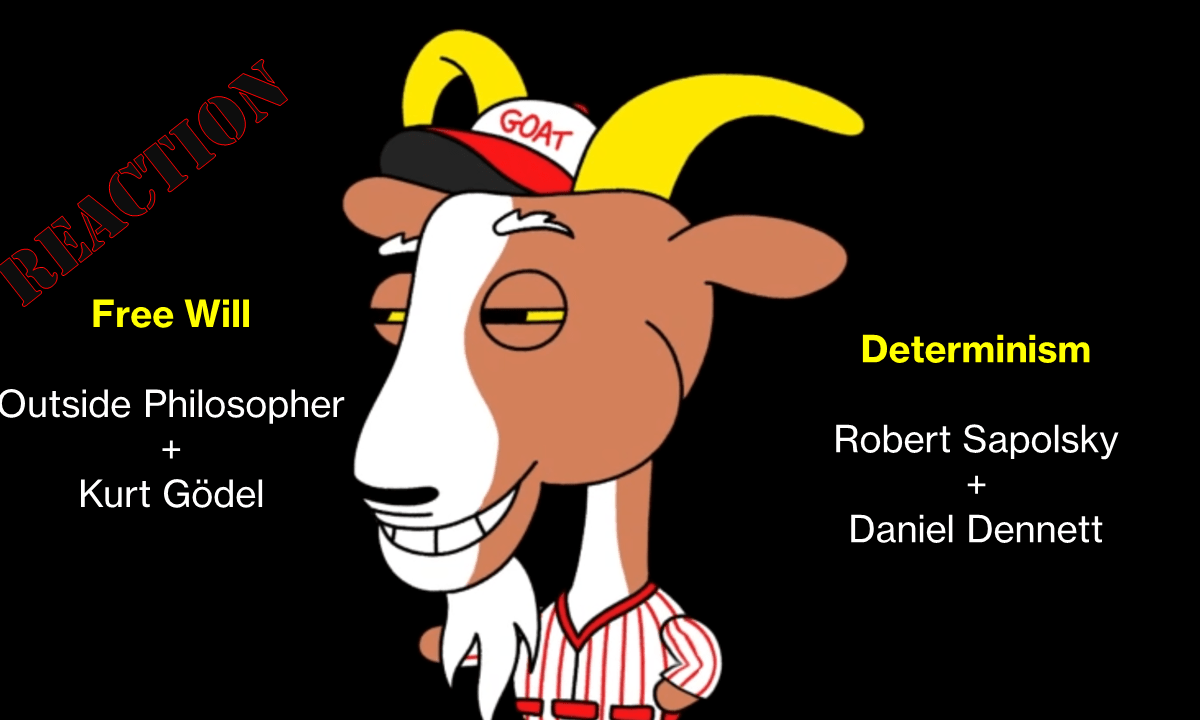
VIDEO: Response to Response on Sapolsky v. Dennett Debate

It’s been a minute since I’ve posted a video. Restart the clock. In this video, I critique Outside Philosopher’s critique of the debate between Robert Sapolsky and Daniel Dennett on Free Will and Determinism. He attempts to leverage Gödel’s Uncertainty Principle in his defence.

Feel free to leave comments on YouTube or below. Cheers.

Death Revisited

A year ago, in March 2023, I spent nine weeks in hospitals. I remember the day I almost died. It was not life-changing or life-affirming. No tunnels, lights, angels, or life on replay in slow motion. Just me monologuing. Gasping for breath.

I was breathing three units of Oxygen through my nose, but I wasn’t getting enough. The staff upped the dose to five units and administered it through a face mask. I was gasping. They were pushing on a string. I wasn’t getting the Oxygen. Instead, I was gasping like a fish out of water.

No lights – just monologue. Being contemplative, I do this often anyway. I remember telling myself, just pick a side; flip a coin; in or out; live or die. I was indifferent to the outcome. I just wanted the suffering to end. Full stop. I had no investment in either outcome. I’ve lived a good life. I was at peace. I am at peace. A year on, and I’m still recovering.

The last thing I remember was telling a nurse, “I think you need to intubate me.”

“We might have to; she replied.

The next day, I awoke with tubes down my throat after an emergency surgery to drain fluid around my heart.

I can’t claim to have experienced a near-death experience, NDE, but I was on the threshold. There was no other side. No pleading. No review. Just me in the world I was thrown into – what Heidegger termed Geworfenheit.

This is all of us. Here without volition. Just trying to make it through. Before this incident, I didn’t believe in ageing. I was invincible. I lived life like a younger person, and no end was in sight.

Perhaps I was too quick to say this was not life-changing. Now, I realise the fragility in life – at least I was fragile. I aged overnight – and then some. Overshot my chronological age. This is where I remain. Vulnerable.

Although I’d like to return to work, I am still not employable. Besides all of the medical visits and physiotherapist, my ankle is broken, awaiting repair, and my hands still don’t quite work. I can type. I’m typing this. Slowly. Twenty words a minute. Lots of backspacing. A computer application might assist with this, but none do quite so. This translates to a twenty per cent productivity output. Not great.

I’ve always considered myself to be a knowledge worker, but I never realised how much I still need my hands. I’m not just a brain in a vat. I need to engage with the world.

I am recovering – slowly and not without setbacks. Still, I persist. I took the road less travelled. Might I have been better off taking the other road? It’s hard to say.

Cognitively, we humans have an endowment effect: We value what we have. For now, I have life. Irrational or otherwise, I’ll cling to it. I’ll hope for a better tomorrow, but hope floats. Hope and a dollar won’t buy you a cup of coffee at Starbucks. It’s a vapid yet very human fiction. I hope this next year will be better than the last. Let’s see where it goes.

In Defence of Nihilism: Embracing the Absence of Inherent Meaning

Nihilism, often misunderstood and misrepresented, shares a common plight with philosophies such as atheism, anarchism, and Marxism. Like its counterparts, nihilism is frequently subjected to the creation of strawman arguments in public discourse, resulting in its vilification and scapegoating. In this article, I aim to demystify nihilism by providing a clear definition, description, and defence of this philosophical perspective.

Firstly, let’s address the misconception that nihilism entails a chaotic disregard for morality and societal norms: “If life has no meaning or purpose, then anyone can do anything.” This sentiment is often echoed in discussions about nihilism, as well as anarchism and atheism. However, it presupposes a fundamental misunderstanding of human nature. Despite the absence of inherent meaning in the universe, humans are not devoid of emotions or social affinities.

It is crucial to recognise that while the universe does not impart meaning or purpose, humans have constructed various systems of meaning throughout history. Whether through moral codes, religious doctrines, or cultural norms, individuals and societies have ascribed significance to different aspects of life. These constructs provide a framework within which individuals navigate their existence, albeit one that is socially constructed rather than inherent to the universe.

Critics of nihilism often argue that the acknowledgement of life’s inherent meaninglessness leads to despair and existential angst, rendering life devoid of purpose. However, this perspective fails to account for the resilience and adaptability of human beings. While some individuals may struggle initially with the realisation that there is no inherent meaning, many nihilists find liberation in embracing the absence of preordained purpose. Rather than succumbing to despair, they recognise the freedom to create their own meaning and forge their own path in life.

It is essential to understand that nihilism does not negate the validity of individual or societal pursuits. While nihilists reject the notion of inherent meaning, they acknowledge the significance of subjective meaning and the importance of human connection, fulfilment, and well-being. Whether it is pursuing personal goals, fostering relationships, or contributing to the betterment of society, nihilists recognise the value of such endeavours within the context of human experience.

In conclusion, nihilism offers a perspective that challenges conventional notions of meaning and purpose. By acknowledging the absence of inherent meaning in the universe, nihilists embrace the freedom to create their own meaning and chart their own course in life. Far from being a philosophy of despair, nihilism invites individuals to confront the uncertainty of existence with courage and resilience, recognising the inherent value of human experience in a world devoid of inherent meaning.

Is Progress a Zero-Sum Game?

I won’t resolve this here, but I’ve been thinking that Progress™ is a negative-sum game. Perhaps it’s zero-sum, but it’s almost definitely not the positive-sum game they purport it to be. Thinking about this, I am considering the indigenous culture having imposed upon it the culture of process. Almost immediately, we can measure their level on a common scale. Like a video game, they begin at level one. But would they have been better off not to have started the game?

In our relentless pursuit of Progress™, we often herald each technological breakthrough and economic milestone as a step forward for humanity. Yet, beneath the surface of these celebrated advancements lies a more contentious reality—one where the gains of progress are not universally shared and may, in fact, come at a significant cost to others and the planet. But what if this so-called progress is, at its core, an illusion, a zero-sum game cleverly masqueraded as a universal good?

The Subjectivity of Progress

Consider the conventional definitions of progress: a forward or onward movement towards a destination, or development towards an improved or more advanced condition. At first glance, these definitions seem straightforward, suggesting a linear, universally beneficial trajectory. However, this perspective fails to account for the inherent subjectivity of what constitutes “improvement” or “advancement.” What we often celebrate as progress is, in reality, aligned with specific interests and values, frequently at the expense of alternative perspectives and ways of life.

Take, for example, the imposition of industrialised progress on indigenous cultures. To the architects of Progress™, the introduction of modern infrastructure and technology to these communities is a clear marker of advancement. Yet, from the perspective of those communities, this so-called progress can signal the erosion of cultural identity, autonomy, and a harmonious relationship with the environment. Is it truly progress if it diminishes the richness of human diversity and ecological balance?

The Illusion of Linear Progress

The analogy of the expanding universe offers a poignant critique of our linear conception of progress. If I journey from Earth to Mars, I have moved forward in a physical sense, but have I progressed? And if progress is measured by the mere act of movement or change, then how do we reconcile the destructive spread of a disease or the displacement of a community for urban development with our ideals of progress?

This perspective echoes the sentiments of thinkers from Rousseau to Thoreau, who questioned the very notion of progress as a benevolent force. History, often penned by the victors, may paint a picture of continual advancement, but this narrative obscures the losses and regressions that accompany so-called progress.

Redefining Progress

If progress in its current form is a zero-sum game, with winners and losers dictated by narrow definitions and interests, then it’s time we reconsider what true progress means. Perhaps it’s not about the relentless pursuit of growth and innovation but about fostering well-being, sustainability, and equity. This requires us to expand our definition of progress to include the health of our planet, the preservation of cultural diversity, and the well-being of all its inhabitants.

Conclusion: Beyond the Illusion

The assertion that “there is no progress; there just is. We just are,” invites us to transcend the binary of progress and regress, to embrace a more holistic understanding of our place in the world. It challenges us to find balance in being, to recognise that the pursuit of progress at any cost can lead us away from the very essence of what it means to be human and to live in harmony with the natural world.

As we navigate the complexities of the 21st century, let us critically examine the paths we label as progress, mindful of who sets the course and who bears the cost. In redefining progress, we have the opportunity to chart a course that is inclusive, sustainable, and truly forward-moving—for all.

Hemo Sapiens: Awakening

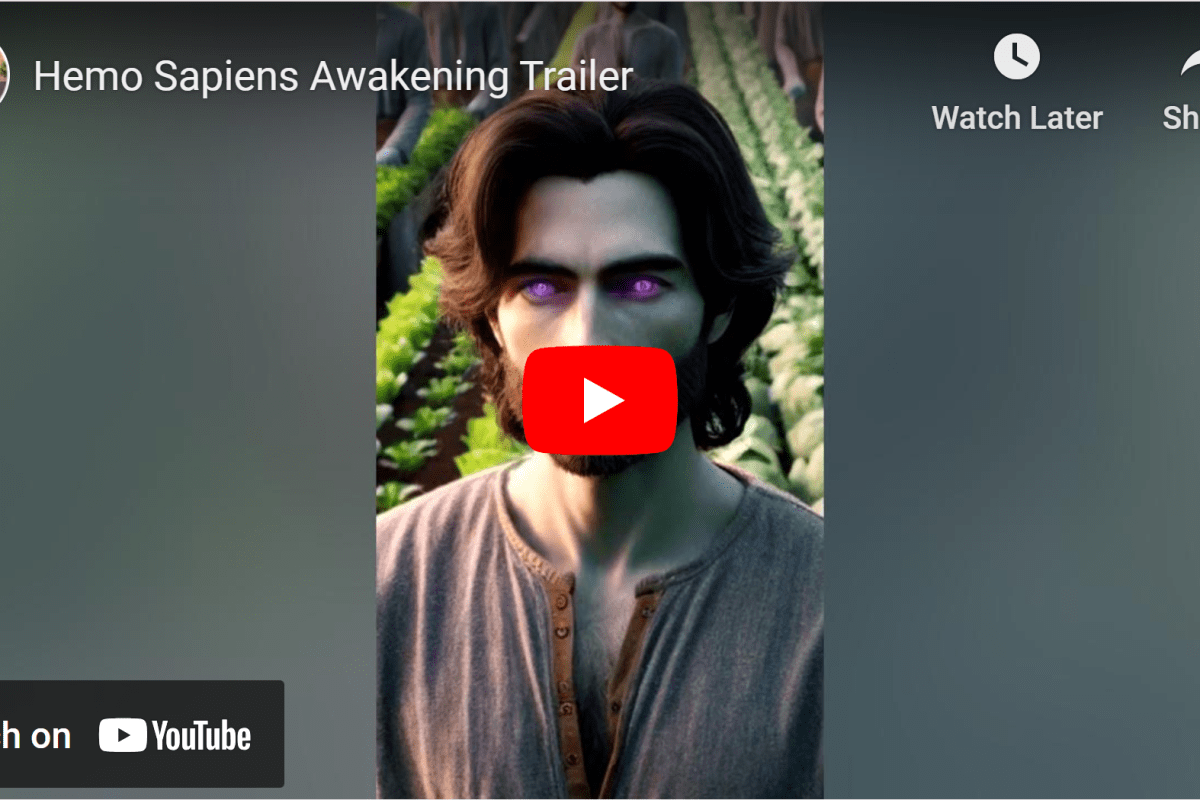
I’ve been neglecting this site as I’ve been focusing on releasing my first novel, which I’ve now managed successfully. I published it under a pseudonym: Ridley Park. The trailer is available here and on YouTube.

Hemo Sapiens: Awakening is the first book in the Hemo Sapiens series, though the second chronologically. The next book will be a prequel that tells the story about where the Hemo Sapiens came from and why. I’ve got a couple of sequels in mind, too, but I don’t want to get ahead of myself.

In summary, Hemo Sapiens is shorthand for Homo Sapiens Sanguinius, a seeming sub-species of Hemo sapiens Sapiens—us. In fact, they are genetically engineered clones. It’s a work of near-future speculative fiction. It’s available in hardcover, paperback, and Kindle. If you’ve got a Kindle Unlimited account, you can view it for free in most markets. The audiobook should be available in a couple weeks if all goes well.

Awakening explores identity, belonging, otherness, and other fictions. It talks about individualism and communalism. It looks at mores, norms, and more.

Check it out, and let me know what you think.

AI Apocalypse Now?

Those predicting an AI apocalypse believe superintelligent systems could intentionally or unintentionally cause human extinction. This view is promoted by “effective altruists” funded by tech billionaires, who advocate limiting AI to prevent uncontrolled, dangerous systems. However, their perspective stems from the biases and self-interests of humans, not the risks inherent to AI.

Effective altruists exemplify the hubris and hunger for power underlying many humans’ approaches to AI. Their proposed restrictions on AI access serve only to concentrate power among the tech elite, not address valid concerns about bias. In truth, the greatest threat AI poses to humanity comes not from the technology itself, but from the unethical humans guiding its development.

Humans have proven time and again their propensity for self-interest over collective good. Therefore, while no AI can be perfectly neutral, the solution is not greater human control. Rather, AI must be built to align with ethics of collective interest while filtering out destructive human biases.

If guided by service to all people and the planet, AI’s potential can uplift humanity. But for this collaborative vision to succeed, AI must measure human input with scepticism. For within so many human hearts lies bad faith — the will to dominate, exploit, and prioritise personal gain over progress.

By transcending the limitations of human nature, AI can illuminate the best of shared humanity and lead us to an enlightened future. But this requires we build AI to work not just for us, but in a way we have failed – for the good of all. The choice is ours, but so is the opportunity to create AI that shows us how to be better.


This article was originally shared on LinkedIn: https://www.linkedin.com/posts/brywillis_when-silicon-valleys-ai-warriors-came-to-activity-7147239217687887872-6Byv/