This is my take on the fifth chapter of The Matter with Things. I suggest reviewing the previous chapters before you delve into this one, but I won’t stop you from jumping queue.
Podcast: Audio rendition of this page content
Intro
Chapter five of The Matter with Things is titled Apprehension, following the previous chapters, Attention, Perception, and Judgment. From the start, let’s clarify that apprehension is not meant in the manner of being nervous or apprehensive. It’s meant to pair with comprehension. More on this presently.
Whilst the previous chapters have been heavily focused on the importance of the right hemisphere, this chapter is focused on the left, which may be given the chance to redeem itself. Not surprisingly perhaps, given the relative function of the right hemisphere versus the left, this chapter is much shorter than prior chapters.
Content
This chapter opens by asking what happens to a person who experiences left hemisphere damage. But let’s return to the chapter title. Apprehension is retaken etymologically and means to hold onto or to grasp. This is the function of the left hemisphere. The right hemisphere is about comprehension. The root ‘prehension’ is Latin for hold; the added ap prefix suggests holding on, whilst the com prefix suggests holding together.
Whilst conceptualising and abstract language is a right hemisphere function, spoken words are a left-brain function. It turns out that so is pointing and other gesticulation, reminding me of some ethnic stereotypes of people who speak with their hands. We need to keep in mind that the right hemisphere controls the left part of the body whilst the left hemisphere controls the right. What this means is that the right hand, being guided by the left hemisphere is marching to a different drummer.
Also, keep in mind from the previous chapters that the right hemisphere is holistic whilst the left is atomistic. Where right hemisphere damage is evident, a person has difficulty viewing the parts of a whole, whilst if the damage is on the left, a person has difficulty constructing a whole from its constituent parts. Namely, it may recognise that a body is constructed from an inventory of pieces—head and shoulders, knees, and toes—, but it can’t seem to grasp the cohesive orchestrated picture.
Apart from body continuity, when the left hemisphere is damaged, it might know all of the steps of a given process—McGilchrist shares the example of a person trying to light a smoking pipe—, but there may be difficulty in some of the instrumentation along the way. He cites an example by Czech neurologist, Arnold Pick, which I share here intact:
The patient is given a pipe and brings it correctly to his mouth, then expertly reaches for the tobacco pouch and takes a match from the box but when asked to light it, sticks the head of the match into the mouthpiece and puts the other end in his mouth as if to smoke it. Then he takes it out of his mouth, draws it out of the mouthpiece and sticks the other end of the match in the mouthpiece of the pipe, pulls it out again, holds it for a while in his hand apparently thinking, and then puts it away.
a person when encountering a pencil would feel compelled to grab it and start writing nothing in particular
To underscore the apprehension, where there is damage evident in the right hemisphere, the right hand (under control of the left hemisphere) may just grasp at things for no reason, perhaps reaching arbitrarily out to doorknobs. In one case, a person when encountering a pencil would feel compelled to grab it and start writing nothing in particular. In each case, the right hemisphere was not available to contextualise the experience. This right hemisphere is opening and exploratory whilst the left is closing and instrumental. It seems one might tend to meander without the left to provide a certain will and direction.
McGilchrist makes some correlations between humans and other great apes, but I’ll just mention this in passing.
I am going to pause to editorialise on McGilchrist’s next claim. He argues that Saussure’s claim that language signs are arbitrary is false and gives some examples—sun, bread, and spaghetti—but I am not ready to accept this stance. For now, I am remaining in the camp with Saussure and Wittgenstein that language is both arbitrary and self-referential. Getting down off my soapbox.
Recall again that whilst the right hemisphere takes the world as presented, the left hemisphere can only re-present. This is why language symbols are handled by the left hemisphere. Coming back to Saussure, the right-brain experiences a ‘cat’ whilst the left-brain names that object a ‘cat’ and classifies it as a mammal, feline, quadruped, and whatever else.
The right hemisphere is about metaphor, prosody, and pragmatics whilst the left hemisphere, though not exclusively, is about syntax and semantics.
The right hemisphere is about metaphor, prosody, and pragmatics whilst the left hemisphere, though not exclusively, is about syntax and semantics. The left hemisphere is about symbols. As such, lipreading and interpreting sign language are both left-brain activities.
An interesting conveyance is a case study of a person with left hemisphere damage reading a book who recites the elephant in place of the written word India, so making an association by not recognising the word itself. And there may be a naming problem, so if there was a problem related to an ankle, they would point to an ankle but substitute the name of the part.
Finally, to reiterate the holistic versus atomistic divide, some people with left hemisphere damage can articulate the parts of the body or a bicycle, but when queried can’t relate that the mouth is beneath the nose or some such.
Perspective
To summarise, McGilchrist leaves with a comment, “The fabric of reality typically goes for the most part unaltered when the left hemisphere is suppressed.”
As I’ve been editorialising a bit throughout, I don’t have much to add at this point. Aside from my Saussure nit, I am still very interested in the concept that the right hemisphere constructs reality. I feel that I interpret this construction differently to Iain.
I believe that we agree that there is a world out there, and we interpret this world by interacting with it. Where I feel we differ is that he feels there is a world of objects that we interact with and perceive whilst I believe that we construct this world of objects by means of constructing the underlying material, from particles to fields. I think he’ll discuss this more in later chapters and I could be off base. Time will tell.
Having put Apprehension to bed, next up is a chapter on Emotional Support and Intelligence. I hope you’ll join me.
What are your thoughts? What did you think of this chapter? Were there any surprises? Anything of particular interest?
In this segment, I continue the journey through Iain McGilchrist’s masterwork, The Matter with Things by summarising chapter three, Perception, a followup to the previous chapters, respectively titled Some Preliminaries and Attention. I strongly recommend that you listen to these in turn, but feel free to play the rebel and cut queue. No one will even notice but you, and if you don’t tell, neither shall I. Come join me.
Podcast: Audio rendition of this page content
Intro
Chapter two of The Matter with Things is titled Perception. Following the previous chapter, Attention, it’s about how we perceive what we attend to. Without attention, there is no perception, but perception is not always correspondent with the so-called reality “out there”.
Content
From the start, McGilchrist wants to assess which hemisphere is more veridical. Spoiler Alert: It’s the right half. But you already knew that because you’ve been keeping pace. And you also know that I feel he is leaving an option on the table, that neither is veridical to the actual terrain; rather, one just better maps the map. But the question essentially resolves to the same place, not as much verity as trust.
Sensory perception occurs in both hemispheres, but it is better in the right hemisphere than the left, as the left has been somewhat relegated to re-presentation over time—the same hemisphere that is better suited for codifying and mapping using symbolic language—something reserved for the brains of primates—which gives us a virtually inexhaustible way of mapping the world.
Perception is holistic, something better handled by the right hemisphere, being as the left hemisphere is more about focus and specificity. On balance, the right hemisphere is the arbiter of performance delegation, whether to perform a task or delegate it to the left hemisphere. About three-quarters of perception functions are right hemisphere processes.
McGilchrist is partial to the position advanced by Merleau-Ponty, that is “perception as a reciprocal encounter.” Perception is not a passive act. It is an interactive intercourse with the environment. What and how we perceive is affected by our experience and the situation.
Visual Perception
Perception involves all the available senses—and by definition none of those otherwise unavailable. He starts with vision. The right hemisphere does a lot of heavy lifting here. It handles size, shape and pattern recognition, contour, shadows, distance and depth, for example, three-dimensional space, and motion and time as well as the ability to recognise objects from unusual angles or from incomplete information, which I tend to think of as playing some Gestalt role. The right also handles colour perception, though the left maintains the colour name mapping.
The left hemisphere is slightly faster at detection, but if what is detected has any signal degradation, the right hemisphere tends to be more accurate. And since the left hemisphere is, what I’ll call lazy, it may tire quickly and space out, so the right hemisphere may have to intervene, if even a bit more slowly. Paradoxically, if the left hemisphere is given more time, its recognition error rate increases. Incidentally, one reason the right hemisphere may respond more slowly is that it is deliberating to attempt to deliver the correct response whilst the left tosses out its first best guess and declares victory. Nailed it!
Nailed It!
Recall from the last chapter that the left hemisphere is also a master of denial, so it is unapologetic when it guesses wrong. I imagine it signalling ‘that’s not a bus’ just as it hits you and then insists that it never was a bus; that injury must have been caused by something else. Perhaps it was an untoward wrecking ball.
Without delving into details here, McGilchrist points out that much early research might be invalid because it employed cathode ray tubes—CRTs—whose mechanisms present biased information to the visual field, thereby invalidating conclusions.
the left hemisphere is better at recognising tools—hammers and spanners—, but not musical instruments, which it perceives more as living entities
An interesting area for me is that the left hemisphere is better at recognising tools—hammers and spanners—, but not musical instruments, which it perceives more as living entities. And this is an apt segue to auditory perception.
Auditory Perception.
Whereas the left hemisphere is better at symbolic language processing and “the processing of meaningless noises, such as clicks”, the right hemisphere pretty much handles the rest, from pitch, inflexion, tone, phrasing, metre and complex rhythm, and melody. The left keeps tabs on basic rhythmic patterns. It is assumed that rhyming relies on both hemispheres working in concert.
For most people, music processing is a right hemisphere event, but this is not true for professional musicians, who utilise both hemispheres, likely owing to the musical language translation processing unnecessary for the casual listener.
Olfactory Perception
Interestingly, the acuity of the nose is orders of magnitude superior to that of the eyes and ears. Olfactory recognition and discrimination have a right hemisphere preference, but emotional reactions to scent may be stronger in the left hemisphere.
Gustatory Perception
“Apart from five very basic tastes – salt, sweet, sour, bitter and umami – which come from the tongue, all flavours come from the olfactory sense.” In general, gustatory perception is a right hemisphere function. However, there is an exception for professional wine tasters, who like professional musicians need to map experiences to words associated to rating and naming.
Tactile Perception
Remembering that the right hemisphere controls the left half of the body, whilst the left hemisphere controls the right, the sense of touch is superior in the left hand. Feelings of warmth, and temperature discriminations in general, are associated with right hemisphere activation. Interoception, the ability to perceive the internal workings of the body, is another right hemisphere process.
Local versus Global Perception
Recall that the right hemisphere captures the world holistically whilst the left hemisphere has a laser focus. This equates respectively to global and local perception. As it happens, the right can do both, but the left is limited to local. This means that if the left hemisphere is damaged, the right can pick up the slack, but if the right hemisphere is damaged, the left cannot compensate for the lost holistic perspective. In practice, the right runs the show and delegates to the left when it deems it to be appropriate for the circumstance. For some reason, normal adolescents have a bias toward local perception over global.
Pathologies of Perception
This leads us to abnormalities, such as Alzheimer’s disease. Deterioration of right hemisphere function leads to a sense of disorganisation and loss of sensation. This hemisphere is also responsible for constructing a sense of self and self-awareness. McGilchrist calls out that the term self has multiple meanings. Much of the notion of self is associated with the medial prefrontal cortex in both hemispheres, but the objectified self and the self as an expression of will (in the respect Schopenhauer spoke of) are left brain aspects.
Perception of a contiguous self over time is a right hemisphere function, the loss of which is not uncommon in cases of schizophrenia.
In discussing visual hallucinations and distortions, almost ninety per cent of these have been attributable to right hemisphere anomalies. McGilchrist shares examples over several pages, but I’ll summarise by description alone of what can be categorised under the umbrella term of metamorphopsia. These might lead to object impermanence, or viewing things as too large or too small, too close or too distant, skewed, or the wrong shape altogether. In some cases, only half of an object, including self-perception, was outsized. This might occur on a macro level or a micro level, which is to say that it may be entire objects or bodies or just faces, or just familiar faces or just eyes or just one eye. This might occur on a macro level or a micro level, which is to say that it may be entire objects or bodies or just faces, or just familiar faces or just eyes or just one eye.
Some of these cases involved motion, for example, the sense that some object is receding away from the observer as the observer draws nearer to it.
After a journey through Charles Dodgson, AKA Lewis Carroll, and Alice in Wonderland, provides a plethora of examples in prose of some of these visual effects.
From visual hallucinations, we wonder through hallucinations of the other senses, though the data points on these are much sparser, but the left hemisphere does seem to be the culprit of most auditory hallucinations.
Perspective
To summarise, I am again left to feel that the left hemisphere is a deadbeat hanger-on. It’s there in a pinch, but it’s an unreliable narrator and worker that falls asleep at the wheel. Psychology does have a position on what a normal person should see and hear and taste and touch, but normal doesn’t mean real.
I was hoping to see some information and perspective on synaesthesia, a condition where people perceive experiences through sense-perception organs different to normal. These people see music and hear smells or taste colours and so on. We consider this to be anomalous, but does it provide a fitness benefit, and are these people ahead of “normal” people or are they carrying excess baggage that creates a burden, even if the condition is otherwise benign.
Now that we’ve covered attention and perception, we’ll be covering judgment in the next chapter. I hope you’ll join me.
What are your thoughts? What did you think of this chapter? Have you experienced or know of anyone who has experienced any of these so-called anomalies. Are you familiar with any of the effects mentioned in Alice in Wonderland? Leave comments below.
I’ve decided after all to share my thoughts as I journey through Iain McGilchrist’s The Matter with Things. Come join me.
Podcast: Audio rendition of this page content (6:41)
Intro and Biographical
I’ve decided, perhaps against my better judgement, to have a run at Iain McGilchrist’s The Matter with Things. At almost 3,000 pages this seems a bit daunting at the start. I debate whether I wish to pursue this course because it slows my pace significantly—perhaps allowing me to progress at a rate 15 to 20 per cent of what I might have otherwise been able to maintain. However, creating content affords me at least two offsetting benefits. Firstly, I get to share my experience with a wider audience and do so in the moment. Secondly, it allows me to better absorb and comprehend the material. As a former professor of economics myself, I internalised the aphorism “to teach is to learn twice.” Of course, this is not teaching so much as regurgitating and providing my own reactions and perspectives in places. It may be akin to learning some one-point-some-odd times. Let’s round up to two.
Biographically, McGilchrist was a lecturer of Literature at Oxford before refocusing on Medicine and then Psychiatry with an interest in Neuroscience. Interestingly, he was particularly interested in hemisphere differences in the brain and was advised strongly not to pursue this academically, as it was a certain career-killer. Besides the domain was already over-studied and summarily disproven. Iain persisted.
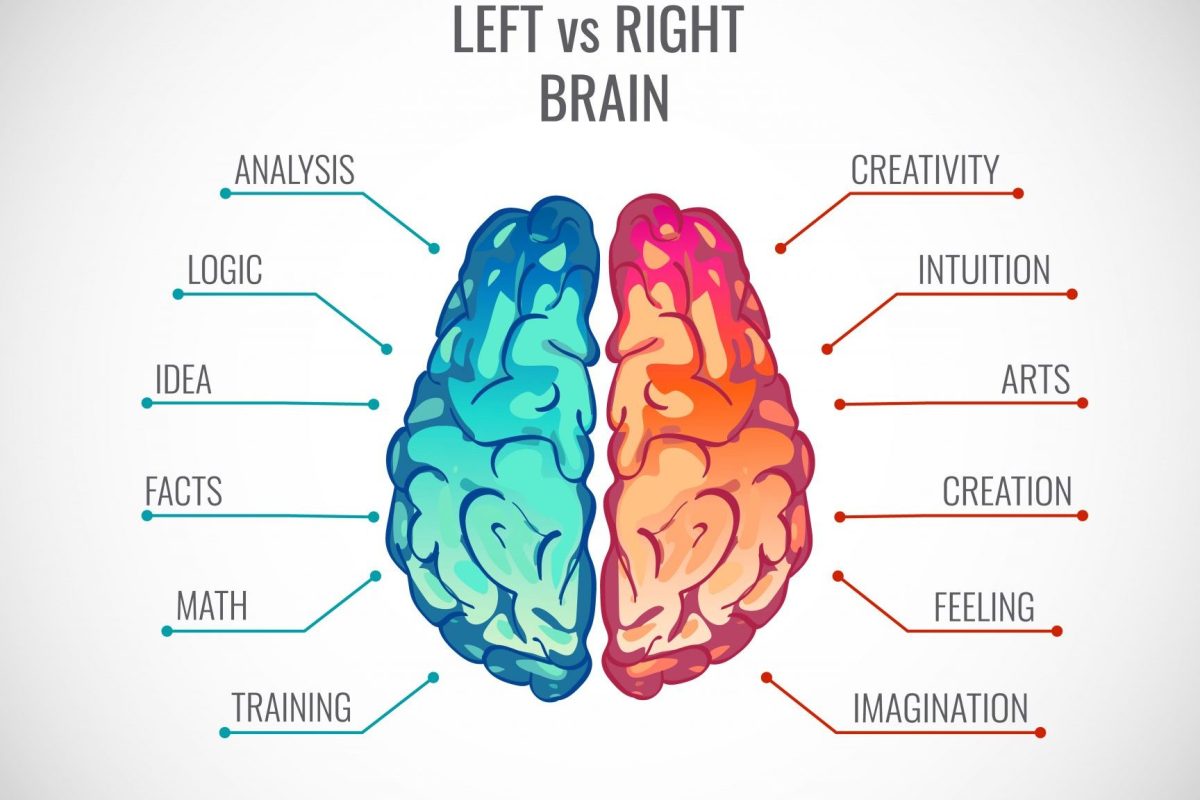
As it happens, the older notions of hemispheric differences were facile nonsense, but there was evidence of brain asymmetry—which will become readily apparent in the opening chapters—, and this has been his passion project ever since.
Structure
The Matter with Things is a two-volume set presented in three parts, the first two contained in the first volume. Neuropsychology—both neurological and neuropsychological—is the theme of the first part, which is comprised of nine chapters. The second part consists of 10 chapters with a focus on epistemology. The second volume, being the third part, is about metaphysics.
Content
The first chapter is aptly named, Some Preliminaries and How We Got Here. Per the author, this is the most technical chapter with the added encouragement: “If you survive this, you’re good to go.”
This chapter provides some basic history of the evolution of the brain. He establishes that the “raison d’être [of the right hemisphere] is to enable us to be on the lookout for potential predators, to form bonds with mates, and to understand, and interpret the living world around us” whilst the left hemisphere’s purpose “is to enable us to be effective predators.”
This is a gross oversimplification, but details will follow. Essentially, the right hemisphere experiences the external world rather holistically as presented whilst the left hemisphere interprets, codifies, and maps this world for later access. He doesn’t mention it in this chapter, but since I’ve read a bit ahead already—so we’ll return to it presently—the left hemisphere does not, loosely speaking, interact with the external world. It creates map based on what the right hemisphere conveys of the terrain, as I like to call it, and refers only to the map from then on. This sets us up for some peculiar behaviours, but we’ll get to that in upcoming chapters.
Perspective
I don’t have much to say about this first chapter as it is pretty much scientific facts, and I don’t have any unique perspective to offer. As I expect to reserve the tail of these segments for perspective, I’ll use this allotted space for some general thoughts going in.
I am not sure where McGilchrist falls on the Realism versus Idealism front. As I understand from other sources, he believes there is an out there out there, and without our brains, perception couldn’t happen. I also understand that he’s a Panpsychist, which is to say that he believes that everything has consciousness, so it will be interesting how that all comes together. Unfortunately, I feel this is second-volume fare.
As I am an Analytic Idealist, I believe that there is an out there out there as well. But I don’t believe we have any access to its veridical nature. What we experience is a Bayesian approximation, the best guess necessary for us to survive and evolve. I mention this as I believe it is a difference of opinion I have up front, so I am offering full disclosure of a potential bias. Also, I get the feeling that he conflates this paradigm with those espousing views that we live in a Matrix-style simulation, or everything is a hologram or holograph, and one day I’ll understand the difference between the two.
If you know the difference between a hologram and a holograph, let me know in the comments or on the blog.
Have you read this book already? Are you interested in reading it? If so, stick around and perhaps you’ll gather enough information here to catch your attention.
Several of my esteemed colleagues prompted me to become familiar with Iain McGilchrist. I had viewed hours upon hours of his lectures before I decided to commit to his latest book and likely magnum opus, though I don’t want to sell him short. The Matter with Things is an approximately 3,000-page, two-volume tome. To be fair, it’s about 1,600 pages of narrative content with the remainder being appendices, a bibliography, an index, and other such back matter.
Podcast: Audio rendition of the content on this page.
I’ve mentioned much of this before, but I am writing this post with a particular LinkedIn audience in mind, whom I don’t expect to be familiar with my prior commentary, though they are invited to explore more. McGilchrist’s thesis is that the human brain operates with asymmetrical hemispherical differences. These differences are not the facile “left-brain analytical, right-brain creative” distinction of yore, rather the differences are more nuanced. If you are interested in the minutiae of this, stick around and read past and future posts when they arrive, as I’ll be documenting my journey through these volumes presently.
So, what’s the matter with project managers? And why bring up project managers? In my workaday life, I’ve often been asked to perform project management functions, something decidedly not my forte. I could be reading into and am guilty of reductionism, but in reading The Matter with Things, I may have stumbled onto something with explanatory power. So let’s pause for a quick reflection.
Pistachio in hand
In a very small nutshell. I’m talking, perhaps, pistachio-sized here. The right brain hemisphere is the part that experiences the world as it is. The right brain is not about making judgments and categorising. Rather, it’s about just absorbing without interpreting, per se. On the other hand, the left brain hemisphere interprets, codifies, and maps this world for later access. Again, forgive the over-simplification, but this is the information pertinent to the matter at hand—a very left-hemisphere control function, I might add.
It turns out that the left brain is not so much concerned with the outside world at large. Once it has its map, it is rather content to reference it from there on in unless the right brain nudges it to pass along more information. Whereas the right hemisphere opens possibilities, the left hemisphere shuts them down. If you’ve read Daniel Kahneman’s work, Thinking Fast and Slow, you may notice certain parallels. I’d be interested to know if McGilchrist comments on this. Perhaps a later topic.
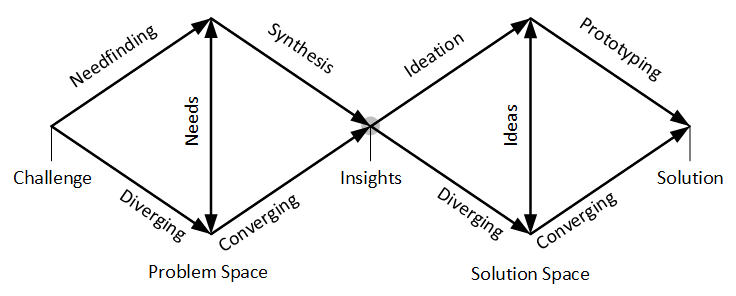
Borrowing from some aspects of Design Thinking, there is a double diamond design process model. I purloined one from the internet that will work for my purposes.
Double Diamond Design Process Model
I feel that I can simplify and assume that the diverging activity represents a right hemisphere strength whilst the converging is more apt to be a left hemisphere activity.
The right brain is not only always open to seeing options and opportunities, it actively seeks them. The left brain just wants to close any discussion and settle on a decision or an answer.
From an evolutionary perspective, the “raison d’être [of the right hemisphere] is to enable us to be on the lookout for potential predators, to form bonds with mates, and to understand, and interpret the living world around us” whilst the left hemisphere’s purpose “is to enable us to be effective predators.”
A right-hemisphere dominant person will likely continue to play what-if until the cows come home. A left-brain dominant person will take the first semi-viable solution and want to run on it. No need for deliberation. In a balanced scenario, the left and right hemispheres will battle for dominance, but they will arrive at a good-enough solution.
And this is where project managers enter the picture, and where I exit. I am decidedly over-indexed on the right brain. Among other things, I see options and possibilities. And, sure, I have enough balance to resolve to take action, but I don’t lose track of the possibilities and I am always ready to change course at a moment’s notice—what we call pivot in the business—or perish as the case might be.
The project manager, on the other hand, sees the map. This represents practically inviolable marching orders.
Disney Sorceror’s Apprentice Brooms-Flood Scene
One aspect of a good project manager is the ability to filter out the noise. Rather, this is what a right-brain person would surmise. Instead, the left-brain person doesn’t even register the noise. Where a right-brain person has to expend energy continually filtering out options and possibilities, the left-brain person never registers these options from the start. So, where I as a right-brain person may find it exhausting to actively and continuously limit this noise, this threshold is never triggered for the left-brainer.
In closing, I want to remind you again and again and again, that this is a gross oversimplification and rather metaphorical in nature. Nonetheless, I feel the that it is germane and offers insights into why some people are more apt at certain tasks than others.
I want to emphasise that one side is not better than the other. A right-dominant person is not superior to e left-dominant person, and vice versa. As with the brain itself, these can be complementary. Some people are very capable of tasking whichever hemisphere is necessary, but this is rarer than one might at first assume. McGilchrist provides many examples, so you can read them for yourself firsthand, or you can follow along as I call out key highlights in The Matter with Things.
If you have any comments or suggestions, feel free to leave them in the space provided.
As a Social Justice Warrior, I tend to favour diversity and inclusion as a principle. As such, I follow some people who share this interest. In fact, most of these people expend much more energy toward this end than I do. The challenge I am about to convey is that some people don’t read beyond the subject line, and don’t even attempt to assess the underlying claim, let alone the issue at hand.
I recently engaged in a nonsensical interaction that I am sharing and dissecting. It started with this share, an image of the border outline of Nigeria with an overlay caption that reads: “Nigeria becomes the first country to ban white and British models in all advertising”.
I’d like to point out two items in particular. Firstly, the caption is fabricated. I’ll get to the source reference presently. Secondly, the re-poster aptly corrects the caption when he shared it—”Well, all foreign models, but HELL YEAH!”
Nigeria recently passes a law that essentially assesses a tariff or levy on advertising content using non-Nigerian talent. There is no mention of ‘white’ models, though British models would fall under this umbrella. This protectionist law stems from nationalism. I’d guess that ‘white’ people comprise less than one per cent of the Nigerian national population, but I could be wrong. This is well outside my area of expertise.
My response was to say “Down with Nationalism and the Promotion of Otherism.” I may be misinterpreting myself, but it feels to me that this is denouncing racism and other forms of otherness.
Sabrina responds, ‘Why is not having white models in advertising a bad thing?” and “Isn’t the whole point of advertising [for] people to…see themselves… ?” In response, I should have pointed out that the initiative had nothing to do with skin colour. Instead, I responded to the second question: the point of advertising is to sell product. Full stop. If people see themselves with the product, then great. Clearly, this comprises a fraction of successful adverts. More common is to make a connection to what they aspire to. It’s not about making a social statement—unless, of course, that social statement will sell more product. If an ad with a white model will sell more product, a business would be derelict not to employ one; conversely, if white models result in lower sales, a business would be foolish not to switch to the more successful vector.
Sabrina really goes off the reservation with her reply, somehow conflating Nigeria with the African continent. Attention to detail is not her forte.
At this point, I feed into her laziness and send her a link to an Al-Jazeera article addressing the law.
She leaves with a parting shot, and I quote: “Have you ever thought about the harm you might cause by playing devil’s advocate and “creating an argument”?”
She’s off course and then attempts to diminish my point by calling it ‘playing devil’s advocate’ rather than admitting that she hadn’t even considered the rationale and possible ramifications. She didn’t even grasp the main point, so I suppose I should forgive her for not noticing secondary and edge cases.
At this point, Dr Perkins adds her voice. Her initial question is valid, and as I responded, the answer is “No”. The race card was introduced by some narrator who didn’t know what game he was broadcasting. But then she goes on to “applaud Nigeria for making a [decision] centering [on] Blackness”, save to say that was not what prompted the decision.
Notice, too, that other people “Liked” the other comments, a testament to the principle of least effort of the bystanders, too.
I recognise that the original post anchored the conversation off the actual topic, but it was also very easy to track down the reference and note the content discrepancy. Granted, this takes time and effort, but so does responding on a thread and then escalating commitment to a non-cause. And for one tilting at windmills to be tossing around accusations of playing devil’s advocate. It’s not a good sign.
But wait, there’s more. I commented on this post on a second thread.
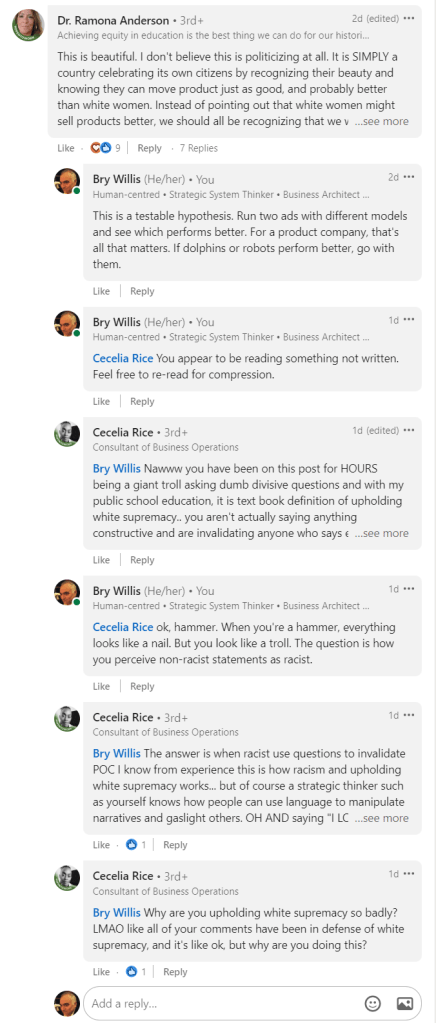
In this case, Dr Anderson suggests that this is just “a country celebrating its own citizens by recognizing their beauty and knowing they can move product just as good, and probably better than white women, to which I responded that this is a testable hypothesis. It’s either true that on balance white models sell more product or black models do. Again, don’t fail to miss the point that none of this is about white versus black models.
Somehow, LinkedIn can’t seem to keep their threads in order, but Ms Rice takes my hypothesis testing point as a support for racism before precipitating to full-on troll mode.
It scares me to see that there are two academic doctors participating in this thread, neither with a trait of attention to detail nor even a fundamental pursuit of evidence.
This is why it is difficult to engage with social media. You have no idea what level a commenter is coming in on. And even when spoon-fed information, they refuse to alter their position. In fact, they tend to double down on their wrongness. Moving on…
I’ve only read the first four chapters of Iain McGilchrist’s The Matter with Things. My intent is to build up to how his ideas intersect with my workaday life in a future segment, but for now, I’ll summarise some main themes.
Podcast: Audio rendition of this page content (< 5 minutes)
The chapters I’ve read are
Some preliminaries: How we got here
Attention
Perception
Judgment
The next chapter is Apprehension.
Philosophically, or rather I have an interest in McGilchrist’s ontological model, but that appears not to arrive until the second volume, perhaps in chapters 24 or 25, respectively Space and Matter and Matter and Consciousness. Being that this underlaid my reluctance to engage with this book, I did take liberties and skimmed these chapters quickly in an attempt to discern whether he is a Realist or an Idealist.
Until recently, I’ve been a Realist with reservations, but now I consider myself instead to be an Idealist with reservations—though I may have fewer reservations, so perhaps I am moving in the right direction.
As a Realist with reservations, I felt that there was some underlying reality, but sense-perception and cognitive limitations limited access to it, so correspondence to it was necessarily limited.
As an Idealist with reservations, I feel that there is some underlying reality, and sense-perception and cognitive limitations limit access to it, so correspondence to it is still necessarily limited, so we generate an approximation.
I agree with Donald Hoffman’s assertion of Fitness Before Truth, in summary, that it is faster and more efficient to assess environmental fitness and take penalties where the assessment may have been a false positive. If one recoils in error from a coiled garden hose initially perceiving it to be a snake, the penalty is low. If a delay is incurred to assess some ‘snakeness’ truth value, we may have already been bitten. If we see something charging at us, better to avert and assess than to take time to discern. It’s of little consolation to consider, “Ah. I’m being mauled by a cheetah.” Better to have ducked and covered.
My chapter skimming was not enough to ascertain McGilchrist’s position. I’ll wait until I arrive there in due time. No need to spoil the ending. Given the book’s title, I am leaning toward Idealist, but I may be mistaken.
Moving on, these chapters build on each other. Not so much with narrative content as to represent the necessary chain of perceptual events: attention, perception, and judgment—in this order.
We cannot judge what we can’t perceive, and we can’t perceive what doesn’t come into the sense-perception space. McGilchrist reminds the reader that just because something is in a space where it can be perceived does not mean it can or will be perceived. He cites the example of the invisible gorilla in a basketball game study, which I’ll link to separately.
What we attend to is a matter of the situation and experience. Once we bring our attention to it, we can attempt to perceive it. Is it a snake or just a garden hose? Finally, we can make a judgment—it was just a garden hose. Silly old bear. Or, I sure am thankful my reflexes are lightning quick.
Winnie the Pooh: Silly Old Bear
McGilchrist provides a plethora of examples, though most are tied to split-brain scenarios, which brings me to my last point. One of his theses is that left-right brain hemisphere differences are real and significant. Some had argued that the left-right representation is false, and he wants to take it back and regain that space by asserting arguments to the contrary.
I expect to discuss this more in an upcoming segment and apply my preliminary thoughts to my comprehension.
I love the panels, interviews, and insights presented on The Institute of Art and Ideas channels. In this segment, I am familiar with the host, Robert Lawrence Kuhn, who has put this all together, and two of the panellists, Iain McGilchrist and Donald Hoffman. I am not familiar with Eva Jablonka or Michelle Montague. This is an interesting conversation on consciousness, but I am commenting on McGilchrist’s position on love and how science can never capture the essence or dimensions of it because it is subjective and experiential. I’ve cued the video clip below to just prior to his response to provide he view with a set up.
As I’ve been saying for some decades now, I believe that love is a weasel word in the realm of justice and freedom. It’s an archetypal extreme, but it doesn’t mean anything more than trebled or analogical references.
McGilchrist resorts to the age-old, you don’t know it if you haven’t experienced it. This was famously captured by the US Supreme court’s take on pornography, “I can’t tell you what it is, but I know it when I see it.” This is used with God and faith as well. So, bollox, really. They’ve got nothing. And if you haven’t experienced it, then you aren’t a member of the club, and it’s your loss. Rubbish.
From the transcript, Iain tells the viewer (edited below for clarity),
“Love is a very real experience. and you only know it when you’ve had it. But it’s something that science can only refer to physical correlates of—rather ineffectively… But it’s not the same as knowing what love actually is.
“And the same is true of consciousness. It’s a subjective phenomenon, and as such, it’s not open to the kind of science that that i think is being required.”
Notice that this is the same defence asserted by religions. If you are seeking evidence, you are barking up the wrong tree. The evidence is that you can experience it, but this is not a shared experience. The shared experience occurs when people who feel they have had a similar experience can gather together and compare notes and share stories like they were participating in a 12-Steps program. Hullo, my name is Bukowski, and I’m an alcoholic.
Love is a delusion. Consider the notion of romantic love —just one of several purported flavours of love. What do we mean by this? We mean that we are very attracted to and emotionally attached to some other entity. Let’s limit this to other people. We care for this person and about what happens to this person, and we’d presumably like to remain a partner with this person. Generally, there would also be a sense that the other party reciprocates this feeling, but unrequited love is another aspect.
Given this state, we can measure hormonal changes, pupil dilation, and other physiological changes. And if we want to label this state love, then great. In practice, that’s what we’ve done. But so what? All we’ve really done is to take a bundle of descriptions and collated them into a nebulous term.
There are a couple of perspectives on this type of love. There is the person who senses their own feelings about their experience of love, as in “I love X”. Then there is a target of this love who may experience that they are loved by someone. Finally, there is the observer that might assess that Y loves X and or vice versa.
But what does this really mean? Is it just that Y like X very very much and has painted a picture of a future than includes this person? That Y has constructed some narrative storyline that includes X? That there is likely some lust involved in this particular flavour of love? Is love more than this? Is love more than just a shortcut? Is it just an acronym for “Likes Other Very Extremely”? Alright, I’ll stay out of the acronym construction business and end this just now.
The Conspiracy against the Human Race is a work of non-fiction by horror author Thomas Ligotti. There is an audio podcast version and a YouTube video version. Feel free to leave comments in the space below or on YouTube.
Transcript
In this segment, I’ll be reviewing a book by Thomas Ligotti, The Conspiracy Against the Human Race, A Contrivance of Horror.
I haven’t done any book reviews, but since I tend to read a lot of books, I figure why not share my take and see how it’s received? If you like these reviews, click the like button and I’ll consider creating more.
Let’s get started.
First, I’ll be providing a little background, and then I’ll summarise some of the content and main themes. I’ll close with my review and perspective.
The author is Thomas Ligotti. He is a published writer in the horror genre in the vein of Lovecraft’s atmospheric horror. I’ve not read any of his work and haven’t read much fiction in ages.
The Conspiracy Against the Human Race is Ligotti’s first work of non-fiction. The book was originally published in 2010. I read the 2018 paperback version published by Penguin Books.
Conspiracy Against the Human Race falls into the category of Ethics and Moral Philosophy in a subcategory of pessimism. The main thesis of this book is that humans ought never to have been born. Following in the footsteps of anti-natalist David Benatar, who published Better Never to Have Been Born in 2007, Ligotti doubles down on Benatar’s position on the harm of coming into existence and argues that humans should just become extinct. Moreover, we should take out life in general.
In the book, Ligotti posits that consciousness was a blunder of nature and is the root of all suffering. He argues the derived Buddhist position of dukkha, which translates as Life is suffering. He establishes that most people are aware of this fact, but that we are nonetheless wired to be biased toward optimism through delusion and what a psychoanalyst might call repressed memories. Moreover, pessimists are a cohort not tolerated by society, who don’t want their delusions shattered.
Philosophically, Ligotti is a determinist. I’ve created content on this topic, but in a nutshell, determinism is the belief that all events are caused by antecedent events, leading to a chain of causes and effects stretching back to the beginning of time and bringing us to where we are now. If we were able to rewind time and restart the process, we would necessarily end up in the same place, and all future processes will unfold in a like manner.
Ligotti likes the metaphor of puppets. He employs puppets in two manners. Firstly, being the determinist he is, he reminds us that we are meat puppets with no free will. Our strings are controlled by something that is not us. This something ends up being Schopenhauer’s Will, reminding us that one can want what we will, but we can’t will what we will. This Will is the puppeteer. Secondly, puppets are soulless, lifeless homunculi that are employed in the horror genre to create unease by means of an uncanny association. He cites the work and philosophy of Norwegian author Peter Zapffe, who also elucidates human existence as a tragedy. Humans are born with one and only one right—the right to die. And death is the only certainty. The knowledge of this causes unnecessary suffering.
Quoting Ligotti,
“Stringently considered, then, our only natural birthright is a right to die. No other right has ever been allocated to anyone except as a fabrication, whether in modern times or days past. The divine right of kings may now be acknowledged as a fabrication, a falsified permit for prideful dementia and impulsive mayhem. The inalienable rights of certain people, on the other hand, seemingly remain current: somehow we believe they are not fabrications because hallowed documents declare they are real.”
Ligotti reminds us that consciousness is a mystery. We don’t really know what it is or what causes it other than it exists and we seem to have it, to be cursed with it. He adopts Zapffe’s position that consciousness is also responsible for the false notion of the self.
As all life is, humans are the result of an evolutionary process. Consciousness was just the result of an evolutionary blunder. He cites Zapffe and conveys that “mutations must be considered blind. They work, are thrown forth, without any contact of interest with their environment.”
Whilst pessimists view consciousness as a curse, optimists such as Nicholas Humphry think of it as a marvellous endowment.
He summarises the reason humans have it worse than the rest of nature:
“For the rest of the earth’s organisms, existence is relatively uncomplicated. Their lives are about three things: survival, reproduction, death—and nothing else. But we know too much to content ourselves with surviving, reproducing, dying—and nothing else. We know we are alive and know we will die. We also know we will suffer during our lives before suffering—slowly or quickly—as we draw near to death. This is the knowledge we “enjoy” as the most intelligent organisms to gush from the womb of nature. And being so, we feel shortchanged if there is nothing else for us than to survive, reproduce, and die. We want there to be more to it than that, or to think there is. This is the tragedy: Consciousness has forced us into the paradoxical position of striving to be unself-conscious of what we are—hunks of spoiling flesh on disintegrating bones.”
I’ll repeat that: Consciousness has forced us into the paradoxical position of striving to be unself-conscious.
He cites Zapffe’s four principal strategies to minimise our consciousness, isolation, anchoring, distraction, and sublimation
Isolation is compartmentalising the dire facts of being alive. So, he argues, that a coping mechanism is to push our suffering out of sight, out of mind, shoved back into the unconscious so we don’t have to deal with it.
Anchoring is a stabilisation strategy by adopting fictions as truth. We conspire to anchor our lives in metaphysical and institutional “verities”—God, Morality, Natural Law, Country, Family—that inebriate us with a sense of being official, authentic, and safe in our beds.
Distraction falls into the realm of manufactured consent. People lose themselves in their television sets, their government’s foreign policy, their science projects, their careers, their place in society or the universe, et cetera. Anything not to think about the human condition.
Sublimation. This reminds me of Camus’ take on the Absurd. Just accept it. Embrace it and incorporate it into your routine. Pour it into your art or music. Ligotti invokes Camus’ directive that we must imagine Sisyphus happy, but he dismisses the quip as folly.
Ligotti underscores his thesis by referencing the works of other authors from David Benatar to William James.
Interestingly, he suggests that people who experience depression are actually in touch with reality and that psychology intervenes to mask it again with the preferred veil of delusion and delf-deception. Society can’t operate if people aren’t in tune with the masquerade. Citing David Livingstone Smith in his 2007 publication, Why We Lie: The Evolution of Deception and the Unconscious Mind, Ligotti writes: “Psychiatry even works on the assumption that the “healthy” and viable is at one with the highest in personal terms. Depression, “fear of life,” refusal of nourishment and so on are invariably taken as signs of a pathological state and treated thereafter.”
Ligotti returns to the constructed notion of the self and presents examples of how a lack of self is an effective horror trope, citing John Carpenter’s The Thing and Invasion of the Body Snatchers.
He spends a good amount of time on ego-death and the illusion of self, a topic I’ve covered previously. He mentions Thomas Metzinger and his writings in several places including his Being No One, published in 2004, ostensibly reinforcing a position described as naïve realism, that things not being knowable as they really are in themselves, something every scientist and philosopher knows.
He delves into Buddhism as a gateway to near-death experiences, where people have dissociated their sense of self, illustrating the enlightenment by accident of U. G. Krishnamurti, who after some calamity “was no longer the person he once was, for now he was someone whose ego had been erased. In this state, he had all the self-awareness of a tree frog. To his good fortune, he had no problem with his new way of functioning. He did not need to accept it, since by his report he had lost all sense of having an ego that needed to accept or reject anything.” Krishnamurti had become a veritable zombie. He also cited the examples of Tem Horwitz, John Wren-Lewis, and Suzanne Segal, but I won’t elaborate here.
Russian Romantic author, Leo Tolstoy, famous for War and Peace and Anna Karenina, was another pessimist. He noticed a coping approach his associates had employed to deal with their morality.
Ignorance is the first. As the saying goes, ignorance is bliss. For whatever reason, these people are simply blind to the inevitability of their mortal lives. As Tolstoy said these people just did not know or understand that “life is an evil and an absurdity”.
Epicureanism comes next. The tactic here is to understand that we are all in here and no one gets out alive, so we might as well make the best of it and adopt a hedonistic lifestyle.
Following Camus’ cue, or rather Camus following Tolstoy and Schopenhauer, he suggests the approach of strength and energy, by which he means the strength and energy to suicide.
Finally, one can adopt the path of weakness. This is the category Tolstoy finds himself in, writing “People of this kind know that death is better than life, but not having the strength to act rationally—to end the deception quickly and kill themselves—they seem to wait for something.”
The last section of the book feels a bit orthogonal to the rest. I won’t bother with details, but essentially he provides the reader with examples of how horror works by exploring some passages, notably Radcliffe’s, The Mysteries of Udolpho; Conrad’s Heart of Darkness; Poe’s Fall of the House of Usher; Lovecraft’s Call of Cthulhu; and contrasting Shakespeare’s Macbeth and Hamlet.
This has been a summary of Thomas Logotti’s Conspiracy against the human race. Here’s my take. But first some background, as it might be important to understand where I am coming from.
I am a Nihilist. I feel that life has no inherent meaning, but people employ existentialist strategies to create a semblance of meaning, much akin to Zapffe’s distraction theme or perhaps anchoring. This said I feel that, similar to anarchism, people don’t understand nihilism. Technically, it’s considered to be a pessimistic philosophy because they are acculturated to expect meaning, but I find it liberating. People feel that without some constraints of meaning, that chaos will ensue as everyone will adopt Tolstoy’s Epicureanism or to fall into despair and suicide. What they don’t know is they’ve already fabricated some narrative and have adopted one of Zappfe’s first three offerings: isolation, which is to say repression); anchoring on God or country; or distracting themselves with work, sports, politics, social media, or reading horror stories.
Because of my background, I identify with Ligotti’s position. I do feel the suffering and anguish that he mentions, and perhaps I am weak and rationalising, but I don’t feel that things are so bad. I may be more sympathetic to Benatar’s anti-natalism than to advocate for a mass extinction event, though I feel that humans are already heading down that path. Perhaps this could be psychoanalysed as collective guilt, but I won’t go there.
I recommend reading this. I knocked it out in a few hours, and you could shorten this by skipping the last section altogether. If you are on the fence, I’d suggest reading David Benatar’s Better Never to Have Been. Perhaps I’ll review that if there seems to be interest. If you’ve got the time, read both.
So there you have it. That’s my summary and review of Thomas Ligotti’s The Conspiracy against the Human Race.
Before I end this, I’ll share a personal story about an ex-girlfriend of mine. Although she experienced some moments of happiness and joy, she saw life as a burden. Because she had been raised Catholic and embodied the teachings, she was afraid that committing suicide would relegate her to hell. In fact, on one occasion, she and her mum had been robbed at gunpoint, and her mum stepped between my girlfriend and the gun. They gave the gunmen what they wanted, so the situation came to an end.
My girlfriend laid into her mother that if she ever did something like that again and took a bullet that was her ticket out, she would never forgive her. As it turned out, my girlfriend died as collateral damage during the Covid debacle. She became ill, but because she was living with her elderly mum, she didn’t want to go to hospital and bring something back. One early morning, she was writhing in pain and her mum called the ambulance. She died later that morning in hospital, having waited too long.
For me, I saw the mercy in it all. She got her ticket out and didn’t have to face the hell eventuality. Not that I believe in any of that, but she was able to exit in peace. Were it not for the poison of religion, she could have exited sooner. She was not, in Tolstoy’s words, weak, so much as she had been a victim of indoctrination. I feel this indoctrination borders on child abuse, but I’ll spare you the elaboration. So, what are your thoughts on this book? Is there a conspiracy against humanity? Are optimists ruining it for the pessimists? What do you think about anti-natalism or even extinction of all conscious beings or the extreme case of all life on earth? Is Ligotti on to something or just on something?
I have agreed with this sentiment for as long as I can remember, at least stretching back to age 10 or 12 and long before I had ever heard of the likes of Proudhon. I don’t believe that Proudhon is a big focus in the United States. I never encountered him in all of my studies from kindergarten to grad school—and I was an economics major.
In the US, disparaging Marx was always in vogue, with the off-hand remark along the lines of “Communism works on paper, but because of human nature, it can’t work in practice. And by the way, look at the Soviet Union. That’s all the proof you need.” Of course, I was left thinking that at least it worked on paper, something I can’t say with a straight face for Democracy.
For those who are familiar with Proudhon, he is likely remembered for his quote, “Property is theft!” I’ve discussed this before.
La propriété, c’est le vol!
Property is theft!
But this is a different quote: “I do not wish to be either ruler or ruled.” When I was in high school, there was a saying, lead, follow, or get out of the way. As imperfect of a metaphor as it is, I just wanted out of the way. In the world of leaders and followers, I wanted to be an advisor. In a manner—given the false dichotomy of followers and leaders—, this relegated me a de facto follower. Only I am not a follower. I not only question authority and authority figures, I question the legitimacy of their power. Not a great follower, to be sure.
I feel I am the peasant in Monty Python’s Holy Grail who tells King Arthur upon encountering him, “Well, I didn’t vote for you.” Not that voting yields some source of legitimacy. What options does one have?
Philosophically speaking, there is no justification for personal bodily autonomy. Someone just made this claim, and some others agreed. Sounds good to me, but there is no real reason to support the idea save for selfish rationale.
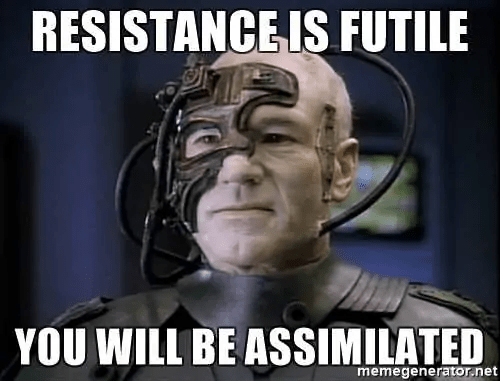
The science fiction staple, Star Trek, famously created a Borg where autonomy was futile. Because of our acculturation, we find this idea perhaps silly or perhaps appalling or absurd, but one is not more justifiable than another except by rhetorical devices. Yet neither is right.
Resistance is futile!
In the West, we tend to prefer a rather middle path, and perception doesn’t actually comply with reality. I think that people believe that they are more autonomous than they are. I’d be willing to argue that this is the same delusion underlying a sense of free will. Sartre might have argued that we each retain a sort of nuclear option as a last resort, but a choice between two options is hardly freedom. It sounds a lot like Sophie’s Choice (spoiler alert).
Not so come across like Hobbes, but I do feel that violence (subject to semantic distinction), or at least the potential for it, is inherent in any living system. With political and legal systems, violence just shifts from explicit to implicit, and so out of sight, out of mind.
In any case, I do not wish to be either ruler or ruled. I just want to advise. I’m an introvert. I want to be left alone. I value the benefits of society and I participate at the margins, and that’s where I prefer to remain. If the direction of the train I am on seems to be running off the tracks I’d presume it should be on, then I’ll get vocal. Otherwise, I’ll take the privilege to concentrate on cerebral and philosophical interests.
My attention is otherwise occupied, so I won’t take time for a longer post, but I feel this illustrates my point that people just need to blame. It’s a knee-jerk response, and target accuracy is unnecessary, as this demonstrates.
tl;dr – Karen misplaced her headphones in her bag
From an evolutionary perspective, this also highlights theories supporting fitness over truth—fitness beats truth, FBT. Were that a rival stealing hard-earned food, better to apprehend or remediate than gather all the facts only to allow the culprit to escape. Of course, in cases like this, one gets false positives.










 Philosophics