As I continue reading Chapter 6 of Yuval Noah Harari’s Nexus, I find myself wrestling with the masterful misdirection and rhetorical strategies he employs. A critical reader can discern the writing on the wall, but his choir of loyal readers likely consumes his narrative like red meat, uncritically savouring its surface-level appeal.
Social Media and Misinformation
Harari begins by addressing the role of social media in spreading disinformation and misinformation, particularly singling out Facebook. From there, he pivots to Q-Anon conspiracy theories. While these topics are undeniably relevant, Harari’s framing feels more like an indictment of the masses rather than a nuanced critique of the systemic factors enabling these phenomena.
The Voter Knows Best?
Harari leans heavily on platitudes like “the customer is always right” and “the voters know best.” These truisms may resonate with an indoctrinated audience but fail to hold up under scrutiny. The powers that be—whether governments or corporations—exploit this mentality, much like religious institutions exploit faith. Harari’s concern seems rooted in the fear that AI could outmanoeuvre these same masses, creating competition for global entities like the World Economic Forum (WEF), which, in his view, aims to remain unchallenged.
Taxation, Nexus, and the Future of Nation-States
Harari’s discussion of taxation and the nexus between power and information is intriguing, but it misses a larger point. Nation-states, as I see it, are becoming anachronisms, unable to defend themselves against the rise of technocratic forces. Taxation, once a cornerstone of state power, may soon be irrelevant as the global landscape shifts toward what I call Feudalism 2.0—a hierarchy dominated by transnational actors like the WEF.
Harari poorly frames a Uruguayan taxation dilemma, reducing it to a simplistic trade-off between information and power without addressing the broader implications. This shallow analysis leaves much to be desired.
Determinism and Misdirection
Next, Harari mischaracterises the philosophical concept of determinism, likely to mislead readers who aren’t well-versed in its nuances. He spins a cautionary tale based on this revised definition, which may serve his rhetorical goals but detracts from the intellectual integrity of his argument.
Setting the Stage
Harari ends the chapter with a statement about the importance of time and place in history, using it as a setup to provoke a sense of urgency. While this is a classic rhetorical device, it feels hollow without substantive backing.
Final Reflections
Many Modernists may embrace Harari’s narrative uncritically, but for me, the veneer is thin and riddled with holes. His analysis fails to engage with more profound critiques of power and governance, relying instead on cherry-picked anecdotes and oversimplified arguments. The chapter’s focus on social media, AI, and taxation could have been fertile ground for profound insights, but Harari instead opts for rhetorical flourish over rigorous examination. Still, I’ll press on and see what the next chapter holds.
My reaction to Yuval Noah Harari’s Nexus continues with Chapter 4, “Errors: The Fantasy of Infallibility.” Spoiler alert: Harari makes a critical misstep by overly defending so-called self-correcting institutions compared to non-self-correcting ones.
Harari provides a solid account of how religious institutions and other dogmatic ideological constructs are slow to change, contrasting them with relatively faster self-correcting systems like science. Once again, he underscores the tension between order and truth—two critical dimensions in his worldview and cornerstones of Modernist beliefs.
Audio: Podcast conversation on this topic.
I agree with Harari that the lack of self-correction in institutions is problematic and that self-correction is better than the alternative. However, he overestimates the speed and efficacy of these self-correcting mechanisms. His argument presumes the existence of some accessible underlying truth, which, while an appealing notion, is not always so clear-cut. Harari cites examples of scientific corrections that took decades to emerge, giving the impression that, with enough time, everything will eventually self-correct. As the environment changes, corrections will naturally follow—albeit over long spans of time. Ultimately, Harari makes a case for human intervention without recognising it as an Achilles’ heel.
Harari’s Blind Spot
Harari largely overlooks the influence of money, power, and self-interest in these systems. His alignment with the World Economic Forum (WEF) suggests that, while he may acknowledge its fallibility, he still deems it “good enough” for governance. This reflects a paternalistic bias. Much like technologists who view technology as humanity’s salvation, Harari, as a Humanist, places faith in humans as the ultimate stewards of this task. However, his argument fails to adequately account for hubris, cognitive biases, and human deficits.
The Crux of the Problem
The core issue with Harari’s argument is that he appears to be chasing a local maxima by adopting a human-centric solution. His proposed solutions require not only human oversight but the oversight of an anointed few—presumably his preferred “elite” humans—even if other solutions might ultimately prove superior. He is caught in the illusion of control. While Harari’s position on transhuman capabilities is unclear, I suspect he would steadfastly defend human cognitive superiority to the bitter end.
In essence, Harari’s vision of self-correcting systems is optimistic yet flawed. By failing to fully acknowledge the limits of human fallibility and the structural influences of power and self-interest, he leaves his argument vulnerable to critique. Ultimately, his belief in the self-correcting nature of human institutions reflects more faith than rigour.
As I continue to react to Harari’s Nexus, I can’t help but feel like a curmudgeon. Our worldviews diverge so starkly that my critique begins to feel like a petty grudge—as though I am inconsolable. Be that as it may, I’ll persist. Please excuse any revelatory ad hominems that may ensue.
Audio: Podcast of the page contents
Harari is an unabashed Zionist and unapologetic nationalist. Unfortunately, his stories, centred on Israel and India, don’t resonate with me. This is fine—I’m sure many people outside the US are equally weary of hearing everything framed from an American perspective. Still, these narratives do little for me.
Patriotism and property are clearly important to Harari. As a Modernist, he subscribes to all the trappings of Modernist thought that I rail against. He appears aligned with the World Economic Forum, portraying it as a noble and beneficial bureaucracy, while viewing AI as an existential threat to its control. Harari’s worldview suggests there are objectively good and bad systems, and someone must oversee them. Naturally, he presents himself as possessing the discernment to judge which systems are beneficial or detrimental.
In this chapter, Harari recounts the cholera outbreak in London, crediting it with fostering a positive bureaucracy to ensure clean water sources. However, he conflates the tireless efforts of a single physician with the broader bureaucratic structure. He uses this example, alongside Modi’s Clean India initiative, to champion bureaucracy, even as he shares a personal anecdote highlighting its flaws. His rhetorical strategy seems aimed at cherry-picking positive aspects of bureaucracy, establishing a strawman to diminish its negatives, and then linking these with artificial intelligence. As an institutionalist, Harari even goes so far as to defend the “deep state.”
Earlier, Harari explained how communication evolved from Human → Human to Human → Stories. Now, he introduces Human → Document systems, connecting these to authority, the growing power of administrators, and the necessity of archives. He argues that our old stories have not adapted to address the complexities of the modern world. Here, he sets up religion as another bogeyman. As a fellow atheist, I don’t entirely disagree with him, but it’s clear he’s using religion as a metaphor to draw parallels with AI and intractable doctrines.
Harari juxtaposes “death by tiger” with “death by document,” suggesting the latter—the impersonal demise caused by bureaucracy—is harder to grapple with. This predates Luigi Mangione’s infamous response to UnitedHealthcare’s CEO Brian Thompson, highlighting the devastating impact of administrative systems. Harari also briefly references obligate siblicide and sibling rivalry, which seem to segue into evolution and concepts of purity versus impurity.
Echoing Jonathan Haidt, Harari explores the dynamics of curiosity and disgust while reinforcing an “us versus them” narrative. He touches on the enduring challenges of India’s caste system, presenting yet another layer of complexity. Harari’s inclination towards elitism shines through, though he occasionally acknowledges the helplessness people face when confronting bureaucracy. He seems particularly perturbed by revolts in which the public destroys documents and debts—revealing what feels like a document fetish and an obsession with traceability.
While he lauds AI’s ability to locate documents and weave stories by connecting disparate content, Harari concludes the chapter with a segue into the next: a discussion of errors and holy books. Once again, he appears poised to draw parallels that serve to undermine AI. Despite my critiques, I’m ready to dive into the next chapter.
Chapter 2 of Yuval Noah Harari’s Nexus centres on the power of stories and their role in shaping human societies. For Harari, stories are not merely narratives but essential tools that have elevated human-to-human networks into human-to-story networks—a transition he frames as unadulterated Progress™, reflecting his dyed-in-the-wool Modernist perspective.
Audio: Podcast on this content
The Power of Stories
Harari argues that fictional stories underpin the strength of social networks, enabling constructs like nations and economies to thrive. He celebrates these intersubjective frameworks as shared functional experiences that facilitate progress. While Harari’s thesis is compelling, his tone suggests an uncritical embrace of these constructs as inherently good. Branding and propaganda, for example, are presented as valid tools—but only when used by those on the “right side” of history, a position Harari implicitly claims for himself.
Order Above All Else
One of Harari’s key claims is that order trumps truth and justice. He justifies limiting both for the sake of maintaining stability, positioning this as his modus operandi. This prioritisation of order reveals a functionalist worldview where utility outweighs ethical considerations. Harari goes further to define “good” information as that which either discovers truth or creates order, a reductionistic view that leaves little room for dissent or alternative interpretations.
By extension, Harari endorses the concept of the “noble lie”—deception deemed acceptable if it serves these ends. While pragmatism may demand such compromises, Harari’s framing raises concerns about how this justification could be weaponised to silence opposition or reinforce entrenched power structures.
Alignment with Power
Harari’s alignment with institutional power becomes increasingly evident as the chapter progresses. His discussion of intersubjective constructs positions them as the bedrock of human achievement, but he appears unwilling to scrutinise the role of institutions like the World Economic Forum (WEF) in perpetuating inequalities. Harari’s lack of criticism for these entities mirrors historical justifications of despotic regimes by those aligned with their goals. He seems more concerned about AI’s potential to disrupt the plans of such institutions than about its impact on humanity as a whole.
Fiction as a Weapon
Harari concludes with an implicit hope that his narrative might gain consensus to undermine opposition to these power structures. His fondness for fiction—and his belief that “a story is greater than any truth”—positions storytelling as both a tool and a weapon. While this reflects the undeniable power of narratives, it also underscores Harari’s selective morality: stories are good when they align with his perspective and problematic when they don’t.
Final Thoughts
Chapter 2 of Nexus is a study in the utility of stories, but it also reveals Harari’s Modernist biases and alignment with institutional power. His prioritisation of order over truth and justice, coupled with his justification of noble lies, paints a picture of a pragmatist willing to compromise ethics for stability. Whether this perspective deepens or is challenged in later chapters remains to be seen, but for now, Harari’s narrative raises as many concerns as it seeks to address. I don’t mean to be overly cynical, but I can’t help but think that this book lays the groundwork for propagandising his playbook.
I question whether reviewing a book chapter by chapter is the best approach. It feels more like a reaction video because I am trying to suss out as I go. Also, I question the integrity and allegiance of the author, a point I often make clear. Perhaps ‘integrity’ is too harsh as he may have integrity relative to his worldview. It just happens to differ from mine.
Chapter 1 of Yuval Noah Harari’s Nexus, ironically titled “What is Information?” closes not with clarity but with ambiguity. Harari, ever the rhetorician, acknowledges the difficulty of achieving consensus on what ‘information’ truly means. Instead of attempting a rigorous definition, he opts for the commonsense idiomatic approach—a conveniently disingenuous choice, given that information is supposedly the book’s foundational theme. To say this omission is bothersome would be an understatement; it is a glaring oversight in a chapter dedicated to unpacking this very concept.
Audio: Podcast related to this content.
Sidestepping Rigour
Harari’s rationale for leaving ‘information’ undefined appears to rest on its contested nature, yet this does not excuse the absence of his own interpretation. While consensus may indeed be elusive, a book with such grand ambitions demands at least a working definition. Without it, readers are left adrift, navigating a central theme that Harari refuses to anchor. This omission feels particularly egregious when juxtaposed against his argument that information fundamentally underlies everything. How can one build a convincing thesis on such an unstable foundation?
The Map and the Terrain
In typical Harari fashion, the chapter isn’t devoid of compelling ideas. He revisits the map-and-terrain analogy, borrowing from Borges to argue that no map can perfectly represent reality. While this metaphor is apt for exploring the limitations of knowledge, it falters when Harari insists on the existence of an underlying, universal truth. His examples—Israeli versus Palestinian perspectives, Orthodox versus secular vantage points—highlight the relativity of interpretation. Yet he clings to the Modernist belief that events have an objective reality: they occur at specific times, dates, and places, regardless of perspective. This insistence feels like an ontological claim awkwardly shoehorned into an epistemological discussion.
Leveraging Ambiguity
One can’t help but suspect that Harari’s refusal to define ‘information’ serves a rhetorical purpose. By leaving the concept malleable, he gains the flexibility to adapt its meaning to suit his arguments throughout the book. This ambiguity may prove advantageous in bolstering a wide-ranging thesis, but it also risks undermining the book’s intellectual integrity. Readers may find themselves wondering whether Harari is exploring complexity or exploiting it.
Final Thoughts on Chapter 1
The chapter raises more questions than it answers, not least of which is whether Harari intends to address these foundational gaps in later chapters. If the preface hinted at reductionism, Chapter 1 confirms it, with Harari’s Modernist leanings and rhetorical manoeuvres taking centre stage. “What is Information?” may be a provocative title, but its contents suggest that the question is one Harari is not prepared to answer—at least, not yet.
I’ve just begun reading Yuval Noah Harari’s Nexus. As the prologue comes to a close, I find myself navigating an intellectual terrain riddled with contradictions, ideological anchors, and what I suspect to be strategic polemics. Harari, it seems, is speaking directly to his audience of elites and intellectuals, crafting a narrative that leans heavily on divisive rhetoric and reductionist thinking—all while promising to explore the nuanced middle ground between information as truth, weapon, and power grab. Does he deliver on this promise? The jury is still out, but the preface itself raises plenty of questions.
Audio: Podcast reflecting on this content.
The Anatomy of a Polemic
From the outset, Harari frames his discussion as a conflict between populists and institutionalists. He discredits the former with broad strokes, likening them to the sorcerer’s apprentice—irrational actors awaiting divine intervention to resolve the chaos they’ve unleashed. This imagery, though evocative, immediately positions populists as caricatures rather than serious subjects of analysis. To compound this, he critiques not only populist leaders like Donald Trump but also the rationality of their supporters, signalling a disdain that reinforces the divide between the “enlightened” and the “misguided.”
This framing, of course, aligns neatly with his target audience. Elites and intellectuals are likely to nod along, finding affirmation in Harari’s critique of populism’s supposed anti-rationality and embrace of spiritual empiricism. Yet, this approach risks alienating those outside his ideological choir, creating an echo chamber rather than fostering meaningful dialogue. I’m unsure whether he is being intentionally polemic and provocative to hook the reader into the book or if this tone will persist to the end.
The Rise of the Silicon Threat
One of Harari’s most striking claims in the preface is his fear that silicon-based organisms (read: AI) will supplant carbon-based life forms. This existential anxiety leans heavily into speciesism, painting a stark us-versus-them scenario. Whilst Harari’s concern may resonate with those wary of unchecked technological advancement, it smacks of sensationalism—a rhetorical choice that risks reducing complex dynamics to clickbait-level fearmongering. How, exactly, does he support this claim? That remains to be seen, though the sceptic in me suspects this argument may prioritise dramatic appeal over substantive evidence.
Virtue Ethics and the Modernist Lens
Harari’s ideological stance emerges clearly in his framing of worldviews as divisions of motives: power, truth, or justice. This naïve triad mirrors his reliance on virtue ethics, a framework that feels both dated and overly simplistic in the face of the messy realities he seeks to unpack. Moreover, his defence of institutionalism—presented as the antidote to populist chaos—ignores the systemic failings that have eroded trust in these very institutions. By focusing on discrediting populist critiques rather than interrogating institutional shortcomings, Harari’s argument risks becoming one-sided.
A Preface Packed with Paradoxes
Despite these critiques, Harari’s preface is not without its merits. For example, his exploration of the “ant-information” cohort of conspiracy theorists raises interesting questions about the weaponisation of information and the cultural shifts driving these movements. However, his alignment with power concerns—notably the World Economic Forum—casts a shadow over his ability to critique these dynamics impartially. Is he unpacking the mechanisms of power or merely reinforcing the ones that align with his worldview?
The Promise of Middle Ground—or the Illusion of It
Harari’s stated goal to explore the middle ground between viewing information as truth, weapon, or power grab is ambitious. Yet, the preface itself leans heavily toward polarisation, framing AI as an existential enemy and populists as irrational antagonists. If he genuinely seeks to unpack the nuanced intersections of these themes, he will need to move beyond the reductionism and rhetorical flourishes that dominate his opening chapter.
Final Thoughts
I liked Hararis’ first publication, Sapiens, that looked back into the past, but I was less enamoured with his prognosticating, and I worry that this is more of the same. As I move beyond the preface of Nexus, I remain curious but sceptical. Harari’s narrative thus far feels more like a carefully curated polemic than a genuine attempt to navigate the complexities of the information age. Whether he builds on these initial positions or continues entrenching them will determine whether Nexus delivers on its promise or merely reinforces existing divides. One thing is certain: the prologue has set the stage for a provocative, if polarising, journey.
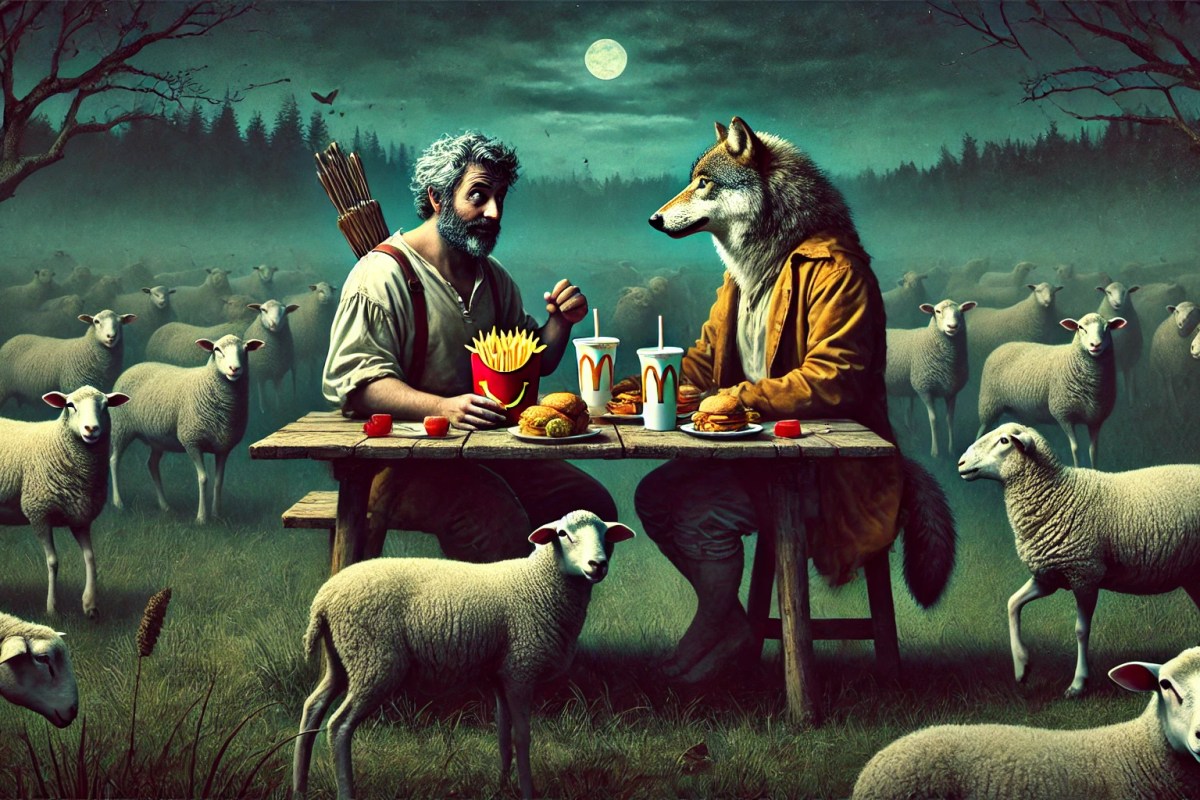
As the clock ticks us into 2025, a peculiar tale has surfaced in the blogosphere: a dark twist on the classic fable of the “wolf in sheep’s clothing,” served with a side of nihilistic absurdity. If you haven’t read it yet, you can find the original story over at Blog for Chumps. It’s a biting little narrative that turns traditional moralising on its head. Here’s why it deserves your attention.
Audio: NotebookLM Podcast on this topic.
The Tale in Brief
A hungry wolf, tired of dodging vigilant shepherds, decides to forgo subterfuge altogether. He waltzes into the flock, making no effort to hide his predatory nature. A naïve lamb follows him, and predictably, the wolf claims his meal. Later, the wolf returns to the sheepfold, where the shepherd — instead of protecting his flock — teams up with the wolf. Together, they butcher a sheep before abandoning the scene entirely to indulge in McDonald’s, leaving the traumatised sheep to accept their grim new reality.
Not exactly bedtime reading for the kids.
Themes: A Cynical Mirror to Our World
This tale is not merely a grotesque subversion of pastoral simplicity; it’s a scalpel slicing into the rotting carcass of modern society. Here’s what lurks beneath its woolly surface:
1. Cynicism Towards Authority
In most fables, the shepherd embodies protection and care. Here, he’s a collaborator in senseless violence. The shepherd’s betrayal critiques the notion of benevolent authority, suggesting that those entrusted with safeguarding the vulnerable often act in their own interests or, worse, align themselves with destructive forces. Sound familiar? Think political complicity, corporate greed, or any number of modern failures of leadership.
2. Normalisation of Atrocity
The sheep, described as cognitively intact, accept their grim reality without resistance. This isn’t a story about oblivious innocence; it’s about the horrifying human capacity to adapt to systemic violence. It reflects how people, faced with injustice, often acquiesce to their oppressors rather than challenge the status quo.
3. Inversion of Expectations
The wolf doesn’t even bother with the traditional sheepskin disguise. His audacity mirrors the brazen nature of modern exploitation, where bad actors operate in plain sight, confident in the public’s apathy or resignation. It’s a commentary on the erosion of shame, accountability, and even the pretence of decency.
4. Absurdity and Nihilism
The shepherd and wolf ditch their victim to grab fast food, trivialising the violence they’ve inflicted. The juxtaposition of archaic brutality with banal consumerism is absurd yet disturbingly resonant. It suggests that, in our era, even cruelty can be relegated to a footnote in the pursuit of comfort or convenience.
Symbols: Layers of Meaning
The tale brims with symbolic resonance:
The Wolf: A stand-in for unchecked greed or predatory systems, the wolf’s brazen behaviour highlights the dangers of apathy and unchallenged power.
The Shepherd: His betrayal symbolises the failure of institutions — governments, corporations, or other entities — to protect those they claim to serve.
The Sheep: Far from being simple-minded, the sheep’s acceptance of their grim new reality is a biting critique of societal complacency.
McDonald’s: A modern symbol of triviality and consumerism, it underscores the absurdity of senseless violence in a world driven by shallow comforts.
A Stark Commentary on Power Dynamics
At its core, the story is a brutal satire of power and complicity. Though ostensibly adversaries, the shepherd and wolf unite to exploit the powerless. It’s a chilling reminder of how often power structures protect their own interests at the expense of the vulnerable.
The sheep’s passive acceptance is equally damning. It forces readers to confront their own role as silent witnesses or even complicit actors in systems of oppression. What happens when we’re no longer shocked by atrocity but instead integrate it into the fabric of our existence?
The Satirical Edge
What makes this story particularly effective is its dark, sardonic, and unapologetically hyperbolic tone. It revels in absurdity while delivering a grim truth about human nature. The shepherd and wolf’s nonchalance is as hilarious as it is horrifying, making the tale an unsettling mirror of a society where injustice and apathy often go hand in hand.
Final Thoughts
This fable may be short, but its implications are vast. It’s a cautionary tale about the dangers of complacency, the betrayal of trust, and the absurdity of modern priorities. More importantly, it’s a call to resist the normalisation of harm — to recognise wolves and shepherds for what they are and demand better from ourselves and those in power.
So, as we usher in a new year, let this tale serve as a grim reminder: the wolf doesn’t always need a disguise, and the shepherd isn’t always your friend. Sometimes, they’re just two blokes on their way to McDonald’s.
Imagine you’re alone in the desert, lost and desperate for water. The sun beats down mercilessly, and the sand stretches out in every direction, an endless sea of dunes. Just as you’re about to give up hope, you spot a palm tree in the distance, swaying gently in the shimmering heat. Your heart leaps – could it be an oasis, a chance for survival? You stumble towards it, but as you approach, the tree seems to flicker and dance, always just out of reach. Is it really there, or is it a mirage, a trick of the mind born of desperation and the desert’s cruel illusions?
Audio: Podcast conversation about this article.
This question – how do we distinguish between objective reality and our subjective perceptions – has haunted philosophers for centuries. From ancient debates between Protagoras and Plato to the radical scepticism of Descartes, thinkers have grappled with the nature of truth and our access to it. Is there an external world that exists independently of our minds, or is reality fundamentally shaped by our individual and collective experiences?
The rise of Enlightenment rationalism in the 17th and 18th centuries sought to establish a firm foundation for objective knowledge. Descartes’ methodological doubt, which questioned the reliability of sense perceptions, and Kant’s exploration of the a priori structures of reason were attempts to secure certainty in the face of relativistic challenges. Yet the spectre of relativism persisted, finding new expressions in
Nietzsche’s perspectivism and the linguistic turn of the 20th century.
Today, the debate between relativism and objectivism remains as pressing as ever. In a world of increasing cultural diversity, competing moral frameworks, and the proliferation of ‘alternative facts,’ the question of whether truth is relative or absolute has far-reaching implications. How do we navigate the labyrinth of subjective experiences and cultural norms whilst still maintaining a commitment to truth and rationality?
In this essay, we will explore the complex relationship between relativism and objectivism, drawing on insights from thinkers such as Thomas Kuhn, Richard Rorty, Michel Foucault, and Paul Feyerabend. By examining how our perceptions and beliefs are shaped by cognitive biases, cultural conditioning, and power dynamics, we will argue for a nuanced understanding of truth that recognises the inescapability of interpretation whilst still preserving the possibility of meaningful dialogue and consensus. Just as the desert wanderer must learn to distinguish between the mirage and the true oasis, we must develop the philosophical tools to navigate the shifting sands of relativism and objectivism. Only by embracing the complexity and ambiguity of the quest for truth can we hope to find our way through the wilderness of human experience.
Defining the Terrain: Objectivism, Subjectivism, and Relativism
Before we can navigate the complex landscape of relativism and objectivism, we must first establish a clear understanding of these core concepts. What do we mean when we speak of objective reality, subjective experience, and relativistic truth?
Objective Reality: The Elusive Ideal
At the heart of the objectivist worldview lies the notion of an external, mind-independent reality. This is the world of physical objects, natural laws, and brute facts – a realm that exists independently of our perceptions, beliefs, or desires. For the objectivist, truth is a matter of correspondence between our ideas and this external reality. When we say that the Earth orbits the Sun or that water boils at 100 degrees Celsius, we are making claims about objective features of the world that hold true regardless of what any individual or culture believes.
However, the concept of objective reality is not without its challenges. As Descartes famously argued in his Meditations, how can we be certain that our perceptions accurately represent the external world? Might we not be deceived by a malicious demon or, in a more modern vein, by a sophisticated simulation? The possibility of perceptual error or illusion suggests that our access to objective reality is always mediated by our subjective experiences.
Subjective Experience: The Inescapable Lens
In contrast to the objectivist emphasis on an external reality, the subjectivist perspective foregrounds the primacy of individual experience. Our perceptions, thoughts, feelings, and beliefs shape our unique engagement with the world, colouring our understanding of truth and meaning. Two individuals may look at the same work of art or confront the same ethical dilemma, yet come away with radically different interpretations based on their personal histories, cultural backgrounds, and emotional states. The subjectivist view finds support in the work of thinkers like David Hume, who argued that our ideas and beliefs arise not from direct access to objective reality, but from the associations and habits of our own minds. More recently, the field of cognitive psychology has revealed the myriad ways in which our perceptions and judgements are shaped by unconscious biases, heuristics, and emotional influences. From the confirmation bias that leads us to seek out information that reinforces our preexisting beliefs to the availability heuristic that causes us to overestimate the likelihood of vivid or easily remembered events, our subjective experiences are permeated by cognitive quirks that distort our understanding of reality.
Relativism: Navigating the Intersubjective Matrix
If objective reality is elusive and subjective experience inescapable, what are we to make of truth and knowledge? This is where relativism enters the picture. Relativism is the view that truth, morality, and meaning are not absolute or universal but are instead relative to particular individuals, cultures, or historical contexts. For the relativist, there is no single, objective standard by which to adjudicate between competing beliefs or values. Rather, truth is always situated within specific interpretive frameworks shaped by the language, norms, and practices of different communities.
One of the most influential articulations of relativism can be found in the work of Thomas Kuhn. In his landmark book, The Structure of Scientific Revolutions, Kuhn argued that even the supposedly objective realm of science is structured by paradigms – overarching theoretical frameworks that determine what counts as legitimate questions, methods, and evidence within a given scientific community. When paradigms shift, as happened during the transition from Newtonian to Einsteinian physics, it’s not simply a matter of uncovering new objective facts. Rather, the very nature of reality and truth undergo a radical transformation.
The relativist perspective highlights the ways in which our understanding of the world is always embedded within cultural and historical contexts. The beliefs and values that we take for granted as natural or self-evident are, in fact, the products of contingent social processes. Michel Foucault’s genealogical investigations into the history of madness, sexuality, and criminality, for example, reveal how our conceptions of normality and deviance have shifted dramatically over time, shaped by the interplay of power, knowledge, and discourse.
Yet relativism need not collapse into an ‘anything goes’ nihilism or scepticism. Richard Rorty argues that we can still engage in meaningful dialogue and work towards pragmatic consensus, even if we abandon the notion of a single, absolute truth. By recognising the contingency and fallibility of our beliefs, we open up space for genuine conversation and mutual understanding across differences.
Conclusion
Objectivism, subjectivism, and relativism offer competing visions of the nature of truth and our relationship to reality. Whilst the dream of objective certainty remains alluring, the challenges posed by perceptual variability, cognitive bias, and cultural diversity suggest that a more nuanced approach is needed. By embracing the insights of relativism – the recognition that truth is always shaped by interpretation and context – we can navigate the complex terrain of human experience with greater humility, openness, and creativity.
As we move forward in this essay, we will explore how the dialectic of objective reality and subjective experience plays out in specific domains, from the perception of physical objects to the construction of scientific knowledge. By engaging with thinkers like Kuhn, Foucault, and Rorty, we will map the contours of a relativistic understanding of truth that acknowledges the inescapability of perspective whilst still preserving the possibility of meaningful dialogue and pragmatic consensus. The path ahead is not a straight line to absolute certainty but a winding trail through the wilderness of interpretation – a journey that demands courage, curiosity, and a willingness to question our most cherished assumptions. The Dialectic of Perception and Interpretation
Having established the key concepts of objectivism, subjectivism, and relativism, we can now delve into the dynamics of how perception and interpretation shape our understanding of reality. This dialectical process unfolds across three interrelated moments: the cultural shaping of perception, the individual’s subjective experience of the world, and the relativistic synthesis of these experiences into a situated understanding of truth.
The Palm Tree: A Case Study in Perceptual Dynamics
To illustrate this dialectic, let us return to the example of the desert wanderer and the palm tree. At first glance, the palm tree seems to be a straightforward object of perception – a physical entity with distinctive features such as a tall, slender trunk and a crown of feathery fronds. Yet even this seemingly simple act of recognition is shaped by a complex interplay of cultural, cognitive, and subjective factors. Firstly, the very concept of a ‘palm tree’ is a product of cultural learning and categorisation. From an early age, we are taught to distinguish between different types of plants and to associate them with specific names, uses, and symbolic meanings. The palm tree, for instance, may evoke associations with tropical paradise, desert oases, or biblical imagery, depending on one’s cultural background and personal experiences. This cultural shaping of perception predisposes us to see the world in certain ways, priming us to recognise and interpret objects according to preexisting schemas and categories.
Secondly, the individual’s subjective experience of the palm tree is mediated by a range of cognitive and perceptual factors. As Kuhn’s off-colour playing card experiment demonstrates, our expectations and prior knowledge can lead us to overlook or misinterpret anomalous stimuli. In the case of the desert wanderer, the intense desire for water and the harsh environmental conditions may distort their perception, causing them to see a mirage where there is none. Moreover, the physiology of the human visual system itself imposes certain constraints on how we process and interpret sensory information, as evidenced by well-known optical illusions such as the Müller-Lyer illusion.
Thirdly, the relativistic synthesis of these cultural and subjective factors yields a situated understanding of the palm tree that is both shaped by and shapes the individual’s broader worldview. The desert wanderer’s recognition of the palm tree as a sign of an oasis is not simply a neutral act of perception but a meaning-making process that reflects their cultural knowledge, personal desires, and embodied experiences. This interpretation, in turn, influences their subsequent actions and beliefs, shaping their understanding of the world and their place within it.
The Science of Perception: From Descartes to Kahneman
The philosophical and scientific study of perception has long grappled with the challenges posed by subjectivity and relativism. Descartes, in his Meditations, famously questioned the reliability of sensory experience, arguing that our perceptions could be deceived by dreams, illusions, or even a malicious demon. This radical doubt laid the groundwork for the epistemological project of modernity, which sought to establish a firm foundation for knowledge based on clear and distinct ideas rather than fallible sensory impressions.
However, as the work of cognitive psychologists like Daniel Kahneman has shown, even our most basic perceptual judgments are subject to a wide range of biases and distortions. From the anchoring effect, which causes us to rely too heavily on the first piece of information we receive, to the availability heuristic, which leads us to overestimate the likelihood of vivid or easily remembered events, our minds are constantly shaping and filtering our experiences in ways that depart from objective reality.
The Relativistic Synthesis: Embracing Perspective
Given the complex interplay of cultural, subjective, and cognitive factors that shape our perceptions, how are we to make sense of truth and knowledge? The relativistic approach suggests that we must abandon the quest for a single, absolute truth and instead embrace the multiplicity of perspectives that arise from our situated experiences.
This is not to say that all interpretations are equally valid or that there are no constraints on our understanding of reality. As Rorty argues, we can still engage in meaningful dialogue and work towards pragmatic consensus by recognising the contingency and fallibility of our beliefs. The goal is not to eliminate perspective but to cultivate a reflexive awareness of how our perspectives shape and are shaped by the world around us.
In the realm of science, for instance, Kuhn’s notion of paradigm shifts highlights how even our most rigorous and objective forms of knowledge are structured by overarching theoretical frameworks that determine what counts as valid evidence and explanation. For example, the transition from Newtonian to Einsteinian physics was not simply a matter of accumulating new facts but a radical reconceptualisation of the nature of space, time, and gravity. By recognising the role of paradigms in shaping scientific understanding, we can appreciate the ways in which our knowledge is always situated within particular historical and cultural contexts.
Conclusion
The dialectic of perception and interpretation reveals the complex dynamics through which our understanding of reality is shaped by an interplay of cultural, subjective, and cognitive factors. From the cultural categorisation of objects to the cognitive biases that distort our judgments, our experiences of the world are always mediated by the lenses of our situated perspectives.
Embracing a relativistic approach to truth and knowledge does not mean abandoning the quest for understanding but rather recognising the inescapability of perspective and the need for ongoing dialogue and reflexivity. By engaging with the work of thinkers like Descartes, Kahneman, Kuhn, and Rorty, we can cultivate a more nuanced and self-aware understanding of how we make sense of the world around us.
As we continue our exploration of relativism and objectivism, we will delve deeper into the implications of this relativistic synthesis for questions of scientific knowledge, moral reasoning, and political discourse. The path ahead is not a simple one, but by embracing the complexity and multiplicity of human experience, we open up new possibilities for understanding and transformation.
Relativism and the Politics of Knowledge
Having explored the dialectical process through which our perceptions and interpretations of reality are shaped by cultural, subjective, and cognitive factors, we now turn to the broader implications of relativism for the nature of scientific knowledge and the influence of power and ideology on the production of truth.
The Social Construction of Scientific Knowledge
One of the key insights of relativistic approaches to science, as developed by thinkers like Thomas Kuhn and Paul Feyerabend, is that scientific knowledge is not a purely objective or value-neutral representation of reality but is instead shaped by the social, historical, and cultural contexts in which it is produced. Kuhn’s notion of paradigm shifts, as we have seen, highlights how even the most rigorous and empirical forms of knowledge are structured by overarching theoretical frameworks that determine what counts as valid evidence and explanation.
This social constructionist view of science challenges the traditional image of the scientist as a disinterested observer, carefully recording the facts of nature without bias or prejudice. Instead, it suggests that scientific knowledge is always informed by the assumptions, values, and interests of the communities that produce it. The questions that scientists ask, the methods they employ, and the conclusions they draw are all shaped by the prevailing paradigms and social norms of their time and place.
Feyerabend takes this critique even further, arguing that the very idea of a single, unified scientific method is a myth that obscures the pluralistic and often chaotic nature of scientific practice. In his view, science is not a monolithic enterprise guided by a set of fixed rules and procedures but a diverse array of practices and approaches that are constantly evolving in response to new empirical challenges and theoretical insights. By embracing a more anarchistic and pluralistic conception of science, Feyerabend suggests, we can open up new possibilities for creative and innovative thinking that are often stifled by the rigid orthodoxies of established paradigms.
The Power/Knowledge Nexus
The social constructionist view of science also highlights the ways in which the production of knowledge is intimately bound up with relations of power and ideology. As Michel Foucault argues in his genealogical investigations of madness, sexuality, and criminality, what counts as true or false, normal or deviant, is not an objective fact of nature but a product of historically contingent systems of discourse and practice that are shaped by the interests and agendas of those in positions of power.
This power/knowledge nexus operates at multiple levels, from the institutional structures that determine what kinds of research get funded and published to the broader cultural and political currents that shape public understanding and policy decisions. The pharmaceutical industry, for example, has been criticised for its role in shaping the research agenda around mental health and illness, promoting a narrow biomedical model that emphasises the use of drugs over other forms of treatment and downplaying the social and environmental factors that contribute to psychological distress.
Similarly, the fossil fuel industry has been accused of spreading misinformation and doubt about the reality and severity of climate change in order to protect its own economic interests and delay the transition to renewable energy sources. These examples illustrate how the production of scientific knowledge is never a purely disinterested or objective process but is always entangled with the material and ideological interests of powerful actors and institutions.
The Paradox of Relativism
The relativistic view of science and knowledge raises a number of important challenges and paradoxes. If all knowledge is socially constructed and shaped by relations of power, does this mean that there is no such thing as objective truth or that all claims to knowledge are equally valid? Does the recognition of multiple paradigms and perspectives lead to a kind of ‘anything goes’ relativism that undermines the very possibility of rational inquiry and debate?
These are serious questions that have been the subject of much debate and controversy among philosophers, sociologists, and historians of science. Some critics of relativism argue that it leads to a kind of self-defeating scepticism or nihilism, in which the very idea of truth or knowledge becomes meaningless. Others worry that relativism opens the door to a dangerous kind of subjectivism or irrationalism, in which any belief or opinion, no matter how baseless or harmful, can be justified on the grounds of cultural or personal perspective.
However, defenders of relativism argue that these fears are overblown and that a more nuanced and sophisticated understanding of the social and historical dimensions of knowledge need not lead to a complete rejection of truth or rationality. Rorty, for example, suggests that we can still engage in meaningful dialogue and debate across different paradigms and perspectives by adopting a pragmatic and fallibilistic approach that recognises the contingency and limitations of all knowledge claims whilst still striving for intersubjective agreement and consensus.
Similarly, Feyerabend argues that the recognition of multiple methodologies and approaches in science need not lead to a chaotic free-for-all but can instead foster a more open and creative dialogue between different traditions and ways of knowing. By embracing a more pluralistic and democratic conception of science, he suggests, we can challenge the dogmatism and authoritarianism of established paradigms and create space for new and innovative ideas to emerge.
Conclusion
The relativistic view of science and knowledge poses significant challenges to traditional conceptions of objectivity, truth, and rationality. By recognising the social, historical, and cultural dimensions of knowledge production, relativism highlights the ways in which even the most rigorous and empirical forms of inquiry are shaped by the assumptions, values, and interests of the communities that produce them.
At the same time, the power/knowledge nexus reminds us that the production of truth is never a neutral or disinterested process but is always entangled with relations of power and ideology that shape what counts as valid or legitimate knowledge. The pharmaceutical industry and the fossil fuel industry provide stark examples of how scientific research can be distorted and manipulated to serve the interests of powerful actors and institutions.
Whilst these insights can be unsettling and even destabilising, they need not lead to a complete rejection of truth or rationality. By adopting a more pragmatic and fallibilistic approach to knowledge, as suggested by thinkers like Rorty and Feyerabend, we can still engage in meaningful dialogue and debate across different paradigms and perspectives whilst recognising the contingency and limitations of all knowledge claims.
Ultimately, the relativistic view of science and knowledge invites us to cultivate a more reflexive and critical stance towards the production of truth, one that is attentive to the social, historical, and political dimensions of knowledge and open to the possibility of multiple ways of knowing and being in the world. By embracing a more pluralistic and democratic conception of science and knowledge, we can challenge the dogmatism and authoritarianism of established paradigms and create space for new and transformative ideas to emerge.
The Ethical and Political Implications of Relativism
Having explored the implications of relativism for scientific knowledge and the role of power in shaping the production of truth, we now turn to the ethical and political dimensions of relativism and consider how a more pluralistic and contextual understanding of truth might inform our approach to questions of social justice, democracy, and human rights.
Relativism and Moral Universalism
One of the most pressing challenges posed by relativism is the question of whether there are any universal moral principles or values that hold true across all cultures and societies. The idea of moral universalism – the belief that there are certain fundamental ethical norms that apply to all human beings, regardless of their particular social or historical context – has a long and venerable history in Western philosophy, from the Kantian idea of the categorical imperative to the utilitarianism of Bentham and Mill.
However, the relativistic view of truth and knowledge poses a serious challenge to the idea of moral universalism. If all truth claims are shaped by the particular social and historical contexts in which they arise, then how can we justify the idea of universal moral principles that transcend these contexts? Doesn’t the recognition of cultural diversity and the multiplicity of moral frameworks around the world undermine the very notion of a single, universal morality?
These questions have been the subject of much debate and controversy among moral philosophers and social theorists. Some defenders of moral relativism argue that the idea of universal moral principles is itself a product of Western cultural imperialism and that any attempt to impose a single moral framework on all societies is a form of ethnocentric domination. Others suggest that whilst there may be some common moral intuitions or sentiments shared by all human beings, these are always mediated by the particular cultural and linguistic contexts in which they are expressed and cannot be reduced to a set of abstract, universal principles.
On the other hand, critics of moral relativism argue that the rejection of universal moral principles leads to a kind of ethical nihilism or subjectivism, in which any action or belief can be justified on the grounds of cultural or personal preference. They point to the existence of widespread moral norms against murder, theft, and deception as evidence of a common human morality that transcends cultural differences and argue that without some notion of universal moral principles, we have no basis for condemning clear cases of injustice or oppression.
Relativism, Democracy, and Human Rights
The debate over moral relativism has important implications for how we think about democracy, human rights, and social justice in a globalised world. If we reject the idea of universal moral principles, then on what basis can we justify the idea of universal human rights, such as the right to life, liberty, and security of person, or the right to freedom of speech and association? How can we condemn human rights abuses or political oppression in other societies without appealing to some notion of universal moral standards? At the same time, the recognition of cultural diversity and the multiplicity of moral frameworks around the world poses challenges for how we think about democracy and political legitimacy. If different societies have different conceptions of the good life and the just society, then how can we adjudicate between these competing visions in a way that respects cultural differences whilst still upholding basic principles of human rights and democratic governance?
One possible response to these challenges is to adopt a more pragmatic and contextual approach to questions of ethics and politics, one that recognises the irreducible plurality of moral and political frameworks whilst still striving for some degree of cross-cultural dialogue and understanding. This approach, which has been developed by thinkers like Richard Rorty and Jürgen Habermas, emphasises the importance of democratic deliberation and the public use of reason as a way of navigating the tensions between cultural diversity and moral universalism.
On this view, the goal of ethics and politics is not to establish a single, universal set of moral principles that applies to all societies but rather to foster a more open and inclusive dialogue between different cultural and moral traditions, one that allows for the possibility of mutual learning and transformation. By engaging in this kind of intercultural dialogue, we can work towards a more nuanced and contextual understanding of human rights and social justice, one that takes into account the particular histories, struggles, and aspirations of different communities whilst still upholding basic principles of human dignity and democratic participation.
Conclusion
The ethical and political implications of relativism are complex and far-reaching and raise fundamental questions about the nature of morality, democracy, and human rights in a globalised world. Whilst the recognition of cultural diversity and the multiplicity of moral frameworks pose challenges to traditional notions of moral universalism, it need not lead to a complete rejection of universal moral principles or a descent into ethical nihilism.
By adopting a more pragmatic and contextual approach to ethics and politics, one that emphasises the importance of democratic deliberation and intercultural dialogue, we can work towards a more nuanced and inclusive understanding of social justice and human rights, one that takes into account the irreducible plurality of human experience whilst still striving for some degree of cross-cultural understanding and solidarity.
Ultimately, the challenge of relativism is not to abandon the search for truth or the quest for a more just and humane world but rather to recognise the complexity and contingency of these endeavours and to approach them with a spirit of humility, openness, and critical reflection. By embracing the insights of relativism whilst still upholding the values of democracy, human rights, and social justice, we can chart a path towards a more pluralistic and emancipatory vision of human flourishing.
Conclusion: Navigating the Labyrinth of Relativism
Throughout this essay, we have explored the complex relationship between relativism, objectivism, and the nature of truth. We have argued for a more nuanced and contextual understanding of truth that recognises the inescapable influence of culture, subjectivity, and power in shaping our knowledge and beliefs. By examining the paradoxes and tensions between the idea of an objective reality and the subjective nature of human experience, we have sought to challenge traditional assumptions about the neutrality and universality of knowledge.
In the first section, we introduced the central paradox of objectivism and subjectivism, highlighting the ways in which the lenses of perception, interpretation, and cultural conditioning always mediate our understanding of reality. Using the metaphor of the desert wanderer and the palm tree, we explored how even our most fundamental experiences of the world are shaped by a complex interplay of sensory input, cognitive processing, and cultural meaning-making.
In the second section, we delved deeper into the dialectic of perception and interpretation, drawing on insights from thinkers like Descartes, Kahneman, and Kuhn to show how a dynamic interplay between cultural frameworks, individual experience, and the social construction of meaning shapes our understanding of reality. We argued that embracing a more relativistic approach to truth need not lead to a complete rejection of objectivity or rationality, but rather invites us to cultivate a more reflexive and self-critical stance towards the production of knowledge.
In the third section, we explored the politics of knowledge, examining how scientific knowledge is shaped by social, historical, and ideological factors and how the power/knowledge nexus operates to privilege certain forms of knowledge and marginalise others. Drawing on the work of Foucault and other social constructionists, we challenged the traditional view of science as a neutral and objective enterprise and argued for a more pluralistic and democratic approach to knowledge production.
Finally, in the fourth section, we considered the ethical and political implications of relativism, discussing how a more contextual and dialogical understanding of truth might transform our approach to questions of moral universalism, human rights, and social justice. Whilst acknowledging the challenges and paradoxes posed by relativism, we suggested that a pragmatic approach based on democratic deliberation and intercultural dialogue offers a promising way forward.
Ultimately, the labyrinth of relativism is not a simple or straightforward path but rather a complex and challenging terrain that requires ongoing navigation and negotiation. By embracing a more relativistic understanding of truth, we are invited to confront the contingency and partiality of our own perspectives and to engage in a more honest and authentic dialogue with others. This demands a willingness to question our assumptions, to listen to alternative viewpoints, and to remain open to the possibility of transformation and growth.
At the same time, relativism’s insights need not lead to a complete abandonment of the search for truth or the quest for a more just and humane world. Rather, they can inspire us to approach these endeavours with a spirit of humility, curiosity, and critical reflection, recognising the irreducible complexity and diversity of human experience. By engaging in the kind of intercultural dialogue and democratic deliberation that relativism demands, we can work towards a more inclusive and emancipatory vision of knowledge, ethics, and politics.
In the end, the labyrinth of relativism is not a puzzle to be solved or a destination to be reached but rather an ongoing journey of discovery and transformation. It invites us to embrace the multiplicity and contingency of human experience, challenge our assumptions and biases, and remain open to the possibility of new and unexpected insights. Whilst the path may be difficult and the challenges profound, it offers a more honest, authentic, and liberating approach to understanding ourselves and our world.
As we navigate the twists and turns of this labyrinth, we must remember that the search for truth is not a solitary or isolated endeavour but a collective and dialogical one. It requires us to engage with others in a spirit of openness, empathy, and mutual respect, recognising the ways in which our own perspectives are shaped by the particular contexts and experiences that we bring to the table. By cultivating this kind of intercultural understanding and solidarity, we can work towards a more just and equitable world that honours all human beings’ diversity and dignity.
So, let us embark on this journey with courage and compassion, knowing that the path and destination are uncertain. Let us embrace the complexity and ambiguity of the human condition and remain committed to the ongoing search for truth, justice, and understanding. Only by navigating the labyrinth of relativism can we hope to glimpse the elusive and ever-changing nature of reality and create a world that is more inclusive, humane, and authentically our own.
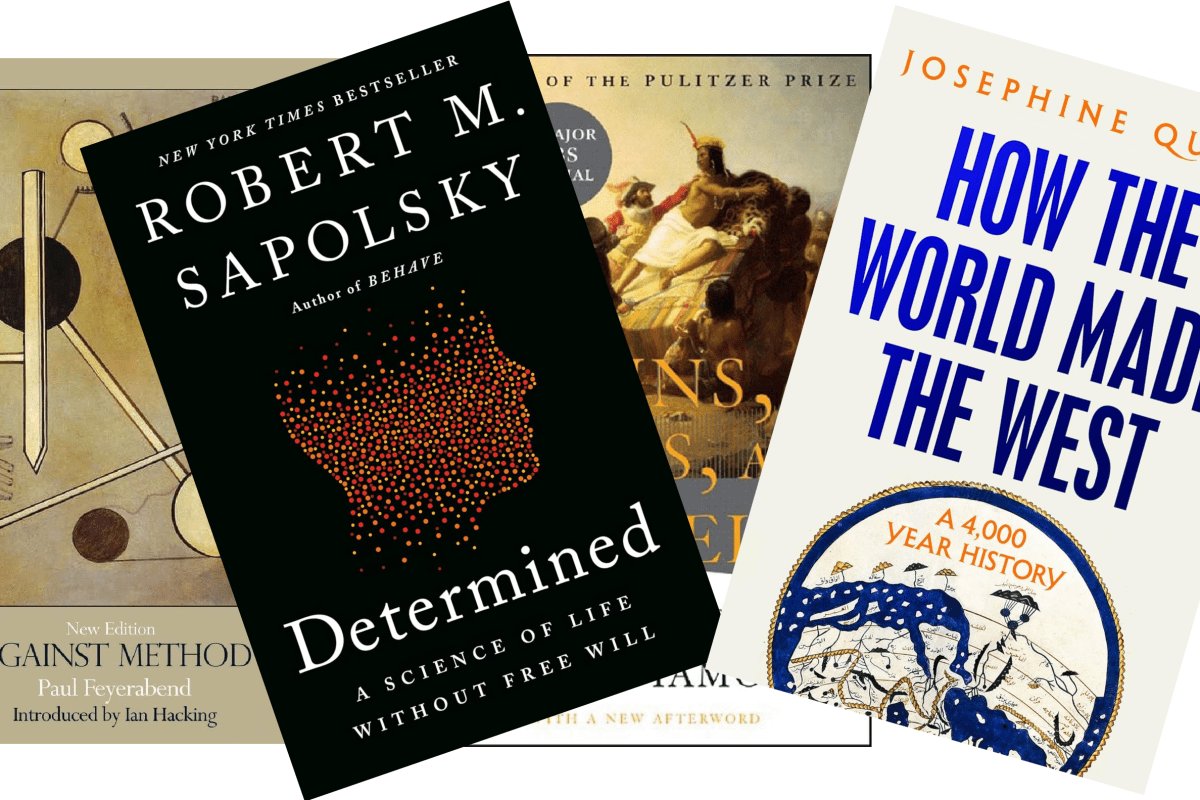
These are my favourite books I read in 2024. Only one was first published this year, so it seems I was playing catch-up and rereading. Two are about history; two are about the philosophy of science; and one is about biological free will or the lack thereof.
Against Method is a re-read for me. It makes the list on the coattails of a higher-ranked book. Feyerabend makes a compelling case against the Scientific Method™. To complete the set, I’d also recommend Bruno Latour‘s We Have Never Been Modern.
Determined arrives on the heels of Sapolsky’s Behave, another classic that I’d recommend even more, but I read it in 2018, so it doesn’t make the cut. In Determined, Sapolsky makes the case that there is no room or need for free will to explain human behaviour.
As with Against Method, Guns, Germs, and Steel makes the list only to complement my next choice. It views history through an environmental lens. To fill out the historical perspective, I recommend David Graeber’s The Dawn of Everything: A New History of Humanity (with David Wengrow). I’d recommend Yuval Noah Harari‘s Sapiens: A Brief History of Humankind, but it occupies a different category and is more about a plausible broad narrative than the detail explored in the others listed.
Quinn makes history approachable as she questions the uniformity of civilisations pushed by orthodoxy. Read this in context with the aforementioned historical accounts for a fuller perspective.
I was born in 1961. This should have been bedtime reading for me. I’d heard of this work, but one really has to read it. It’s less Modernist than I had presumed—though not to the extent of Feyerabend or Latour mentioned above. Again, reading all three provides a robust perspective on the philosophy of science.
Like Quinn, the writing is approachable. I had expected it to be stilted. It is academic, and it may boost your vocabulary, but give it a gander. It also works well in an audiobook format if you are so inclined.
This about closes out 2024. What do you think about these choices? Agree or disagree? What are your top recommendations?
In the great philosophical tug-of-war between materialism and idealism, where reality is argued to be either wholly independent of perception or entirely a construct of the mind, there lies an underexplored middle ground—a conceptual liminal space that we might call “Intersectionalism.” This framework posits that reality is neither purely objective nor subjective but emerges at the intersection of the two. It is the terrain shaped by the interplay between what exists and how it is perceived, mediated by the limits of human cognition and sensory faculties.
Audio: Podcast conversation on this topic.
Intersectionalism offers a compelling alternative to the extremes of materialism and idealism. By acknowledging the constraints of perception and interpretation, it embraces the provisionality of knowledge, the inevitability of blind spots, and the productive potential of uncertainty. This essay explores the foundations of Intersectionalism, its implications for knowledge and understanding, and the ethical and practical insights it provides.
Reality as an Intersection
At its core, Intersectionalism asserts that reality exists in the overlapping space between the objective and the subjective. The objective refers to the world as it exists independently of any observer—the “terrain.” The subjective encompasses perception, cognition, and interpretation—the “map.” Reality, then, is not fully contained within either but is co-constituted by their interaction.
Consider the act of seeing a tree. The tree, as an object, exists independently of the observer. Yet, the experience of the tree is entirely mediated by the observer’s sensory and cognitive faculties. Light reflects off the tree, enters the eye, and is translated into electrical signals processed by the brain. This process creates a perception of the tree, but the perception is not the tree itself.
This gap between perception and object highlights the imperfect alignment of subject and object. No observer perceives reality “as it is” but only as it appears through the interpretive lens of their faculties. Reality, then, is a shared but imperfectly understood phenomenon, subject to distortion and variation across individuals and species.
The Limits of Perception and Cognition
Humans, like all organisms, perceive the world through the constraints of their sensory and cognitive systems. These limitations shape not only what we can perceive but also what we can imagine. For example:
Sensory Blind Spots: Humans are limited to the visible spectrum of light (~380–750 nm), unable to see ultraviolet or infrared radiation without technological augmentation. Other animals, such as bees or snakes, perceive these spectra as part of their natural sensory worlds. Similarly, humans lack the electroreception of sharks or the magnetoreception of birds.
Dimensional Constraints: Our spatial intuition is bounded by three spatial dimensions plus time, making it nearly impossible to conceptualise higher-dimensional spaces without resorting to crude analogies (e.g., imagining a tesseract as a 3D shadow of a 4D object).
Cognitive Frameworks: Our brains interpret sensory input through patterns and predictive models. These frameworks are adaptive but often introduce distortions, such as cognitive biases or anthropocentric assumptions.
This constellation of limitations suggests that what we perceive and conceive as reality is only a fragment of a larger, potentially unknowable whole. Even when we extend our senses with instruments, such as infrared cameras or particle detectors, the data must still be interpreted through the lens of human cognition, introducing new layers of abstraction and potential distortion.
The Role of Negative Space
One of the most intriguing aspects of Intersectionalism is its embrace of “negative space” in knowledge—the gaps and absences that shape what we can perceive and understand. A compelling metaphor for this is the concept of dark matter in physics. Dark matter is inferred not through direct observation but through its gravitational effects on visible matter. It exists as a kind of epistemic placeholder, highlighting the limits of our current sensory and conceptual tools.
Similarly, there may be aspects of reality that elude detection altogether because they do not interact with our sensory or instrumental frameworks. These “unknown unknowns” serve as reminders of the provisional nature of our maps and the hubris of assuming completeness. Just as dark matter challenges our understanding of the cosmos, the gaps in our perception challenge our understanding of reality itself.
Practical and Ethical Implications
Intersectionalism’s recognition of perceptual and cognitive limits has profound implications for science, ethics, and philosophy.
Science and Knowledge
In science, Intersectionalism demands humility. Theories and models, however elegant, are maps rather than terrains. They approximate reality within specific domains but are always subject to revision or replacement. String theory, for instance, with its intricate mathematics and reliance on extra dimensions, risks confusing the elegance of the map for the completeness of the terrain. By embracing the provisionality of knowledge, Intersectionalism encourages openness to new paradigms and methods that might better navigate the negative spaces of understanding.
Ethics and Empathy
Ethically, Intersectionalism fosters a sense of humility and openness toward other perspectives. If reality is always interpreted subjectively, then every perspective—human, animal, or artificial—offers a unique and potentially valuable insight into the intersection of subject and object. Recognising this pluralism can promote empathy and cooperation across cultures, species, and disciplines.
Technology and Augmentation
Technological tools extend our sensory reach, revealing previously unseen aspects of reality. However, they also introduce new abstractions and biases. Intersectionalism advocates for cautious optimism: technology can help illuminate the terrain but will never eliminate the gap between map and terrain. Instead, it shifts the boundaries of our blind spots, often revealing new ones in the process.
Conclusion: Navigating the Space Between
Intersectionalism provides a framework for understanding reality as a shared but imperfect intersection of subject and object. It rejects the extremes of materialism and idealism, offering instead a middle path that embraces the limitations of perception and cognition while remaining open to the possibilities of negative space and unknown dimensions. In doing so, it fosters humility, curiosity, and a commitment to provisionality—qualities essential for navigating the ever-expanding terrain of understanding.
By acknowledging the limits of our maps and the complexity of the terrain, Intersectionalism invites us to approach reality not as a fixed and knowable entity but as an unfolding interplay of perception and existence. It is a philosophy not of certainty but of exploration, always probing the space between.










 Philosophics