Metaphor and Simile

Chapter 10 of The Master and His Emissary is titled The Enlightement, which is to say another chapter centred around a religious theme and paradigm shift. Only it isn’t. This chapter is focused mainly on metaphor and poetry, and that’s where I want to comment.

If you haven’t happened to have read the prior posts on The Master and His Emissary or The Matter with Things, I’ll summarise the functions of the left and right cerebral hemispheres. If you have, feel free to skip this paragraph. The left hemisphere is closing and convergent whilst the right hemisphere is expansive and divergent, The left is about naming, categorising, and analysing; the right is about experiencing the world as presenced. Where the right hemisphere is about presentation, the left is about re-representation. A challenge occurs when the re-presented view of the left supersedes the experiential view of the right. This is what occurs in a left-dominant brain.

Metaphor is a function of the right hemisphere. The left hemisphere considers metaphor to be a figure of speech. It trivialises it in one of two ways. Either, it reduces it to components that map to some other concepts—ignoring the parts that can’t be mapped—, or it assumes the metaphor to be whimsy and therefore without inherent value.

But metaphor is more than a figure of speech. It’s a figure of thought that can’t be reduced. Metaphor is like art or music and other residences of the right hemisphere. These things must be taken as whole entities and be considered in the manner of Gestalt.

Being analytical and representative, the left hemisphere can be educated. I could be wrong, but I don’t see how the right can be strengthened. It seems that its weakness is interference from the left, but the left is constantly wintering on that it’s always right, and all you need is to be more analytical. If you don’t have empathy, you can’t learn it. If you don’t understand metaphor, you’re pretty much out of luck. The same goes for anything in the experiential right hemisphere.

Might I be wrong? Sure, I’m no neuroscientist, but short of some external event, like a stroke, brain lesions, head trauma, or some such. I don’t see the vector. In a way, it’s like the advancement of technology. It’s difficult to stem the tide and reverse it. This is the challenge. In the West, we’ve been on a path to rationality and reason—left hemisphere fare—, which has shifted it further and further left. We just need more systems and processes.

Why the title, “Metaphor and Simile?” Metaphor resides in the province of the right hemisphere. Simile resides in the left. I remember listening to Joseph Campbell in the 1980s discussing the power of metaphor. Where metaphor is a mode of thought, simile is just a figure of speech. And it’s an analytical analogue. Love is like a rose. There’s a simple mapping. Love is a rose is more robust. John Lennon sings these lines in Mind Games.

Love is the answer and you know that for sure
Love is a flower you got to let it grow

Love is a flower. You got to let it grow. Grammatical structure aside—only an intractable problem for left-brainers—, this is a relatively simple metaphor, flowers grow and bloom; love grows and blooms. 

Follows are another few famous metaphors. These may feel more accessible than some others.

“All the world’s a stage, and all the men and women merely players. They have their exits and their entrances.”

William Shakespeare

“All our words are but crumbs that fall down from the feast of the mind.”

Khalil Gibran

This one is particularly interesting as it suggests how diminutive words are relative to that of the mind—mere crumbs.

“And your very flesh shall be a great poem.”

Walt Whitman

How shall your flesh be a great poem? No like a great poem, but to be a great poem.

I’ve talked about Robert Frost’s The Road Less Travelled previously.

Two roads diverged in a yellow wood,
And sorry I could not travel both
And be one traveler, long I stood
And looked down one as far as I could
To where it bent in the undergrowth;

Then took the other, as just as fair,
And having perhaps the better claim,
Because it was grassy and wanted wear;
Though as for that the passing there
Had worn them really about the same,

And both that morning equally lay
In leaves no step had trodden black.
Oh, I kept the first for another day!
Yet knowing how way leads on to way,
I doubted if I should ever come back.

I shall be telling this with a sigh
Somewhere ages and ages hence:
Two roads diverged in a wood, and I—
I took the one less traveled by,
And that has made all the difference.

This poem is replete with metaphors.

The road itself is a metaphor for life, and the forks are the choices we make. Interpreted from a post-Modern perspective, and as Frost said himself, the trick is that it doesn’t matter which path is taken. In any case, irrespective of which paths you take, it will still make all the difference.

I’ve digressed.

McGilchrist says societies and people are moving too far into a left-dominant worldview, which only reinforces and accelerates this worldview. I don’t know how reversible it is. It’s swung both ways before, but that was prior to Scientism. This and hubris are not a great combination. In the end, the probability of teaching someone metaphor is on par with teaching someone to appreciate a work of art or a piece of music.

McGilchrist says we need to regain this capacity for metaphor—and empathy and so on—, but this requires (in my mind) a paradigm shift. I don’t see it happening at an individual level. There would need to be a cultural shift, and that is unforeseeable from here at the moment.

Here’s the challenge as I see it. In saying that we need to regain the ability to understand metaphor without assuming it can be deconstructed without a loss of meaning, he doesn’t provide a path—at least not yet. I’ve got two chapters remaining, so perhaps he’ll offer some guidance or conceptual framework in one of them. Otherwise, the future looks bleak. Of course, humans are adaptable. Evolution works that way, but you can also veer down an evolutionary dead end without knowing your journey has no viable future until you get there. And that will make all the difference. 

Education is an admirable thing: Oscar Wilde

“Education is an admirable thing, but it is well to remember from time to time that nothing that is worth knowing can be taught.”

— Oscar Wilde

I’ve loved this quote since I first read it however many years ago. I used to have a plaque with this inscription hung on a wall. This quote came back to mind when I was reading more McGilchrist. I expect to post the summary of chapter nine of The Matter with Things by the end of the weekend. I’ve read it and am now extracting a summary. But I digress.

“Education is an admirable thing.” This is a testament to the left cerebral hemisphere, although it provides fodder for the right as well. Instruction is about categorisation and structure; language and rote; stuffing out brains with facts and trivia.

But “nothing worth knowing can be taught.” This is a right hemisphere conceit. It can’t be taught because it must be experienced.

One can’t teach allegory.

One can’t teach allusion.

One can’t teach metaphor.

One can teach simile.

One can teach poetry, but one can’t teach a poem.

One can teach art, but one can’t teach a work of art.

One can teach music, but one can’t teach the qualia of music. That’s a minor key. You’re supposed to feel sad there. That’s a major seventh chord, doesn’t that uplift you? And what about this raga?

What can’t be taught lay in the realm of intuition and feeling. Emotional response.

“Nothing worth knowing can be taught.”

Bang the Jrum Slowly!

I was riding a chrain down a shchreet banging a jrum and eating shrimp.

Podcast: Audio rendition of this page content

If you keep up with English language morphology—and let’s be honest here, who doesn’t?—the opening sentence is a phonetic respelling of ‘I was riding a train down a street banging a drum and eating shrimp’ but for a new generation. Dr Geoff Lindsey created a video, which includes material drawn from his book English After RP: Standard British Pronunciation Today. But don’t be fooled by the RP reference. There is plenty of relevance to the shifts in General American English if ever there was such a thing.

As noted previously, the principle of least effort tends to be a guiding factor for language morphology, and we’re witnessing the conservation of effort driving this shift.

Technically, what’s happening is that, traditionally, we performed some lingual gymnastics gliding (or not) from an alveolar consonant to a post-alveolar shift. The new fashion is to shift the entire structure into a post-alveolar space. Lazy wins. Of course, I’ll expect to hear from vocal prescriptivists, the traditional grammar Nazis, who will insist, “If I see a T in train, I’m going to pronounce it like a T, dammit. No ch-ch as in choo-choo for this ‘adult’.”

I’ve summarised the italicised words in a table.

TraditionIPANouveauIPA
train/tɹeɪn/chrain/t͡ʃɹeɪn/
drum/ˈdɹʌm/jrum/ˈdʒɹʌm/
street/stɹiːt/shchreet/ʃt͡ʃɹiːt/
shrimp/ʃɹɪmp/shrimp/ʃɹɪmp/

Traditionally—which is to say the language spoken by older native English speakers—, the consonant clusters are pronounced pretty much as written. One would pronounce the T or TR in train; the DR in drum; and the STR in street. Shrimp had already made the shift, so we can think of it as a trendsetter.

Notice how the T in train shifts to a CH sound (/t͡ʃ/) or how the D in drum shifts to a J sound (/dʒ/). As the video shows, Michelle Obama is a bit ahead of the change curve, as she’s already shifted the S in street to a post-alveolar-friendly Sh Ch (/ʃt͡ʃ/), replacing the ST with a Sh-Ch combination, the S becoming Sh and the T becoming Ch. This trend has not caught on more broadly, but it seems it may be inevitable and allows us to keep this in a nice and tidy box.

In the video, there is a clip recounting a story of a seven-year-old just learning to write (and evidently into Star Wars) who wrote the following.

IMAGE: Watch out for the stormtrooper as written by a 7-year-old native English speaker

Notice that he is trying to capture a quasi-phonetic rendition of the word TROOPER that he hears (correctly) as CHROOPER. Again, this might cause grammar Nazis to go on a rampage. I don’t expect any spelling back-formation reformation to follow suit. We’ll just add this to the “English is not a phonetic language and has a lot of spelling exceptions” adage.

If you are a native English speaker, is this something you notice? If you speak English as a second language, have you noticed this trend? Which camp are you in? Old school or new school?

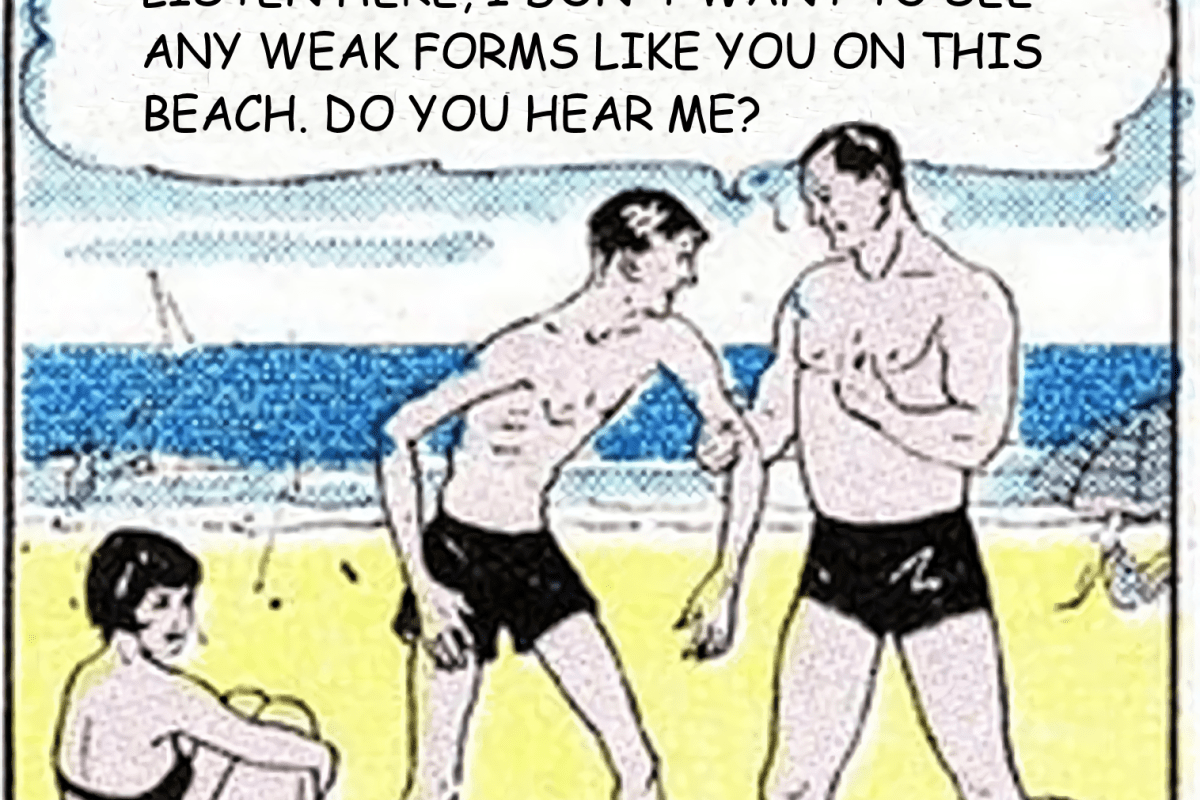
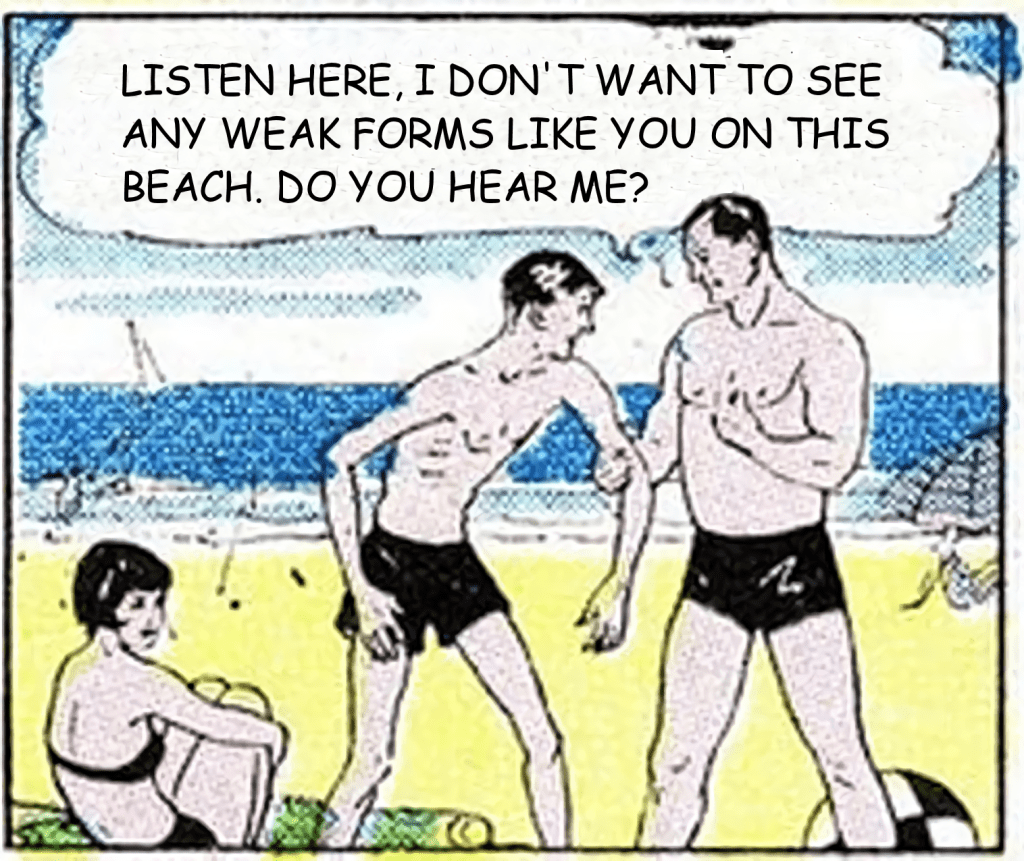
English Weak Forms

I have been so utterly distracted by YouTube this weekend. In this case, it’s a video by Dr Geoff Lindsey explaining weak forms of the English language.

Podcast: Audio rendition of this page content

Much of my work life involves speaking either with non-native English speakers or speakers of English who may be quite well versed in English and yet have a certain rigidity in their execution. Along with local accents, this makes the language feel unnatural to a native speaker.

A common challenge is the adoption of weak forms. Following the principle of least effort, language speakers are lazy. In fact, one may extrapolate this morphology to predict where language may drift next. One example that comes to mind is the American habit of uttering flap Ts over ‘real’ Ts that require slightly more effort to produce.

In English, one says the words, butter, water, doctor, and sister as /ˈbʌtə/,/ˈwɔtəɹ/, /ˈdɒktə/, /ˈsɪstə(ɹ)/ whilst in American English, using the flap T sound, one says (respelt in parentheses) /ˈbʌdəɹ/ (buhd-er), / ˈwɔdəɹ/ (wahd-er), /ˈdɔkdɚ/ (dok-der), /ˈsɪsdər/ (sis-der). Whether the pronunciation of the R is rhotic or non-rhotic is another issue altogether.

But this is about something a bit different. It’s about weak forms, particularly vowels that can be weakened from the strong vowel sound to the shwa (/ə/) sound. It turns out that we do this a lot. In fact, more often than not. Rather than a rehash from the video, I’ve cued it to where Tom Hiddleston recites Lord Byron’s So We’ll Go No More a Roving.

So, we'll go no more a roving
   So late into the night,
Though the heart be still as loving,
   And the moon be still as bright.

For the sword outwears its sheath,
   And the soul wears out the breast,
And the heart must pause to breathe,
   And love itself have rest.

Though the night was made for loving,
   And the day returns too soon,
Yet we'll go no more a roving
   By the light of the moon.

As it happens, much of the difference between native English and English as spoken by non-natives is the hyper-diction heard by choosing the strong rather than the weak form of certain words.

The Matter with Things: Chapter Eight Summary: Creativity

Index and table of contents

Intro

Creativity is the eighth chapter of Iain McGilchrist’s The Matter with Things.

In the last chapters, the topics were about different intelligences. As we’ll see, intelligence is one of the factors for creativity, but there are more. Let’s crack on.

Podcast: Audio rendition of this page content

Content

Creativity is an elusive phenomenon that cannot only not be summoned at will, the very act of trying inhibits it. Unlike left-hemisphere-oriented intelligence, there are no simple tests for creativity because of their very nature. Assessing the left-hemisphere is relatively simple because it is systematic and any tests have definite known solutions—whether calculating some figure, solving a puzzle, choosing analogies, or recounting some trivia. There is no such test for creating something not yet created, but there are some proxies that most people categorically fail.

Psychologist, Colin Martindale, had this to say about the personal characteristics of creativity

Creativity is a rare trait. This is presumably because it requires the simultaneous presence of a number of traits (e.g., intelligence, perseverance, unconventionality, the ability to think in a particular manner). None of these traits is especially rare. What is quite uncommon is to find them all present in the same person.”

— Colin Martindale

Whereas the left hemisphere is analytical, the right hemisphere (hence creativity) is a Gestalt. When given a difficult time-boxed challenge, the left hemisphere dominant individual who does not arrive at the expected response on time will commit to and defend an incorrect response (think escalating commitment), and the right hemisphere dominant individual will simply not commit to a response under the thought that there were still options to be explored.

Effectively, creativity can be broken down into three phases: preparation, incubation, and illumination.

In essence, for the creative individual, the best we can do is to leave well enough alone. Anything but space and permission will kill the creative impulse.

Preparation is simply the accumulation of a particular domain of knowledge. For an artist, it will be to understand, perhaps, colour, shape, texture, form, shadow, media, or so forth; for a musician, it might be to understand melody, harmony, tempo, timbre, dynamics, and so on; for a mathematician, it might be basic arithmetic, theories, proofs, and on and on. It’s also important to note that accumulated information in multiple domains also forms a foundation leveraged by many polymaths.

Incubation is simply waiting for something to grow in the prepared garden. Incubation is an unconscious activity and cannot be controlled or accessed by the conscious mind. In fact, conscious effort and introspection will serve only to impede cultivation. Digging up planted seeds to see how they are growing will only hinder the process.

Illumination is the final phase. Again, this is unwilled. Prepared and incubated flowers bloom. Of course, this is an imperfect metaphor because the ground must already have been fertile at the start. Tossing seeds on fallow ground still yields no blooms no matter how carefully attended.

In essence, for the creative individual, the best we can do is to leave well enough alone. Anything but space and permission will kill the creative impulse.

McGilchrist discusses generative, permissive, and translational requirements.

“The key element in generation seems to be the ability to think of many diverse ideas quickly, demanding breadth, flexibility and analogical thinking – seeing likeness within apparent dissimilarity.” This can be summed up as divergent thinking. This is the openness afforded by the right hemisphere as opposed to the convergent behaviour of the left. As it happens, this is where artificial intelligence falls flat as it is predicated on convergent activity.

The right hemisphere Gestalten surveys the environment and notes otherwise unperceived parallels. It is not a systematic approach. In the words of Oscar Wilde, “Education is an admirable thing. But it is well to remember from time to time that nothing that is worth knowing can be taught.”

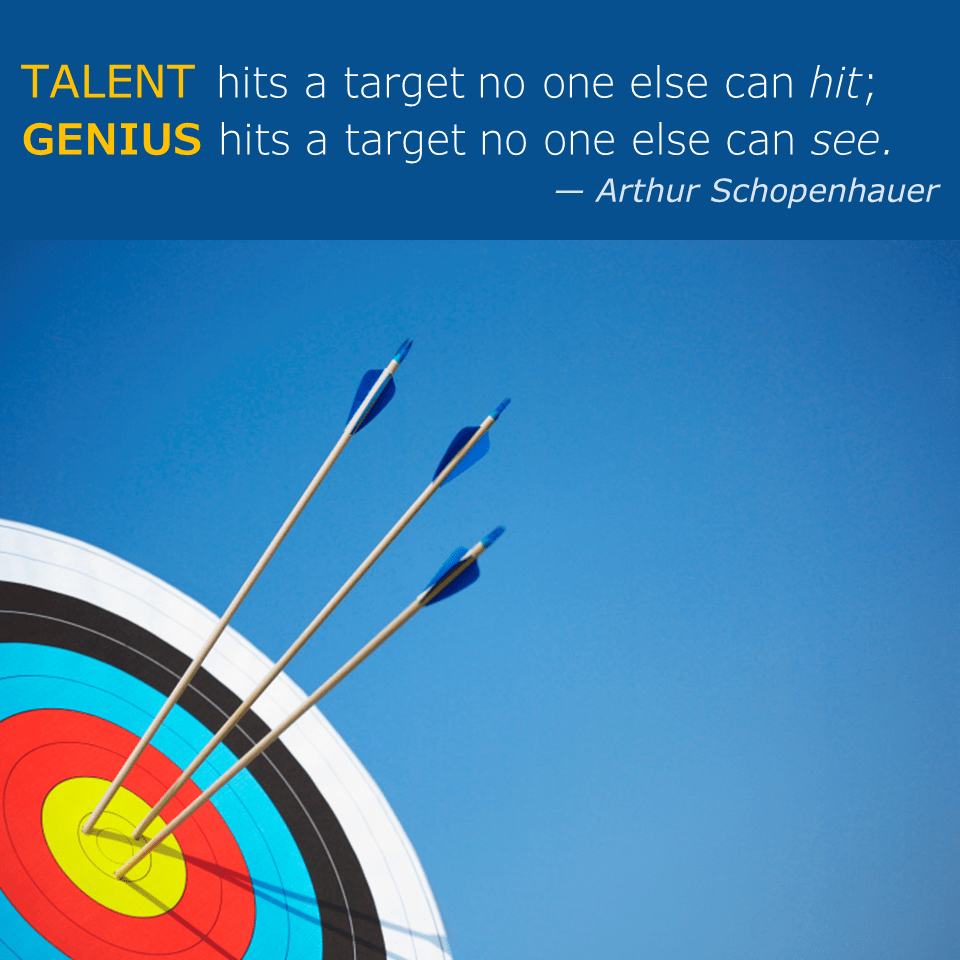
“Talent hits a target no-one else can hit;
genius hits a target no-one else can see”.

Arthur Schopenhauer

Schopenhauer sums it up nicely, “Talent hits a target no-one else can hit; genius hits a target no-one else can see”.

Citing Isaac Asimov writing about Darwin’s insight, he notes that before Darwin, many people had read Malthus and studied species, but they lacked the creative spark that Darwin had.

Steve Jobs noted that

“Creativity is just connecting things. When you ask creative people how they did something, they feel a little guilty because they didn’t really do it, they just saw something. It seemed obvious to them after a while. That’s because they were able to connect experiences they’ve had and synthesize new things … A lot of people in our industry haven’t had very diverse experiences. So, they don’t have enough dots to connect, and they end up with very linear solutions without a broad perspective on the problem. The broader one’s understanding of the human experience, the better design we will have.”

— Steve Jobs

This is a failing of the business world and of specialisation more generally. McGilchrist writes, “Linear approaches and analytic thinking, characteristic of the left hemisphere, are fine in the right context, and may at a subsequent phase take part in creativity by narrowing things down and eliminating some of them, but on their own will not achieve creativity”.

There is a direct link between intelligence and creativity. Ego crushes creativity.

There is a direct link between intelligence and creativity. Ego crushes creativity.

He again cites Asimov:

“My feeling is that as far as creativity is concerned, isolation is required. The creative person is, in any case, continually working at it. His mind is shuffling his information at all times, even when he is not conscious of it …The presence of others can only inhibit this process, since creation is embarrassing.”

— Isaac Asimov

Some people excel at maths, but many are systematic and procedural left-hemisphere types; they apply logic and reason—insert tab A into slot B. The famous mathematicians understand the procedures, but their ideas come from intuition rather than reason. The left hemisphere doesn’t recognise this as a viable vector, and therein lies the rub. “Math is not about following directions; it’s about making new directions,” writes mathematician Paul Lockhart.

This is why we hear so many accounts of aha moments, something coming to one person in a dream or Isaac Newton’s falling apple anecdote.

“These thoughts did not come in any verbal formulation. I very rarely think in words at all.
A thought comes, and I may try to express it in words afterward”

Albert Einstein

Einstein told Max Wertheimer, founder of Gestalt psychology, “These thoughts did not come in any verbal formulation. I very rarely think in words at all. A thought comes, and I may try to express it in words afterward”. Words are a left-hemisphere phenomenon.

Many accomplished musicians hear a piece whole. All they need to do is to compose it to staff paper or perform it. We hear this regularly: “I was driving from here to there and it just came to me. All I needed to do is to remember it long enough to get it down.”

I found McGilchrist’s inclusion of hemispheric damage quite interesting. He provides many examples of artists, composers, and poets, but I’ll only summarise them. For musicians and Artists with right hemisphere damage, those who even retained the urge to create did so at a lower quality level. However, those with left hemisphere damage operated at the same level and oftentimes at a higher level, without the inhibition and censorship of the left hemisphere.

It’s important to note that most people rely on both hemispheres. When I write left hemisphere dominant, I mean to say that either the right hemisphere simply underperforms or that the left hemisphere does not cede control back to the right hemisphere. Generally speaking, both hemispheres experience the world, and a strong right hemisphere will act as air traffic controller, or perhaps have the right of first refusal, but this is a loose metaphor because sometimes the left hemisphere just fields an experience and takes its best guess how to handle it even if it should have been fielded by the right hemisphere and even if the left hemisphere provides the wrong answer. The left hemisphere is the hemisphere of the ego and identity, so it is somewhat relentless and defensive even when it is wrong.

As a side note, I trust that political identity and escalating commitment are left-hemisphere activities and why modern Western politics feel so intractable.

After a strong argument for right hemisphere dominance and divergent thinking being hallmarks of creativity, he offers some counter-evidence and counters some of it.

A paper by Arne Dietrich and Riam Kanso co-authored a book citing instances of convergent thought processes that led to something innovative or creative. At the onset, McGilchrist calls them out for conflating problem-solving with creativity. In the end, the left hemisphere does play a role. He calls this the translational phase. Essentially, this is Mozart having heard his symphony and needing to put his thoughts to paper. Or the poet.

He goes off on a bit of a tangent noting how words pale concepts, and divergence and convergence are no exception. This fits in with my own insufficiency of language theory, but McGilchrist and I have different rationales for our arguments, so I’ll not side-track this summary.

He cites some statistics correlating creativity with mental health disorders and incidences of suicide. This will set the reader up perfectly for the next chapter about schizophrenia and autism.

Perspective

In summary, creativity has got me riled up more than in the previous chapters. This is partially due to how it comports with my own observations. I have always felt that humans are not very creative or innovative despite protests to the contrary. In fact, I’ve often commented when I’ve heard people say something like “artificial intelligence will never create the next…” Fill in the blank: Mozart, Picasso, Michelangelo, Nabokov, Wordsworth. Or Einstein. Of course, neither will a human be the next of these.

All these people are right cerebral hemisphere dominant. AI operates systematically, in the manner of the left hemisphere. None of these people built up systematically. Instead, their ideas were wholly formed, and their creations were reductive rather than additive. Famously, Michelangelo was to have said, “The sculpture is already complete within the marble block before I start my work. It is already there. I just have to chisel away the superfluous material.” He sees the solution first and then builds towards it.

In my professional life, I have been a strategist as a management consultant as well as a business analyst. In each case, I could quickly assess a situation and then spend weeks or months defending my intuition with words, diagrams, and numbers.

As a business analyst, I would offer a recommendation, and this would need to come with an estimate to deliver the recommendation. This figure would come to me in a matter of minutes. Then, per protocol, I would need to enter micro-level details into a pricing model so it could calculate from the ground up. First, this was time-consuming. Second, this would be circulated for review where different people would (almost invariably) reduce the number of hours estimated, typically due to pressure to reduce the cost. Ultimately, a number would be output and tendered to the client or the person footing the bill. Again (almost invariably), the number initially intuited was more accurate and reflective of what was ultimately invoiced. Unfortunately, business is a left-hemisphere endeavour, and that will be its Achilles’ heel and denouement.

This wraps up the chapter on Creativity. The next chapter is “what schizophrenia and autism can tell us”, and is the end of part one of The Matter with Things.

What are your thoughts and experiences with creativity now that you’ve heard McGilchrist’s take?

Leave comments below.

Moral Binaries

At heart, I’m an Emotivist. Following Ayer, I don’t believe that morals (and their brethren ethics) convey more than, “I like this, and I don’t like that.” Stevenson’s Prescriptivist extension makes sense, too: “I think this is good, and so should you.”

It seems that Hilary Lawson and I share this perspective. He makes the further point, one I’ll surely adopt, that morals and ethics are effectively ‘designed’ to shut down argument and discussion. It’s akin to the parent telling the kid, “Because I said so”—or “because it’s the right thing to do”.

Podcast: Audio rendition of this page content

I’m a moral non-cognitivist, but people have difficulty enough grasping relativism and subjectivism, so I’m only going to reference moral relativism here. As a moral relativist, right and wrong were both subjective and contextual. One person’s freedom fighter is another person’s terrorist. I won’t derail this with obvious examples. Once one adopts a position, they enjoy the luxury of turning off any critical thinking.

I’ll presume that morals predate religion and deities, but now that the thinking world has abandoned the notion of gods, they’ve replaced it with morals and ethics—and nature, but that’s a topic for another day. The faith-based world retains a notion of gods, but that is fraught with the same relativism of my god is right, and your god is wrong.

As Hilary notes, we’ve transferred the authority, per Nietzsche, from gods to morals in and of themselves, so it again becomes a device for the unengaged. He notes, as I do, that some absolute Truth is a fool’s errand. Echoing Donald Hoffman, what we need is fitness—what Lawson calls usefulness—, not Truth, which is inaccessible anyway—even if it did exist, which of course it doesn’t.

He cites the position Wittgenstein arrives at in his Tractatus. There is and can never be a place where language—words and symbols—intersect with ‘reality’, so the best we can do is to talk about it in a third-person sort of way.

As I consider the works of McGilchrist, it feels like Lawson is establishing moral simplicity as a left hemisphere function. Seeing beyond this is a right hemisphere activity, so that’s not promising. There seem to be few right-brain thinkers and then it comes to convincing the left-brain crowd. In a poor metaphor, the challenge is rather like trying to convey the maths of special relativity to the same crowd. They are going to tune out before they hear enough of the story. The left-brain is good at saying, ”la la la la, la la, la”.  

Without getting too far off track, a major challenge is that systems of government and laws are facile left hemisphere-dominant activities. These are people in power and influential. Rhetoricians have right hemisphere dominance, but they understand that their power depends on defending the status quo that has elevated them to where they are. As Upton Sinclair said, “’It is difficult to get a man to understand something, when his salary depends on his not understanding it.” This holds true for women and non-binary others.

In closing, Lawson asserts that apart from comic book supervillains, people tend to do what they believe to be good, and yet all goods are not created equally, nor all bads. And in the manner that one person’s trash is another’s treasure, one person’s good is another’s bad.

This moral discourse is not benign. It’s dangerous. I don’t want to steep this in contemporary politics, but this is being propagandised in things like the Ukraine conflict or the Covid response. If you’re not with us, you’re against us. This is divisive and creates a rift. That governments are propagating this divide is even more disconcerting, especially when they unapologetically backtrack only a few months later in the wake of people suffering economic impacts, including getting fired, for opposing a position that has turned out to be wrong and that was being asserted in the name of science and yet with little empirical support. These people are politicians and not scientists but attempting to hide behind science like a human shield, it serves to erode trust in science. Trust in science is a separate topic, so I’ll leave it there.

I recommend watching the complete video of Hilary Lawson to gain his perspective and nuance. My point is only to underscore his positions and to say that I agree. What do you think about morals? Are they a device to assert power over others, or is there something more to it than this? If not moral, then what? Leave a comment.

Whitewashing Spoken English

An AI startup is facing allegations of racism and discrimination after being accused of manipulating non-American accents to sound “more white.” The company uses speech recognition technology to change the user’s accent in near-real time. (Source)

Podcast: Audio rendition of this page content

Friction is an impediment to a perfect customer experience. Removing this friction is always welcome, but homogenisation by a dominant culture is a bit more sketchy. It’s laudable that someone aims to remove friction from communication. Raze that tower of Babel—or does it need constructing? I’m no biblical scholar. I’m all for fostering communication, but this control should be an option for the customer receiving the call, not the sender—press 1 if you don’t wish to hear a foreign accent.

When it comes down to it, translation services have the same challenge. Which accent comes out the other end? (I’ll guess it is similar to this one.)

And what American accent is being represented? The neutral accent of the flyover states, the Texas drawl, or the non-rhotic accent of Harvard Yard? I’m guessing it’s not California cool or urban Philadelphia or down on the bayou. Press 7 for Canadian English, eh?

It’s bad enough that US English, despite having a minority of speakers, is running roughshod over World English

It’s bad enough that US English, despite having a minority of speakers, is running roughshod over World English spelling and pronunciation, colonising the world via streaming services and infestation on the internet.

The BBC relaxed its RP requirements in 1989 for the purpose of regional cultural inclusiveness. Which direction do we want to go?

In the end, this is another example of businesses being more concerned with business than customers and the human experience.

As for me, I prefer an accent I don’t have to work so hard to discern. But at the same time, I’ve worked with many people whose first language is not English, and though it does take a bit more effort, it’s really not that difficult. Besides, I’ve heard native English speakers with regional accents and dialects that are just as taxing.

I sent a survey a month or so ago asking which regional accent people preferred. As it turned out—and not unsurprisingly—, people preferred the English they are used to hearing. Continental Indians preferred continental English; Americans wanted neutral American English; Jamaicans preferred Jamaican English, and British speakers preferred modern RP. And so it goes.

What’s your take?

The Matter with Things: Chapter Six Summary: Emotional and Social Intelligence

Index and table of contents

Intro

Chapter 6 of The Matter with Things is titled Emotional and Social Intelligence, following the previous chapters, Attention, Perception, Judgment, and Apprehension. Chapter 7 is about cognitive intelligence.

The gist of chapter 6 is to convey the importance of emotional and social intelligence in forming a full picture of the world. Absent these, reality becomes increasingly tenuous to retain a grip on because the left hemisphere just doesn’t have the emotional awareness to grasp the full picture. 

Audio: Podcast version of this page content

Content

At the start, this chapter reminds us that the right hemisphere not only constructs our sense of self, but it also facilitates the construction of other selves, which allows us to empathise with others. It also allows us to assess intent. And it goes deeper than this.

McGilchrist shares some anecdotes about schizophrenic patients with impaired right hemispheres who believe that nothing is real and that people are play-acting. In hospital, they perceive the ward to be a stage and the medical staff to be actors.

As if by a control knob, changes to the right hemisphere may create a diminished sense of reality as well as an intensified sense—of being hyperaware. This is not dissimilar to certain claims by some with heightened lucidity; however, the data do not permit a clear-cut conclusion. On a related note, the intensified sense may also increase emotional reactions, so one might be more prone to crying—whether tears of joy or sadness.  

Abnormal electrical activity in the right hemisphere can heighten a sense of familiarity leading to a sense of déjà vu. A diminished sense has the contrary effect, reducing a sense of familiarity, leading to a sense of jamais vu, ‘never before seen’, Related to déjà vu, there have been cases of déjà vécu, ‘already experienced’ (rather than seen). Together, over 86% of these phenomena are associated with the right hemisphere.

Recall that each hemisphere controls the body contralaterally, so the right hemisphere controls the left side of the body—hands and arms, eyes, and so on. And it’s deeper than this. For example, being the arbiter of empathy, the left hand (being controlled by the right hemisphere) is used for empathetic touch. Beyond humans, bottleneck dolphins tend to stroke other dolphins with their left flippers.

This affects humans and other animals with a sort of left-eye empathy that even affects how babies are held or otherwise attended to, preferring the left side of the body over the right.

Theory of mind (ToM), a topic in its own right, is a right hemisphere-dominant capability that allows us to empathise with another or to put ourselves into another’s shoes. This ability extends to other species like elephants, apes and dogs, whales and dolphins, crows and magpies, and goats and seals.

The left hemisphere is good at understanding the what of actions

The left hemisphere is good at understanding the what of actions, say picking up a cup or flicking a switch; it’s not so great at discerning the why. Recall in a previous chapter the case of the person with right hemisphere damage automatically picking up a pen or pencil but then not having anything particular in mind to write. The left hemisphere noticed the pen as a writing instrument and picked it up. Without the right hemisphere to provide the why, this person just kept accumulating writing implements.

This can be seen in children with autism. They recognise well enough that a person is doing something—performing some action—, but they just can’t understand why.

He tells us that “a huge body of evidence confirms that the right hemisphere is much superior to the left in receiving, interpreting, recalling or understanding anything that involves emotion.”

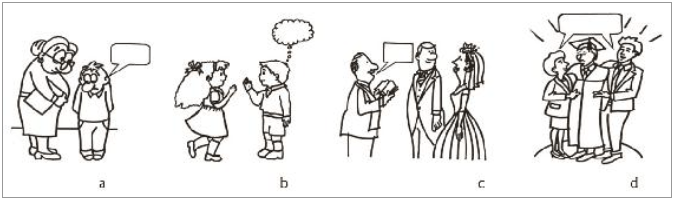
I’ll just share one example, and McGilchrist provides common responses from persons with both hemispheres intact as well as responses with right hemisphere deficits. For image b, a ‘normal’ response is for the respondent to fill in the boy’s talk bubble with ‘Boy, she’s cute.’ A couple of right hemisphere deficit responses were ‘I wonder how big her allowance is’ and ‘Let’s arm-wrestle’, obviously missing context.

The right hemisphere is responsible for understanding emotion, irony, jokes and humour—and the ability to tell the difference between jokes and lies. When told a joke and given an opportunity to fill in the punchline, the language of right hemisphere deficit patients ‘is often excessive and rambling; their comments are often off-colour and their humour is frequently inappropriate; they tend to focus on insignificant details or make tangential remarks’. Moreover, when asked to reconvey a story, the right hemisphere deficit people produced an ‘abundance of embellishments’ to it.

One subject with right hemisphere resection asked, ‘how do you feel?’ responded ‘With my hands’

Other right hemisphere functions are the ability to grasp the semantic nuance and intonation of a speaker. One subject with right hemisphere resection asked, ‘How do you feel?’ He responded, ‘With my hands,’ but he wasn’t joking.

People who have undergone a right hemispherectomy demonstrate a ‘shallow affect, rigidity, [and] lack of imagination’. The left hemisphere seems to prefer denotative speech whilst the right prefers connotative, hence a broader set of possible meanings. Interestingly, yet perhaps not surprisingly, clichés are the domain of the left hemisphere. Poetry and music reside on the right.

Wrapping up this chapter, the right hemisphere tends to serve as the emotional centre, save for anger, which is a left hemisphere activity.

Perspective

In summary, the left brain is very focused. Damage to the right hemisphere mimics the responses of autistic and schizophrenic individuals who interpret inputs differently and without nuance. This nuance often contains emotional or empathetic content that is lost on this cohort.

I am left wondering if schizophrenia and autism are right hemisphere problems, as it were, or if I would be reading into things to arrive at this conclusion.  

Having completed Emotional and Social Intelligence next up is a chapter on Cognitive Intelligence. I hope you’ll join me.

What are your thoughts? What did you think of this chapter? Were there any surprises? Anything of particular interest?

Leave comments below.

The Unbearable Preciseness of Language

First, accept my heartfelt apology in advance for employing the word preciseness over precision. I was seeking a term closer to lightness, a conceit to the Unbearable Lightness of Being.

Audio: Podcast rendition of this page content

It appears that I am at odds with Iain McGilchrist if I am interpreting The Master and His Emissary correctly, His position is that verbal and written language is too precise for accurate communication. Gestures and facial queues are necessary to convey the entire payload; otherwise, it is easy to miss nuances in empathy and metaphor. Missing most are signals conveyed by the eyes, which are interpreted by the right hemisphere. The left hemisphere is more concerned with the mouth.

Before I get too far ahead of myself, the position I’ve asserted for years is that of the insufficiency of language. As diametric as this might seem at face value, I feel that it’s both, and it depends on the words and the contexts, though it feels that we are in disagreement here as well.

It’s long been said that the eyes are the window to the soul, and these people were onto something. The eyes convey emotional content to be interpreted by the right hemisphere. This hemisphere is all about seeing the big picture as well as metaphor.

The left hemisphere is more concerned with maps and symbols, so it is looking at the mouth and lips for minute details.

People with right hemisphere deficits can’t decode meta information conveyed by the eyes. Practically, this means that they can’t interpret metaphor, innuendo, sarcasm or humour. This is also the case for schizophrenics and people further right on the autism spectrum, including those with Asperger’s syndrome. I don’t know if the connexion between these psychological conditions and right hemisphere effects is due to a deficient right hemisphere or something related to the communication channel between the hemispheres. This has not yet been mentioned.

I also find it interesting that this deficit creates a situation where a sufferer can’t discern a joke from a lie, which is telling. In a manner of thinking, a joke is a bit of an untruth or stretching a fact or omitting some details to make a point, so without the larger context that this is the purpose of the joke, it might easily be interpreted as a lie.

All of this is interesting, but these are not the insufficiencies I am concerned with. In these cases, these deficits inhibit the receipt of relevant information. My contention involves the majority of people—the ones we term as ‘normal’.

One of my pet peeves is weasel words. Justice is a big one among these. I wonder if he feels that the Gestalt of the right hemisphere is what I am missing. This is the pornography the US Supreme Court judge, Potter Stewart, who says he can’t define it, but he’ll know it when he sees it. I say that this imprecision is meant to allow for arbitrary and capricious application on a whim or to meat some ulterior motive. This is decidedly not a problem of over-precision, and this is where I hold issue. Can it be too precise, too sharp to a point it needs the edges rounded? Yes. I can see that as well.

Intermission

I feel that missing non-verbal cues is a massive challenge for videoconference calls—even when the audience is one-to-one. First, the resolution needs to be high enough to see the eyes and face, so the person needs to be in frame and not one of several people barely discernible, presume, of course, that they are showing themselves on camera at the start.

Assuming that the resolution and lighting are appropriate and the person’s face is framed in a manner to reveal their eyes and mouth, gesticulation and body language are likely missing, so we are missing more non-verbal cues. I’ll also assume that we can discern aspects of prosody which as timbre, pitch, and intonation.

Add to this a videoconference with multiple participants. Sure, you might be able to see all of the faces, but there is still something missing from these thumbnail views. In some cases, I’ve seen long shots, say, in a conference room, but the detail is notably lacking. No nuance here.

Can we adapt to this situation? Yes, Of course. Should you meet in person where it’s possible and importance is of the utmost? Of course. You’d be a tone-deaf fool not to.

Epilogue

The last point I’d like to make about language being too precise is that for an erudite person like McGilchrist, it just might be, but most people don’t have large vocabularies and have barely adequate grammatical skills. They are hardly at risk of precision. An apt analogy might be to liken them to three-year-olds with crayons—no offence to three-year-olds with crayons. Plenty of people are a step or two above functional illiteracy, but that’s not saying much. To these people, language is less of a sword than it is a blunt instrument, a proverbial bag of bowling balls.

Voltaire once quipped that he’d have written a shorter letter if he had the time, noting the effort necessary for concision. The problem with trying to encode a message not conveyable by body language into a document is that its word count might need to double or treble, which I argue would at the same time reduce interest and comprehension, opening room to misinterpret the intent—all because missing non-verbal queues were lost.

In the end, I am doubling down on my position. Language is insufficient for all but the simplest and basic communication, and it is not too precise. The word McGilchrist is looking for is blunt.

Cerebral Hemisphere Differences: The Colour and the Shape

One key aspect of left and right hemisphere differences is the notion of identification versus naming and categorisation. I tend to view the right hemisphere as rather Zen. It just sees things as they are without particular care, judgment, or attachment.

Podcast: Audio rendition of this page content
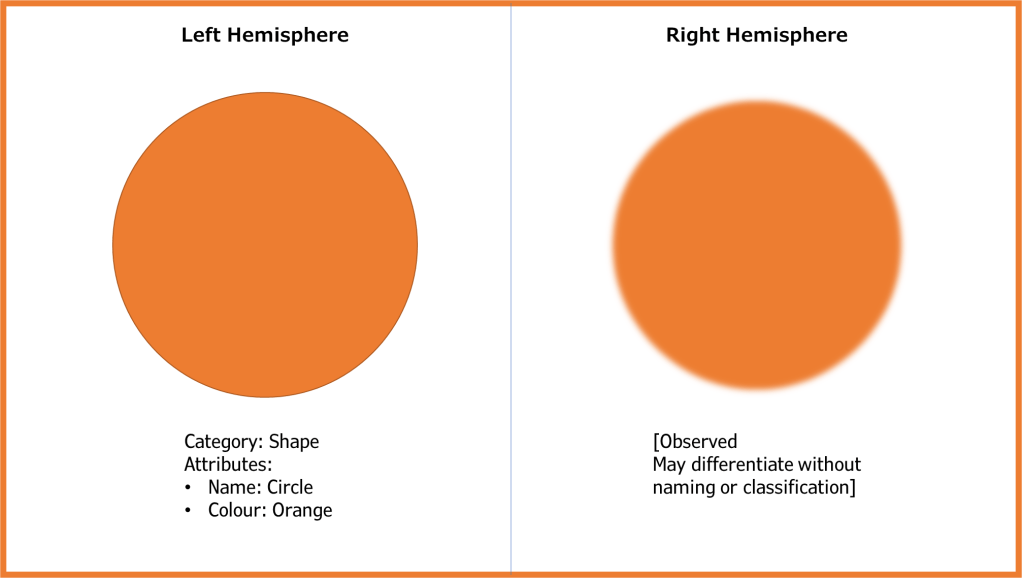
2 Orange Circles as tentatively experienced by the left and right hemispheres of the brain.

I composited a quick illustration to convey the difference. Starting with the right hemisphere, the object is recognised in a global context. Whilst it can be distinguished from a blue thing or a square thing, this is done by holistically surveying the world. The difference is perceived but rather without reflection on memory.

Generally speaking, both hemispheres ‘see’ the object, but where the right hemisphere is interested in the object as presented, the left hemisphere is interested in re-presentation. Where the right hemisphere is about being open to the experience itself, the left closes.

From an evolutionary vantage, the right hemisphere is interested in surveying the world at large and being alert to potential danger or survival queues, perhaps a food source. If the right hemisphere is triggered, the left hemisphere jumps in. This said, the left hemisphere is tightly focused, so if something does alert it—remembering that it is not switched off awaiting the right brain to activate it—, it will respond more quickly than the right hemisphere, though as I’ve noted previously, accuracy is not it’s forte, as the right hemisphere may have to convey that the snake that startled you was, in fact, a garden hose.

The left hemisphere is where categorisation and naming take place. Moreover, it stores the object for later retrieval, creating a map. If a subsequent observation is made, it is compared and contrasted relative to the map. After enough observations are made, the left brain isn’t so interested in observing the external world. It perceives a circle-y shape or perhaps an orangy colour and is convinced (metaphorically) that its cached version is satisfactory.

There is a book named Drawing from the Right Side of the Brain. I don’t want to comment on the book in depth, save to say that the author’s premise is that the so-called left-hemisphere person will look at the face of a subject and draw a generic oval shape. The eyes will be general eye shapes, following the same pattern for the nose and mouth. In the end, they will have rendered a portrait on the level of a child.

Whistler’s Mother, a restoration as reimagined by Mr Bean in the movie Bean.

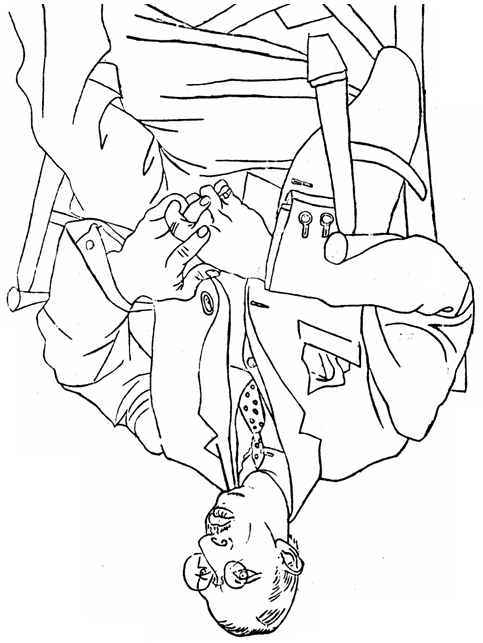
The artist who inhabits the left brain will instead note the contours, shadows, and colours of the face in front of them. One exercise that I had learned in some art class years before I read this was to draw from an inverted portrait. Not being so common as upright faces, the left brain has no representations modelled and so defers to the right hemisphere that is now looking at the object—the terrain—rather than the model.

Inverted image of Igor Stravinsky, a popular subject for breaking left-brain fixedness

I find the divided hemisphere activity in animals without stereoscopic vision to be fascinating. Perhaps, I’ll comment on this next.


* I am not claiming that the right hemisphere sees the world as fuzzy or hazy. Rather, this was me taking artistic licence to not ascribe strict boundaries to the objects in the world, especially as constrained by language.