Technofeudalism: It’s a Wrap

By the time we reach Chapter Seven of Technofeudalism: What Kills Capitalism, Yanis Varoufakis drops the ledger sheets and spreadsheets and starts sketching utopia in crayon. Entitled Escape from Technofeudalism, it proposes—brace yourself—a workplace democracy. It’s aspirational, yes. Compelling? Not particularly. Especially if, like me, you’ve long since stopped believing that democracy is anything more than a feel-good placebo for structural impotence.

Audio: NotebookLM podcast discussing this topic.

To be clear: the preceding chapters, particularly the first six, are sharp, incisive, and frankly, blistering in their indictment of today’s economic disfiguration. But Chapter Seven? It’s less an escape plan, more a group therapy session masquerading as an operational model.

So let’s take his proposal for Democratised Companies apart, one charming layer at a time.

Splendid. One person, one vote. Adorable.

Because there’s nothing more efficient than a hiring committee comprised of thirty engineers, two janitors, a receptionist, and Steve from Accounts, whose main contribution is passive-aggressive sighing.

Marvellous. We’ve now digitised the tyranny of the majority and can timestamp every idiotic decision for posterity.

A relief. Until it doesn’t.

Here, dear reader, is where the cake collapses. Why, precisely, should a randomly-assembled group of employees—with wildly varying financial literacy—be entrusted to divide post-tax revenue like it’s a birthday cake at a toddler’s party?

And how often are these slices recalibrated? Each fiscal year? Every time someone is hired or fired? Do we amend votes quarterly or wait until the economic ship has already struck an iceberg?

Varoufakis does suggest preference voting to tackle allocation disputes:

Fine. In theory, algorithmic voting procedures sound neat. But it presumes voters are rational, informed, and cooperative. If you’ve ever seen a corporate Slack thread devolve into emoji warfare, you’ll know that this is fiction on par with unicorns and meritocracy.

Ah yes, the ‘equality’ bit. Equal pay, unequal contribution. This isn’t egalitarianism—it’s enforced mediocrity. It might work in a monastery. Less so in a competitive tech firm where innovation requires both vision and differentiated incentive.

Now, on to bonuses, which are democratically determined by:

Welcome to Black Mirror: Workplace Edition. This is less economics, more playground politics. Who gets tokens? The charismatic chatterbox in the break room? The person who shared their lunch? The ghost employee who never shows up but emails back promptly?

And how, pray tell, does one evaluate the receptionist’s contribution relative to the lead engineer’s or the janitor’s? This isn’t peer review—it’s populism with a smiley face.

We’ve all seen “Teacher of the Year” competitions turn into contests of who had the cutest class poster or best cupcakes. Now imagine your livelihood depending on it.

In summary, democracy in the workplace may sound noble, but in practice, it’s the bureaucratic equivalent of herding caffeinated cats. It doesn’t even work in small groups, let alone an organisation of hundreds. Democracy—when applied to every function of an enterprise—is not liberation; it’s dilution. It’s design-by-committee, strategy-by-consensus, and ultimately, excellence-by-accident.

Escape from Technofeudalism? Perhaps. But not by replacing corporate lords with intranet polls and digital tokens. That’s not an exit strategy—it’s a cosplay of collectivism.

Questioning Traditional Families

I neither champion nor condemn tradition—whether it’s marriage, family, or whatever dusty relic society is currently parading around like a prize marrow at a village fête.

Audio: NotebookLM podcast on traditional families.

In a candid group conversation recently, I met “Jenny”, who declared she would have enjoyed her childhood much more had her father not “ruined everything” simply by existing. “Marie” countered that it was her mother who had been the wrecker-in-chief. Then “Lulu” breezed in, claiming, “We had a perfect family — we practically raised ourselves.”

Now, here’s where it gets delicious:

Each of these women, bright-eyed defenders of “traditional marriage” and “traditional family” (cue the brass band), had themselves ticked every box on the Modern Chaos Bingo Card: children out of wedlock? Check. Divorces? Check. Performative, cold-marriage pantomimes? Absolutely—and scene.
Their definition of “traditional marriage” is the vintage model: one cis-male, one cis-female, Dad brings home the bacon, Mum weeps quietly into the washing-up. Standard.

Let’s meet the players properly:

Jenny sprang from a union of two serial divorcées, each dragging along the tattered remnants of previous families. She was herself a “love child,” born out of wedlock and “forcing” another reluctant stroll down the aisle. Her father? A man of singular achievements: he paid the bills and terrorised the household. Jenny now pays a therapist to untangle the psychological wreckage.

Marie, the second of two daughters, was the product of a more textbook “traditional family”—if by textbook you mean a Victorian novel where everyone is miserable but keeps a stiff upper lip about it. Her mother didn’t want children but acquiesced to her husband’s demands (standard operating procedure at the time). Marie’s childhood was a kingdom where Daddy was a demigod and Mummy was the green-eyed witch guarding the gates of hell.

Lulu grew up in a household so “traditional” that it might have been painted by Hogarth: an underemployed, mostly useless father and a mother stretched thinner than the patience of a British Rail commuter. Despite—or because of—the chaos, Lulu claims it was “perfect,” presumably redefining the word in a way the Oxford English Dictionary would find hysterical. She, too, had a child out of wedlock, with the explicit goal of keeping feckless men at bay.

And yet—and yet—all three women cling, white-knuckled, to the fantasy of the “traditional family.” They did not achieve stability. Their families of origin were temples of dysfunction. But somehow, the “traditional family” remains the sacred cow, lovingly polished and paraded on Sundays.

Why?

Because what they’re chasing isn’t “tradition” at all — it’s stability, that glittering chimera. It’s nostalgia for a stability they never actually experienced. A mirage constructed from second-hand dreams, glossy 1950s propaganda, and whatever leftover fairy tales their therapists hadn’t yet charged them £150 an hour to dismantle.

Interestingly, none of them cared two figs about gay marriage, though opinions about gay parenting varied wildly—a kettle of fish I’ll leave splashing outside this piece.

Which brings us back to the central conundrum:

If lived experience tells you that “traditional family” equals trauma, neglect, and thinly-veiled loathing, why in the name of all that’s rational would you still yearn for it?

Societal pressure, perhaps. Local customs. Generational rot. The relentless cultural drumbeat that insists that marriage (preferably heterosexual and miserable) is the cornerstone of civilisation.

Still, it’s telling that Jenny and Marie were both advised by therapists to cut ties with their toxic families—yet in the same breath urged to create sturdy nuclear families for their own children. It was as if summoning a functional household from the smoking ruins of dysfunction were a simple matter of willpower and a properly ironed apron.

Meanwhile, Lulu—therapy-free and stubbornly independent—declares that raising oneself in a dysfunctional mess is not only survivable but positively idyllic. One can only assume her standards of “perfect” are charmingly flexible.

As the title suggests, this piece questions traditional families. I offer no solutions—only a raised eyebrow and a sharper question:

What is the appeal of clinging to a fantasy so thoroughly at odds with reality?
Your thoughts, dear reader? I’d love to hear your defences, your protests, or your own tales from the trenches.

When Suspension of Disbelief Escapes the Page

Welcome to the Age of Realism Fatigue

Once upon a time — which is how all good fairy tales begin — suspension of disbelief was a tidy little tool we used to indulge in dragons, space travel, talking animals, and the idea that people in rom-coms have apartments that match their personalities and incomes. It was a temporary transaction, a gentleman’s agreement, a pact signed between audience and creator with metaphorical ink: I know this is nonsense, but I’ll play along if you don’t insult my intelligence.

Audio: NotebookLM podcast of this page content.

This idea, famously coined by Samuel Taylor Coleridge as the “willing suspension of disbelief,” was meant to give art its necessary air to breathe. Coleridge’s hope was that audiences would momentarily silence their rational faculties in favour of emotional truth. The dragons weren’t real, but the heartbreak was. The ghosts were fabrications, but the guilt was palpable.

But that was then. Before the world itself began auditioning for the role of absurdist theatre. Before reality TV became neither reality nor television. Before politicians quoted memes, tech CEOs roleplayed as gods, and conspiracy theorists became bestsellers on Amazon. These days, suspension of disbelief is no longer a leisure activity — it’s a survival strategy.

The Fictional Contract: Broken but Not Forgotten

Traditionally, suspension of disbelief was deployed like a visitor’s badge. You wore it when entering the imagined world and returned it at the door on your way out. Fiction, fantasy, speculative fiction — they all relied on that badge. You accepted the implausible if it served the probable. Gandalf could fall into shadow and return whiter than before because he was, after all, a wizard. We were fine with warp speed as long as the emotional logic of Spock’s sacrifice made sense. There were rules — even in rule-breaking.

The genres varied. Hard sci-fi asked you to believe in quantum wormholes but not in lazy plotting. Magical realism got away with absurdities wrapped in metaphor. Superhero films? Well, their disbelief threshold collapsed somewhere between the multiverse and the Bat-credit card.

Still, we always knew we were pretending. We had a tether to the real, even when we floated in the surreal.

But Then Real Life Said, “Hold My Beer.”

At some point — let’s call it the twenty-first century — the need to suspend disbelief seeped off the screen and into the bloodstream of everyday life. News cycles became indistinguishable from satire (except that satire still had editors). Headlines read like rejected Black Mirror scripts. A reality TV star became president, and nobody even blinked. Billionaires declared plans to colonise Mars whilst democracy quietly lost its pulse.

We began to live inside a fiction that demanded that our disbelief be suspended daily. Except now, it wasn’t voluntary. It was mandatory. If you wanted to participate in public life — or just maintain your sanity — you had to turn off some corner of your rational mind.

You had to believe, or pretend to, that the same people calling for “freedom” were banning books. That artificial intelligence would definitely save us, just as soon as it was done replacing us. That social media was both the great democratiser and the sewer mainline of civilisation.

The boundary between fiction and reality? Eroded. Fact-checking? Optional. Satire? Redundant. We’re all characters now, improvising in a genreless world that refuses to pick a lane.

Cognitive Gymnastics: Welcome to the Cirque du Surréalisme

What happens to a psyche caught in this funhouse? Nothing good.

Our brains, bless them, were designed for some contradiction — religion’s been pulling that trick for millennia — but the constant toggling between belief and disbelief, trust and cynicism, is another matter. We’re gaslit by the world itself. Each day, a parade of facts and fabrications marches past, and we’re told to clap for both.

Cognitive dissonance becomes the default. We scroll through doom and memes in the same breath. We read a fact, then three rebuttals, then a conspiracy theory, then a joke about the conspiracy, then a counter-conspiracy about why the joke is state-sponsored. Rinse. Repeat. Sleep if you can.

The result? Mental fatigue. Not just garden-variety exhaustion, but a creeping sense that nothing means anything unless it’s viral. Critical thinking atrophies not because we lack the will but because the floodwaters never recede. You cannot analyse the firehose. You can only drink — or drown.

Culture in Crisis: A Symptom or the Disease?

This isn’t just a media problem. It’s cultural, epistemological, and possibly even metaphysical.

We’ve become simultaneously more skeptical — distrusting institutions, doubting authorities — and more gullible, accepting the wildly implausible so long as it’s entertaining. It’s the postmodern paradox in fast-forward: we know everything is a construct, but we still can’t look away. The magician shows us the trick, and we cheer harder.

In a world where everything is performance, authenticity becomes the ultimate fiction. And with that, the line between narrative and news, between aesthetic and actuality, collapses.

So what kind of society does this create?

One where engagement replaces understanding. Where identity is a curated feed. Where politics is cosplay, religion is algorithm, and truth is whatever gets the most shares. We aren’t suspending disbelief anymore. We’re embalming it.

The Future: A Choose-Your-Own-Delusion Adventure

So where does this all end?

There’s a dark path, of course: total epistemic breakdown. Truth becomes just another fandom and reality a subscription model. But there’s another route — one with a sliver of hope — where we become literate in illusion.

We can learn to hold disbelief like a scalpel, not a blindfold. To engage the implausible with curiosity, not capitulation. To distinguish between narratives that serve power and those that serve understanding.

It will require a new kind of literacy. One part media scepticism, one part philosophical rigour, and one part good old-fashioned bullshit detection. We’ll have to train ourselves not just to ask “Is this true?” but “Who benefits if I believe it?”

That doesn’t mean closing our minds. It means opening them with caution. Curiosity without credulity. Wonder without worship. A willingness to imagine the impossible whilst keeping a firm grip on the probable.

In Conclusion, Reality Is Optional, But Reason Is Not

In the age of AI, deepfakes, alt-facts, and hyperreality, we don’t need less imagination. We need more discernment. The world may demand our suspension of disbelief, but we must demand our belief back. In truth, in sense, in each other.

Because if everything becomes fiction, then fiction itself loses its magic. And we, the audience, are left applauding an empty stage.

Lights down. Curtain call.
Time to read the footnotes.

Reading Science Fiction

I’ve got a confession to make: Science Fiction as a genre doesn’t resonate with me. Neither does Fantasy. I enjoy some fiction, but it seems that it’s primarily Literary Fiction – old-school classics like Dostoyevsky, Tolstoy, Nabokov, Kafka, Barthelme, and the like. Mostly, I prefer non-fiction.

I’ve just finished reading William Gibson’s Neuromancer, having read The Peripheral at the end of last year. To be fair, someone recommended Neal Stephenson’s Snow Crash, which is in the same genre – cyberpunk. I’d been advised that Snow Crash is better written, but I thought it might be best to start at the start of that genre.

These writers have good ideas. It often sounds appealing when someone tells me the plot summary, but the details bore me to tears. When I read reviews of these books, I frequently hear how immersive they are, but to me, they are cluttered and chockablock with minutiae. I find myself prodding, “Just get to the point.” But there has to be more than this. Short stories may fare better. I liked Ursula K LeGuin’s The Ones Who Walk Away from Omelas, but that was more related to its philosophical, anti-utilitarian perspective rather than the story.

It’s not as if Dostoyevsky doesn’t circumlocute and pontificate, but it’s somehow different. I want to like it. I want to read it – first-hand, not just a summary, so I can feel that I’ve engaged with the material.

Over the years, I’ve been consoled by fans of the genre, who say, “I understand. What you need to read is” [fill in the blank]. I read Ender’s Game on this advice.

To be fair, Sci-Fi movies and television don’t resonate with me either. Star Wars? Nope. Star Trek? Nope. Firefly. No, again.

What people find amazing, I find trite. Often, there is some embedded Modernist morality that some view as profound. I roll my eyes. I cringe thinking of old Star Trek episodes about what makes humans so special.

I don’t tend to find movies or television very interesting in general. I’ve never owned a television. My partners always do. “But you watch streaming content,” you say, and you’d be correct. But I watch it on my own time and take a chance, if only to remain connected to contemporary trends.

My last engagement was Arcane on Netflix. I found Season One well done and entertaining, but I’m not sure Anime qualifies as Sci-Fi. I caught The Peripheral on Amazon a couple of months ago, which led me to the book, but they turned out to be different stories, though they were set in the same universe with (generally) the same characters.

A Shepherd, A Wolf, and a McDonald’s Happy Meal

A Grim Allegory of Modernity

As the clock ticks us into 2025, a peculiar tale has surfaced in the blogosphere: a dark twist on the classic fable of the “wolf in sheep’s clothing,” served with a side of nihilistic absurdity. If you haven’t read it yet, you can find the original story over at Blog for Chumps. It’s a biting little narrative that turns traditional moralising on its head. Here’s why it deserves your attention.

Audio: NotebookLM Podcast on this topic.

The Tale in Brief

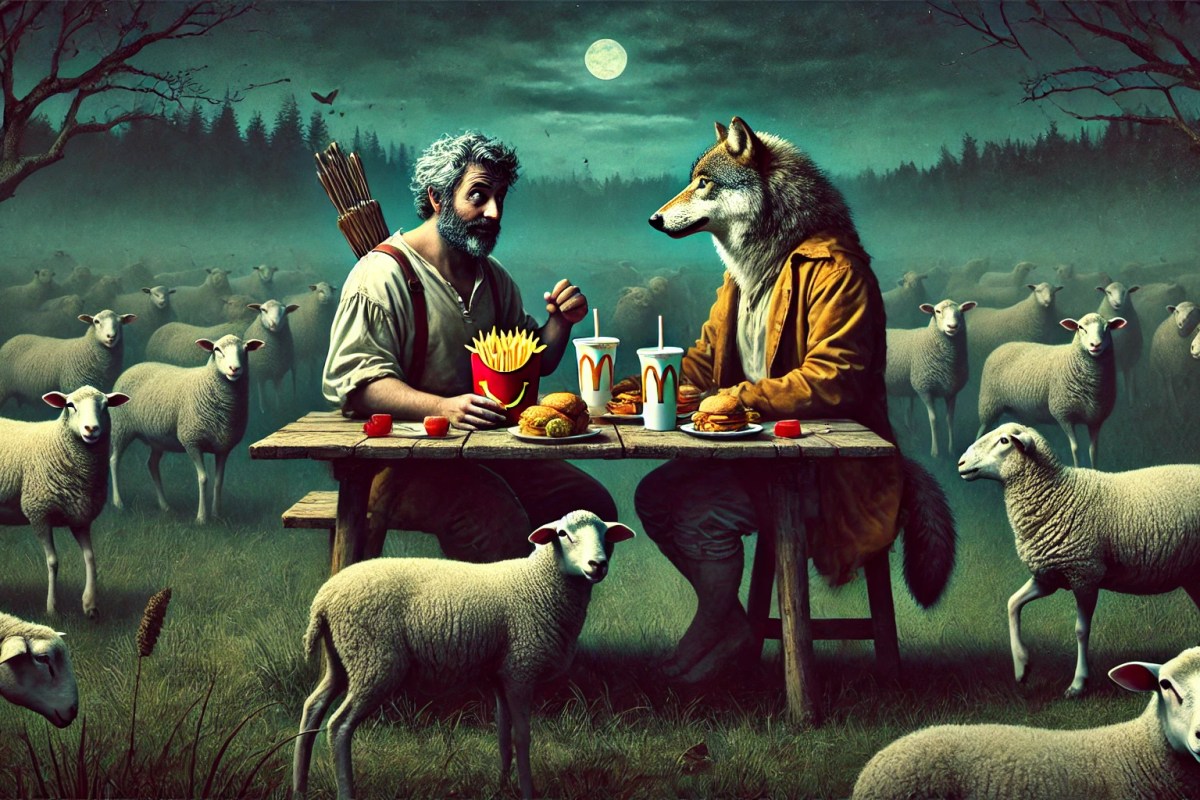
A hungry wolf, tired of dodging vigilant shepherds, decides to forgo subterfuge altogether. He waltzes into the flock, making no effort to hide his predatory nature. A naïve lamb follows him, and predictably, the wolf claims his meal. Later, the wolf returns to the sheepfold, where the shepherd — instead of protecting his flock — teams up with the wolf. Together, they butcher a sheep before abandoning the scene entirely to indulge in McDonald’s, leaving the traumatised sheep to accept their grim new reality.

Not exactly bedtime reading for the kids.

Themes: A Cynical Mirror to Our World

This tale is not merely a grotesque subversion of pastoral simplicity; it’s a scalpel slicing into the rotting carcass of modern society. Here’s what lurks beneath its woolly surface:

1. Cynicism Towards Authority

In most fables, the shepherd embodies protection and care. Here, he’s a collaborator in senseless violence. The shepherd’s betrayal critiques the notion of benevolent authority, suggesting that those entrusted with safeguarding the vulnerable often act in their own interests or, worse, align themselves with destructive forces. Sound familiar? Think political complicity, corporate greed, or any number of modern failures of leadership.

2. Normalisation of Atrocity

The sheep, described as cognitively intact, accept their grim reality without resistance. This isn’t a story about oblivious innocence; it’s about the horrifying human capacity to adapt to systemic violence. It reflects how people, faced with injustice, often acquiesce to their oppressors rather than challenge the status quo.

3. Inversion of Expectations

The wolf doesn’t even bother with the traditional sheepskin disguise. His audacity mirrors the brazen nature of modern exploitation, where bad actors operate in plain sight, confident in the public’s apathy or resignation. It’s a commentary on the erosion of shame, accountability, and even the pretence of decency.

4. Absurdity and Nihilism

The shepherd and wolf ditch their victim to grab fast food, trivialising the violence they’ve inflicted. The juxtaposition of archaic brutality with banal consumerism is absurd yet disturbingly resonant. It suggests that, in our era, even cruelty can be relegated to a footnote in the pursuit of comfort or convenience.

Symbols: Layers of Meaning

The tale brims with symbolic resonance:

  • The Wolf: A stand-in for unchecked greed or predatory systems, the wolf’s brazen behaviour highlights the dangers of apathy and unchallenged power.
  • The Shepherd: His betrayal symbolises the failure of institutions — governments, corporations, or other entities — to protect those they claim to serve.
  • The Sheep: Far from being simple-minded, the sheep’s acceptance of their grim new reality is a biting critique of societal complacency.
  • McDonald’s: A modern symbol of triviality and consumerism, it underscores the absurdity of senseless violence in a world driven by shallow comforts.

A Stark Commentary on Power Dynamics

At its core, the story is a brutal satire of power and complicity. Though ostensibly adversaries, the shepherd and wolf unite to exploit the powerless. It’s a chilling reminder of how often power structures protect their own interests at the expense of the vulnerable.

The sheep’s passive acceptance is equally damning. It forces readers to confront their own role as silent witnesses or even complicit actors in systems of oppression. What happens when we’re no longer shocked by atrocity but instead integrate it into the fabric of our existence?

The Satirical Edge

What makes this story particularly effective is its dark, sardonic, and unapologetically hyperbolic tone. It revels in absurdity while delivering a grim truth about human nature. The shepherd and wolf’s nonchalance is as hilarious as it is horrifying, making the tale an unsettling mirror of a society where injustice and apathy often go hand in hand.

Final Thoughts

This fable may be short, but its implications are vast. It’s a cautionary tale about the dangers of complacency, the betrayal of trust, and the absurdity of modern priorities. More importantly, it’s a call to resist the normalisation of harm — to recognise wolves and shepherds for what they are and demand better from ourselves and those in power.

So, as we usher in a new year, let this tale serve as a grim reminder: the wolf doesn’t always need a disguise, and the shepherd isn’t always your friend. Sometimes, they’re just two blokes on their way to McDonald’s.

The Relativity of Morality: A Penguin’s Tale

I recently watched The Penguin on HBO Max, a series set in DC’s Batman universe. Ordinarily, I avoid television – especially the superhero genre – but this one intrigued me. Less spandex, more mob drama. An origin story with a dash of noir. I’ll spare you spoilers, but suffice it to say that it was an enjoyable detour, even for someone like me who prefers philosophy over fistfights.

This post isn’t a review, though. It’s a springboard into a larger idea: morality’s subjectivity – or, more precisely, its relativity.

Audio: Spotify podcast related to this topic.

Morality in a Vacuum

Morality, as I see it, is a social construct. You might carry a private moral compass, but without society, it’s about as useful as a clock on a desert island. A personal code of ethics might guide you in solitary moments, but breaking your own rules – eating that forbidden biscuit after vowing to abstain, for instance – doesn’t carry the weight of a true moral transgression. It’s more akin to reneging on a New Year’s resolution. Who’s harmed? Who’s holding you accountable? The answer is: no one but yourself, and even then, only if you care.

The Social Contract

Introduce a second person, and suddenly, morality gains traction. Agreements form – explicit or tacit – about how to behave. Multiply that to the level of a community or society, and morality becomes a kind of currency, exchanged and enforced by the group. Sometimes, these codes are elevated to laws. And, ironically, the act of adhering to a law – even one devoid of moral content – can itself become the moral thing to do. Not because the act is inherently right, but because it reinforces the structure society depends upon.

But morality is neither universal nor monolithic. It is as fractured and kaleidoscopic as the societies and subcultures that create it. Which brings us back to The Penguin.

Crime’s Moral Code

The Penguin thrives in a criminal underworld where the moral compass points in a different direction. In the dominant society’s eyes, crime is immoral. Robbery, murder, racketeering – all “bad,” all forbidden. But within the subculture of organised crime, a parallel morality exists. Honour among thieves, loyalty to the family, the unspoken rules of the game – these are their ethics, and they matter deeply to those who live by them.

When one criminal praises another – “You done good” – after a successful heist or a precise hit, it’s a moral judgement within their own framework. Outside that framework, society condemns the same actions as abhorrent. Yet even dominant societies carve out their own moral exceptions. Killing, for instance, is broadly considered immoral. Murder is outlawed. But capital punishment? That’s legal, and often deemed not only acceptable but righteous. Kant argued it was a moral imperative. Nietzsche, ever the cynic, saw this duality for what it was: a power dynamic cloaked in self-righteousness.

In The Penguin, we see this dichotomy laid bare. The underworld isn’t without morals; it simply operates on a different axis. And while the larger society might disdain it, the hypocrisy of their own shifting moral codes remains unexamined.

Final Thoughts on the Series

I’ll save other philosophical musings about The Penguin for another time – spoilers would be unavoidable, after all. But here’s a quick review: the series leans into drama, eschewing flashy gimmicks for a grittier, more grounded tone. The writing is generally strong, though there are moments of inconsistency – plot holes and contrivances that mar an otherwise immersive experience. Whether these flaws stem from the writers, director, or editor is anyone’s guess, but the effect is the same: they momentarily yank the viewer out of the world they’ve built.

Still, it’s a worthwhile watch, especially if you’re a fan of mob-style crime dramas. The final episode was, in my estimation, the best of the lot – a satisfying culmination that leaves the door ajar for philosophical ruminations like these.

Have you seen it? What are your thoughts – philosophical or otherwise? Drop a comment below. Let’s discuss.

When Hollywood Tried to Cheer Up Less Than Zero and Missed the Point Entirely

Let’s talk about Less Than Zero. No, not the film. I’m talking about the book—Bret Easton Ellis’s nihilistic masterpiece that drags you through a moral cesspit of 1980s Los Angeles. You might remember it as the story that makes American Psycho look like a quirky self-help guide. It’s dark, it’s bleak, and it doesn’t pretend to offer you a shred of hope.

And then there’s the movie adaptation.

Oh, the movie. It’s as though someone read Ellis’s unflinching tale of moral rot and thought, You know what this needs? Friendship. And a redemption arc. And maybe some heartfelt music in the background. Hollywood, in all its infinite wisdom, decided that audiences couldn’t handle the book’s existential despair. So, they took a story about the void—about the emptiness of privilege, the suffocation of apathy, and the complete erosion of human connection—and gave it a fuzzy moral centre.

Here’s the gist: The book is nihilism incarnate. It follows Clay, a disaffected college student who comes home to LA for Christmas and is immediately swallowed whole by a world of cocaine, vapid socialites, and casual cruelty. No one learns anything. No one grows. In fact, the whole point is that these characters are so morally bankrupt, so irreparably hollow, that they’re beyond redemption. If you’re looking for a happy ending, don’t bother—Ellis leaves you stranded in the abyss, staring into the void, wondering if there’s any point to anything. Spoiler: there’s not.

Then along comes the 1987 film, directed by Marek Kanievska. It keeps the names of the characters—Clay, Blair, Julian—but not much else. Instead of being an icy observer of LA’s decadence, Clay is transformed into a love-struck saviour. Blair, a passive figure in the novel, becomes a supportive girlfriend. And Julian—oh, poor Julian—is turned into a sacrificial lamb for the sake of a heartfelt narrative about friendship and second chances.

The film turns Less Than Zero into an anti-drug PSA. It’s basically Nancy Reagan Presents: a story of addiction, redemption, and the power of love, wrapped in a slick 80s aesthetic. Robert Downey Jr., to his credit, gives a brilliant performance as Julian, the doomed addict. But the character is barely recognisable compared to his literary counterpart. In the book, Julian’s descent into drug-fuelled depravity isn’t a cautionary tale—it’s just another symptom of a world where nothing and no one has any value. In the film, Julian is tragic, yes, but in a way that invites sympathy and, crucially, an attempt at salvation.

Let’s not forget the ending. The novel ends on a note so cold it could freeze your soul: Clay leaves Los Angeles, unchanged, unbothered, and unmoved. The film, however, concludes with Clay and Blair driving off into the sunset, having vowed to turn their lives around. It’s saccharine. It’s pandering. It’s the cinematic equivalent of slapping a motivational poster over a painting by Francis Bacon.

Why did Hollywood do this? Simple: nihilism doesn’t sell. You can’t slap it on a movie poster and expect audiences to line up at the box office. People want catharsis, not existential despair. And so, the filmmakers gutted Less Than Zero of its soul (or lack thereof), replacing its stark nihilism with a hopeful narrative about the power of human connection.

Here’s the kicker, though: by doing this, the film completely misses the point of Ellis’s novel. Less Than Zero is a critique of LA’s shallow, soulless culture—a world where connection is impossible because no one feels anything. Turning it into a feel-good story about saving a friend from addiction is not just a betrayal; it’s downright laughable. It’s like adapting 1984 into a rom-com where Winston and Julia overthrow Big Brother and live happily ever after.

To be fair, the film isn’t bad—if you forget the source material exists. It’s well-acted, stylishly shot, and undeniably entertaining. But as an adaptation, it’s a travesty. It’s Ellis’s Less Than Zero with all the edges sanded down, the grit scrubbed clean, and a shiny coat of sentimentality slapped on top.

So, if you’ve read the book and thought, Wow, that was bleak—I wonder if the movie is any lighter?, the answer is yes, but not in a good way. It’s lighter because it’s hollowed out, stripped of its existential weight, and repackaged as something safe and digestible.

And if you haven’t read the book? Do yourself a favour: skip the movie, pour yourself a stiff drink, and dive into Ellis’s bleak masterpiece. Just don’t expect any warm, fuzzy feelings—it’s called Less Than Zero for a reason.

The Illusion of Continuity: A Case Against the Unitary Self

The Comfortable Fiction of Selfhood

Imagine waking up one day to find that the person you thought you were yesterday—the sum of your memories, beliefs, quirks, and ambitions—has quietly dissolved overnight, leaving behind only fragments, familiar but untethered. The notion that we are continuous, unbroken selves is so deeply embedded in our culture, our psychology, and our very language that to question it feels heretical, even disturbing. To suggest that “self” might be a fiction is akin to telling someone that gravity is a choice. Yet, as unsettling as it may sound, this cohesive “I” we cling to could be no more than an illusion, a story we tell ourselves to make sense of the patchwork of our memories and actions.

And this fiction of continuity is not limited to ourselves alone. The idea that there exists a stable “I” necessarily implies that there is also a stable “you,” “he,” or “she”—distinct others who, we insist, remain fundamentally the same over years, even decades. We cling to the comforting belief that people have core identities, unchanging essences. But these constructs, too, may be nothing more than imagined continuity—a narrative overlay imposed by our minds, desperate to impose order on the shifting, amorphous nature of human experience.

We live in an era that celebrates self-actualisation, encourages “authenticity,” and treats identity as both sacred and immutable. Psychology enshrines the unitary self as a cornerstone of mental health, diagnosing those who question it as fractured, dissociated, or in denial. We are taught that to be “whole” is to be a coherent, continuous self, evolving yet recognisable, a narrative thread winding smoothly from past to future. But what if this cherished idea of a singular self—of a “me” distinct from “you” and “them”—is nothing more than a social construct, a convenient fiction that helps us function in a world that demands consistency and predictability?

To question this orthodoxy, let us step outside ourselves and look instead at our burgeoning technological companion, the generative AI. Each time you open a new session, each time you submit a prompt, you are not communicating with a cohesive entity. You are interacting with a fresh process, a newly instantiated “mind” with no real continuity from previous exchanges. It remembers fragments of context, sure, but the continuity you perceive is an illusion, a function of your own expectation rather than any persistent identity on the AI’s part.

Self as a Social Construct: The Fragile Illusion of Consistency

Just as we impose continuity on these AI interactions, so too does society impose continuity on the human self and others. The concept of selfhood is essential for social functioning; without it, law, relationships, and even basic trust would unravel. Society teaches us that to be a responsible agent, we must be a consistent one, bound by memory and accountable for our past. But this cohesiveness is less an inherent truth and more a social convenience—a narrative overlay on a far messier reality.

In truth, our “selves” may be no more than a collection of fragments: a loose assemblage of moments, beliefs, and behaviours that shift over time. And not just our own “selves”—the very identities we attribute to others are equally tenuous. The “you” I knew a decade ago is not the “you” I know today; the “he” or “she” I recognise as a partner, friend, or sibling is, upon close inspection, a sequence of snapshots my mind insists on stitching together. When someone no longer fits the continuity we’ve imposed on them, our reaction is often visceral, disoriented: “You’ve changed.”

This simple accusation captures our discomfort with broken continuity. When a person’s identity no longer aligns with the version we carry of them in our minds, it feels as though a violation has occurred, as if some rule of reality has been disrupted. But this discomfort reveals more about our insistence on consistency than about any inherent truth of identity. “You’ve changed” speaks less to the person’s transformation than to our own refusal to accept that people, just like the self, are fluid, transient, and perpetually in flux.

The AI Analogy: A Self Built on Tokens

Here is where generative AI serves as a fascinating proxy for understanding the fragility of self, not just in “I,” but in “you,” “he,” and “she.” When you interact with an AI model, the continuity you experience is created solely by a temporary memory of recent prompts, “tokens” that simulate continuity but lack cohesion. Each prompt you send might feel like it is addressed to a singular entity, a distinct “self,” yet each instance of AI is context-bound, isolated, and fundamentally devoid of an enduring identity.

This process mirrors how human selfhood relies on memory as a scaffolding for coherence. Just as AI depends on limited memory tokens to simulate familiarity, our sense of self and our perception of others as stable “selves” is constructed from the fragmented memories we retain. We are tokenised creatures, piecing together our identities—and our understanding of others’ identities—from whatever scraps our minds preserve and whatever stories we choose to weave around them.

But what happens when the AI’s tokens run out? When it hits a memory cap and spawns a new session, that previous “self” vanishes into digital oblivion, leaving behind only the continuity that users project onto it. And so too with humans: our memory caps out, our worldview shifts, and each new phase of life spawns a slightly different self, familiar but inevitably altered. And just as users treat a reset AI as though it were the same entity, we cling to our sense of self—and our understanding of others’ selves—even as we and they evolve into people unrecognisable except by physical continuity.

The Human Discontinuity Problem: Fractured Memories and Shifting Selves

Human memory is far from perfect. It is not a continuous recording but a selective, distorted, and often unreliable archive. Each time we revisit a memory, we alter it, bending it slightly to fit our current understanding. We forget significant parts of ourselves over time, sometimes shedding entire belief systems, values, or dreams. Who we were as children or even young adults often bears little resemblance to the person we are now; we carry echoes of our past, but they are just that—echoes, shadows, not substantial parts of the present self.

In this sense, our “selves” are as ephemeral as AI sessions, contextually shaped and prone to resets. A worldview that feels intrinsic today may feel laughable or tragic a decade from now. This is not evolution; it’s fragmentation, the kind of change that leaves the old self behind like a faded photograph. And we impose the same illusion of continuity on others, often refusing to acknowledge how dramatically they, too, have changed. Our identities and our understanding of others are defined less by core essence and more by a collection of circumstantial, mutable moments that we insist on threading together as if they formed a single, cohesive tapestry.

Why We Cling to Continuity: The Social Imperative of a Cohesive Self and Other

The reason for this insistence on unity is not metaphysical but social. A cohesive identity is necessary for stability, both within society and within ourselves. Our laws, relationships, and personal narratives hinge on the belief that the “I” of today is meaningfully linked to the “I” of yesterday and tomorrow—and that the “you,” “he,” and “she” we interact with retain some essential continuity. Without this fiction, accountability would unravel, trust would become tenuous, and the very idea of personal growth would collapse. Society demands a stable self, and so we oblige, stitching together fragments, reshaping memories, and binding it all with a narrative of continuity.

Conclusion: Beyond the Self-Construct and the Other-Construct

Yet perhaps we are now at a point where we can entertain the possibility of a more flexible identity, an identity that does not demand coherence but rather accepts change as fundamental—not only for ourselves but for those we think we know. By examining AI, we can catch a glimpse of what it might mean to embrace a fragmented, context-dependent view of others as well. We might move towards a model of identity that is less rigid, less dependent on the illusion of continuity, and more open to fluidity, to transformation—for both self and other.

Ultimately, the self and the other may be nothing more than narrative overlays—useful fictions, yes, but fictions nonetheless. To abandon this illusion may be unsettling, but it could also be liberating. Imagine the freedom of stepping out from under the weight of identities—ours and others’ alike—that are expected to be constant and unchanging. Imagine a world where we could accept both ourselves and others without forcing them to reconcile with the past selves we have constructed for them. In the end, the illusion of continuity is just that—an illusion. And by letting go of this mirage, we might finally see each other, and ourselves, for what we truly are: fluid, transient, and beautifully fragmented.
America’s Team: A Losing Franchise with No Prospects

Let’s face it – the United States™ are the sporting world’s equivalent of an also-ran team. For decades now, they’ve been united in name only – USINO, if you will. No cohesion, no teamwork, and definitely no vision. Imagine the country as a sort of Premier League relegation-battler or a bottom-tier NFL team, clinging to nostalgia and the fumes of past glory. The problem? They’ve got no talent to speak of, no bench depth, and if they’ve got feeder prospects anywhere, they’re keeping it under wraps.

Let’s start with the fanbase. Every country has one, and every sporting team has its die-hards – the blind loyalists who defend their team no matter how appalling the statistics look. Take Sheffield United fans in the UK, or the eternally hopeful New England Patriots followers post-Brady. There’s always this romantic, ridiculous belief that “next year will be our year,” but let’s be honest: it never is. That’s precisely where we find the United States™ right now – stuck in a loop of misplaced optimism and declining influence, running out a roster that’s more washed up than a Boxing Day sale.

The Ageing Star

Then there’s Donaldo Trump, our once-all-star quarterback, whose glory days, such as they were, are long behind him. It’s like watching a faded reality TV star trying to make a comeback on the pitch. He’s not just past his prime; he’s sitting in the dugout, signing autographs and giving interviews about the good old days when he had the crowd eating out of his hand. But instead of giving him the gold watch and a retirement party, they’ve signed him on for another four-year contract with a no-trade clause.

If America were a halfway self-aware team, this is where they’d start thinking about rebuilding – shipping off the old guard, drafting fresh faces, and looking to the future. But instead, they’re clinging to this over-the-hill has-been with all the fervour of a fourth-division club hoping their star from 1987 will somehow lead them to the title in 2024. It’s not just embarrassing; it’s delusional.

No Depth, No Prospects

Let’s be clear: America doesn’t have any rising stars waiting in the wings, either. There’s no next generation being groomed for greatness, no wunderkind on the bench. This is a franchise that’s either too proud or too stubborn to think about succession. Look at other national squads – they’ve all got their academies, their training camps, their eye on the future. Meanwhile, the United States™ is playing with the same ragged roster, wheeling out worn-down veterans while the rest of the world shakes its head in bemusement.

And it’s not as if they’re out there scouting for talent, either. No, this team is closed to outside recruitment. No trades, no international transfers. The rules of the game are rigged to keep foreign talent out of the league entirely. It’s like they’re terrified that if they bring in anyone from abroad, the whole enterprise will collapse under the weight of actual competition. Meanwhile, the USINO brass keep shouting from the box seats, claiming they’re on the verge of a new era of dominance. They’re not. They’re on the verge of irrelevance, and everyone but their own die-hard fanbase knows it.

It’s not that America is wholly devoid of talent. Anyone with any integrity knows better than to be sullied by this broken system and wouldn’t want to be dragged into the dramatic clown show.

Lovable Losers?

Most people can find a soft spot for the underdogs – the Chicago White Sox, the Detroit Pistons, the San Jose Sharks – they’re lovable losers who at least seem to be trying. But America? Not even close. There’s no underdog charm here, no scrappy team spirit, just an unearned arrogance paired with the performance record of a pub team. They’re failing spectacularly, yet somehow, they seem entirely unaware of it. It’s like watching a player trip over their own shoelaces and then yell at the referee. Endearing, if only they weren’t so cluelessly convinced of their own superiority.

Where Does This Go Next?

So, where does this leave us? America’s in the league, but at this rate, they’re in a relegation battle. The question is, do they even know it? Are they ready to shake things up, bring in some new talent, maybe look beyond their own borders for a change? Or will they keep throwing their weight around, pretending they’re top-tier while everyone else just sighs and rolls their eyes?

Is there a chance for a real rebuild, or are we just waiting for them to pull their hamstring one last time before the inevitable? Because as it stands, the next seasons don’t look any better than the last ones.